11/16/13 
1 
William Estrem 
Abstract 
This presentation will examine how enterprise 
architects can apply risk management capabilities to 
the development and operation of an enterprise 
architecture.  
The approach incorporates the TOGAF 9 Risk 
Management framework along with other risk 
management methods.  
In particular, the approach will focus on the The 
Open Group Risk Management Taxonomy and Risk 
Assessment standard. 
© 2013 - Metaplexity Associates® LLC - All Rights Reserved. 2
11/16/13 
2 
What we will cover 
• What is Risk Management? 
• How is Risk Management treated in Enterprise 
Architecture? 
• What are some types of Enterprise Risk Management? 
• Can we define a Business Capability for Risk 
Management? 
• What are the FAIR Taxonomy and Risk Analysis 
Standards? 
• Can FAIR and other standards be used together to 
improve Enterprise Risk Management Capability? 
© 2013 - Metaplexity Associates® LLC - All Rights Reserved. 3 
Risk is a natural part of the business landscape. 
If left unmanaged, the uncertainty can spread like weeds. 
If managed effectively, losses can be avoided and benefits 
obtained. 
Source: RiskIT. IT Governance Institute 
4 
© 2013 - Metaplexity Associates® LLC - All Rights Reserved.
11/16/13 
3 
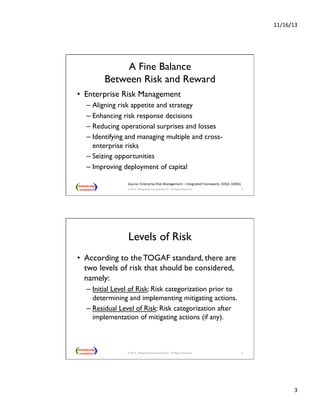
A Fine Balance 
Between Risk and Reward 
• Enterprise Risk Management 
– Aligning risk appetite and strategy 
– Enhancing risk response decisions 
– Reducing operational surprises and losses 
– Identifying and managing multiple and cross-enterprise 
risks 
– Seizing opportunities 
– Improving deployment of capital 
Source: 
Enterprise 
Risk 
Management 
– 
Integrated 
Framework, 
COSO. 
(2004). 
© 2013 - Metaplexity Associates® LLC - All Rights Reserved. 5 
Levels of Risk 
• According to the TOGAF standard, there are 
two levels of risk that should be considered, 
namely: 
– Initial Level of Risk: Risk categorization prior to 
determining and implementing mitigating actions. 
– Residual Level of Risk: Risk categorization after 
implementation of mitigating actions (if any). 
© 2013 - Metaplexity Associates® LLC - All Rights Reserved. 6
11/16/13 
4 
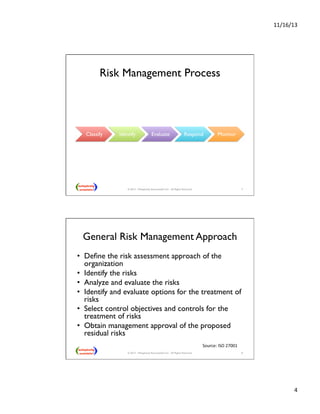
Risk Management Process 
Classify Identify Evaluate Respond Monitor 
© 2013 - Metaplexity Associates® LLC - All Rights Reserved. 7 
General Risk Management Approach 
• Define the risk assessment approach of the 
organization  
• Identify the risks  
• Analyze and evaluate the risks  
• Identify and evaluate options for the treatment of 
risks  
• Select control objectives and controls for the 
treatment of risks  
• Obtain management approval of the proposed 
residual risks  
Source: 
ISO 
27001 
© 2013 - Metaplexity Associates® LLC - All Rights Reserved. 8
11/16/13 
5 
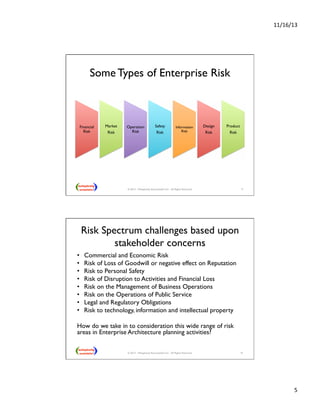
Some Types of Enterprise Risk 
Financial 
Risk 
Market  
Risk 
Operation 
Risk 
Safety  
Risk 
Information 
Risk 
Design  
Risk 
Product 
Risk 
© 2013 - Metaplexity Associates® LLC - All Rights Reserved. 9 
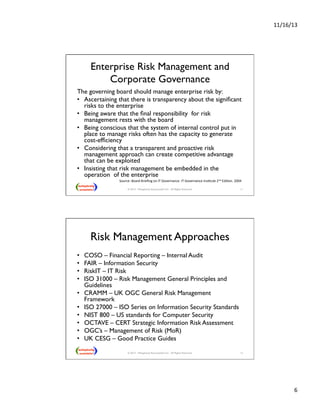
Risk Spectrum challenges based upon 
stakeholder concerns 
• Commercial and Economic Risk 
• Risk of Loss of Goodwill or negative effect on Reputation  
• Risk to Personal Safety  
• Risk of Disruption to Activities and Financial Loss 
• Risk on the Management of Business Operations  
• Risk on the Operations of Public Service  
• Legal and Regulatory Obligations  
• Risk to technology, information and intellectual property 
How do we take in to consideration this wide range of risk 
areas in Enterprise Architecture planning activities? 
© 2013 - Metaplexity Associates® LLC - All Rights Reserved. 10
11/16/13 
6 
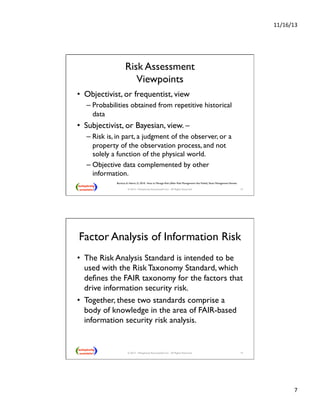
Enterprise Risk Management and 
Corporate Governance 
The governing board should manage enterprise risk by: 
• Ascertaining that there is transparency about the significant 
risks to the enterprise 
• Being aware that the final responsibility for risk 
management rests with the board 
• Being conscious that the system of internal control put in 
place to manage risks often has the capacity to generate 
cost-efficiency 
• Considering that a transparent and proactive risk 
management approach can create competitive advantage 
that can be exploited 
• Insisting that risk management be embedded in the 
operation of the enterprise 
Source: 
Board 
Briefing 
on 
IT 
Governance. 
IT 
Governance 
InsNtute 
2nd 
EdiNon. 
2004 
© 2013 - Metaplexity Associates® LLC - All Rights Reserved. 11 
Risk Management Approaches 
• COSO – Financial Reporting – Internal Audit 
• FAIR – Information Security 
• RiskIT – IT Risk 
• ISO 31000 – Risk Management General Principles and 
Guidelines 
• CRAMM – UK OGC General Risk Management 
Framework 
• ISO 27000 – ISO Series on Information Security Standards 
• NIST 800 – US standards for Computer Security 
• OCTAVE – CERT Strategic Information Risk Assessment 
• OGC’s – Management of Risk (MoR) 
• UK CESG – Good Practice Guides  
© 2013 - Metaplexity Associates® LLC - All Rights Reserved. 12
11/16/13 
7 
Risk Assessment 
Viewpoints 
• Objectivist, or frequentist, view  
– Probabilities obtained from repetitive historical 
data 
• Subjectivist, or Bayesian, view. –  
– Risk is, in part, a judgment of the observer, or a 
property of the observation process, and not 
solely a function of the physical world.  
– Objective data complemented by other 
information. 
Borison, A. Hamm, G. 2010. How to Manage Risk (After Risk Management Has Failed). Sloan Management Review. 
© 2013 - Metaplexity Associates® LLC - All Rights Reserved. 13 
Factor Analysis of Information Risk 
• The Risk Analysis Standard is intended to be 
used with the Risk Taxonomy Standard, which 
defines the FAIR taxonomy for the factors that 
drive information security risk.  
• Together, these two standards comprise a 
body of knowledge in the area of FAIR-based 
information security risk analysis. 
© 2013 - Metaplexity Associates® LLC - All Rights Reserved. 14
11/16/13 
8 
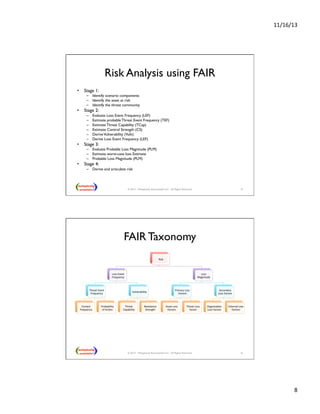
Risk Analysis using FAIR 
• Stage 1:  
– Identify scenario components  
– Identify the asset at risk  
– Identify the threat community  
• Stage 2:  
– Evaluate Loss Event Frequency (LEF) 
– Estimate probable Threat Event Frequency (TEF)  
– Estimate Threat Capability (TCap)  
– Estimate Control Strength (CS)  
– Derive Vulnerability (Vuln)  
– Derive Loss Event Frequency (LEF)  
• Stage 3:  
– Evaluate Probable Loss Magnitude (PLM)  
– Estimate worst-case loss Estimate  
– Probable Loss Magnitude (PLM)  
• Stage 4:  
– Derive and articulate risk  
© 2013 - Metaplexity Associates® LLC - All Rights Reserved. 15 
FAIR Taxonomy 
Risk 
Loss 
Event 
Frequency 
Threat 
Event 
Frequency 
Contact 
Frequency 
Probability 
of 
AcNon 
Vulnerability 
Threat 
Capability 
Resistance 
Strength 
Loss 
Magnitude 
Primary 
Loss 
Factors 
Asset 
Loss 
Factors 
Threat 
Loss 
Factor 
Secondary 
Loss 
Factors 
OrganizaNon 
Loss 
Factors 
External 
Loss 
Factors 
© 2013 - Metaplexity Associates® LLC - All Rights Reserved. 16
11/16/13 
9 
Broader Applicability? 
Although the concepts and standards within the 
FAIR Standard were not developed with the 
intention of being applied towards other risk 
types, experience has demonstrated that they 
can be effectively applied to other risk types. 
© 2013 - Metaplexity Associates® LLC - All Rights Reserved. 17 
Risk and the TOGAF Standard 
• Risk already plays an important part in the 
TOGAF standard be we recognize that there 
are perhaps improvements and innovations to 
add. 
• Over the next set of slides we will look more 
closely at Risk within the ADM 
© 2013 - Metaplexity Associates® LLC - All Rights Reserved. 18
11/16/13 
10 
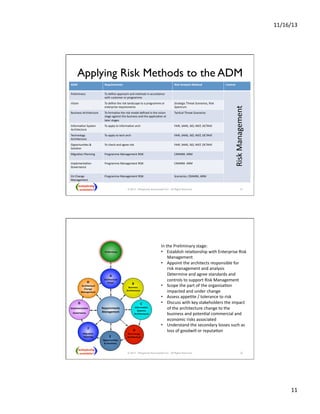
Loss, Threat and Vulnerability  
and the EA Context 
• Enterprise Architects should work with specialist resources 
to determine the true cost of any loss, but to help 
determine this the architect has to provide the context. 
• Context is defined via the Content Metamodel through the 
development of Building Blocks 
• Each Building Block can be examined through ADM 
techniques that will provide specific information and 
support for more detailed Risk Management understanding 
• Use Building Blocks to: 
– define the variety of asset types 
– assess the threat to the assets and vulnerability 
– determine the relationships between assets and their 
interdependencies  
© 2013 - Metaplexity Associates® LLC - All Rights Reserved. 19 
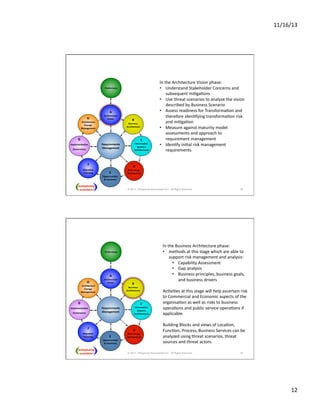
TOGAF viewpoints that support Risk 
Analysis  
• Viewpoints enable the Architect to build context for a risk model and 
assessment: 
– Location Catalog 
– Business Service / Function Catalog 
– Interface Catalog  
– Business Service / Information Diagram 
– Application and User Location Diagram 
– Solution Concept Diagram  
– System Use-Case Diagram – including Mis-Use Cases 
– Role / System Matrix 
– System / Data Matrix 
– System / Organisation Matrix  
– Application Interaction Matrix  
– Business Interaction Matrix  
– System Technology Matrix 
© 2013 - Metaplexity Associates® LLC - All Rights Reserved. 20
11/16/13 
11 
Applying Risk Methods to the ADM 
ADM 
Requirements 
Risk 
Analysis 
Method 
Control 
Preliminary 
To 
define 
approach 
and 
methods 
in 
accordance 
with 
customer 
or 
programme 
Vision 
To 
define 
the 
risk 
landscape 
to 
a 
programme 
or 
enterprise 
requirements 
Strategic 
Threat 
Scenarios, 
Risk 
Spectrum 
Business 
Architecture 
To 
formalize 
the 
risk 
model 
defined 
in 
the 
vision 
stage 
against 
the 
business 
and 
the 
applicaNon 
at 
later 
stages 
TacNcal 
Threat 
Scenarios 
InformaNon 
System 
Architecture 
To 
apply 
to 
informaNon 
arch 
FAIR, 
SANS, 
ISO, 
NIST, 
OCTAVE 
Technology 
Architecture 
To 
apply 
to 
tech 
arch 
FAIR, 
SANS, 
ISO, 
NIST, 
OCTAVE 
OpportuniNes 
 
SoluNon 
To 
check 
and 
agree 
risk 
FAIR, 
SANS, 
ISO, 
NIST, 
OCTAVE 
MigraNon 
Planning 
Programme 
Management 
RISK 
CRAMM, 
ARM 
ImplementaNon 
Governance 
Programme 
Management 
RISK 
CRAMM. 
ARM 
EA 
Change 
Management 
Programme 
Management 
RISK 
Scenarios, 
CRAMM, 
ARM 
Risk 
Management 
21 
© 2013 - Metaplexity Associates® LLC - All Rights Reserved. 
22 
In 
the 
Preliminary 
stage: 
• Establish 
relaNonship 
with 
Enterprise 
Risk 
Management 
• Appoint 
the 
architects 
responsible 
for 
risk 
management 
and 
analysis 
Determine 
and 
agree 
standards 
and 
controls 
to 
support 
Risk 
Management 
• Scope 
the 
part 
of 
the 
organisaNon 
impacted 
and 
under 
change 
• Assess 
appeNte 
/ 
tolerance 
to 
risk 
• Discuss 
with 
key 
stakeholders 
the 
impact 
of 
the 
architecture 
change 
to 
the 
business 
and 
potenNal 
commercial 
and 
economic 
risks 
associated 
• Understand 
the 
secondary 
losses 
such 
as 
loss 
of 
goodwill 
or 
reputaNon 
A 
Architecture 
H 
Vision 
Architecture 
Change 
Management 
G 
Implementaon 
Governance 
C 
Informaon 
Systems 
Architectures 
Requirements 
Management 
B 
Business 
Architecture 
E 
Opportunies 
 
Soluons 
F 
Migraon 
Planning 
Preliminary 
D 
Technology 
Architecture 
© 2013 - Metaplexity Associates® LLC - All Rights Reserved.
11/16/13 
12 
23 
In 
the 
Architecture 
Vision 
phase: 
• Understand 
Stakeholder 
Concerns 
and 
subsequent 
miNgaNons 
• Use 
threat 
scenarios 
to 
analyze 
the 
vision 
described 
by 
Business 
Scenario 
• Assess 
readiness 
for 
TransformaNon 
and 
therefore 
idenNfying 
transformaNon 
risk 
and 
miNgaNon 
• Measure 
against 
maturity 
model 
assessments 
and 
approach 
to 
requirement 
management 
• IdenNfy 
iniNal 
risk 
management 
requirements 
A 
Architecture 
H 
Vision 
Architecture 
Change 
Management 
G 
Implementaon 
Governance 
C 
Informaon 
Systems 
Architectures 
Requirements 
Management 
B 
Business 
Architecture 
E 
Opportunies 
 
Soluons 
F 
Migraon 
Planning 
Preliminary 
D 
Technology 
Architecture 
© 2013 - Metaplexity Associates® LLC - All Rights Reserved. 
24 
In 
the 
Business 
Architecture 
phase: 
• methods 
at 
this 
stage 
which 
are 
able 
to 
support 
risk 
management 
and 
analysis: 
• Capability 
Assessment 
• Gap 
analysis 
• Business 
principles, 
business 
goals, 
and 
business 
drivers 
AcNviNes 
at 
this 
stage 
will 
help 
ascertain 
risk 
to 
Commercial 
and 
Economic 
aspects 
of 
the 
organisaNon 
as 
well 
as 
risks 
to 
business 
operaNons 
and 
public 
service 
operaNons 
if 
applicable. 
Building 
Blocks 
and 
views 
of 
LocaNon, 
FuncNon, 
Process, 
Business 
Services 
can 
be 
analyzed 
using 
threat 
scenarios, 
threat 
sources 
and 
threat 
actors. 
A 
Architecture 
H 
Vision 
Architecture 
Change 
Management 
G 
Implementaon 
Governance 
C 
Informaon 
Systems 
Architectures 
Requirements 
Management 
B 
Business 
Architecture 
E 
Opportunies 
 
Soluons 
F 
Migraon 
Planning 
Preliminary 
D 
Technology 
Architecture 
© 2013 - Metaplexity Associates® LLC - All Rights Reserved.
11/16/13 
13 
In 
the 
InformaNon 
Systems 
Architecture 
phase 
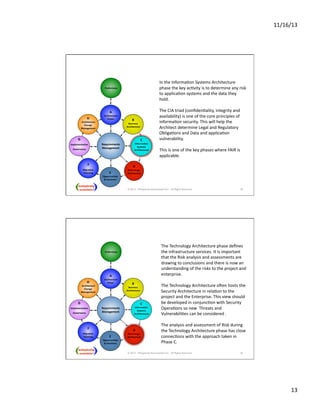
the 
key 
acNvity 
is 
to 
determine 
any 
risk 
to 
applicaNon 
systems 
and 
the 
data 
they 
hold. 
25 
The 
CIA 
triad 
(confidenNality, 
integrity 
and 
availability) 
is 
one 
of 
the 
core 
principles 
of 
informaNon 
security. 
This 
will 
help 
the 
Architect 
determine 
Legal 
and 
Regulatory 
ObligaNons 
and 
Data 
and 
applicaNon 
vulnerability. 
This 
is 
one 
of 
the 
key 
phases 
where 
FAIR 
is 
applicable. 
A 
Architecture 
H 
Vision 
Architecture 
Change 
Management 
G 
Implementaon 
Governance 
C 
Informaon 
Systems 
Architectures 
Requirements 
Management 
B 
Business 
Architecture 
E 
Opportunies 
 
Soluons 
F 
Migraon 
Planning 
Preliminary 
D 
Technology 
Architecture 
© 2013 - Metaplexity Associates® LLC - All Rights Reserved. 
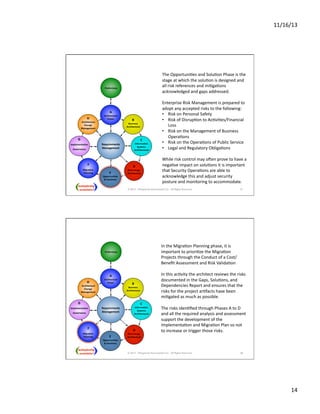
The 
Technology 
Architecture 
phase 
defines 
the 
infrastructure 
services. 
It 
is 
important 
that 
the 
Risk 
analysis 
and 
assessments 
are 
drawing 
to 
conclusions 
and 
there 
is 
now 
an 
understanding 
of 
the 
risks 
to 
the 
project 
and 
enterprise. 
The 
Technology 
Architecture 
ocen 
hosts 
the 
Security 
Architecture 
in 
relaNon 
to 
the 
project 
and 
the 
Enterprise. 
This 
view 
should 
be 
developed 
in 
conjuncNon 
with 
Security 
OperaNons 
so 
new 
Threats 
and 
VulnerabiliNes 
can 
be 
considered 
. 
The 
analysis 
and 
assessment 
of 
Risk 
during 
the 
Technology 
Architecture 
phase 
has 
close 
connecNons 
with 
the 
approach 
taken 
in 
Phase 
C. 
26 
A 
Architecture 
H 
Vision 
Architecture 
Change 
Management 
G 
Implementaon 
Governance 
C 
Informaon 
Systems 
Architectures 
Requirements 
Management 
B 
Business 
Architecture 
E 
Opportunies 
 
Soluons 
F 
Migraon 
Planning 
Preliminary 
D 
Technology 
Architecture 
© 2013 - Metaplexity Associates® LLC - All Rights Reserved.
11/16/13 
14 
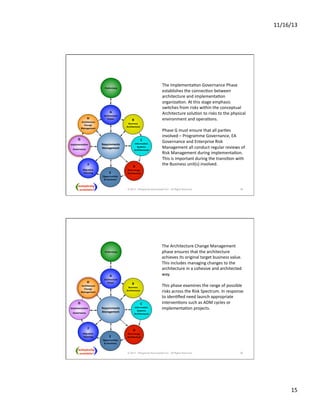
The 
OpportuniNes 
and 
SoluNon 
Phase 
is 
the 
stage 
at 
which 
the 
soluNon 
is 
designed 
and 
all 
risk 
references 
and 
miNgaNons 
acknowledged 
and 
gaps 
addressed. 
Enterprise 
Risk 
Management 
is 
prepared 
to 
adopt 
any 
accepted 
risks 
to 
the 
following: 
• Risk 
27 
on 
Personal 
Safety 
• Risk 
of 
DisrupNon 
to 
AcNviNes/Financial 
Loss 
• Risk 
on 
the 
Management 
of 
Business 
OperaNons 
• Risk 
on 
the 
OperaNons 
of 
Public 
Service 
• Legal 
and 
Regulatory 
ObligaNons 
While 
risk 
control 
may 
ocen 
prove 
to 
have 
a 
negaNve 
impact 
on 
soluNons 
it 
is 
important 
that 
Security 
OperaNons 
are 
able 
to 
acknowledge 
this 
and 
adjust 
security 
posture 
and 
monitoring 
to 
accommodate. 
A 
Architecture 
H 
Vision 
Architecture 
Change 
Management 
G 
Implementaon 
Governance 
C 
Informaon 
Systems 
Architectures 
Requirements 
Management 
B 
Business 
Architecture 
E 
Opportunies 
 
Soluons 
F 
Migraon 
Planning 
Preliminary 
D 
Technology 
Architecture 
© 2013 - Metaplexity Associates® LLC - All Rights Reserved. 
28 
In 
the 
MigraNon 
Planning 
phase, 
it 
is 
important 
to 
prioriNze 
the 
MigraNon 
Projects 
through 
the 
Conduct 
of 
a 
Cost/ 
Benefit 
Assessment 
and 
Risk 
ValidaNon 
In 
this 
acNvity 
the 
architect 
reviews 
the 
risks 
documented 
in 
the 
Gaps, 
SoluNons, 
and 
Dependencies 
Report 
and 
ensures 
that 
the 
risks 
for 
the 
project 
arNfacts 
have 
been 
miNgated 
as 
much 
as 
possible. 
The 
risks 
idenNfied 
through 
Phases 
A 
to 
D 
and 
all 
the 
required 
analysis 
and 
assessment 
support 
the 
development 
of 
the 
ImplementaNon 
and 
MigraNon 
Plan 
so 
not 
to 
increase 
or 
trigger 
those 
risks. 
A 
Architecture 
H 
Vision 
Architecture 
Change 
Management 
G 
Implementaon 
Governance 
C 
Informaon 
Systems 
Architectures 
Requirements 
Management 
B 
Business 
Architecture 
E 
Opportunies 
 
Soluons 
F 
Migraon 
Planning 
Preliminary 
D 
Technology 
Architecture 
© 2013 - Metaplexity Associates® LLC - All Rights Reserved.
11/16/13 
15 
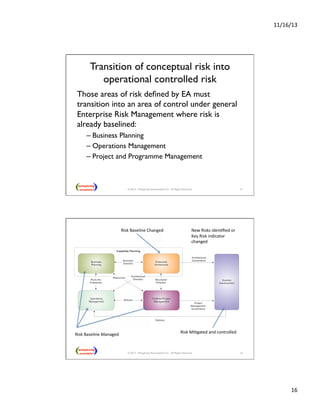
The 
ImplementaNon 
Governance 
Phase 
establishes 
the 
connecNon 
between 
architecture 
and 
implementaNon 
organizaNon. 
At 
this 
stage 
emphasis 
switches 
from 
risks 
within 
the 
conceptual 
Architecture 
soluNon 
to 
risks 
to 
the 
physical 
environment 
and 
operaNons. 
Phase 
G 
must 
ensure 
that 
all 
parNes 
involved 
– 
Programme 
Governance, 
EA 
Governance 
and 
Enterprise 
Risk 
Management 
all 
conduct 
regular 
reviews 
of 
Risk 
Management 
during 
implementaNon. 
This 
is 
important 
during 
the 
transiNon 
with 
the 
Business 
unit(s) 
involved. 
29 
A 
Architecture 
H 
Vision 
Architecture 
Change 
Management 
G 
Implementaon 
Governance 
C 
Informaon 
Systems 
Architectures 
Requirements 
Management 
B 
Business 
Architecture 
E 
Opportunies 
 
Soluons 
F 
Migraon 
Planning 
Preliminary 
D 
Technology 
Architecture 
© 2013 - Metaplexity Associates® LLC - All Rights Reserved. 
The 
Architecture 
Change 
Management 
phase 
ensures 
that 
the 
architecture 
achieves 
its 
original 
target 
business 
value. 
This 
includes 
managing 
changes 
to 
the 
architecture 
in 
a 
cohesive 
and 
architected 
way. 
This 
phase 
examines 
the 
range 
of 
possible 
risks 
across 
the 
Risk 
Spectrum. 
In 
response 
to 
idenNfied 
need 
launch 
appropriate 
intervenNons 
such 
as 
ADM 
cycles 
or 
implementaNon 
projects. 
30 
A 
Architecture 
H 
Vision 
Architecture 
Change 
Management 
G 
Implementaon 
Governance 
C 
Informaon 
Systems 
Architectures 
Requirements 
Management 
B 
Business 
Architecture 
E 
Opportunies 
 
Soluons 
F 
Migraon 
Planning 
Preliminary 
D 
Technology 
Architecture 
© 2013 - Metaplexity Associates® LLC - All Rights Reserved.
11/16/13 
16 
Transition of conceptual risk into 
operational controlled risk 
Those areas of risk defined by EA must 
transition into an area of control under general 
Enterprise Risk Management where risk is 
already baselined: 
– Business Planning 
– Operations Management 
– Project and Programme Management 
© 2013 - Metaplexity Associates® LLC - All Rights Reserved. 31 
32 
CapabilityPlanning 
Business 
Planning 
Operations 
Management 
Enterprise 
Architecture 
Portfolio/Project 
Management 
Business 
Direction 
Runsthe 
Enterprise 
Structured 
Direction 
Delivers 
New 
Risks 
idenNfied 
or 
Key 
Risk 
indicator 
changed 
Project 
Management 
Governance 
Delivers 
Architectural 
Governance 
Architectural 
Direction 
Resources 
Solution 
Development 
Risk 
Baseline 
Managed 
Risk 
Baseline 
Changed 
Risk 
MiNgated 
and 
controlled 
© 2013 - Metaplexity Associates® LLC - All Rights Reserved.
11/16/13 
17 
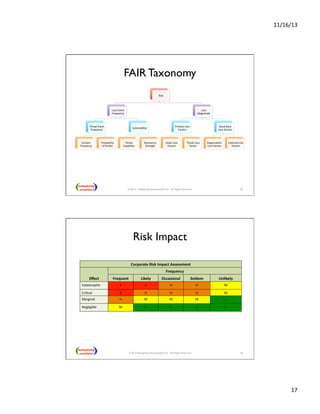
FAIR Taxonomy 
Risk 
Loss 
Event 
Frequency 
Threat 
Event 
Frequency 
Contact 
Frequency 
Probability 
of 
AcNon 
Vulnerability 
Threat 
Capability 
Resistance 
Strength 
Loss 
Magnitude 
Primary 
Loss 
Factors 
Asset 
Loss 
Factors 
Threat 
Loss 
Factor 
Secondary 
Loss 
Factors 
OrganizaNon 
Loss 
Factors 
External 
Loss 
Factors 
© 2013 - Metaplexity Associates® LLC - All Rights Reserved. 33 
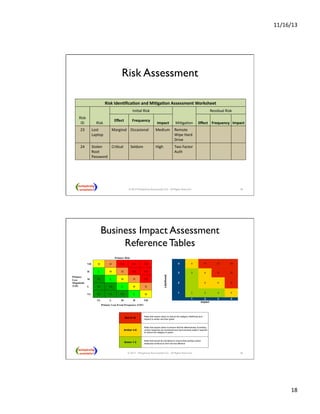
Risk Impact 
Corporate 
Risk 
Impact 
Assessment 
© 2013 Metaplexity Associates® LLC - All Rights Reserved 34 
Effect 
Frequency 
Frequent 
Likely 
Occasional 
Seldom 
Unlikely 
Catastrophic 
E 
E 
H 
H 
M 
CriNcal 
E 
H 
H 
H 
M 
Marginal 
H 
M 
M 
M 
L 
Negligible 
M 
L 
L 
L 
L
11/16/13 
18 
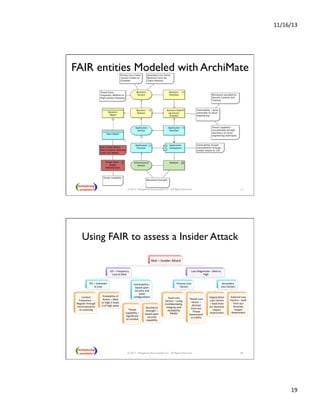
Risk Assessment 
Risk 
Idenficaon 
and 
Migaon 
Assessment 
Worksheet 
© 2013 Metaplexity Associates® LLC - All Rights Reserved 35 
Risk 
ID 
Risk 
IniNal 
Risk 
MiNgaNon 
Residual 
Risk 
Effect 
Frequency 
Impact 
Effect 
Frequency 
Impact 
23 
Lost 
Laptop 
Marginal 
Occasional 
Medium 
Remote 
Wipe 
Hard 
Drive 
24 
Stolen 
Root 
Password 
CriNcal 
Seldom 
High 
Two 
Factor 
Auth 
Business Impact Assessment 
Reference Tables 
36 
Likelihood 
4 4 
8 
12 
16 
3 3 
6 
9 
12 
2 4 
6 
8 
1 1 
2 
3 
4 
1 2 3 4 
Impact 
Red 8-16 Risks that require action to reduce the category (likelihood and / 
impact) to amber and then green 
Amber 4-6 
Risks that require action to ensure that the effectiveness of existing 
control measures are monitored and improvements made if required 
to reduce the category to green 
Green 1-3 Risks that should be monitored to ensure that existing control 
measures continue to work and are effective 
Primary 
Loss 
Magnitude 
(LM) 
Primary Risk 
VH M H VH VH VH 
H L M H VH VH 
M VL L M H VH 
L VL VL L M H 
VL VL VL VL L M 
VL L M H VH 
Primary Loss Event Frequency (LEF) 
© 2013 - Metaplexity Associates® LLC - All Rights Reserved.
11/16/13 
19 
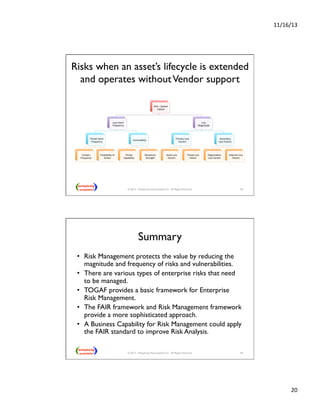
FAIR entities Modeled with ArchiMate 
© 2013 - Metaplexity Associates® LLC - All Rights Reserved. 37 
Using FAIR to assess a Insider Attack 
38 
Risk 
– 
Insider 
Afack 
LEF 
– 
Frequency 
Low 
to 
Med 
TEF 
– 
Unknown 
to 
Low 
Contact 
Frequency 
– 
Regular 
through 
reconnaissance 
or 
scanning 
Probability 
of 
AcNon 
– 
Med 
to 
High 
if 
Asset 
is 
of 
high 
value 
Vulnerability 
– 
based 
upon 
security 
and 
asset 
configuraNons 
Threat 
Capability 
– 
Significant 
to 
Limited 
Resistance 
Strength 
– 
based 
upon 
security 
capability 
Loss 
Magnitude 
– 
Med 
to 
High 
Primary 
Loss 
Factors 
Asset 
Loss 
Factors 
– 
using 
ConfidenNality, 
Integrity 
and 
Availability 
Model 
Threat 
Loss 
Factor 
– 
derived 
from 
our 
Threat 
Assessment 
or 
CAPEC 
Secondary 
Loss 
Factors 
OrganizaNon 
Loss 
Factors 
– 
built 
from 
our 
Business 
Impact 
Assessment 
External 
Loss 
Factors 
– 
built 
from 
our 
Business 
Impact 
Assessment 
© 2013 - Metaplexity Associates® LLC - All Rights Reserved.
11/16/13 
20 
Risks when an asset’s lifecycle is extended 
and operates without Vendor support 
39 
Risk 
– 
System 
Failure 
Loss 
Event 
Frequency 
Threat 
Event 
Frequency 
Contact 
Frequency 
Probability 
of 
AcNon 
Vulnerability 
Threat 
Capability 
Resistance 
Strength 
Loss 
Magnitude 
Primary 
Loss 
Factors 
Asset 
Loss 
Factors 
Threat 
Loss 
Factor 
Secondary 
Loss 
Factors 
OrganizaNon 
Loss 
Factors 
External 
Loss 
Factors 
© 2013 - Metaplexity Associates® LLC - All Rights Reserved. 
Summary 
• Risk Management protects the value by reducing the 
magnitude and frequency of risks and vulnerabilities. 
• There are various types of enterprise risks that need 
to be managed. 
• TOGAF provides a basic framework for Enterprise 
Risk Management. 
• The FAIR framework and Risk Management framework 
provide a more sophisticated approach. 
• A Business Capability for Risk Management could apply 
the FAIR standard to improve Risk Analysis. 
© 2013 - Metaplexity Associates® LLC - All Rights Reserved. 40

Building Risk Management into Enterprise Architecture

  • 1.
    11/16/13 1 WilliamEstrem Abstract This presentation will examine how enterprise architects can apply risk management capabilities to the development and operation of an enterprise architecture. The approach incorporates the TOGAF 9 Risk Management framework along with other risk management methods. In particular, the approach will focus on the The Open Group Risk Management Taxonomy and Risk Assessment standard. © 2013 - Metaplexity Associates® LLC - All Rights Reserved. 2
  • 2.
    11/16/13 2 Whatwe will cover • What is Risk Management? • How is Risk Management treated in Enterprise Architecture? • What are some types of Enterprise Risk Management? • Can we define a Business Capability for Risk Management? • What are the FAIR Taxonomy and Risk Analysis Standards? • Can FAIR and other standards be used together to improve Enterprise Risk Management Capability? © 2013 - Metaplexity Associates® LLC - All Rights Reserved. 3 Risk is a natural part of the business landscape. If left unmanaged, the uncertainty can spread like weeds. If managed effectively, losses can be avoided and benefits obtained. Source: RiskIT. IT Governance Institute 4 © 2013 - Metaplexity Associates® LLC - All Rights Reserved.
  • 3.
    11/16/13 3 AFine Balance Between Risk and Reward • Enterprise Risk Management – Aligning risk appetite and strategy – Enhancing risk response decisions – Reducing operational surprises and losses – Identifying and managing multiple and cross-enterprise risks – Seizing opportunities – Improving deployment of capital Source: Enterprise Risk Management – Integrated Framework, COSO. (2004). © 2013 - Metaplexity Associates® LLC - All Rights Reserved. 5 Levels of Risk • According to the TOGAF standard, there are two levels of risk that should be considered, namely: – Initial Level of Risk: Risk categorization prior to determining and implementing mitigating actions. – Residual Level of Risk: Risk categorization after implementation of mitigating actions (if any). © 2013 - Metaplexity Associates® LLC - All Rights Reserved. 6
  • 4.
    11/16/13 4 RiskManagement Process Classify Identify Evaluate Respond Monitor © 2013 - Metaplexity Associates® LLC - All Rights Reserved. 7 General Risk Management Approach • Define the risk assessment approach of the organization • Identify the risks • Analyze and evaluate the risks • Identify and evaluate options for the treatment of risks • Select control objectives and controls for the treatment of risks • Obtain management approval of the proposed residual risks Source: ISO 27001 © 2013 - Metaplexity Associates® LLC - All Rights Reserved. 8
  • 5.
    11/16/13 5 SomeTypes of Enterprise Risk Financial Risk Market Risk Operation Risk Safety Risk Information Risk Design Risk Product Risk © 2013 - Metaplexity Associates® LLC - All Rights Reserved. 9 Risk Spectrum challenges based upon stakeholder concerns • Commercial and Economic Risk • Risk of Loss of Goodwill or negative effect on Reputation • Risk to Personal Safety • Risk of Disruption to Activities and Financial Loss • Risk on the Management of Business Operations • Risk on the Operations of Public Service • Legal and Regulatory Obligations • Risk to technology, information and intellectual property How do we take in to consideration this wide range of risk areas in Enterprise Architecture planning activities? © 2013 - Metaplexity Associates® LLC - All Rights Reserved. 10
  • 6.
    11/16/13 6 EnterpriseRisk Management and Corporate Governance The governing board should manage enterprise risk by: • Ascertaining that there is transparency about the significant risks to the enterprise • Being aware that the final responsibility for risk management rests with the board • Being conscious that the system of internal control put in place to manage risks often has the capacity to generate cost-efficiency • Considering that a transparent and proactive risk management approach can create competitive advantage that can be exploited • Insisting that risk management be embedded in the operation of the enterprise Source: Board Briefing on IT Governance. IT Governance InsNtute 2nd EdiNon. 2004 © 2013 - Metaplexity Associates® LLC - All Rights Reserved. 11 Risk Management Approaches • COSO – Financial Reporting – Internal Audit • FAIR – Information Security • RiskIT – IT Risk • ISO 31000 – Risk Management General Principles and Guidelines • CRAMM – UK OGC General Risk Management Framework • ISO 27000 – ISO Series on Information Security Standards • NIST 800 – US standards for Computer Security • OCTAVE – CERT Strategic Information Risk Assessment • OGC’s – Management of Risk (MoR) • UK CESG – Good Practice Guides © 2013 - Metaplexity Associates® LLC - All Rights Reserved. 12
  • 7.
    11/16/13 7 RiskAssessment Viewpoints • Objectivist, or frequentist, view – Probabilities obtained from repetitive historical data • Subjectivist, or Bayesian, view. – – Risk is, in part, a judgment of the observer, or a property of the observation process, and not solely a function of the physical world. – Objective data complemented by other information. Borison, A. Hamm, G. 2010. How to Manage Risk (After Risk Management Has Failed). Sloan Management Review. © 2013 - Metaplexity Associates® LLC - All Rights Reserved. 13 Factor Analysis of Information Risk • The Risk Analysis Standard is intended to be used with the Risk Taxonomy Standard, which defines the FAIR taxonomy for the factors that drive information security risk. • Together, these two standards comprise a body of knowledge in the area of FAIR-based information security risk analysis. © 2013 - Metaplexity Associates® LLC - All Rights Reserved. 14
  • 8.
    11/16/13 8 RiskAnalysis using FAIR • Stage 1: – Identify scenario components – Identify the asset at risk – Identify the threat community • Stage 2: – Evaluate Loss Event Frequency (LEF) – Estimate probable Threat Event Frequency (TEF) – Estimate Threat Capability (TCap) – Estimate Control Strength (CS) – Derive Vulnerability (Vuln) – Derive Loss Event Frequency (LEF) • Stage 3: – Evaluate Probable Loss Magnitude (PLM) – Estimate worst-case loss Estimate – Probable Loss Magnitude (PLM) • Stage 4: – Derive and articulate risk © 2013 - Metaplexity Associates® LLC - All Rights Reserved. 15 FAIR Taxonomy Risk Loss Event Frequency Threat Event Frequency Contact Frequency Probability of AcNon Vulnerability Threat Capability Resistance Strength Loss Magnitude Primary Loss Factors Asset Loss Factors Threat Loss Factor Secondary Loss Factors OrganizaNon Loss Factors External Loss Factors © 2013 - Metaplexity Associates® LLC - All Rights Reserved. 16
  • 9.
    11/16/13 9 BroaderApplicability? Although the concepts and standards within the FAIR Standard were not developed with the intention of being applied towards other risk types, experience has demonstrated that they can be effectively applied to other risk types. © 2013 - Metaplexity Associates® LLC - All Rights Reserved. 17 Risk and the TOGAF Standard • Risk already plays an important part in the TOGAF standard be we recognize that there are perhaps improvements and innovations to add. • Over the next set of slides we will look more closely at Risk within the ADM © 2013 - Metaplexity Associates® LLC - All Rights Reserved. 18
  • 10.
    11/16/13 10 Loss,Threat and Vulnerability and the EA Context • Enterprise Architects should work with specialist resources to determine the true cost of any loss, but to help determine this the architect has to provide the context. • Context is defined via the Content Metamodel through the development of Building Blocks • Each Building Block can be examined through ADM techniques that will provide specific information and support for more detailed Risk Management understanding • Use Building Blocks to: – define the variety of asset types – assess the threat to the assets and vulnerability – determine the relationships between assets and their interdependencies © 2013 - Metaplexity Associates® LLC - All Rights Reserved. 19 TOGAF viewpoints that support Risk Analysis • Viewpoints enable the Architect to build context for a risk model and assessment: – Location Catalog – Business Service / Function Catalog – Interface Catalog – Business Service / Information Diagram – Application and User Location Diagram – Solution Concept Diagram – System Use-Case Diagram – including Mis-Use Cases – Role / System Matrix – System / Data Matrix – System / Organisation Matrix – Application Interaction Matrix – Business Interaction Matrix – System Technology Matrix © 2013 - Metaplexity Associates® LLC - All Rights Reserved. 20
  • 11.
    11/16/13 11 ApplyingRisk Methods to the ADM ADM Requirements Risk Analysis Method Control Preliminary To define approach and methods in accordance with customer or programme Vision To define the risk landscape to a programme or enterprise requirements Strategic Threat Scenarios, Risk Spectrum Business Architecture To formalize the risk model defined in the vision stage against the business and the applicaNon at later stages TacNcal Threat Scenarios InformaNon System Architecture To apply to informaNon arch FAIR, SANS, ISO, NIST, OCTAVE Technology Architecture To apply to tech arch FAIR, SANS, ISO, NIST, OCTAVE OpportuniNes SoluNon To check and agree risk FAIR, SANS, ISO, NIST, OCTAVE MigraNon Planning Programme Management RISK CRAMM, ARM ImplementaNon Governance Programme Management RISK CRAMM. ARM EA Change Management Programme Management RISK Scenarios, CRAMM, ARM Risk Management 21 © 2013 - Metaplexity Associates® LLC - All Rights Reserved. 22 In the Preliminary stage: • Establish relaNonship with Enterprise Risk Management • Appoint the architects responsible for risk management and analysis Determine and agree standards and controls to support Risk Management • Scope the part of the organisaNon impacted and under change • Assess appeNte / tolerance to risk • Discuss with key stakeholders the impact of the architecture change to the business and potenNal commercial and economic risks associated • Understand the secondary losses such as loss of goodwill or reputaNon A Architecture H Vision Architecture Change Management G Implementaon Governance C Informaon Systems Architectures Requirements Management B Business Architecture E Opportunies Soluons F Migraon Planning Preliminary D Technology Architecture © 2013 - Metaplexity Associates® LLC - All Rights Reserved.
  • 12.
    11/16/13 12 23 In the Architecture Vision phase: • Understand Stakeholder Concerns and subsequent miNgaNons • Use threat scenarios to analyze the vision described by Business Scenario • Assess readiness for TransformaNon and therefore idenNfying transformaNon risk and miNgaNon • Measure against maturity model assessments and approach to requirement management • IdenNfy iniNal risk management requirements A Architecture H Vision Architecture Change Management G Implementaon Governance C Informaon Systems Architectures Requirements Management B Business Architecture E Opportunies Soluons F Migraon Planning Preliminary D Technology Architecture © 2013 - Metaplexity Associates® LLC - All Rights Reserved. 24 In the Business Architecture phase: • methods at this stage which are able to support risk management and analysis: • Capability Assessment • Gap analysis • Business principles, business goals, and business drivers AcNviNes at this stage will help ascertain risk to Commercial and Economic aspects of the organisaNon as well as risks to business operaNons and public service operaNons if applicable. Building Blocks and views of LocaNon, FuncNon, Process, Business Services can be analyzed using threat scenarios, threat sources and threat actors. A Architecture H Vision Architecture Change Management G Implementaon Governance C Informaon Systems Architectures Requirements Management B Business Architecture E Opportunies Soluons F Migraon Planning Preliminary D Technology Architecture © 2013 - Metaplexity Associates® LLC - All Rights Reserved.
  • 13.
    11/16/13 13 In the InformaNon Systems Architecture phase the key acNvity is to determine any risk to applicaNon systems and the data they hold. 25 The CIA triad (confidenNality, integrity and availability) is one of the core principles of informaNon security. This will help the Architect determine Legal and Regulatory ObligaNons and Data and applicaNon vulnerability. This is one of the key phases where FAIR is applicable. A Architecture H Vision Architecture Change Management G Implementaon Governance C Informaon Systems Architectures Requirements Management B Business Architecture E Opportunies Soluons F Migraon Planning Preliminary D Technology Architecture © 2013 - Metaplexity Associates® LLC - All Rights Reserved. The Technology Architecture phase defines the infrastructure services. It is important that the Risk analysis and assessments are drawing to conclusions and there is now an understanding of the risks to the project and enterprise. The Technology Architecture ocen hosts the Security Architecture in relaNon to the project and the Enterprise. This view should be developed in conjuncNon with Security OperaNons so new Threats and VulnerabiliNes can be considered . The analysis and assessment of Risk during the Technology Architecture phase has close connecNons with the approach taken in Phase C. 26 A Architecture H Vision Architecture Change Management G Implementaon Governance C Informaon Systems Architectures Requirements Management B Business Architecture E Opportunies Soluons F Migraon Planning Preliminary D Technology Architecture © 2013 - Metaplexity Associates® LLC - All Rights Reserved.
  • 14.
    11/16/13 14 The OpportuniNes and SoluNon Phase is the stage at which the soluNon is designed and all risk references and miNgaNons acknowledged and gaps addressed. Enterprise Risk Management is prepared to adopt any accepted risks to the following: • Risk 27 on Personal Safety • Risk of DisrupNon to AcNviNes/Financial Loss • Risk on the Management of Business OperaNons • Risk on the OperaNons of Public Service • Legal and Regulatory ObligaNons While risk control may ocen prove to have a negaNve impact on soluNons it is important that Security OperaNons are able to acknowledge this and adjust security posture and monitoring to accommodate. A Architecture H Vision Architecture Change Management G Implementaon Governance C Informaon Systems Architectures Requirements Management B Business Architecture E Opportunies Soluons F Migraon Planning Preliminary D Technology Architecture © 2013 - Metaplexity Associates® LLC - All Rights Reserved. 28 In the MigraNon Planning phase, it is important to prioriNze the MigraNon Projects through the Conduct of a Cost/ Benefit Assessment and Risk ValidaNon In this acNvity the architect reviews the risks documented in the Gaps, SoluNons, and Dependencies Report and ensures that the risks for the project arNfacts have been miNgated as much as possible. The risks idenNfied through Phases A to D and all the required analysis and assessment support the development of the ImplementaNon and MigraNon Plan so not to increase or trigger those risks. A Architecture H Vision Architecture Change Management G Implementaon Governance C Informaon Systems Architectures Requirements Management B Business Architecture E Opportunies Soluons F Migraon Planning Preliminary D Technology Architecture © 2013 - Metaplexity Associates® LLC - All Rights Reserved.
  • 15.
    11/16/13 15 The ImplementaNon Governance Phase establishes the connecNon between architecture and implementaNon organizaNon. At this stage emphasis switches from risks within the conceptual Architecture soluNon to risks to the physical environment and operaNons. Phase G must ensure that all parNes involved – Programme Governance, EA Governance and Enterprise Risk Management all conduct regular reviews of Risk Management during implementaNon. This is important during the transiNon with the Business unit(s) involved. 29 A Architecture H Vision Architecture Change Management G Implementaon Governance C Informaon Systems Architectures Requirements Management B Business Architecture E Opportunies Soluons F Migraon Planning Preliminary D Technology Architecture © 2013 - Metaplexity Associates® LLC - All Rights Reserved. The Architecture Change Management phase ensures that the architecture achieves its original target business value. This includes managing changes to the architecture in a cohesive and architected way. This phase examines the range of possible risks across the Risk Spectrum. In response to idenNfied need launch appropriate intervenNons such as ADM cycles or implementaNon projects. 30 A Architecture H Vision Architecture Change Management G Implementaon Governance C Informaon Systems Architectures Requirements Management B Business Architecture E Opportunies Soluons F Migraon Planning Preliminary D Technology Architecture © 2013 - Metaplexity Associates® LLC - All Rights Reserved.
  • 16.
    11/16/13 16 Transitionof conceptual risk into operational controlled risk Those areas of risk defined by EA must transition into an area of control under general Enterprise Risk Management where risk is already baselined: – Business Planning – Operations Management – Project and Programme Management © 2013 - Metaplexity Associates® LLC - All Rights Reserved. 31 32 CapabilityPlanning Business Planning Operations Management Enterprise Architecture Portfolio/Project Management Business Direction Runsthe Enterprise Structured Direction Delivers New Risks idenNfied or Key Risk indicator changed Project Management Governance Delivers Architectural Governance Architectural Direction Resources Solution Development Risk Baseline Managed Risk Baseline Changed Risk MiNgated and controlled © 2013 - Metaplexity Associates® LLC - All Rights Reserved.
  • 17.
    11/16/13 17 FAIRTaxonomy Risk Loss Event Frequency Threat Event Frequency Contact Frequency Probability of AcNon Vulnerability Threat Capability Resistance Strength Loss Magnitude Primary Loss Factors Asset Loss Factors Threat Loss Factor Secondary Loss Factors OrganizaNon Loss Factors External Loss Factors © 2013 - Metaplexity Associates® LLC - All Rights Reserved. 33 Risk Impact Corporate Risk Impact Assessment © 2013 Metaplexity Associates® LLC - All Rights Reserved 34 Effect Frequency Frequent Likely Occasional Seldom Unlikely Catastrophic E E H H M CriNcal E H H H M Marginal H M M M L Negligible M L L L L
  • 18.
    11/16/13 18 RiskAssessment Risk Idenficaon and Migaon Assessment Worksheet © 2013 Metaplexity Associates® LLC - All Rights Reserved 35 Risk ID Risk IniNal Risk MiNgaNon Residual Risk Effect Frequency Impact Effect Frequency Impact 23 Lost Laptop Marginal Occasional Medium Remote Wipe Hard Drive 24 Stolen Root Password CriNcal Seldom High Two Factor Auth Business Impact Assessment Reference Tables 36 Likelihood 4 4 8 12 16 3 3 6 9 12 2 4 6 8 1 1 2 3 4 1 2 3 4 Impact Red 8-16 Risks that require action to reduce the category (likelihood and / impact) to amber and then green Amber 4-6 Risks that require action to ensure that the effectiveness of existing control measures are monitored and improvements made if required to reduce the category to green Green 1-3 Risks that should be monitored to ensure that existing control measures continue to work and are effective Primary Loss Magnitude (LM) Primary Risk VH M H VH VH VH H L M H VH VH M VL L M H VH L VL VL L M H VL VL VL VL L M VL L M H VH Primary Loss Event Frequency (LEF) © 2013 - Metaplexity Associates® LLC - All Rights Reserved.
  • 19.
    11/16/13 19 FAIRentities Modeled with ArchiMate © 2013 - Metaplexity Associates® LLC - All Rights Reserved. 37 Using FAIR to assess a Insider Attack 38 Risk – Insider Afack LEF – Frequency Low to Med TEF – Unknown to Low Contact Frequency – Regular through reconnaissance or scanning Probability of AcNon – Med to High if Asset is of high value Vulnerability – based upon security and asset configuraNons Threat Capability – Significant to Limited Resistance Strength – based upon security capability Loss Magnitude – Med to High Primary Loss Factors Asset Loss Factors – using ConfidenNality, Integrity and Availability Model Threat Loss Factor – derived from our Threat Assessment or CAPEC Secondary Loss Factors OrganizaNon Loss Factors – built from our Business Impact Assessment External Loss Factors – built from our Business Impact Assessment © 2013 - Metaplexity Associates® LLC - All Rights Reserved.
  • 20.
    11/16/13 20 Riskswhen an asset’s lifecycle is extended and operates without Vendor support 39 Risk – System Failure Loss Event Frequency Threat Event Frequency Contact Frequency Probability of AcNon Vulnerability Threat Capability Resistance Strength Loss Magnitude Primary Loss Factors Asset Loss Factors Threat Loss Factor Secondary Loss Factors OrganizaNon Loss Factors External Loss Factors © 2013 - Metaplexity Associates® LLC - All Rights Reserved. Summary • Risk Management protects the value by reducing the magnitude and frequency of risks and vulnerabilities. • There are various types of enterprise risks that need to be managed. • TOGAF provides a basic framework for Enterprise Risk Management. • The FAIR framework and Risk Management framework provide a more sophisticated approach. • A Business Capability for Risk Management could apply the FAIR standard to improve Risk Analysis. © 2013 - Metaplexity Associates® LLC - All Rights Reserved. 40