Inventories
(IAS2)
Overview
• Definition of inventories
• Measurement of inventories
• Conversion costs
• Fixed production overheads
• Excluded costs
• Cost measurement techniques
• Cost formulas
• Net realisable value
• Disclosure requirements
Definition of inventories
(IAS2)
Inventories are assets:
• held for sale in the ordinary course of
business;
• in the process of production for such sale;
or
• in the form of materials or supplies to be
consumed in the production process or in
the rendering of services.
Measurement of inventories
Inventories are measured "at the lower of cost and net
realisable value" (IAS2)
• Cost comprises "all costs of purchase, costs of
conversion and other costs incurred in bringing the
inventories to their present location and condition".
• Net realisable value is "the estimated selling price in
the ordinary course of business less the estimated
costs of completion and the estimated costs
necessary to make the sale".
Conversion costs
• Costs directly related to production (such as direct
materials, direct labour) plus a systematic
allocation of fixed and variable production
overheads.
• Fixed production overheads are indirect costs of
production which remain fairly constant (e.g.
depreciation of factory buildings, costs of factory
management).
• Variable production overheads are indirect costs of
production which vary with volume of production
(e.g. indirect materials and labour).
Fixed production overheads
• Allocation of fixed production overheads to units of
production is based on normal activity.
• If actual activity is less than normal, unallocated
fixed overheads are recognised as an expense, not
as part of the cost of inventories.
• If actual activity is greater than normal, the amount
of fixed overhead allocated to each unit of
production is decreased.
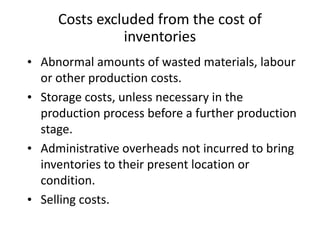
Costs excluded from the cost of
inventories
• Abnormal amounts of wasted materials, labour
or other production costs.
• Storage costs, unless necessary in the
production process before a further production
stage.
• Administrative overheads not incurred to bring
inventories to their present location or
condition.
• Selling costs.
Cost measurement techniques
• Techniques such as standard costing or the
retail method may be used if the results
provide a reasonable approximation to cost.
• Standard costs should be regularly reviewed
and, if necessary, revised.
• The retail method determines the cost of
inventory by reducing sales value by the
appropriate gross margin.
Cost formulas
• The cost of inventories that are not inter-
changeable should be ascertained "by using specific
identification of their individual costs".
• For interchangeable items, costs are ascertained
using either of the following cost formulas:
a) First-In, First-Out (FIFO)
b) Weighted average cost (AVCO)
• Last-In, First-Out (LIFO) is not allowed.
Net realisable value (NRV)
• The costs and NRV of inventories should
normally be compared "item by item" (IAS2).
• However, similar or related items may be
grouped if this is appropriate.
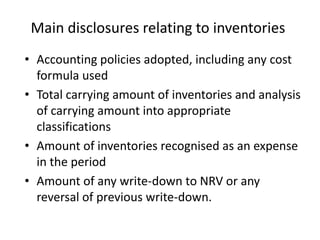
Main disclosures relating to inventories
• Accounting policies adopted, including any cost
formula used
• Total carrying amount of inventories and analysis
of carrying amount into appropriate
classifications
• Amount of inventories recognised as an expense
in the period
• Amount of any write-down to NRV or any
reversal of previous write-down.
The End

Inventories.pptx

  • 1.
  • 2.
    Overview • Definition ofinventories • Measurement of inventories • Conversion costs • Fixed production overheads • Excluded costs • Cost measurement techniques • Cost formulas • Net realisable value • Disclosure requirements
  • 3.
    Definition of inventories (IAS2) Inventoriesare assets: • held for sale in the ordinary course of business; • in the process of production for such sale; or • in the form of materials or supplies to be consumed in the production process or in the rendering of services.
  • 4.
    Measurement of inventories Inventoriesare measured "at the lower of cost and net realisable value" (IAS2) • Cost comprises "all costs of purchase, costs of conversion and other costs incurred in bringing the inventories to their present location and condition". • Net realisable value is "the estimated selling price in the ordinary course of business less the estimated costs of completion and the estimated costs necessary to make the sale".
  • 5.
    Conversion costs • Costsdirectly related to production (such as direct materials, direct labour) plus a systematic allocation of fixed and variable production overheads. • Fixed production overheads are indirect costs of production which remain fairly constant (e.g. depreciation of factory buildings, costs of factory management). • Variable production overheads are indirect costs of production which vary with volume of production (e.g. indirect materials and labour).
  • 6.
    Fixed production overheads •Allocation of fixed production overheads to units of production is based on normal activity. • If actual activity is less than normal, unallocated fixed overheads are recognised as an expense, not as part of the cost of inventories. • If actual activity is greater than normal, the amount of fixed overhead allocated to each unit of production is decreased.
  • 7.
    Costs excluded fromthe cost of inventories • Abnormal amounts of wasted materials, labour or other production costs. • Storage costs, unless necessary in the production process before a further production stage. • Administrative overheads not incurred to bring inventories to their present location or condition. • Selling costs.
  • 8.
    Cost measurement techniques •Techniques such as standard costing or the retail method may be used if the results provide a reasonable approximation to cost. • Standard costs should be regularly reviewed and, if necessary, revised. • The retail method determines the cost of inventory by reducing sales value by the appropriate gross margin.
  • 9.
    Cost formulas • Thecost of inventories that are not inter- changeable should be ascertained "by using specific identification of their individual costs". • For interchangeable items, costs are ascertained using either of the following cost formulas: a) First-In, First-Out (FIFO) b) Weighted average cost (AVCO) • Last-In, First-Out (LIFO) is not allowed.
  • 10.
    Net realisable value(NRV) • The costs and NRV of inventories should normally be compared "item by item" (IAS2). • However, similar or related items may be grouped if this is appropriate.
  • 11.
    Main disclosures relatingto inventories • Accounting policies adopted, including any cost formula used • Total carrying amount of inventories and analysis of carrying amount into appropriate classifications • Amount of inventories recognised as an expense in the period • Amount of any write-down to NRV or any reversal of previous write-down.
  • 12.