Promoting and AssessingCritical Thinking
Topic OutlineIntroduction
Defining Critical Thinking
Critical Thinking vs. Other Concepts
Ways that Inhibit Critical Thinking
Strategies that Enhance Critical Thinking
Assessing Critical Thinking
ConclusionDefine critical thinking.
Know whether it is discipline specific or a “generic” skill.
Know how to develop critical thinking.
Learn how to enhance it via learning experiences.
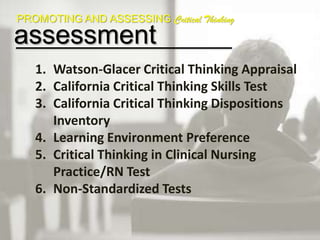
Know different approaches in measuring critical thinking.
PROMOTING AND ASSESSING Critical ThinkingIntroductionDraw upon one’s knowledge base in nursing & related sciencesPerform a myriad of psychomotor skillsInteract effectively with individuals and groups
Additional Abilities that Nurses NeedWork collaboratively with an interdisciplinary team
Provide evidence to support one’s actions
Draw reasoned conclusions
Document clearly and comprehensivelyAdditional Abilities that Nurses NeedProvide leadership that leads to positive change
Be unwilling to merely accept the status quo or tradition
Be creative
Connect ideas in unique waysAdditional Abilities that Nurses NeedEngage in dialogue with individuals and groups
Communicate effectively
Manage conflicting information
Have a questioning mindAdditional Abilities that Nurses NeedMake decisions despite gaps in information and knowledge
Have a “spirit of inquiry”
Contribute to nursing science development
Be reflective and contemplativeAdditional Abilities that Nurses NeedBe open to new perspectives, interpretations, and alternatives
Think criticallyOne of the bodies that accredit nursing education programs which requires critical thinking be an outcome of nursing education programs and that faculty  document the student’s ability in this area.
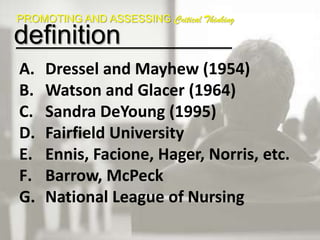
PROMOTING AND ASSESSING Critical ThinkingdefinitionA. Dressel and Mayhew (1954)
“Ability to define a problem, select pertinent information needed to solve the problem, recognize stated and unstated assumptions, formulate or select relevant and promising hypotheses, draw valid conclusions, and judge the validity of inferences.”
PROMOTING AND ASSESSING Critical ThinkingdefinitionDressel and Mayhew (1954)Watson and Glacer (1964)
“A composite of attitudes of inquiry; knowledge of the nature of valid inferences, abstractions, and generalizations; and skills in employing and applying these attitudes and knowledge.”
Involves one’s frame of mind or attitudeIt is a perspective through which one views all situations; not merely a “collection” of skills
PROMOTING AND ASSESSING Critical ThinkingdefinitionDressel and Mayhew (1954)Watson and Glacer (1964)Sandra DeYoung (1995)
“Critical thinking is using the powers of the mind to view the world and to act in a discerning way. It includes having a questioning attitude, examining underlying assumptions, and considering the validity of alternative solutions in order to make reasoned judgments that are sensitive to context.”
PROMOTING AND ASSESSING Critical ThinkingdefinitionDressel and Mayhew (1954)Watson and Glacer (1964)Sandra DeYoung (1995)Fairfield University
Critical thinking is a way of interactingwith the world that is reflective, open and generative.
“Interacting with the world”Engaging with ideas and people
Being curious
Appreciating contextual influences
Being broad, not narrow“Interacting with the world”Being aware of one’s own values
Being involved
Tolerates ambiguity & uncertainty
No tunnel vision“Reflective”Sound knowledge base
Examining the whole
Being thoughtful
Examining assumptions“Reflective”Being insightful
Drawing well-founded conclusions
Continuously looking at and investigating ideas & perspectives“Open”Flexible and open to new ideas
Considers alternatives
Creative
Having intellectual curiosity“Open”Continually rethinking issues, perspectives, points of view“Generative”Creating new ideas
Proposing alternatives
Willing to grow and to take risks
Initiates changeAnalysis ofOther definitions A critical thinking is nonbiased, reasoned and truth orientedCritical thinking involves making judgmentsThinking is critical if it holds up to certain evaluative criteria
Analysis ofOther definitionsd) Critical thinking is tied to a belief of action e) Critical thinking is a “spirit”, an attitude, or an inclination to think about one’s thinking
Richard Paul (1993)“Aspects of Critical Thinking”Summarized the concept of critical thinking by identifying a number of aspects of it.
Richard Paul “Intellectual Standards for Disciplining the Mind”Criteria to judge whether a person’s thinking is critical.
Richard Paul “Intellectual Standards for Disciplining the Mind”“Critical” thinking is precise, deep, logical, relevant, accurate & significant.
Critical thinkingIdentify and evaluate our assumptions
Consider multiple perspectives
Articulate a point of view
Make decisions and commitmentsCritical thinkingConsider the consequences of our decisions
Justify our beliefs and actions
Willing to modify our beliefs and actionsPROMOTING AND ASSESSING Critical ThinkingdefinitionDressel and Mayhew (1954)Watson and Glacer (1964)Sandra DeYoung (1995)Fairfield UniversityEnnis, Facione, Hager, Norris, etc.
“Critical thinking skills are generic, there is nothing different between critical thinking in one situation and critical thinking in another situation.”
PROMOTING AND ASSESSING Critical ThinkingdefinitionDressel and Mayhew (1954)Watson and Glacer (1964)Sandra DeYoung (1995)Fairfield UniversityEnnis, Facione, Hager, Norris, etc.Barrow, McPeck
“Knowledge of a subject is a necessary condition for critical thinking in an area. There are different skills for different circumstances. Knowledge is a necessary condition for critical thinking and critical thinking is subjectspecific.”
PROMOTING AND ASSESSING Critical ThinkingdefinitionDressel and Mayhew (1954)Watson and Glacer (1964)Sandra DeYoung (1995)Fairfield UniversityEnnis, Facione, Hager, Norris, etc.Barrow, McPeckNational League of Nursing
“Critical thinking in nursing practice is a discipline specific, reflective reasoning process that guides a nurse in generating, implementing, and evaluating approaches for dealing with client care and professional concerns.”
“We don’t have to make human beings smart. They are born smart. All we have to do is to stop doing things that make them stupid.”
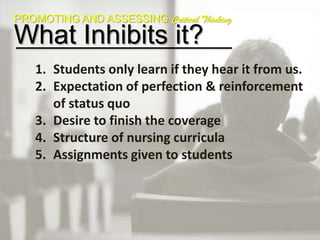
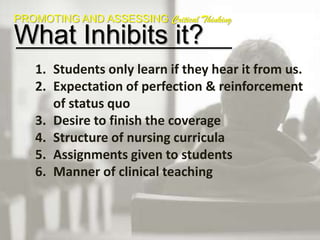
PROMOTING AND ASSESSING Critical ThinkingWhat Inhibits it?1. Students only learn if they hear it from us.
SITUATIONLectures are structured in a way where students have no questions to askRESULTStudents do not have to “struggle” to comprehend  the materialSITUATIONComplicated materials are structured in an organized mannerRESULTStudents think clinical situations are not as complex as they may seemPROMOTING AND ASSESSING Critical ThinkingWhat Inhibits it?Students only learn if they hear it from us.Expectation of perfection& reinforcement of status quo
SITUATIONFaculty assumes students do not know how to problem solve or think criticallyRESULTStudents end up being spoon-fed and not thinking independently how to solve a problemSITUATION“Mistakes are bad, costly and avoided”RESULTStudents are discouraged from taking their first steps from which they could learn a lot in case they get it wrong the first timeSITUATION“There is single best way to solve a problem”RESULTLearning becomes too objective for the students and they are discouraged to explore some optionsSITUATION“Certainty is good, faculty know best”RESULTDiminishes student’s confidence in the way they think and decreases the value of the options they think of when they problem solvePROMOTING AND ASSESSING Critical ThinkingWhat Inhibits it?Students only learn if they hear it from us.Expectation of perfection& reinforcement of status quoDesire to finish the coverage
SITUATIONLecture format is used more often than it shouldRESULTReduces the students to “little more than background”SITUATIONNot overcoming the “addiction to coverage”RESULTThe professor who dictates, the students who reiterate, the talkingteacher and the quietstudentSITUATIONTeachers cram facts and information to learnersRESULTStudents do not have enough time to truly understand what they are learning
PROMOTING AND ASSESSING Critical ThinkingWhat Inhibits it?Students only learn if they hear it from us.Expectation of perfection& reinforcement of status quoDesire to finish the coverageStructure of nursing curricula
SITUATIONCourse is preselected; sequencing is scriptedRESULTStudents fail to think why they enrol the courses and to make choices from among alternativesPROMOTING AND ASSESSING Critical ThinkingWhat Inhibits it?Students only learn if they hear it from us.Expectation of perfection& reinforcement of status quoDesire to finish the coverageStructure of nursing curriculaAssignments given to students
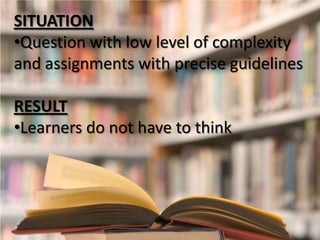
SITUATIONQuestion with low level of complexity and assignments with precise guidelinesRESULTLearners do not have to thinkPROMOTING AND ASSESSING Critical ThinkingWhat Inhibits it?Students only learn if they hear it from us.Expectation of perfection& reinforcement of status quoDesire to finish the coverageStructure of nursing curriculaAssignments given to studentsManner of clinical teaching
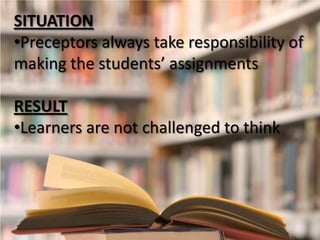
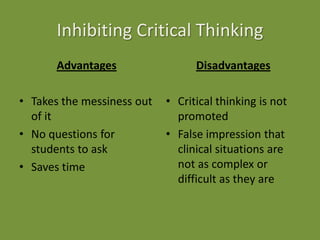
SITUATIONPreceptors always take responsibility of making the students’ assignmentsRESULTLearners are not challenged to thinkInhibiting Critical ThinkingAdvantagesTakes the messiness out of itNo questions for students to askSaves timeDisadvantagesCritical thinking is not promotedFalse impression that clinical situations are not as complex or difficult as they are
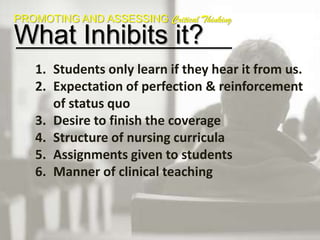
PROMOTING AND ASSESSING Critical ThinkingWhat Inhibits it?Students only learn if they hear it from us.Expectation of perfection& reinforcement of status quoDesire to finish the coverageStructure of nursing curriculaAssignments given to studentsManner of clinical teaching
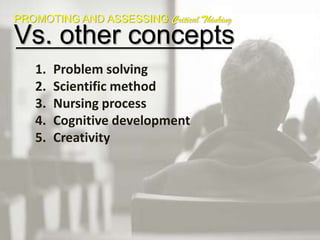
PROMOTING AND ASSESSING Critical ThinkingVs. other conceptsProblem solving
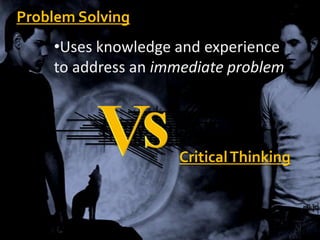
Problem SolvingUses knowledge and experience to address an immediate problemsVCritical Thinking
Problem SolvingA correct answer exists; only limited approaches will worksVCritical Thinking
Problem SolvingLong term perspective is not necessarily takensVCritical ThinkingReasoning about “open-ended” and ill-structured problemsProblem SolvingLong term perspective is not necessarily takensVCritical ThinkingOn contrary, it operates all the timePROMOTING AND ASSESSING Critical ThinkingVs. other conceptsProblem solvingScientific method
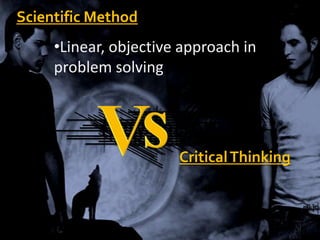
Scientific MethodLinear, objective approach in problem solvingsVCritical Thinking
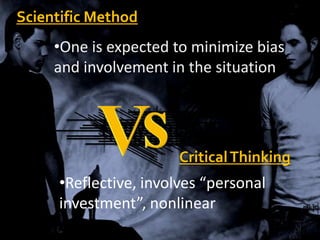
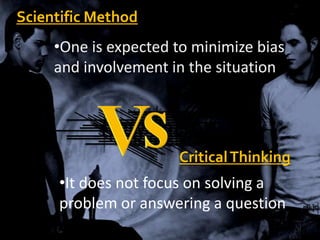
Scientific MethodOne is expected to minimize bias and involvement in the situationsVCritical ThinkingReflective, involves “personal investment”, nonlinearScientific MethodOne is expected to minimize bias and involvement in the situationsVCritical ThinkingIt does not focus on solving a problem or answering a questionPROMOTING AND ASSESSING Critical ThinkingVs. other conceptsProblem solvingScientific methodNursing process
Nursing ProcessA systematic linear approachsVCritical Thinking
Nursing ProcessIncludes assessing situations, outlining plans, taking action, & evaluating resultssVCritical ThinkingNo “steps” to follow, not linear, not specific to clinical situation, does not need an actionPROMOTING AND ASSESSING Critical ThinkingVs. other conceptsProblem solvingScientific methodNursing processCognitive development
Cognitive DevelopmentHow individuals reason and view knowledgesVCritical Thinking
Cognitive DevelopmentHow they manage diversity of opinion and conflicting points of viewsVCritical Thinking
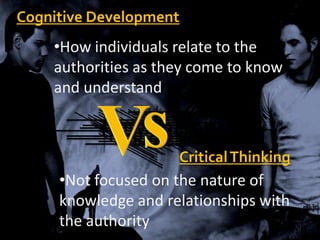
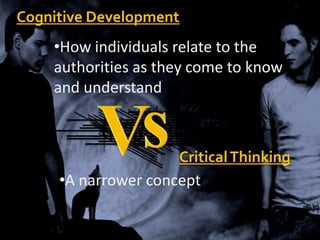
Cognitive DevelopmentHow individuals relate to the authorities as they come to know and understandsVCritical ThinkingNot focused on the nature of knowledge and relationships with the authorityCognitive DevelopmentHow individuals relate to the authorities as they come to know and understandsVCritical ThinkingA narrower conceptPROMOTING AND ASSESSING Critical ThinkingVs. other conceptsProblem solvingScientific methodNursing processCognitive developmentCreativity
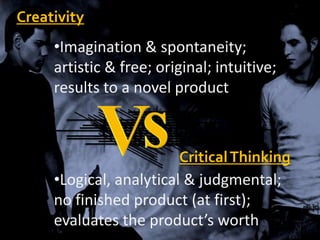
CreativityImagination & spontaneity; artistic & free; original; intuitive; results to a novel productsVCritical ThinkingLogical, analytical & judgmental; no finished product (at first); evaluates the product’s worthPROMOTING AND ASSESSING Critical ThinkingVs. other conceptsProblem solvingScientific methodNursing processCognitive developmentCreativity
Teachers and learners alike view learning as a shared responsibility. It is the educator’sresponsibilityto create an environment that supports this concept.
Teachers become mentorsand facilitators.
They “push” and challengelearners while supporting them.
Egalitarianand democraticenvironment – learners feel empowered and share in the control of their learning process.
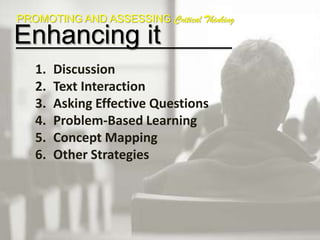
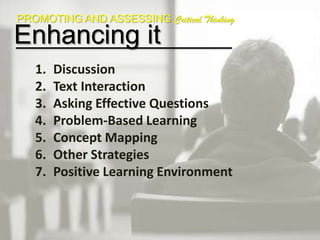
Doing less lecturing.PROMOTING AND ASSESSING Critical ThinkingEnhancing itDiscussion
DiscussionLecture should be limited to a small percentage of the class time
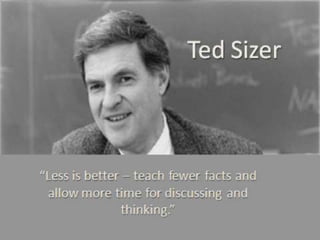
That means: depth of understanding > breadth of contentOnly the most significant concepts are addressed
From straight lecture to lecture w/ comments and questionsDiscussionThe teacher role models critical thinking
Answers the question only when the students are unable to do so
A more effective strategy is when students think through the question they askDiscussionUsing this as a learning strategy is unpredictable
It may turn the classroom in to “a relatively chaotic affair” but it is a “controlled chaos”
Some answers of the students need to be corrected
Teachers give up control so students discover flaws in their thinkingDiscussionDiscussion actively holds the student’s thoughts more than lecture does
Irrelevant and passive thoughts occur more frequently with lecture
Discussion can be most effective in promoting student’s critical thinkingPROMOTING AND ASSESSING Critical ThinkingEnhancing itDiscussionText Interaction
Text InteractionThink critically about what they are reading & comparing it with other things they have read or experienced
Interact with the readings prior to classText InteractionRaise questions about what is presented
Note assumptions that are being made
Point out conflicting information
Recognizing unsupported conclusions
Note questions unanswered by the textText InteractionText interaction helps students think about what they are reading
Students eventually develop a questioning attitude or a spirit of inquiryPROMOTING AND ASSESSING Critical ThinkingEnhancing itDiscussionText InteractionAsking Effective Questions
Effective QuestioningAsking factual questions
Asking questions with many answers
Neither of these two methods of questioning stimulates the student’s use of critical thinking
Questions should be one notch higherEffective QuestioningQuestions with reasoned responses
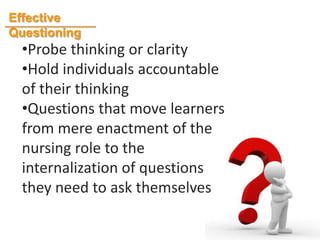
Questions that help student to explore and understand various points of viewEffective QuestioningProbe thinking or clarity
Hold individuals accountable of their thinking
Questions that move learners from mere enactment of the nursing role to the internalization of questions they need to ask themselvesSocratic Questioning
1. Socratic QuestioningAll thoughts are treated as if they are in need of further development no matter how reflective they may be.
Comments and questions are questioned back
Seek to understand the ultimate foundation of what is said1. Socratic QuestioningConceptual Clarification Questions
Get them to think more about what exactly they are asking or thinking about.
Prove the concepts behind their argument.
Basic 'tell me more' questions that get them to go deeper.Sample QuestionsWhy are you saying that?
What exactly does this mean?
What is the nature of ...?
Can you give me an example?
Are you saying ... or ... ?
Can you rephrase that, please?
How does this relate to what we have been talking about?
What do we already know about this? 1. Socratic QuestioningProbing Assumptions
Makes them think about the presuppositions and unquestioned beliefs on which they are founding their argument.
This shakes the bed rock!Sample QuestionsWhat else could we assume?
You seem to be assuming ... ?
Please explain why/how ... ?
What would happen if ... ?
Do you agree or disagree with ... ?
 How did you choose those assumptions?
How can you verify or disprove that assumption? 1. Socratic QuestioningProbing Rationale, Reasons & Evidences
When they give a rationale for their arguments, dig into that reasoning rather than assuming it is a given.
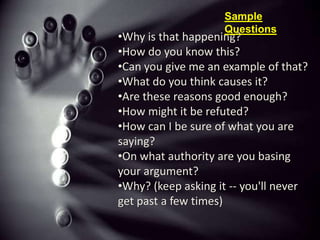
People often use un-thought-through or weakly understood supports for their arguments.Sample QuestionsWhy is that happening?
How do you know this?
Can you give me an example of that?
What do you think causes it?
Are these reasons good enough?
How might it be refuted?
How can I be sure of what you are saying?
On what authority are you basing your argument?
Why? (keep asking it -- you'll never get past a few times)1. Socratic QuestioningQuestioning Viewpoints & Perspectives
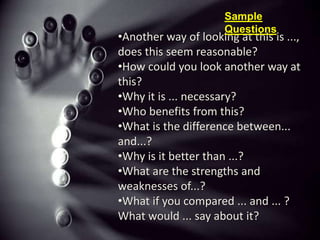
Most arguments are given from a particular position. So attack the position. Show that there are other, equally valid, viewpoints.Sample QuestionsAnother way of looking at this is ..., does this seem reasonable?
How could you look another way at this?
Why it is ... necessary?
Who benefits from this?
What is the difference between... and...?
Why is it better than ...?
What are the strengths and weaknesses of...?
What if you compared ... and ... ? What would ... say about it?1. Socratic QuestioningProbe Implications & Consequences
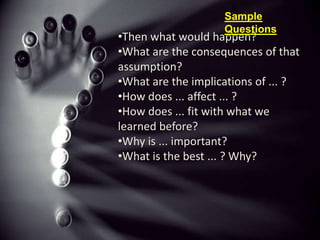
The argument that they give may have logical implications that can be forecast. Do these make sense? Are they desirable?Sample QuestionsThen what would happen?
What are the consequences of that assumption?
What are the implications of ... ?
How does ... affect ... ?
How does ... fit with what we learned before?
Why is ... important?
What is the best ... ? Why? 1. Socratic QuestioningQuestions about the Question
And you can also get reflexive about the whole thing, turning the question in on itself.
Use their attack against themselves.
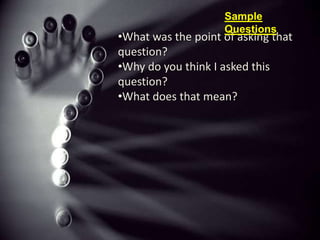
Bounce the ball back into their court.Sample QuestionsWhat was the point of asking that question?
Why do you think I asked this question?
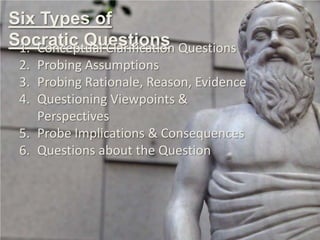
What does that mean? Six Types of Socratic QuestionsConceptual Clarification QuestionsProbing AssumptionsProbing Rationale, Reason, EvidenceQuestioning Viewpoints & PerspectivesProbe Implications & ConsequencesQuestions about the Question
Structured Controversy
II. Structured ControversyControversy is purposely produced
Learners argue for and against and issue
Much like debate, but there is a second roundII. Structured ControversyThey use reasoned judgment, not just factual knowledge
Explore various issues facing the nursing profession
Examination of patient care situationPROMOTING AND ASSESSING Critical ThinkingEnhancing itDiscussionText InteractionAsking Effective QuestionsProblem-Based Learning
Problem-Based LearningStudents attempt to manage problems much like those that are found in clinical setting
Students are compelled to learn medications or pathophysiologyProblem-Based LearningCan be used as a teaching/learning strategy for a course or the entire curriculum
Students will learn in different speeds, sequences, learning circumstancesPROMOTING AND ASSESSING Critical ThinkingEnhancing itDiscussionText InteractionAsking Effective QuestionsProblem-Based LearningConcept Mapping
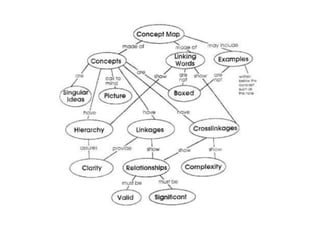
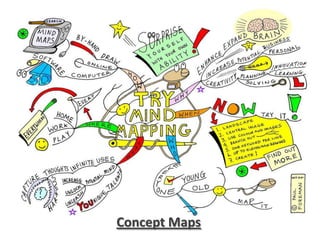
Concept MappingAssist learners to “see” their own thinking and reasoning
They develop relationships among factors, note causes and effects, identify predisposing factors, & formulate expected outcomes
Concept MappingRequire students to draw on an extensive knowledge
Examine assumptions made about the concepts or the relationships among them
Think carefully about how “all the concepts fit together”
PROMOTING AND ASSESSING Critical ThinkingEnhancing itDiscussionText InteractionAsking Effective QuestionsProblem-Based LearningConcept MappingOther Strategies
Other StrategiesCase StudiesCase StudiesProvide an open-ended problem that has more than one desirable outcome
Learners judge the advantages and disadvantages of various options, compare alternative solutions, justify choice of actions
Based on an in-depth investigation of a single individual, group, or eventCase StudiesLongitudinal examination including a systematic way of looking at events, collecting data, analyzing information, and reporting the results
Help learners see more than one perspective and often points out assumptions in the face on incomplete informationOther StrategiesCase Studies
Collaborative LearningCollaborative LearningKnowledge can be created where members actively interact by sharing experiences
Rooted in the social nature of learning
Provides opportunities to complete assignments
Can be structured in an unlimited wayCollaborative LearningLearners solve problems, critique each other’s work, learn from each other
Each individual depends on and is accountable to each otherCollaborative LearningDyad Testing (Vinten & Ellet, 2001)Pair of learns work together and respond to test questions
Both think about the worth of each answer option, argue why they may be right or wrong, and help each other in decision-makingCollaborative LearningExamplesCollaborative writing
Group projects
Joint problem solving
Debates
Study teamsOther StrategiesCase Studies
Collaborative Learning
One-Minute PapersOne-Minute PapersOne of the easiest and most enjoyable ways to think critically on a continuous basis
At the start of each session, a single sheet of paper with statements are givenThe most important thing I learned in class today was…	Summarize two conflicting points of view about…	How clear was today’s lecture for you?
One-Minute PapersThe participants are asked to respond to each statement before the sessions ends and to submit them before leaving
Feedback by the teacher should clarify areas of confusion, answer questions, and comment on the quality of responsesOne-Minute PapersFor the teacher, this helps ascertain students’ understanding of a particular class or getting a sense of how students would rate the course
This will help learners think about their thinking, ability to listen and understand, ability to process what they are hearingOther StrategiesCase Studies
Collaborative Learning

Assessing & Promoting Critical Thinking

  • 2.
  • 3.
  • 4.
  • 5.
    Critical Thinking vs.Other Concepts
  • 6.
    Ways that InhibitCritical Thinking
  • 7.
    Strategies that EnhanceCritical Thinking
  • 8.
  • 9.
  • 10.
    Know whether itis discipline specific or a “generic” skill.
  • 11.
    Know how todevelop critical thinking.
  • 12.
    Learn how toenhance it via learning experiences.
  • 13.
    Know different approachesin measuring critical thinking.
  • 14.
    PROMOTING AND ASSESSINGCritical ThinkingIntroductionDraw upon one’s knowledge base in nursing & related sciencesPerform a myriad of psychomotor skillsInteract effectively with individuals and groups
  • 15.
    Additional Abilities thatNurses NeedWork collaboratively with an interdisciplinary team
  • 16.
    Provide evidence tosupport one’s actions
  • 17.
  • 18.
    Document clearly andcomprehensivelyAdditional Abilities that Nurses NeedProvide leadership that leads to positive change
  • 19.
    Be unwilling tomerely accept the status quo or tradition
  • 20.
  • 21.
    Connect ideas inunique waysAdditional Abilities that Nurses NeedEngage in dialogue with individuals and groups
  • 22.
  • 23.
  • 24.
    Have a questioningmindAdditional Abilities that Nurses NeedMake decisions despite gaps in information and knowledge
  • 25.
    Have a “spiritof inquiry”
  • 26.
    Contribute to nursingscience development
  • 27.
    Be reflective andcontemplativeAdditional Abilities that Nurses NeedBe open to new perspectives, interpretations, and alternatives
  • 28.
    Think criticallyOne ofthe bodies that accredit nursing education programs which requires critical thinking be an outcome of nursing education programs and that faculty document the student’s ability in this area.
  • 29.
    PROMOTING AND ASSESSINGCritical ThinkingdefinitionA. Dressel and Mayhew (1954)
  • 30.
    “Ability to definea problem, select pertinent information needed to solve the problem, recognize stated and unstated assumptions, formulate or select relevant and promising hypotheses, draw valid conclusions, and judge the validity of inferences.”
  • 31.
    PROMOTING AND ASSESSINGCritical ThinkingdefinitionDressel and Mayhew (1954)Watson and Glacer (1964)
  • 32.
    “A composite ofattitudes of inquiry; knowledge of the nature of valid inferences, abstractions, and generalizations; and skills in employing and applying these attitudes and knowledge.”
  • 33.
    Involves one’s frameof mind or attitudeIt is a perspective through which one views all situations; not merely a “collection” of skills
  • 34.
    PROMOTING AND ASSESSINGCritical ThinkingdefinitionDressel and Mayhew (1954)Watson and Glacer (1964)Sandra DeYoung (1995)
  • 35.
    “Critical thinking isusing the powers of the mind to view the world and to act in a discerning way. It includes having a questioning attitude, examining underlying assumptions, and considering the validity of alternative solutions in order to make reasoned judgments that are sensitive to context.”
  • 36.
    PROMOTING AND ASSESSINGCritical ThinkingdefinitionDressel and Mayhew (1954)Watson and Glacer (1964)Sandra DeYoung (1995)Fairfield University
  • 37.
    Critical thinking isa way of interactingwith the world that is reflective, open and generative.
  • 38.
    “Interacting with theworld”Engaging with ideas and people
  • 39.
  • 40.
  • 41.
    Being broad, notnarrow“Interacting with the world”Being aware of one’s own values
  • 42.
  • 43.
  • 44.
  • 45.
  • 46.
  • 47.
  • 48.
  • 49.
    Continuously looking atand investigating ideas & perspectives“Open”Flexible and open to new ideas
  • 50.
  • 51.
  • 52.
    Having intellectual curiosity“Open”Continuallyrethinking issues, perspectives, points of view“Generative”Creating new ideas
  • 53.
  • 54.
    Willing to growand to take risks
  • 55.
    Initiates changeAnalysis ofOtherdefinitions A critical thinking is nonbiased, reasoned and truth orientedCritical thinking involves making judgmentsThinking is critical if it holds up to certain evaluative criteria
  • 56.
    Analysis ofOther definitionsd)Critical thinking is tied to a belief of action e) Critical thinking is a “spirit”, an attitude, or an inclination to think about one’s thinking
  • 57.
    Richard Paul (1993)“Aspectsof Critical Thinking”Summarized the concept of critical thinking by identifying a number of aspects of it.
  • 58.
    Richard Paul “IntellectualStandards for Disciplining the Mind”Criteria to judge whether a person’s thinking is critical.
  • 59.
    Richard Paul “IntellectualStandards for Disciplining the Mind”“Critical” thinking is precise, deep, logical, relevant, accurate & significant.
  • 60.
    Critical thinkingIdentify andevaluate our assumptions
  • 61.
  • 62.
  • 63.
    Make decisions andcommitmentsCritical thinkingConsider the consequences of our decisions
  • 64.
  • 65.
    Willing to modifyour beliefs and actionsPROMOTING AND ASSESSING Critical ThinkingdefinitionDressel and Mayhew (1954)Watson and Glacer (1964)Sandra DeYoung (1995)Fairfield UniversityEnnis, Facione, Hager, Norris, etc.
  • 66.
    “Critical thinking skillsare generic, there is nothing different between critical thinking in one situation and critical thinking in another situation.”
  • 67.
    PROMOTING AND ASSESSINGCritical ThinkingdefinitionDressel and Mayhew (1954)Watson and Glacer (1964)Sandra DeYoung (1995)Fairfield UniversityEnnis, Facione, Hager, Norris, etc.Barrow, McPeck
  • 68.
    “Knowledge of asubject is a necessary condition for critical thinking in an area. There are different skills for different circumstances. Knowledge is a necessary condition for critical thinking and critical thinking is subjectspecific.”
  • 69.
    PROMOTING AND ASSESSINGCritical ThinkingdefinitionDressel and Mayhew (1954)Watson and Glacer (1964)Sandra DeYoung (1995)Fairfield UniversityEnnis, Facione, Hager, Norris, etc.Barrow, McPeckNational League of Nursing
  • 70.
    “Critical thinking innursing practice is a discipline specific, reflective reasoning process that guides a nurse in generating, implementing, and evaluating approaches for dealing with client care and professional concerns.”
  • 71.
    “We don’t haveto make human beings smart. They are born smart. All we have to do is to stop doing things that make them stupid.”
  • 72.
    PROMOTING AND ASSESSINGCritical ThinkingWhat Inhibits it?1. Students only learn if they hear it from us.
  • 73.
    SITUATIONLectures are structuredin a way where students have no questions to askRESULTStudents do not have to “struggle” to comprehend the materialSITUATIONComplicated materials are structured in an organized mannerRESULTStudents think clinical situations are not as complex as they may seemPROMOTING AND ASSESSING Critical ThinkingWhat Inhibits it?Students only learn if they hear it from us.Expectation of perfection& reinforcement of status quo
  • 74.
    SITUATIONFaculty assumes studentsdo not know how to problem solve or think criticallyRESULTStudents end up being spoon-fed and not thinking independently how to solve a problemSITUATION“Mistakes are bad, costly and avoided”RESULTStudents are discouraged from taking their first steps from which they could learn a lot in case they get it wrong the first timeSITUATION“There is single best way to solve a problem”RESULTLearning becomes too objective for the students and they are discouraged to explore some optionsSITUATION“Certainty is good, faculty know best”RESULTDiminishes student’s confidence in the way they think and decreases the value of the options they think of when they problem solvePROMOTING AND ASSESSING Critical ThinkingWhat Inhibits it?Students only learn if they hear it from us.Expectation of perfection& reinforcement of status quoDesire to finish the coverage
  • 75.
    SITUATIONLecture format isused more often than it shouldRESULTReduces the students to “little more than background”SITUATIONNot overcoming the “addiction to coverage”RESULTThe professor who dictates, the students who reiterate, the talkingteacher and the quietstudentSITUATIONTeachers cram facts and information to learnersRESULTStudents do not have enough time to truly understand what they are learning
  • 76.
    PROMOTING AND ASSESSINGCritical ThinkingWhat Inhibits it?Students only learn if they hear it from us.Expectation of perfection& reinforcement of status quoDesire to finish the coverageStructure of nursing curricula
  • 77.
    SITUATIONCourse is preselected;sequencing is scriptedRESULTStudents fail to think why they enrol the courses and to make choices from among alternativesPROMOTING AND ASSESSING Critical ThinkingWhat Inhibits it?Students only learn if they hear it from us.Expectation of perfection& reinforcement of status quoDesire to finish the coverageStructure of nursing curriculaAssignments given to students
  • 78.
    SITUATIONQuestion with lowlevel of complexity and assignments with precise guidelinesRESULTLearners do not have to thinkPROMOTING AND ASSESSING Critical ThinkingWhat Inhibits it?Students only learn if they hear it from us.Expectation of perfection& reinforcement of status quoDesire to finish the coverageStructure of nursing curriculaAssignments given to studentsManner of clinical teaching
  • 79.
    SITUATIONPreceptors always takeresponsibility of making the students’ assignmentsRESULTLearners are not challenged to thinkInhibiting Critical ThinkingAdvantagesTakes the messiness out of itNo questions for students to askSaves timeDisadvantagesCritical thinking is not promotedFalse impression that clinical situations are not as complex or difficult as they are
  • 80.
    PROMOTING AND ASSESSINGCritical ThinkingWhat Inhibits it?Students only learn if they hear it from us.Expectation of perfection& reinforcement of status quoDesire to finish the coverageStructure of nursing curriculaAssignments given to studentsManner of clinical teaching
  • 81.
    PROMOTING AND ASSESSINGCritical ThinkingVs. other conceptsProblem solving
  • 82.
    Problem SolvingUses knowledgeand experience to address an immediate problemsVCritical Thinking
  • 83.
    Problem SolvingA correctanswer exists; only limited approaches will worksVCritical Thinking
  • 84.
    Problem SolvingLong termperspective is not necessarily takensVCritical ThinkingReasoning about “open-ended” and ill-structured problemsProblem SolvingLong term perspective is not necessarily takensVCritical ThinkingOn contrary, it operates all the timePROMOTING AND ASSESSING Critical ThinkingVs. other conceptsProblem solvingScientific method
  • 85.
    Scientific MethodLinear, objectiveapproach in problem solvingsVCritical Thinking
  • 86.
    Scientific MethodOne isexpected to minimize bias and involvement in the situationsVCritical ThinkingReflective, involves “personal investment”, nonlinearScientific MethodOne is expected to minimize bias and involvement in the situationsVCritical ThinkingIt does not focus on solving a problem or answering a questionPROMOTING AND ASSESSING Critical ThinkingVs. other conceptsProblem solvingScientific methodNursing process
  • 87.
    Nursing ProcessA systematiclinear approachsVCritical Thinking
  • 88.
    Nursing ProcessIncludes assessingsituations, outlining plans, taking action, & evaluating resultssVCritical ThinkingNo “steps” to follow, not linear, not specific to clinical situation, does not need an actionPROMOTING AND ASSESSING Critical ThinkingVs. other conceptsProblem solvingScientific methodNursing processCognitive development
  • 89.
    Cognitive DevelopmentHow individualsreason and view knowledgesVCritical Thinking
  • 90.
    Cognitive DevelopmentHow theymanage diversity of opinion and conflicting points of viewsVCritical Thinking
  • 91.
    Cognitive DevelopmentHow individualsrelate to the authorities as they come to know and understandsVCritical ThinkingNot focused on the nature of knowledge and relationships with the authorityCognitive DevelopmentHow individuals relate to the authorities as they come to know and understandsVCritical ThinkingA narrower conceptPROMOTING AND ASSESSING Critical ThinkingVs. other conceptsProblem solvingScientific methodNursing processCognitive developmentCreativity
  • 92.
    CreativityImagination & spontaneity;artistic & free; original; intuitive; results to a novel productsVCritical ThinkingLogical, analytical & judgmental; no finished product (at first); evaluates the product’s worthPROMOTING AND ASSESSING Critical ThinkingVs. other conceptsProblem solvingScientific methodNursing processCognitive developmentCreativity
  • 93.
    Teachers and learnersalike view learning as a shared responsibility. It is the educator’sresponsibilityto create an environment that supports this concept.
  • 94.
  • 95.
    They “push” andchallengelearners while supporting them.
  • 96.
    Egalitarianand democraticenvironment –learners feel empowered and share in the control of their learning process.
  • 97.
    Doing less lecturing.PROMOTINGAND ASSESSING Critical ThinkingEnhancing itDiscussion
  • 98.
    DiscussionLecture should belimited to a small percentage of the class time
  • 99.
    That means: depthof understanding > breadth of contentOnly the most significant concepts are addressed
  • 100.
    From straight lectureto lecture w/ comments and questionsDiscussionThe teacher role models critical thinking
  • 101.
    Answers the questiononly when the students are unable to do so
  • 102.
    A more effectivestrategy is when students think through the question they askDiscussionUsing this as a learning strategy is unpredictable
  • 103.
    It may turnthe classroom in to “a relatively chaotic affair” but it is a “controlled chaos”
  • 104.
    Some answers ofthe students need to be corrected
  • 105.
    Teachers give upcontrol so students discover flaws in their thinkingDiscussionDiscussion actively holds the student’s thoughts more than lecture does
  • 106.
    Irrelevant and passivethoughts occur more frequently with lecture
  • 107.
    Discussion can bemost effective in promoting student’s critical thinkingPROMOTING AND ASSESSING Critical ThinkingEnhancing itDiscussionText Interaction
  • 108.
    Text InteractionThink criticallyabout what they are reading & comparing it with other things they have read or experienced
  • 109.
    Interact with thereadings prior to classText InteractionRaise questions about what is presented
  • 110.
    Note assumptions thatare being made
  • 111.
  • 112.
  • 113.
    Note questions unansweredby the textText InteractionText interaction helps students think about what they are reading
  • 114.
    Students eventually developa questioning attitude or a spirit of inquiryPROMOTING AND ASSESSING Critical ThinkingEnhancing itDiscussionText InteractionAsking Effective Questions
  • 115.
  • 116.
  • 117.
    Neither of thesetwo methods of questioning stimulates the student’s use of critical thinking
  • 118.
    Questions should beone notch higherEffective QuestioningQuestions with reasoned responses
  • 119.
    Questions that helpstudent to explore and understand various points of viewEffective QuestioningProbe thinking or clarity
  • 120.
  • 121.
    Questions that movelearners from mere enactment of the nursing role to the internalization of questions they need to ask themselvesSocratic Questioning
  • 122.
    1. Socratic QuestioningAllthoughts are treated as if they are in need of further development no matter how reflective they may be.
  • 123.
    Comments and questionsare questioned back
  • 124.
    Seek to understandthe ultimate foundation of what is said1. Socratic QuestioningConceptual Clarification Questions
  • 125.
    Get them tothink more about what exactly they are asking or thinking about.
  • 126.
    Prove the conceptsbehind their argument.
  • 127.
    Basic 'tell memore' questions that get them to go deeper.Sample QuestionsWhy are you saying that?
  • 128.
  • 129.
    What is thenature of ...?
  • 130.
    Can you giveme an example?
  • 131.
    Are you saying... or ... ?
  • 132.
    Can you rephrasethat, please?
  • 133.
    How does thisrelate to what we have been talking about?
  • 134.
    What do wealready know about this? 1. Socratic QuestioningProbing Assumptions
  • 135.
    Makes them thinkabout the presuppositions and unquestioned beliefs on which they are founding their argument.
  • 136.
    This shakes thebed rock!Sample QuestionsWhat else could we assume?
  • 137.
    You seem tobe assuming ... ?
  • 138.
  • 139.
  • 140.
    Do you agreeor disagree with ... ?
  • 141.
    How didyou choose those assumptions?
  • 142.
    How can youverify or disprove that assumption? 1. Socratic QuestioningProbing Rationale, Reasons & Evidences
  • 143.
    When they givea rationale for their arguments, dig into that reasoning rather than assuming it is a given.
  • 144.
    People often useun-thought-through or weakly understood supports for their arguments.Sample QuestionsWhy is that happening?
  • 145.
    How do youknow this?
  • 146.
    Can you giveme an example of that?
  • 147.
    What do youthink causes it?
  • 148.
    Are these reasonsgood enough?
  • 149.
    How might itbe refuted?
  • 150.
    How can Ibe sure of what you are saying?
  • 151.
    On what authorityare you basing your argument?
  • 152.
    Why? (keep askingit -- you'll never get past a few times)1. Socratic QuestioningQuestioning Viewpoints & Perspectives
  • 153.
    Most arguments aregiven from a particular position. So attack the position. Show that there are other, equally valid, viewpoints.Sample QuestionsAnother way of looking at this is ..., does this seem reasonable?
  • 154.
    How could youlook another way at this?
  • 155.
    Why it is... necessary?
  • 156.
  • 157.
    What is thedifference between... and...?
  • 158.
    Why is itbetter than ...?
  • 159.
    What are thestrengths and weaknesses of...?
  • 160.
    What if youcompared ... and ... ? What would ... say about it?1. Socratic QuestioningProbe Implications & Consequences
  • 161.
    The argument thatthey give may have logical implications that can be forecast. Do these make sense? Are they desirable?Sample QuestionsThen what would happen?
  • 162.
    What are theconsequences of that assumption?
  • 163.
    What are theimplications of ... ?
  • 164.
    How does ...affect ... ?
  • 165.
    How does ...fit with what we learned before?
  • 166.
    Why is ...important?
  • 167.
    What is thebest ... ? Why? 1. Socratic QuestioningQuestions about the Question
  • 168.
    And you canalso get reflexive about the whole thing, turning the question in on itself.
  • 169.
    Use their attackagainst themselves.
  • 170.
    Bounce the ballback into their court.Sample QuestionsWhat was the point of asking that question?
  • 171.
    Why do youthink I asked this question?
  • 172.
    What does thatmean? Six Types of Socratic QuestionsConceptual Clarification QuestionsProbing AssumptionsProbing Rationale, Reason, EvidenceQuestioning Viewpoints & PerspectivesProbe Implications & ConsequencesQuestions about the Question
  • 173.
  • 174.
  • 175.
    Learners argue forand against and issue
  • 176.
    Much like debate,but there is a second roundII. Structured ControversyThey use reasoned judgment, not just factual knowledge
  • 177.
    Explore various issuesfacing the nursing profession
  • 178.
    Examination of patientcare situationPROMOTING AND ASSESSING Critical ThinkingEnhancing itDiscussionText InteractionAsking Effective QuestionsProblem-Based Learning
  • 179.
    Problem-Based LearningStudents attemptto manage problems much like those that are found in clinical setting
  • 180.
    Students are compelledto learn medications or pathophysiologyProblem-Based LearningCan be used as a teaching/learning strategy for a course or the entire curriculum
  • 181.
    Students will learnin different speeds, sequences, learning circumstancesPROMOTING AND ASSESSING Critical ThinkingEnhancing itDiscussionText InteractionAsking Effective QuestionsProblem-Based LearningConcept Mapping
  • 182.
    Concept MappingAssist learnersto “see” their own thinking and reasoning
  • 183.
    They develop relationshipsamong factors, note causes and effects, identify predisposing factors, & formulate expected outcomes
  • 184.
    Concept MappingRequire studentsto draw on an extensive knowledge
  • 185.
    Examine assumptions madeabout the concepts or the relationships among them
  • 186.
    Think carefully abouthow “all the concepts fit together”
  • 189.
    PROMOTING AND ASSESSINGCritical ThinkingEnhancing itDiscussionText InteractionAsking Effective QuestionsProblem-Based LearningConcept MappingOther Strategies
  • 190.
    Other StrategiesCase StudiesCaseStudiesProvide an open-ended problem that has more than one desirable outcome
  • 191.
    Learners judge theadvantages and disadvantages of various options, compare alternative solutions, justify choice of actions
  • 192.
    Based on anin-depth investigation of a single individual, group, or eventCase StudiesLongitudinal examination including a systematic way of looking at events, collecting data, analyzing information, and reporting the results
  • 193.
    Help learners seemore than one perspective and often points out assumptions in the face on incomplete informationOther StrategiesCase Studies
  • 194.
    Collaborative LearningCollaborative LearningKnowledgecan be created where members actively interact by sharing experiences
  • 195.
    Rooted in thesocial nature of learning
  • 196.
    Provides opportunities tocomplete assignments
  • 197.
    Can be structuredin an unlimited wayCollaborative LearningLearners solve problems, critique each other’s work, learn from each other
  • 198.
    Each individual dependson and is accountable to each otherCollaborative LearningDyad Testing (Vinten & Ellet, 2001)Pair of learns work together and respond to test questions
  • 199.
    Both think aboutthe worth of each answer option, argue why they may be right or wrong, and help each other in decision-makingCollaborative LearningExamplesCollaborative writing
  • 200.
  • 201.
  • 202.
  • 203.
  • 204.
  • 205.
    One-Minute PapersOne-Minute PapersOneof the easiest and most enjoyable ways to think critically on a continuous basis
  • 206.
    At the startof each session, a single sheet of paper with statements are givenThe most important thing I learned in class today was… Summarize two conflicting points of view about… How clear was today’s lecture for you?
  • 207.
    One-Minute PapersThe participantsare asked to respond to each statement before the sessions ends and to submit them before leaving
  • 208.
    Feedback by theteacher should clarify areas of confusion, answer questions, and comment on the quality of responsesOne-Minute PapersFor the teacher, this helps ascertain students’ understanding of a particular class or getting a sense of how students would rate the course
  • 209.
    This will helplearners think about their thinking, ability to listen and understand, ability to process what they are hearingOther StrategiesCase Studies
  • 210.

Editor's Notes

  • #2 This is the cover part. Shown while the members are getting prepared.