MANINDER SINGH et al Int. Journal of Engineering Research and Applications www.ijera.com 
ISSN : 2248-9622, Vol. 4, Issue 8( Version 3), August 2014, pp.50-55 
www.ijera.com 50 | P a g e 
OFDM PAPR Reduction Using Hybrid Partial Transmit Sequences Based On Cuckoo Search Algorithm 1Maninder Singh, 2Charanjit Singh, 3 Amandeep Singh Bhandari 1,2,3Electronics and Communication Engineering Department, Punjabi University, Patiala Abstract: 
The past decade has seen many radical changes and achievements in the field of wireless communication. Applications of wireless communication have grown swiftly in the recent past. This rigorous growth leads to more throughput over wireless channels along with increased reliability. But still the bandwidth demands are endless and increasing day by day. Today we need to constantly work towards achieving reliable wireless communication with high spectral efficiency, low complexity and good error performance results. Orthogonal frequency division multiplexing (OFDM) technique is a promising technique in this regard as it offers high data rate and reliable communications over various fading channels. But the main drawback of OFDM is the high peak to average power ratio (PAPR). In this paper we present the technique to reduce the PAPR using Cuckoo Search Algorithm in multicarrier modulation system. Simulation results show that the proposed scheme considerably outperforms the conventional system. 
I. INTRODUCTION 
In multi-carrier modulation, the most frequently used method is Orthogonal Frequency Division Multiplexing (OFDM); it has become very general in wireless communication. Unfortunately the main disadvantage of OFDM transmission is its large wrapping fluctuation which is quantified as Peak to Average Power Ratio (PAPR). For decrease of this PAPR lot of algorithms have been established. All of the methods have some sort of benefits and drawbacks [1]. Clipping and Filtering is one of the simple method in which some part of transferred signal undergoes into distortion. Also the Coding arrangement decreases the data amount which is undesirable. If we go for the Selected Mapping (SLM) and Partial Transmit Sequence (PTS) system, the PTS method has additional complexity than that of SLM method. This Selected Mapping is one of the promising methods due to its simplicity for implementation which familiarizes no distortion in the transmitted signal. It has been designated first in [2] i.e. to be recognized as the traditional SLM method. An OFDM signal consists of a number of individually modulated subcarriers, which can give a large Peak-to-Average Power Ratio (PAPR) when added up coherently. When N signals are added with the same phase, they generate a peak power that is N times the average power. To escape nonlinear distortion, highly linear amplifiers are essential which cause a severe decrease in power efficiency. Several methods are explained in the literature in order to solve this problem. 
OFDM Transmission Theory 
The basic principle of OFDM is to split input data stream into a number of lower rate streams that are transferred simultaneously over a number of subcarriers, the transmission rate is slower in parallel subcarriers, a frequency selective channel seems flat to each subcarrier. ISI is reduced almost completely by adding a guard interval at the beginning of each OFDM symbol. However, instead of using an empty guard time, this interval is filled with a cyclically extended version of the OFDM symbol. This method is used to avoid ICI. In OFDM, subcarrier spacing is kept at minimum, while still preserving the time domain orthogonality between subcarriers, even though the individual frequency spectrum may overlap. The least subcarrier spacing should equal to 1/T, where T is the symbol period. An OFDM symbol in baseband is defined as: 푥 푡 = 푎 푖+ 푁 2N2−1 푖=− N2exp 푗 2휋푖푡 T 푠 푡 0≤푡≤T where, 푎푖+푁/2denotes the complex symbol modulating the i-th carrier, s(t) is the time window function defined in the interval [0,T], N is the number of subcarriers, and T is the OFDM symbol period. Subcarriers are spaced ΔF=1/Tapart. The correlation coefficient between the subcarriers may be defined as: 휌푘푛= 1T exp 푗 2휋푘푡 T exp −푗 2휋푛푡 T 푑푡 푇 0 As can be seen from (1) 휌푘푛= 1, 푛=푘 0, 푛≠푘 
RESEARCH ARTICLE OPEN ACCESS
MANINDER SINGH et al Int. Journal of Engineering Research and Applications www.ijera.com 
ISSN : 2248-9622, Vol. 4, Issue 8( Version 3), August 2014, pp.50-55 
www.ijera.com 51 | P a g e 
The basic principle of OFDM is to split a high-rate data stream into a number of lower rate streams that are transmitted simultaneously over a number of subcarriers. These subcarriers are overlapped with each other. 
PAPR Reduction Techniques 
Several PAPR [13] reduction techniques have been proposed in the literature. These techniques are divided into two groups. These are signal scrambling techniques and signal distortion techniques. 
(A) Signal Scrambling Technique 
1. Tone reservation 
The main idea of this method is to keep a small set of tones for PAPR reduction. This can be originated as a convex problem and this problem can be solved accurately. Tone reservation method is based on adding a data block and time domain signal. A data block is dependent time domain signal to the original multicarrier signal to minimize the high peak. This time domain signal can be calculated simply at the transmitter of system and stripped off at the receiver. The amount of PAPR reduction depends on some factors such as number of reserved tones, location of the reserved tones, amount of complexity and allowed power on reserved tones.[12] 
2. Block coding 
The fundamental idea is that of all probable message symbols, only those which have low peak power will be chosen by coding as valid code words for transmission. No introduction of distortion to the signals. If there have N subcarriers, they are represented by 2N bits using QPSK modulation and thus 22N messages. Using the whole message space corresponds to zero bits of redundancy. 
3. Selective Level Mapping 
The simple idea of this method is first produce a number of alternative OFDM signals from the original data block and then transmit the OFDM signal having least PAPR. But data rate loss and complexity at the transmitter side are two simple drawbacks for this method. 
4. Tone injection 
Tone Injection (TI) technique is based on general additive method for PAPR reduction. Using an additive method achieves PAPR reduction of multicarrier signal without any data rate loss. TI uses a set of equivalent constellation points for an original constellation points to reduce PAPR. The main idea behind this method is to increase the constellation size. 
(B) Signal Distortion Techniques 
1. Clipping and Filtering 
This is a humblest method used for PAPR reduction. Clipping [15] means the amplitude clipping which limits the peak envelope of the input signal to a prearranged value. xc n =f x = −A x n ≤Ax n x n <퐴 A x n ≥A Where, A is the pre-specified clipping level. 
2. Peak Windowing 
The peak windowing method proposes that it is possible to remove large peaks at the cost of a slight amount of self-interference when large peaks arise less frequently. Peak windowing reduces PAPRs at the cost of increasing the BER and out-of-band radiation. It offers better PAPR reduction with better spectral properties. In peak windowing method we multiply large signal peak with a specific window, for example; Gaussian shaped window, cosine, Kaiser and Hamming window. 
3. Cuckoo Search Algorithm 
Cuckoos are fascinating birds, not only because of the beautiful sounds they can make, but also because of their aggressive reproduction strategy. Some species such as the ani and Guira cuckoos lay their eggs in communal nests, though they may remove others' eggs to increase the hatching probability of their own eggs. Quite a number of species engage the obligate brood parasitism by laying their eggs in the nests of other host birds (often other species). Some cuckoo species such as the New World brood- parasitic Tapera have evolved in such a way that female parasitic cuckoos are often very specialized in the mimicry in colour and pattern of the eggs of a few chosen host species. This reduces the probability of their eggs being abandoned and thus increases their productivity. For the implementation point of view, we can use the following simple representations that each egg in a nest represents a solution, and each cuckoo can lay only one egg (thus representing one solution), the aim is to use the new and potentially better solutions (cuckoos) to replace a not-so-good solution in the nests. For this present work, we will use the simplest approach where each nest has only a single egg. In this case, there is no distinction between eggs, nest or cuckoo, as each nest corresponds to one egg which also represents one cuckoo. When generating new solutions 푥푡+1 for, say, a cuckoo 푖, a Levy fight is performed. 푥푖 (푡+1)=푥푖 (푡)+훼⊕퐿푒푣푦(⋋) 
Where 훼>0 is the step size which should be related to the scales of the problem of interests, in most
MANINDER SINGH et al Int. Journal of Engineering Research and Applications www.ijera.com 
ISSN : 2248-9622, Vol. 4, Issue 8( Version 3), August 2014, pp.50-55 
www.ijera.com 52 | P a g e 
cases, we can use 훼=푂(퐿/10) where L is the characteristic scale of the problem of interest. Proposed Work: Orthogonal frequency division multiplexing (OFDM) offers high data rate and reliable communications over fading channels. But the major disadvantage of OFDM is the high peak to average power ratio. Our objective is to develop a technique to reduce the PAPR using Cuckoo Search algorithm. We will use Cuckoo Search Algorithm for reducing PAPR of OFDM system incorporating Partial Transmit Sequence (PTS), which would allow achieving solution with reduced computational burden and try and evaluate the resultant system performance with and without Cuckoo Search Algorithm. 
System Model 
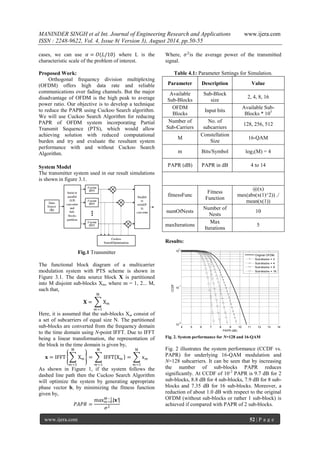
The transmitter system used in our result simulations is shown in figure 3.1. 
Fig.1 Transmitter The functional block diagram of a multicarrier modulation system with PTS scheme is shown in Figure 3.1. The data source block X is partitioned into M disjoint sub-blocks Xm, where m = 1, 2... M, such that, 퐗= X푚 M 푚=1 Here, it is assumed that the sub-blocks Xm consist of a set of subcarriers of equal size N. The partitioned sub-blocks are converted from the frequency domain to the time domain using N-point IFFT. Due to IFFT being a linear transformation, the representation of the block in the time domain is given by, 퐱=IFFT X푚 M 푚=1 = IFFT X푚 M 푚=1= x푚 M 푚=1 As shown in Figure 1, if the system follows the dashed line path then the Cuckoo Search Algorithm will optimize the system by generating appropriate phase vector b, by minimizing the fitness function given by, 푃퐴푃푅= max푚=0 푀−1 퐱′ 휍2 
Where, 휍2is the average power of the transmitted signal. 
Table 4.1: Parameter Settings for Simulation. 
Parameter 
Description 
Value 
Available Sub-Blocks 
Sub-Block size 
2, 4, 8, 16 
OFDM Blocks 
Input bits 
Available Sub- Blocks * 105 
Number of Sub-Carriers 
No. of subcarriers 
128, 256, 512 
M 
Constellation Size 
16-QAM 
m 
Bits/Symbol 
log2(M) = 4 
PAPR (dB) 
PAPR in dB 
4 to 14 
fitnessFunc 
Fitness Function 
@(x) max(abs(x(1)^2)) ./ mean(x(1)) 
numOfNests 
Number of Nests 
10 
maxIterations 
Max Iterations 
5 
Results: 
Fig. 2. System performance for N=128 and 16-QAM Fig. 2 illustrates the system performance (CCDF vs. PAPR) for underlying 16-QAM modulation and N=128 subcarriers. It can be seen that by increasing the number of sub-blocks PAPR reduces significantly. At CCDF of 10-2 PAPR is 9.7 dB for 2 sub-blocks, 8.8 dB for 4 sub-blocks, 7.9 dB for 8 sub- blocks and 7.35 dB for 16 sub-blocks. Moreover, a reduction of about 1.0 dB with respect to the original OFDM (without sub-blocks or rather 1 sub-block) is achieved if compared with PAPR of 2 sub-blocks. 456789101112131410-210-1100PAPR (dB) CCDF Original OFDM. Sub-blocks = 2Sub-blocks = 4Sub-blocks = 8Sub-blocks = 16
MANINDER SINGH et al Int. Journal of Engineering Research and Applications www.ijera.com 
ISSN : 2248-9622, Vol. 4, Issue 8( Version 3), August 2014, pp.50-55 
www.ijera.com 53 | P a g e 
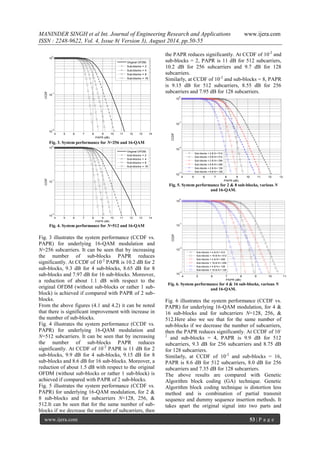
Fig. 3. System performance for N=256 and 16-QAM 
Fig. 4. System performance for N=512 and 16-QAM 
Fig. 3 illustrates the system performance (CCDF vs. 
PAPR) for underlying 16-QAM modulation and 
N=256 subcarriers. It can be seen that by increasing 
the number of sub-blocks PAPR reduces 
significantly. At CCDF of 10-2 PAPR is 10.2 dB for 2 
sub-blocks, 9.3 dB for 4 sub-blocks, 8.65 dB for 8 
sub-blocks and 7.97 dB for 16 sub-blocks. Moreover, 
a reduction of about 1.1 dB with respect to the 
original OFDM (without sub-blocks or rather 1 sub-block) 
is achieved if compared with PAPR of 2 sub-blocks. 
From the above figures (4.1 and 4.2) it can be noted 
that there is significant improvement with increase in 
the number of sub-blocks. 
Fig. 4 illustrates the system performance (CCDF vs. 
PAPR) for underlying 16-QAM modulation and 
N=512 subcarriers. It can be seen that by increasing 
the number of sub-blocks PAPR reduces 
significantly. At CCDF of 10-2 PAPR is 11 dB for 2 
sub-blocks, 9.9 dB for 4 sub-blocks, 9.15 dB for 8 
sub-blocks and 8.6 dB for 16 sub-blocks. Moreover, a 
reduction of about 1.5 dB with respect to the original 
OFDM (without sub-blocks or rather 1 sub-block) is 
achieved if compared with PAPR of 2 sub-blocks. 
Fig. 5 illustrates the system performance (CCDF vs. 
PAPR) for underlying 16-QAM modulation, for 2 & 
8 sub-blocks and for subcarriers N=128, 256, & 
512.It can be seen that for the same number of sub-blocks 
if we decrease the number of subcarriers, then 
the PAPR reduces significantly. At CCDF of 10-2 and 
sub-blocks = 2, PAPR is 11 dB for 512 subcarriers, 
10.2 dB for 256 subcarriers and 9.7 dB for 128 
subcarriers. 
Similarly, at CCDF of 10-2 and sub-blocks = 8, PAPR 
is 9.15 dB for 512 subcarriers, 8.55 dB for 256 
subcarriers and 7.95 dB for 128 subcarriers. 
Fig. 5. System performance for 2 & 8 sub-blocks, various N 
and 16-QAM. 
Fig. 6. System performance for 4 & 16 sub-blocks, various N 
and 16-QAM. 
Fig. 6 illustrates the system performance (CCDF vs. 
PAPR) for underlying 16-QAM modulation, for 4 & 
16 sub-blocks and for subcarriers N=128, 256, & 
512.Here also we see that for the same number of 
sub-blocks if we decrease the number of subcarriers, 
then the PAPR reduces significantly. At CCDF of 10- 
2 and sub-blocks = 4, PAPR is 9.9 dB for 512 
subcarriers, 9.3 dB for 256 subcarriers and 8.75 dB 
for 128 subcarriers. 
Similarly, at CCDF of 10-2 and sub-blocks = 16, 
PAPR is 8.6 dB for 512 subcarriers, 8.0 dB for 256 
subcarriers and 7.35 dB for 128 subcarriers. 
The above results are compared with Genetic 
Algorithm block coding (GA) technique. Genetic 
Algorithm block coding technique is distortion less 
method and is combination of partial transmit 
sequence and dummy sequence insertion methods. It 
takes apart the original signal into two parts and 
4 5 6 7 8 9 10 11 12 13 14 
10 
-2 
10 
-1 
10 
0 
PAPR (dB) 
CCDF 
Original OFDM. 
Sub-blocks = 2 
Sub-blocks = 4 
Sub-blocks = 8 
Sub-blocks = 16 
4 5 6 7 8 9 10 11 12 13 14 
10 
-2 
10 
-1 
10 
0 
PAPR (dB) 
CCDF 
Original OFDM. 
Sub-blocks = 2 
Sub-blocks = 4 
Sub-blocks = 8 
Sub-blocks = 16 
4 5 6 7 8 9 10 11 12 13 
10 
-3 
10 
-2 
10 
-1 
10 
0 
PAPR (dB) 
CCDF 
Sub-blocks = 2 & N = 512 
Sub-blocks = 8 & N = 512 
Sub-blocks = 2 & N = 256 
Sub-blocks = 8 & N = 256 
Sub-blocks = 2 & N = 128 
Sub-blocks = 8 & N = 128 
4 5 6 7 8 9 10 11 
10 
-3 
10 
-2 
10 
-1 
10 
0 
PAPR (dB) 
CCDF 
Sub-blocks = 4 & N = 512 
Sub-blocks = 16 & N = 512 
Sub-blocks = 4 & N = 256 
Sub-blocks = 16 & N = 256 
Sub-blocks = 4 & N = 128 
Sub-blocks = 16 & N = 128
MANINDER SINGH et al Int. Journal of Engineering Research and Applications www.ijera.com 
ISSN : 2248-9622, Vol. 4, Issue 8( Version 3), August 2014, pp.50-55 
www.ijera.com 54 | P a g e 
selects the part having minimum PAPR. The 
following Table 4.2 illustrates the parameter values 
used for GA system. Parameter description is given 
along with. 
Table 4.2: Parameter Settings for GA. 
Parameter Description Value 
Number of 
Sub- 
Blocks 
Sub-Block 
size 
2 
Number of 
Sub- 
Carriers 
No. of 
subcarriers 
64 
PAPR 
(dB) 
PAPR in dB 3 to 10 
Tx 
Transmit 
Antennas 
2 
Rx 
Receive 
Antennas 
1 
Fig. 7: Comparison of CS (128 sub-carriers) with Genetic 
Algorithm technique. 
Fig. 8: Comparison of CS (256 sub-carriers) with Genetic 
Algorithm technique. 
Fig. 7 and 8 compare the system performance (CCDF 
vs. PAPR) for CS and GA schemes, the only 
difference being the number of subcarriers used for 
CS, 128 in Fig. 7 and 256 in Fig. 8. The number of 
sub-blocks used are 4 in both the cases (CS and GA), 
for both figures (4.6 and 4.7). 
From Fig. 7, it can be seen that for the same number 
of sub-blocks (2) and same number of subcarriers 
(64), the PAPR obtained using CS is less than that 
obtained with GA system. At CCDF of 10-2, PAPR is 
8.1 dB for CS and 8.7 dB for GA system, thereby 
having an improvement of 0.6 dB. At CCDF of 10-3, 
an improvement of 0.6 dB is seen, with PAPR of 8.4 
dB for CS and 9 dB for GA system. 
Fig. 8, compares the GA system used in Fig. 4.6 with 
CS (having 256 subcarriers). It can be seen that even 
with more number of subcarriers (64), the PAPR 
obtained using CS is nearly equal to that obtained 
using GA system. 
CONCLUSION 
OFDM is a multicarrier modulation scheme 
which plays an important role in long distance 
communication. One of its biggest challenges in 
OFDM is the peak to average power ratio (PAPR) 
which is ratio of maximum power of given OFDM 
symbol to the average power of that OFDM symbol. 
The simulation results shows that CS is an effective 
method to reduce the PAPR problem. This method 
reduces the probability of having PAPR value. 
Simulation Results are compared with GA coding 
technique. Also effect of changing various simulation 
parameters such as subcarriers, sub-blocks is studied. 
By changing simulation parameters, system 
performance changes in terms of PAPR values and 
probability of PAPR values. 
[1] S. H. Han and J. H. Lee, "An overview of peak-to- 
average power ratio reduction techniques for 
multicarrier transmission," IEEE Wireless 
Communications, vol. 12, no. 2, p. – , 2005. 
[2] R. W. Bauml, R. F. H. Fischer and J. B. Huber, 
"Reducing the peak-to-average power ratio of 
multicarrier modulation by selected mapping," 
Electronics Letters, vol. 32, no. 22, pp. 
2056,2057, 1996. 
[3] S. Y. Le_Goff, S. S. Al-Samahi, B. K. Khoo, C. 
C. Tsimenidis and B. S. Sharif, "Selected 
mapping without side information for papr 
reduction in ofdm," IEEE Transactions on 
Wireless Communications, vol. 8, no. 7, pp. 
2009-7. 
[4] B. Canpolat, "Performance Analysis of Adaptive 
Loading OFDM Under Rayleigh Fading With 
Diversity Combining," 2001. 
[5] R. V. Nee and R. Prasad, "OFDM for Wireless 
Multimedia Communications,” Artech House," 
2000. 
4 5 6 7 8 9 10 11 
10 
-3 
10 
-2 
10 
-1 
10 
0 
PAPR (dB) 
CCDF 
Cuckoo Search 
Genetic Algorithm 
4 5 6 7 8 9 10 11 
10 
-3 
10 
-2 
10 
-1 
10 
0 
PAPR (dB) 
CCDF 
Cuckoo Search 
Genetic Algorithm
MANINDER SINGH et al Int. Journal of Engineering Research and Applications www.ijera.com 
ISSN : 2248-9622, Vol. 4, Issue 8( Version 3), August 2014, pp.50-55 
www.ijera.com 55 | P a g e 
[6] 
A. Ghassemi and A. T. A. Gulliver, "Carrier Frequency Offset Mitigation in OFDM Systems Using Efficient Tone Reservation,” Communication Networks and," in Services Research Conference, 2009. 
[7] 
L. J. Cimini and N. R. Sollenberger, "Peak-to- Average Power Ratio Reduction of an OFDM Signal Using Partial Transmit Sequences," IEEE Communications Letters, Vol.4, No.3, 2000. 
[8] 
I. Hosseini, M. J. Omidi, K. Kasiri, A. Sadri and P. G. Gulak, "Papr Reduction in OFDM Systems Using Polynomial-Based Compressing and Iterative Expanding,” Speech and Signal Processing," IEEE International Conference, vol. 4, 2006. 
[9] 
K. Yang and S. Chang, "Peak-to-Average Power Control in OFDM Using Standard Arrays of Linear Block Codes," IEEE Communications Letters, Vol.7, No.4, 2003. 
[10] 
W. Luqing and C. Tellambura, "An Adaptive- Scaling Algorithm for OFDM PAR Reduction Using Active Constellation Extension,” Vehicular Technology," in IEEE 64th conference, 2006. 
[11] 
J. A. Davis and J. Jedwab, "Peak-to-Mean Power Control in OFDM, Golay Complementary Sequences, and Reed-Muller Codes," IEEE Transactions on Information Theory, Vol.45, No.7, 1999. 
[12] 
S. H. Müller and J. B. Huber, "OFDM with reduced peak-to-average power ratio by optimum combination of partial transmit sequences," Electronics Letters, Vol.33, No.5, 1997. 
[13] 
J. W. C. L. Jungwon, J. P. Choi and L. L. Hui, "Low-Complexity Mean-Delay Estimation for OFDM Systems,” Vehicular Technology," IEEE Transactions, vol. 58, no. 7, pp. 3790-3795, 2009. 
[14] 
O. Edfords, M. Sandell, J.-J. V. de_Beek, D. Landström and F. Sjöberg, "An Introduction to Orthogonal Frequency-Division Multiplexing," 1996. 
[15] 
P. Fan and X.-G. Xia, "Block Coded Modulation for the Reduction of the Peak to Average Power Ratio in OFDM Systems," IEEE Transactions on Consumer Electronics, vol. 45, no. 4, 1999. 
[16] 
Y. Xin-She and S. Deb, "Cuckoo search via Lévy flights." Nature & Biologically Inspired Computing," NaBIC 2009. World Congress on. IEEE, 2009. 
[17] 
T. Wattanasuwakull and W. Benjapolakul, "PAPR Reduction for OFDM Transmission by using a method of Tone Reservation and Tone Injection," in Communications and Signal Processing Fifth International IEEE Conference, 
2005.

OFDM PAPR Reduction Using Hybrid Partial Transmit Sequences Based On Cuckoo Search Algorithm

  • 1.
    MANINDER SINGH etal Int. Journal of Engineering Research and Applications www.ijera.com ISSN : 2248-9622, Vol. 4, Issue 8( Version 3), August 2014, pp.50-55 www.ijera.com 50 | P a g e OFDM PAPR Reduction Using Hybrid Partial Transmit Sequences Based On Cuckoo Search Algorithm 1Maninder Singh, 2Charanjit Singh, 3 Amandeep Singh Bhandari 1,2,3Electronics and Communication Engineering Department, Punjabi University, Patiala Abstract: The past decade has seen many radical changes and achievements in the field of wireless communication. Applications of wireless communication have grown swiftly in the recent past. This rigorous growth leads to more throughput over wireless channels along with increased reliability. But still the bandwidth demands are endless and increasing day by day. Today we need to constantly work towards achieving reliable wireless communication with high spectral efficiency, low complexity and good error performance results. Orthogonal frequency division multiplexing (OFDM) technique is a promising technique in this regard as it offers high data rate and reliable communications over various fading channels. But the main drawback of OFDM is the high peak to average power ratio (PAPR). In this paper we present the technique to reduce the PAPR using Cuckoo Search Algorithm in multicarrier modulation system. Simulation results show that the proposed scheme considerably outperforms the conventional system. I. INTRODUCTION In multi-carrier modulation, the most frequently used method is Orthogonal Frequency Division Multiplexing (OFDM); it has become very general in wireless communication. Unfortunately the main disadvantage of OFDM transmission is its large wrapping fluctuation which is quantified as Peak to Average Power Ratio (PAPR). For decrease of this PAPR lot of algorithms have been established. All of the methods have some sort of benefits and drawbacks [1]. Clipping and Filtering is one of the simple method in which some part of transferred signal undergoes into distortion. Also the Coding arrangement decreases the data amount which is undesirable. If we go for the Selected Mapping (SLM) and Partial Transmit Sequence (PTS) system, the PTS method has additional complexity than that of SLM method. This Selected Mapping is one of the promising methods due to its simplicity for implementation which familiarizes no distortion in the transmitted signal. It has been designated first in [2] i.e. to be recognized as the traditional SLM method. An OFDM signal consists of a number of individually modulated subcarriers, which can give a large Peak-to-Average Power Ratio (PAPR) when added up coherently. When N signals are added with the same phase, they generate a peak power that is N times the average power. To escape nonlinear distortion, highly linear amplifiers are essential which cause a severe decrease in power efficiency. Several methods are explained in the literature in order to solve this problem. OFDM Transmission Theory The basic principle of OFDM is to split input data stream into a number of lower rate streams that are transferred simultaneously over a number of subcarriers, the transmission rate is slower in parallel subcarriers, a frequency selective channel seems flat to each subcarrier. ISI is reduced almost completely by adding a guard interval at the beginning of each OFDM symbol. However, instead of using an empty guard time, this interval is filled with a cyclically extended version of the OFDM symbol. This method is used to avoid ICI. In OFDM, subcarrier spacing is kept at minimum, while still preserving the time domain orthogonality between subcarriers, even though the individual frequency spectrum may overlap. The least subcarrier spacing should equal to 1/T, where T is the symbol period. An OFDM symbol in baseband is defined as: 푥 푡 = 푎 푖+ 푁 2N2−1 푖=− N2exp 푗 2휋푖푡 T 푠 푡 0≤푡≤T where, 푎푖+푁/2denotes the complex symbol modulating the i-th carrier, s(t) is the time window function defined in the interval [0,T], N is the number of subcarriers, and T is the OFDM symbol period. Subcarriers are spaced ΔF=1/Tapart. The correlation coefficient between the subcarriers may be defined as: 휌푘푛= 1T exp 푗 2휋푘푡 T exp −푗 2휋푛푡 T 푑푡 푇 0 As can be seen from (1) 휌푘푛= 1, 푛=푘 0, 푛≠푘 RESEARCH ARTICLE OPEN ACCESS
  • 2.
    MANINDER SINGH etal Int. Journal of Engineering Research and Applications www.ijera.com ISSN : 2248-9622, Vol. 4, Issue 8( Version 3), August 2014, pp.50-55 www.ijera.com 51 | P a g e The basic principle of OFDM is to split a high-rate data stream into a number of lower rate streams that are transmitted simultaneously over a number of subcarriers. These subcarriers are overlapped with each other. PAPR Reduction Techniques Several PAPR [13] reduction techniques have been proposed in the literature. These techniques are divided into two groups. These are signal scrambling techniques and signal distortion techniques. (A) Signal Scrambling Technique 1. Tone reservation The main idea of this method is to keep a small set of tones for PAPR reduction. This can be originated as a convex problem and this problem can be solved accurately. Tone reservation method is based on adding a data block and time domain signal. A data block is dependent time domain signal to the original multicarrier signal to minimize the high peak. This time domain signal can be calculated simply at the transmitter of system and stripped off at the receiver. The amount of PAPR reduction depends on some factors such as number of reserved tones, location of the reserved tones, amount of complexity and allowed power on reserved tones.[12] 2. Block coding The fundamental idea is that of all probable message symbols, only those which have low peak power will be chosen by coding as valid code words for transmission. No introduction of distortion to the signals. If there have N subcarriers, they are represented by 2N bits using QPSK modulation and thus 22N messages. Using the whole message space corresponds to zero bits of redundancy. 3. Selective Level Mapping The simple idea of this method is first produce a number of alternative OFDM signals from the original data block and then transmit the OFDM signal having least PAPR. But data rate loss and complexity at the transmitter side are two simple drawbacks for this method. 4. Tone injection Tone Injection (TI) technique is based on general additive method for PAPR reduction. Using an additive method achieves PAPR reduction of multicarrier signal without any data rate loss. TI uses a set of equivalent constellation points for an original constellation points to reduce PAPR. The main idea behind this method is to increase the constellation size. (B) Signal Distortion Techniques 1. Clipping and Filtering This is a humblest method used for PAPR reduction. Clipping [15] means the amplitude clipping which limits the peak envelope of the input signal to a prearranged value. xc n =f x = −A x n ≤Ax n x n <퐴 A x n ≥A Where, A is the pre-specified clipping level. 2. Peak Windowing The peak windowing method proposes that it is possible to remove large peaks at the cost of a slight amount of self-interference when large peaks arise less frequently. Peak windowing reduces PAPRs at the cost of increasing the BER and out-of-band radiation. It offers better PAPR reduction with better spectral properties. In peak windowing method we multiply large signal peak with a specific window, for example; Gaussian shaped window, cosine, Kaiser and Hamming window. 3. Cuckoo Search Algorithm Cuckoos are fascinating birds, not only because of the beautiful sounds they can make, but also because of their aggressive reproduction strategy. Some species such as the ani and Guira cuckoos lay their eggs in communal nests, though they may remove others' eggs to increase the hatching probability of their own eggs. Quite a number of species engage the obligate brood parasitism by laying their eggs in the nests of other host birds (often other species). Some cuckoo species such as the New World brood- parasitic Tapera have evolved in such a way that female parasitic cuckoos are often very specialized in the mimicry in colour and pattern of the eggs of a few chosen host species. This reduces the probability of their eggs being abandoned and thus increases their productivity. For the implementation point of view, we can use the following simple representations that each egg in a nest represents a solution, and each cuckoo can lay only one egg (thus representing one solution), the aim is to use the new and potentially better solutions (cuckoos) to replace a not-so-good solution in the nests. For this present work, we will use the simplest approach where each nest has only a single egg. In this case, there is no distinction between eggs, nest or cuckoo, as each nest corresponds to one egg which also represents one cuckoo. When generating new solutions 푥푡+1 for, say, a cuckoo 푖, a Levy fight is performed. 푥푖 (푡+1)=푥푖 (푡)+훼⊕퐿푒푣푦(⋋) Where 훼>0 is the step size which should be related to the scales of the problem of interests, in most
  • 3.
    MANINDER SINGH etal Int. Journal of Engineering Research and Applications www.ijera.com ISSN : 2248-9622, Vol. 4, Issue 8( Version 3), August 2014, pp.50-55 www.ijera.com 52 | P a g e cases, we can use 훼=푂(퐿/10) where L is the characteristic scale of the problem of interest. Proposed Work: Orthogonal frequency division multiplexing (OFDM) offers high data rate and reliable communications over fading channels. But the major disadvantage of OFDM is the high peak to average power ratio. Our objective is to develop a technique to reduce the PAPR using Cuckoo Search algorithm. We will use Cuckoo Search Algorithm for reducing PAPR of OFDM system incorporating Partial Transmit Sequence (PTS), which would allow achieving solution with reduced computational burden and try and evaluate the resultant system performance with and without Cuckoo Search Algorithm. System Model The transmitter system used in our result simulations is shown in figure 3.1. Fig.1 Transmitter The functional block diagram of a multicarrier modulation system with PTS scheme is shown in Figure 3.1. The data source block X is partitioned into M disjoint sub-blocks Xm, where m = 1, 2... M, such that, 퐗= X푚 M 푚=1 Here, it is assumed that the sub-blocks Xm consist of a set of subcarriers of equal size N. The partitioned sub-blocks are converted from the frequency domain to the time domain using N-point IFFT. Due to IFFT being a linear transformation, the representation of the block in the time domain is given by, 퐱=IFFT X푚 M 푚=1 = IFFT X푚 M 푚=1= x푚 M 푚=1 As shown in Figure 1, if the system follows the dashed line path then the Cuckoo Search Algorithm will optimize the system by generating appropriate phase vector b, by minimizing the fitness function given by, 푃퐴푃푅= max푚=0 푀−1 퐱′ 휍2 Where, 휍2is the average power of the transmitted signal. Table 4.1: Parameter Settings for Simulation. Parameter Description Value Available Sub-Blocks Sub-Block size 2, 4, 8, 16 OFDM Blocks Input bits Available Sub- Blocks * 105 Number of Sub-Carriers No. of subcarriers 128, 256, 512 M Constellation Size 16-QAM m Bits/Symbol log2(M) = 4 PAPR (dB) PAPR in dB 4 to 14 fitnessFunc Fitness Function @(x) max(abs(x(1)^2)) ./ mean(x(1)) numOfNests Number of Nests 10 maxIterations Max Iterations 5 Results: Fig. 2. System performance for N=128 and 16-QAM Fig. 2 illustrates the system performance (CCDF vs. PAPR) for underlying 16-QAM modulation and N=128 subcarriers. It can be seen that by increasing the number of sub-blocks PAPR reduces significantly. At CCDF of 10-2 PAPR is 9.7 dB for 2 sub-blocks, 8.8 dB for 4 sub-blocks, 7.9 dB for 8 sub- blocks and 7.35 dB for 16 sub-blocks. Moreover, a reduction of about 1.0 dB with respect to the original OFDM (without sub-blocks or rather 1 sub-block) is achieved if compared with PAPR of 2 sub-blocks. 456789101112131410-210-1100PAPR (dB) CCDF Original OFDM. Sub-blocks = 2Sub-blocks = 4Sub-blocks = 8Sub-blocks = 16
  • 4.
    MANINDER SINGH etal Int. Journal of Engineering Research and Applications www.ijera.com ISSN : 2248-9622, Vol. 4, Issue 8( Version 3), August 2014, pp.50-55 www.ijera.com 53 | P a g e Fig. 3. System performance for N=256 and 16-QAM Fig. 4. System performance for N=512 and 16-QAM Fig. 3 illustrates the system performance (CCDF vs. PAPR) for underlying 16-QAM modulation and N=256 subcarriers. It can be seen that by increasing the number of sub-blocks PAPR reduces significantly. At CCDF of 10-2 PAPR is 10.2 dB for 2 sub-blocks, 9.3 dB for 4 sub-blocks, 8.65 dB for 8 sub-blocks and 7.97 dB for 16 sub-blocks. Moreover, a reduction of about 1.1 dB with respect to the original OFDM (without sub-blocks or rather 1 sub-block) is achieved if compared with PAPR of 2 sub-blocks. From the above figures (4.1 and 4.2) it can be noted that there is significant improvement with increase in the number of sub-blocks. Fig. 4 illustrates the system performance (CCDF vs. PAPR) for underlying 16-QAM modulation and N=512 subcarriers. It can be seen that by increasing the number of sub-blocks PAPR reduces significantly. At CCDF of 10-2 PAPR is 11 dB for 2 sub-blocks, 9.9 dB for 4 sub-blocks, 9.15 dB for 8 sub-blocks and 8.6 dB for 16 sub-blocks. Moreover, a reduction of about 1.5 dB with respect to the original OFDM (without sub-blocks or rather 1 sub-block) is achieved if compared with PAPR of 2 sub-blocks. Fig. 5 illustrates the system performance (CCDF vs. PAPR) for underlying 16-QAM modulation, for 2 & 8 sub-blocks and for subcarriers N=128, 256, & 512.It can be seen that for the same number of sub-blocks if we decrease the number of subcarriers, then the PAPR reduces significantly. At CCDF of 10-2 and sub-blocks = 2, PAPR is 11 dB for 512 subcarriers, 10.2 dB for 256 subcarriers and 9.7 dB for 128 subcarriers. Similarly, at CCDF of 10-2 and sub-blocks = 8, PAPR is 9.15 dB for 512 subcarriers, 8.55 dB for 256 subcarriers and 7.95 dB for 128 subcarriers. Fig. 5. System performance for 2 & 8 sub-blocks, various N and 16-QAM. Fig. 6. System performance for 4 & 16 sub-blocks, various N and 16-QAM. Fig. 6 illustrates the system performance (CCDF vs. PAPR) for underlying 16-QAM modulation, for 4 & 16 sub-blocks and for subcarriers N=128, 256, & 512.Here also we see that for the same number of sub-blocks if we decrease the number of subcarriers, then the PAPR reduces significantly. At CCDF of 10- 2 and sub-blocks = 4, PAPR is 9.9 dB for 512 subcarriers, 9.3 dB for 256 subcarriers and 8.75 dB for 128 subcarriers. Similarly, at CCDF of 10-2 and sub-blocks = 16, PAPR is 8.6 dB for 512 subcarriers, 8.0 dB for 256 subcarriers and 7.35 dB for 128 subcarriers. The above results are compared with Genetic Algorithm block coding (GA) technique. Genetic Algorithm block coding technique is distortion less method and is combination of partial transmit sequence and dummy sequence insertion methods. It takes apart the original signal into two parts and 4 5 6 7 8 9 10 11 12 13 14 10 -2 10 -1 10 0 PAPR (dB) CCDF Original OFDM. Sub-blocks = 2 Sub-blocks = 4 Sub-blocks = 8 Sub-blocks = 16 4 5 6 7 8 9 10 11 12 13 14 10 -2 10 -1 10 0 PAPR (dB) CCDF Original OFDM. Sub-blocks = 2 Sub-blocks = 4 Sub-blocks = 8 Sub-blocks = 16 4 5 6 7 8 9 10 11 12 13 10 -3 10 -2 10 -1 10 0 PAPR (dB) CCDF Sub-blocks = 2 & N = 512 Sub-blocks = 8 & N = 512 Sub-blocks = 2 & N = 256 Sub-blocks = 8 & N = 256 Sub-blocks = 2 & N = 128 Sub-blocks = 8 & N = 128 4 5 6 7 8 9 10 11 10 -3 10 -2 10 -1 10 0 PAPR (dB) CCDF Sub-blocks = 4 & N = 512 Sub-blocks = 16 & N = 512 Sub-blocks = 4 & N = 256 Sub-blocks = 16 & N = 256 Sub-blocks = 4 & N = 128 Sub-blocks = 16 & N = 128
  • 5.
    MANINDER SINGH etal Int. Journal of Engineering Research and Applications www.ijera.com ISSN : 2248-9622, Vol. 4, Issue 8( Version 3), August 2014, pp.50-55 www.ijera.com 54 | P a g e selects the part having minimum PAPR. The following Table 4.2 illustrates the parameter values used for GA system. Parameter description is given along with. Table 4.2: Parameter Settings for GA. Parameter Description Value Number of Sub- Blocks Sub-Block size 2 Number of Sub- Carriers No. of subcarriers 64 PAPR (dB) PAPR in dB 3 to 10 Tx Transmit Antennas 2 Rx Receive Antennas 1 Fig. 7: Comparison of CS (128 sub-carriers) with Genetic Algorithm technique. Fig. 8: Comparison of CS (256 sub-carriers) with Genetic Algorithm technique. Fig. 7 and 8 compare the system performance (CCDF vs. PAPR) for CS and GA schemes, the only difference being the number of subcarriers used for CS, 128 in Fig. 7 and 256 in Fig. 8. The number of sub-blocks used are 4 in both the cases (CS and GA), for both figures (4.6 and 4.7). From Fig. 7, it can be seen that for the same number of sub-blocks (2) and same number of subcarriers (64), the PAPR obtained using CS is less than that obtained with GA system. At CCDF of 10-2, PAPR is 8.1 dB for CS and 8.7 dB for GA system, thereby having an improvement of 0.6 dB. At CCDF of 10-3, an improvement of 0.6 dB is seen, with PAPR of 8.4 dB for CS and 9 dB for GA system. Fig. 8, compares the GA system used in Fig. 4.6 with CS (having 256 subcarriers). It can be seen that even with more number of subcarriers (64), the PAPR obtained using CS is nearly equal to that obtained using GA system. CONCLUSION OFDM is a multicarrier modulation scheme which plays an important role in long distance communication. One of its biggest challenges in OFDM is the peak to average power ratio (PAPR) which is ratio of maximum power of given OFDM symbol to the average power of that OFDM symbol. The simulation results shows that CS is an effective method to reduce the PAPR problem. This method reduces the probability of having PAPR value. Simulation Results are compared with GA coding technique. Also effect of changing various simulation parameters such as subcarriers, sub-blocks is studied. By changing simulation parameters, system performance changes in terms of PAPR values and probability of PAPR values. [1] S. H. Han and J. H. Lee, "An overview of peak-to- average power ratio reduction techniques for multicarrier transmission," IEEE Wireless Communications, vol. 12, no. 2, p. – , 2005. [2] R. W. Bauml, R. F. H. Fischer and J. B. Huber, "Reducing the peak-to-average power ratio of multicarrier modulation by selected mapping," Electronics Letters, vol. 32, no. 22, pp. 2056,2057, 1996. [3] S. Y. Le_Goff, S. S. Al-Samahi, B. K. Khoo, C. C. Tsimenidis and B. S. Sharif, "Selected mapping without side information for papr reduction in ofdm," IEEE Transactions on Wireless Communications, vol. 8, no. 7, pp. 2009-7. [4] B. Canpolat, "Performance Analysis of Adaptive Loading OFDM Under Rayleigh Fading With Diversity Combining," 2001. [5] R. V. Nee and R. Prasad, "OFDM for Wireless Multimedia Communications,” Artech House," 2000. 4 5 6 7 8 9 10 11 10 -3 10 -2 10 -1 10 0 PAPR (dB) CCDF Cuckoo Search Genetic Algorithm 4 5 6 7 8 9 10 11 10 -3 10 -2 10 -1 10 0 PAPR (dB) CCDF Cuckoo Search Genetic Algorithm
  • 6.
    MANINDER SINGH etal Int. Journal of Engineering Research and Applications www.ijera.com ISSN : 2248-9622, Vol. 4, Issue 8( Version 3), August 2014, pp.50-55 www.ijera.com 55 | P a g e [6] A. Ghassemi and A. T. A. Gulliver, "Carrier Frequency Offset Mitigation in OFDM Systems Using Efficient Tone Reservation,” Communication Networks and," in Services Research Conference, 2009. [7] L. J. Cimini and N. R. Sollenberger, "Peak-to- Average Power Ratio Reduction of an OFDM Signal Using Partial Transmit Sequences," IEEE Communications Letters, Vol.4, No.3, 2000. [8] I. Hosseini, M. J. Omidi, K. Kasiri, A. Sadri and P. G. Gulak, "Papr Reduction in OFDM Systems Using Polynomial-Based Compressing and Iterative Expanding,” Speech and Signal Processing," IEEE International Conference, vol. 4, 2006. [9] K. Yang and S. Chang, "Peak-to-Average Power Control in OFDM Using Standard Arrays of Linear Block Codes," IEEE Communications Letters, Vol.7, No.4, 2003. [10] W. Luqing and C. Tellambura, "An Adaptive- Scaling Algorithm for OFDM PAR Reduction Using Active Constellation Extension,” Vehicular Technology," in IEEE 64th conference, 2006. [11] J. A. Davis and J. Jedwab, "Peak-to-Mean Power Control in OFDM, Golay Complementary Sequences, and Reed-Muller Codes," IEEE Transactions on Information Theory, Vol.45, No.7, 1999. [12] S. H. Müller and J. B. Huber, "OFDM with reduced peak-to-average power ratio by optimum combination of partial transmit sequences," Electronics Letters, Vol.33, No.5, 1997. [13] J. W. C. L. Jungwon, J. P. Choi and L. L. Hui, "Low-Complexity Mean-Delay Estimation for OFDM Systems,” Vehicular Technology," IEEE Transactions, vol. 58, no. 7, pp. 3790-3795, 2009. [14] O. Edfords, M. Sandell, J.-J. V. de_Beek, D. Landström and F. Sjöberg, "An Introduction to Orthogonal Frequency-Division Multiplexing," 1996. [15] P. Fan and X.-G. Xia, "Block Coded Modulation for the Reduction of the Peak to Average Power Ratio in OFDM Systems," IEEE Transactions on Consumer Electronics, vol. 45, no. 4, 1999. [16] Y. Xin-She and S. Deb, "Cuckoo search via Lévy flights." Nature & Biologically Inspired Computing," NaBIC 2009. World Congress on. IEEE, 2009. [17] T. Wattanasuwakull and W. Benjapolakul, "PAPR Reduction for OFDM Transmission by using a method of Tone Reservation and Tone Injection," in Communications and Signal Processing Fifth International IEEE Conference, 2005.