Pooja Shrivastava Int. Journal of Engineering Research and Applications www.ijera.com
ISSN : 2248-9622, Vol. 4, Issue 12( Part 4), December 2014, pp.45-54
www.ijera.com 45 | P a g e
Reuse of Lathe Waste Steel Scrap in Concrete Pavements
Pooja Shrivastavaa
, Dr.Y.p. Joshib
a. Scholar M.E (Transportation Engineering), Department of Civil Engineering SATI Govt. Engineering
College, Vidisha (M.P) 464001.
b. Professor, Department of Civil Engineering, SATI Govt. Engineering College, Vidisha (M.P.) 464001.
ABSTRACT
These project works assess on the study of the workability and mechanical strength properties of the concrete
reinforced with industrialized waste fibers or the recycled fibers. In each lathe industries wastes are available in
form of steel scraps are yield by the lathe machines in process of finishing of different machines parts and
dumping of these wastes in the barren soil contaminating the soil and ground water that builds an unhealthy
environment. Now a day’s these steel scraps as a waste products used by innovative construction industry and
also in transportation and highway industry. In addition to get sustainable progress and environmental
remuneration, lathe scrap as worn-recycle fibers with concrete are likely to be used. When the steel scrap
reinforced in concrete it acquire a term; fiber reinforced concrete and steel fibers in concrete defined as steel
fiber reinforced concrete (SFRC).Different experimental studies are done to identify about fresh and hardened
concrete properties of steel scrap fiber reinforced concrete (SSFRC) and their mechanical properties are found to
be increase due to the addition of steel scrap in concrete i.e. compressive strength, flexural strength, impact
strength, fatigue strength and split tensile strength were increased but up to 0.5-2% scrap content . When
compared with usual concrete to SSFRC, flexural strength increases by 40% and considerable increases in
tensile and compressive strength. These steel scrap also aid to improve the shrinkage reduction, cracking
resistance i.e. preventing crack propagation and modulus of elasticity. The workability of fresh SSFRC are
carried out by using slump test but it restricted to less scrap contents. This work focuses on the enhancement of
structural strength and improvement in fatigue life of concrete pavements by reuse of scrap steel in concrete.
These concrete roads with SSFRC promises an appreciably eminent design life, offer superior serviceability and
minimize crack growth and corrosion. The pioneer idea of this work is the reuse of waste lathe scrap as recycled
steel fibers, which provides more cost-effective and eco-friendly sustainable SFRC PAVEMENTS.
Keywords: fatigue life, steel scrap, sustainability, fatigue strength
I. INTRODUCTION
The effective utilization of locally available lathe
waste material is certainly a great have to in the
recent years. It also describes the influence of fibers
on SSFRC properties. The actual role of the fibers is
to enhance the toughness of the SSFRC under
different type of loading. Toughness defined as area
under load vs. deflection curve i.e. fibers provide a
enormous arrangement of energy inclusion in post
peak section of load deflection curve. In concrete
pavements fatigue failures take place under the
application of repetitive or cyclic flexural load due to
moving traffic. Therefore fatigue performance is an
important parameter to be considered for design of
SFRC pavements.
The main objectives of this paper are-
 To investigate the use of steel scraps as
steel fiber in rigid pavement.
 To scrutinize the various physical and
mechanical characteristics of the steel
fibers in concrete.
 To compare the effectiveness volume
fraction of steel fibers.
 Perform laboratory investigations in order
to substantiate workability of steel fibers.
 Flexural Fatigue scrutiny of steel fiber
reinforced concrete under repeating load.
 To compare the characteristics of strength
between ordinary concrete and SFRC.
II. STEEL SCRAP FIBER REINFORCED
CONCRETE (SSFRC)
Steel scrap fiber reinforced concrete (SSFRC)
defined as composite materials made with OPC,
aggregates and reinforced with steel scrap randomly
distributed fibers or discrete discontinuous fibers.
The function of fibers in SSFRC is to improve
 Post peak ductility
 Durability
 Pre –crack tensile strength
 Fatigue strength
 Impact strength
 And eradicate temperature and shrinkage
cracks
For effective use of fibers in concrete
RESEARCH ARTICLE OPEN ACCESS
Pooja Shrivastava Int. Journal of Engineering Research and Applications www.ijera.com
ISSN : 2248-9622, Vol. 4, Issue 12( Part 4), December 2014, pp.45-54
www.ijera.com 46 | P a g e
 Fibers should be extensively stiffer i.e. have
a higher modulus of elasticity than the
matrix.
 It must be have sufficient length.
 Fibers also have high aspect ratio i.e. ratio of
their relative length to its diameter.
 It must be a good bonding with concrete
matrix.
In SFRC, steel fibers balance the forces by
transmitting tensile forces to the steel fibers which
run along the cracks, as the result flexural toughness
and flexural strength increases to great amount.
SFRC used broadly in two types of concrete structure
i.e. reinforced concrete structure using steel bars and
non-reinforced structure. That is for the reason that
steel fibers in concrete and steel bars reinforced in
concrete members are completely different.
Scrap Steel Fibers obtained from the lathe machines
of length 20-30 mm, width 1.5-2 mm and thickness
0.3-0.6 mm are used here to reinforce the concrete
matrices. And aspect ratio varies from 50-70 with
high modulus of elasticity about 200 GPa. The shape
of scrap fibers cross section may be rectangular,
twisted and metallic bight appearance.
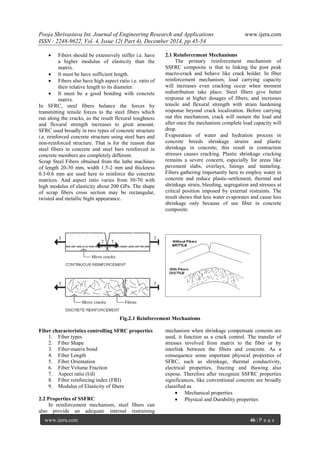
2.1 Reinforcement Mechanisms
The primary reinforcement mechanism of
SSFRC composite is that to linking the post peak
macro-crack and behave like crack holder. In fiber
reinforcement mechanism, load carrying capacity
will increases even cracking occur when moment
redistribution take place. Steel fibers give better
response at higher dosages of fibers, and increases
tensile and flexural strength with strain hardening
response beyond crack localization. Before carrying
out this mechanism, crack will sustain the load and
after once the mechanism complete load capacity will
drop.
Evaporation of water and hydration process in
concrete breeds shrinkage strains and plastic
shrinkage in concrete; this result in contraction
stresses causes cracking. Plastic shrinkage cracking
remains a severe concern, especially for areas like
pavement slabs, overlays, linings and tunneling.
Fibers gathering importantly here to employ water in
concrete and reduce plastic-settlement, thermal and
shrinkage strain, bleeding, segregation and stresses at
critical position imposed by external restraints. The
result shows that less water evaporates and cause less
shrinkage only because of use fiber in concrete
composite.
Fig.2.1 Reinforcement Mechanisms
Fiber characteristics controlling SFRC properties
1. Fiber types
2. Fiber Shape
3. Fiber-matrix bond
4. Fiber Length
5. Fiber Orientation
6. Fiber Volume Fraction
7. Aspect ratio (l/d)
8. Fiber reinforcing index (FRI)
9. Modulus of Elasticity of fibers
2.2 Properties of SSFRC
In reinforcement mechanism, steel fibers can
also provide an adequate internal restraining
mechanism when shrinkage compensate cements are
used, it function as a crack control. The transfer of
stresses involved from matrix to the fiber or by
interlink between the fibers and concrete. As a
consequence some important physical properties of
SFRC, such as shrinkage, thermal conductivity,
electrical properties, freezing and thawing also
expose. Therefore after recognize SSFRC properties
significances, like conventional concrete are broadly
classified as
 Mechanical properties
 Physical and Durability properties
Pooja Shrivastava Int. Journal of Engineering Research and Applications www.ijera.com
ISSN : 2248-9622, Vol. 4, Issue 12( Part 4), December 2014, pp.45-54
www.ijera.com 47 | P a g e
Mechanical properties
The mechanical properties are basically
influenced by the fibers characteristics i.e. types of
fibers, aspect ratio, quantity of fibers, strength of
concrete matrix ;size, shape and designing methods
of specimen and aggregates. The mechanical
properties are discussed in following section;
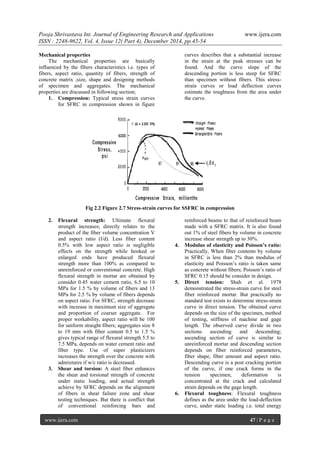
1. Compression: Typical stress strain curves
for SFRC in compression shown in figure
curves describes that a substantial increase
in the strain at the peak stresses can be
found. And the curve slope of the
descending portion is less steep for SFRC
than specimen without fibers. This stress-
strain curves or load deflection curves
estimate the toughness from the area under
the curve.
Fig 2.2 Figure 2.7 Stress-strain curves for SSFRC in compression
2. Flexural strength: Ultimate flexural
strength increases; directly relates to the
product of the fiber volume concentration V
and aspect ratio (l/d). Less fiber content
0.5% with low aspect ratio is negligible
effects on the strength while hooked or
enlarged ends have produced flexural
strength more than 100% as compared to
unreinforced or conventional concrete. High
flexural strength in mortar are obtained by
consider 0.45 water cement ratio, 6.5 to 10
MPa for 1.5 % by volume of fibers and 13
MPa for 2.5 % by volume of fibers depends
on aspect ratio. For SFRC, strength decrease
with increase in maximum size of aggregate
and proportion of coarser aggregate. For
proper workability, aspect ratio will be 100
for uniform straight fibers; aggregates size 8
to 19 mm with fiber content 0.5 to 1.5 %
gives typical range of flexural strength 5.5 to
7.5 MPa, depends on water cement ratio and
fiber type. Use of super plasticizers
increases the strength over the concrete with
admixtures if w/c ratio is decreased.
3. Shear and torsion: A steel fiber enhances
the shear and torsional strength of concrete
under static loading, and actual strength
achieve by SFRC depends on the alignment
of fibers in shear failure zone and shear
testing techniques. But there is conflict that
of conventional reinforcing bars and
reinforced beams to that of reinforced beam
made with a SFRC matrix. It is also found
out 1% of steel fibers by volume in concrete
increase shear strength up to 30%.
4. Modulus of elasticity and Poisson’s ratio:
Practically, When fiber contents by volume
in SFRC is less than 2% than modulus of
elasticity and Poisson’s ratio is taken same
as concrete without fibers; Poisson’s ratio of
SFRC 0.15 should be consider in design.
5. Direct tension: Shah et al. 1978
demonstrated the stress-strain curve for steel
fiber reinforced mortar. But practically no
standard test exists to determine stress-strain
curve in direct tension. The obtained curve
depends on the size of the specimen, method
of testing, stiffness of machine and gage
length. The observed curve divide in two
sections ascending and descending;
ascending section of curve is similar to
unreinforced mortar and descending section
depends on fiber reinforced parameters,
fiber shape, fiber amount and aspect ratio.
Descending curve is a post cracking portion
of the curve, if one crack forms in the
tension specimen, deformation is
concentrated at the crack and calculated
strain depends on the gage length.
6. Flexural toughness: Flexural toughness
defines as the area under the load-deflection
curve, under static loading i.e. total energy
Pooja Shrivastava Int. Journal of Engineering Research and Applications www.ijera.com
ISSN : 2248-9622, Vol. 4, Issue 12( Part 4), December 2014, pp.45-54
www.ijera.com 48 | P a g e
absorbed earlier before complete separation
of specimen. It is one of the most excellent
properties of SFRC which makes it different
from conventional concrete. Presence of
fibers reduce the brittleness of concrete,
even cracks occurred SFRC maintain its
strength at the point of rupture.
Physical and Durability Properties
Several different materials are used to improve
physical properties of materials such as creep,
shrinkage, abrasion, skid resistance, thermal
properties etc., in addition permeability and freezing
thawing damage causes due to cracking makes
concrete less durable. These effects of fibers in
concrete have been determined using testing methods
and some physical properties of SFRC are;
1. Creep: The presences of low fiber content
in concrete from 0.1% to 1% have no
significant effect on the creep. SFRC
showed small long term deflection than
conventional concrete without fiber due to
flexural creep performance. ASTM C 1399
perform creep test based on the average
residual strength of the beam size
100x100x350mm to a deflection of 0.2mm.
It is important in interface bond strength
where enclosure behavior of fiber permitted
only in pullout mode rather than fracture
mode.
2. Extreme temperature and fire: Due to low
thermal conductivity and high heat capacity
concrete is more resistance to extreme
temperature and does not fuel combustion
when exposed to flames. Steel fibers
reinforce in concrete improve the
performance under extreme temperature and
fire. Conventional concrete resistance the
high temperature up to 400˚ F after this
temperature concrete degrades as the bond
of cement and aggregates. At 800˚ F normal
concrete sustain only 50% of its original
compressive strength. If temperature
increases up to 1700˚ F, there is loss of 90%
of structural integrity of concrete; fibers will
not prevent failure under such extreme
temperature but increases its time of fire
exposure to help people . This safe time help
fire extinguisher to evacuate structures and
allow fire safety. Fire studies involves
temperature and duration of fire, rate of feat
transfer, moisture content, specimen
geometry, concrete age, types of aggregates
and other factors.
3. Shrinkage: The mainly shrinkage property
of concrete depends on the property of
materials, temperature and relative humidity
of the environment. Concrete shrinks and
restrained due to drying environment, tensile
stresses are developed and concrete may
crack. It is one of the most common causes
of cracking of walls, slabs and pavements.
And method to resist shrinkage is
reinforcing short discrete fibers in concrete.
Steel fibers in shrinkage resistance play
important role as;
 They allow multiple cracking in matrix.
 They allow transfer tensile stress across the
cracks.
 Permitting healing and sealing of concrete.
4. Permeability and diffusion: Conventional
concrete are susceptible to degradation and
different factors are responsible for this such
as corrosion in reinforcement and in
aggregates, freezing thawing, alkali-silica
reaction, sulphur attack, damage all theses
causes permeability and diffusion in
concrete. SFRC overcome these problems
and has been used successfully in structures
where water proofing required such as
linings in tunnel, storage tanks for liquids.
Permeability of concrete is negligible in an
un-cracked condition when water cement
ratio just about less than 0.45. Steel fibers in
FRC impart improved crack escalation
resistance, and also increased surface
roughness of individual cracks and become
good in branching cracks, due to this
reinforcement in concrete reduce
permeability of cracked concrete.
5. Thermal conductivity: For measure
thermal conductivity both transient i.e.
unsteady heat flow and steady state heat are
used for materials. The steady heat
procedures consider for non homogenous
materials, such as mortar and concrete, from
this linear heat flow and thermal temperature
gradient is measured. The fibers blocks of
size 75x75x150mm was prepared to test
thermal conductivity, contains 0, 0.5, 1.0,
2.0, 4.0 and 8.0%steel fibers. The thermal
conductivity of conventional mortar
was0.862 W/m˚C and concrete was 1.530
W/m˚C with 0.0, 0.5, 1.0, 1.5 % volume of
steel fibers with two different geometric
shapes; flat and crimped.
6. Abrasion/ cavitations/ erosion resistance:
Abrasion resistance relates to pavement and
slab wear-tear under wheeled traffic is
largely unaffected by steel fibers. Steel
fibers also have no effects on abrasion
resistance of concrete matrix by debris of
flowing water. SFRC has greater resistance
to cavitations forces produced by the high
Pooja Shrivastava Int. Journal of Engineering Research and Applications www.ijera.com
ISSN : 2248-9622, Vol. 4, Issue 12( Part 4), December 2014, pp.45-54
www.ijera.com 49 | P a g e
velocity water flow and impact caused by
debris in high velocity flowing water.
The erosion caused by low velocities
particles and impact caused by high
velocities difference between two is
noted. Tests were conducted at Waterways
Experiment Station with addition of steel
fibers in concrete do not improve abrasion
or erosion resistance due to adjustments of
coarse aggregate in mixture reduces coarse
content and increase paste content.
7. Friction and skid resistance: Laboratory
tests were performed to test the friction and
skid resistance property of and concrete
SFRC i.e. skid, rolling resistance and static
friction. The sample prepare for test have
size of aggregate 9.5 mm in SFRC,
maximum size aggregate. Tests result
showed that for dry concrete surface, has no
wear or erosion resistance and deterioration
of the surface, while SFRC have abrasion or
erosion resistance with 15% high skid and
rolling resistance than conventional concrete
under dry, wet and frozen condition.
8. Freezing and thawing: The durable
property of SFRC under freeze and thawing
conditions includes following factors i.e
cement concrete, aggregates, air content,
water cement ratio, fiber types and
geometry, fiber content. Balaguru and
Ramkrishnan 1986 examine the effects of air
content, cement concrete, water cement
ratio, fiber types, fiber content and geometry
on the freezing and thawing resistance of
SFRC. Air contents varied from 1.2 to 10.8
%, cement contents of 362,408,473 kg/m3
and steel fibers hooked ends 44.4 and 59.2
kg/m3were used in experiments. Two
specimens are prepared of size 100 x 100x
350 mm were subjected to more than 300
freezing and thawing cycles. Air content is
an important factor for freeze and thawing
resistance, like plain concrete air entrained
in SFRC improves its freezing thawing
resistance. The modulus of rupture of beam
specimens decrease with freezing and
thawing cycling for both plain and concrete.
The most of the author conclude that SFRC
has excellent resistance to freezing and
thawing measured under ASTM C 666/ C
666 M.
9. Corrosion resistance: The primary cause
corrosion in concrete is similar to SFRC i.e.
chloride-induced corrosion and corrosion
caus4d by the reduction of pH of the
concrete matrix from carbonation. When
SFRC are exposed to marine tidal cycles
showed no corrosion of low-carbon steel and
galvanized steel fibers added in concrete
matrix by 2 % weight of cement. From
different types of steel fibers, melt extract
fibers remained free from corrosion at very
much greater levels of chloride ions.
10.
III. MATERIALS
3.1Cement: Ordinary Portland cement (OPC- 53 grade) is used in this experimental work and tested as per IS
12269-1987. Conforming weight of each cement bag was 50 kg.
Table no. 3.1Properties of cement
S.NO. Properties Values
1. Standard consistency (%) 33
2. Initial setting time(min.) 30
3. Final setting time (min.) 600
4. Specific gravity 3.15
5. Compressive strength at 28 days N/mm² 53
6. Fineness (%) 2.25
3.2Aggregates
Fine aggregates: Fine sand used from zone II consider for the experiment. The properties of fine aggregates are
Table no. 3.2Properties of Fine aggregates
S.NO. Properties Values
1. Water absorption (%) 0.05
2. Specific gravity 2.65
3. Fineness modulus 2.46
Coarse aggregates: The properties of the coarse aggregate are
Pooja Shrivastava Int. Journal of Engineering Research and Applications www.ijera.com
ISSN : 2248-9622, Vol. 4, Issue 12( Part 4), December 2014, pp.45-54
www.ijera.com 50 | P a g e
Table no.3.3 Properties of Coarse Aggregate
S.NO. Properties Values
1. Water absorption (%) 1
2. Specific gravity 2.70
3. Fineness modulus 7.133
4. Impact value (%) 7.5
5. Abrasion value (%) 18.9
6. Crushing value (%) 20
3.3 Fibers: These steel fibers are in scarped form called steel scrap or elongated chips. These are in form of
waste product and used as steel fibers in concrete.
Table no.3.4Properties of Scrap Steel Fiber
IV. FRESH AND HARDEN PROPERTIES OF SSFRC
1. Workability: The workability of fresh SFRC is a measured of its ability to be mixed, handled, transported and
importantly place and consolidated. Slump test is a common, convenient and inexpensive test but refer only for small fiber
contents, for high volume contents inverted cone or vebe test is referred.
Table no.4.1 Slump for SFRC
S.NO. Steel fibers (%) Slump (mm)
1. 0 80
2. 0.5 75
3. 1 70
4. 1.5 70
5. 2 70
2. Compressive Strength: Fibers usually minor effects on compressive strength, slightly increasing or
decreasing the result. Cubes moulds are used to prepare 15 cubes testing under universal testing machine.
Table no.4.2 Compressive strength of SFRC
Steel fibers (%) S.NO Load at failure
(KN)
Strength at 28 days (N/mm²) Average strength at 28
days (N/mm²)
0% 1 520 23.67 24.41
2 530 24.11
3 560 25.44
0.5% 1 510 23.22 24.55
2 540 24.55
3 570 25.89
1% 1 530 24.41 24.95
2 560 25.44
3 550 25
1.5% 1 550 25 25.00
2 570 25.89
3 530 24.11
2% 1 540 24.55 23.92
2 520 23.67
3 540 23.55
S.NO. Properties Values
1. Cross –section Straight and deformed
2. Diameter(mm) 0.3-0.75
3. Length (mm) 25-40
4. Density kg/m3
7850
5. Young modulus(N/mm²) 2 x 10⁵
6. Tensile strength (N/mm²) 500-3000
7. Specific gravity 7.85
8. Aspect ratio 45-100
9. Elongation (%) 5-35
Pooja Shrivastava Int. Journal of Engineering Research and Applications www.ijera.com
ISSN : 2248-9622, Vol. 4, Issue 12( Part 4), December 2014, pp.45-54
www.ijera.com 51 | P a g e
3. Splitting Tensile Strength: 15 cylinder specimens of size 150 mm dia. by 300 mm height were prepared for
each fiber contents. Result from the tensile test, following tensile strength of SFRC after 28 days .ACI 544, 2R-
89 refer splitting tensile test for fiber content concrete.
Table No.4.3 Split tensile strength of SFRC
Steel
fiber
(%)
S.NO. Load at failure
KN
Strength at 28 days (N/mm²) Average strength (N/mm²)
0% 1 270 3.64 3.4
2 220 3.07
3 250 3.49
0.5% 1 280 3.91 3.63
2 240 3.35
3 260 3.64
1% 1 300 4.20 3.91
2 280 3.91
3 260 3.64
1.5% 1 300 4.20 4.06
2 310 4.34
3 260 3.64
2% 1 280 3.91 3.82
2 280 3.91
3 260 3.64
4. Flexural Strength and Flexural Toughness: The principle of flexural behaviour of SFRC depends on the
load deflection curve of the third-point loading test. For plain concrete, the stress ratio for flexural fatigue
endurance (at 2 million test cycles)is usually 0.45 to 0.50whereas for SFRC with high dosages of steel fibers it
can be from 0.65 t0 0.9. Higher factor 0.7 and above cannot be used, unless results of specific investigations are
available. For load reversal the fatigue strength is only slightly less. If micro polymeric fibers are used in small
dosages (< 0.3% by volume of concrete) for plastic shrinkage control, the endurance stress ratio 0.45 will
remain.
Following flexural strength of SFRC increases with increases in fiber contents of steel.
Table no 4.4 Flexural strength of SFRC
Steel
fibers
(%)
S.NO Load at failure
(Kg)
Strength at 28 days (N/mm²) Average strength at 28
days (N/mm²)
0% 1 2170 4.432 4.110
2 2330 4.752
3 1530 3.148
0.5% 1 1850 3.790 4.164
2 2090 4.272
3 2170 4.432
1% 1 2330 4.753 4.59
2 2250 4.593
3 2170 4.432
1.5% 1 2570 5.234 5.79
2 2490 6.074
3 2490 6.074
2% 1 2650 5.395 5.02
2 2410 4.913
3 2330 4.753
Pooja Shrivastava Int. Journal of Engineering Research and Applications www.ijera.com
ISSN : 2248-9622, Vol. 4, Issue 12( Part 4), December 2014, pp.45-54
www.ijera.com 52 | P a g e
Endurance limit 0.50
1. Straight line relation for SR from 1 to 0.576
Log 10 N= (0.9800-SR)/0.07618
Or
SR=0.980-0.07618 Log10 N
At SR=0.576, N= 2.00 x10⁵
2. From SR=0.576 or less, relation is a curve.
N= [3.3735/ (SR-0.480)] 3.333
OR
SR = (3.7375/N0.300)
+ 0.480
At N=3.73 X10⁷
, SR=0.50; At N=Infinity, SR=0.48
Endurance limit 0.60
1. Straight line relation for SR from 1 to 0.627
Log 10N = (0.9900-SR)/0.06189
OR
SR= 0.990-0.06189 Log 10N
At SR =0.627, N= 5.00 x 10⁵
2. From SR=0.627 or less, relation is a curve.
N= [2.9212/ (SR-0.570)] 3.333
OR
SR= (2.9212/ N0.300
) +0.570
At N=4.25 X 10⁶
, SR=0.60; At N= infinity. SR= 0.570
Endurance limit 0.70
1. Straight relation for SR from 1 to 0.714
Log 10N= (1.00- SR)/0.04761
OR
SR = 1.00-0.04761 Log 10N
At SR=0.714, N= 1.00 x 10⁶
2. From SR=0.714 or less, relation is a curve.
N= [4.0381/ (SR-0.65)] 3.333
OR
SR= (430381/ N0.300
) +0.65
At N=2.28 x 10⁷
, SR =0.70; At N= Infinity, SR= 0.650
V. RESULTS, GRAPHS AND DISCUSSIONS
Following results are achieved, after 28 days i.e.;
1. Compressive strength of SFRC slightly increases 3% as compared to plain concrete.
2. Tensile strength of scrap steel fiber concrete increases up to 20% considerable increases.
3. Flexural strength of SFRC effectively increases nearly 40 %.
However, results are found that mechanical properties of SSFRC increases up to addition of 1.5% fiber contents
and on further increasing fiber contents it will decrease the strength. ACI and JSCE also recommend use of fiber
contents up to 2 % more than it needs further investigations. Due to increase in flexural strength of SFRC,
fatigue behaviour of SFRC also analysis, stress ratio for SFRC obtained i.e. 0.65 to 0.90 and also IRC: SP-46-
2013 recommends this stress ratio for SFRC pavements. With this results SSFRC are suitable for concrete
pavements with flexural strength exceeds up to 40% and fatigue ratio 0.65 nominal.
Pooja Shrivastava Int. Journal of Engineering Research and Applications www.ijera.com
ISSN : 2248-9622, Vol. 4, Issue 12( Part 4), December 2014, pp.45-54
www.ijera.com 53 | P a g e
Figure.5.1 Compressive strength of SFRC after 28 days Figure 5.2 Split tensile strength of SFRC after 28 days
Figure.5.3 Flexural strength of SFRC after 28 days
References
[1.] ACI Committee 544 ‘State-of-the-Art Report on Fiber Reinforced Concrete ’
[2.] ACI Committee 544 ‘Placing, and Finishing Steel Fiber Reinforced Concrete Reported by ACI
Committee 544’
[3.] ACI Committee 544 ‘Design Considerations for Steel Fiber Reinforced Concrete’
[4.] Ângela G. Graeff1, Kypros Pilakoutas2, Cyril Lynsdale3 and KyriacosNeocleous ‘Corrosion
Durability of Recycled Steel Fiber Reinforced Concrete’
[5.] . Thirumurugana and M. Sivarajab ‘Workability and strength properties of hybrid fiber reinforced
concrete from industrial waste’Asian journal of civil engineering (BHRC) vol. 14, No. 3 (2013)
[6.] G.Murali, C.M.Vivek Vardhan, R.Prabu, Z.Mohammed Sadaquath Ali Khan, T.Aarif Mohamed and
T.Suresh ‘Experimental investigation on fiber reinforced concrete using waste materials’ ISSN: 2248-
9622 Vol. 2, Issue 2,Mar-Apr 2012, pp.278-283
[7.] Adhoc Lecturer, Sarvajanik College of Engineering Technology, Surat ‘Some Studies on Steel Fiber
Reinforced Concrete’ ISSN 2250-2459, ISO 9001:2008 Certified Journal, Volume 3, Issue 1, January
2013
[8.] IRC-44-1976 ‘Tentative guidelines for cement concrete mix design for pavements’.
[9.] JSCE Concrete Committee ‘Recommendation for design and construction of steel fiber reinforced
concrete’
23.2
23.4
23.6
23.8
24
24.2
24.4
24.6
24.8
25
25.2
0 0.5 1 1.5 2
compressivestrengthN/mm²
fiber contents in %
Compressive strength at 28 days
N/mm²
Compressive
strength at 28
days N/mm²
3
3.2
3.4
3.6
3.8
4
4.2
0 0.5 1 1.5 2
splitrensilestrengthN/mm²
fiber contents in %
split tensile strength at 28 days (N/mm²)
split tensile
strength at 28
days (N/mm²)
0
1
2
3
4
5
6
7
0 0.5 1 1.5 2
flexuralstrengthN/mm²
fiber contents in %
Average Flexural Strength at 28 days N/mm²
Average Flexural
Strength at 28
days N/mm²
Pooja Shrivastava Int. Journal of Engineering Research and Applications www.ijera.com
ISSN : 2248-9622, Vol. 4, Issue 12( Part 4), December 2014, pp.45-54
www.ijera.com 54 | P a g e
[10.] G Vijayakumar1, P Senthilnathan1, K Pandurangan1 and G Ramakrishna ‘Impact and energy
absorption character tics of lathe scrap reinforced concrete’ ISSN 2319 – 6009 Vol. 1, No. 1,
November 2012© 2012 IJSCER
[11.] CCANZ Information bulletin: IB 39 ‘Fiber reinforced concrete’
[12.] Faisal fouad wafa ‘Properties and applications of fiber reinforced concrete’ JKAU: Eng. Sci., Vol. 2,
pp. 49-6~ (1410 A.H./19lJlI A.D.)
[13.] AShahiron Shahidan ‘Behavior of SFRC slab due to volume fraction of fiber; Project report for
Master of science in structural engg. and construction, University Putra Malaysia
[14.] Shirule Pravin, Swami Suman and Nilesh Chincholkar ‘Reuse of steel scrap from lathe machine as
reinforced material to enhance properties of concrete’ Global J. of Engg. and Applied Science
2012:2(2)
[15.] D. Bjegovic and A. Baricevic & S. Lakusic ‘Innovative low cost fiber-reinforced concrete Part I:
Mechanical and durability properties’
[16.] Dr. M. C. Nataraja ‘ Fiber reinforced concrete behaviour properties and apllication’
[17.] Dipan patel ‘Use of Steel Fiber in Rigid Pavement’ Volume: 2 | Issue: 6 | June 2013 • ISSN No 2277 –
8160.
[18.] ACI Committee 544 ‘Measurement of Properties of Fiber Reinforced Concrete Guide for Specifying,
Proportioning, Mixing’
[19.] Frank Papworth, Royce Ratcliffe, Peter Norton ‘ Design of steel fiber reinforced concrete slabs on
ground and shotcrete linings’
[20.] Le Trung Thanh, Nguyen Cong Thang, Tong Ton Kien2
, Nguyen Thi Thang, Nguyen Manh Phat2
,
Nguyen Van Tuan, Tran Ba Viet ‘Enhancement of flexural toughness for steel fiber reinforced
concrete regarding sustainable development’The international Conference on Sustainable Built
Environment for Now and the Future. Hanoi, 26 -27 March 2013
[21.] ISSN 2250-2459, ISO 9001:2008 Certified Journal, Volume 3, Issue 1, January 2013
[22.] www.google.com
[23.] www.wikipedia.com

Reuse of Lathe Waste Steel Scrap in Concrete Pavements

  • 1.
    Pooja Shrivastava Int.Journal of Engineering Research and Applications www.ijera.com ISSN : 2248-9622, Vol. 4, Issue 12( Part 4), December 2014, pp.45-54 www.ijera.com 45 | P a g e Reuse of Lathe Waste Steel Scrap in Concrete Pavements Pooja Shrivastavaa , Dr.Y.p. Joshib a. Scholar M.E (Transportation Engineering), Department of Civil Engineering SATI Govt. Engineering College, Vidisha (M.P) 464001. b. Professor, Department of Civil Engineering, SATI Govt. Engineering College, Vidisha (M.P.) 464001. ABSTRACT These project works assess on the study of the workability and mechanical strength properties of the concrete reinforced with industrialized waste fibers or the recycled fibers. In each lathe industries wastes are available in form of steel scraps are yield by the lathe machines in process of finishing of different machines parts and dumping of these wastes in the barren soil contaminating the soil and ground water that builds an unhealthy environment. Now a day’s these steel scraps as a waste products used by innovative construction industry and also in transportation and highway industry. In addition to get sustainable progress and environmental remuneration, lathe scrap as worn-recycle fibers with concrete are likely to be used. When the steel scrap reinforced in concrete it acquire a term; fiber reinforced concrete and steel fibers in concrete defined as steel fiber reinforced concrete (SFRC).Different experimental studies are done to identify about fresh and hardened concrete properties of steel scrap fiber reinforced concrete (SSFRC) and their mechanical properties are found to be increase due to the addition of steel scrap in concrete i.e. compressive strength, flexural strength, impact strength, fatigue strength and split tensile strength were increased but up to 0.5-2% scrap content . When compared with usual concrete to SSFRC, flexural strength increases by 40% and considerable increases in tensile and compressive strength. These steel scrap also aid to improve the shrinkage reduction, cracking resistance i.e. preventing crack propagation and modulus of elasticity. The workability of fresh SSFRC are carried out by using slump test but it restricted to less scrap contents. This work focuses on the enhancement of structural strength and improvement in fatigue life of concrete pavements by reuse of scrap steel in concrete. These concrete roads with SSFRC promises an appreciably eminent design life, offer superior serviceability and minimize crack growth and corrosion. The pioneer idea of this work is the reuse of waste lathe scrap as recycled steel fibers, which provides more cost-effective and eco-friendly sustainable SFRC PAVEMENTS. Keywords: fatigue life, steel scrap, sustainability, fatigue strength I. INTRODUCTION The effective utilization of locally available lathe waste material is certainly a great have to in the recent years. It also describes the influence of fibers on SSFRC properties. The actual role of the fibers is to enhance the toughness of the SSFRC under different type of loading. Toughness defined as area under load vs. deflection curve i.e. fibers provide a enormous arrangement of energy inclusion in post peak section of load deflection curve. In concrete pavements fatigue failures take place under the application of repetitive or cyclic flexural load due to moving traffic. Therefore fatigue performance is an important parameter to be considered for design of SFRC pavements. The main objectives of this paper are-  To investigate the use of steel scraps as steel fiber in rigid pavement.  To scrutinize the various physical and mechanical characteristics of the steel fibers in concrete.  To compare the effectiveness volume fraction of steel fibers.  Perform laboratory investigations in order to substantiate workability of steel fibers.  Flexural Fatigue scrutiny of steel fiber reinforced concrete under repeating load.  To compare the characteristics of strength between ordinary concrete and SFRC. II. STEEL SCRAP FIBER REINFORCED CONCRETE (SSFRC) Steel scrap fiber reinforced concrete (SSFRC) defined as composite materials made with OPC, aggregates and reinforced with steel scrap randomly distributed fibers or discrete discontinuous fibers. The function of fibers in SSFRC is to improve  Post peak ductility  Durability  Pre –crack tensile strength  Fatigue strength  Impact strength  And eradicate temperature and shrinkage cracks For effective use of fibers in concrete RESEARCH ARTICLE OPEN ACCESS
  • 2.
    Pooja Shrivastava Int.Journal of Engineering Research and Applications www.ijera.com ISSN : 2248-9622, Vol. 4, Issue 12( Part 4), December 2014, pp.45-54 www.ijera.com 46 | P a g e  Fibers should be extensively stiffer i.e. have a higher modulus of elasticity than the matrix.  It must be have sufficient length.  Fibers also have high aspect ratio i.e. ratio of their relative length to its diameter.  It must be a good bonding with concrete matrix. In SFRC, steel fibers balance the forces by transmitting tensile forces to the steel fibers which run along the cracks, as the result flexural toughness and flexural strength increases to great amount. SFRC used broadly in two types of concrete structure i.e. reinforced concrete structure using steel bars and non-reinforced structure. That is for the reason that steel fibers in concrete and steel bars reinforced in concrete members are completely different. Scrap Steel Fibers obtained from the lathe machines of length 20-30 mm, width 1.5-2 mm and thickness 0.3-0.6 mm are used here to reinforce the concrete matrices. And aspect ratio varies from 50-70 with high modulus of elasticity about 200 GPa. The shape of scrap fibers cross section may be rectangular, twisted and metallic bight appearance. 2.1 Reinforcement Mechanisms The primary reinforcement mechanism of SSFRC composite is that to linking the post peak macro-crack and behave like crack holder. In fiber reinforcement mechanism, load carrying capacity will increases even cracking occur when moment redistribution take place. Steel fibers give better response at higher dosages of fibers, and increases tensile and flexural strength with strain hardening response beyond crack localization. Before carrying out this mechanism, crack will sustain the load and after once the mechanism complete load capacity will drop. Evaporation of water and hydration process in concrete breeds shrinkage strains and plastic shrinkage in concrete; this result in contraction stresses causes cracking. Plastic shrinkage cracking remains a severe concern, especially for areas like pavement slabs, overlays, linings and tunneling. Fibers gathering importantly here to employ water in concrete and reduce plastic-settlement, thermal and shrinkage strain, bleeding, segregation and stresses at critical position imposed by external restraints. The result shows that less water evaporates and cause less shrinkage only because of use fiber in concrete composite. Fig.2.1 Reinforcement Mechanisms Fiber characteristics controlling SFRC properties 1. Fiber types 2. Fiber Shape 3. Fiber-matrix bond 4. Fiber Length 5. Fiber Orientation 6. Fiber Volume Fraction 7. Aspect ratio (l/d) 8. Fiber reinforcing index (FRI) 9. Modulus of Elasticity of fibers 2.2 Properties of SSFRC In reinforcement mechanism, steel fibers can also provide an adequate internal restraining mechanism when shrinkage compensate cements are used, it function as a crack control. The transfer of stresses involved from matrix to the fiber or by interlink between the fibers and concrete. As a consequence some important physical properties of SFRC, such as shrinkage, thermal conductivity, electrical properties, freezing and thawing also expose. Therefore after recognize SSFRC properties significances, like conventional concrete are broadly classified as  Mechanical properties  Physical and Durability properties
  • 3.
    Pooja Shrivastava Int.Journal of Engineering Research and Applications www.ijera.com ISSN : 2248-9622, Vol. 4, Issue 12( Part 4), December 2014, pp.45-54 www.ijera.com 47 | P a g e Mechanical properties The mechanical properties are basically influenced by the fibers characteristics i.e. types of fibers, aspect ratio, quantity of fibers, strength of concrete matrix ;size, shape and designing methods of specimen and aggregates. The mechanical properties are discussed in following section; 1. Compression: Typical stress strain curves for SFRC in compression shown in figure curves describes that a substantial increase in the strain at the peak stresses can be found. And the curve slope of the descending portion is less steep for SFRC than specimen without fibers. This stress- strain curves or load deflection curves estimate the toughness from the area under the curve. Fig 2.2 Figure 2.7 Stress-strain curves for SSFRC in compression 2. Flexural strength: Ultimate flexural strength increases; directly relates to the product of the fiber volume concentration V and aspect ratio (l/d). Less fiber content 0.5% with low aspect ratio is negligible effects on the strength while hooked or enlarged ends have produced flexural strength more than 100% as compared to unreinforced or conventional concrete. High flexural strength in mortar are obtained by consider 0.45 water cement ratio, 6.5 to 10 MPa for 1.5 % by volume of fibers and 13 MPa for 2.5 % by volume of fibers depends on aspect ratio. For SFRC, strength decrease with increase in maximum size of aggregate and proportion of coarser aggregate. For proper workability, aspect ratio will be 100 for uniform straight fibers; aggregates size 8 to 19 mm with fiber content 0.5 to 1.5 % gives typical range of flexural strength 5.5 to 7.5 MPa, depends on water cement ratio and fiber type. Use of super plasticizers increases the strength over the concrete with admixtures if w/c ratio is decreased. 3. Shear and torsion: A steel fiber enhances the shear and torsional strength of concrete under static loading, and actual strength achieve by SFRC depends on the alignment of fibers in shear failure zone and shear testing techniques. But there is conflict that of conventional reinforcing bars and reinforced beams to that of reinforced beam made with a SFRC matrix. It is also found out 1% of steel fibers by volume in concrete increase shear strength up to 30%. 4. Modulus of elasticity and Poisson’s ratio: Practically, When fiber contents by volume in SFRC is less than 2% than modulus of elasticity and Poisson’s ratio is taken same as concrete without fibers; Poisson’s ratio of SFRC 0.15 should be consider in design. 5. Direct tension: Shah et al. 1978 demonstrated the stress-strain curve for steel fiber reinforced mortar. But practically no standard test exists to determine stress-strain curve in direct tension. The obtained curve depends on the size of the specimen, method of testing, stiffness of machine and gage length. The observed curve divide in two sections ascending and descending; ascending section of curve is similar to unreinforced mortar and descending section depends on fiber reinforced parameters, fiber shape, fiber amount and aspect ratio. Descending curve is a post cracking portion of the curve, if one crack forms in the tension specimen, deformation is concentrated at the crack and calculated strain depends on the gage length. 6. Flexural toughness: Flexural toughness defines as the area under the load-deflection curve, under static loading i.e. total energy
  • 4.
    Pooja Shrivastava Int.Journal of Engineering Research and Applications www.ijera.com ISSN : 2248-9622, Vol. 4, Issue 12( Part 4), December 2014, pp.45-54 www.ijera.com 48 | P a g e absorbed earlier before complete separation of specimen. It is one of the most excellent properties of SFRC which makes it different from conventional concrete. Presence of fibers reduce the brittleness of concrete, even cracks occurred SFRC maintain its strength at the point of rupture. Physical and Durability Properties Several different materials are used to improve physical properties of materials such as creep, shrinkage, abrasion, skid resistance, thermal properties etc., in addition permeability and freezing thawing damage causes due to cracking makes concrete less durable. These effects of fibers in concrete have been determined using testing methods and some physical properties of SFRC are; 1. Creep: The presences of low fiber content in concrete from 0.1% to 1% have no significant effect on the creep. SFRC showed small long term deflection than conventional concrete without fiber due to flexural creep performance. ASTM C 1399 perform creep test based on the average residual strength of the beam size 100x100x350mm to a deflection of 0.2mm. It is important in interface bond strength where enclosure behavior of fiber permitted only in pullout mode rather than fracture mode. 2. Extreme temperature and fire: Due to low thermal conductivity and high heat capacity concrete is more resistance to extreme temperature and does not fuel combustion when exposed to flames. Steel fibers reinforce in concrete improve the performance under extreme temperature and fire. Conventional concrete resistance the high temperature up to 400˚ F after this temperature concrete degrades as the bond of cement and aggregates. At 800˚ F normal concrete sustain only 50% of its original compressive strength. If temperature increases up to 1700˚ F, there is loss of 90% of structural integrity of concrete; fibers will not prevent failure under such extreme temperature but increases its time of fire exposure to help people . This safe time help fire extinguisher to evacuate structures and allow fire safety. Fire studies involves temperature and duration of fire, rate of feat transfer, moisture content, specimen geometry, concrete age, types of aggregates and other factors. 3. Shrinkage: The mainly shrinkage property of concrete depends on the property of materials, temperature and relative humidity of the environment. Concrete shrinks and restrained due to drying environment, tensile stresses are developed and concrete may crack. It is one of the most common causes of cracking of walls, slabs and pavements. And method to resist shrinkage is reinforcing short discrete fibers in concrete. Steel fibers in shrinkage resistance play important role as;  They allow multiple cracking in matrix.  They allow transfer tensile stress across the cracks.  Permitting healing and sealing of concrete. 4. Permeability and diffusion: Conventional concrete are susceptible to degradation and different factors are responsible for this such as corrosion in reinforcement and in aggregates, freezing thawing, alkali-silica reaction, sulphur attack, damage all theses causes permeability and diffusion in concrete. SFRC overcome these problems and has been used successfully in structures where water proofing required such as linings in tunnel, storage tanks for liquids. Permeability of concrete is negligible in an un-cracked condition when water cement ratio just about less than 0.45. Steel fibers in FRC impart improved crack escalation resistance, and also increased surface roughness of individual cracks and become good in branching cracks, due to this reinforcement in concrete reduce permeability of cracked concrete. 5. Thermal conductivity: For measure thermal conductivity both transient i.e. unsteady heat flow and steady state heat are used for materials. The steady heat procedures consider for non homogenous materials, such as mortar and concrete, from this linear heat flow and thermal temperature gradient is measured. The fibers blocks of size 75x75x150mm was prepared to test thermal conductivity, contains 0, 0.5, 1.0, 2.0, 4.0 and 8.0%steel fibers. The thermal conductivity of conventional mortar was0.862 W/m˚C and concrete was 1.530 W/m˚C with 0.0, 0.5, 1.0, 1.5 % volume of steel fibers with two different geometric shapes; flat and crimped. 6. Abrasion/ cavitations/ erosion resistance: Abrasion resistance relates to pavement and slab wear-tear under wheeled traffic is largely unaffected by steel fibers. Steel fibers also have no effects on abrasion resistance of concrete matrix by debris of flowing water. SFRC has greater resistance to cavitations forces produced by the high
  • 5.
    Pooja Shrivastava Int.Journal of Engineering Research and Applications www.ijera.com ISSN : 2248-9622, Vol. 4, Issue 12( Part 4), December 2014, pp.45-54 www.ijera.com 49 | P a g e velocity water flow and impact caused by debris in high velocity flowing water. The erosion caused by low velocities particles and impact caused by high velocities difference between two is noted. Tests were conducted at Waterways Experiment Station with addition of steel fibers in concrete do not improve abrasion or erosion resistance due to adjustments of coarse aggregate in mixture reduces coarse content and increase paste content. 7. Friction and skid resistance: Laboratory tests were performed to test the friction and skid resistance property of and concrete SFRC i.e. skid, rolling resistance and static friction. The sample prepare for test have size of aggregate 9.5 mm in SFRC, maximum size aggregate. Tests result showed that for dry concrete surface, has no wear or erosion resistance and deterioration of the surface, while SFRC have abrasion or erosion resistance with 15% high skid and rolling resistance than conventional concrete under dry, wet and frozen condition. 8. Freezing and thawing: The durable property of SFRC under freeze and thawing conditions includes following factors i.e cement concrete, aggregates, air content, water cement ratio, fiber types and geometry, fiber content. Balaguru and Ramkrishnan 1986 examine the effects of air content, cement concrete, water cement ratio, fiber types, fiber content and geometry on the freezing and thawing resistance of SFRC. Air contents varied from 1.2 to 10.8 %, cement contents of 362,408,473 kg/m3 and steel fibers hooked ends 44.4 and 59.2 kg/m3were used in experiments. Two specimens are prepared of size 100 x 100x 350 mm were subjected to more than 300 freezing and thawing cycles. Air content is an important factor for freeze and thawing resistance, like plain concrete air entrained in SFRC improves its freezing thawing resistance. The modulus of rupture of beam specimens decrease with freezing and thawing cycling for both plain and concrete. The most of the author conclude that SFRC has excellent resistance to freezing and thawing measured under ASTM C 666/ C 666 M. 9. Corrosion resistance: The primary cause corrosion in concrete is similar to SFRC i.e. chloride-induced corrosion and corrosion caus4d by the reduction of pH of the concrete matrix from carbonation. When SFRC are exposed to marine tidal cycles showed no corrosion of low-carbon steel and galvanized steel fibers added in concrete matrix by 2 % weight of cement. From different types of steel fibers, melt extract fibers remained free from corrosion at very much greater levels of chloride ions. 10. III. MATERIALS 3.1Cement: Ordinary Portland cement (OPC- 53 grade) is used in this experimental work and tested as per IS 12269-1987. Conforming weight of each cement bag was 50 kg. Table no. 3.1Properties of cement S.NO. Properties Values 1. Standard consistency (%) 33 2. Initial setting time(min.) 30 3. Final setting time (min.) 600 4. Specific gravity 3.15 5. Compressive strength at 28 days N/mm² 53 6. Fineness (%) 2.25 3.2Aggregates Fine aggregates: Fine sand used from zone II consider for the experiment. The properties of fine aggregates are Table no. 3.2Properties of Fine aggregates S.NO. Properties Values 1. Water absorption (%) 0.05 2. Specific gravity 2.65 3. Fineness modulus 2.46 Coarse aggregates: The properties of the coarse aggregate are
  • 6.
    Pooja Shrivastava Int.Journal of Engineering Research and Applications www.ijera.com ISSN : 2248-9622, Vol. 4, Issue 12( Part 4), December 2014, pp.45-54 www.ijera.com 50 | P a g e Table no.3.3 Properties of Coarse Aggregate S.NO. Properties Values 1. Water absorption (%) 1 2. Specific gravity 2.70 3. Fineness modulus 7.133 4. Impact value (%) 7.5 5. Abrasion value (%) 18.9 6. Crushing value (%) 20 3.3 Fibers: These steel fibers are in scarped form called steel scrap or elongated chips. These are in form of waste product and used as steel fibers in concrete. Table no.3.4Properties of Scrap Steel Fiber IV. FRESH AND HARDEN PROPERTIES OF SSFRC 1. Workability: The workability of fresh SFRC is a measured of its ability to be mixed, handled, transported and importantly place and consolidated. Slump test is a common, convenient and inexpensive test but refer only for small fiber contents, for high volume contents inverted cone or vebe test is referred. Table no.4.1 Slump for SFRC S.NO. Steel fibers (%) Slump (mm) 1. 0 80 2. 0.5 75 3. 1 70 4. 1.5 70 5. 2 70 2. Compressive Strength: Fibers usually minor effects on compressive strength, slightly increasing or decreasing the result. Cubes moulds are used to prepare 15 cubes testing under universal testing machine. Table no.4.2 Compressive strength of SFRC Steel fibers (%) S.NO Load at failure (KN) Strength at 28 days (N/mm²) Average strength at 28 days (N/mm²) 0% 1 520 23.67 24.41 2 530 24.11 3 560 25.44 0.5% 1 510 23.22 24.55 2 540 24.55 3 570 25.89 1% 1 530 24.41 24.95 2 560 25.44 3 550 25 1.5% 1 550 25 25.00 2 570 25.89 3 530 24.11 2% 1 540 24.55 23.92 2 520 23.67 3 540 23.55 S.NO. Properties Values 1. Cross –section Straight and deformed 2. Diameter(mm) 0.3-0.75 3. Length (mm) 25-40 4. Density kg/m3 7850 5. Young modulus(N/mm²) 2 x 10⁵ 6. Tensile strength (N/mm²) 500-3000 7. Specific gravity 7.85 8. Aspect ratio 45-100 9. Elongation (%) 5-35
  • 7.
    Pooja Shrivastava Int.Journal of Engineering Research and Applications www.ijera.com ISSN : 2248-9622, Vol. 4, Issue 12( Part 4), December 2014, pp.45-54 www.ijera.com 51 | P a g e 3. Splitting Tensile Strength: 15 cylinder specimens of size 150 mm dia. by 300 mm height were prepared for each fiber contents. Result from the tensile test, following tensile strength of SFRC after 28 days .ACI 544, 2R- 89 refer splitting tensile test for fiber content concrete. Table No.4.3 Split tensile strength of SFRC Steel fiber (%) S.NO. Load at failure KN Strength at 28 days (N/mm²) Average strength (N/mm²) 0% 1 270 3.64 3.4 2 220 3.07 3 250 3.49 0.5% 1 280 3.91 3.63 2 240 3.35 3 260 3.64 1% 1 300 4.20 3.91 2 280 3.91 3 260 3.64 1.5% 1 300 4.20 4.06 2 310 4.34 3 260 3.64 2% 1 280 3.91 3.82 2 280 3.91 3 260 3.64 4. Flexural Strength and Flexural Toughness: The principle of flexural behaviour of SFRC depends on the load deflection curve of the third-point loading test. For plain concrete, the stress ratio for flexural fatigue endurance (at 2 million test cycles)is usually 0.45 to 0.50whereas for SFRC with high dosages of steel fibers it can be from 0.65 t0 0.9. Higher factor 0.7 and above cannot be used, unless results of specific investigations are available. For load reversal the fatigue strength is only slightly less. If micro polymeric fibers are used in small dosages (< 0.3% by volume of concrete) for plastic shrinkage control, the endurance stress ratio 0.45 will remain. Following flexural strength of SFRC increases with increases in fiber contents of steel. Table no 4.4 Flexural strength of SFRC Steel fibers (%) S.NO Load at failure (Kg) Strength at 28 days (N/mm²) Average strength at 28 days (N/mm²) 0% 1 2170 4.432 4.110 2 2330 4.752 3 1530 3.148 0.5% 1 1850 3.790 4.164 2 2090 4.272 3 2170 4.432 1% 1 2330 4.753 4.59 2 2250 4.593 3 2170 4.432 1.5% 1 2570 5.234 5.79 2 2490 6.074 3 2490 6.074 2% 1 2650 5.395 5.02 2 2410 4.913 3 2330 4.753
  • 8.
    Pooja Shrivastava Int.Journal of Engineering Research and Applications www.ijera.com ISSN : 2248-9622, Vol. 4, Issue 12( Part 4), December 2014, pp.45-54 www.ijera.com 52 | P a g e Endurance limit 0.50 1. Straight line relation for SR from 1 to 0.576 Log 10 N= (0.9800-SR)/0.07618 Or SR=0.980-0.07618 Log10 N At SR=0.576, N= 2.00 x10⁵ 2. From SR=0.576 or less, relation is a curve. N= [3.3735/ (SR-0.480)] 3.333 OR SR = (3.7375/N0.300) + 0.480 At N=3.73 X10⁷ , SR=0.50; At N=Infinity, SR=0.48 Endurance limit 0.60 1. Straight line relation for SR from 1 to 0.627 Log 10N = (0.9900-SR)/0.06189 OR SR= 0.990-0.06189 Log 10N At SR =0.627, N= 5.00 x 10⁵ 2. From SR=0.627 or less, relation is a curve. N= [2.9212/ (SR-0.570)] 3.333 OR SR= (2.9212/ N0.300 ) +0.570 At N=4.25 X 10⁶ , SR=0.60; At N= infinity. SR= 0.570 Endurance limit 0.70 1. Straight relation for SR from 1 to 0.714 Log 10N= (1.00- SR)/0.04761 OR SR = 1.00-0.04761 Log 10N At SR=0.714, N= 1.00 x 10⁶ 2. From SR=0.714 or less, relation is a curve. N= [4.0381/ (SR-0.65)] 3.333 OR SR= (430381/ N0.300 ) +0.65 At N=2.28 x 10⁷ , SR =0.70; At N= Infinity, SR= 0.650 V. RESULTS, GRAPHS AND DISCUSSIONS Following results are achieved, after 28 days i.e.; 1. Compressive strength of SFRC slightly increases 3% as compared to plain concrete. 2. Tensile strength of scrap steel fiber concrete increases up to 20% considerable increases. 3. Flexural strength of SFRC effectively increases nearly 40 %. However, results are found that mechanical properties of SSFRC increases up to addition of 1.5% fiber contents and on further increasing fiber contents it will decrease the strength. ACI and JSCE also recommend use of fiber contents up to 2 % more than it needs further investigations. Due to increase in flexural strength of SFRC, fatigue behaviour of SFRC also analysis, stress ratio for SFRC obtained i.e. 0.65 to 0.90 and also IRC: SP-46- 2013 recommends this stress ratio for SFRC pavements. With this results SSFRC are suitable for concrete pavements with flexural strength exceeds up to 40% and fatigue ratio 0.65 nominal.
  • 9.
    Pooja Shrivastava Int.Journal of Engineering Research and Applications www.ijera.com ISSN : 2248-9622, Vol. 4, Issue 12( Part 4), December 2014, pp.45-54 www.ijera.com 53 | P a g e Figure.5.1 Compressive strength of SFRC after 28 days Figure 5.2 Split tensile strength of SFRC after 28 days Figure.5.3 Flexural strength of SFRC after 28 days References [1.] ACI Committee 544 ‘State-of-the-Art Report on Fiber Reinforced Concrete ’ [2.] ACI Committee 544 ‘Placing, and Finishing Steel Fiber Reinforced Concrete Reported by ACI Committee 544’ [3.] ACI Committee 544 ‘Design Considerations for Steel Fiber Reinforced Concrete’ [4.] Ângela G. Graeff1, Kypros Pilakoutas2, Cyril Lynsdale3 and KyriacosNeocleous ‘Corrosion Durability of Recycled Steel Fiber Reinforced Concrete’ [5.] . Thirumurugana and M. Sivarajab ‘Workability and strength properties of hybrid fiber reinforced concrete from industrial waste’Asian journal of civil engineering (BHRC) vol. 14, No. 3 (2013) [6.] G.Murali, C.M.Vivek Vardhan, R.Prabu, Z.Mohammed Sadaquath Ali Khan, T.Aarif Mohamed and T.Suresh ‘Experimental investigation on fiber reinforced concrete using waste materials’ ISSN: 2248- 9622 Vol. 2, Issue 2,Mar-Apr 2012, pp.278-283 [7.] Adhoc Lecturer, Sarvajanik College of Engineering Technology, Surat ‘Some Studies on Steel Fiber Reinforced Concrete’ ISSN 2250-2459, ISO 9001:2008 Certified Journal, Volume 3, Issue 1, January 2013 [8.] IRC-44-1976 ‘Tentative guidelines for cement concrete mix design for pavements’. [9.] JSCE Concrete Committee ‘Recommendation for design and construction of steel fiber reinforced concrete’ 23.2 23.4 23.6 23.8 24 24.2 24.4 24.6 24.8 25 25.2 0 0.5 1 1.5 2 compressivestrengthN/mm² fiber contents in % Compressive strength at 28 days N/mm² Compressive strength at 28 days N/mm² 3 3.2 3.4 3.6 3.8 4 4.2 0 0.5 1 1.5 2 splitrensilestrengthN/mm² fiber contents in % split tensile strength at 28 days (N/mm²) split tensile strength at 28 days (N/mm²) 0 1 2 3 4 5 6 7 0 0.5 1 1.5 2 flexuralstrengthN/mm² fiber contents in % Average Flexural Strength at 28 days N/mm² Average Flexural Strength at 28 days N/mm²
  • 10.
    Pooja Shrivastava Int.Journal of Engineering Research and Applications www.ijera.com ISSN : 2248-9622, Vol. 4, Issue 12( Part 4), December 2014, pp.45-54 www.ijera.com 54 | P a g e [10.] G Vijayakumar1, P Senthilnathan1, K Pandurangan1 and G Ramakrishna ‘Impact and energy absorption character tics of lathe scrap reinforced concrete’ ISSN 2319 – 6009 Vol. 1, No. 1, November 2012© 2012 IJSCER [11.] CCANZ Information bulletin: IB 39 ‘Fiber reinforced concrete’ [12.] Faisal fouad wafa ‘Properties and applications of fiber reinforced concrete’ JKAU: Eng. Sci., Vol. 2, pp. 49-6~ (1410 A.H./19lJlI A.D.) [13.] AShahiron Shahidan ‘Behavior of SFRC slab due to volume fraction of fiber; Project report for Master of science in structural engg. and construction, University Putra Malaysia [14.] Shirule Pravin, Swami Suman and Nilesh Chincholkar ‘Reuse of steel scrap from lathe machine as reinforced material to enhance properties of concrete’ Global J. of Engg. and Applied Science 2012:2(2) [15.] D. Bjegovic and A. Baricevic & S. Lakusic ‘Innovative low cost fiber-reinforced concrete Part I: Mechanical and durability properties’ [16.] Dr. M. C. Nataraja ‘ Fiber reinforced concrete behaviour properties and apllication’ [17.] Dipan patel ‘Use of Steel Fiber in Rigid Pavement’ Volume: 2 | Issue: 6 | June 2013 • ISSN No 2277 – 8160. [18.] ACI Committee 544 ‘Measurement of Properties of Fiber Reinforced Concrete Guide for Specifying, Proportioning, Mixing’ [19.] Frank Papworth, Royce Ratcliffe, Peter Norton ‘ Design of steel fiber reinforced concrete slabs on ground and shotcrete linings’ [20.] Le Trung Thanh, Nguyen Cong Thang, Tong Ton Kien2 , Nguyen Thi Thang, Nguyen Manh Phat2 , Nguyen Van Tuan, Tran Ba Viet ‘Enhancement of flexural toughness for steel fiber reinforced concrete regarding sustainable development’The international Conference on Sustainable Built Environment for Now and the Future. Hanoi, 26 -27 March 2013 [21.] ISSN 2250-2459, ISO 9001:2008 Certified Journal, Volume 3, Issue 1, January 2013 [22.] www.google.com [23.] www.wikipedia.com