STEEL FIBER REINFORCEMENT CONCRETE
STRUCTURE LAB
ISHIKA SAXENA
PROF. RADHE SHYAM KUMAWAT
1
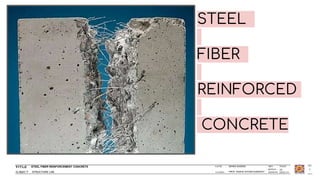
STEEL
FIBER
REINFORCED
CONCRETE
STEEL FIBER REINFORCEMENT CONCRETE
STRUCTURE LAB
ISHIKA SAXENA
PROF. RADHE SHYAM KUMAWAT
1
INTRODUCTION
Concrete is strong in compression but weak in
tension. As concrete is brittle material the failure
in concrete due to tension is sudden. There are also
cracks in concrete due to shrinkage and these
micro cracks propagate and leads to failure. To
safeguard the concrete against flexural cracks
fibres are used in concrete section which is known
as fibre reinforced concrete
STEEL FIBER REINFORCEMENT CONCRETE
STRUCTURE LAB
ISHIKA SAXENA
PROF. RADHE SHYAM KUMAWAT
1
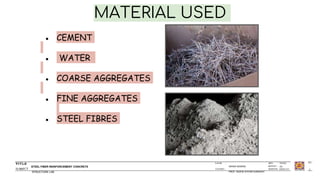
MATERIAL USED
● CEMENT
● WATER
● COARSE AGGREGATES
● FINE AGGREGATES
● STEEL FIBRES
STEEL FIBER REINFORCEMENT CONCRETE
STRUCTURE LAB
ISHIKA SAXENA
PROF. RADHE SHYAM KUMAWAT
1
Fiber- reinforced concrete (FRC) is concrete
containing fibrous material which increases its
structural integrity. It contains short discrete fibres
that are uniformly distributed and randomly oriented.
Fibres include steel fibres, glass fibres, synthetic
fibres and natural fibres – each of which lend varying
properties to the concrete. In addition, the character
of fibre-reinforced concrete changes with varying
concretes, fibre materials, geometries, distribution,
orientation, and densities.
FIBER REINFORCED CONCRETE
STEEL FIBER REINFORCEMENT CONCRETE
STRUCTURE LAB
ISHIKA SAXENA
PROF. RADHE SHYAM KUMAWAT
1
STEEL FIBER REINFORCED CONCRETE
Steel fiber reinforced concrete is a composite material having fibers as
the additional ingredients, dispersed uniformly at random in small
percentages, i.e. between 0.3% and 2.5% by volume in plain concrete. SFRC
products are manufactured by adding steel fibers to the ingredients of
concrete in the mixer and by transferring the green concrete into moulds.
The product is then compacted and cured by the conventional methods.
Segregation or balling is one of the problems encountered during mixing
and compacting SFRC. This should be avoided for uniform distribution of
fibers. The energy required for mixing, conveying, placing and finishing of
SFRC is slightly higher. Use of pan mixer and fiber dispenser to assist in
better mixing and to reduce the formation of fiber balls is essential.
Additional fines and limiting maximum size of aggregates to 20mm
occasionally, cement contents of 350 kg to 550 kg per cubic meter are
normally needed.
STEEL FIBER REINFORCEMENT CONCRETE
STRUCTURE LAB
ISHIKA SAXENA
PROF. RADHE SHYAM KUMAWAT
1
● Steel fibers are added to concrete to improve the structural
properties, particularly tensile and flexural strength. The
extent of improvement in the mechanical properties achieved
with SFRC over those of plain concrete depends on several
factors, such as shape, size, volume, percentage and
distribution of fibers.
● SFRC products are manufactured by adding steel fibers to the
ingredients of concrete in the mixer and by transferring the
green concrete into moulds. The product is then compacted and
cured by the conventional methods.
● Segregation or balling is one of the problems encountered
during mixing and compacting SFRC. This should be avoided for
uniform distribution of fibers. The energy required for mixing,
conveying, placing and finishing of SFRC is slightly higher.
STEEL FIBER REINFORCEMENT CONCRETE
STRUCTURE LAB
ISHIKA SAXENA
PROF. RADHE SHYAM KUMAWAT
1
ESSENTIAL PROPERTIES OF SFRC
● FIBRES SHOULD HAVE A HIGH STRENGTH AND
MODULUS OF ELASTICITY.
● FIBRES SHOULD BE PROTECTED FROM CORROSION BY
THE ALKALINE ENVIRONMENT PF CEMENTITIOUS
MATRIX.
● FIBRES SHOULD HAVE THE PROPERTY OF “ SURFACE
ROUGHNESS “ TO ENHANCE BONDING WITH THE
SURFACE.
● IN DIFFERENT ENVIRONMENTS COMPOSITIONS OF
THE FIBRES SHOULD BE VARIED. I.E. IN HIGH
TEMPERATURE STAINLESS STEEL FIBRES SHOULD BE
USED.
STEEL FIBER REINFORCEMENT CONCRETE
STRUCTURE LAB
ISHIKA SAXENA
PROF. RADHE SHYAM KUMAWAT
1
COMPOSITION OF STEEL
BAR ● THE COMBINATION OF STEEL FIBRES
GENERALLY INCLUDES CARBON STEEL OR
STAINLESS STEEL.
● THE LENGTH DIMENSION RANGES FROM
6.4MM TO 76MM WHILE THE DIAMETER
RANGES FROM 0.25MM-0.75MM
● THE STEEL FIBRES ARE DESCRIBED BY
CONVENIENT PARAMETER “ASPECT
RATIO”.IT IS DETERMINED BY LENGTH TO
DIAMETER RATIO.IT VARIES FROM 20-100.
STEEL FIBER REINFORCEMENT CONCRETE
STRUCTURE LAB
ISHIKA SAXENA
PROF. RADHE SHYAM KUMAWAT
1
APPLICATIONS OF SFRC
● SFRC HAS BEEN TRIED ON OVERLAYS PF AIR-FIELD,ROAD
PAVEMENTS,INDUSTRIAL FLOORINGS, BRIDGE
DECKS,CANAL LINING,EXPLOSIVE RESISTENCE
STRUCTURE,ETC.
● IT CAN ALSO BE USED FOR THE FABRICATION OF PRE-
CAST PRODUCTS LIKE PIPES,BOATS,BEAMSSTAIR CASE
STEPS,WALL PANELS,MANHOLE COVERS,ETC.
● SFRC IS ALSO BEING USED FOR THE MANUFACTURING OF
PREFABRICATED FORMWORK MOULDS OF “U” SHAPE FOR
CASTING LINTELS AND SMALL BEAMS.
STEEL FIBER REINFORCEMENT CONCRETE
STRUCTURE LAB
ISHIKA SAXENA
PROF. RADHE SHYAM KUMAWAT
1
• The required mix was prepared.
• Steel fibres are uniformly put on concrete and mixed thoroughly.
• The concrete was casted in cubes and beams
• The casted members are vibrated to remove air pockets . Vibration is
done so that there is no segregation of steel fibres.
Casting Of The Concrete Beams And Cubes
STEEL FIBER REINFORCEMENT CONCRETE
STRUCTURE LAB
ISHIKA SAXENA
PROF. RADHE SHYAM KUMAWAT
1
ADVANTAGES OF SFRC
● SFRC distributes localized stresses.
● Reduction in maintenance and repair cost.
● Provides tough and durable surfaces.
● Reduces surface permeability, dusting and wear.
● Cost saving.
● They act as crack arrestor.
● Increases tensile strength and toughness.
● Resistance to impact.
● Resistance to freezing and thawing
STEEL FIBER REINFORCEMENT CONCRETE
STRUCTURE LAB
ISHIKA SAXENA
PROF. RADHE SHYAM KUMAWAT
1
LIMITATIONS OF
SFRC
● THE USE OF SFRC REQUIRES A MORE PRECISE CONFIGURATION
AS COMPARED TO NORMAL CONCRETE.
● UNLESS STEEL FIBRES ARE ADDED IN ADEQUATE
QUANTITIES,THE DESIRED IMPROVEMENTS CANNOT BE
OBTAINED.
● AS THE QUANTITY OF THE FIBRES IS INCREASED WORKABILITY
OF THE CONCRETE IS DECREASED.
● ANOTHER PROBLEM IS THE CORROSION OF THE SURFACE WHICH
MAY INFLUENCE THE APPEARANCE OF THE SURFACE
● STEEL FIBRES ARE NOT COST EFFECTIVE. DUE TO ADDITION OF
1% STEEL FIBRES OF THE TOTAL VOLUME,THERE WILL BE
MASSIVE CHANGE IN THE TOTAL COST OF CONSTRUCTION.
STEEL FIBER REINFORCEMENT CONCRETE
STRUCTURE LAB
ISHIKA SAXENA
PROF. RADHE SHYAM KUMAWAT
1
SOME SFRC CONSTRUCTIONS
STEEL FIBER REINFORCEMENT CONCRETE
STRUCTURE LAB
ISHIKA SAXENA
PROF. RADHE SHYAM KUMAWAT
1
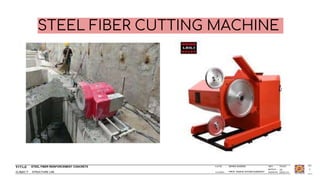
STEEL FIBER CUTTING MACHINE
STEEL FIBER REINFORCEMENT CONCRETE
STRUCTURE LAB
ISHIKA SAXENA
PROF. RADHE SHYAM KUMAWAT
1

01-SFRC.pptx

  • 1.
    STEEL FIBER REINFORCEMENTCONCRETE STRUCTURE LAB ISHIKA SAXENA PROF. RADHE SHYAM KUMAWAT 1 STEEL FIBER REINFORCED CONCRETE
  • 2.
    STEEL FIBER REINFORCEMENTCONCRETE STRUCTURE LAB ISHIKA SAXENA PROF. RADHE SHYAM KUMAWAT 1 INTRODUCTION Concrete is strong in compression but weak in tension. As concrete is brittle material the failure in concrete due to tension is sudden. There are also cracks in concrete due to shrinkage and these micro cracks propagate and leads to failure. To safeguard the concrete against flexural cracks fibres are used in concrete section which is known as fibre reinforced concrete
  • 3.
    STEEL FIBER REINFORCEMENTCONCRETE STRUCTURE LAB ISHIKA SAXENA PROF. RADHE SHYAM KUMAWAT 1 MATERIAL USED ● CEMENT ● WATER ● COARSE AGGREGATES ● FINE AGGREGATES ● STEEL FIBRES
  • 4.
    STEEL FIBER REINFORCEMENTCONCRETE STRUCTURE LAB ISHIKA SAXENA PROF. RADHE SHYAM KUMAWAT 1 Fiber- reinforced concrete (FRC) is concrete containing fibrous material which increases its structural integrity. It contains short discrete fibres that are uniformly distributed and randomly oriented. Fibres include steel fibres, glass fibres, synthetic fibres and natural fibres – each of which lend varying properties to the concrete. In addition, the character of fibre-reinforced concrete changes with varying concretes, fibre materials, geometries, distribution, orientation, and densities. FIBER REINFORCED CONCRETE
  • 5.
    STEEL FIBER REINFORCEMENTCONCRETE STRUCTURE LAB ISHIKA SAXENA PROF. RADHE SHYAM KUMAWAT 1 STEEL FIBER REINFORCED CONCRETE Steel fiber reinforced concrete is a composite material having fibers as the additional ingredients, dispersed uniformly at random in small percentages, i.e. between 0.3% and 2.5% by volume in plain concrete. SFRC products are manufactured by adding steel fibers to the ingredients of concrete in the mixer and by transferring the green concrete into moulds. The product is then compacted and cured by the conventional methods. Segregation or balling is one of the problems encountered during mixing and compacting SFRC. This should be avoided for uniform distribution of fibers. The energy required for mixing, conveying, placing and finishing of SFRC is slightly higher. Use of pan mixer and fiber dispenser to assist in better mixing and to reduce the formation of fiber balls is essential. Additional fines and limiting maximum size of aggregates to 20mm occasionally, cement contents of 350 kg to 550 kg per cubic meter are normally needed.
  • 6.
    STEEL FIBER REINFORCEMENTCONCRETE STRUCTURE LAB ISHIKA SAXENA PROF. RADHE SHYAM KUMAWAT 1 ● Steel fibers are added to concrete to improve the structural properties, particularly tensile and flexural strength. The extent of improvement in the mechanical properties achieved with SFRC over those of plain concrete depends on several factors, such as shape, size, volume, percentage and distribution of fibers. ● SFRC products are manufactured by adding steel fibers to the ingredients of concrete in the mixer and by transferring the green concrete into moulds. The product is then compacted and cured by the conventional methods. ● Segregation or balling is one of the problems encountered during mixing and compacting SFRC. This should be avoided for uniform distribution of fibers. The energy required for mixing, conveying, placing and finishing of SFRC is slightly higher.
  • 7.
    STEEL FIBER REINFORCEMENTCONCRETE STRUCTURE LAB ISHIKA SAXENA PROF. RADHE SHYAM KUMAWAT 1 ESSENTIAL PROPERTIES OF SFRC ● FIBRES SHOULD HAVE A HIGH STRENGTH AND MODULUS OF ELASTICITY. ● FIBRES SHOULD BE PROTECTED FROM CORROSION BY THE ALKALINE ENVIRONMENT PF CEMENTITIOUS MATRIX. ● FIBRES SHOULD HAVE THE PROPERTY OF “ SURFACE ROUGHNESS “ TO ENHANCE BONDING WITH THE SURFACE. ● IN DIFFERENT ENVIRONMENTS COMPOSITIONS OF THE FIBRES SHOULD BE VARIED. I.E. IN HIGH TEMPERATURE STAINLESS STEEL FIBRES SHOULD BE USED.
  • 8.
    STEEL FIBER REINFORCEMENTCONCRETE STRUCTURE LAB ISHIKA SAXENA PROF. RADHE SHYAM KUMAWAT 1 COMPOSITION OF STEEL BAR ● THE COMBINATION OF STEEL FIBRES GENERALLY INCLUDES CARBON STEEL OR STAINLESS STEEL. ● THE LENGTH DIMENSION RANGES FROM 6.4MM TO 76MM WHILE THE DIAMETER RANGES FROM 0.25MM-0.75MM ● THE STEEL FIBRES ARE DESCRIBED BY CONVENIENT PARAMETER “ASPECT RATIO”.IT IS DETERMINED BY LENGTH TO DIAMETER RATIO.IT VARIES FROM 20-100.
  • 9.
    STEEL FIBER REINFORCEMENTCONCRETE STRUCTURE LAB ISHIKA SAXENA PROF. RADHE SHYAM KUMAWAT 1 APPLICATIONS OF SFRC ● SFRC HAS BEEN TRIED ON OVERLAYS PF AIR-FIELD,ROAD PAVEMENTS,INDUSTRIAL FLOORINGS, BRIDGE DECKS,CANAL LINING,EXPLOSIVE RESISTENCE STRUCTURE,ETC. ● IT CAN ALSO BE USED FOR THE FABRICATION OF PRE- CAST PRODUCTS LIKE PIPES,BOATS,BEAMSSTAIR CASE STEPS,WALL PANELS,MANHOLE COVERS,ETC. ● SFRC IS ALSO BEING USED FOR THE MANUFACTURING OF PREFABRICATED FORMWORK MOULDS OF “U” SHAPE FOR CASTING LINTELS AND SMALL BEAMS.
  • 10.
    STEEL FIBER REINFORCEMENTCONCRETE STRUCTURE LAB ISHIKA SAXENA PROF. RADHE SHYAM KUMAWAT 1 • The required mix was prepared. • Steel fibres are uniformly put on concrete and mixed thoroughly. • The concrete was casted in cubes and beams • The casted members are vibrated to remove air pockets . Vibration is done so that there is no segregation of steel fibres. Casting Of The Concrete Beams And Cubes
  • 11.
    STEEL FIBER REINFORCEMENTCONCRETE STRUCTURE LAB ISHIKA SAXENA PROF. RADHE SHYAM KUMAWAT 1 ADVANTAGES OF SFRC ● SFRC distributes localized stresses. ● Reduction in maintenance and repair cost. ● Provides tough and durable surfaces. ● Reduces surface permeability, dusting and wear. ● Cost saving. ● They act as crack arrestor. ● Increases tensile strength and toughness. ● Resistance to impact. ● Resistance to freezing and thawing
  • 12.
    STEEL FIBER REINFORCEMENTCONCRETE STRUCTURE LAB ISHIKA SAXENA PROF. RADHE SHYAM KUMAWAT 1 LIMITATIONS OF SFRC ● THE USE OF SFRC REQUIRES A MORE PRECISE CONFIGURATION AS COMPARED TO NORMAL CONCRETE. ● UNLESS STEEL FIBRES ARE ADDED IN ADEQUATE QUANTITIES,THE DESIRED IMPROVEMENTS CANNOT BE OBTAINED. ● AS THE QUANTITY OF THE FIBRES IS INCREASED WORKABILITY OF THE CONCRETE IS DECREASED. ● ANOTHER PROBLEM IS THE CORROSION OF THE SURFACE WHICH MAY INFLUENCE THE APPEARANCE OF THE SURFACE ● STEEL FIBRES ARE NOT COST EFFECTIVE. DUE TO ADDITION OF 1% STEEL FIBRES OF THE TOTAL VOLUME,THERE WILL BE MASSIVE CHANGE IN THE TOTAL COST OF CONSTRUCTION.
  • 13.
    STEEL FIBER REINFORCEMENTCONCRETE STRUCTURE LAB ISHIKA SAXENA PROF. RADHE SHYAM KUMAWAT 1 SOME SFRC CONSTRUCTIONS
  • 14.
    STEEL FIBER REINFORCEMENTCONCRETE STRUCTURE LAB ISHIKA SAXENA PROF. RADHE SHYAM KUMAWAT 1 STEEL FIBER CUTTING MACHINE
  • 15.
    STEEL FIBER REINFORCEMENTCONCRETE STRUCTURE LAB ISHIKA SAXENA PROF. RADHE SHYAM KUMAWAT 1