IOSR Journal of Mechanical and Civil Engineering (IOSR-JMCE)
e-ISSN: 2278-1684,p-ISSN: 2320-334X, Volume 12, Issue 2 Ver. VII (Mar - Apr. 2015), PP 48-53
www.iosrjournals.org
DOI: 10.9790/1684-12274853 www.iosrjournals.org 48 | Page
Performance of RC Beam Column Connections Subjected to
Cyclic Loading
Minakshi Vaghani 1
, Dr. S.A. Vasanwala 2
, Dr. A.K. Desai 3
1
(Civil Engineering Department, Sarvajanik College of Engineering & Technology, Surat – 1, India)
2,3.
(Applied Mechanics Department, SVNIT, Surat- 1, India)
Abstract : Structures and lifelines designed for typical loading are often badly damaged or can collapse during
earthquakes. The observations from recent earthquakes show that many RC structures have failed in the brittle
behaviour of beam-column connections due to the deficiency of seismic details in the joint regions. Joint shear
failures have been observed recently in many existing RC structures subjected to severe earthquake loadings. In
this study, RC beam column specimen was casted and tested for excitation of cyclic loading. Attempts are made
to study the performance of the test specimen by studying loop hysteresis, maximum push and pull load and load
at the propagation of first crack.
Keywords: Non-linear analysis; Crack propagation, cyclic loading
I. Introduction
Designing beam–column joints is considered to be a complex and challenging task for structural
engineers, and careful design of joints in RC frame structures is crucial to the safety of the structure. Although
the size of the joint is controlled by the size of the frame members, joints are subjected to a different set of loads
from those used in designing beams and columns. It has been identified that the deficiencies of joints are mainly
caused due to inadequate design to resist shear forces (horizontal and vertical) and consequently by inadequate
transverse and vertical shear reinforcement and of course due to insufficient anchorage capacity in the joint [1].
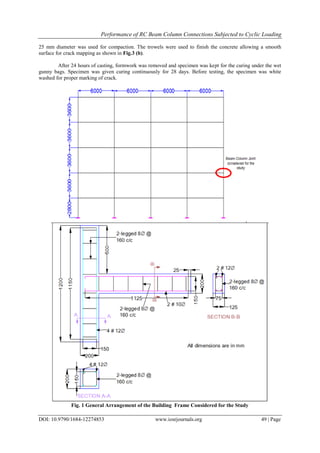
In this study, a conventional four-storey RC school building (Fig.1) is considered for analysis, design
and detailing of exterior joint. Different failure modes are expected in beam-column joints depending on the
type of joint (exterior or interior) and the adopted structural details. Hence, in the present study, exterior beam-
column joint has been chosen for investigating the performance under seismic type loading.
II. Design Of Test Specimen
Characteristic compressive strength of concrete and tensile strength of steel used in the specimen have
been taken as 30 MPa and 415 MPa, respectively. The specimen has the following general and cross-sectional
dimensions: height of column is 3200 mm having cross-sections of (425 x 425) mm and length of beam is 2500
mm with beam size (300 x 525) mm. For casting the specimen, weight ratio of cement: sand: coarse aggregate
was adopted as 1 (cement): 2.25 (fine aggregate): 2.35 (coarse aggregate-60% 10 mm size, 40% 20 mm size):
0.5 (w/c). Ordinary Portland Cement (OPC) with 28 days minimum compressive strength of 53 MPa is used.
Analysis of a conventional four storey RC building frame is carried out using STAAD.Pro. Based on
analysis data, critical region such as exterior joint is selected for the study. Gravity load design (GLD) specimen
was designed and the reinforcement is provided as per details given in IS: 456 – 2000. The geometry of the
specimen is finalised in order to match the bending moment distribution at the joint for which it is designed.
Seismic analysis (Response Spectrum Analysis) of the framed structure (Fig. 1) has been performed using
STAAD.Pro to obtain the design forces. The results obtained from the analysis of a 3 - bay four-storey RC
building under the load combinations are used to design the specimen. Finally, as shown in Fig. 2, the geometry
of the components (top and bottom portion of column and beam length from joint face) is chosen to match the
bending moment distribution at the joint for which it was designed.
III. Preparation Of Test Specimen
For the construction of beam column specimen, foldable wooden moulds are prepared so set specimen
can be easily removed from the mould. These moulds can be reused. As per details given in Fig. 2
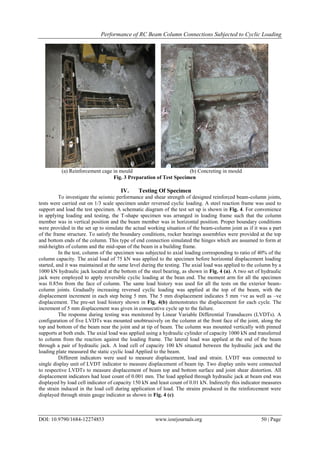
reinforcement bars are provided. Fig. 3 shows the wooden mould with reinforcement bars placed inside it. Strain
gauges were fixed with reinforcement bars in order to study the strain developed in the bars when the specimen
is loaded. After the assemblage of the beam and column reinforcement, the assembly was put into the formwork
and was made ready for casting as shown in Fig. 3 (a). The plain concrete used in all groups was prepared by
proportion 1: 1.57: 3.20. The concrete was poured in the formwork horizontally. The compaction of the concrete
was performed using a vibrator to produce uniformity throughout the specimen. A needle vibrator with a head of
Performance of RC Beam Column Connections Subjected to Cyclic Loading
DOI: 10.9790/1684-12274853 www.iosrjournals.org 49 | Page
25 mm diameter was used for compaction. The trowels were used to finish the concrete allowing a smooth
surface for crack mapping as shown in Fig.3 (b).
After 24 hours of casting, formwork was removed and specimen was kept for the curing under the wet
gunny bags. Specimen was given curing continuously for 28 days. Before testing, the specimen was white
washed for proper marking of crack.
Fig. 1 General Arrangement of the Building Frame Considered for the Study
Performance of RC Beam Column Connections Subjected to Cyclic Loading
DOI: 10.9790/1684-12274853 www.iosrjournals.org 50 | Page
(a) Reinforcement cage in mould (b) Concreting in mould
Fig. 3 Preparation of Test Specimen
IV. Testing Of Specimen
To investigate the seismic performance and shear strength of designed reinforced beam-column joints,
tests were carried out on 1/3 scale specimen under reversed cyclic loading. A steel reaction frame was used to
support and load the test specimen. A schematic diagram of the test set up is shown in Fig. 4. For convenience
in applying loading and testing, the T-shape specimen was arranged in loading frame such that the column
member was in vertical position and the beam member was in horizontal position. Proper boundary conditions
were provided in the set up to simulate the actual working situation of the beam-column joint as if it was a part
of the frame structure. To satisfy the boundary conditions, rocker bearings assemblies were provided at the top
and bottom ends of the column. This type of end connection simulated the hinges which are assumed to form at
mid-heights of column and the mid-span of the beam in a building frame.
In the test, column of the specimen was subjected to axial loading corresponding to ratio of 40% of the
column capacity. The axial load of 75 kN was applied to the specimen before horizontal displacement loading
started, and it was maintained at the same level during the testing. The axial load was applied to the column by a
1000 kN hydraulic jack located at the bottom of the steel bearing, as shown in Fig. 4 (a). A two set of hydraulic
jack were employed to apply reversible cyclic loading at the bean end. The moment arm for all the specimen
was 0.85m from the face of column. The same load history was used for all the tests on the exterior beam-
column joints. Gradually increasing reversed cyclic loading was applied at the top of the beam, with the
displacement increment in each step being 5 mm. The 5 mm displacement indicates 5 mm +ve as well as –ve
displacement. The pre-set load history shown in Fig. 4(b) demonstrates the displacement for each cycle. The
increment of 5 mm displacement was given in consecutive cycle up to the failure.
The response during testing was monitored by Linear Variable Differential Transducers (LVDTs). A
configuration of five LVDTs was mounted unobtrusively on the column at the front face of the joint, along the
top and bottom of the beam near the joint and at tip of beam. The column was mounted vertically with pinned
supports at both ends. The axial load was applied using a hydraulic cylinder of capacity 1000 kN and transferred
to column from the reaction against the loading frame. The lateral load was applied at the end of the beam
through a pair of hydraulic jack. A load cell of capacity 100 kN situated between the hydraulic jack and the
loading plate measured the static cyclic load Applied to the beam.
Different indicators were used to measure displacement, load and strain. LVDT was connected to
single display unit of LVDT indicator to measure displacement of beam tip. Two display units were connected
to respective LVDTs to measure displacement of beam top and bottom surface and joint shear distortion. All
displacement indicators had least count of 0.001 mm. The load applied through hydraulic jack at beam end was
displayed by load cell indicator of capacity 150 kN and least count of 0.01 kN. Indirectly this indicator measures
the strain induced in the load cell during application of load. The strains produced in the reinforcement were
displayed through strain gauge indicator as shown in Fig. 4 (c).
Performance of RC Beam Column Connections Subjected to Cyclic Loading
DOI: 10.9790/1684-12274853 www.iosrjournals.org 51 | Page
(a) Experimental set-up
(c) Measuring devices
(d) Cyclic load history
Fig. 4 Testing of Test Specimen
V. Results And Discussions
The cyclic performance characteristics of the beam–column joints can be evaluated through hysteretic
behaviors such as ductility, energy dissipation capacity, strength deterioration, and stiffness degradation.
5.1 Crack and Damage Pattern
Ten full displacement cycles were applied to the test specimen. In the first loading cycle, the specimen
was loaded up to 9.63 kN up and 9.38 kN down to test the instrumentations. First flexural crack was observed
during second cycle at displacement of 10 mm (drift ratio of 1.18%).
Fig. 5 Crack and Damage Pattern of Beam-Column Specimen
The corresponding restoring force was measured as 15.72 kN down. In the fourth cycle, a load of 24.95
kN was applied down and 22.58 kN up to the specimen and new flexural and flexural–shear cracks formed
along the beam length. In the sixth cycle, vertical crack formed in the joint region at beam-tip load of 29.68 kN
due to bond-slip of the beam bottom bars. During the eighth cycle, diagonal shear cracks developed in the joint
region, and the specimen reached a load of 31.06 kN at a beam-tip displacement of 35.9 mm. Repeating the
same cycle, the beam reached the same displacement but at lower load level and the beam bars started to slip out
of the joint with an associated reduction in the developed strain in the bars. The final failure pattern is shown in
Fig. 5.
5.2 Hysteretic Behaviour
The most important parameter for seismic performance of structural D-regions can be described by
load–displacement hysteresis during the cyclic loading which can indicate the ductility capacity and energy
dissipation efficiency of the component [2,3]. It is well proven that the beam-column joint of reinforced
Performance of RC Beam Column Connections Subjected to Cyclic Loading
DOI: 10.9790/1684-12274853 www.iosrjournals.org 52 | Page
concrete structure is the single crucial component in dissipating seismic energy during earthquake. In view of
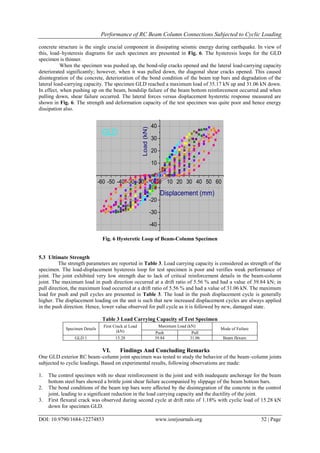
this, load–hysteresis diagrams for each specimen are presented in Fig. 6. The hysteresis loops for the GLD
specimen is thinner.
When the specimen was pushed up, the bond-slip cracks opened and the lateral load-carrying capacity
deteriorated significantly; however, when it was pulled down, the diagonal shear cracks opened. This caused
disintegration of the concrete, deterioration of the bond condition of the beam top bars and degradation of the
lateral load-carrying capacity. The specimen GLD reached a maximum load of 35.17 kN up and 31.06 kN down.
In effect, when pushing up on the beam, bondslip failure of the beam bottom reinforcement occurred and when
pulling down, shear failure occurred. The lateral forces versus displacement hysteretic response measured are
shown in Fig. 6. The strength and deformation capacity of the test specimen was quite poor and hence energy
dissipation also.
-60 -50 -40 -30 -20 -10 0 10 20 30 40 50 60
-40
-30
-20
-10
0
10
20
30
40
Load(kN)
Displacement (mm)
GLD
Fig. 6 Hysteretic Loop of Beam-Column Specimen
5.3 Ultimate Strength
The strength parameters are reported in Table 3. Load carrying capacity is considered as strength of the
specimen. The load-displacement hysteresis loop for test specimen is poor and verifies weak performance of
joint. The joint exhibited very low strength due to lack of critical reinforcement details in the beam-column
joint. The maximum load in push direction occurred at a drift ratio of 5.56 % and had a value of 39.84 kN; in
pull direction, the maximum load occurred at a drift ratio of 5.56 % and had a value of 31.06 kN. The maximum
load for push and pull cycles are presented in Table 3. The load in the push displacement cycle is generally
higher. The displacement loading on the unit is such that new increased displacement cycles are always applied
in the push direction. Hence, lower value observed for pull cycle as it is followed by new, damaged state.
Table 3 Load Carrying Capacity of Test Specimen
Specimen Details
First Crack at Load
(kN)
Maximum Load (kN)
Mode of Failure
Push Pull
GLD 1 15.28 39.84 31.06 Beam flexure
VI. Findings And Concluding Remarks
One GLD exterior RC beam–column joint specimen was tested to study the behavior of the beam–column joints
subjected to cyclic loadings. Based on experimental results, following observations are made:
1. The control specimen with no shear reinforcement in the joint and with inadequate anchorage for the beam
bottom steel bars showed a brittle joint shear failure accompanied by slippage of the beam bottom bars.
2. The bond conditions of the beam top bars were affected by the disintegration of the concrete in the control
joint, leading to a significant reduction in the load carrying capacity and the ductility of the joint.
3. First flexural crack was observed during second cycle at drift ratio of 1.18% with cyclic load of 15.28 kN
down for specimen GLD.
Performance of RC Beam Column Connections Subjected to Cyclic Loading
DOI: 10.9790/1684-12274853 www.iosrjournals.org 53 | Page
4. The maximum load in push direction occurred at a drift ratio of 5.56 % and had a value of 39.84 kN; in pull
direction, the maximum load occurred at a drift ratio of 5.56 % and had a value of 31.06 kN for GLD
specimen.
References
Journal Papers:
[1]. Akanshu Sharma, R. Eligehausen, G.R. Reddy (2011), "A new model to simulate joint shear behavior of poorly detailed beam–
column connections in RC structures under seismic loads, Part I: Exterior joints", Engineering Structures, 33, 1034–1051.
[2]. Constanze Röhma, Balthasar Novák, Saptarshi Sasmal, Ramanjaneyulu Karusala, Voggu Srinivas(2012), " Behaviour of fibre
reinforced beam-column sub-assemblages under reversed cyclic loading ”, Construction and Building Materials, 36 ,319–329
[3]. Saptarshi Sasmal, Balthasar Novák, K. Ramanjaneyulu (2011), "Numerical analysis of fiber composite-steel plate upgraded beam–
column sub-assemblage under cyclic loading", Composite Structures 93, pp. 599–610.
[4]. G. A. Lakshmi, Anjan Dutta, S.K. Deb (2008), "Numerical Studies of Strengthening of Beam-column Joint under Cyclic Excitation
using FRP Composites", Journal of Structural Engineering, 35, 59-65.
[5]. Ghobarah A. and T. El-Amoury (2002). "Seismic rehabilitation of beam–column joint using GFRP sheets", Engineering Structures
5, 1397–1407.
[6]. Ghobarah A., M. El-Attar, N.M. Aly (2000), "Evaluation of retrofit strategies for reinforced concrete columns: a case study",
Engineering Structures, 22, 490–501.
[7]. Kien Le-Trung, Kihak Lee, Jaehong Lee, Do Hyung Lee, Sungwoo Woo (2010), "Experimental study of RC beam–column joints
strengthened using CFRP composites", Composites: Part B, 41, 76–85.
[8]. Kien Le-Trung, Kihak Lee, Myoungsu Shin, Jaehong Lee (2011), "Analytical assessment and modeling of RC beam-column
connections strengthened with CFRP composites", Composites: Part B, 42, 1786–1798.
[9]. Jaehong Kim and James M. LaFave,"Joint Shear Behavior of Reinforced Concrete Beam-Column Connections subjected to Seismic
Lateral Loading", NSEL Report Series Report No. NSEL-020 November 2009
Book:
[1]. Dr. Durgesh C Rai (2007), Review of Documents on Seismic Strengthening of Existing Buildings, IITK,-GSDMA - EQ07 - V1.0,
India
Standards:
[1]. Indian Standard (IS 13920-1993). Ductile detailing of reinforced concrete structures subjected to seismic forces – code of practice
Bureau of Indian Standards , New Delhi.
[2]. Indian Standard (IS-456-2000). Plain and reinforced concrete – code of practice. New Delhi: Bureau of Indian Standards, New
Delhi.

I012274853

  • 1.
    IOSR Journal ofMechanical and Civil Engineering (IOSR-JMCE) e-ISSN: 2278-1684,p-ISSN: 2320-334X, Volume 12, Issue 2 Ver. VII (Mar - Apr. 2015), PP 48-53 www.iosrjournals.org DOI: 10.9790/1684-12274853 www.iosrjournals.org 48 | Page Performance of RC Beam Column Connections Subjected to Cyclic Loading Minakshi Vaghani 1 , Dr. S.A. Vasanwala 2 , Dr. A.K. Desai 3 1 (Civil Engineering Department, Sarvajanik College of Engineering & Technology, Surat – 1, India) 2,3. (Applied Mechanics Department, SVNIT, Surat- 1, India) Abstract : Structures and lifelines designed for typical loading are often badly damaged or can collapse during earthquakes. The observations from recent earthquakes show that many RC structures have failed in the brittle behaviour of beam-column connections due to the deficiency of seismic details in the joint regions. Joint shear failures have been observed recently in many existing RC structures subjected to severe earthquake loadings. In this study, RC beam column specimen was casted and tested for excitation of cyclic loading. Attempts are made to study the performance of the test specimen by studying loop hysteresis, maximum push and pull load and load at the propagation of first crack. Keywords: Non-linear analysis; Crack propagation, cyclic loading I. Introduction Designing beam–column joints is considered to be a complex and challenging task for structural engineers, and careful design of joints in RC frame structures is crucial to the safety of the structure. Although the size of the joint is controlled by the size of the frame members, joints are subjected to a different set of loads from those used in designing beams and columns. It has been identified that the deficiencies of joints are mainly caused due to inadequate design to resist shear forces (horizontal and vertical) and consequently by inadequate transverse and vertical shear reinforcement and of course due to insufficient anchorage capacity in the joint [1]. In this study, a conventional four-storey RC school building (Fig.1) is considered for analysis, design and detailing of exterior joint. Different failure modes are expected in beam-column joints depending on the type of joint (exterior or interior) and the adopted structural details. Hence, in the present study, exterior beam- column joint has been chosen for investigating the performance under seismic type loading. II. Design Of Test Specimen Characteristic compressive strength of concrete and tensile strength of steel used in the specimen have been taken as 30 MPa and 415 MPa, respectively. The specimen has the following general and cross-sectional dimensions: height of column is 3200 mm having cross-sections of (425 x 425) mm and length of beam is 2500 mm with beam size (300 x 525) mm. For casting the specimen, weight ratio of cement: sand: coarse aggregate was adopted as 1 (cement): 2.25 (fine aggregate): 2.35 (coarse aggregate-60% 10 mm size, 40% 20 mm size): 0.5 (w/c). Ordinary Portland Cement (OPC) with 28 days minimum compressive strength of 53 MPa is used. Analysis of a conventional four storey RC building frame is carried out using STAAD.Pro. Based on analysis data, critical region such as exterior joint is selected for the study. Gravity load design (GLD) specimen was designed and the reinforcement is provided as per details given in IS: 456 – 2000. The geometry of the specimen is finalised in order to match the bending moment distribution at the joint for which it is designed. Seismic analysis (Response Spectrum Analysis) of the framed structure (Fig. 1) has been performed using STAAD.Pro to obtain the design forces. The results obtained from the analysis of a 3 - bay four-storey RC building under the load combinations are used to design the specimen. Finally, as shown in Fig. 2, the geometry of the components (top and bottom portion of column and beam length from joint face) is chosen to match the bending moment distribution at the joint for which it was designed. III. Preparation Of Test Specimen For the construction of beam column specimen, foldable wooden moulds are prepared so set specimen can be easily removed from the mould. These moulds can be reused. As per details given in Fig. 2 reinforcement bars are provided. Fig. 3 shows the wooden mould with reinforcement bars placed inside it. Strain gauges were fixed with reinforcement bars in order to study the strain developed in the bars when the specimen is loaded. After the assemblage of the beam and column reinforcement, the assembly was put into the formwork and was made ready for casting as shown in Fig. 3 (a). The plain concrete used in all groups was prepared by proportion 1: 1.57: 3.20. The concrete was poured in the formwork horizontally. The compaction of the concrete was performed using a vibrator to produce uniformity throughout the specimen. A needle vibrator with a head of
  • 2.
    Performance of RCBeam Column Connections Subjected to Cyclic Loading DOI: 10.9790/1684-12274853 www.iosrjournals.org 49 | Page 25 mm diameter was used for compaction. The trowels were used to finish the concrete allowing a smooth surface for crack mapping as shown in Fig.3 (b). After 24 hours of casting, formwork was removed and specimen was kept for the curing under the wet gunny bags. Specimen was given curing continuously for 28 days. Before testing, the specimen was white washed for proper marking of crack. Fig. 1 General Arrangement of the Building Frame Considered for the Study
  • 3.
    Performance of RCBeam Column Connections Subjected to Cyclic Loading DOI: 10.9790/1684-12274853 www.iosrjournals.org 50 | Page (a) Reinforcement cage in mould (b) Concreting in mould Fig. 3 Preparation of Test Specimen IV. Testing Of Specimen To investigate the seismic performance and shear strength of designed reinforced beam-column joints, tests were carried out on 1/3 scale specimen under reversed cyclic loading. A steel reaction frame was used to support and load the test specimen. A schematic diagram of the test set up is shown in Fig. 4. For convenience in applying loading and testing, the T-shape specimen was arranged in loading frame such that the column member was in vertical position and the beam member was in horizontal position. Proper boundary conditions were provided in the set up to simulate the actual working situation of the beam-column joint as if it was a part of the frame structure. To satisfy the boundary conditions, rocker bearings assemblies were provided at the top and bottom ends of the column. This type of end connection simulated the hinges which are assumed to form at mid-heights of column and the mid-span of the beam in a building frame. In the test, column of the specimen was subjected to axial loading corresponding to ratio of 40% of the column capacity. The axial load of 75 kN was applied to the specimen before horizontal displacement loading started, and it was maintained at the same level during the testing. The axial load was applied to the column by a 1000 kN hydraulic jack located at the bottom of the steel bearing, as shown in Fig. 4 (a). A two set of hydraulic jack were employed to apply reversible cyclic loading at the bean end. The moment arm for all the specimen was 0.85m from the face of column. The same load history was used for all the tests on the exterior beam- column joints. Gradually increasing reversed cyclic loading was applied at the top of the beam, with the displacement increment in each step being 5 mm. The 5 mm displacement indicates 5 mm +ve as well as –ve displacement. The pre-set load history shown in Fig. 4(b) demonstrates the displacement for each cycle. The increment of 5 mm displacement was given in consecutive cycle up to the failure. The response during testing was monitored by Linear Variable Differential Transducers (LVDTs). A configuration of five LVDTs was mounted unobtrusively on the column at the front face of the joint, along the top and bottom of the beam near the joint and at tip of beam. The column was mounted vertically with pinned supports at both ends. The axial load was applied using a hydraulic cylinder of capacity 1000 kN and transferred to column from the reaction against the loading frame. The lateral load was applied at the end of the beam through a pair of hydraulic jack. A load cell of capacity 100 kN situated between the hydraulic jack and the loading plate measured the static cyclic load Applied to the beam. Different indicators were used to measure displacement, load and strain. LVDT was connected to single display unit of LVDT indicator to measure displacement of beam tip. Two display units were connected to respective LVDTs to measure displacement of beam top and bottom surface and joint shear distortion. All displacement indicators had least count of 0.001 mm. The load applied through hydraulic jack at beam end was displayed by load cell indicator of capacity 150 kN and least count of 0.01 kN. Indirectly this indicator measures the strain induced in the load cell during application of load. The strains produced in the reinforcement were displayed through strain gauge indicator as shown in Fig. 4 (c).
  • 4.
    Performance of RCBeam Column Connections Subjected to Cyclic Loading DOI: 10.9790/1684-12274853 www.iosrjournals.org 51 | Page (a) Experimental set-up (c) Measuring devices (d) Cyclic load history Fig. 4 Testing of Test Specimen V. Results And Discussions The cyclic performance characteristics of the beam–column joints can be evaluated through hysteretic behaviors such as ductility, energy dissipation capacity, strength deterioration, and stiffness degradation. 5.1 Crack and Damage Pattern Ten full displacement cycles were applied to the test specimen. In the first loading cycle, the specimen was loaded up to 9.63 kN up and 9.38 kN down to test the instrumentations. First flexural crack was observed during second cycle at displacement of 10 mm (drift ratio of 1.18%). Fig. 5 Crack and Damage Pattern of Beam-Column Specimen The corresponding restoring force was measured as 15.72 kN down. In the fourth cycle, a load of 24.95 kN was applied down and 22.58 kN up to the specimen and new flexural and flexural–shear cracks formed along the beam length. In the sixth cycle, vertical crack formed in the joint region at beam-tip load of 29.68 kN due to bond-slip of the beam bottom bars. During the eighth cycle, diagonal shear cracks developed in the joint region, and the specimen reached a load of 31.06 kN at a beam-tip displacement of 35.9 mm. Repeating the same cycle, the beam reached the same displacement but at lower load level and the beam bars started to slip out of the joint with an associated reduction in the developed strain in the bars. The final failure pattern is shown in Fig. 5. 5.2 Hysteretic Behaviour The most important parameter for seismic performance of structural D-regions can be described by load–displacement hysteresis during the cyclic loading which can indicate the ductility capacity and energy dissipation efficiency of the component [2,3]. It is well proven that the beam-column joint of reinforced
  • 5.
    Performance of RCBeam Column Connections Subjected to Cyclic Loading DOI: 10.9790/1684-12274853 www.iosrjournals.org 52 | Page concrete structure is the single crucial component in dissipating seismic energy during earthquake. In view of this, load–hysteresis diagrams for each specimen are presented in Fig. 6. The hysteresis loops for the GLD specimen is thinner. When the specimen was pushed up, the bond-slip cracks opened and the lateral load-carrying capacity deteriorated significantly; however, when it was pulled down, the diagonal shear cracks opened. This caused disintegration of the concrete, deterioration of the bond condition of the beam top bars and degradation of the lateral load-carrying capacity. The specimen GLD reached a maximum load of 35.17 kN up and 31.06 kN down. In effect, when pushing up on the beam, bondslip failure of the beam bottom reinforcement occurred and when pulling down, shear failure occurred. The lateral forces versus displacement hysteretic response measured are shown in Fig. 6. The strength and deformation capacity of the test specimen was quite poor and hence energy dissipation also. -60 -50 -40 -30 -20 -10 0 10 20 30 40 50 60 -40 -30 -20 -10 0 10 20 30 40 Load(kN) Displacement (mm) GLD Fig. 6 Hysteretic Loop of Beam-Column Specimen 5.3 Ultimate Strength The strength parameters are reported in Table 3. Load carrying capacity is considered as strength of the specimen. The load-displacement hysteresis loop for test specimen is poor and verifies weak performance of joint. The joint exhibited very low strength due to lack of critical reinforcement details in the beam-column joint. The maximum load in push direction occurred at a drift ratio of 5.56 % and had a value of 39.84 kN; in pull direction, the maximum load occurred at a drift ratio of 5.56 % and had a value of 31.06 kN. The maximum load for push and pull cycles are presented in Table 3. The load in the push displacement cycle is generally higher. The displacement loading on the unit is such that new increased displacement cycles are always applied in the push direction. Hence, lower value observed for pull cycle as it is followed by new, damaged state. Table 3 Load Carrying Capacity of Test Specimen Specimen Details First Crack at Load (kN) Maximum Load (kN) Mode of Failure Push Pull GLD 1 15.28 39.84 31.06 Beam flexure VI. Findings And Concluding Remarks One GLD exterior RC beam–column joint specimen was tested to study the behavior of the beam–column joints subjected to cyclic loadings. Based on experimental results, following observations are made: 1. The control specimen with no shear reinforcement in the joint and with inadequate anchorage for the beam bottom steel bars showed a brittle joint shear failure accompanied by slippage of the beam bottom bars. 2. The bond conditions of the beam top bars were affected by the disintegration of the concrete in the control joint, leading to a significant reduction in the load carrying capacity and the ductility of the joint. 3. First flexural crack was observed during second cycle at drift ratio of 1.18% with cyclic load of 15.28 kN down for specimen GLD.
  • 6.
    Performance of RCBeam Column Connections Subjected to Cyclic Loading DOI: 10.9790/1684-12274853 www.iosrjournals.org 53 | Page 4. The maximum load in push direction occurred at a drift ratio of 5.56 % and had a value of 39.84 kN; in pull direction, the maximum load occurred at a drift ratio of 5.56 % and had a value of 31.06 kN for GLD specimen. References Journal Papers: [1]. Akanshu Sharma, R. Eligehausen, G.R. Reddy (2011), "A new model to simulate joint shear behavior of poorly detailed beam– column connections in RC structures under seismic loads, Part I: Exterior joints", Engineering Structures, 33, 1034–1051. [2]. Constanze Röhma, Balthasar Novák, Saptarshi Sasmal, Ramanjaneyulu Karusala, Voggu Srinivas(2012), " Behaviour of fibre reinforced beam-column sub-assemblages under reversed cyclic loading ”, Construction and Building Materials, 36 ,319–329 [3]. Saptarshi Sasmal, Balthasar Novák, K. Ramanjaneyulu (2011), "Numerical analysis of fiber composite-steel plate upgraded beam– column sub-assemblage under cyclic loading", Composite Structures 93, pp. 599–610. [4]. G. A. Lakshmi, Anjan Dutta, S.K. Deb (2008), "Numerical Studies of Strengthening of Beam-column Joint under Cyclic Excitation using FRP Composites", Journal of Structural Engineering, 35, 59-65. [5]. Ghobarah A. and T. El-Amoury (2002). "Seismic rehabilitation of beam–column joint using GFRP sheets", Engineering Structures 5, 1397–1407. [6]. Ghobarah A., M. El-Attar, N.M. Aly (2000), "Evaluation of retrofit strategies for reinforced concrete columns: a case study", Engineering Structures, 22, 490–501. [7]. Kien Le-Trung, Kihak Lee, Jaehong Lee, Do Hyung Lee, Sungwoo Woo (2010), "Experimental study of RC beam–column joints strengthened using CFRP composites", Composites: Part B, 41, 76–85. [8]. Kien Le-Trung, Kihak Lee, Myoungsu Shin, Jaehong Lee (2011), "Analytical assessment and modeling of RC beam-column connections strengthened with CFRP composites", Composites: Part B, 42, 1786–1798. [9]. Jaehong Kim and James M. LaFave,"Joint Shear Behavior of Reinforced Concrete Beam-Column Connections subjected to Seismic Lateral Loading", NSEL Report Series Report No. NSEL-020 November 2009 Book: [1]. Dr. Durgesh C Rai (2007), Review of Documents on Seismic Strengthening of Existing Buildings, IITK,-GSDMA - EQ07 - V1.0, India Standards: [1]. Indian Standard (IS 13920-1993). Ductile detailing of reinforced concrete structures subjected to seismic forces – code of practice Bureau of Indian Standards , New Delhi. [2]. Indian Standard (IS-456-2000). Plain and reinforced concrete – code of practice. New Delhi: Bureau of Indian Standards, New Delhi.