Download to read offline
![IOSR Journal of Electrical and Electronics Engineering (IOSR-JEEE)
e-ISSN: 2278-1676,p-ISSN: 2320-3331, Volume 10, Issue 6 Ver. II (Nov – Dec. 2015), PP 68-77
www.iosrjournals.org
DOI: 10.9790/1676-10626877 www.iosrjournals.org 68 | Page
Smart Mutatable Advanced Technology Wheelchair
Shruti Kulkarni1
, Prashali Sharma2
, Nilay Chowdhury3
,
Tanay Chowdhury4
1
(U.G Student, Electronics & Telecommunication, Pune University, Maharashtra, India)
2
(U.G Student, Electronics & Telecommunication, Pune University, Maharashtra, India)
3
(U.G Student, Electronics & Telecommunication, Pune University Maharashtra,, India)
4
(U.G Student, Electronics & Telecommunication, Pune University, Maharashtra, India)
Abstract: While the needs of many individuals with disabilities can be satisfied with power wheelchairs, some
members of the disabled community find it difficult or impossible to operate a standard power wheelchair. To
accommodate this population, several researchers have used technologies originally developed for mobile
robots to create “smart wheelchairs” that reduce the physical, perceptual, and cognitive skills necessary to
operate a power wheelchair. We are developing a Smart Mutatable Advanced Technology wheelchair. This
paper describes the design of a prototype, which has been evaluated on wheelchair.
Keywords: disability, rehabilitation, smart features, smart phone, smart wheelchair.
I. Introduction
The number of people who are paralyzed and therefore dependent on others due to loss of self-mobility
is growing with the population. The development of the wheelchair for paralyzed users is surprisingly recent
starting with the conventional manually powered wheelchairs and advancing to electrical wheelchairs.
Conventional wheelchair use tends to focus exclusively on manual use of hands which excludes those unable to
do so. Diseases or accidents injuring the nervous system also affect because people lose their ability to move
their voluntary muscle. Because voluntary muscle is the main actuator enabling people to move their body,
paralysis may cause a person not move their loco motor organ such as arm, leg and others.
Scientist Stephen W. Hawking is perhaps the most well-known victim of major paralysis – Hawking
was diagnosed with incurable Amyotrophic Lateral Sclerosis (ALS) in 1962, thereafter using a wheelchair to
move. Many of those suffering close to or complete paralysis usually however still can control their eye
movement which inspired us to develop an eye-controlled electric wheelchair.
(a) Alex Dev, Horizon C Chacko (2011) used EOG to control the wheelchair locomotion. A pair of
electrodes is placed horizontally to left and right Eye. If the eye is moved from the centre position
towards one electrode, a potential change occurs between the electrodes. Due to the changes in the
potential the wheelchair can be controlled.
(b) S.Tameemsultana and N. Kali Saranya (2011) [1] used head and finger movement for wheelchair
locomotion. In finger movement they use flex sensor, placed on the finger. It is an analog resistor usually in the
form of strip long variable resistance. Due to the bending of finger the resistance varies which controls the
locomotion of the wheelchair. Bending the sensor at one point more than 90 may permanently damage the
sensor which is a main drawback. The system already existing for the physically challenged person controlled
by other different technologies has some defects:
In Eye ball sensor they use infra red sensor to control the wheelchair where continuous fall of IR
radiation in the eye causes irritation to the patient (Alex Dev, Horizon C Chacko and Roshan Varghese,
April, 2012, ISBN.)
In voice control the person must use the exact commands only to control the movement. Change in the
words restricts the wheelchair movement (Manuel Mazo, 1995) [2]. All the electronic system and also
the philosophy for functioning has been sufficiently refined to attain the subsequent performances:
- To ensure easy, comfortable driving.
- To reply to the speed requirements for a system of this kind (maximum speeds of up to three m/s).
- To be simply adaptable to any kind of commercial wheelchair chassis.
- To ease learning to handle the chair and getting most potency.
- To ensure much constant speeds, to an oversized extent independently of the characteristics of the
surface over that the wheel chair is moving (greater or lesser roughness of the ground and also slope of
same) and the weight of the person using it.
Keeping in mind our aim of helping patients in all aspects, study was conducted to determine how to
collaborate easy functioning wheelchair with low cost. Hence a wheelchair was developed rounding off all
possible considerations to get a complete package of simple design, low cost and user friendly operations.](https://image.slidesharecdn.com/i010626877-160706060221/85/I010626877-1-320.jpg)
![IOSR Journal of Electrical and Electronics Engineering (IOSR-JEEE)
e-ISSN: 2278-1676,p-ISSN: 2320-3331, Volume 10, Issue 6 Ver. II (Nov – Dec. 2015), PP 68-77
www.iosrjournals.org
DOI: 10.9790/1676-10626877 www.iosrjournals.org 68 | Page
Smart Mutatable Advanced Technology Wheelchair
Shruti Kulkarni1
, Prashali Sharma2
, Nilay Chowdhury3
,
Tanay Chowdhury4
1
(U.G Student, Electronics & Telecommunication, Pune University, Maharashtra, India)
2
(U.G Student, Electronics & Telecommunication, Pune University, Maharashtra, India)
3
(U.G Student, Electronics & Telecommunication, Pune University Maharashtra,, India)
4
(U.G Student, Electronics & Telecommunication, Pune University, Maharashtra, India)
Abstract: While the needs of many individuals with disabilities can be satisfied with power wheelchairs, some
members of the disabled community find it difficult or impossible to operate a standard power wheelchair. To
accommodate this population, several researchers have used technologies originally developed for mobile
robots to create “smart wheelchairs” that reduce the physical, perceptual, and cognitive skills necessary to
operate a power wheelchair. We are developing a Smart Mutatable Advanced Technology wheelchair. This
paper describes the design of a prototype, which has been evaluated on wheelchair.
Keywords: disability, rehabilitation, smart features, smart phone, smart wheelchair.
I. Introduction
The number of people who are paralyzed and therefore dependent on others due to loss of self-mobility
is growing with the population. The development of the wheelchair for paralyzed users is surprisingly recent
starting with the conventional manually powered wheelchairs and advancing to electrical wheelchairs.
Conventional wheelchair use tends to focus exclusively on manual use of hands which excludes those unable to
do so. Diseases or accidents injuring the nervous system also affect because people lose their ability to move
their voluntary muscle. Because voluntary muscle is the main actuator enabling people to move their body,
paralysis may cause a person not move their loco motor organ such as arm, leg and others.
Scientist Stephen W. Hawking is perhaps the most well-known victim of major paralysis – Hawking
was diagnosed with incurable Amyotrophic Lateral Sclerosis (ALS) in 1962, thereafter using a wheelchair to
move. Many of those suffering close to or complete paralysis usually however still can control their eye
movement which inspired us to develop an eye-controlled electric wheelchair.
(a) Alex Dev, Horizon C Chacko (2011) used EOG to control the wheelchair locomotion. A pair of
electrodes is placed horizontally to left and right Eye. If the eye is moved from the centre position
towards one electrode, a potential change occurs between the electrodes. Due to the changes in the
potential the wheelchair can be controlled.
(b) S.Tameemsultana and N. Kali Saranya (2011) [1] used head and finger movement for wheelchair
locomotion. In finger movement they use flex sensor, placed on the finger. It is an analog resistor usually in the
form of strip long variable resistance. Due to the bending of finger the resistance varies which controls the
locomotion of the wheelchair. Bending the sensor at one point more than 90 may permanently damage the
sensor which is a main drawback. The system already existing for the physically challenged person controlled
by other different technologies has some defects:
In Eye ball sensor they use infra red sensor to control the wheelchair where continuous fall of IR
radiation in the eye causes irritation to the patient (Alex Dev, Horizon C Chacko and Roshan Varghese,
April, 2012, ISBN.)
In voice control the person must use the exact commands only to control the movement. Change in the
words restricts the wheelchair movement (Manuel Mazo, 1995) [2]. All the electronic system and also
the philosophy for functioning has been sufficiently refined to attain the subsequent performances:
- To ensure easy, comfortable driving.
- To reply to the speed requirements for a system of this kind (maximum speeds of up to three m/s).
- To be simply adaptable to any kind of commercial wheelchair chassis.
- To ease learning to handle the chair and getting most potency.
- To ensure much constant speeds, to an oversized extent independently of the characteristics of the
surface over that the wheel chair is moving (greater or lesser roughness of the ground and also slope of
same) and the weight of the person using it.
Keeping in mind our aim of helping patients in all aspects, study was conducted to determine how to
collaborate easy functioning wheelchair with low cost. Hence a wheelchair was developed rounding off all
possible considerations to get a complete package of simple design, low cost and user friendly operations.](https://image.slidesharecdn.com/i010626877-160706060221/75/I010626877-1-2048.jpg)
![Smart Mutatable Advanced Technology Wheelchair
DOI: 10.9790/1676-10626877 www.iosrjournals.org 77 | Page
V. Conclusion
This innovative project will come in handy for various people around the world who can‟t walk or are
partially handicapped & are blind. The design structured for this wheelchair is a comfortable one where the
patient will have no issues with comfort. Overall this wheelchair has the ability to travel anywhere with no
human efforts except giving it direction controls. It operates on battery which can be recharged. We have
described the system which is driven by the latest up growing technologies and advanced algorithms. Though
main focus is on human-machine system interface, further advancements can be done through more research.
The interface and software can be modified and re-developed according to the need in future. Further
advancement in the wheelchair are possible by decreasing the power requirements of the wheel chair or finding
a way to automatically charge the battery with the help of motion of the wheel chair or solar panel.
Acknowledgement
We would like to extend our sincere & heartfelt obligation towards Mr. Bendre (Owner of Bendre
Fabrications), Mrs. R.S. Kamathe (HOD & Assistant Professor, PES MCOE), Mrs. A.P. Laturkar (Assistant
professor, project coordinator & guide, PES MCOE) and Mrs. M.S. Kanitkar (Assistant professor & project
coordinator, PES MCOE) of Electronics & Telecommunication department for their active guidance, help,
cooperation & encouragement. We would also like to thank Mr. D. T. Sharma and Mrs. K. Sharma for their
constant and precious help and support towards the accomplishment of the project.
References
[1] S. Tameemsultana and N. Kali Saranya, “Implementation of Head and Finger Movement Based Automatic Wheel Chair”, Bonfring
International Journal of Power Systems and Integrated Circuits, vol. 1, Special Issue, pp 48-51, December 2011.
[2] Manuel Mazo, Francisco J. Rodriguez, Jose L, Lazaro, Jesus Urena, Juan C. Garcia, Enrique Santiso, Pedro Revenga and J. Jesus
Garcia, “Wheelchair for Physically Disabled People with Voice, Ultrasonic and Infrared Sensor Control “, Autonomous Robots,
vol.2, no. 3, pp. 203-224 ,Sep 1995.
[3] Ali Meghdari, F. Amiri, A. Baghani, H. Mahboubi, A. Lotfi, Y. Khalighi, R. Karimi, H. Nejat, M. Amirian, S. Kamali, and S.
Moradi, ”CEDRA”, July 2003,RoboCup Rescue Robot League Competition Awardee Paper.
[4] Sandeep H.Deshmukh,Devesh Yadav & Binni Chowalloor,”Development of stair climbing transporter”, December 12-13 2007,13th
National Conference on Mechanisms and Machines (NaCoMM07).
[5] Ritika Pahuja, Narender Kumar,”Android Mobile Phone Controlled Bluetooth Robot using 8051 Microcontroller”, July 2014,
Volume 2 Issue 7, International Journal of Scientific Engineering and Research (IJSER).
[6] Tabasum Shaikh, Naseem Farheen Sayyed, Shaheen Pathan, “Review of Multilevel Controlled Wheelchair”, 4th National
Conference On Electronic Technologies, pp. 275-279, April 2013.
[7] Chandika T.Mohanraj, “Automation and Emerging Technology Development of 2d Seed Sowing Robo”, Journal of Agricultural
Science, vol. 1, no.1, June 2009.
[8] Vasundhara G. Posugade, Komal K. Shedge, Chaitali S. Tikhe, “Touch-Screen Based Wheelchair System”, International Journal of
Engineering Research and Applications ,vol. 2, issue 2, pp.1245-1248 , Mar-Apr 2012.](https://image.slidesharecdn.com/i010626877-160706060221/85/I010626877-10-320.jpg)

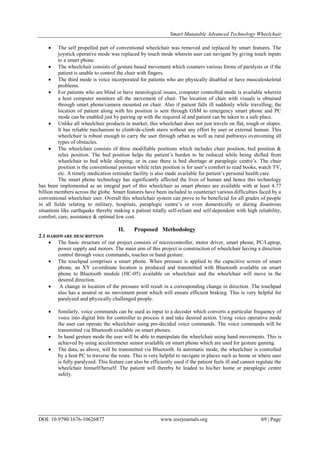
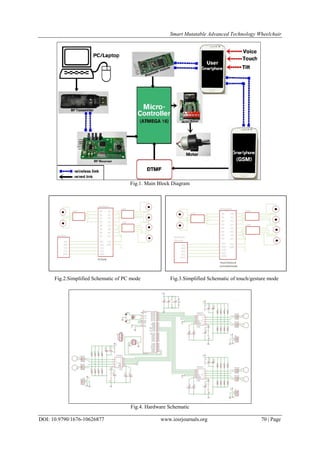
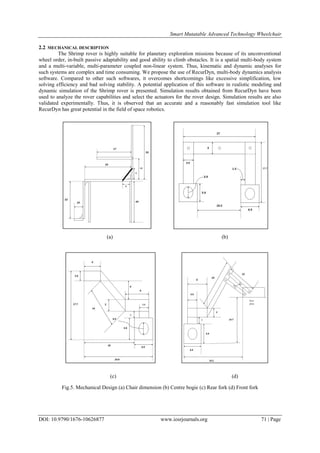
This document describes a smart wheelchair prototype that was developed to help people with disabilities have more independence and mobility. The wheelchair can be controlled through a smart phone interface using touch inputs, hand gestures detected by the phone's sensors, or voice commands. It can also be controlled automatically through a connected computer to navigate preset routes. The wheelchair prototype aims to accommodate people with different types and severities of paralysis or disabilities through its multiple operation modes and adjustable seating positions. It was designed with a focus on low cost, ease of use, and overcoming obstacles that typical wheelchairs cannot handle.


![Getting Started with Apache Spark: Big Data Made Simple [Free Meetup]](https://cdn.slidesharecdn.com/ss_thumbnails/apachesparkgettingstarted-260203175547-8361bcc3-thumbnail.jpg?width=640&height=640&fit=bounds)


