Research driven solutions
i-Ship
Intelligent Ship
Reporting
i-Ship
Intelligent Ship Reporting
2
i-Ship
Takes care of all reporting
formalities for your shipping
company in Europe and
globally, in a dependable
and cost effective manner.
Directive 2010/65/EU
compliant.
Contents
A new way to interconnect ships
with stakeholders and authorities
Advanced reporting features and
key benefits
Reporting compliance
environment
Functional details and design
principles
3
4
6
8
Innovation and technological
advantages10
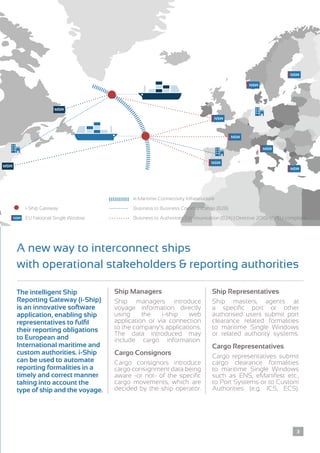
A new way to interconnect ships
with operational stakeholders & reporting authorities
Ship Managers
Ship managers introduce
voyage information directly
using the i-ship web
application or via connection
to the company’s applications.
The data introduced may
include cargo information.
Cargo Consignors
Cargo consignors introduce
cargo consignment data being
aware -or not- of the specific
cargo movements, which are
decided by the ship operator.
The intelligent Ship
Reporting Gateway (i-Ship)
is an innovative software
application, enabling ship
representatives to fulfil
their reporting obligations
to European and
International maritime and
custom authorities. i-Ship
can be used to automate
reporting formalities in a
timely and correct manner
taking into account the
type of ship and the voyage.
Ship Representatives
Ship masters, agents at
a specific port or other
authorised users submit port
clearance related formalities
to maritime Single Windows
or related authority systems.
Cargo Representatives
Cargo representatives submit
cargo clearance formalities
to maritime Single Windows
such as ENS, eManifest etc.,
to Port Systems or to Custom
Authorities (e.g. ICS, ECS).
MSW
i-Ship Gateway
e-Maritime Connectivity Infrastructure
Business to Business Communication (B2B)
MSW
Business to Authorities Communication (B2A) | Directive 2010/65/EU compliant
NSW
NSW
NSW
NSW
NSW
NSW
NSW
EU National Single WindowNSW
3
Advanced reporting features
and key benefits
i-Ship
Intelligent Ship Reporting
•	 A highly flexible and
user-friendly tool for
linking voyage/ship cargo
information with port
formalities reporting.
•	 Easy configuration of the
communication with the
Maritime, Custom and
Border Control Authorities’
systems in a variety of
electronic formats and
according to regulations
applicable per country
and/or port for specific
ship service.
•	 Easy preloading and change
of data repeated frequently
in notifications (e.g. ship
particulars, port codes).
FLEXIBILITY &
EASE OF USE
STREAMLINED
REPORTING PROCESS
INTEGRATION WITH
FLEET SYSTEMS
01 02 03
•	 Reduction of IT complexity
through SAAS (software
as a service).
•	 	Easy integration / sharing
of information with other
company “in-house” and
external partner systems.
•	 	Interfacing to existing ship
applications and other
information sources for
automated extraction of
reporting data.
•	 	Support for planning
and implementing
phased development of
compliance automation
across the fleet.
•	 Streamlined reporting
work-flows for the
exchange of ship and
cargo information among
all involved actors,
respecting their access
rights.
•	 	Harmonisation with
international standards
(e.g. ISO 28005, WCO,
EDIFACT) and EU specific
formats and requirements.
•	 	Work-flows for dealing
with exceptional
circumstances and
deviations.
•	 	Monitoring reporting
process KPIs.
4
A collaborative web-based reporting environment,
designed to meet the needs of ship managers and their business
associates. It acts as a common gateway to all reporting nodes
(Port Systems, Single Windows, Customs), providing a single link
for shipping companies to submit their reporting formalities.
EXTENSIBILY &
CUSTOMISATION
COMPLIANCE
QUALITY VISIBILITY
TIME - COST
EFFICIENCY
04 05 06
•	 Extensible rule engine that
can be adjusted to the
user needs and extended
to conform to the latest
legislation, without
technical complexity.
•	 	Customisable user profiles
and access rights.
•	 	Easy customisation of
specific company practices
ashore and onboard.
•	 Customisable voyage
based business
notifications.
•	 	Automated updating of
data models to adhere to
new regulations.
•	 	Visibility of the reporting/
compliance status of
the fleet by the shipping
management team.
•	 Improved collaboration
with authorities; enhanced
compliance quality and
associated reputation
benefits.
•	 	Generation of warning
alerts when sailing into
Emission Control Areas
(ECA) and management of
related records.
•	 Creation of reporting
documents for world-wide
shipping.
•	 	Reduction of the reporting
burden -from hours to
minutes- allowing ship
personnel to focus on
efficiency and safety of
operations.
•	 	Reduction of the overall
cost of reporting by
eliminating non-adding
value activities.
•	 Synchronisation for
optimised berthing times.
•	 	Reduced clearance
uncertainties leading to
improved planning.
•	 	Shorter lead times.
5
Common Reporting Schema (CRS)
Harmonising Reporting Formalities
A unifying ship reporting domain
model for Maritime Single Windows
TradeandTransportSingleWindowsprovidesignificantadvantages
to both businesses and regulatory authorities. As European
member states prepare National Single Windows in accordance
with the Directive 2010/65/EU, it is recognized that the key to
successful implementation is a unifying ship reporting model.
The Common Reporting Schema (CRS), as the name implies,
supportsaunifiedsolutionforregulatoryinformationmanagement
associated with trade and transport at both National, EU and
international levels. CRS was developed in eMAR to provide the
data model and messages for Directive 2010/65/EU compliant
NSWs with knowledge of current standards and international
e-reporting systems such as e-NOA US and e-PANS Singapore.
It is harmonised with EU initiatives such as the AnNA project and
data mapping activities carried out by the European Commission.
A major advantage of CRS
is that it is structured to
represent accurately both
cargo and ship/voyage
perspectives. It has been
constructed taking into
account the main international
standards, particularly WCO
and EPC. CRS is part of the
eMAR Strategic Framework
(EMSF) and therefore
supports interoperability
with e-Maritime applications.
CRS has been extensively
testedundervariousscenarios,
including submissions:
•	 To Customs ICS systems,
•	 To SafeSeaNet via multiple
National SSN applications,
•	 	To an eMAR NSW prototype,
•	 To a NSW prototype
produced by EMSA (IMP),
•	 By the DNV Navigator,
•	 By DANAOS shipping company,
•	 By masters and experts.
i-Ship
Intelligent Ship Reporting
A new version of the Common
Reporting Schema was developed
in the eMAR Project. It provides
compatibility with NSW models
and remains simple and extensible.
CRS
ISO 28005
eMS-defined types
AnNA
B2MSW
ICS ENS
6
EU Ship reporting requirements
fulfilled by i-Ship
Reporting
Requirement
Legal Basis Potential
Submission
Formats
Pre-arrival notice
According to EU legal Acts (Article 4 of Directive 2002/59/
EC) and similar regulations adopted by Norway and Iceland, a
notification for ships arriving in ports of the Member States is
required (submitted at least 24 hours before arrival and including
ETA and person on board information).
XML-based
(ISO 28005/ EMSA
epc xsd edition)
XML-based
(WCO-based AnNA
format)
XML-based
(eMAR CRS)
Passenger and
crew lists
According to EU legal Acts (Article 7 of Regulation (EC) No
562/2006) passenger and crew and stowaways information for
border checks on persons, is notified to border control Authorities.
Notification of
dangerous or
polluting goods
carried on board
According to EU legal Acts (Article 13 of Directive 2002/59/
EC) and similar regulations adopted by Norway and Iceland, a
notification of dangerous or polluting goods carried on board is
required.
Notification
of waste and
residues
According to EU legal Acts (Article 6 of Directive 2000/59/
EC) and similar regulations adopted by Norway and Iceland a
notification of waste and residues is required (submitted at least
24 hours before arrival).
Information on
ship security level
& on last 10 calls
at port facilities
According to EU legal Acts (Article 6 of Regulation (EC) No
725/2004) and similar regulations adopted by Norway and
Iceland a notification of security information (including e.g. the
information on ship security level and on last 10 calls at port
facilities)is required (submitted at least 24 hours before arrival).
Entry summary
declaration (ENS)
According to EU Custom regulations an Entry summary
declaration (ENS) for cargo consignments loaded at non Union
ports has to be lodged at the Custom Office of first entry in the
Union or at an ENS office of lodgment at least 24h before the
departure of the ship from the port where the consignment was
originally loaded.
XML-based
(ISO 28005/ EMSA
epc xsd edition)
XML-based
(WCO-based AnNA
format)
XML-based
(eMAR CRS)
XML-based DDNIA
format (DG TAXUD)
Cargo Manifest
According to specific Customs regulations applicable in European
countries a cargo manifest is to be lodged for ships arriving and/
or leaving EU ports. Furthermore a declaration of goods unloaded
for temporary storage might be required.
FAL Forms
National regulations may require the submission of individual
FAL forms for ships arriving or departing.
EDIFACT
XML-based (ISO
28005) XML-based
(eMAR CRS)
Berth Requests
National regulations may require the electronic submission of
berth allocation
EDIFACT (BERMAN)
XML-based
(eMAR CRS)
7
Ships
The “ships” area presents
a list of all the vessels that
the user is authorized to
handle; mostly used for
creating future voyages.
Voyages
The ”voyages” area presents
a list of all voyages that the
logged-in user can manage.
Thislistmaybefilteredthrough
text search or by a specific ship
name. Users may choose to
update the details of a specific
voyage or create a notification.
Notifications
The ”notifications” area
presents a list of the reporting
obligations and their status
(pending submission, having
been submitted or authorized,
etc.). Users can produce
and submit notifications.
The i-Ship
dashboard
facilitates choice
of actions in
three areas: ships,
voyages and
notifications.
Notifications
Voyages Ships
i-Ship
Intelligent Ship Reporting
Functional Details
Design Principles
Dashboard overview
8
Users configure time thresholds and applicable formalities
according to national legislation, as well as modify these
settings to accommodate port level requirements. The set
of formalities from which a ship is exempted are specified.
Design and
Deployment
Details
i-Ship is offered as a SAAS
(software as service), but
can also be available on
private clouds or on premise.
Currently it is deployed in
Microsoft’s Azure WebSites
infrastructure. It is monitored
and can be auto-scaled to
meet demand and SLA terms.
The application is configured
touseSSLandRSAencryption
for securing data exchange.
i-Ship has its own user
management module which
provides authentication and
identity control. Access control
is done with roles, permissions,
and attribute filtering which
are all configurable by
application administrators.
Access from the application
to the database is made with
an additional security layer.
The service can be hosted
by a ship operator or a
service broker providing
services to several shipping
actors (managers or agents).
9
Alerting and business rules enforcement interface
i-Ship innovation
Technological advantages
The i-Ship prototype has been
developed as part of the eMAR
project, building on FP7 projects in
the period 2008-2014.
i-Ship
Intelligent Ship Reporting
i-Ship is Directive 2010/65/
EU compliant; it ensures full
compliance with the EU legal
requirements on ship and cargo
reporting, taking into account
exceptions for regular shipping.
UtilisingresearchoutputsfromkeyFP7projects
•	 eFreight: Deliverables related to CRS
(work related to cargo data elements);
prototype intermodal Next Generation
Single Window and e-freight platform.
•	 COMCIS: Integration of ENS messages
to ICS Customs systems using CRS.
•	 SUPPORT,CONTAINandiCargo:Connectivity
infrastructure, semantic integration
technologies, cloud and smart systems.
•	 eCompliance: Rules Engine.
Related work
•	 DG TAXUD on ENS-related messages.
•	 eMS Group on data elements definition/
business rules and specifically
on data mapping-related reports.
•	 AnNA project on data elements/
messages definition and specifically on
B2MSW reports and relevant messages.
•	 EMSA on IMP demonstrator project and SSN
(documents published on the EMSA web site).
•	 Testing programme by masters and shipping
experts.
eCompliance
iCargo
AnNA
eFreight
10
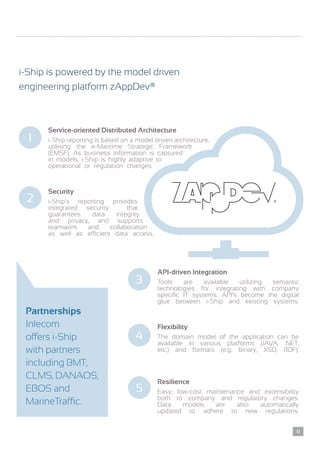
i-Ship is powered by the model driven
engineering platform zAppDev®
Service-oriented Distributed Architecture
i-Ship reporting is based on a model driven architecture,
utilising the e-Maritime Strategic Framework
(EMSF). As business information is captured
in models, i-Ship is highly adaptive to
operational or regulation changes.
1
Security
i-Ship’s reporting provides
integrated security that
guarantees data integrity
and privacy, and supports
teamwork and collaboration
as well as efficient data access.
2
API-driven Integration
Tools are available utilizing semantic
technologies for integrating with company
specific IT systems. API’s become the digital
glue between i-Ship and existing systems.
3
Flexibility
The domain model of the application can be
available in various platforms (JAVA, .NET,
etc.) and formats (e.g. binary, XSD, RDF).
4
Resilience
Easy, low-cost maintenance and extensibility
both to company and regulatory changes.
Data models are also automatically
updated to adhere to new regulations.
5
Partnerships
Inlecom
offers i-Ship
with partners
including BMT,
CLMS, DANAOS,
EBOS and
MarineTraffic.
11
Research driven solutions
Inlecom is dedicated to research
and innovation in transport
and logistics covering policy,
strategy, operational processes,
and ICT solutions. We have built
extensive knowledge on Single
Windowsproducedbynumerous
projects over the past six
years and developed workable
solutions for the industry.
i-Ship is backed by a range of
Inlecom consultancy services for
e-Maritime and Single Windows
and the InleMar Ecosystem.
INLECOM Systems Ltd
Knowledge Dock Business Centre
4-6 University Way
London, E16 2RD, UK
www.inlecom.com
email: info@inlecom.com
Tel: 0044 1444239910

i-ship brochure

  • 1.
  • 2.
    i-Ship Intelligent Ship Reporting 2 i-Ship Takescare of all reporting formalities for your shipping company in Europe and globally, in a dependable and cost effective manner. Directive 2010/65/EU compliant. Contents A new way to interconnect ships with stakeholders and authorities Advanced reporting features and key benefits Reporting compliance environment Functional details and design principles 3 4 6 8 Innovation and technological advantages10
  • 3.
    A new wayto interconnect ships with operational stakeholders & reporting authorities Ship Managers Ship managers introduce voyage information directly using the i-ship web application or via connection to the company’s applications. The data introduced may include cargo information. Cargo Consignors Cargo consignors introduce cargo consignment data being aware -or not- of the specific cargo movements, which are decided by the ship operator. The intelligent Ship Reporting Gateway (i-Ship) is an innovative software application, enabling ship representatives to fulfil their reporting obligations to European and International maritime and custom authorities. i-Ship can be used to automate reporting formalities in a timely and correct manner taking into account the type of ship and the voyage. Ship Representatives Ship masters, agents at a specific port or other authorised users submit port clearance related formalities to maritime Single Windows or related authority systems. Cargo Representatives Cargo representatives submit cargo clearance formalities to maritime Single Windows such as ENS, eManifest etc., to Port Systems or to Custom Authorities (e.g. ICS, ECS). MSW i-Ship Gateway e-Maritime Connectivity Infrastructure Business to Business Communication (B2B) MSW Business to Authorities Communication (B2A) | Directive 2010/65/EU compliant NSW NSW NSW NSW NSW NSW NSW EU National Single WindowNSW 3
  • 4.
    Advanced reporting features andkey benefits i-Ship Intelligent Ship Reporting • A highly flexible and user-friendly tool for linking voyage/ship cargo information with port formalities reporting. • Easy configuration of the communication with the Maritime, Custom and Border Control Authorities’ systems in a variety of electronic formats and according to regulations applicable per country and/or port for specific ship service. • Easy preloading and change of data repeated frequently in notifications (e.g. ship particulars, port codes). FLEXIBILITY & EASE OF USE STREAMLINED REPORTING PROCESS INTEGRATION WITH FLEET SYSTEMS 01 02 03 • Reduction of IT complexity through SAAS (software as a service). • Easy integration / sharing of information with other company “in-house” and external partner systems. • Interfacing to existing ship applications and other information sources for automated extraction of reporting data. • Support for planning and implementing phased development of compliance automation across the fleet. • Streamlined reporting work-flows for the exchange of ship and cargo information among all involved actors, respecting their access rights. • Harmonisation with international standards (e.g. ISO 28005, WCO, EDIFACT) and EU specific formats and requirements. • Work-flows for dealing with exceptional circumstances and deviations. • Monitoring reporting process KPIs. 4
  • 5.
    A collaborative web-basedreporting environment, designed to meet the needs of ship managers and their business associates. It acts as a common gateway to all reporting nodes (Port Systems, Single Windows, Customs), providing a single link for shipping companies to submit their reporting formalities. EXTENSIBILY & CUSTOMISATION COMPLIANCE QUALITY VISIBILITY TIME - COST EFFICIENCY 04 05 06 • Extensible rule engine that can be adjusted to the user needs and extended to conform to the latest legislation, without technical complexity. • Customisable user profiles and access rights. • Easy customisation of specific company practices ashore and onboard. • Customisable voyage based business notifications. • Automated updating of data models to adhere to new regulations. • Visibility of the reporting/ compliance status of the fleet by the shipping management team. • Improved collaboration with authorities; enhanced compliance quality and associated reputation benefits. • Generation of warning alerts when sailing into Emission Control Areas (ECA) and management of related records. • Creation of reporting documents for world-wide shipping. • Reduction of the reporting burden -from hours to minutes- allowing ship personnel to focus on efficiency and safety of operations. • Reduction of the overall cost of reporting by eliminating non-adding value activities. • Synchronisation for optimised berthing times. • Reduced clearance uncertainties leading to improved planning. • Shorter lead times. 5
  • 6.
    Common Reporting Schema(CRS) Harmonising Reporting Formalities A unifying ship reporting domain model for Maritime Single Windows TradeandTransportSingleWindowsprovidesignificantadvantages to both businesses and regulatory authorities. As European member states prepare National Single Windows in accordance with the Directive 2010/65/EU, it is recognized that the key to successful implementation is a unifying ship reporting model. The Common Reporting Schema (CRS), as the name implies, supportsaunifiedsolutionforregulatoryinformationmanagement associated with trade and transport at both National, EU and international levels. CRS was developed in eMAR to provide the data model and messages for Directive 2010/65/EU compliant NSWs with knowledge of current standards and international e-reporting systems such as e-NOA US and e-PANS Singapore. It is harmonised with EU initiatives such as the AnNA project and data mapping activities carried out by the European Commission. A major advantage of CRS is that it is structured to represent accurately both cargo and ship/voyage perspectives. It has been constructed taking into account the main international standards, particularly WCO and EPC. CRS is part of the eMAR Strategic Framework (EMSF) and therefore supports interoperability with e-Maritime applications. CRS has been extensively testedundervariousscenarios, including submissions: • To Customs ICS systems, • To SafeSeaNet via multiple National SSN applications, • To an eMAR NSW prototype, • To a NSW prototype produced by EMSA (IMP), • By the DNV Navigator, • By DANAOS shipping company, • By masters and experts. i-Ship Intelligent Ship Reporting A new version of the Common Reporting Schema was developed in the eMAR Project. It provides compatibility with NSW models and remains simple and extensible. CRS ISO 28005 eMS-defined types AnNA B2MSW ICS ENS 6
  • 7.
    EU Ship reportingrequirements fulfilled by i-Ship Reporting Requirement Legal Basis Potential Submission Formats Pre-arrival notice According to EU legal Acts (Article 4 of Directive 2002/59/ EC) and similar regulations adopted by Norway and Iceland, a notification for ships arriving in ports of the Member States is required (submitted at least 24 hours before arrival and including ETA and person on board information). XML-based (ISO 28005/ EMSA epc xsd edition) XML-based (WCO-based AnNA format) XML-based (eMAR CRS) Passenger and crew lists According to EU legal Acts (Article 7 of Regulation (EC) No 562/2006) passenger and crew and stowaways information for border checks on persons, is notified to border control Authorities. Notification of dangerous or polluting goods carried on board According to EU legal Acts (Article 13 of Directive 2002/59/ EC) and similar regulations adopted by Norway and Iceland, a notification of dangerous or polluting goods carried on board is required. Notification of waste and residues According to EU legal Acts (Article 6 of Directive 2000/59/ EC) and similar regulations adopted by Norway and Iceland a notification of waste and residues is required (submitted at least 24 hours before arrival). Information on ship security level & on last 10 calls at port facilities According to EU legal Acts (Article 6 of Regulation (EC) No 725/2004) and similar regulations adopted by Norway and Iceland a notification of security information (including e.g. the information on ship security level and on last 10 calls at port facilities)is required (submitted at least 24 hours before arrival). Entry summary declaration (ENS) According to EU Custom regulations an Entry summary declaration (ENS) for cargo consignments loaded at non Union ports has to be lodged at the Custom Office of first entry in the Union or at an ENS office of lodgment at least 24h before the departure of the ship from the port where the consignment was originally loaded. XML-based (ISO 28005/ EMSA epc xsd edition) XML-based (WCO-based AnNA format) XML-based (eMAR CRS) XML-based DDNIA format (DG TAXUD) Cargo Manifest According to specific Customs regulations applicable in European countries a cargo manifest is to be lodged for ships arriving and/ or leaving EU ports. Furthermore a declaration of goods unloaded for temporary storage might be required. FAL Forms National regulations may require the submission of individual FAL forms for ships arriving or departing. EDIFACT XML-based (ISO 28005) XML-based (eMAR CRS) Berth Requests National regulations may require the electronic submission of berth allocation EDIFACT (BERMAN) XML-based (eMAR CRS) 7
  • 8.
    Ships The “ships” areapresents a list of all the vessels that the user is authorized to handle; mostly used for creating future voyages. Voyages The ”voyages” area presents a list of all voyages that the logged-in user can manage. Thislistmaybefilteredthrough text search or by a specific ship name. Users may choose to update the details of a specific voyage or create a notification. Notifications The ”notifications” area presents a list of the reporting obligations and their status (pending submission, having been submitted or authorized, etc.). Users can produce and submit notifications. The i-Ship dashboard facilitates choice of actions in three areas: ships, voyages and notifications. Notifications Voyages Ships i-Ship Intelligent Ship Reporting Functional Details Design Principles Dashboard overview 8
  • 9.
    Users configure timethresholds and applicable formalities according to national legislation, as well as modify these settings to accommodate port level requirements. The set of formalities from which a ship is exempted are specified. Design and Deployment Details i-Ship is offered as a SAAS (software as service), but can also be available on private clouds or on premise. Currently it is deployed in Microsoft’s Azure WebSites infrastructure. It is monitored and can be auto-scaled to meet demand and SLA terms. The application is configured touseSSLandRSAencryption for securing data exchange. i-Ship has its own user management module which provides authentication and identity control. Access control is done with roles, permissions, and attribute filtering which are all configurable by application administrators. Access from the application to the database is made with an additional security layer. The service can be hosted by a ship operator or a service broker providing services to several shipping actors (managers or agents). 9 Alerting and business rules enforcement interface
  • 10.
    i-Ship innovation Technological advantages Thei-Ship prototype has been developed as part of the eMAR project, building on FP7 projects in the period 2008-2014. i-Ship Intelligent Ship Reporting i-Ship is Directive 2010/65/ EU compliant; it ensures full compliance with the EU legal requirements on ship and cargo reporting, taking into account exceptions for regular shipping. UtilisingresearchoutputsfromkeyFP7projects • eFreight: Deliverables related to CRS (work related to cargo data elements); prototype intermodal Next Generation Single Window and e-freight platform. • COMCIS: Integration of ENS messages to ICS Customs systems using CRS. • SUPPORT,CONTAINandiCargo:Connectivity infrastructure, semantic integration technologies, cloud and smart systems. • eCompliance: Rules Engine. Related work • DG TAXUD on ENS-related messages. • eMS Group on data elements definition/ business rules and specifically on data mapping-related reports. • AnNA project on data elements/ messages definition and specifically on B2MSW reports and relevant messages. • EMSA on IMP demonstrator project and SSN (documents published on the EMSA web site). • Testing programme by masters and shipping experts. eCompliance iCargo AnNA eFreight 10
  • 11.
    i-Ship is poweredby the model driven engineering platform zAppDev® Service-oriented Distributed Architecture i-Ship reporting is based on a model driven architecture, utilising the e-Maritime Strategic Framework (EMSF). As business information is captured in models, i-Ship is highly adaptive to operational or regulation changes. 1 Security i-Ship’s reporting provides integrated security that guarantees data integrity and privacy, and supports teamwork and collaboration as well as efficient data access. 2 API-driven Integration Tools are available utilizing semantic technologies for integrating with company specific IT systems. API’s become the digital glue between i-Ship and existing systems. 3 Flexibility The domain model of the application can be available in various platforms (JAVA, .NET, etc.) and formats (e.g. binary, XSD, RDF). 4 Resilience Easy, low-cost maintenance and extensibility both to company and regulatory changes. Data models are also automatically updated to adhere to new regulations. 5 Partnerships Inlecom offers i-Ship with partners including BMT, CLMS, DANAOS, EBOS and MarineTraffic. 11
  • 12.
    Research driven solutions Inlecomis dedicated to research and innovation in transport and logistics covering policy, strategy, operational processes, and ICT solutions. We have built extensive knowledge on Single Windowsproducedbynumerous projects over the past six years and developed workable solutions for the industry. i-Ship is backed by a range of Inlecom consultancy services for e-Maritime and Single Windows and the InleMar Ecosystem. INLECOM Systems Ltd Knowledge Dock Business Centre 4-6 University Way London, E16 2RD, UK www.inlecom.com email: info@inlecom.com Tel: 0044 1444239910