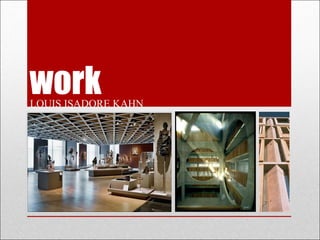
Louis Isadore
Kahn
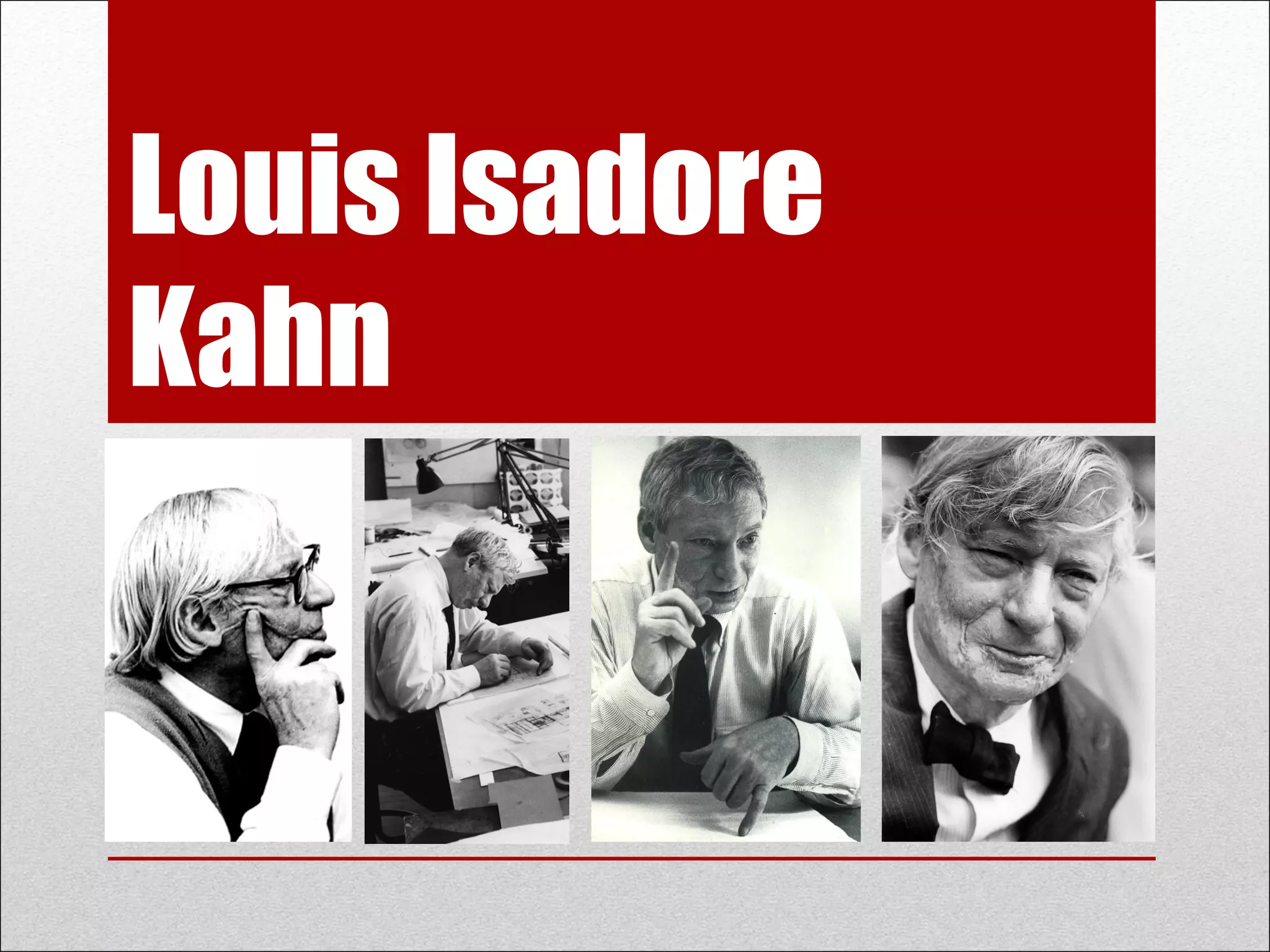
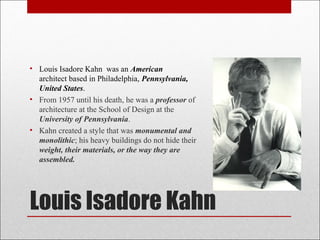
Louis Isadore Kahn
• Louis Isadore Kahn was an American
architect based in Philadelphia, Pennsylvania,
United States.
• From 1957 until his death, he was a professor of
architecture at the School of Design at the
University of Pennsylvania.
• Kahn created a style that was monumental and
monolithic; his heavy buildings do not hide their
weight, their materials, or the way they are
assembled.
• Louis Kahn's works are considered as monumental
beyond modernism.
• Kahn was one of the most influential architects of
the 20th century.
• He was awarded the AIA Gold Medal and the
RIBA Gold Medal.
• At the time of this death he was considered by
some as "America's foremost living architect.’’
• Born February 20, 1901 on Saaremaa Island in
Estonian.
• Kahn was the oldest of three children.
• Kahn's Jewish parents immigrated to the United
States in 1906.
• His given name at birth was “Itze-Leib
Schmuilowsky” but was changed upon arrival in
the US.
• On March 17, 1974, he died of a heart attack in a
men's restroom in Pennsylvania Station in New
York City.
Biography
• Kahn’s parents knew he would be an artistic
person.
• At age 12, Kahn attended the Fleischer School of
Art in Philadelphia and spent much of his time
there painting.
• Later, he attended Philadelphia Central High
School.
• While there, he focused many of his classes on the
arts. This is where Kahn would get his first taste of
architecture.
Education
• He entered the architecture program at the
University of Pennsylvania in 1920.
• At the University of Pennsylvania, Kahn was
trained under Paul P. Cret, a well-respected
architect. Cret was educated in the Beaux-Arts
tradition, the classical architecture style, and
passed this on to his students.
• After graduating from University of Pennsylvania
in the spring of 1924, Kahn went on to work for
Philadelphia City Architect, John Molitor.
Working primarily as a draftsman, Kahn was
involved on a number of civic designs.
• Kahn took a journey to Europe to study the
architecture, specifically ancient.
• The ancient architecture he observed in Europe
would later influence the designs of his buildings.
• Kahn thought the architecture being produced in
America was lacking in the “monumental and
spiritual qualities of ancient buildings.”
• He finally started his own firm in 1935.
• He served as a design critic and professor of
architecture at Yale School of Architecture from
1947 to 1957.
• From 1957 he was a professor at the University of
Pennsylvania.
Inspiration& work
• He was known for creating monumental
architecture that responded to human scale.
• He created distinction between served space &
servant spaces.
• His palette of materials tended towards highly
textured brick & bare concrete.
• Also he used marble.
• He is widely known for his spaces of poetic
sensibility.
Design Philosophies
• Kahn used many different shapes and lines.
• However, among his most famous creations, he
seems to favor both parallel and perpendicular
lines.
• Through his bold technique, he created streamline,
radical, and futuristic looking buildings.
Geometry in his work
LOUIS ISADORE KAHN
work
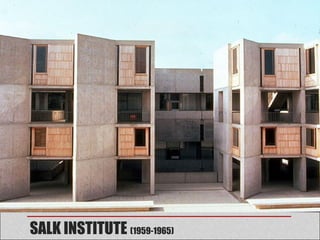
SALK INSTITUTE (1959-1965)
• Jonas Salk, who founded the polio
vaccine, approached Louis I. Kahn
to be the architect for a biomedical
research institute.
• Salk’s humanitarian vision “that
medical research does not belong
entirely to medicine or the physical
science. It belongs to population,”
• The Salk Institute began as a
collaborative vision shared between
the architect and the client.
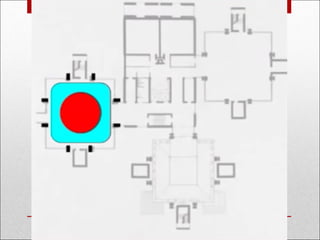
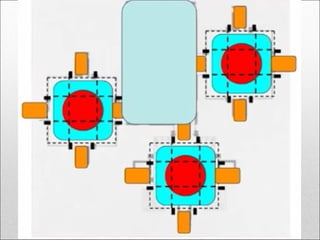
• The three main clusters were
planned that expresses the form of
the Salk Institute – the laboratory,
the meeting place [the meeting
house], and, the living place [the
village].
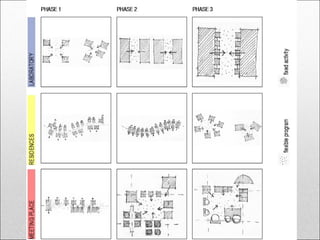
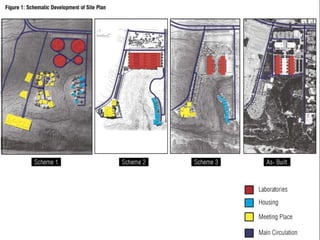
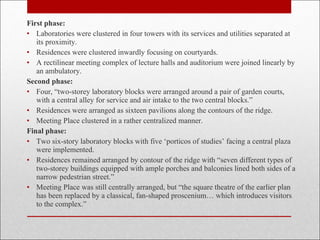
First phase:
• Laboratories were clustered in four towers with its services and utilities separated at
its proximity.
• Residences were clustered inwardly focusing on courtyards.
• A rectilinear meeting complex of lecture halls and auditorium were joined linearly by
an ambulatory.
Second phase:
• Four, “two-storey laboratory blocks were arranged around a pair of garden courts,
with a central alley for service and air intake to the two central blocks.”
• Residences were arranged as sixteen pavilions along the contours of the ridge.
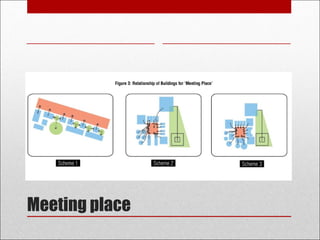
• Meeting Place clustered in a rather centralized manner.
Final phase:
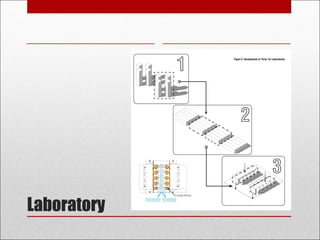
• Two six-story laboratory blocks with five ‘porticos of studies’ facing a central plaza
were implemented.
• Residences remained arranged by contour of the ridge with “seven different types of
two-storey buildings equipped with ample porches and balconies lined both sides of a
narrow pedestrian street.”
• Meeting Place was still centrally arranged, but “the square theatre of the earlier plan
has been replaced by a classical, fan-shaped proscenium… which introduces visitors
to the complex.”
16Laboratory
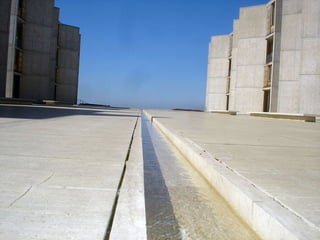
Meeting place
PLANS
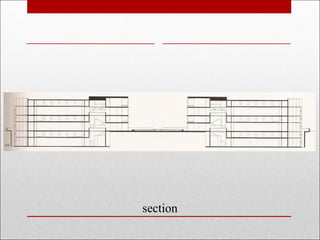
section
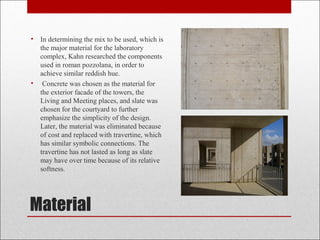
Material
• In determining the mix to be used, which is
the major material for the laboratory
complex, Kahn researched the components
used in roman pozzolana, in order to
achieve similar reddish hue.
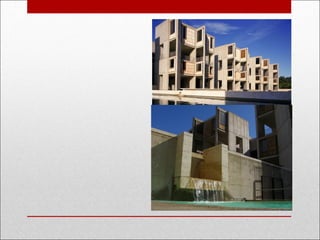
• Concrete was chosen as the material for
the exterior facade of the towers, the
Living and Meeting places, and slate was
chosen for the courtyard to further
emphasize the simplicity of the design.
Later, the material was eliminated because
of cost and replaced with travertine, which
has similar symbolic connections. The
travertine has not lasted as long as slate
may have over time because of its relative
softness.
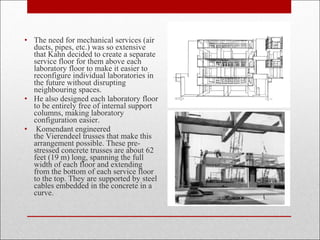
• The need for mechanical services (air
ducts, pipes, etc.) was so extensive
that Kahn decided to create a separate
service floor for them above each
laboratory floor to make it easier to
reconfigure individual laboratories in
the future without disrupting
neighbouring spaces.
• He also designed each laboratory floor
to be entirely free of internal support
columns, making laboratory
configuration easier.
• Komendant engineered
the Vierendeel trusses that make this
arrangement possible. These pre-
stressed concrete trusses are about 62
feet (19 m) long, spanning the full
width of each floor and extending
from the bottom of each service floor
to the top. They are supported by steel
cables embedded in the concrete in a
curve.
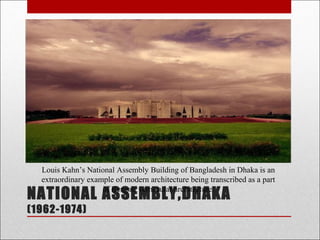
NATIONAL ASSEMBLY,DHAKA
(1962-1974)
Louis Kahn’s National Assembly Building of Bangladesh in Dhaka is an
extraordinary example of modern architecture being transcribed as a part
of Bengali vernacular architecture.
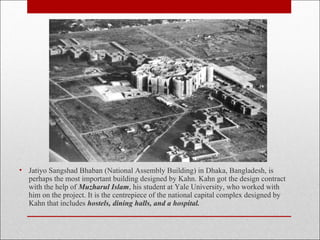
• Jatiyo Sangshad Bhaban (National Assembly Building) in Dhaka, Bangladesh, is
perhaps the most important building designed by Kahn. Kahn got the design contract
with the help of Muzharul Islam, his student at Yale University, who worked with
him on the project. It is the centrepiece of the national capital complex designed by
Kahn that includes hostels, dining halls, and a hospital.
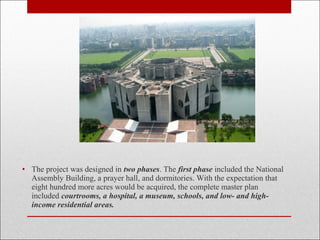
• The project was designed in two phases. The first phase included the National
Assembly Building, a prayer hall, and dormitories. With the expectation that
eight hundred more acres would be acquired, the complete master plan
included courtrooms, a hospital, a museum, schools, and low- and high-
income residential areas.
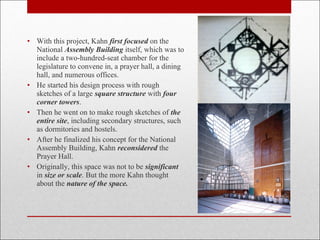
• With this project, Kahn first focused on the
National Assembly Building itself, which was to
include a two-hundred-seat chamber for the
legislature to convene in, a prayer hall, a dining
hall, and numerous offices.
• He started his design process with rough
sketches of a large square structure with four
corner towers.
• Then he went on to make rough sketches of the
entire site, including secondary structures, such
as dormitories and hostels.
• After he finalized his concept for the National
Assembly Building, Kahn reconsidered the
Prayer Hall.
• Originally, this space was not to be significant
in size or scale. But the more Kahn thought
about the nature of the space.
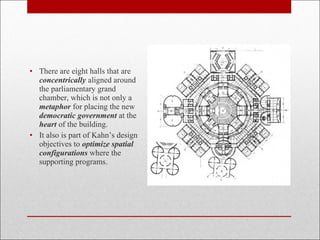
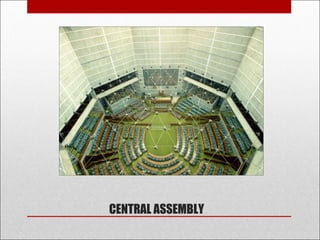
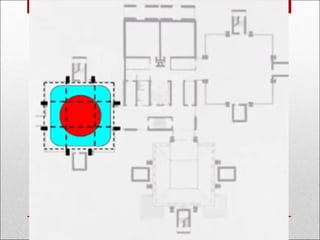
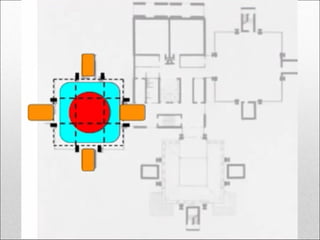
• There are eight halls that are
concentrically aligned around
the parliamentary grand
chamber, which is not only a
metaphor for placing the new
democratic government at the
heart of the building.
• It also is part of Kahn’s design
objectives to optimize spatial
configurations where the
supporting programs.
CENTRAL ASSEMBLY
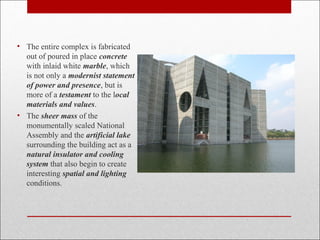
• The entire complex is fabricated
out of poured in place concrete
with inlaid white marble, which
is not only a modernist statement
of power and presence, but is
more of a testament to the local
materials and values.
• The sheer mass of the
monumentally scaled National
Assembly and the artificial lake
surrounding the building act as a
natural insulator and cooling
system that also begin to create
interesting spatial and lighting
conditions.
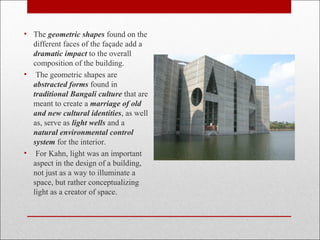
• The geometric shapes found on the
different faces of the façade add a
dramatic impact to the overall
composition of the building.
• The geometric shapes are
abstracted forms found in
traditional Bangali culture that are
meant to create a marriage of old
and new cultural identities, as well
as, serve as light wells and a
natural environmental control
system for the interior.
• For Kahn, light was an important
aspect in the design of a building,
not just as a way to illuminate a
space, but rather conceptualizing
light as a creator of space.
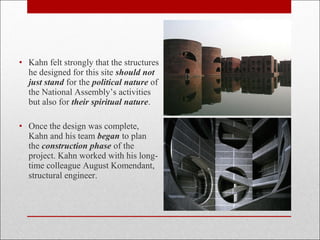
• Kahn felt strongly that the structures
he designed for this site should not
just stand for the political nature of
the National Assembly’s activities
but also for their spiritual nature.
• Once the design was complete,
Kahn and his team began to plan
the construction phase of the
project. Kahn worked with his long-
time colleague August Komendant,
structural engineer.
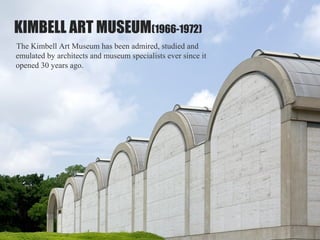
KIMBELL ART MUSEUM(1966-1972)
The Kimbell Art Museum has been admired, studied and
emulated by architects and museum specialists ever since it
opened 30 years ago.
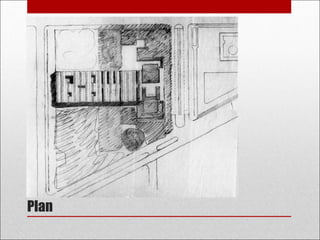
Plan
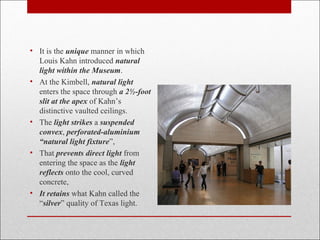
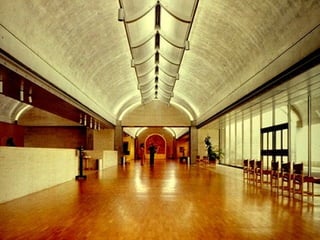
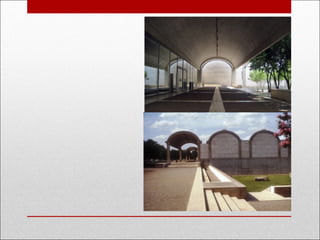
• It is the unique manner in which
Louis Kahn introduced natural
light within the Museum.
• At the Kimbell, natural light
enters the space through a 2½-foot
slit at the apex of Kahn’s
distinctive vaulted ceilings.
• The light strikes a suspended
convex, perforated-aluminium
“natural light fixture”,
• That prevents direct light from
entering the space as the light
reflects onto the cool, curved
concrete,
• It retains what Kahn called the
“silver” quality of Texas light.
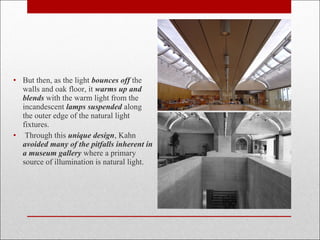
• But then, as the light bounces off the
walls and oak floor, it warms up and
blends with the warm light from the
incandescent lamps suspended along
the outer edge of the natural light
fixtures.
• Through this unique design, Kahn
avoided many of the pitfalls inherent in
a museum gallery where a primary
source of illumination is natural light.
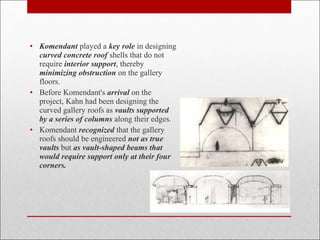
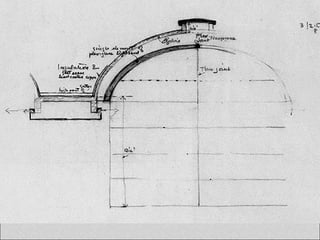
• Komendant played a key role in designing
curved concrete roof shells that do not
require interior support, thereby
minimizing obstruction on the gallery
floors.
• Before Komendant's arrival on the
project, Kahn had been designing the
curved gallery roofs as vaults supported
by a series of columns along their edges.
• Komendant recognized that the gallery
roofs should be engineered not as true
vaults but as vault-shaped beams that
would require support only at their four
corners.
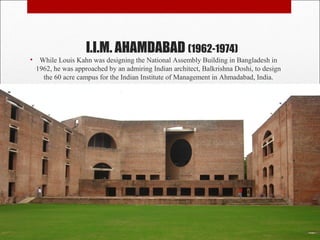
I.I.M. AHAMDABAD (1962-1974)
• While Louis Kahn was designing the National Assembly Building in Bangladesh in
1962, he was approached by an admiring Indian architect, Balkrishna Doshi, to design
the 60 acre campus for the Indian Institute of Management in Ahmadabad, India.
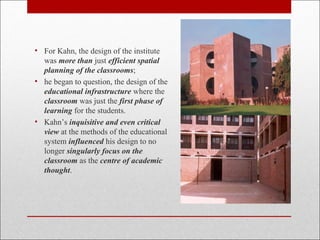
• For Kahn, the design of the institute
was more than just efficient spatial
planning of the classrooms;
• he began to question, the design of the
educational infrastructure where the
classroom was just the first phase of
learning for the students.
• Kahn’s inquisitive and even critical
view at the methods of the educational
system influenced his design to no
longer singularly focus on the
classroom as the centre of academic
thought.
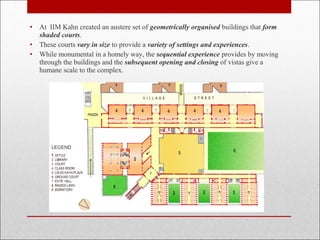
• At IIM Kahn created an austere set of geometrically organised buildings that form
shaded courts.
• These courts vary in size to provide a variety of settings and experiences.
• While monumental in a homely way, the sequential experience provides by moving
through the buildings and the subsequent opening and closing of vistas give a
humane scale to the complex.
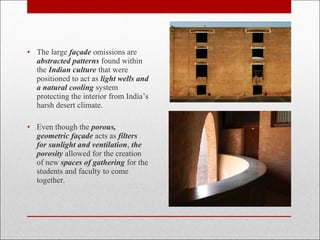
• The large façade omissions are
abstracted patterns found within
the Indian culture that were
positioned to act as light wells and
a natural cooling system
protecting the interior from India’s
harsh desert climate.
• Even though the porous,
geometric façade acts as filters
for sunlight and ventilation, the
porosity allowed for the creation
of new spaces of gathering for the
students and faculty to come
together.
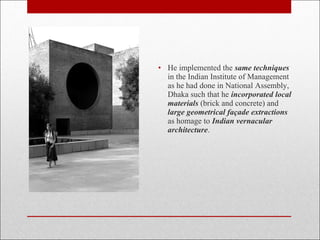
• He implemented the same techniques
in the Indian Institute of Management
as he had done in National Assembly,
Dhaka such that he incorporated local
materials (brick and concrete) and
large geometrical façade extractions
as homage to Indian vernacular
architecture.
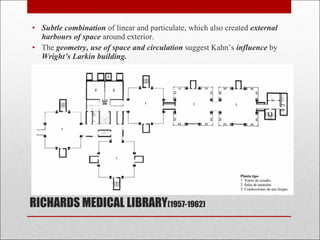
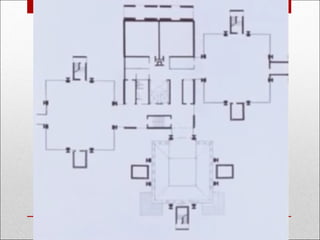
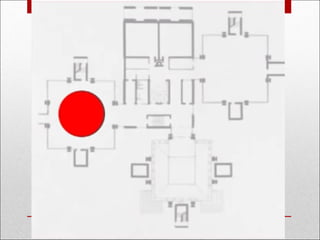
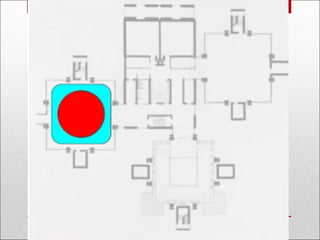
RICHARDS MEDICAL LIBRARY(1957-1962)
• Subtle combination of linear and particulate, which also created external
harbours of space around exterior.
• The geometry, use of space and circulation suggest Kahn’s influence by
Wright’s Larkin building.
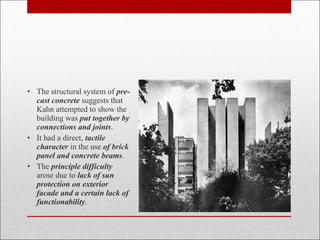
• The structural system of pre-
cast concrete suggests that
Kahn attempted to show the
building was put together by
connections and joints.
• It had a direct, tactile
character in the use of brick
panel and concrete beams.
• The principle difficulty
arose due to lack of sun
protection on exterior
facade and a certain lack of
functionability.
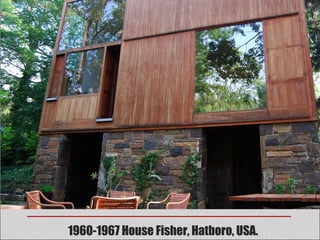
1960-1967 House Fisher, Hatboro, USA.
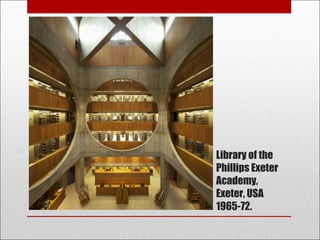
Library of the
Phillips Exeter
Academy,
Exeter, USA
1965-72.
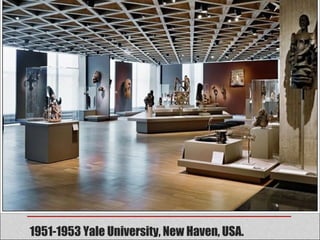
1951-1953 Yale University, New Haven, USA.
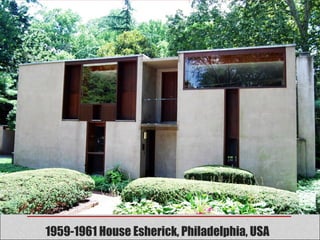
1959-1961 House Esherick, Philadelphia, USA
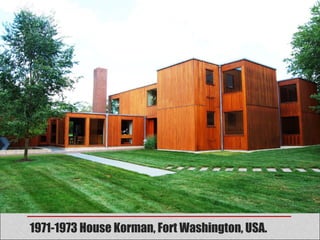
1971-1973 House Korman, Fort Washington, USA.
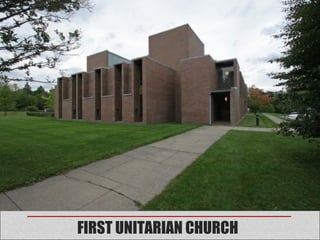
FIRST UNITARIAN CHURCH
-W.J.CURTIS
Extracts from the works of
-INCENT SCULLY: LOUIS I KAHN AND THE RUINS
OF ROME
-ROBERT McCARTER:LOIUS I KAHN
-CARTER WISEMAN: BEYOND TIME AND STYLE
-KATHELEEN JAMES-CHOKRAWORTY
-SARAH GOLDHAGEN
-James Steele: Architecture in detail
-Daid Brownlee : Louis I kahn in the realm of architecture
-www.archdaily.com
BIBLIOGRAPHY
THANK YOU

I kahn

  • 1.
  • 2.
    Louis Isadore Kahn •Louis Isadore Kahn was an American architect based in Philadelphia, Pennsylvania, United States. • From 1957 until his death, he was a professor of architecture at the School of Design at the University of Pennsylvania. • Kahn created a style that was monumental and monolithic; his heavy buildings do not hide their weight, their materials, or the way they are assembled.
  • 3.
    • Louis Kahn'sworks are considered as monumental beyond modernism. • Kahn was one of the most influential architects of the 20th century. • He was awarded the AIA Gold Medal and the RIBA Gold Medal. • At the time of this death he was considered by some as "America's foremost living architect.’’
  • 4.
    • Born February20, 1901 on Saaremaa Island in Estonian. • Kahn was the oldest of three children. • Kahn's Jewish parents immigrated to the United States in 1906. • His given name at birth was “Itze-Leib Schmuilowsky” but was changed upon arrival in the US. • On March 17, 1974, he died of a heart attack in a men's restroom in Pennsylvania Station in New York City. Biography
  • 5.
    • Kahn’s parentsknew he would be an artistic person. • At age 12, Kahn attended the Fleischer School of Art in Philadelphia and spent much of his time there painting. • Later, he attended Philadelphia Central High School. • While there, he focused many of his classes on the arts. This is where Kahn would get his first taste of architecture. Education
  • 6.
    • He enteredthe architecture program at the University of Pennsylvania in 1920. • At the University of Pennsylvania, Kahn was trained under Paul P. Cret, a well-respected architect. Cret was educated in the Beaux-Arts tradition, the classical architecture style, and passed this on to his students. • After graduating from University of Pennsylvania in the spring of 1924, Kahn went on to work for Philadelphia City Architect, John Molitor. Working primarily as a draftsman, Kahn was involved on a number of civic designs.
  • 7.
    • Kahn tooka journey to Europe to study the architecture, specifically ancient. • The ancient architecture he observed in Europe would later influence the designs of his buildings. • Kahn thought the architecture being produced in America was lacking in the “monumental and spiritual qualities of ancient buildings.” • He finally started his own firm in 1935. • He served as a design critic and professor of architecture at Yale School of Architecture from 1947 to 1957. • From 1957 he was a professor at the University of Pennsylvania. Inspiration& work
  • 8.
    • He wasknown for creating monumental architecture that responded to human scale. • He created distinction between served space & servant spaces. • His palette of materials tended towards highly textured brick & bare concrete. • Also he used marble. • He is widely known for his spaces of poetic sensibility. Design Philosophies
  • 9.
    • Kahn usedmany different shapes and lines. • However, among his most famous creations, he seems to favor both parallel and perpendicular lines. • Through his bold technique, he created streamline, radical, and futuristic looking buildings. Geometry in his work
  • 10.
  • 11.
  • 12.
    SALK INSTITUTE (1959-1965) •Jonas Salk, who founded the polio vaccine, approached Louis I. Kahn to be the architect for a biomedical research institute. • Salk’s humanitarian vision “that medical research does not belong entirely to medicine or the physical science. It belongs to population,” • The Salk Institute began as a collaborative vision shared between the architect and the client. • The three main clusters were planned that expresses the form of the Salk Institute – the laboratory, the meeting place [the meeting house], and, the living place [the village].
  • 15.
    First phase: • Laboratorieswere clustered in four towers with its services and utilities separated at its proximity. • Residences were clustered inwardly focusing on courtyards. • A rectilinear meeting complex of lecture halls and auditorium were joined linearly by an ambulatory. Second phase: • Four, “two-storey laboratory blocks were arranged around a pair of garden courts, with a central alley for service and air intake to the two central blocks.” • Residences were arranged as sixteen pavilions along the contours of the ridge. • Meeting Place clustered in a rather centralized manner. Final phase: • Two six-story laboratory blocks with five ‘porticos of studies’ facing a central plaza were implemented. • Residences remained arranged by contour of the ridge with “seven different types of two-storey buildings equipped with ample porches and balconies lined both sides of a narrow pedestrian street.” • Meeting Place was still centrally arranged, but “the square theatre of the earlier plan has been replaced by a classical, fan-shaped proscenium… which introduces visitors to the complex.”
  • 16.
  • 17.
  • 18.
  • 19.
  • 20.
    Material • In determiningthe mix to be used, which is the major material for the laboratory complex, Kahn researched the components used in roman pozzolana, in order to achieve similar reddish hue. • Concrete was chosen as the material for the exterior facade of the towers, the Living and Meeting places, and slate was chosen for the courtyard to further emphasize the simplicity of the design. Later, the material was eliminated because of cost and replaced with travertine, which has similar symbolic connections. The travertine has not lasted as long as slate may have over time because of its relative softness.
  • 21.
    • The needfor mechanical services (air ducts, pipes, etc.) was so extensive that Kahn decided to create a separate service floor for them above each laboratory floor to make it easier to reconfigure individual laboratories in the future without disrupting neighbouring spaces. • He also designed each laboratory floor to be entirely free of internal support columns, making laboratory configuration easier. • Komendant engineered the Vierendeel trusses that make this arrangement possible. These pre- stressed concrete trusses are about 62 feet (19 m) long, spanning the full width of each floor and extending from the bottom of each service floor to the top. They are supported by steel cables embedded in the concrete in a curve.
  • 23.
    NATIONAL ASSEMBLY,DHAKA (1962-1974) Louis Kahn’sNational Assembly Building of Bangladesh in Dhaka is an extraordinary example of modern architecture being transcribed as a part of Bengali vernacular architecture.
  • 24.
    • Jatiyo SangshadBhaban (National Assembly Building) in Dhaka, Bangladesh, is perhaps the most important building designed by Kahn. Kahn got the design contract with the help of Muzharul Islam, his student at Yale University, who worked with him on the project. It is the centrepiece of the national capital complex designed by Kahn that includes hostels, dining halls, and a hospital.
  • 25.
    • The projectwas designed in two phases. The first phase included the National Assembly Building, a prayer hall, and dormitories. With the expectation that eight hundred more acres would be acquired, the complete master plan included courtrooms, a hospital, a museum, schools, and low- and high- income residential areas.
  • 26.
    • With thisproject, Kahn first focused on the National Assembly Building itself, which was to include a two-hundred-seat chamber for the legislature to convene in, a prayer hall, a dining hall, and numerous offices. • He started his design process with rough sketches of a large square structure with four corner towers. • Then he went on to make rough sketches of the entire site, including secondary structures, such as dormitories and hostels. • After he finalized his concept for the National Assembly Building, Kahn reconsidered the Prayer Hall. • Originally, this space was not to be significant in size or scale. But the more Kahn thought about the nature of the space.
  • 27.
    • There areeight halls that are concentrically aligned around the parliamentary grand chamber, which is not only a metaphor for placing the new democratic government at the heart of the building. • It also is part of Kahn’s design objectives to optimize spatial configurations where the supporting programs.
  • 28.
  • 29.
    • The entirecomplex is fabricated out of poured in place concrete with inlaid white marble, which is not only a modernist statement of power and presence, but is more of a testament to the local materials and values. • The sheer mass of the monumentally scaled National Assembly and the artificial lake surrounding the building act as a natural insulator and cooling system that also begin to create interesting spatial and lighting conditions.
  • 30.
    • The geometricshapes found on the different faces of the façade add a dramatic impact to the overall composition of the building. • The geometric shapes are abstracted forms found in traditional Bangali culture that are meant to create a marriage of old and new cultural identities, as well as, serve as light wells and a natural environmental control system for the interior. • For Kahn, light was an important aspect in the design of a building, not just as a way to illuminate a space, but rather conceptualizing light as a creator of space.
  • 31.
    • Kahn feltstrongly that the structures he designed for this site should not just stand for the political nature of the National Assembly’s activities but also for their spiritual nature. • Once the design was complete, Kahn and his team began to plan the construction phase of the project. Kahn worked with his long- time colleague August Komendant, structural engineer.
  • 32.
    KIMBELL ART MUSEUM(1966-1972) TheKimbell Art Museum has been admired, studied and emulated by architects and museum specialists ever since it opened 30 years ago.
  • 33.
  • 34.
    • It isthe unique manner in which Louis Kahn introduced natural light within the Museum. • At the Kimbell, natural light enters the space through a 2½-foot slit at the apex of Kahn’s distinctive vaulted ceilings. • The light strikes a suspended convex, perforated-aluminium “natural light fixture”, • That prevents direct light from entering the space as the light reflects onto the cool, curved concrete, • It retains what Kahn called the “silver” quality of Texas light.
  • 36.
    • But then,as the light bounces off the walls and oak floor, it warms up and blends with the warm light from the incandescent lamps suspended along the outer edge of the natural light fixtures. • Through this unique design, Kahn avoided many of the pitfalls inherent in a museum gallery where a primary source of illumination is natural light.
  • 37.
    • Komendant playeda key role in designing curved concrete roof shells that do not require interior support, thereby minimizing obstruction on the gallery floors. • Before Komendant's arrival on the project, Kahn had been designing the curved gallery roofs as vaults supported by a series of columns along their edges. • Komendant recognized that the gallery roofs should be engineered not as true vaults but as vault-shaped beams that would require support only at their four corners.
  • 40.
    I.I.M. AHAMDABAD (1962-1974) •While Louis Kahn was designing the National Assembly Building in Bangladesh in 1962, he was approached by an admiring Indian architect, Balkrishna Doshi, to design the 60 acre campus for the Indian Institute of Management in Ahmadabad, India.
  • 41.
    • For Kahn,the design of the institute was more than just efficient spatial planning of the classrooms; • he began to question, the design of the educational infrastructure where the classroom was just the first phase of learning for the students. • Kahn’s inquisitive and even critical view at the methods of the educational system influenced his design to no longer singularly focus on the classroom as the centre of academic thought.
  • 42.
    • At IIMKahn created an austere set of geometrically organised buildings that form shaded courts. • These courts vary in size to provide a variety of settings and experiences. • While monumental in a homely way, the sequential experience provides by moving through the buildings and the subsequent opening and closing of vistas give a humane scale to the complex.
  • 43.
    • The largefaçade omissions are abstracted patterns found within the Indian culture that were positioned to act as light wells and a natural cooling system protecting the interior from India’s harsh desert climate. • Even though the porous, geometric façade acts as filters for sunlight and ventilation, the porosity allowed for the creation of new spaces of gathering for the students and faculty to come together.
  • 44.
    • He implementedthe same techniques in the Indian Institute of Management as he had done in National Assembly, Dhaka such that he incorporated local materials (brick and concrete) and large geometrical façade extractions as homage to Indian vernacular architecture.
  • 45.
    RICHARDS MEDICAL LIBRARY(1957-1962) •Subtle combination of linear and particulate, which also created external harbours of space around exterior. • The geometry, use of space and circulation suggest Kahn’s influence by Wright’s Larkin building.
  • 53.
    • The structuralsystem of pre- cast concrete suggests that Kahn attempted to show the building was put together by connections and joints. • It had a direct, tactile character in the use of brick panel and concrete beams. • The principle difficulty arose due to lack of sun protection on exterior facade and a certain lack of functionability.
  • 54.
  • 55.
    Library of the PhillipsExeter Academy, Exeter, USA 1965-72.
  • 56.
  • 57.
    1959-1961 House Esherick,Philadelphia, USA
  • 58.
    1971-1973 House Korman,Fort Washington, USA.
  • 59.
  • 61.
    -W.J.CURTIS Extracts from theworks of -INCENT SCULLY: LOUIS I KAHN AND THE RUINS OF ROME -ROBERT McCARTER:LOIUS I KAHN -CARTER WISEMAN: BEYOND TIME AND STYLE -KATHELEEN JAMES-CHOKRAWORTY -SARAH GOLDHAGEN -James Steele: Architecture in detail -Daid Brownlee : Louis I kahn in the realm of architecture -www.archdaily.com BIBLIOGRAPHY
  • 62.