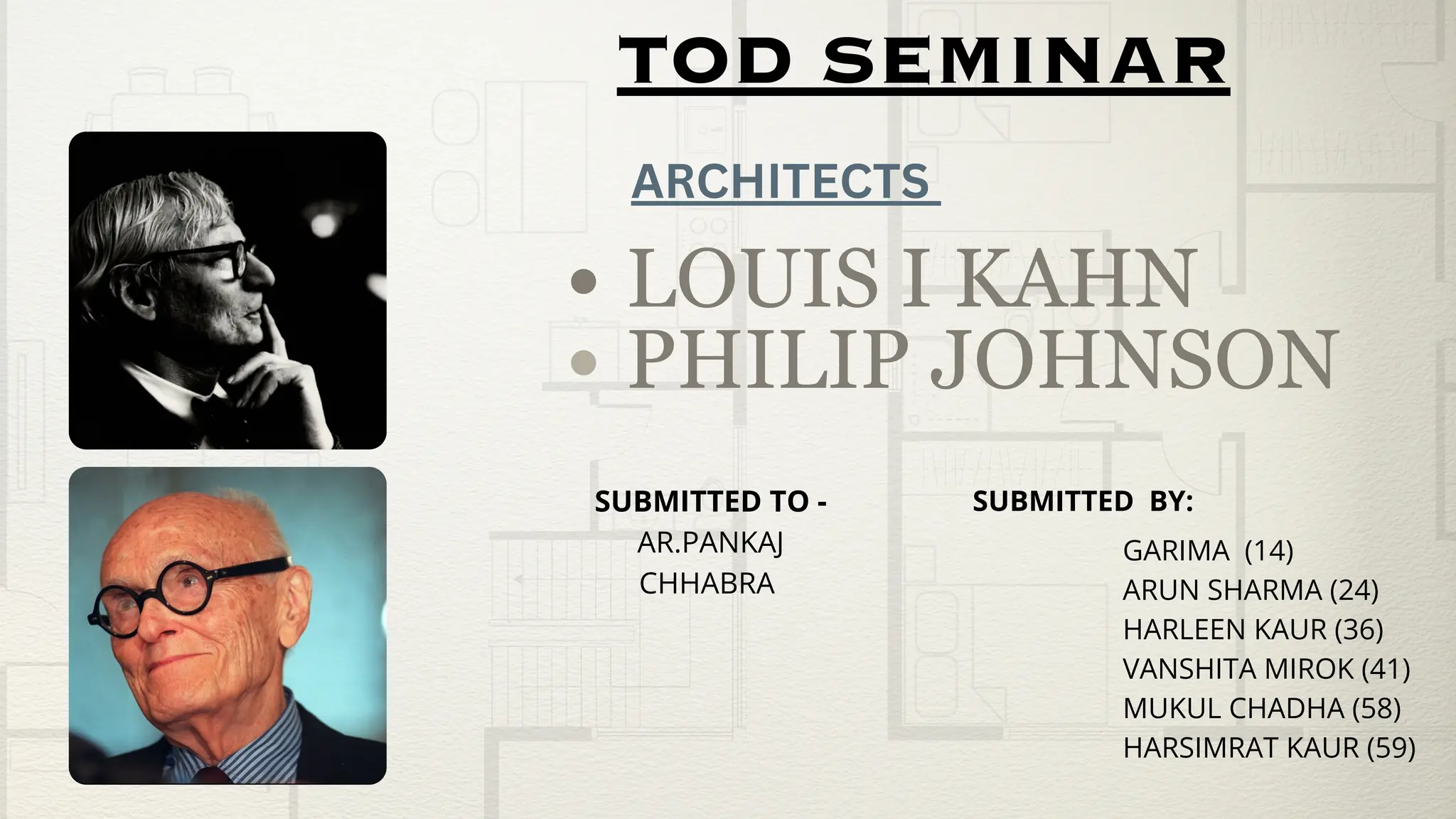
LOUIS I KAHN
PHILIPJOHNSON
TOD SEMINAR
ARCHITECTS
GARIMA (14)
ARUN SHARMA (24)
HARLEEN KAUR (36)
VANSHITA MIROK (41)
MUKUL CHADHA (58)
HARSIMRAT KAUR (59)
SUBMITTED TO -
AR.PANKAJ
CHHABRA
SUBMITTED BY:
2.
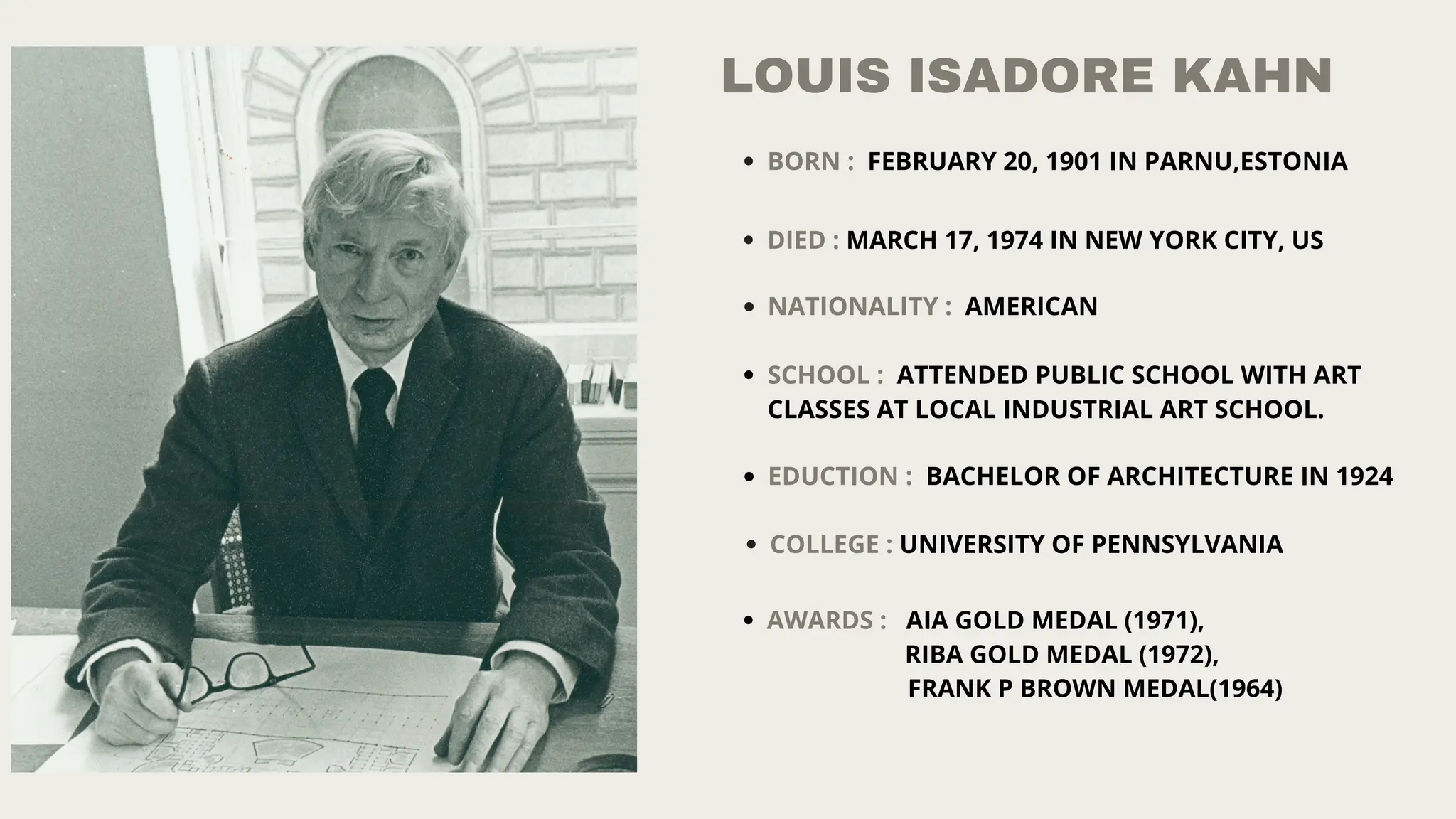
LOUIS ISADORE KAHN
BORN: FEBRUARY 20, 1901 IN PARNU,ESTONIA
DIED : MARCH 17, 1974 IN NEW YORK CITY, US
NATIONALITY : AMERICAN
COLLEGE : UNIVERSITY OF PENNSYLVANIA
AWARDS : AIA GOLD MEDAL (1971),
RIBA GOLD MEDAL (1972),
FRANK P BROWN MEDAL(1964)
SCHOOL : ATTENDED PUBLIC SCHOOL WITH ART
CLASSES AT LOCAL INDUSTRIAL ART SCHOOL.
EDUCTION : BACHELOR OF ARCHITECTURE IN 1924
3.
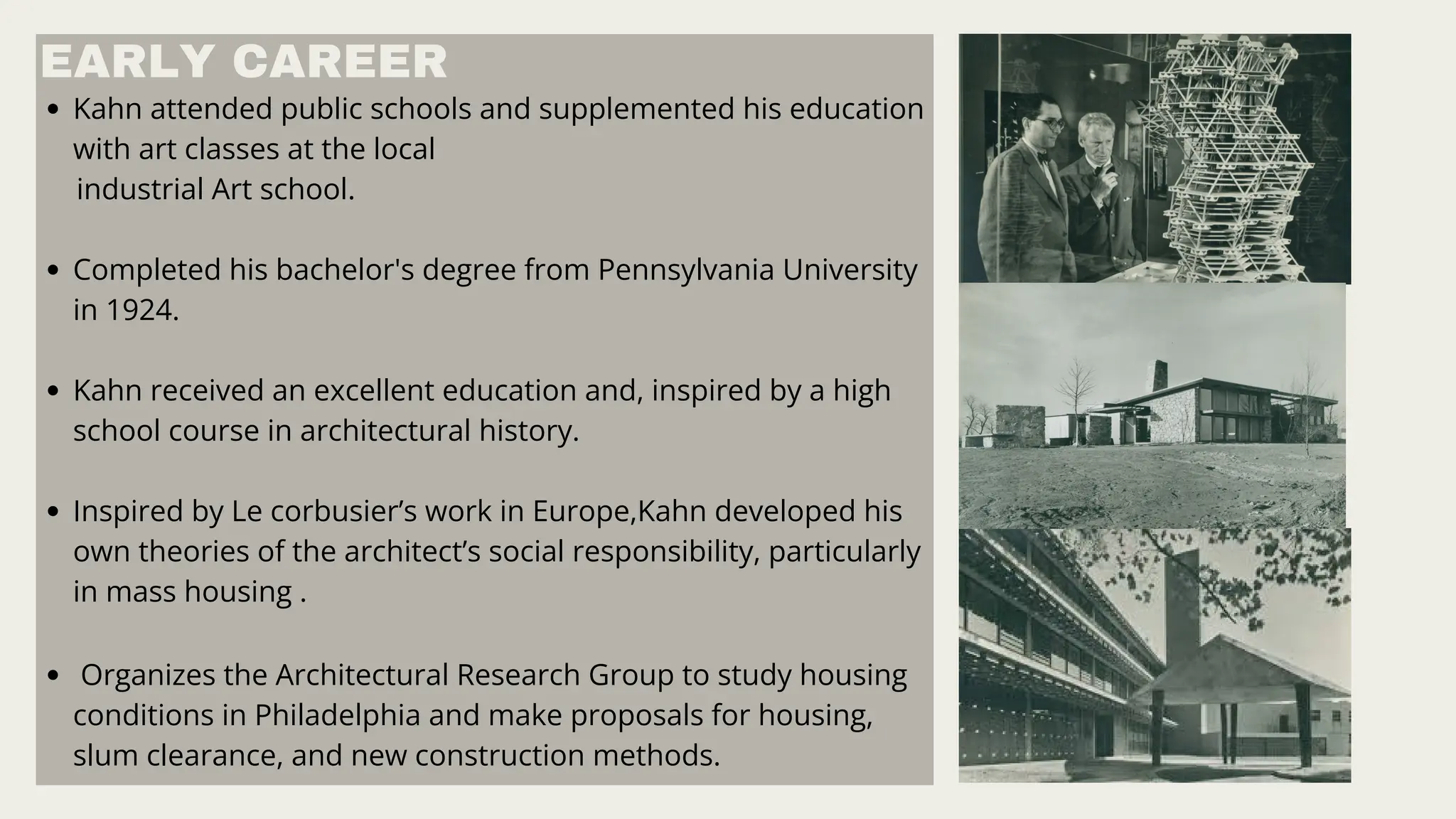
Kahn attended publicschools and supplemented his education
with art classes at the local
industrial Art school.
Completed his bachelor's degree from Pennsylvania University
in 1924.
Kahn received an excellent education and, inspired by a high
school course in architectural history.
Inspired by Le corbusier’s work in Europe,Kahn developed his
own theories of the architect’s social responsibility, particularly
in mass housing .
Organizes the Architectural Research Group to study housing
conditions in Philadelphia and make proposals for housing,
slum clearance, and new construction methods.
EARLY CAREER
4.
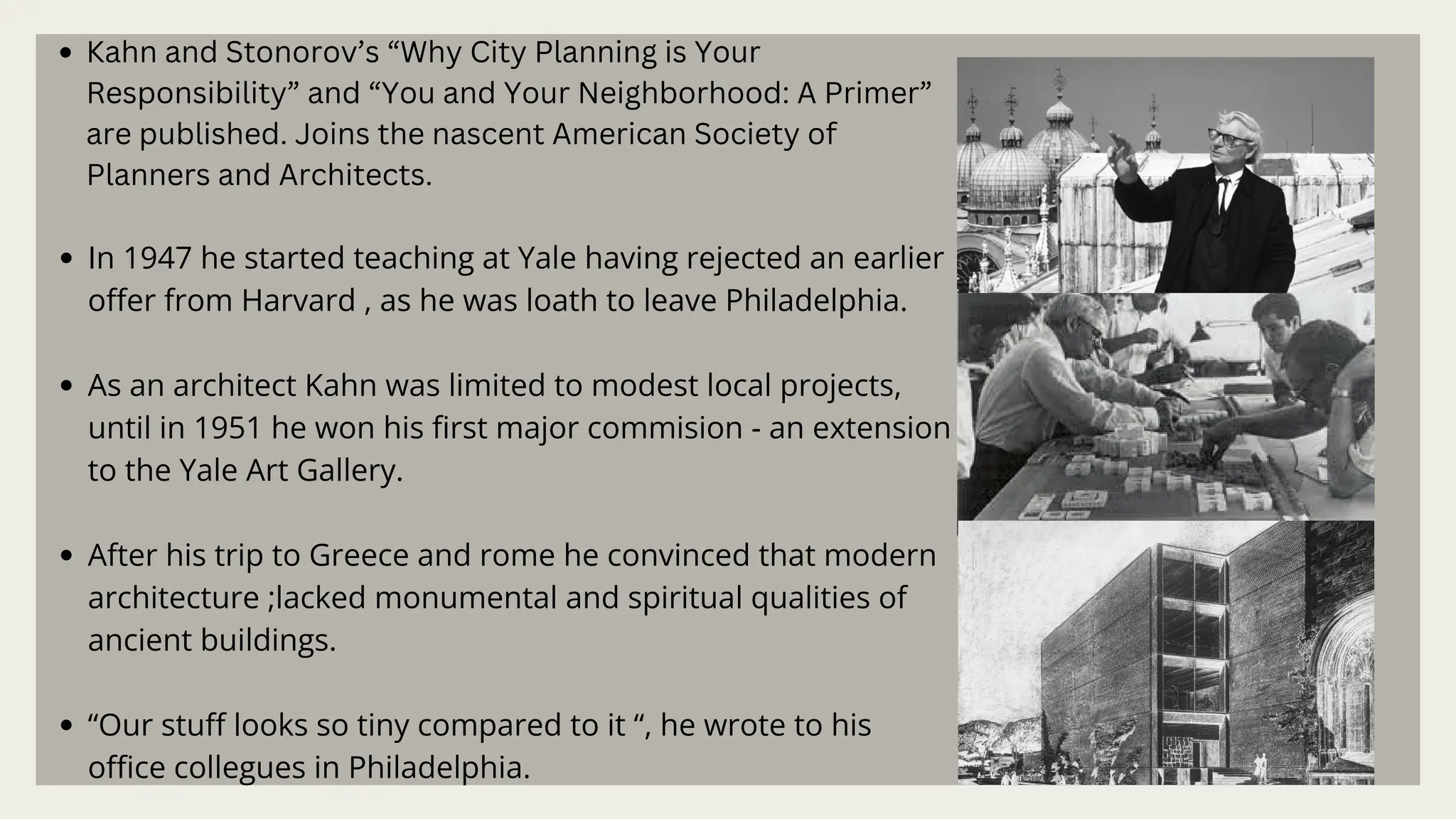
Kahn and Stonorov’s“Why City Planning is Your
Responsibility” and “You and Your Neighborhood: A Primer”
are published. Joins the nascent American Society of
Planners and Architects.
In 1947 he started teaching at Yale having rejected an earlier
offer from Harvard , as he was loath to leave Philadelphia.
As an architect Kahn was limited to modest local projects,
until in 1951 he won his first major commision - an extension
to the Yale Art Gallery.
After his trip to Greece and rome he convinced that modern
architecture ;lacked monumental and spiritual qualities of
ancient buildings.
“Our stuff looks so tiny compared to it “, he wrote to his
office collegues in Philadelphia.
5.
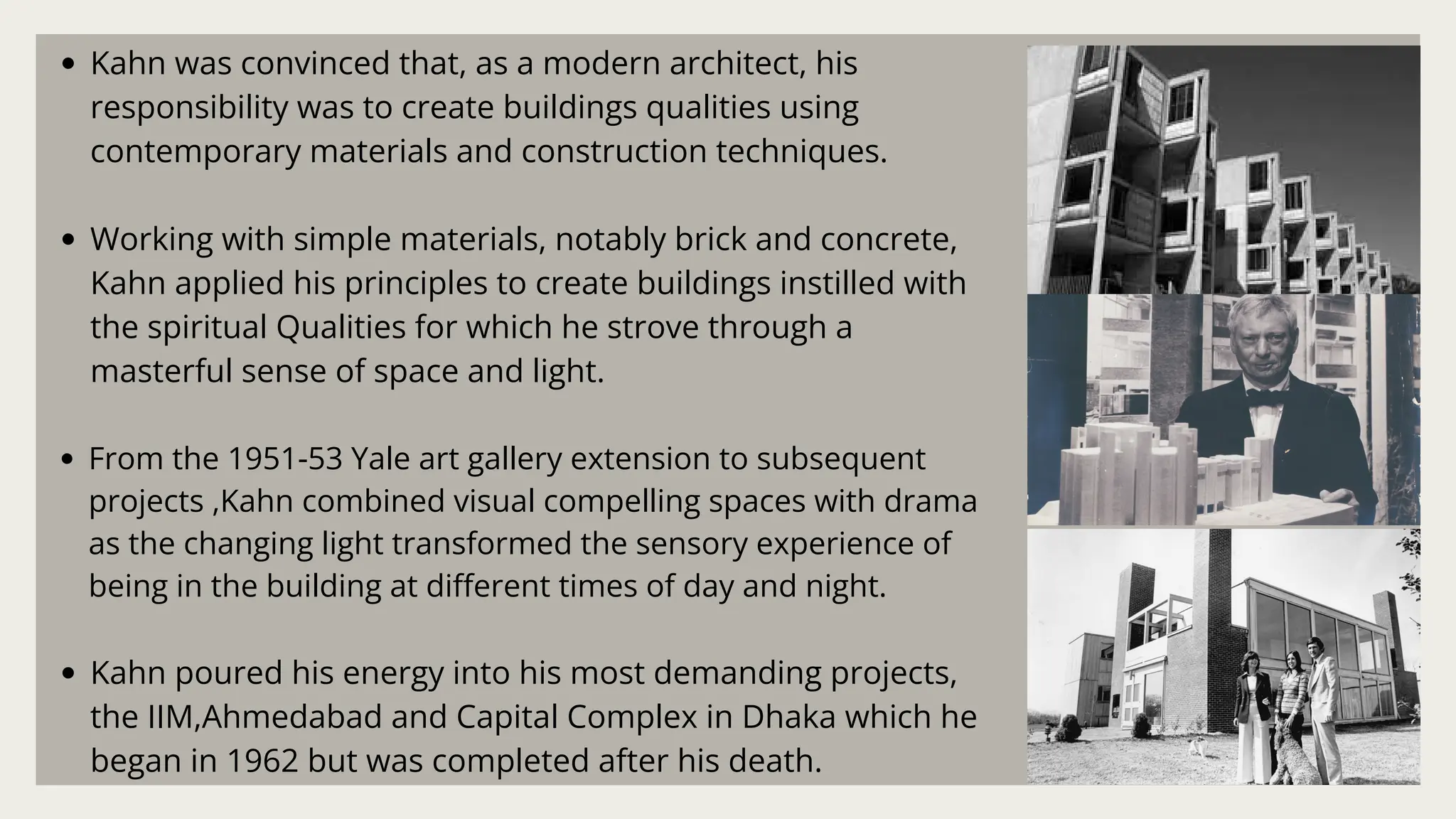
Kahn was convincedthat, as a modern architect, his
responsibility was to create buildings qualities using
contemporary materials and construction techniques.
Working with simple materials, notably brick and concrete,
Kahn applied his principles to create buildings instilled with
the spiritual Qualities for which he strove through a
masterful sense of space and light.
From the 1951-53 Yale art gallery extension to subsequent
projects ,Kahn combined visual compelling spaces with drama
as the changing light transformed the sensory experience of
being in the building at different times of day and night.
Kahn poured his energy into his most demanding projects,
the IIM,Ahmedabad and Capital Complex in Dhaka which he
began in 1962 but was completed after his death.
6.
INFLUENCES ON LOUISI KAHN
PAUL PHILIPPE CRET - Cret's
emphasis on classical architecture
and Beaux-Arts principles greatly
impacted Kahn's architectural style.
Kahn admired Cret's use of
monumental forms, spatial clarity,
and attention to detail.
LE CORBUSIER - Kahn was inspired
by Le Corbusier's concept of
"architecture as a machine for
living" and his focus on creating
spaces that are both functional and
aesthetically pleasing.
F.L.WRIGHT -Wright's concept of
"organic architecture," where
buildings are integrated into their
environment and reflect the natural
world, inspired Kahn to consider the
relationship between architecture and
nature in his own work.
MIES VAN DER ROHE - Mies van der
Rohe's focus on structural clarity and
the use of steel and glass as primary
materials resonated with Kahn's
architectural approach.
7.
PHILOSOPHY
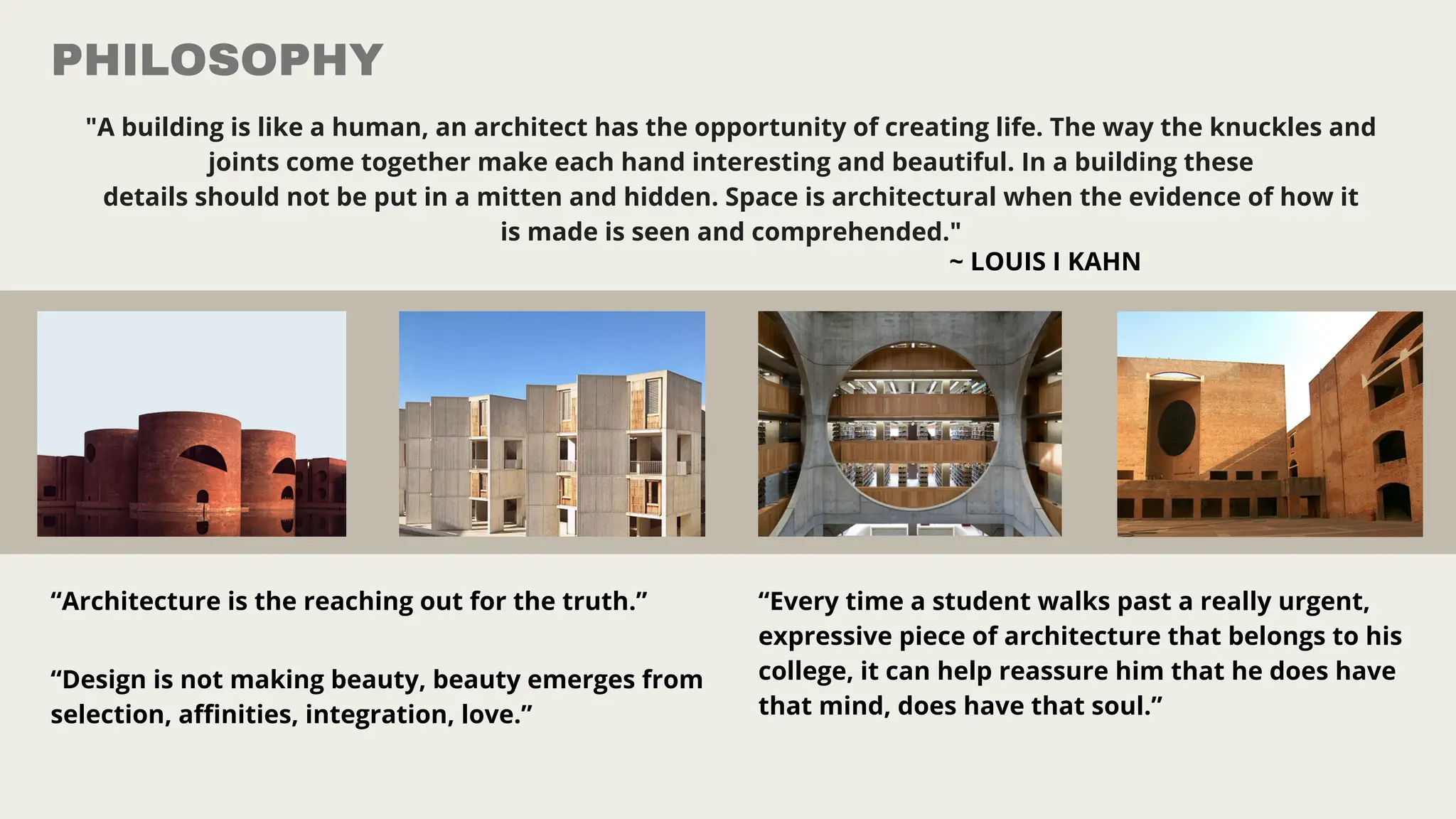
"A building islike a human, an architect has the opportunity of creating life. The way the knuckles and
joints come together make each hand interesting and beautiful. In a building these
details should not be put in a mitten and hidden. Space is architectural when the evidence of how it
is made is seen and comprehended."
~ LOUIS I KAHN
“Architecture is the reaching out for the truth.”
“Design is not making beauty, beauty emerges from
selection, affinities, integration, love.”
“Every time a student walks past a really urgent,
expressive piece of architecture that belongs to his
college, it can help reassure him that he does have
that mind, does have that soul.”
8.
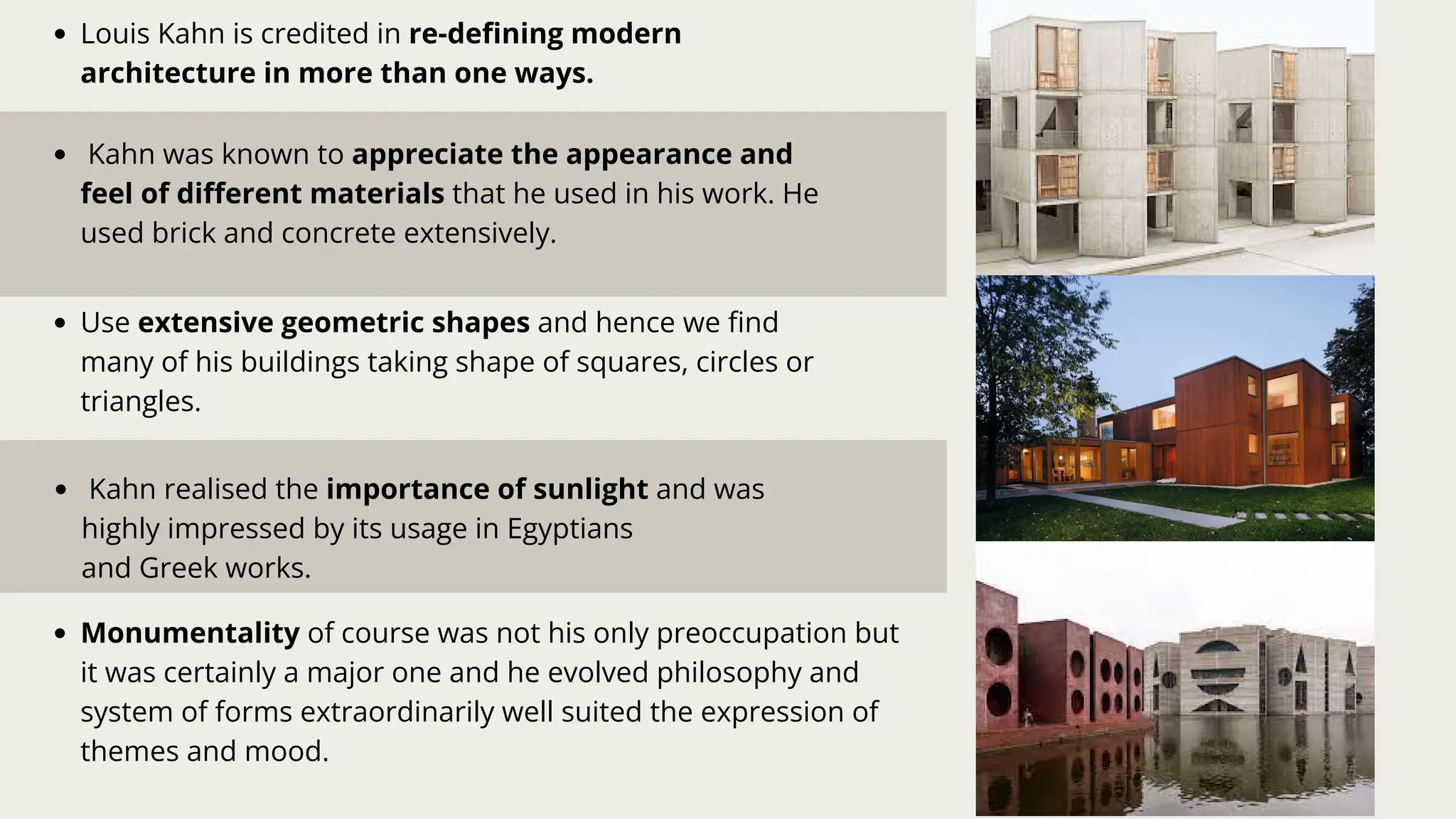
Kahn was knownto appreciate the appearance and
feel of different materials that he used in his work. He
used brick and concrete extensively.
Kahn realised the importance of sunlight and was
highly impressed by its usage in Egyptians
and Greek works.
Use extensive geometric shapes and hence we find
many of his buildings taking shape of squares, circles or
triangles.
Louis Kahn is credited in re-defining modern
architecture in more than one ways.
Monumentality of course was not his only preoccupation but
it was certainly a major one and he evolved philosophy and
system of forms extraordinarily well suited the expression of
themes and mood.
9.
He fused togethermodern constructional means
with additional methods.
His architecture was infused with a deep feeling of
human situations which enabled him to avoid mere
shape making of formalists.
He gave support to individuality and freedom to
respond in unique ways to particular constraints of
each building programme.
He never rebelled against the new technology ,
materials and aesthetics that had come to
characterise contemporary buildings.
He insisted on reworking the process of design to
allow the inclusion of both greater personal artistic
statement and occupant concern.
10.
BUILDING TECHNIQUE
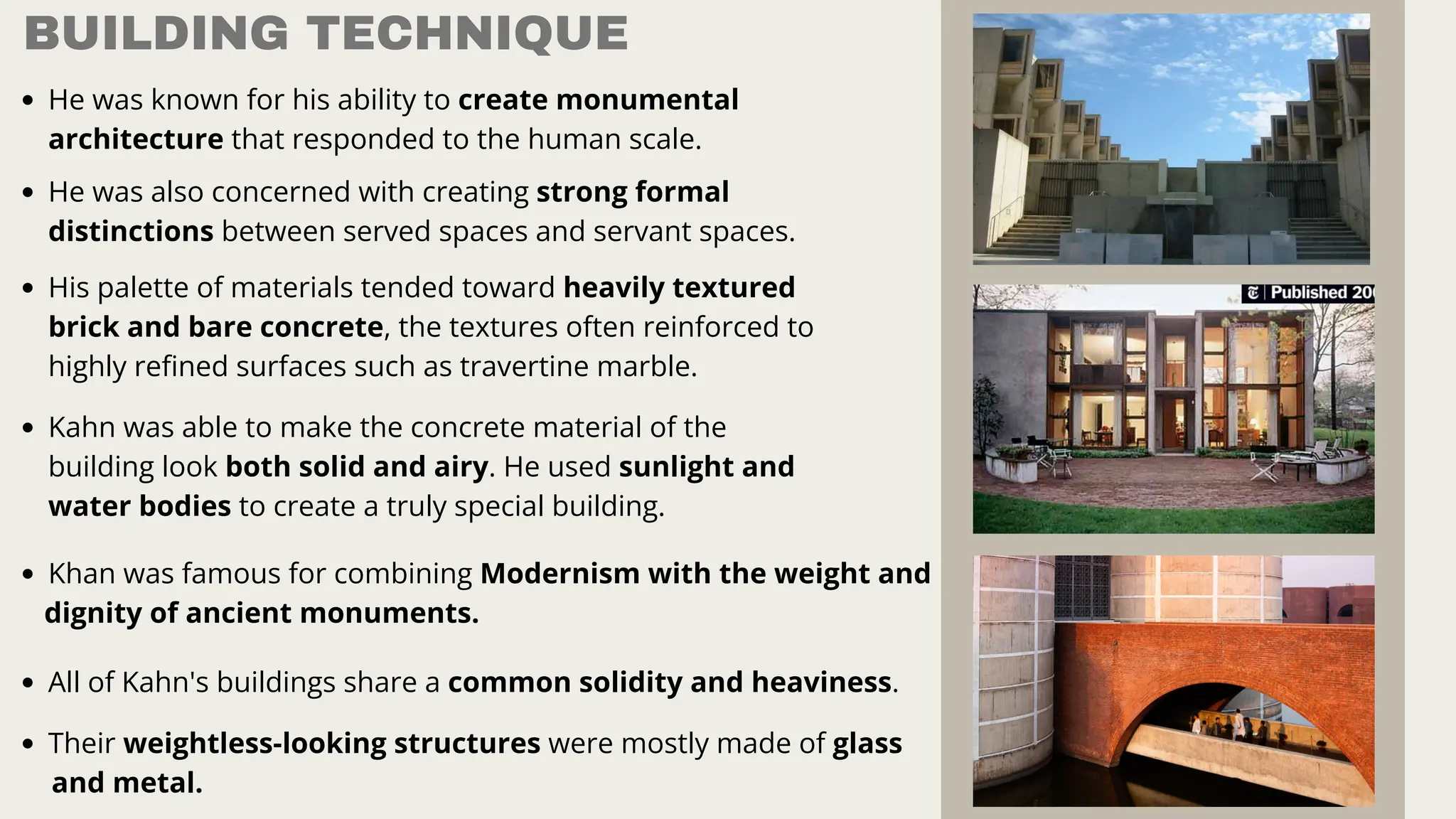
He wasknown for his ability to create monumental
architecture that responded to the human scale.
He was also concerned with creating strong formal
distinctions between served spaces and servant spaces.
His palette of materials tended toward heavily textured
brick and bare concrete, the textures often reinforced to
highly refined surfaces such as travertine marble.
Kahn was able to make the concrete material of the
building look both solid and airy. He used sunlight and
water bodies to create a truly special building.
Khan was famous for combining Modernism with the weight and
dignity of ancient monuments.
All of Kahn's buildings share a common solidity and heaviness.
Their weightless-looking structures were mostly made of glass
and metal.
11.
LOUIS KAHN’S
ARCHITECTURAL STYLE
COMBINEDMODERNISM,
BRUTALISM, AND
MONUMENTAL
MODERNISM. HIS DESIGNS
FEATURED CLEAN LINES,
GEOMETRIC FORMS, AND
FUNCTIONALITY. KAHN
ALSO EMBRACED THE USE
OF RAW CONCRETE, BOLD
MASSING, AND
EXPRESSIVE STRUCTURAL
ELEMENTS IN LINE WITH
THE BRUTALIST STYLE.
12.
CONCEPT
INFLUENCED BY ANCIENTRUINS,
KAHN'S STYLE TENDS TO THE
MONUMENTAL AND
MONOLITHIC; HIS HEAVY
BUILDINGS DO NOT HIDE THEIR
WEIGHT,
THEIR MATERIALS, OR THE WAY
THEY ARE ASSEMBLED. LOUIS
KAHN'S WORKS ARE CONSIDERED
AS MONUMENTAL BEYOND
MODERNISM.
ONE OF THE KEY CONCEPTS THAT
KAHN OFTEN EMPLOYED IN HIS
DESIGNS IS THE IDEA OF
"SERVED" AND "SERVANT"
SPACES.
13.
KAHN USED MANYDIFFERENT SHAPES AND LINES TO
CREATE HIS MASTERPIECES.
HOWEVER, AMONG HIS MOST FAMOUS CREATIONS,
HE SEEMS TO FAVOR BOTH PARALLEL AND
PERPENDICULAR LINES.
THROUGH HIS BOLD TECHNIQUE, HE CREATED
STREAMLINE, RADICAL, AND FUTURISTIC LOOKING
BUILDINGS. HIS STYLE IS HIS OWN, AND HIS
CREATIONS ARE LEGENDARY, THROUGH THE USE OF
GEOMETRY.
HE OFTEN EMPLOYED SIMPLE GEOMETRIC SHAPES
SUCH AS CUBES, SPHERES, AND PYRAMIDS TO
CREATE POWERFUL AND MONUMENTAL
ARCHITECTURAL COMPOSITIONS.
GEOMETRY
14.
USE OF LIGHT
KAHNBELIEVED THAT LIGHT WAS AN
ESSENTIAL ELEMENT IN ARCHITECTURE.
HE CAREFULLY CONSIDERED HOW NATURAL
LIGHT COULD ILLUMINATE AND DEFINE
SPACES WITHIN HIS BUILDINGS, CREATING A
SENSE OF WARMTH AND SPIRITUALITY.
MATERIALITY
KAHN HAD A DEEP RESPECT FOR
MATERIALS AND CRAFTSMANSHIP.
HE BELIEVED THAT THE CHOICE OF
MATERIALS AND THE WAY THEY WERE USED
COULD EXPRESS THE ESSENCE OF A
BUILDING AND CREATE A SENSE OF
TIMELESSNESS.
15.
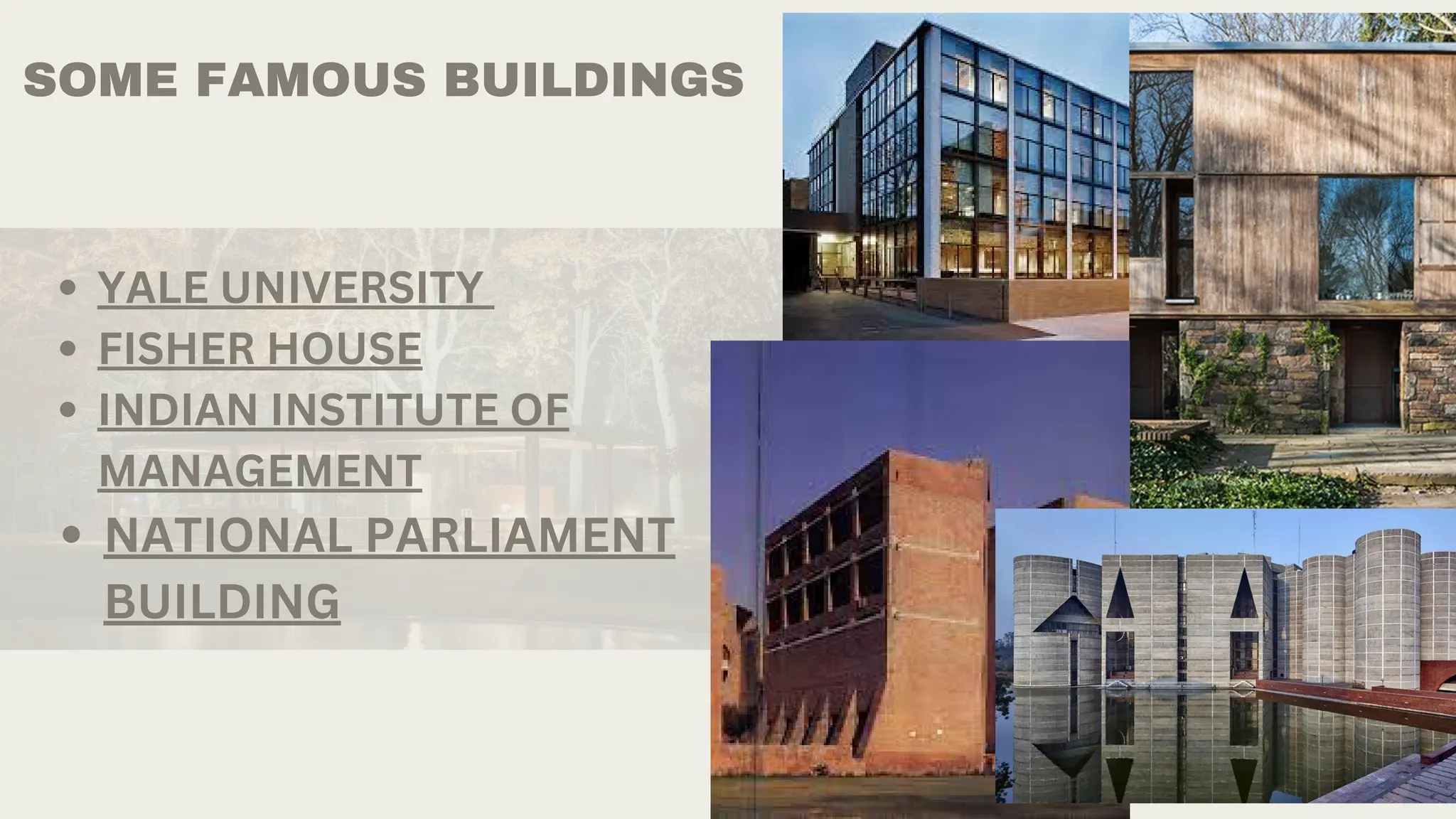
SOME FAMOUS BUILDINGS
YALEUNIVERSITY
FISHER HOUSE
INDIAN INSTITUTE OF
MANAGEMENT
NATIONAL PARLIAMENT
BUILDING
16.
YALE UNIVERSITY ARTGALLERY
Location: New Haven, Connecticut
Date: 1951 to 1954
Building Type: art gallery and design center
Construction System: site-cast concrete, curtain wall infill,
brick
Context: urban campus
Climate: temperate
Style: Modern
The Yale University Art Gallery, located in New Haven,
Connecticut, is one of the oldest university art museums in the
United States. It houses an extensive collection of art spanning
thousands of years and various cultures.
This building was the first of three art museums that Kahn designed
throughout his career and represented a dramatic change for the
conventional architecture of museums in America and in all recognized
buildings as a whole.
17.
CONCEPT
ELEMENTS
With the YaleArt Gallery, Louis Kahn sets new concepts such as symmetry, clear
separation between space and another, and a new vocabulary based on the
triangle and the circle. The triangle as an element appears on the stairs and as
structural concept in the construction of the concrete roof structure designed as a
waffle-slab
Constructed of brick, concrete, glass, and steel, and presenting a
windowless wall along its most public facade, the Kahn building was the
first modernist structure at Yale.
Kahn’s design has been celebrated not only for its beauty, geometry,
and light, but also for its structural and engineering innovations,
particularly the tetrahedral ceiling and cylindrical main staircase.
The building consists of two main bodies, crossed vertically by
pure geometric shapes, such as rectangle, circle or equilateral
triangle.
18.
ARCHITECTURE FEATURES
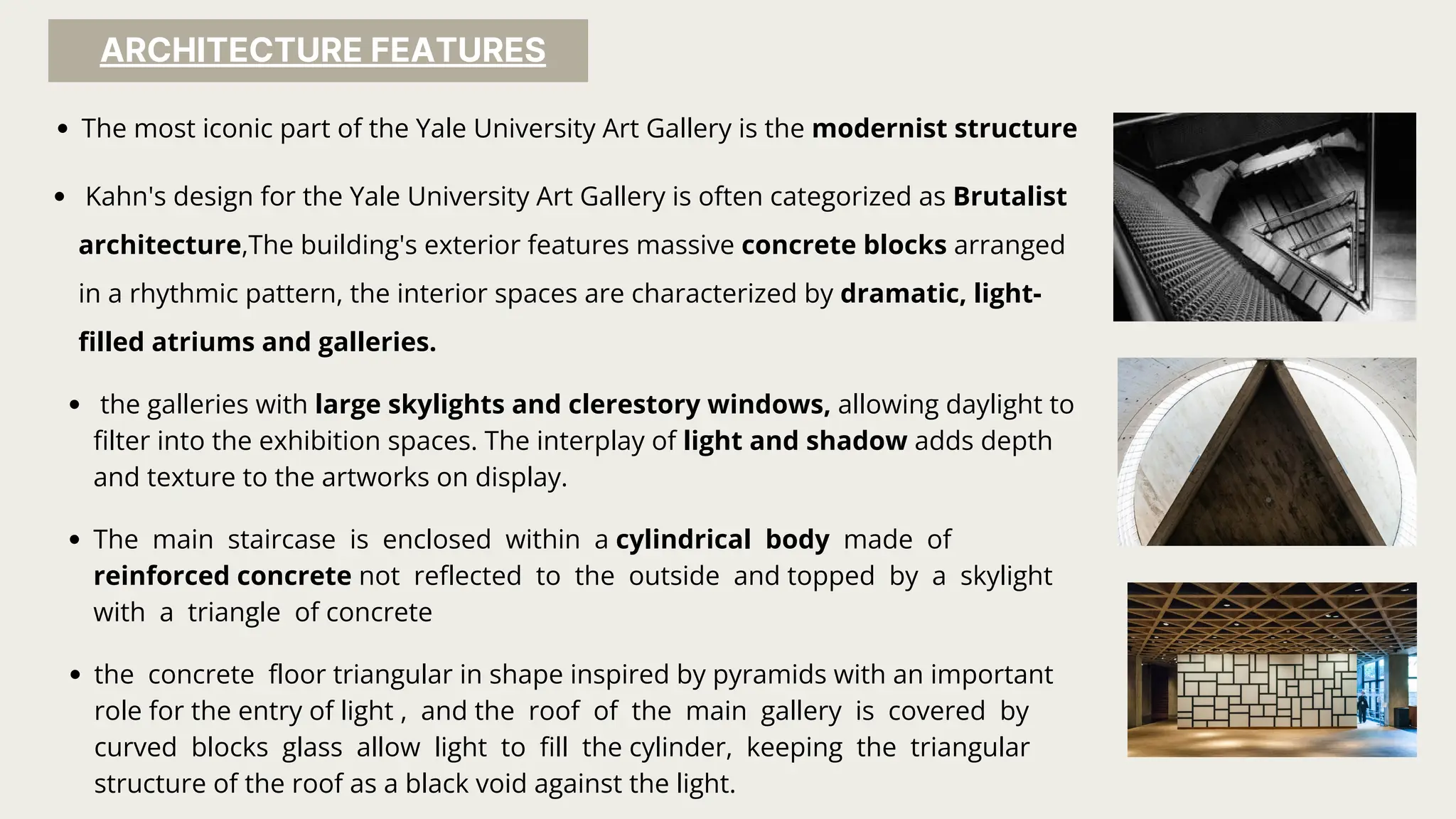
The mosticonic part of the Yale University Art Gallery is the modernist structure
Kahn's design for the Yale University Art Gallery is often categorized as Brutalist
architecture,The building's exterior features massive concrete blocks arranged
in a rhythmic pattern, the interior spaces are characterized by dramatic, light-
filled atriums and galleries.
the galleries with large skylights and clerestory windows, allowing daylight to
filter into the exhibition spaces. The interplay of light and shadow adds depth
and texture to the artworks on display.
The main staircase is enclosed within a cylindrical body made of
reinforced concrete not reflected to the outside and topped by a skylight
with a triangle of concrete
the concrete floor triangular in shape inspired by pyramids with an important
role for the entry of light , and the roof of the main gallery is covered by
curved blocks glass allow light to fill the cylinder, keeping the triangular
structure of the roof as a black void against the light.
19.
FISHER HOUSE
LOCATION -SITUATED IN THE SUBURBS OF HATBORO,
PENNSYLVANIA STATE, UNITED STATES.
CONCEPT -THE FISHER HOUSE IS THE SIMPLEST
EXPRESSION OF KAHN’S IDEA: TWO CUBES, ONE FOR
THE LIVING ROOM AND THE OTHER FOR THE
BEDROOMS, WHICH TOUCH AT AN ANGLE AS IF BY
CHANCE, LIKE DICE THROWN ON A TABLE. IN REALITY,
THEY ARE NOT PERFECT CUBES, AND THE “CUBE” OF
THE LIVING ROOM IS NOT EVEN SQUARE IN FLOOR, BUT
THEY ARE CLOSE ENOUGH TO BE PERCEIVED AS SUCH.
DESCRIPTION- AS IN THE ESHERICK HOUSE,
VENTILATION IS FACILITATED BY WINDOWS WITH
WOODEN SHUTTERS DEEPLY SET BACK WITH
RESPECT TO THE PLANE OF THE FAÇADE, SO THAT
THE SHUTTERS DO NOT PROTRUDE WHEN OPEN.
20.
SPACES
EXTERIOR
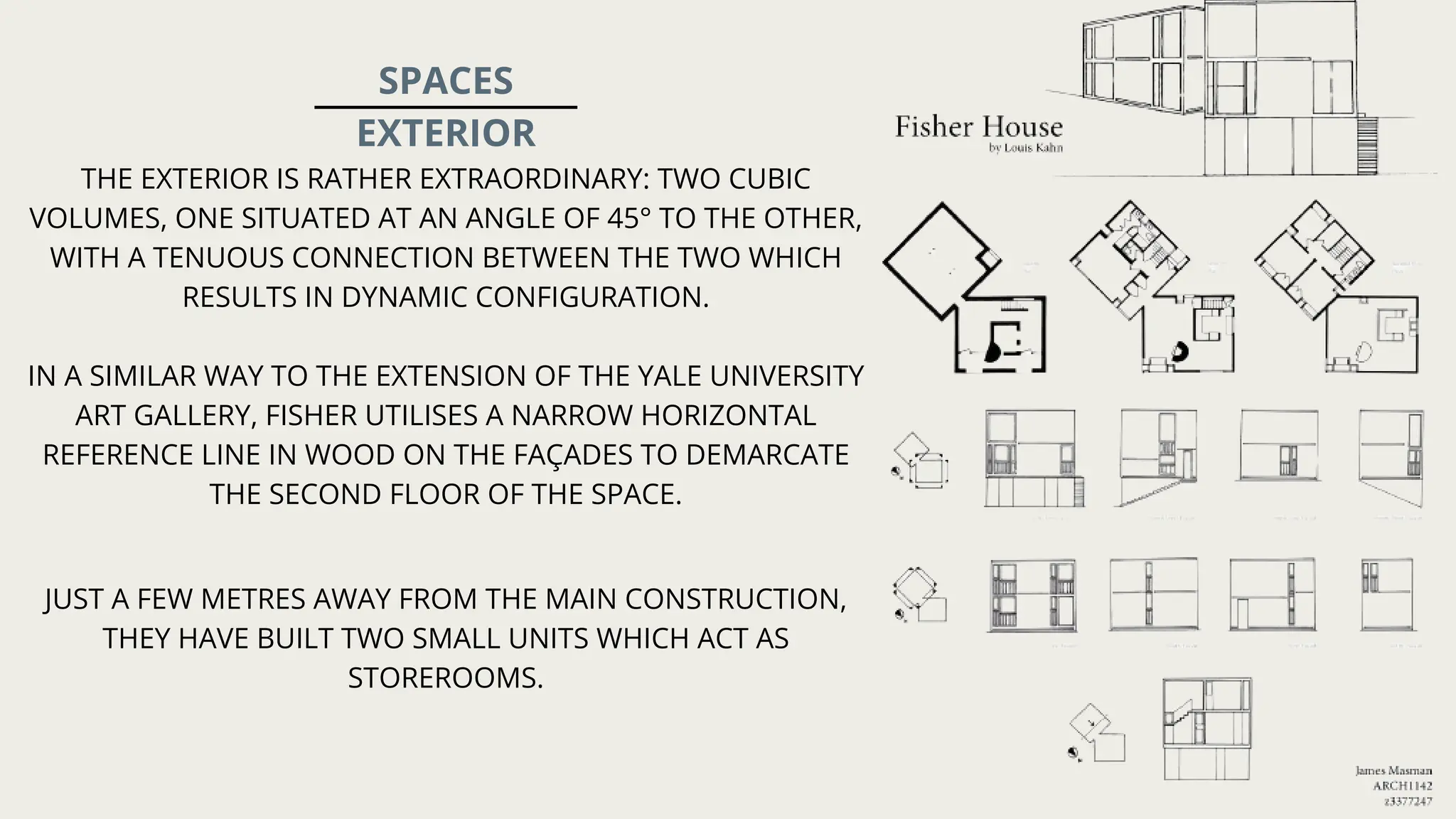
THE EXTERIOR ISRATHER EXTRAORDINARY: TWO CUBIC
VOLUMES, ONE SITUATED AT AN ANGLE OF 45° TO THE OTHER,
WITH A TENUOUS CONNECTION BETWEEN THE TWO WHICH
RESULTS IN DYNAMIC CONFIGURATION.
IN A SIMILAR WAY TO THE EXTENSION OF THE YALE UNIVERSITY
ART GALLERY, FISHER UTILISES A NARROW HORIZONTAL
REFERENCE LINE IN WOOD ON THE FAÇADES TO DEMARCATE
THE SECOND FLOOR OF THE SPACE.
JUST A FEW METRES AWAY FROM THE MAIN CONSTRUCTION,
THEY HAVE BUILT TWO SMALL UNITS WHICH ACT AS
STOREROOMS.
21.
STRUCTURE
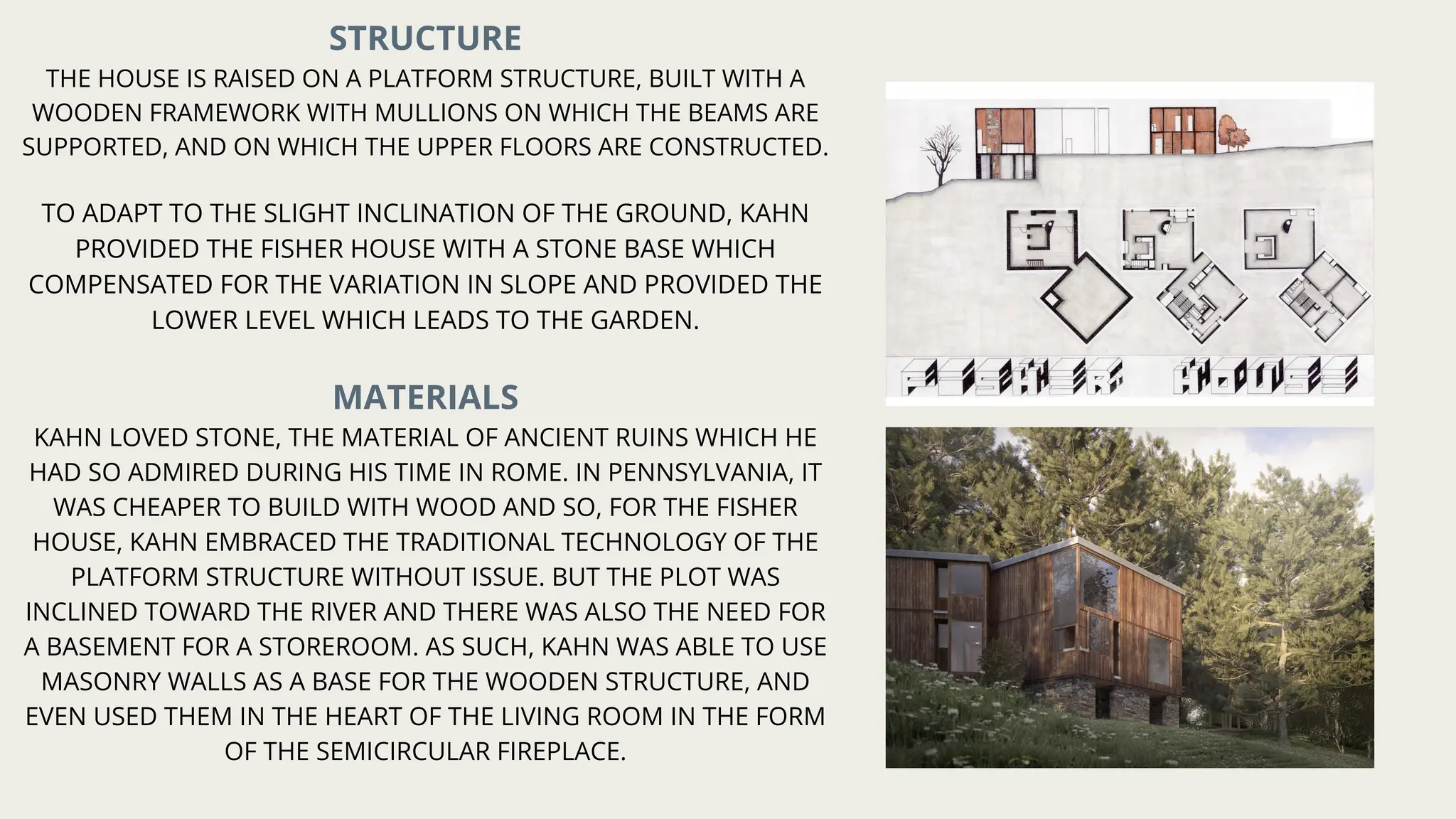
THE HOUSE ISRAISED ON A PLATFORM STRUCTURE, BUILT WITH A
WOODEN FRAMEWORK WITH MULLIONS ON WHICH THE BEAMS ARE
SUPPORTED, AND ON WHICH THE UPPER FLOORS ARE CONSTRUCTED.
TO ADAPT TO THE SLIGHT INCLINATION OF THE GROUND, KAHN
PROVIDED THE FISHER HOUSE WITH A STONE BASE WHICH
COMPENSATED FOR THE VARIATION IN SLOPE AND PROVIDED THE
LOWER LEVEL WHICH LEADS TO THE GARDEN.
MATERIALS
KAHN LOVED STONE, THE MATERIAL OF ANCIENT RUINS WHICH HE
HAD SO ADMIRED DURING HIS TIME IN ROME. IN PENNSYLVANIA, IT
WAS CHEAPER TO BUILD WITH WOOD AND SO, FOR THE FISHER
HOUSE, KAHN EMBRACED THE TRADITIONAL TECHNOLOGY OF THE
PLATFORM STRUCTURE WITHOUT ISSUE. BUT THE PLOT WAS
INCLINED TOWARD THE RIVER AND THERE WAS ALSO THE NEED FOR
A BASEMENT FOR A STOREROOM. AS SUCH, KAHN WAS ABLE TO USE
MASONRY WALLS AS A BASE FOR THE WOODEN STRUCTURE, AND
EVEN USED THEM IN THE HEART OF THE LIVING ROOM IN THE FORM
OF THE SEMICIRCULAR FIREPLACE.
22.
THE NATIONAL PARLIAMENTBUILDING
LOCATED IN THE CITY OF DHAKA, THE
NATIONAL ASSEMBLY BUILDING OF
BANGLADESH, JATIYO
SANGSAD BHABAN, STANDS OUT AS AN
ARCHITECTURAL MASTERPIECE SURROUNDED
BY WATER AND BEAUTIFULLY LANDSCAPED
GARDENS. CONSIDERED TO BE THE LARGEST
LEGISLATIVE COMPLEX
IN THE WORLD, IT IS HOME TO ALL OF
BANGLADESH'S PARLIAMENTARY ACTIVITY
THE ARCHITECT'S KEY DESIGN PHILOSOPHY WAS TO
REPRESENT BANGLADESHI CULTURE AN HERITAGE,
WHILE AT THE SAME TIME OPTIMIZING THE USE OF
SPACE.
THE ASSEMBLY BUILDING RECEIVED THE
AGA KHAN AWARD FOR ARCHITECTURE IN
1989.
23.
KAHNSKILLFULLYINCORPORATEDGEOMETRYINTOTHEDESIGNOFTHE
PARLIAMENT HOUSE BYUTILIZING A SERIES OF GEOMETRIC FORMS
AND SHAPES TO CREATE A HARMONIOUS AND VISUALLY STRIKING
ARCHITECTURALCOMPOSITION.
THEBUILDING'SGEOMETRICELEMENTSARENOTMERELYDECORATIVE
BUT PLAY A FUNDAMENTAL ROLE IN DEFINING THE STRUCTURE'S
SPATIALORGANIZATIONANDSYMBOLICSIGNIFICANCE.
ONE OF THE PROMINENT GEOMETRIC FEATURES IN THE DESIGN IS THE
USE OF MONUMENTAL CONCRETE SHELLS AND GEOMETRIC
VOLUMES THAT DEFINE THE BUILDING'S OVERALL FORM. THESE
GEOMETRIC SHAPES, SUCH AS CYLINDERS, CUBES, AND PYRAMIDS,
INTERACT WITH EACH OTHER TO CREATE A SENSE OF BALANCE AND
UNITYWITHINTHESTRUCTURE.
IN SUMMARY, LOUIS I. KAHN'S INCORPORATION OF GEOMETRY INTO THE
DESIGN OF THE PARLIAMENT HOUSE DEMONSTRATES HIS EXCEPTIONAL
SKILL IN USING GEOMETRIC FORMS AND SHAPES TO CREATE A
POWERFULANDMEANINGFULARCHITECTURALEXPRESSION.
THE NATIONAL PARLIAMENT BUILDING
24.
THE NATIONAL PARLIAMENTBUILDING
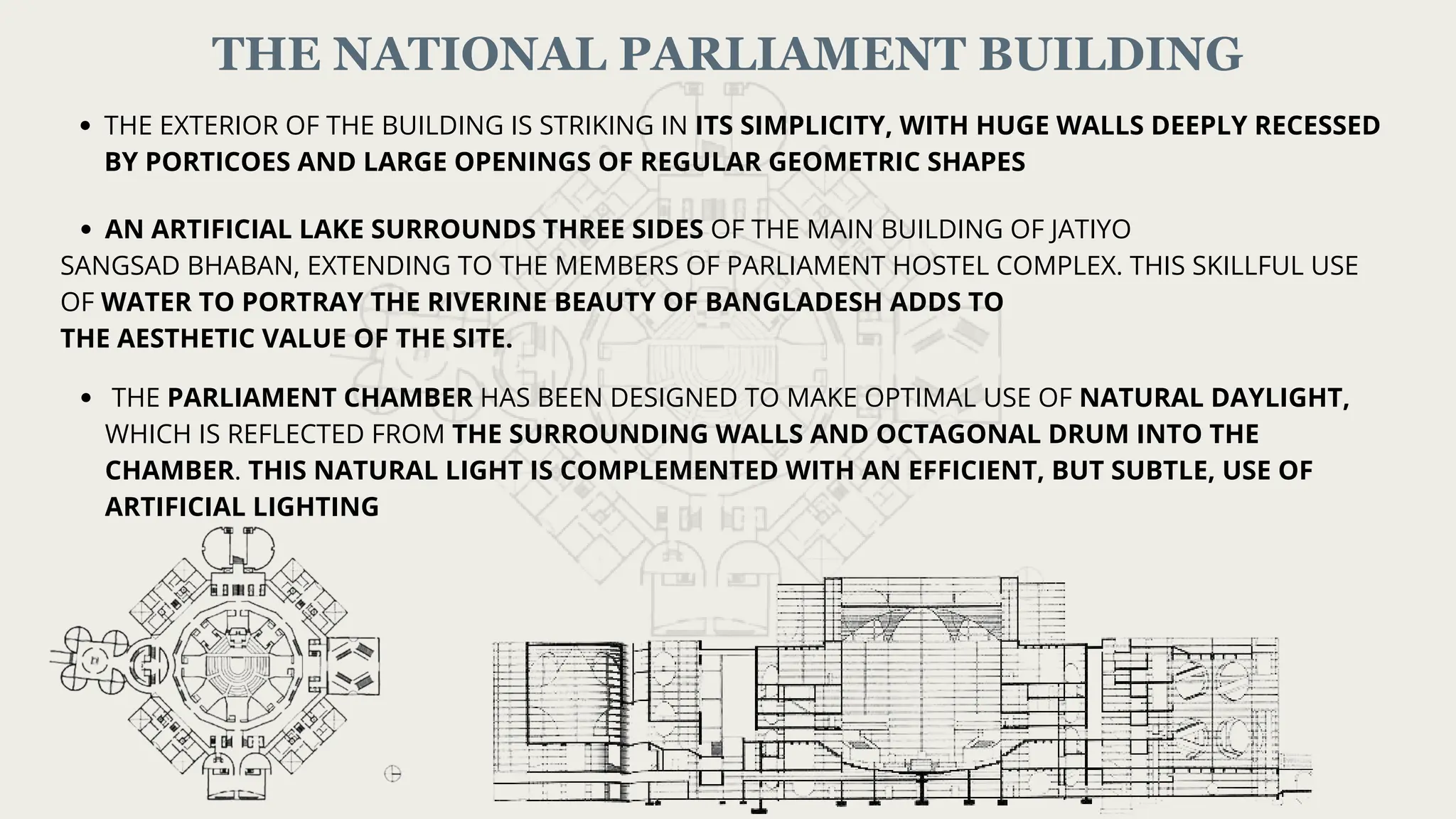
THE EXTERIOR OF THE BUILDING IS STRIKING IN ITS SIMPLICITY, WITH HUGE WALLS DEEPLY RECESSED
BY PORTICOES AND LARGE OPENINGS OF REGULAR GEOMETRIC SHAPES
AN ARTIFICIAL LAKE SURROUNDS THREE SIDES OF THE MAIN BUILDING OF JATIYO
SANGSAD BHABAN, EXTENDING TO THE MEMBERS OF PARLIAMENT HOSTEL COMPLEX. THIS SKILLFUL USE
OF WATER TO PORTRAY THE RIVERINE BEAUTY OF BANGLADESH ADDS TO
THE AESTHETIC VALUE OF THE SITE.
THE PARLIAMENT CHAMBER HAS BEEN DESIGNED TO MAKE OPTIMAL USE OF NATURAL DAYLIGHT,
WHICH IS REFLECTED FROM THE SURROUNDING WALLS AND OCTAGONAL DRUM INTO THE
CHAMBER. THIS NATURAL LIGHT IS COMPLEMENTED WITH AN EFFICIENT, BUT SUBTLE, USE OF
ARTIFICIAL LIGHTING
25.
INDIAN INSTITUTE OFMANAGEMENT
Location - Ahmedabad , India
Date -1962 to 1974
Building type- management institute
It was Kahn's method of blend modern architecture and Indian
tradition into an architecture that could only be applied for the
Indian Institute of Management.
He incorporated local materials (brick and concrete) and large
geometrical façade extractions as homage to Indian vernacular
architecture.
The large façade omissions are abstracted patterns found
within the Indian culture that were positioned to act as light
wells and a natural cooling system protecting the interior
from India's harsh desert climate.
The broad airy corridors, the amphitheatre like classrooms and
transition spaces in the complex enhance interaction among the
faculty, students and visitors.
26.
PLANNING AND DESIGN
Theplan demonstrates a rigid order in a hierarchy according
to different functions. .
The campus is meticulously planned to accommodate
academic, residential, administrative, and recreational
facilities within a cohesive layout. The master plan often
includes provisions for future expansion while preserving the
campus's overall integrity.
The school embodies multiple
programs like academic blocks, faculty
offices, 33 fully furnished dormitories
for student accommodation, an
auditorium, a library, a plaza, and
sporting recreational arrangements.
ENTRY AND EXIT PARKING ROAD
27.
ARCHITECTURE FEATURES
Louis KahnPlaza: . The plaza serves as the central gathering
space and features a reflecting pool, surrounded by exposed brick
walls and geometric patterns.
Exposed Brick Facades: Kahn's design incorporated exposed
brickwork extensively throughout the campus. These brick facades
give the buildings a distinct character and blend well with the
surrounding landscape.
Open Courtyards: The campus design incorporates several open
courtyards, which serve as interactive spaces for students and
faculty. These courtyards provide natural light and ventilation.
Red Sandstone Finishes: Some parts of the campus utilize red
sandstone finishes, adding warmth and texture to the architectural
palette.
Modular Design: Kahn's design for IIM Ahmedabad incorporates
modular elements, with buildings arranged in a grid-like pattern.
This modular approach allows for flexibility in space utilization and
future expansion while maintaining a cohesive architectural
language.
28.
KEY DIFFERENCES INKAHN'S
EARLY AND LATER
ARCHITECTURAL WORKS
Louis I. Kahn's early architectural works
were characterized by a sense of
experimentation and exploration of design
principles. In his early works, such as the
Yale University Art Gallery and the
Richards Medical Research Building,
Kahn focused on incorporating natural
light, geometric forms, and a sense of
monumentality into his designs. These
early works showcased his interest in
materials, structure, and spatial
relationships.
In contrast, Kahn's later architectural
works displayed a more mature and
refined approach to design. Buildings
like the National Assembly Building
in Bangladesh and the Kimbell Art
Museum demonstrated Kahn's
mastery of light and shadow, his
use of monumental forms, and his
profound understanding of the
spiritual qualities of architecture.
His later works often featured a more
monumental scale and a deeper
exploration of the relationship
between architecture and its
surroundings.
29.
PHILIP JOHNSON
BORN :July 8,1906 in Cleveland ,Ohio,
U.S
DIED : January 25,2005 [aged 98] in
Connecticut ,U.S
UNIVERSITY: Harvard Graduate school
of Design,Massachusetts.
EDUCATION : Bachelor of Arts degree
from Harvard University.
AWARDS : Pritzkar award [1979]
AIA gold medal[1978]
Royal gold medal[1985]
Presidential medal of
freedom
INFLUENCED BY : Mies van der rohe and
Le corbusier.
30.
Study completion andtrips to Europe:Upon completing his studies in 1930, he made a
series of trips to Europe, particularly Germany
Joined Henry-Russell Hitchcock, a prominent architectural historian, who was
introducing Americans to the work of Le Corbusier, Walter Gropius, and other modernists.
1928 Meeting in Germany: Philip Johnson first met German architect Ludwig Mies van
der Rohe in 1928 during a trip to Germany.
Formation of Lifelong Relationship: The meeting marked the beginning of a lifelong
relationship characterized by both collaboration and competition between Philip
Johnson and Ludwig Mies van der Rohe.
EARLY LIFE AND CAREER
31.
1930 Directorship atMoMA: Philip
Johnson became the inaugural director of
the architecture department at the
Museum of Modern Art (MoMA) in 1930.
Facilitating Architect Visits: During his
tenure, Johnson organized visits by
influential architects like Walter Gropius
and Le Corbusier to MoMA
Modern architecture exhibition: In 1932, he
organized the first exhibition on modern
architecture at the Museum of Modern Art
EARLY LIFE AND CAREER
32.
ARCHITECTURAL INFLUENCE
Le Corbusier'sInfluence: Le
Corbusier advocated for open floor
plans and the use of large windows
to bring in natural
light.emphasizing functionality,
open spaces, and minimal
ornamentation.
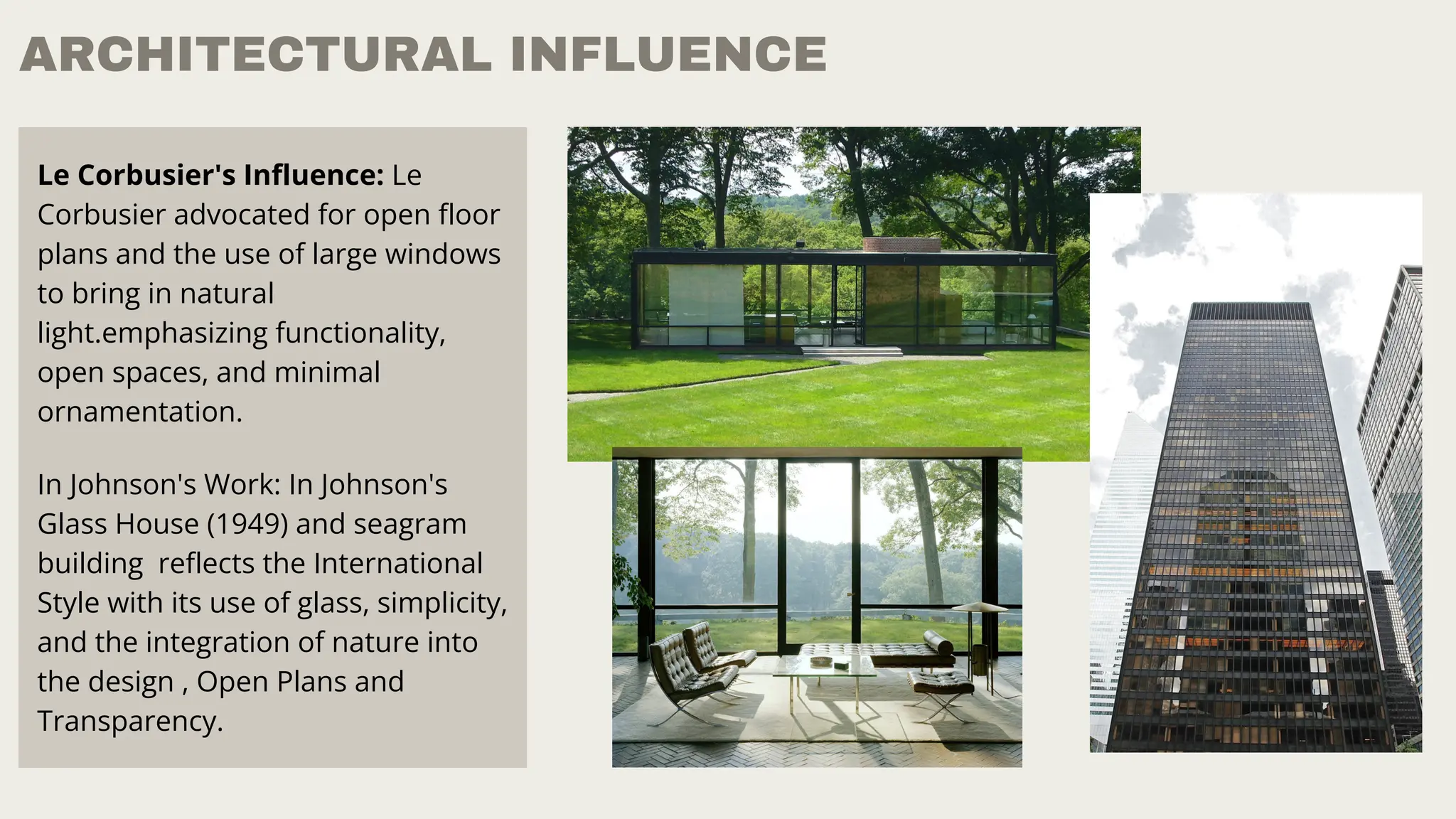
In Johnson's Work: In Johnson's
Glass House (1949) and seagram
building reflects the International
Style with its use of glass, simplicity,
and the integration of nature into
the design , Open Plans and
Transparency.
33.
ARCHITECTURAL INFLUENCE
WALTER GROPIOUS: Johnson
embraced the International Style, a
movement closely associated with
Gropius and Bauhaus, evident in
the use of clean lines, geometric
forms, and a rejection of
excessive ornamentation.
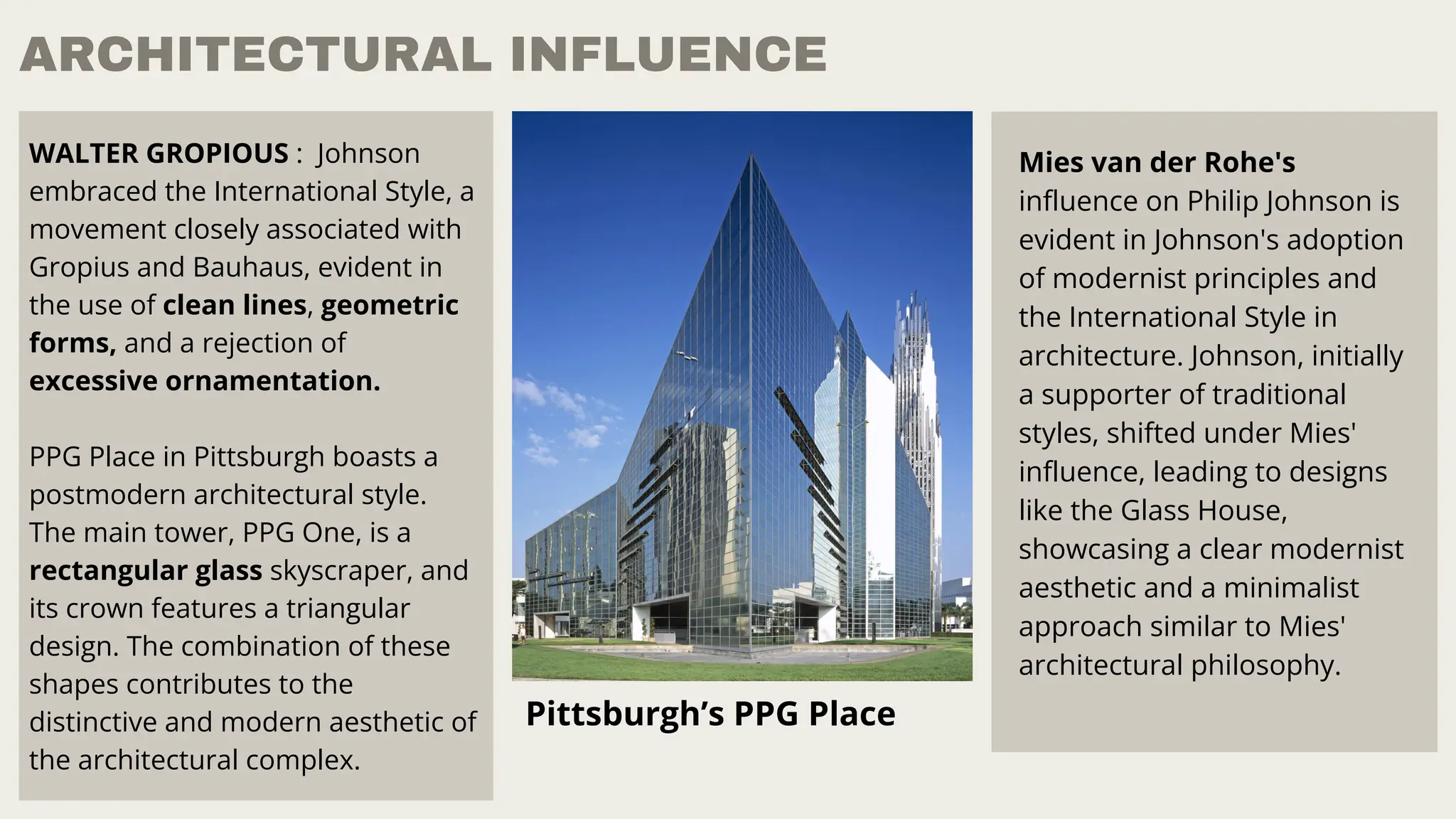
PPG Place in Pittsburgh boasts a
postmodern architectural style.
The main tower, PPG One, is a
rectangular glass skyscraper, and
its crown features a triangular
design. The combination of these
shapes contributes to the
distinctive and modern aesthetic of
the architectural complex.
Pittsburgh’s PPG Place
Mies van der Rohe's
influence on Philip Johnson is
evident in Johnson's adoption
of modernist principles and
the International Style in
architecture. Johnson, initially
a supporter of traditional
styles, shifted under Mies'
influence, leading to designs
like the Glass House,
showcasing a clear modernist
aesthetic and a minimalist
approach similar to Mies'
architectural philosophy.
34.
PHILOSOPHY
Modernism: Johnson wasa pioneer of modernist
architecture in the United States. He believed in the
use of new materials and technologies to create
buildings that were functional, efficient, and
aesthetically pleasing.
Clean lines, a simple geometric form .
Bronze exterior and large, open plaza reflect
the modernist principles.
“Less is more” : Emphasizing clarity
and simplicity in architectural
composition.
Geometric massing.
Minimal ornamentation.
Transparency.
35.
Experimentation and Innovation:Throughout
his career, Johnson was constantly
experimenting with new ideas, materials, and
forms.
He was not afraid to take risks and push the
boundaries of architectural convention, leading
to the development of innovative and
groundbreaking designs.
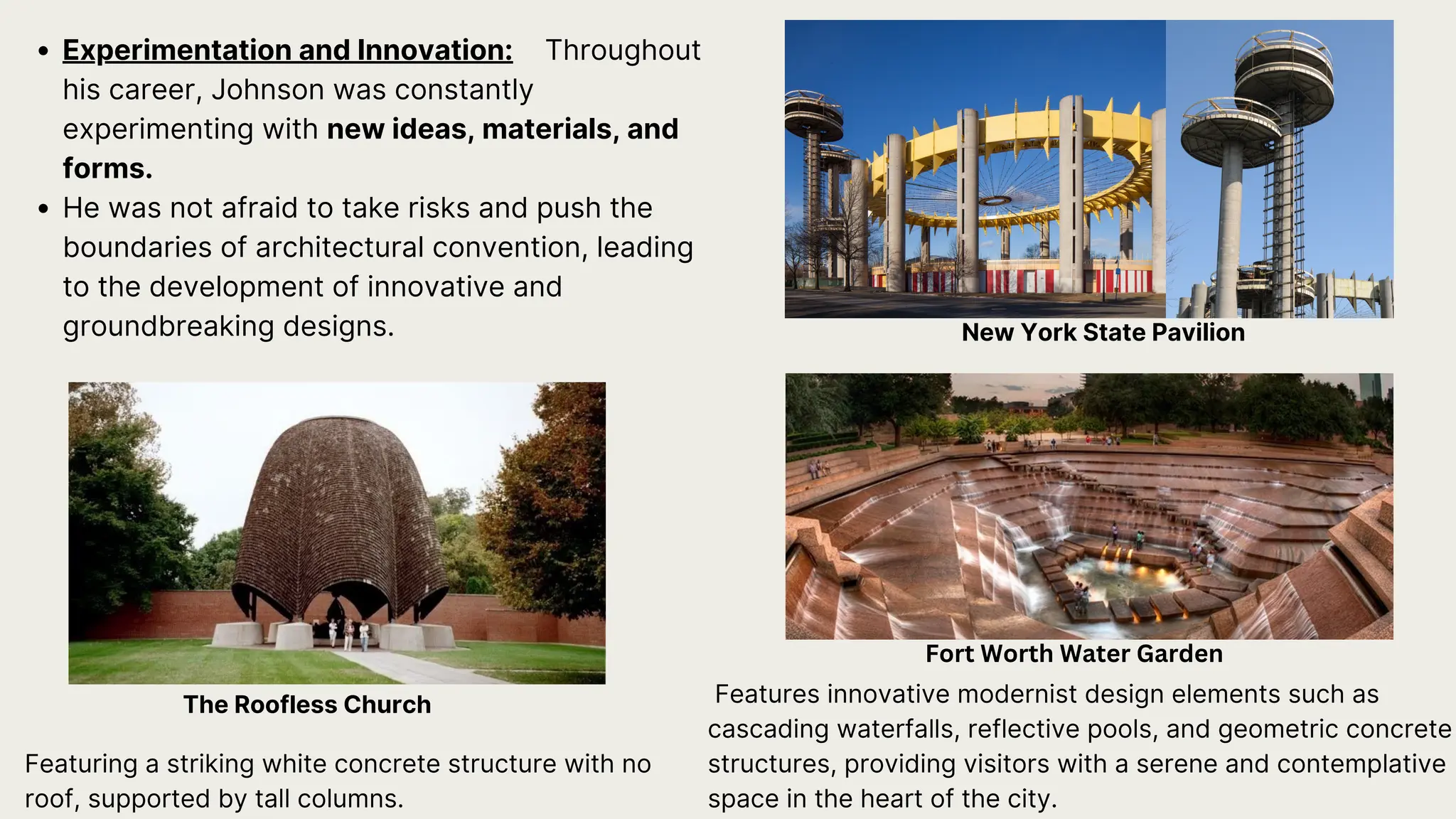
Featuring a striking white concrete structure with no
roof, supported by tall columns.
The Roofless Church
Fort Worth Water Garden
New York State Pavilion
Features innovative modernist design elements such as
cascading waterfalls, reflective pools, and geometric concrete
structures, providing visitors with a serene and contemplative
space in the heart of the city.
36.
ARCHITECTURAL PRINCIPLES
Geometric Forms:Embracing simplicity and
clarity of design. His buildings feature clean
lines, sharp angles, and precise compositions.
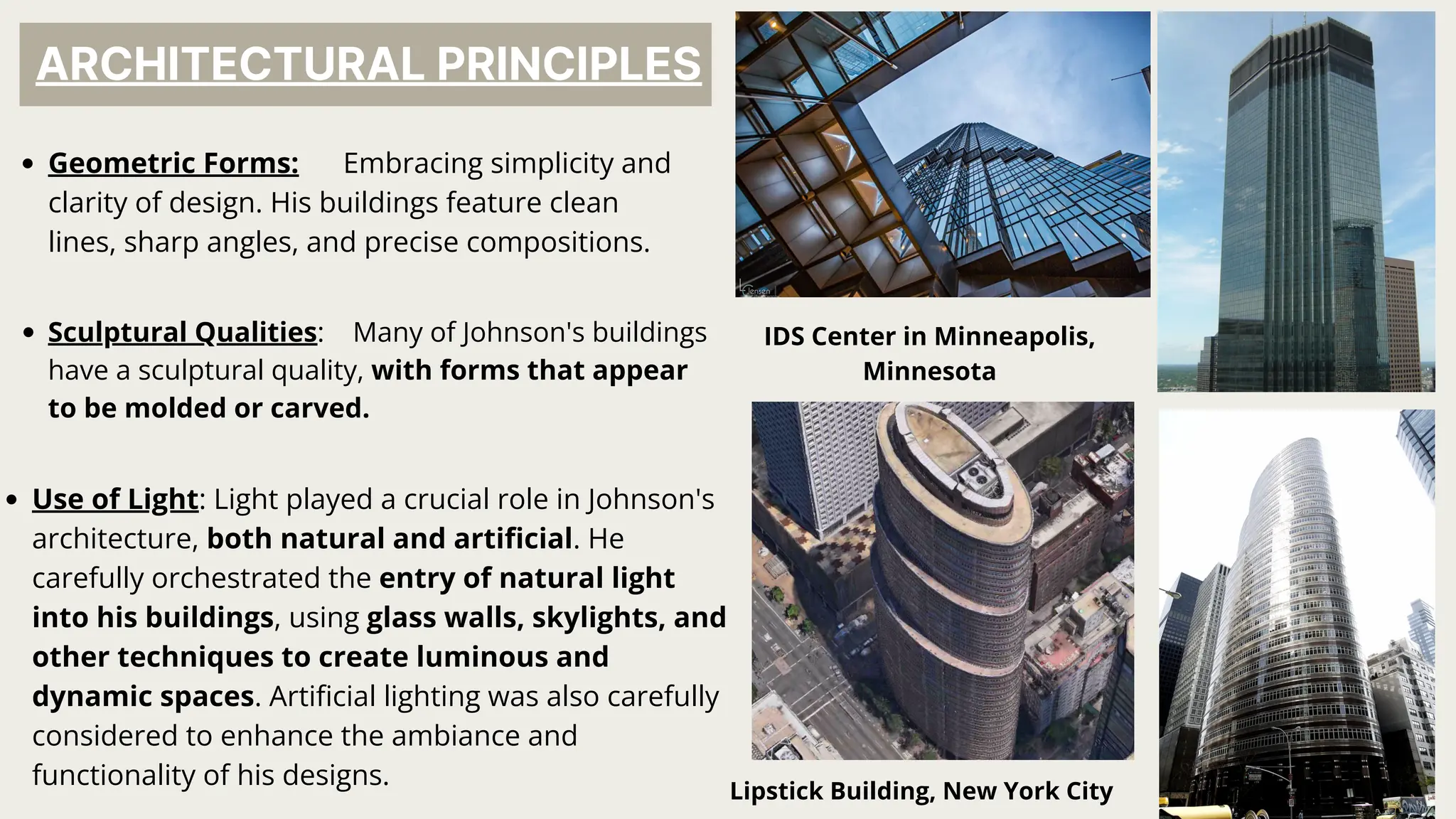
IDS Center in Minneapolis,
Minnesota
Sculptural Qualities: Many of Johnson's buildings
have a sculptural quality, with forms that appear
to be molded or carved.
Lipstick Building, New York City
Use of Light: Light played a crucial role in Johnson's
architecture, both natural and artificial. He
carefully orchestrated the entry of natural light
into his buildings, using glass walls, skylights, and
other techniques to create luminous and
dynamic spaces. Artificial lighting was also carefully
considered to enhance the ambiance and
functionality of his designs.
37.
His first practicalarchitectural work in 1949 , was a residence for himself in New Canaan,
connecticut famously known as Glass house . His earliest works pay homage to simplistic and
minimalistic style
He made a number of other houses in a similar vane and throughout the 1950s designed many
well known works including the Seagram building in New York, done in collaboration with Mies van
der rohe.
From 1967 to 1989 Johnson collaborated with John Burgee, his most productive period he
became to be known at this time as builder of iconic office towers.
EARLY WORKS
38.
In 1991 Philipsplit with John Burgee and opened his own practice. he worked as solo
practitioner for 4 years . In 1994, he invited Alan Ritchie to join him as partner.
For 10 years Philip and John worked closely together exploring new paths in architecture ,
designing buildings. one of the last building that Philip designed with Alan before his death
was the Urban Glass House.
Philip was earlier proponent of modern architecture who later went in various design
directions till post modernism
In modern architecture the buildings followed the principle of “LESS IS MORE” This means
buildings should be simple.
In post modernism the idea of “LESS IS A BORE” was followed, which means it should break
the simplicity of the modernism.
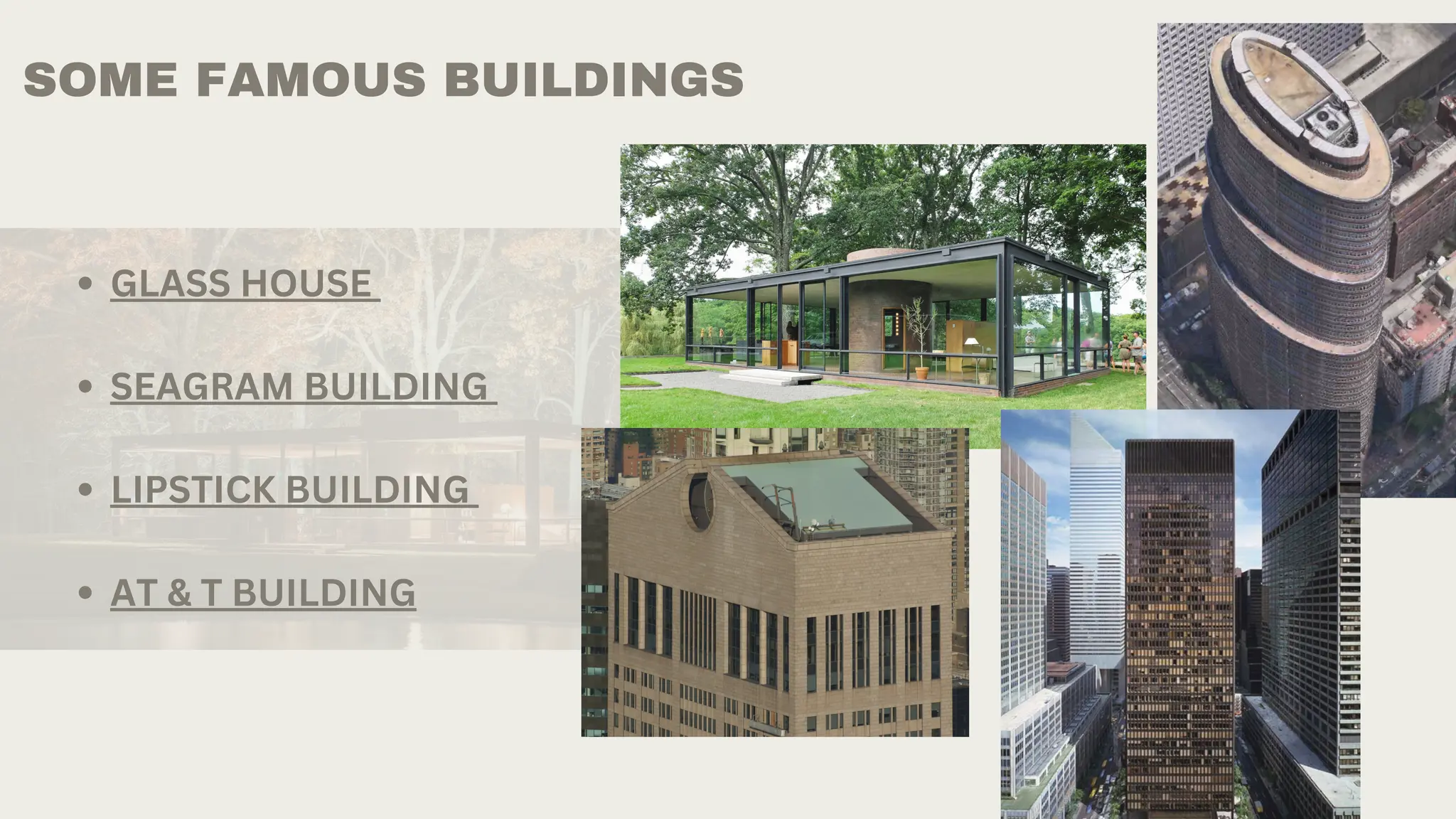
GLASS HOUSE, NEWCANAAN
ARCHITECT: Philip Johnson .
HEIGHT: single-Storey, 56 ft long, 32 feet wide and 11 ft
high
LOCATION: New Canaan,Connecticut.
COMPLETION: In 1949.
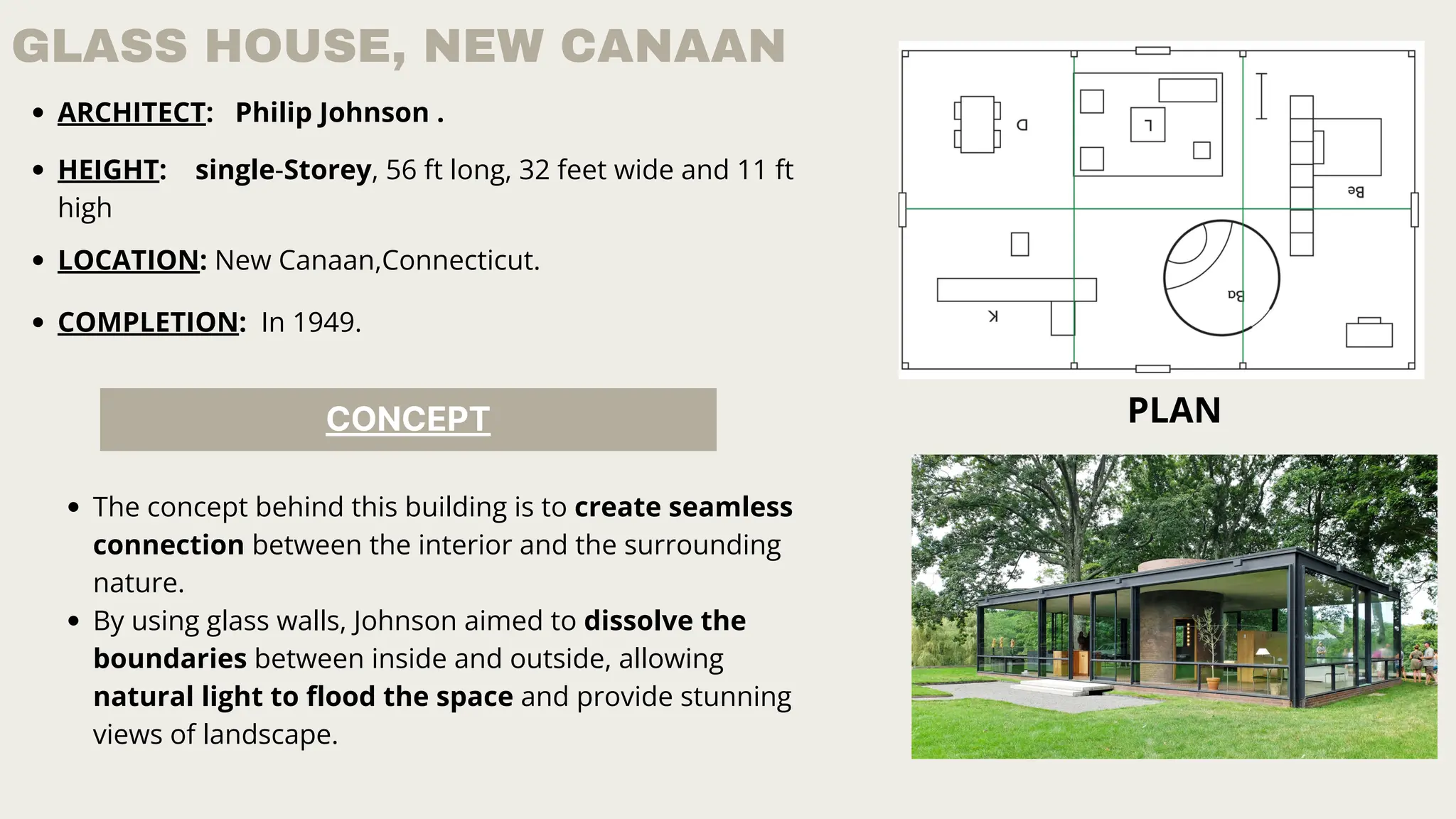
PLAN
CONCEPT
The concept behind this building is to create seamless
connection between the interior and the surrounding
nature.
By using glass walls, Johnson aimed to dissolve the
boundaries between inside and outside, allowing
natural light to flood the space and provide stunning
views of landscape.
41.
ARCHITECTURE
It is influencedby the Farnsworth House in Plano by Mies van der Rohe and is build on the ideas of
German architects from 1920s. In a house of glass ,the views of the landscape are its “wallpaper”
Transparent open- plan frame structure which was his own
residence.
Use of pure forms like rectangular and cylinder inspired by le
corbusier’s modernist works.
His earliest work,built in modernism following simplicity and
minimilistic approach.
The glass house welcomed the modernist style to American
residential architecture, using new materials like steel and glass
panels to integrate the design into landscape.
Spatial division in glass building are achieved by a brick cylinder
containing a bathroom
The interior is open with the space divide the low walnut cabinets, a brick cylinder contains the
bathroom and it is the only object to reach floor to ceiling
42.
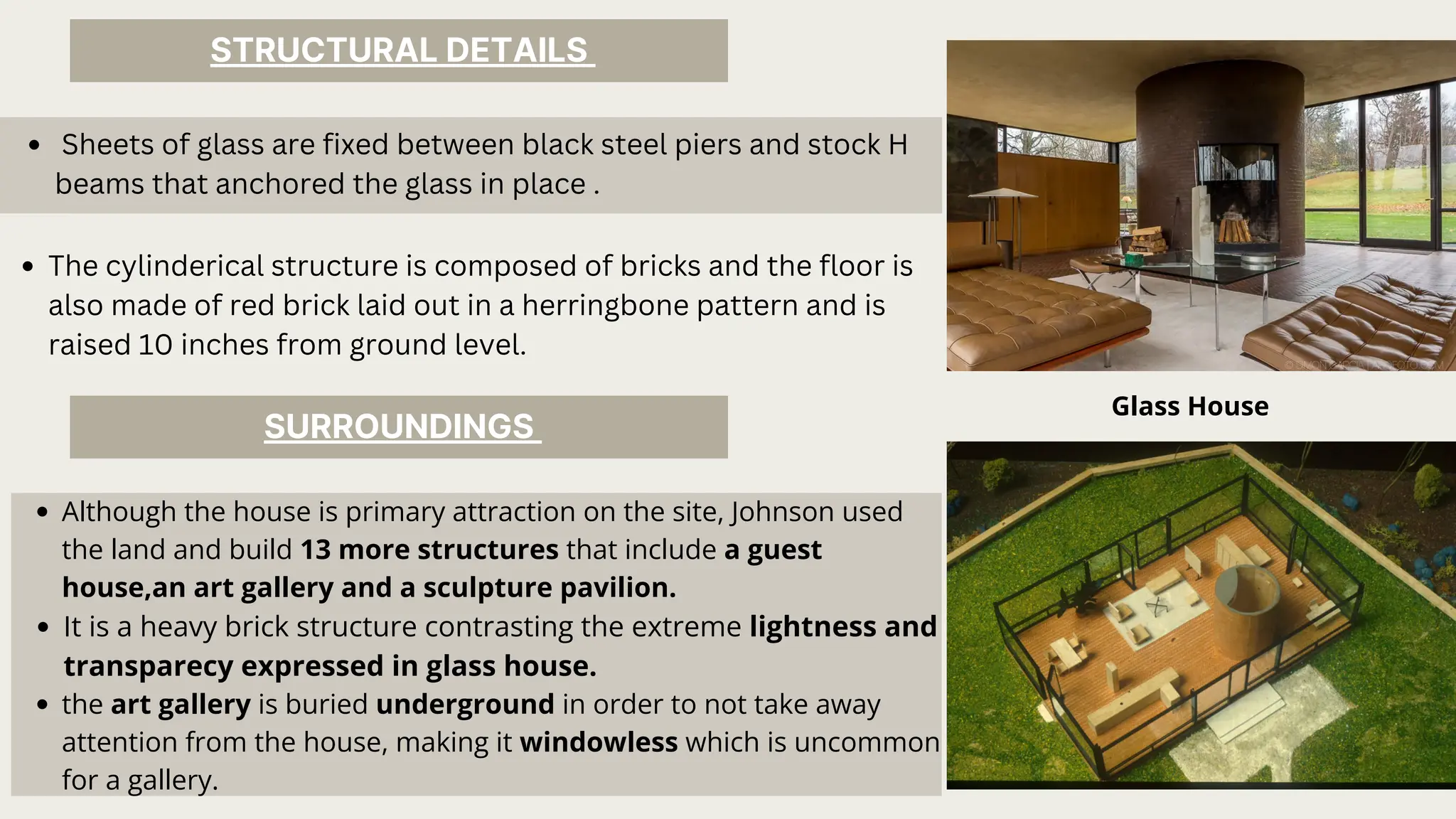
Although the houseis primary attraction on the site, Johnson used
the land and build 13 more structures that include a guest
house,an art gallery and a sculpture pavilion.
It is a heavy brick structure contrasting the extreme lightness and
transparecy expressed in glass house.
the art gallery is buried underground in order to not take away
attention from the house, making it windowless which is uncommon
for a gallery.
STRUCTURAL DETAILS
SURROUNDINGS
Glass House
Sheets of glass are fixed between black steel piers and stock H
beams that anchored the glass in place .
The cylinderical structure is composed of bricks and the floor is
also made of red brick laid out in a herringbone pattern and is
raised 10 inches from ground level.
43.
SEAGRAM BUILDING
ARCHITECT: PhilipJohnson collabs with Mies van
de Rohe.
HEIGHT: 39-Storey, high-rise tower 515 feet (157 m)
tall.
LOCATION: 375 Park Avenue in Manhattan, New York City.
COMPLETION: In 1958.
Rectangular Layout: The Seagram Building has a rectangular
footprint, with a symmetrical floor plan that maximizes
interior space.
Column-Free Interior: column-free interior,. Steel beams
support the floors, allowing for large, open floor plates
without the need for interior columns.
SEAGRAM BUILDING
PLANNING
44.
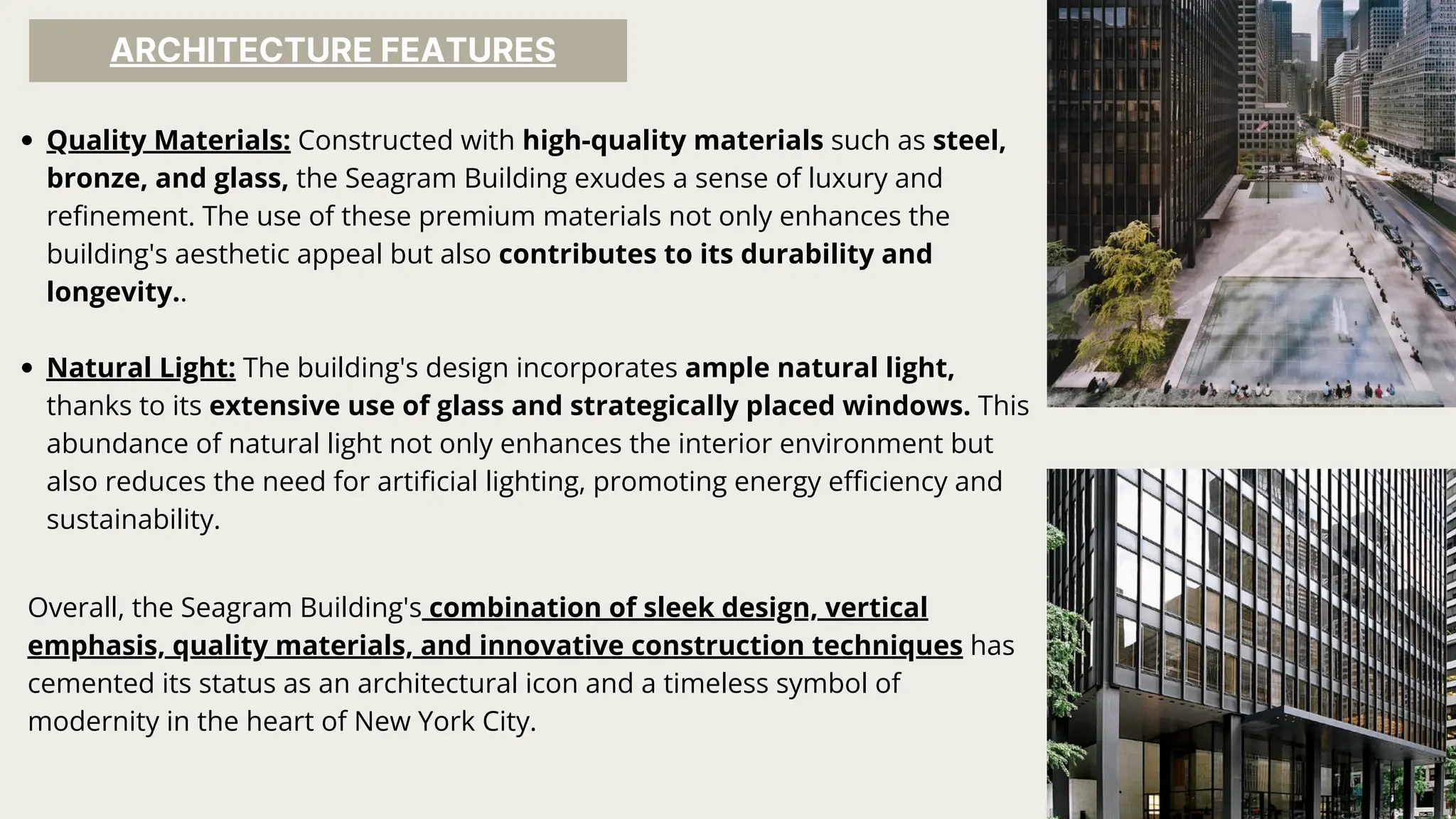
Sleek Facade: Thebuilding's facade is characterized by a minimalist
design featuring bronze-colored mullions and dark-tinted glass
panels.
Vertical Emphasis: The Seagram Building emphasizes verticality with
its towering height and slender profile. Its rectilinear form rises
majestically from the ground, creating a strong visual presence on
the New York City skyline.
ARCHITECTURE FEATURES
Style: Exemplifies the International Style, characterized by simplicity,
geometric forms, and the rejection of ornamentation.
Functionalism: Embraces the modernist principle of functionalism,
where the design emphasizes the building's purpose and rejects
unnecessary embellishments
Legacy: Considered a landmark in architectural history, the Seagram
Building remains an enduring symbol of the mid-20th-century
modernist movement.
45.
ARCHITECTURE FEATURES
Quality Materials:Constructed with high-quality materials such as steel,
bronze, and glass, the Seagram Building exudes a sense of luxury and
refinement. The use of these premium materials not only enhances the
building's aesthetic appeal but also contributes to its durability and
longevity..
Natural Light: The building's design incorporates ample natural light,
thanks to its extensive use of glass and strategically placed windows. This
abundance of natural light not only enhances the interior environment but
also reduces the need for artificial lighting, promoting energy efficiency and
sustainability.
Overall, the Seagram Building's combination of sleek design, vertical
emphasis, quality materials, and innovative construction techniques has
cemented its status as an architectural icon and a timeless symbol of
modernity in the heart of New York City.
46.
Date built: 1980–83
Design:Philip Johnson, Architect with John
Burgee
Location: 560 Madison Avenue (at 56th
Street)
Height: 197 m
Floors: 37
Architectural style: Postmodern architecture
AT&T [ THE SONY TOWER ]
47.
Skyscraper design witha distinctive and
ornamental structure on top.
Some architects criticized this mix, preferring
simpler and more efficient skyscraper designs.
Others found it refreshing because it deviated from
the seriousness of typical modern buildings of the
early 1980s.
The building was controversial – some didn't like the
mix, while others liked its departure from mundane
and purely functional designs of that era.
AT&T Building opened in 1984, breaking away from
the typical box-shaped, glass-and-metal towers .
AT&T [ THE SONY TOWER ]
48.
MODERNIST - POSTMODERNISTFUSION
Clean Modernist Form:
Sleek, geometric design.
Rectangular tower with a simple base.
Utilization of high-quality materials like steel and granite.
Postmodern Ornamentation:
Elaborate Chippendale-inspired crown at the top.
Arched pediments and broken pediment central to the design.
Contrast between minimalist structure and ornamental top.
Public Reception and Influence:
The AT&T Building's successful integration of modernist and
postmodernist elements influenced architectural discourse
and practice, encouraging architects to explore hybrid styles
and experiment with architectural expression.
49.
FEATURES
Chippendale Crown: Oneof the most distinctive features
of the AT&T Building is its ornamental top, often referred
to as the "Chippendale crown."
Arched Entryway: The main entrance of the building
features a prominent arched entryway, emphasizing the
postmodern emphasis on historical references and
classical elements.
Vertical Stripes: The facade of the AT&T Building is
characterized by vertical striping, created by alternating
bands of windows and granite. This design choice adds
visual interest
50.
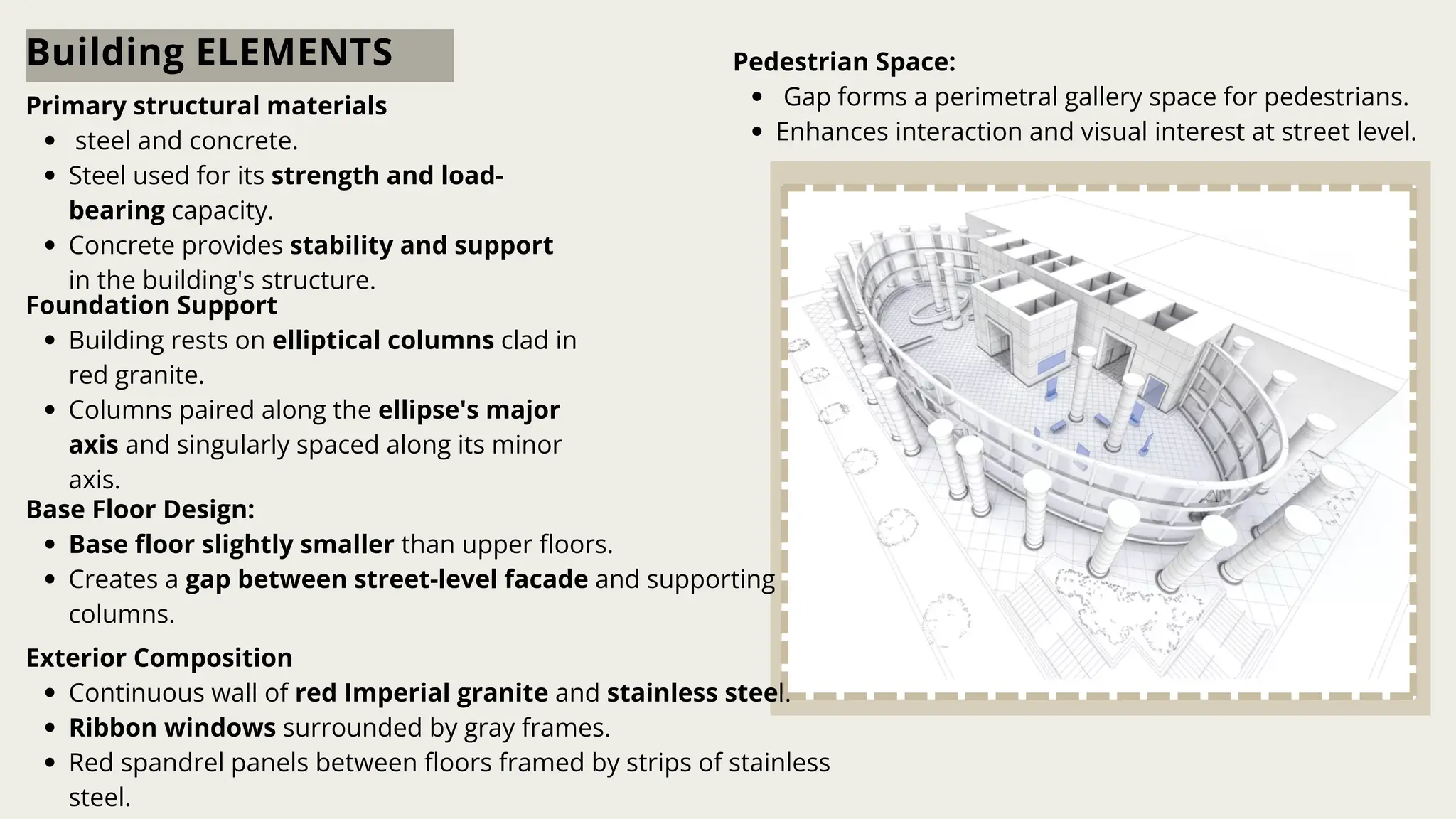
885 Third Avenue(Lipstick Building)
Architect: John Burgee and Philip Johnson.
Height: 453 feet (138 meters).
Completion Year:Completed construction in 1986.
Location: 885 Third Avenue, Midtown Manhattan, NYC
Number of Floors:Consists of 34 floors.
Total Space:The building encompasses 54,000 m2 of space.
Superstructure Composition:The superstructure is primarily
made of reinforced concrete.
Unique Massing
The building comprises three oval cylinders stacked upon
one another, diminishing in size from bottom to top.
The shape and color resemblance led to its nickname, the
"Lipstick Building."
Current Use :Currently housing various offices and businesses.
Architectural Inspiration:
Elliptical columnar perimeter reminiscent of Baroque era.
Shape chosen for aesthetic appeal and historical reference.
51.
Foundation Support
Building restson elliptical columns clad in
red granite.
Columns paired along the ellipse's major
axis and singularly spaced along its minor
axis.
Base Floor Design:
Base floor slightly smaller than upper floors.
Creates a gap between street-level facade and supporting
columns.
Pedestrian Space:
Gap forms a perimetral gallery space for pedestrians.
Enhances interaction and visual interest at street level.
Building ELEMENTS
Primary structural materials
steel and concrete.
Steel used for its strength and load-
bearing capacity.
Concrete provides stability and support
in the building's structure.
Exterior Composition
Continuous wall of red Imperial granite and stainless steel.
Ribbon windows surrounded by gray frames.
Red spandrel panels between floors framed by strips of stainless
steel.
52.
FEATURES
Postmodern architecture, characterizedby its
playful and non-traditional design elements.
Cylindrical Form:The distinctive cylindrical shape of
the tower sets it apart, deviating from more
conventional skyscraper designs.
Red Granite and Stainless Steel Cladding:The
exterior is adorned with red granite and stainless
steel, contributing to its vibrant and
glossy appearance.
Large Windows: The design incorporates large
windows, offering ample natural light and views of the
surrounding area.
Double-height Atrium: The lobby features a
double-height atrium, creating a spacious and
visually striking entrance
53.
MODERNISM
Early Career inModernism: Johnson began his career as a fervent advocate
of modernism, heavily influenced by the works of European modernist
architects such as Le Corbusier and Mies van der Rohe.
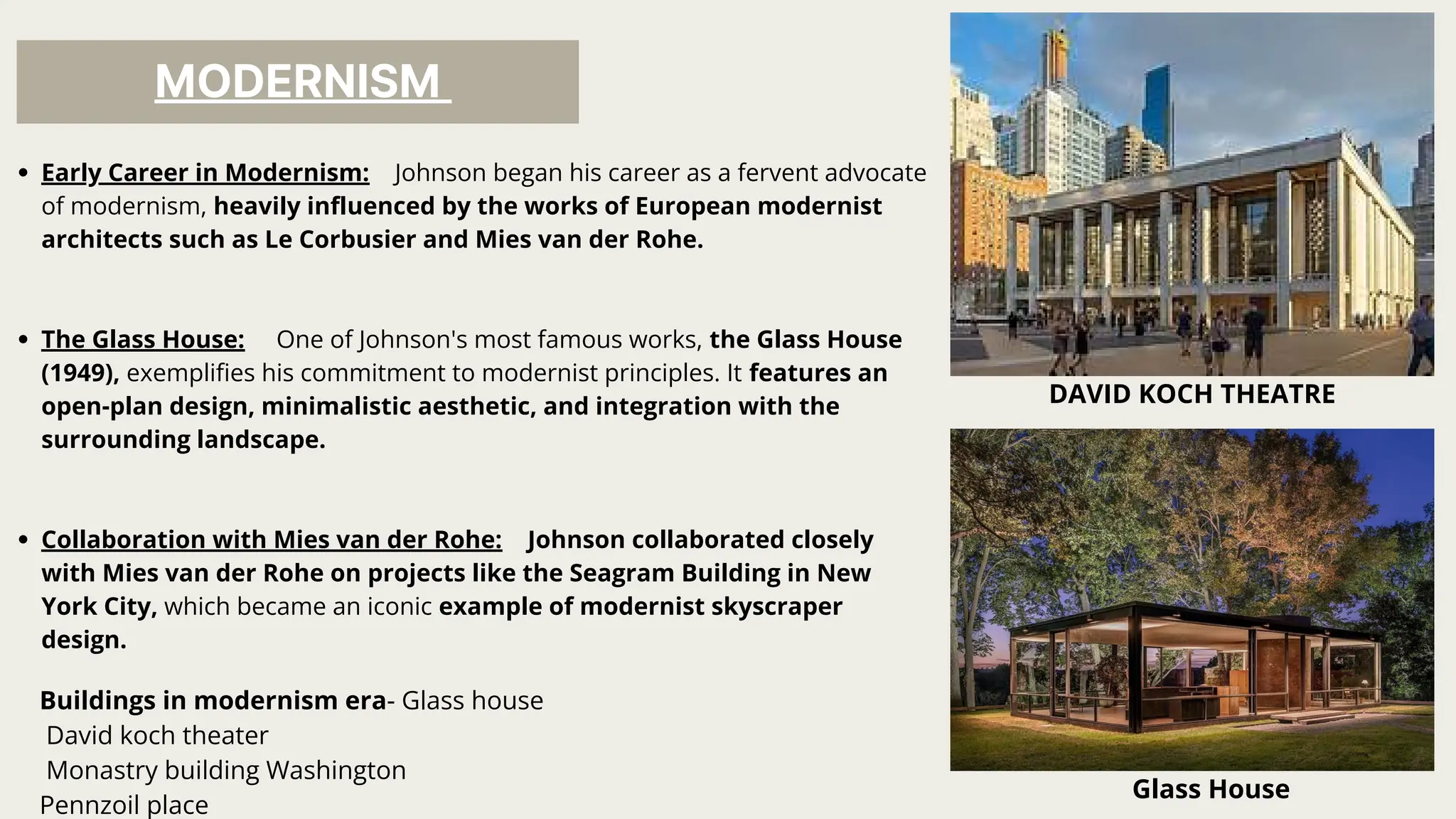
The Glass House: One of Johnson's most famous works, the Glass House
(1949), exemplifies his commitment to modernist principles. It features an
open-plan design, minimalistic aesthetic, and integration with the
surrounding landscape.
Collaboration with Mies van der Rohe: Johnson collaborated closely
with Mies van der Rohe on projects like the Seagram Building in New
York City, which became an iconic example of modernist skyscraper
design.
Glass House
Buildings in modernism era- Glass house
David koch theater
Monastry building Washington
Pennzoil place
DAVID KOCH THEATRE
54.
POSTMODERNISM
Shift Towards Postmodernism:In the late 1960s and early 1970s, Johnson
underwent a notable shift in his architectural philosophy, moving away from
strict modernist principles towards a more eclectic and historical
approach.
AT&T Building (now 550 Madison Avenue): Johnson's design for the AT&T
Building in New York City (completed in 1984) marked a significant departure
from modernism. The building's Chippendale-inspired pediment and playful use
of historical references challenged the rigid dogmas of modernist architecture.
Humor and Playfulness: Johnson's postmodern works often exhibited a
sense of humor and playfulness, incorporating elements of irony, pastiche,
and architectural quotation.
CRYSTAL CATHEDRAL
Buildings in Postmodernism era- Crystal cathedral,
PPG palace , Pittsburg,
PPG PLACE , PITTSBURG











![PHILIP JOHNSON
BORN : July 8,1906 in Cleveland ,Ohio,
U.S
DIED : January 25,2005 [aged 98] in
Connecticut ,U.S
UNIVERSITY: Harvard Graduate school
of Design,Massachusetts.
EDUCATION : Bachelor of Arts degree
from Harvard University.
AWARDS : Pritzkar award [1979]
AIA gold medal[1978]
Royal gold medal[1985]
Presidential medal of
freedom
INFLUENCED BY : Mies van der rohe and
Le corbusier.](https://image.slidesharecdn.com/todseminarlouisikahnandphilipjohnson-250506184045-592c530f/75/Architect-Louis-I-kahn-and-Philip-Johnson-pdf-29-2048.jpg)







![Date built: 1980–83
Design: Philip Johnson, Architect with John
Burgee
Location: 560 Madison Avenue (at 56th
Street)
Height: 197 m
Floors: 37
Architectural style: Postmodern architecture
AT&T [ THE SONY TOWER ]](https://image.slidesharecdn.com/todseminarlouisikahnandphilipjohnson-250506184045-592c530f/75/Architect-Louis-I-kahn-and-Philip-Johnson-pdf-46-2048.jpg)
![Skyscraper design with a distinctive and
ornamental structure on top.
Some architects criticized this mix, preferring
simpler and more efficient skyscraper designs.
Others found it refreshing because it deviated from
the seriousness of typical modern buildings of the
early 1980s.
The building was controversial – some didn't like the
mix, while others liked its departure from mundane
and purely functional designs of that era.
AT&T Building opened in 1984, breaking away from
the typical box-shaped, glass-and-metal towers .
AT&T [ THE SONY TOWER ]](https://image.slidesharecdn.com/todseminarlouisikahnandphilipjohnson-250506184045-592c530f/75/Architect-Louis-I-kahn-and-Philip-Johnson-pdf-47-2048.jpg)