louis i kAHN
Done By:
Nisryn Sherief
EARLY YEARS AND EDUCATION
Born February 20,1901 on Saaremmaa Islan in Kuressaare.
Kahn's Jewish parents immigrated to the United States in 1906
His given name at birth was Itze-Leib Schmullowsky but was changed
upon arrival in the US.
Kahn attended Philadephia’s Central High School and the Public
Industrial Art School.
 He later studied architecture at the University of Pennsylvania, where
he was mentored by the French-born architect Paul Cret. Kahn received
his degree in architecture in 1924.
CAREER BEGINNINGS
After college,he worked as a senior draftsman in the office of Philadelphia,City
Architect John Molitor
To find his inspiration,he traveled through Europe visiting castles and medieval
strongholds in 1928,only 4 years after graduating.
He finally started his own firm in 1935.
While he still designed and worked as a design critic on the side,Louis became a
professor of architecture at Yale school of Architecture.
In 1950-51, Kahn was the architect in residence at the American Academy in
Rome.
CONCEPT
Influenced by ancient ruins,Kahn's style lends to the
monumental and monolithic;his heavy buildings do not hide
their weight,their materials,or the way they are assembled.
Louis Kahn's works are considered as monumental beyond
modernism.
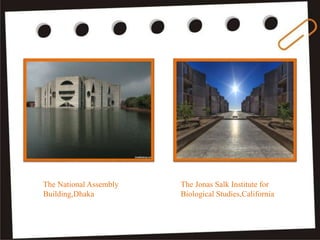
The Jonas Salk Institute for
Biological Studies,California
The National Assembly
Building,Dhaka
GEOMETRY IN HIS WORK
Kahn used many different shapes and lines to create
his masterpieces.However,among his most famous
creations,he seems to favor both paralled and
perpendicular lines.Through his bold technique,he
created streamline,radical and futuristic looking
buildings.
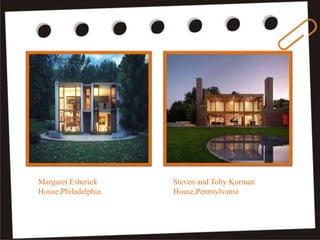
Margaret Esherick
House,Philadelphia
Steven and Toby Korman
House,Pennsylvania
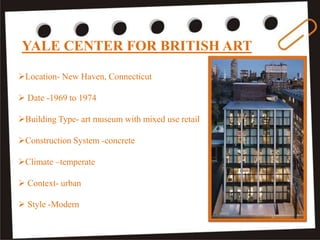
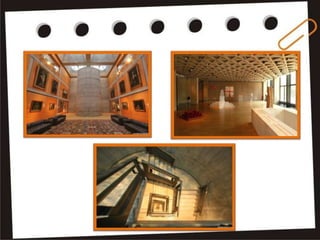
YALE CENTER FOR BRITISH ART
Location- New Haven, Connecticut
 Date -1969 to 1974
Building Type- art museum with mixed use retail
Construction System -concrete
Climate –temperate
 Context- urban
 Style -Modern
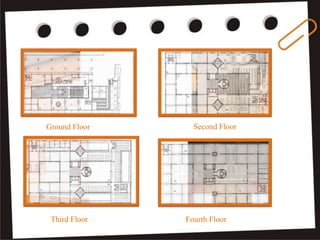
Ground Floor Second Floor
Third Floor Fourth Floor
Kahn began with a site across from one of his earliest public
buildings,The Yale Art Gallery.
Kahn used the first floor on the two streets as retail space.
Kahn removed the infill and created a covered entry.
This entry brought the visitor into the entry court,an enclosed four
story atrium.
Through the entry court on the first floor,the auditorium terraces
down to the basement,a three story enclosed atrium.
The plan are then layed out around the two courts.
Mainly galleries on the top three floors.
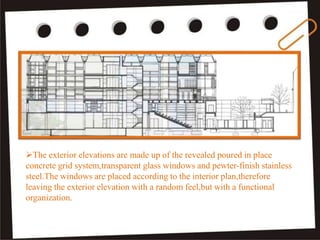
The exterior elevations are made up of the revealed poured in place
concrete grid system,transparent glass windows and pewter-finish stainless
steel.The windows are placed according to the interior plan,therefore
leaving the exterior elevation with a random feel,but with a functional
organization.
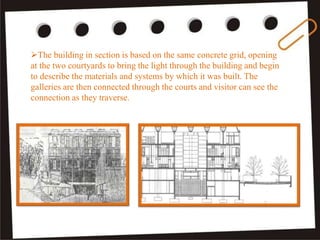
The building in section is based on the same concrete grid, opening
at the two courtyards to bring the light through the building and begin
to describe the materials and systems by which it was built. The
galleries are then connected through the courts and visitor can see the
connection as they traverse.
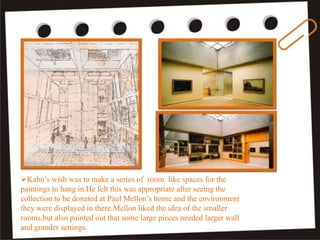
Kahn’s wish was to make a series of room like spaces for the
paintings to hang in.He felt this was appropriate after seeing the
collection to be donated at Paul Mellon’s home and the environment
they were displayed in there.Mellon liked the idea of the smaller
rooms,but also painted out that some large pieces needed larger wall
and grander settings.
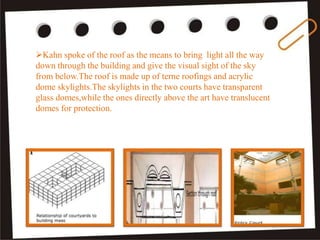
Kahn spoke of the roof as the means to bring light all the way
down through the building and give the visual sight of the sky
from below.The roof is made up of terne roofings and acrylic
dome skylights.The skylights in the two courts have transparent
glass domes,while the ones directly above the art have translucent
domes for protection.
LIST OF OTHER WORKS
Erdman Hall Domitries,
at Bryn Mawr,
Pennsylvania
Esherick House,at
Chestnut Hill,
Pennsylvania
Phillips Exeter
Library, at Exeter,
New Hampshire.
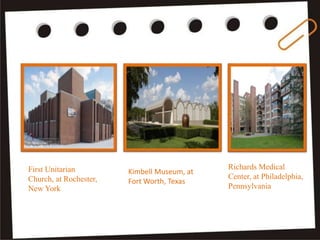
First Unitarian
Church, at Rochester,
New York
Kimbell Museum, at
Fort Worth, Texas
Richards Medical
Center, at Philadelphia,
Pennsylvania
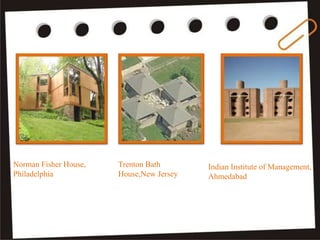
Norman Fisher House,
Philadelphia
Trenton Bath
House,New Jersey
Indian Institute of Management,
Ahmedabad
LEGACY AND HONORS
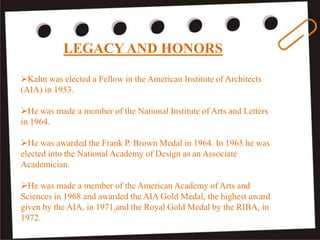
Kahn was elected a Fellow in the American Institute of Architects
(AIA) in 1953.
He was made a member of the National Institute of Arts and Letters
in 1964.
He was awarded the Frank P. Brown Medal in 1964. In 1965 he was
elected into the National Academy of Design as an Associate
Academician.
He was made a member of the American Academy of Arts and
Sciences in 1968 and awarded the AIA Gold Medal, the highest award
given by the AIA, in 1971,and the Royal Gold Medal by the RIBA, in
1972.
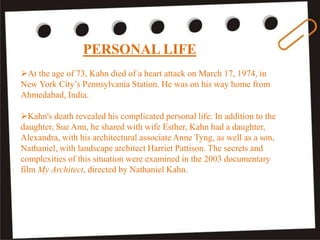
PERSONAL LIFE
At the age of 73, Kahn died of a heart attack on March 17, 1974, in
New York City’s Pennsylvania Station. He was on his way home from
Ahmedabad, India.
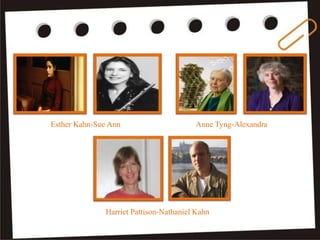
Kahn's death revealed his complicated personal life: In addition to the
daughter, Sue Ann, he shared with wife Esther, Kahn had a daughter,
Alexandra, with his architectural associate Anne Tyng, as well as a son,
Nathaniel, with landscape architect Harriet Pattison. The secrets and
complexities of this situation were examined in the 2003 documentary
film My Architect, directed by Nathaniel Kahn.
Esther Kahn-Sue Ann Anne Tyng-Alexandra
Harriet Pattison-Nathaniel Kahn
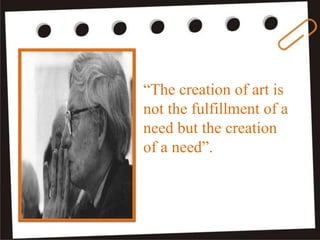
“The creation of art is
not the fulfillment of a
need but the creation
of a need”.
BIBLIOGRAPHY
http://www.slideshare.net/vijiramesh24/louis-i-kahn-33384097
http://www.greatbuildings.com/building
http:// www.biography.com/people/louis-kahn-37884#synopsis
http://www.greatbuildings.com/buildings/National_Assembly_in_Dacc.ht
ml
https://en.wikipedia.org/wiki/Louis_Kahns/Yale_Center_for_British_A.ht
ml
Louis I Kahn
Louis I Kahn
Louis I Kahn

Louis I Kahn

  • 1.
    louis i kAHN DoneBy: Nisryn Sherief
  • 2.
    EARLY YEARS ANDEDUCATION Born February 20,1901 on Saaremmaa Islan in Kuressaare. Kahn's Jewish parents immigrated to the United States in 1906 His given name at birth was Itze-Leib Schmullowsky but was changed upon arrival in the US. Kahn attended Philadephia’s Central High School and the Public Industrial Art School.  He later studied architecture at the University of Pennsylvania, where he was mentored by the French-born architect Paul Cret. Kahn received his degree in architecture in 1924.
  • 3.
    CAREER BEGINNINGS After college,heworked as a senior draftsman in the office of Philadelphia,City Architect John Molitor To find his inspiration,he traveled through Europe visiting castles and medieval strongholds in 1928,only 4 years after graduating. He finally started his own firm in 1935. While he still designed and worked as a design critic on the side,Louis became a professor of architecture at Yale school of Architecture. In 1950-51, Kahn was the architect in residence at the American Academy in Rome.
  • 4.
    CONCEPT Influenced by ancientruins,Kahn's style lends to the monumental and monolithic;his heavy buildings do not hide their weight,their materials,or the way they are assembled. Louis Kahn's works are considered as monumental beyond modernism.
  • 5.
    The Jonas SalkInstitute for Biological Studies,California The National Assembly Building,Dhaka
  • 6.
    GEOMETRY IN HISWORK Kahn used many different shapes and lines to create his masterpieces.However,among his most famous creations,he seems to favor both paralled and perpendicular lines.Through his bold technique,he created streamline,radical and futuristic looking buildings.
  • 7.
  • 8.
    YALE CENTER FORBRITISH ART Location- New Haven, Connecticut  Date -1969 to 1974 Building Type- art museum with mixed use retail Construction System -concrete Climate –temperate  Context- urban  Style -Modern
  • 9.
    Ground Floor SecondFloor Third Floor Fourth Floor
  • 10.
    Kahn began witha site across from one of his earliest public buildings,The Yale Art Gallery. Kahn used the first floor on the two streets as retail space. Kahn removed the infill and created a covered entry. This entry brought the visitor into the entry court,an enclosed four story atrium. Through the entry court on the first floor,the auditorium terraces down to the basement,a three story enclosed atrium. The plan are then layed out around the two courts. Mainly galleries on the top three floors.
  • 11.
    The exterior elevationsare made up of the revealed poured in place concrete grid system,transparent glass windows and pewter-finish stainless steel.The windows are placed according to the interior plan,therefore leaving the exterior elevation with a random feel,but with a functional organization.
  • 12.
    The building insection is based on the same concrete grid, opening at the two courtyards to bring the light through the building and begin to describe the materials and systems by which it was built. The galleries are then connected through the courts and visitor can see the connection as they traverse.
  • 13.
    Kahn’s wish wasto make a series of room like spaces for the paintings to hang in.He felt this was appropriate after seeing the collection to be donated at Paul Mellon’s home and the environment they were displayed in there.Mellon liked the idea of the smaller rooms,but also painted out that some large pieces needed larger wall and grander settings.
  • 14.
    Kahn spoke ofthe roof as the means to bring light all the way down through the building and give the visual sight of the sky from below.The roof is made up of terne roofings and acrylic dome skylights.The skylights in the two courts have transparent glass domes,while the ones directly above the art have translucent domes for protection.
  • 16.
    LIST OF OTHERWORKS Erdman Hall Domitries, at Bryn Mawr, Pennsylvania Esherick House,at Chestnut Hill, Pennsylvania Phillips Exeter Library, at Exeter, New Hampshire.
  • 17.
    First Unitarian Church, atRochester, New York Kimbell Museum, at Fort Worth, Texas Richards Medical Center, at Philadelphia, Pennsylvania
  • 18.
    Norman Fisher House, Philadelphia TrentonBath House,New Jersey Indian Institute of Management, Ahmedabad
  • 19.
    LEGACY AND HONORS Kahnwas elected a Fellow in the American Institute of Architects (AIA) in 1953. He was made a member of the National Institute of Arts and Letters in 1964. He was awarded the Frank P. Brown Medal in 1964. In 1965 he was elected into the National Academy of Design as an Associate Academician. He was made a member of the American Academy of Arts and Sciences in 1968 and awarded the AIA Gold Medal, the highest award given by the AIA, in 1971,and the Royal Gold Medal by the RIBA, in 1972.
  • 20.
    PERSONAL LIFE At theage of 73, Kahn died of a heart attack on March 17, 1974, in New York City’s Pennsylvania Station. He was on his way home from Ahmedabad, India. Kahn's death revealed his complicated personal life: In addition to the daughter, Sue Ann, he shared with wife Esther, Kahn had a daughter, Alexandra, with his architectural associate Anne Tyng, as well as a son, Nathaniel, with landscape architect Harriet Pattison. The secrets and complexities of this situation were examined in the 2003 documentary film My Architect, directed by Nathaniel Kahn.
  • 21.
    Esther Kahn-Sue AnnAnne Tyng-Alexandra Harriet Pattison-Nathaniel Kahn
  • 22.
    “The creation ofart is not the fulfillment of a need but the creation of a need”.
  • 23.