Pokhara Engineering College
Pokhara, Phirke
Department Of Architecture
DESIGN THEORY
TOPIC : AR. LOUIS KAHN
SUBMITTED TO : PRAGATI BANIYA MAM
SUBMITTED BY : GROUP ‘D’
AKARSHA SHRESTHA
SHRIYA SHRESTHA
SABINA KHADKA
SAHARA BARAL
ALISHA GAUTAM
Introduction
Born On February20, 1901 At Parnu,
Estonia
Real Name : Itze-leib Schmuilowsky
Became An American Architect On
March 17, 1974, Based On Philadelphia,
Pennsylvania, United States
Quote
 Architecture is the reaching out for the truth
 Design is not making beauty, beauty emerges from selection, affinities,
integration, love
 Every time a student walks past a really urgent, expressive piece of
architecture the belongs to his college, it can help reassure him that he
does have that mind, does have that soul.
 “What does the building want to be?”
Career
 1926 – Worked As Senior Draftsman In Ar. John Molitor’s Office
 1929 – Worked As The Offices Of Paul Phillipe Cret, Then With
Zantzinger, Borie And Medary
 1932 – Kahn And Dominique Berninger Founded The Architectural
Research Group
 1947 – Teaching Career At Yale University And University Of
Pennsylvania
After Working In Various Capacities For Served Firms In
Philadelphia, He Founded His Own Atelier In 1935
Awards - AIA Gold Medal(1971), RIBA Gold Medal (1972), Frank P
Brown Medal(1964)
Building Technique
 He was known for his ability to create monumental
architecture that responded to the human scale
 He was also concerned with creating strong formal
distinctions between served spaces and servant spaces
 His palette of materials tended towards heavily textured
brick and bare concrete,
 Kahn was able to make the concrete material of the
building look both solid and airy.
 He used sunlight and water bodies to create a truly special
building
 Kahn’s design has been celebrated not only for its beauty,
geometry and light but also for its structural and
engineering innovations
Some of his works
 Yale University Art Gallery , New Haven, Connecticut
(1951-1953)
 Richard Medical Research Laboratories, University O
Pennsylvania, Philadelphia, (1957-1965)
 The Salk Institute, La Jolla, California (1959-1965)
 First Unitarian Church, Rochester, New York (1959-
1969)
 Jatiyo Sangshad Bhawan (National Assembly Building)
In Dhaka, Building (1962-1974)
 Kimbell Art Museum, Fort Worth, Texas (1967-1972)
Yale University Art Gallery
Location : 1111 Chapel Street, New Haven, Connecticut, USA.
Concept:
 Symmetry
 Clear separation between spaces and space
 A new vocabulary based on the triangle and the circle
 The triangle as a figure appears on the stairs and as
structural concepts in the construction forged
rosettes
 From the street, the building is perceived as the of
brick , windowless, monolithic, with is southeast
façade
 It was the extension of an existing building in an
empty corner which is connected with the old
building through the alignment of facades.
Interior
 The building’s interior is characterized by a system of
precast concrete roof that houses the gallery lighting
and ventilation
 Which was an innovative structural engineering hollow
concrete tetrahedrons, where numbers of functions is
combine and give the interior a rich and changing
quality
Spaces
 It was conceived as a unique, modular,
consisting of two prismatic
 The exhibition rooms are created using
modular panels
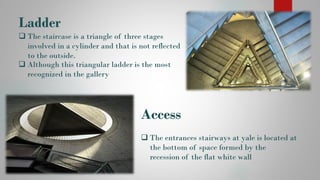
 The entrances stairways at yale is located at
the bottom of space formed by the
recession of the flat white wall
Access
Ladder
 The staircase is a triangle of three stages
involved in a cylinder and that is not reflected
to the outside.
 Although this triangular ladder is the most
recognized in the gallery
Structure
 Modulated Rectangular Structure Of Concrete
 First Building To Use Concrete Roof Structure Consists Of A Tetrahedron With
Special Armor That Exposes The Light Fixtures And Duct Air Conditioning
 Reduces The Height Of The Floor-to-floor, Channeling The Air Through The
Structure
 Buildings Materials : Brick, Concrete, Glass And Steel Which A Significant
Departure From Neo-gothic Style.
This building was the first of three art museum.
Yale university of art gallery was considered as his masterpiece.
Kimbell Art Museum: Light Is The Theme
“The Museum Has As Many Moods As There Are Moments In Time, And
Never… Will There Be A Single Day Like The Other.” - Louis Kahn
Concept:
 Kimbell art museum was designed by Louis Kahn
and Renzo Piano in Fort Worth, Texas, United
States in 1966-1972 AD.
 The museum is famous for its architecture and art
collection from the 20th century.
 Kimbell Art Museum is widely regarded as one of
the outstanding architectural achievement of the
modern era.
Architectural Features:
 The building suggests the grand arches and vaults
of roman architecture.
 The museum is based on modern architecture in
its lack of ornament or revivalist detail.
 Light is the theme.
 The basic plan is composed of sixteen cycloid
vaults (100 x 20 feet) that are arranged in three
parallel units of six, four, and six in the
Kimbell. Other elements are based on a ratio of
20 to 10.
Light
 Natural light enters through narrow plexiglass
skylights along the top of cycloid barrel vaults.
 The light is diffused by aluminum reflectors that
hang below, giving a silvery gleam to the vault
surfaces and providing a perfect fluctuating
illumination for the works of art.
 Additionally, three courtyards punctuate the interior
space.
Structure
Brown specifically stated that “natural light should play a vital part
in illumination.”
Along with Kahn's own strong interest in the use of natural light,
resulted in Kahn's early concept of a room with a vaulted ceiling that
would allow natural light to enter the space from above.
Materials
Kahn preferred simple forms and
natural materials.
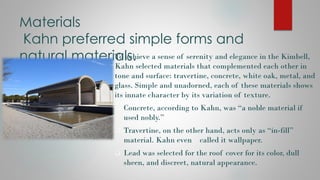
To achieve a sense of serenity and elegance in the Kimbell,
Kahn selected materials that complemented each other in
tone and surface: travertine, concrete, white oak, metal, and
glass. Simple and unadorned, each of these materials shows
its innate character by its variation of texture.
 Concrete, according to Kahn, was “a noble material if
used nobly.”
 Travertine, on the other hand, acts only as “in-fill”
material. Kahn even called it wallpaper.
 Lead was selected for the roof cover for its color, dull
sheen, and discreet, natural appearance.
National Assembly Building of Bangladesh
Jatiyo Sangshad Bhaban(JSB). Located in the capital Dhaka.
 The Core Of The Composition Is The Assembly
Chamber, A 300-seat, 30-meters
 High, Domed Amphitheatre And The Library.
These Spaces Alternate Among Eight
 "Light And Air Courts" And A Restaurant, As
Well As Entrances To The Garden And
 Mosque. Built Of Rough-shuttered, Poured-in-
place Concrete, The Walls Are Inlaid
 With Bands Of White Marble
Layout
 The Main Building (The Bhaban)
Is Divided Into Three Parts:
 • The Main Plaza
 • South Plaza
 • Presidential Plaza
 It is one of the largest legislative complexes
in the world.
 It houses all parliamentary activities of Bangladesh
The geometric shapes found on the different faces of the
façade add dramatic impact to the building.
 The geometric shapes are abstracted forms found in
traditional Bengali culture that are meant to create a
marriage of old and new cultural identities, as well as,
serve as light wells and a natural
 Environmental control system for the interior.
 For Kahn, light was an important aspect in the design
 Building, not just as a way to illuminate a space, but
rather.
 Conceptualizing light as a creator of space
Concept
The Salk Institute
The Salk institute was founded in
1960 by Jonas Salk, the developer
of the polio vaccine.
It is composed of 2 groups of buildings sited on the edge of a magnificent cliff, with the
pacific ocean falling behind in the horizon.
 The structure consists of two symmetric
buildings with a stream of water flowing in
the middle of a courtyard that separates the
two.
 There are no walls separating laboratories
on any floor.
 The lighting fixtures have been designed
to easily slide along rails.
 In the courtyard is a citrus grove
containing several orderly rows of lime trees.
Structure:
 The 2 buildings are mirrored around an open plaza which forms a strong
linear axis with the Pacific Ocean on one end and the entrance on the other,
thus highlighting and framing the landscape rather than imposing itself on
it.
 The plaza is sharply cleared impossible to avoid and is finished in
travertine marble, without anything in it except a single small linear channel
of water running down the centre.
 The simplicity being highlighted by the magnificent backdrop of the sky
and the ocean with the seagulls fluttering in the distance.
 The buildings are 6 floors in height with 3 levels housing the laboratories
while the other 3 houses the services and utilities.
 Each laboratory block has five study towers, with each tower containing
four offices, except for those near the entrance to the court, which only
contain two.
 The concrete was made with volcanic ash relying on the basis of ancient
Roman concrete making techniques, and as a result gives off a warm,
pinkish glow.
 A diagonal wall allows each of the thirty-six scientists using the studies
to have a view of the Pacific.
 Every study is fitted with a combination of operable sliding and fixed
glass panels in teak wood frames.
 Made in exposed concrete, the walls are unfinished showing clearly the
shuttering marks and also the tie rod holes.
The imperfections formed in the concrete surface during casting were left
as such and were not covered up and finished, maintaining the integrity
of the material.
It is not only is the building beautiful but functional.
A place which was really spiritual.
Building material
 Concrete,
 Teak,
 Lead glass
 And steel
THANK YOU!

louis-kahn.pdf

  • 1.
    Pokhara Engineering College Pokhara,Phirke Department Of Architecture DESIGN THEORY TOPIC : AR. LOUIS KAHN SUBMITTED TO : PRAGATI BANIYA MAM SUBMITTED BY : GROUP ‘D’ AKARSHA SHRESTHA SHRIYA SHRESTHA SABINA KHADKA SAHARA BARAL ALISHA GAUTAM
  • 2.
    Introduction Born On February20,1901 At Parnu, Estonia Real Name : Itze-leib Schmuilowsky Became An American Architect On March 17, 1974, Based On Philadelphia, Pennsylvania, United States
  • 3.
    Quote  Architecture isthe reaching out for the truth  Design is not making beauty, beauty emerges from selection, affinities, integration, love  Every time a student walks past a really urgent, expressive piece of architecture the belongs to his college, it can help reassure him that he does have that mind, does have that soul.  “What does the building want to be?”
  • 4.
    Career  1926 –Worked As Senior Draftsman In Ar. John Molitor’s Office  1929 – Worked As The Offices Of Paul Phillipe Cret, Then With Zantzinger, Borie And Medary  1932 – Kahn And Dominique Berninger Founded The Architectural Research Group  1947 – Teaching Career At Yale University And University Of Pennsylvania After Working In Various Capacities For Served Firms In Philadelphia, He Founded His Own Atelier In 1935 Awards - AIA Gold Medal(1971), RIBA Gold Medal (1972), Frank P Brown Medal(1964)
  • 5.
    Building Technique  Hewas known for his ability to create monumental architecture that responded to the human scale  He was also concerned with creating strong formal distinctions between served spaces and servant spaces  His palette of materials tended towards heavily textured brick and bare concrete,  Kahn was able to make the concrete material of the building look both solid and airy.  He used sunlight and water bodies to create a truly special building  Kahn’s design has been celebrated not only for its beauty, geometry and light but also for its structural and engineering innovations
  • 6.
    Some of hisworks  Yale University Art Gallery , New Haven, Connecticut (1951-1953)  Richard Medical Research Laboratories, University O Pennsylvania, Philadelphia, (1957-1965)  The Salk Institute, La Jolla, California (1959-1965)  First Unitarian Church, Rochester, New York (1959- 1969)  Jatiyo Sangshad Bhawan (National Assembly Building) In Dhaka, Building (1962-1974)  Kimbell Art Museum, Fort Worth, Texas (1967-1972)
  • 7.
    Yale University ArtGallery Location : 1111 Chapel Street, New Haven, Connecticut, USA. Concept:  Symmetry  Clear separation between spaces and space  A new vocabulary based on the triangle and the circle  The triangle as a figure appears on the stairs and as structural concepts in the construction forged rosettes  From the street, the building is perceived as the of brick , windowless, monolithic, with is southeast façade  It was the extension of an existing building in an empty corner which is connected with the old building through the alignment of facades.
  • 8.
    Interior  The building’sinterior is characterized by a system of precast concrete roof that houses the gallery lighting and ventilation  Which was an innovative structural engineering hollow concrete tetrahedrons, where numbers of functions is combine and give the interior a rich and changing quality Spaces  It was conceived as a unique, modular, consisting of two prismatic  The exhibition rooms are created using modular panels
  • 9.
     The entrancesstairways at yale is located at the bottom of space formed by the recession of the flat white wall Access Ladder  The staircase is a triangle of three stages involved in a cylinder and that is not reflected to the outside.  Although this triangular ladder is the most recognized in the gallery
  • 10.
    Structure  Modulated RectangularStructure Of Concrete  First Building To Use Concrete Roof Structure Consists Of A Tetrahedron With Special Armor That Exposes The Light Fixtures And Duct Air Conditioning  Reduces The Height Of The Floor-to-floor, Channeling The Air Through The Structure  Buildings Materials : Brick, Concrete, Glass And Steel Which A Significant Departure From Neo-gothic Style. This building was the first of three art museum. Yale university of art gallery was considered as his masterpiece.
  • 11.
    Kimbell Art Museum:Light Is The Theme “The Museum Has As Many Moods As There Are Moments In Time, And Never… Will There Be A Single Day Like The Other.” - Louis Kahn Concept:  Kimbell art museum was designed by Louis Kahn and Renzo Piano in Fort Worth, Texas, United States in 1966-1972 AD.  The museum is famous for its architecture and art collection from the 20th century.  Kimbell Art Museum is widely regarded as one of the outstanding architectural achievement of the modern era.
  • 12.
    Architectural Features:  Thebuilding suggests the grand arches and vaults of roman architecture.  The museum is based on modern architecture in its lack of ornament or revivalist detail.  Light is the theme.  The basic plan is composed of sixteen cycloid vaults (100 x 20 feet) that are arranged in three parallel units of six, four, and six in the Kimbell. Other elements are based on a ratio of 20 to 10.
  • 13.
    Light  Natural lightenters through narrow plexiglass skylights along the top of cycloid barrel vaults.  The light is diffused by aluminum reflectors that hang below, giving a silvery gleam to the vault surfaces and providing a perfect fluctuating illumination for the works of art.  Additionally, three courtyards punctuate the interior space. Structure Brown specifically stated that “natural light should play a vital part in illumination.” Along with Kahn's own strong interest in the use of natural light, resulted in Kahn's early concept of a room with a vaulted ceiling that would allow natural light to enter the space from above.
  • 14.
    Materials Kahn preferred simpleforms and natural materials. To achieve a sense of serenity and elegance in the Kimbell, Kahn selected materials that complemented each other in tone and surface: travertine, concrete, white oak, metal, and glass. Simple and unadorned, each of these materials shows its innate character by its variation of texture.  Concrete, according to Kahn, was “a noble material if used nobly.”  Travertine, on the other hand, acts only as “in-fill” material. Kahn even called it wallpaper.  Lead was selected for the roof cover for its color, dull sheen, and discreet, natural appearance.
  • 15.
    National Assembly Buildingof Bangladesh Jatiyo Sangshad Bhaban(JSB). Located in the capital Dhaka.  The Core Of The Composition Is The Assembly Chamber, A 300-seat, 30-meters  High, Domed Amphitheatre And The Library. These Spaces Alternate Among Eight  "Light And Air Courts" And A Restaurant, As Well As Entrances To The Garden And  Mosque. Built Of Rough-shuttered, Poured-in- place Concrete, The Walls Are Inlaid  With Bands Of White Marble
  • 16.
    Layout  The MainBuilding (The Bhaban) Is Divided Into Three Parts:  • The Main Plaza  • South Plaza  • Presidential Plaza  It is one of the largest legislative complexes in the world.  It houses all parliamentary activities of Bangladesh
  • 17.
    The geometric shapesfound on the different faces of the façade add dramatic impact to the building.  The geometric shapes are abstracted forms found in traditional Bengali culture that are meant to create a marriage of old and new cultural identities, as well as, serve as light wells and a natural  Environmental control system for the interior.  For Kahn, light was an important aspect in the design  Building, not just as a way to illuminate a space, but rather.  Conceptualizing light as a creator of space Concept
  • 18.
    The Salk Institute TheSalk institute was founded in 1960 by Jonas Salk, the developer of the polio vaccine. It is composed of 2 groups of buildings sited on the edge of a magnificent cliff, with the pacific ocean falling behind in the horizon.
  • 19.
     The structureconsists of two symmetric buildings with a stream of water flowing in the middle of a courtyard that separates the two.  There are no walls separating laboratories on any floor.  The lighting fixtures have been designed to easily slide along rails.  In the courtyard is a citrus grove containing several orderly rows of lime trees. Structure:
  • 20.
     The 2buildings are mirrored around an open plaza which forms a strong linear axis with the Pacific Ocean on one end and the entrance on the other, thus highlighting and framing the landscape rather than imposing itself on it.  The plaza is sharply cleared impossible to avoid and is finished in travertine marble, without anything in it except a single small linear channel of water running down the centre.  The simplicity being highlighted by the magnificent backdrop of the sky and the ocean with the seagulls fluttering in the distance.  The buildings are 6 floors in height with 3 levels housing the laboratories while the other 3 houses the services and utilities.
  • 21.
     Each laboratoryblock has five study towers, with each tower containing four offices, except for those near the entrance to the court, which only contain two.  The concrete was made with volcanic ash relying on the basis of ancient Roman concrete making techniques, and as a result gives off a warm, pinkish glow.  A diagonal wall allows each of the thirty-six scientists using the studies to have a view of the Pacific.  Every study is fitted with a combination of operable sliding and fixed glass panels in teak wood frames.  Made in exposed concrete, the walls are unfinished showing clearly the shuttering marks and also the tie rod holes.
  • 22.
    The imperfections formedin the concrete surface during casting were left as such and were not covered up and finished, maintaining the integrity of the material. It is not only is the building beautiful but functional. A place which was really spiritual. Building material  Concrete,  Teak,  Lead glass  And steel
  • 23.