Thyroid function & thyroid
diseases
Presenter: Mohamed Ali (PGY1)
Moderator: Dr. Abdulaziz (internist at
Haramaya university)
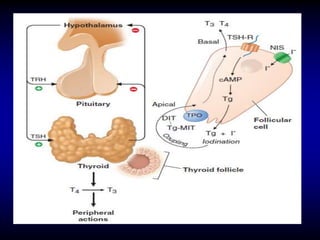
Thyroid assessment
• TSH, FT3/4
• RIU
• FNA
• U/S
• CT
• MRI
Hypothyroidism
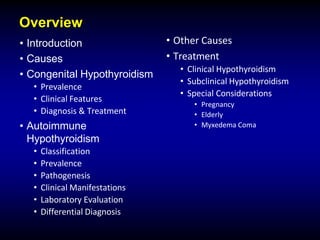
Overview
• Introduction
• Causes
• Congenital Hypothyroidism
• Prevalence
• Clinical Features
• Diagnosis & Treatment
• Autoimmune
Hypothyroidism
• Classification
• Prevalence
• Pathogenesis
• Clinical Manifestations
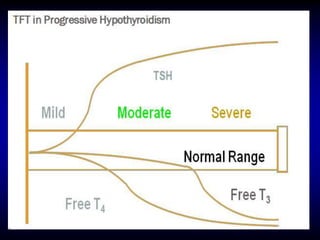
• Laboratory Evaluation
• Differential Diagnosis
• Other Causes
• Treatment
• Clinical Hypothyroidism
• Subclinical Hypothyroidism
• Special Considerations
• Pregnancy
• Elderly
• Myxedema Coma
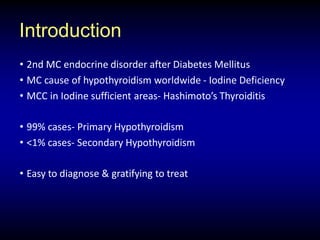
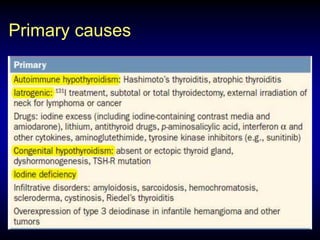
Introduction
• 2nd MC endocrine disorder after Diabetes Mellitus
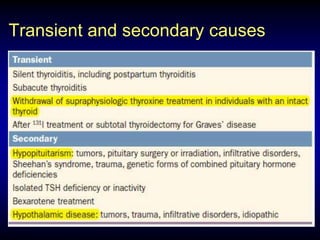
• MC cause of hypothyroidism worldwide - Iodine Deficiency
• MCC in Iodine sufficient areas- Hashimoto’s Thyroiditis
• 99% cases- Primary Hypothyroidism
• <1% cases- Secondary Hypothyroidism
• Easy to diagnose & gratifying to treat
Primary causes
Transient and secondary causes
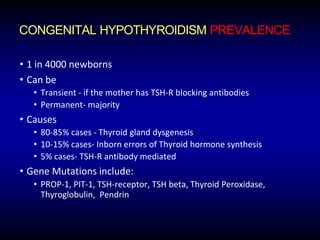
CONGENITAL HYPOTHYROIDISM PREVALENCE
• 1 in 4000 newborns
• Can be
• Transient - if the mother has TSH-R blocking antibodies
• Permanent- majority
• Causes
• 80-85% cases - Thyroid gland dysgenesis
• 10-15% cases- Inborn errors of Thyroid hormone synthesis
• 5% cases- TSH-R antibody mediated
• Gene Mutations include:
• PROP-1, PIT-1, TSH-receptor, TSH beta, Thyroid Peroxidase,
Thyroglobulin, Pendrin
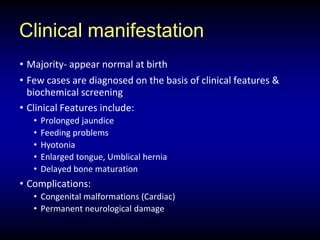
Clinical manifestation
• Majority- appear normal at birth
• Few cases are diagnosed on the basis of clinical features &
biochemical screening
• Clinical Features include:
• Prolonged jaundice
• Feeding problems
• Hyotonia
• Enlarged tongue, Umblical hernia
• Delayed bone maturation
• Complications:
• Congenital malformations (Cardiac)
• Permanent neurological damage
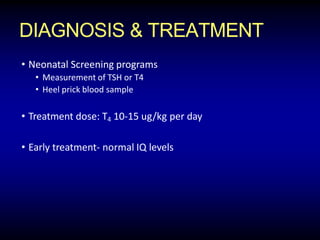
DIAGNOSIS & TREATMENT
• Neonatal Screening programs
• Measurement of TSH or T4
• Heel prick blood sample
• Treatment dose: T4 10-15 ug/kg per day
• Early treatment- normal IQ levels
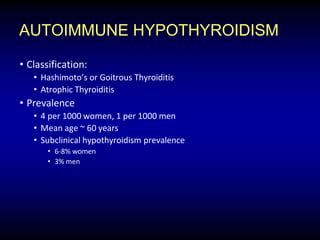
AUTOIMMUNE HYPOTHYROIDISM
• Classification:
• Hashimoto’s or Goitrous Thyroiditis
• Atrophic Thyroiditis
• Prevalence
• 4 per 1000 women, 1 per 1000 men
• Mean age ~ 60 years
• Subclinical hypothyroidism prevalence
• 6-8% women
• 3% men
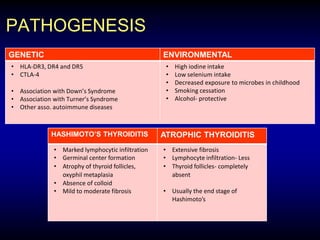
PATHOGENESIS
GENETIC ENVIRONMENTAL
• HLA-DR3, DR4 and DR5
• CTLA-4
• Association with Down’s Syndrome
• Association with Turner’s Syndrome
• Other asso. autoimmune diseases
• High iodine intake
• Low selenium intake
• Decreased exposure to microbes in childhood
• Smoking cessation
• Alcohol- protective
HASHIMOTO’S THYROIDITIS ATROPHIC THYROIDITIS
• Marked lymphocytic infiltration
• Germinal center formation
• Atrophy of thyroid follicles,
oxyphil metaplasia
• Absence of colloid
• Mild to moderate fibrosis
• Extensive fibrosis
• Lymphocyte infiltration- Less
• Thyroid follicles- completely
absent
• Usually the end stage of
Hashimoto’s
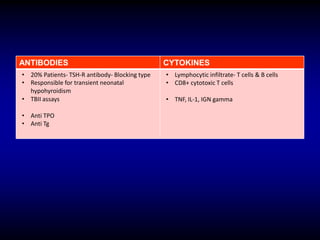
ANTIBODIES CYTOKINES
• 20% Patients- TSH-R antibody- Blocking type
• Responsible for transient neonatal
hypohyroidism
• TBII assays
• Anti TPO
• Anti Tg
• Lymphocytic infiltrate- T cells & B cells
• CD8+ cytotoxic T cells
• TNF, IL-1, IGN gamma
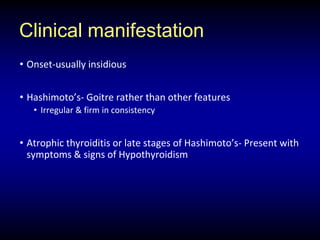
Clinical manifestation
• Onset-usually insidious
• Hashimoto’s- Goitre rather than other features
• Irregular & firm in consistency
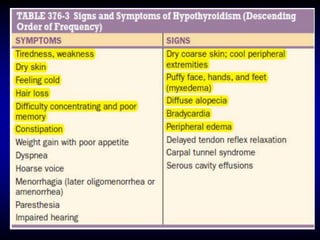
• Atrophic thyroiditis or late stages of Hashimoto’s- Present with
symptoms & signs of Hypothyroidism
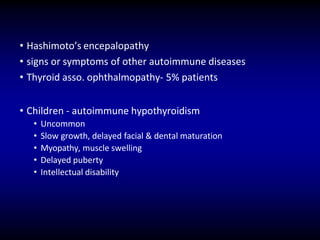
• Hashimoto’s encepalopathy
• signs or symptoms of other autoimmune diseases
• Thyroid asso. ophthalmopathy- 5% patients
• Children - autoimmune hypothyroidism
• Uncommon
• Slow growth, delayed facial & dental maturation
• Myopathy, muscle swelling
• Delayed puberty
• Intellectual disability
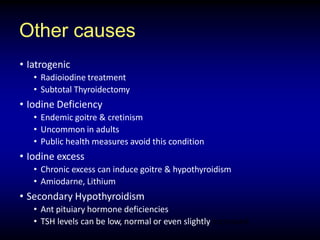
Other causes
• Iatrogenic
• Radioiodine treatment
• Subtotal Thyroidectomy
• Iodine Deficiency
• Endemic goitre & cretinism
• Uncommon in adults
• Public health measures avoid this condition
• Iodine excess
• Chronic excess can induce goitre & hypothyroidism
• Amiodarne, Lithium
• Secondary Hypothyroidism
• Ant pituiary hormone deficiencies
• TSH levels can be low, normal or even slightly increased
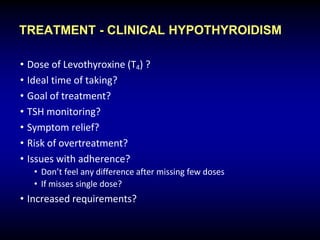
TREATMENT - CLINICAL HYPOTHYROIDISM
• Dose of Levothyroxine (T4) ?
• Ideal time of taking?
• Goal of treatment?
• TSH monitoring?
• Symptom relief?
• Risk of overtreatment?
• Issues with adherence?
• Don’t feel any difference after missing few doses
• If misses single dose?
• Increased requirements?
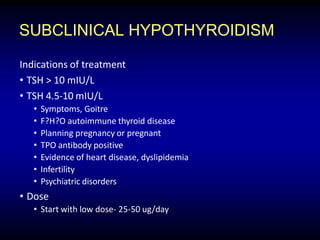
SUBCLINICAL HYPOTHYROIDISM
Indications of treatment
• TSH > 10 mIU/L
• TSH 4.5-10 mIU/L
• Symptoms, Goitre
• F?H?O autoimmune thyroid disease
• Planning pregnancy or pregnant
• TPO antibody positive
• Evidence of heart disease, dyslipidemia
• Infertility
• Psychiatric disorders
• Dose
• Start with low dose- 25-50 ug/day
SPECIAL CONSIDERATIONS
• Pregnancy
• Thyroid function should be monitored
• Before conception- therapy to target TSH in normal range
• TFT
• Every 4 weeks in first half of pregnancy
• every 6-8 weks after 20 weeks
• Levothyroxine dose is increased by 45%
• After delivery dose- Pre pregnancy levels
• Elderly
• Require 20% less dose than younger specially cardiac patients
• Starting dose 12.5 to 2 ug/day
• Gradual increments in 2-3 months
• Surgery?
• Myxedema coma
• 20-40% mortality
• Almost always - Elderly patient
• Precipitating conditions- That impair respiration
• Drugs, Pneumonia, CHF, MI
• CVA , GI bleed
• Levothyroxine
• Initial- 200-400 ug IV bolus or through Nasogastric tube f/b
• Daily oral dose 1.6 ug/kg
• Liothyronine (T3)
• Since T4->T3 conversion is impaired
• 5-20 ug f/b 2.5 -10 ug 8 hrly
• Supportive therapy
• External warming
• Parenteral Hydrocortisone (50 mg every 6 hrly)
• Treat precipitating factor
• Ventilatory support , ABG
• Hypertonic saline or IV det©roMseedi
Subclinical hypothyroidism
• Overview
• Subclinical hypothyroidism is defined as an increased
serum TSH in the presence of normal serum T4.
• Prevalent in Women and Elderly
CAUSES
• Iatrogenic
• Hashimoto’s Thyroiditis
• Postpartum thyroiditis
• Thyroid Infiltration
• Medications
• Partial Thyroidectomy
• Head and Neck radiation
CLINICAL CONSEQUENCES
• Overt Hypothyroidism
• Cardiovascular Disease
• Diastolic Dysfunction
• Diastolic Hypertension
• Increase in LDL-C, CRP
• Aternation in coagulation parameters, endothelial dysfunction
• Decreased Fertility
• Nonalcoholic Fatty Liver Disease (NAFLD)
• Neuropsychiatric manifestations
INDICATION OF TREATMENT
• Patients with serum TSH >10.0 mU/L
• Patients <65 yrs, Asymptomatic
• Infertile, Ovulatory dysfunction or planning for
pregnancy
• Symptoms or signs of hypothyroidism
• Goitre
• High serum anti-TPO antibodies
• Comorbidities- IHD, DM, Dyslipidemia
Hyperthyroidism
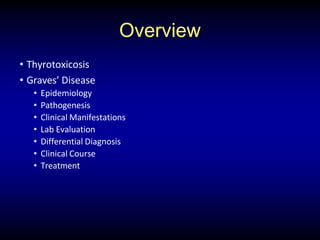
Overview
• Thyrotoxicosis
• Graves’ Disease
• Epidemiology
• Pathogenesis
• Clinical Manifestations
• Lab Evaluation
• Differential Diagnosis
• Clinical Course
• Treatment
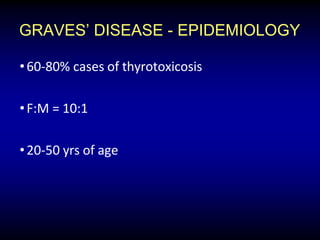
GRAVES’ DISEASE - EPIDEMIOLOGY
•60-80% cases of thyrotoxicosis
•F:M = 10:1
•20-50 yrs of age
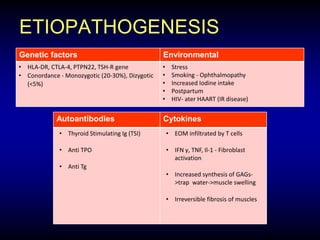
ETIOPATHOGENESIS
Genetic factors Environmental
• HLA-DR, CTLA-4, PTPN22, TSH-R gene
• Conordance - Monozygotic (20-30%), Dizygotic
(<5%)
• Stress
• Smoking - Ophthalmopathy
• Increased Iodine intake
• Postpartum
• HIV- ater HAART (IR disease)
Autoantibodies Cytokines
• Thyroid Stimulating Ig (TSI)
• Anti TPO
• Anti Tg
• EOM infiltrated by T cells
• IFN γ, TNF, Il-1 - Fibroblast
activation
• Increased synthesis of GAGs-
>trap water->muscle swelling
• Irreversible fibrosis of muscles
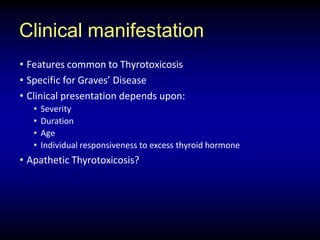
Clinical manifestation
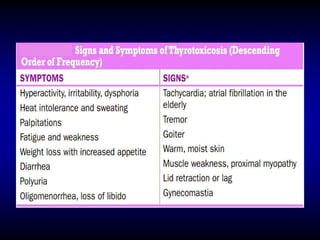
• Features common to Thyrotoxicosis
• Specific for Graves’ Disease
• Clinical presentation depends upon:
• Severity
• Duration
• Age
• Individual responsiveness to excess thyroid hormone
• Apathetic Thyrotoxicosis?
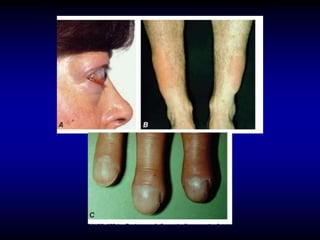
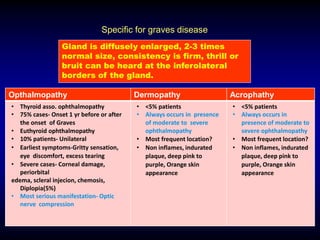
Specific for graves disease
Gland is diffusely enlarged, 2-3 times
normal size, consistency is firm, thrill or
bruit can be heard at the inferolateral
borders of the gland.
Opthalmopathy Dermopathy Acrophathy
• Thyroid asso. ophthalmopathy
• 75% cases- Onset 1 yr before or after
the onset of Graves
• Euthyroid ophthalmopathy
• 10% patients- Unilateral
• Earliest symptoms-Gritty sensation,
eye discomfort, excess tearing
• Severe cases- Corneal damage,
periorbital
edema, scleral injecion, chemosis,
Diplopia(5%)
• Most serious manifestation- Optic
nerve compression
• <5% patients
• Always occurs in presence
of moderate to severe
ophthalmopathy
• Most frequent location?
• Non inflames, indurated
plaque, deep pink to
purple, Orange skin
appearance
• <5% patients
• Always occurs in
presence of moderate to
severe ophthalmopathy
• Most frequent location?
• Non inflames, indurated
plaque, deep pink to
purple, Orange skin
appearance
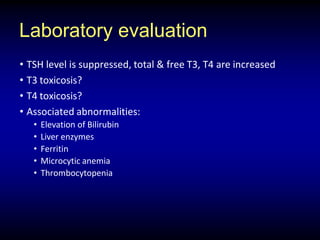
Laboratory evaluation
• TSH level is suppressed, total & free T3, T4 are increased
• T3 toxicosis?
• T4 toxicosis?
• Associated abnormalities:
• Elevation of Bilirubin
• Liver enzymes
• Ferritin
• Microcytic anemia
• Thrombocytopenia
Clinical course
• Clinical features worsen without treatment
• Mortality 10-30% without treatment
• 15% patients- Develop Hypothyroidism 10-15 years later
• Ophthalmopathy
• Worsens over initial 3-6 months-->Plateau phase 12-18 months ->
Improves spontaneously
• Radioiodine treatment- worsens ophthalmopathy
• Dermopathy
• appears after 1-2 years
• may improve spontaneously
Treatment
• Treatment Approach
• Rapid amelioration of symptoms
• Decreasing Thyroid Hormone synthesis
• Symptom Control: Beta blocker
• Propanolol (DOC)-20-40 mg 6 hrly or Atenolol
• Relief from sympathetic overactivity (Anxiety, Palpitations,
increased bowel activity, lid retraction, tremors)
• Decrease thyroid hormone synthesis
• Antithyroid Drugs (Thionamides)
• Radioiodine
• Surgery
ANTITHYROID DRUGS (THIONAMIDES
• Used for 1-2 years prior to definitive therapy (surgery or radioablation)
• Indications:
• Pregnancy
• Children & Adolescent
• Severe Graves’ disease with eye changes
• MOA: Inhibit TPO enzyme & iodination & organification
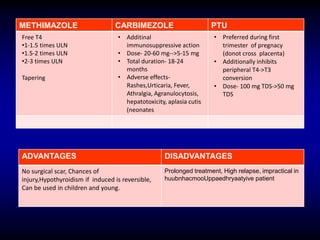
METHIMAZOLE CARBIMEZOLE PTU
Free T4
•1-1.5 times ULN
•1.5-2 times ULN
•2-3 times ULN
Tapering
• Additinal
immunosuppressive action
• Dose- 20-60 mg-->5-15 mg
• Total duration- 18-24
months
• Adverse effects-
Rashes,Urticaria, Fever,
Athralgia, Agranulocytosis,
hepatotoxicity, aplasia cutis
(neonates
• Preferred during first
trimester of pregnacy
(donot cross placenta)
• Additionally inhibits
peripheral T4->T3
conversion
• Dose- 100 mg TDS->50 mg
TDS
ADVANTAGES DISADVANTAGES
No surgical scar, Chances of
injury,Hypothyroidism if induced is reversible,
Can be used in children and young.
Prolonged treatment, High relapse, impractical in
huubnhacmooUppaedhryaatyive patient
Radioiodine ablation
• Definite therapy in non-pregnant patients
• Strictly avoided in smokers & those with moderate - severe
ophthalmopathy
• Indications
1. Patients >40 years of age
2. Young individuals who are sterilized
3. Young patients with short life span
• I131 capule -> emits gamma radiation -> ablation of thyroid
gland within 6-18 weeks
• Dose- 185-555 MBq
• Complications- Hypothyroidism, Infertlity, Secondary cancers
Surgery
• Subtotal Thyroidectomy
• Indications
• Severe hyperthyroidism in children
• Pregnant women who cannot tolerate thionamides
• Large goitre with severe ophthalmopathy or pressure symptoms
• Who require quick normalization of thyroid function
• Preparation: Propanolol, Methimazole, Potassium Iodide
• Complications
• Hypothyroidism
• Hypoparathyroidism
• Hypocalcemia
• RLN damage
ADJUNCTIVE THERAPIES
• Oral Radio-contrast Agents: Sodium Ipodate, Iopanoic acid
• Iodine elixirs: 10 drops of SSKI
• Glucocorticoids
• Cholestyramine: 4 gm four times a day
• Potassium perchlorate
• Lithium
• Calcium: for skeletal health 1 gm per day
Treatment for graves
disease
• Reversal of Hyperthyroidism
• Smoking cessation
• Local measures: Eyes shades, artificial tears
& lubricants
Drugs
• Selenium - Antioxidant
• Glucocorticoids - Anti inflammatory
• Teprotumumab - IGF-1 receptor inhibitor
• Mycophenolate moetil
• Tocilizumab - Anti IL6
• Rituximab - Anti CD 20
Surgery
• Orbital decompression
• Fat decompression
• Bilateral lateral tarsorrhaphy
• resection of Muller’s muscle
Treatment of dermopathy
• Usually asymptomatic- Treatment is not
necessary
• Indications: Pruritus, Local discomfort,
Unsightly appearance, progression of
lesions
Non Pharmacological
• Avoid tobacco
• Reduce weight
• Normalize thyroid function
Pharmacological
• Topical Fluocinolon acetonide
• Intralesional Triamcinolone acetate
• Pentoxiphylline
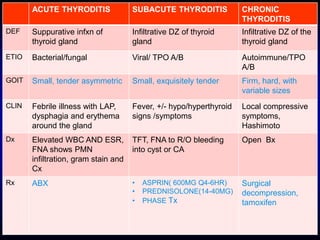
ACUTE THYRODITIS SUBACUTE THYRODITIS CHRONIC
THYRODITIS
DEF Suppurative infxn of
thyroid gland
Infiltrative DZ of thyroid
gland
Infiltrative DZ of the
thyroid gland
ETIO Bacterial/fungal Viral/ TPO A/B Autoimmune/TPO
A/B
GOIT Small, tender asymmetric Small, exquisitely tender Firm, hard, with
variable sizes
CLIN Febrile illness with LAP,
dysphagia and erythema
around the gland
Fever, +/- hypo/hyperthyroid
signs /symptoms
Local compressive
symptoms,
Hashimoto
Dx Elevated WBC AND ESR,
FNA shows PMN
infiltration, gram stain and
Cx
TFT, FNA to R/O bleeding
into cyst or CA
Open Bx
Rx ABX • ASPRIN( 600MG Q4-6HR)
• PREDNISOLONE(14-40MG)
• PHASE Tx
Surgical
decompression,
tamoxifen
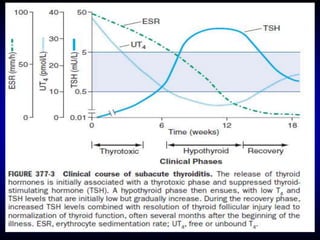
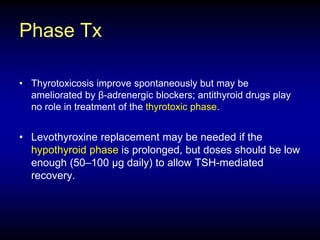
Phase Tx
• Thyrotoxicosis improve spontaneously but may be
ameliorated by β-adrenergic blockers; antithyroid drugs play
no role in treatment of the thyrotoxic phase.
• Levothyroxine replacement may be needed if the
hypothyroid phase is prolonged, but doses should be low
enough (50–100 μg daily) to allow TSH-mediated
recovery.
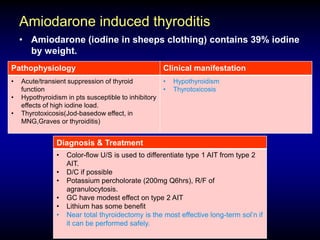
Amiodarone induced thyroditis
• Amiodarone (iodine in sheeps clothing) contains 39% iodine
by weight.
Pathophysiology Clinical manifestation
• Acute/transient suppression of thyroid
function
• Hypothyroidism in pts susceptible to inhibitory
effects of high iodine load.
• Thyrotoxicosis(Jod-basedow effect, in
MNG,Graves or thyroiditis)
• Hypothyroidism
• Thyrotoxicosis
Diagnosis & Treatment
• Color-flow U/S is used to differentiate type 1 AIT from type 2
AIT.
• D/C if possible
• Potassium percholorate (200mg Q6hrs), R/F of
agranulocytosis.
• GC have modest effect on type 2 AIT
• Lithium has some benefit
• Near total thyroidectomy is the most effective long-term sol’n if
it can be performed safely.
Thyroid nodular DZ & thyroid CA
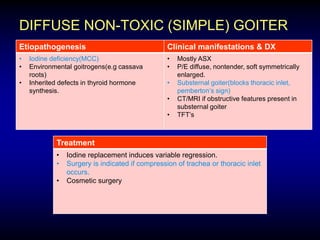
DIFFUSE NON-TOXIC (SIMPLE) GOITER
Etiopathogenesis Clinical manifestations & DX
• Iodine deficiency(MCC)
• Environmental goitrogens(e.g cassava
roots)
• Inherited defects in thyroid hormone
synthesis.
• Mostly ASX
• P/E diffuse, nontender, soft symmetrically
enlarged.
• Substernal goiter(blocks thoracic inlet,
pemberton’s sign)
• CT/MRI if obstructive features present in
substernal goiter
• TFT’s
Treatment
• Iodine replacement induces variable regression.
• Surgery is indicated if compression of trachea or thoracic inlet
occurs.
• Cosmetic surgery
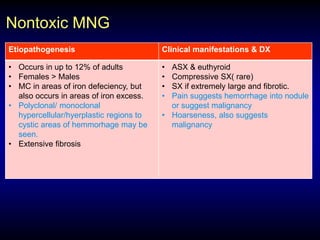
Nontoxic MNG
Etiopathogenesis Clinical manifestations & DX
• Occurs in up to 12% of adults
• Females > Males
• MC in areas of iron defeciency, but
also occurs in areas of iron excess.
• Polyclonal/ monoclonal
hypercellular/hyerplastic regions to
cystic areas of hemmorhage may be
seen.
• Extensive fibrosis
• ASX & euthyroid
• Compressive SX( rare)
• SX if extremely large and fibrotic.
• Pain suggests hemorrhage into nodule
or suggest malignancy
• Hoarseness, also suggests
malignancy
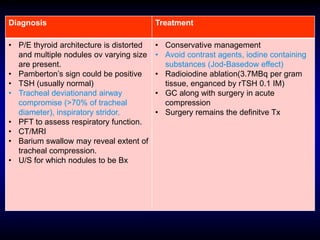
Diagnosis Treatment
• P/E thyroid architecture is distorted
and multiple nodules ov varying size
are present.
• Pamberton’s sign could be positive
• TSH (usually normal)
• Tracheal deviationand airway
compromise (>70% of tracheal
diameter), inspiratory stridor.
• PFT to assess respiratory function.
• CT/MRI
• Barium swallow may reveal extent of
tracheal compression.
• U/S for which nodules to be Bx
• Conservative management
• Avoid contrast agents, iodine containing
substances (Jod-Basedow effect)
• Radioiodine ablation(3.7MBq per gram
tissue, enganced by rTSH 0.1 IM)
• GC along with surgery in acute
compression
• Surgery remains the definitve Tx
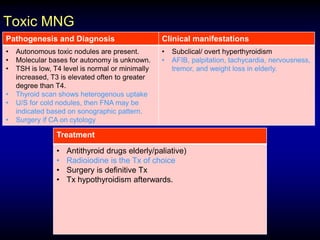
Toxic MNG
Pathogenesis and Diagnosis Clinical manifestations
• Autonomous toxic nodules are present.
• Molecular bases for autonomy is unknown.
• TSH is low, T4 level is normal or minimally
increased, T3 is elevated often to greater
degree than T4.
• Thyroid scan shows heterogenous uptake
• U/S for cold nodules, then FNA may be
indicated based on sonographic pattern.
• Surgery if CA on cytology
• Subclical/ overt hyperthyroidism
• AFIB, palpitation, tachycardia, nervousness,
tremor, and weight loss in elderly.
Treatment
• Antithyroid drugs elderly/paliative)
• Radioiodine is the Tx of choice
• Surgery is definitive Tx
• Tx hypothyroidism afterwards.
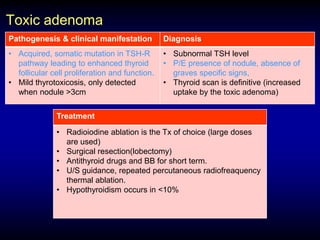
Toxic adenoma
Pathogenesis & clinical manifestation Diagnosis
• Acquired, somatic mutation in TSH-R
pathway leading to enhanced thyroid
follicular cell proliferation and function.
• Mild thyrotoxicosis, only detected
when nodule >3cm
• Subnormal TSH level
• P/E presence of nodule, absence of
graves specific signs,
• Thyroid scan is definitive (increased
uptake by the toxic adenoma)
Treatment
• Radioiodine ablation is the Tx of choice (large doses
are used)
• Surgical resection(lobectomy)
• Antithyroid drugs and BB for short term.
• U/S guidance, repeated percutaneous radiofreaquency
thermal ablation.
• Hypothyroidism occurs in <10%
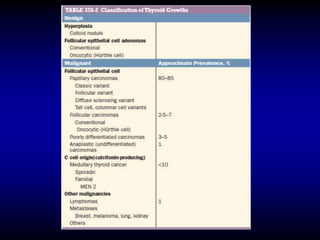
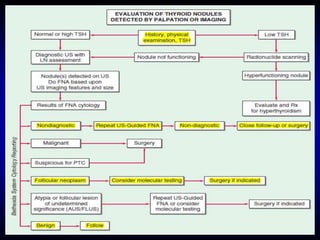
Thyroid growths
• Benign
• Malignant
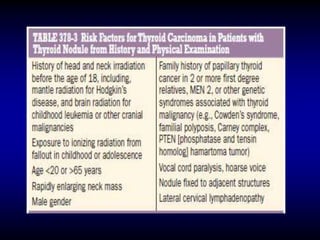
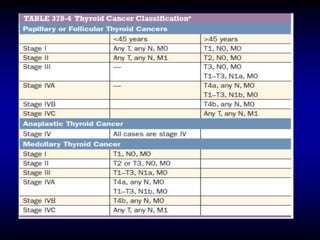
Thyroid cancer
• Most common malignancy in endocrine system.
• Malignant tumors derived from the follicular epithelium
are classified according to histologic features.
– Differentiated tumors, such as papillary thyroid cancer (PTC) or
follicular thyroid cancer (FTC), are often curable, and the
prognosis is good for patients identified with early-stage disease.
– In contrast, anaplastic thyroid cancer (ATC) is aggressive,
responds poorly to treatment, and is associated with a bleak
prognosis.
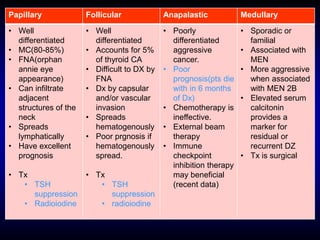
Papillary Follicular Anapalastic Medullary
• Well
differentiated
• MC(80-85%)
• FNA(orphan
annie eye
appearance)
• Can infiltrate
adjacent
structures of the
neck
• Spreads
lymphatically
• Have excellent
prognosis
• Tx
• TSH
suppression
• Radioiodine
• Well
differentiated
• Accounts for 5%
of thyroid CA
• Difficult to DX by
FNA
• Dx by capsular
and/or vascular
invasion
• Spreads
hematogenously
• Poor prgnosis if
hematogenously
spread.
• Tx
• TSH
suppression
• radioiodine
• Poorly
differentiated
aggressive
cancer.
• Poor
prognosis(pts die
with in 6 months
of Dx)
• Chemotherapy is
ineffective.
• External beam
therapy
• Immune
checkpoint
inhibition therapy
may beneficial
(recent data)
• Sporadic or
familial
• Associated with
MEN
• More aggressive
when associated
with MEN 2B
• Elevated serum
calcitonin
provides a
marker for
residual or
recurrent DZ
• Tx is surgical
Thanks, any questions

Thyroid assessment & thyroid DZ.ppt

  • 1.
    Thyroid function &thyroid diseases Presenter: Mohamed Ali (PGY1) Moderator: Dr. Abdulaziz (internist at Haramaya university)
  • 3.
    Thyroid assessment • TSH,FT3/4 • RIU • FNA • U/S • CT • MRI
  • 5.
  • 6.
    Overview • Introduction • Causes •Congenital Hypothyroidism • Prevalence • Clinical Features • Diagnosis & Treatment • Autoimmune Hypothyroidism • Classification • Prevalence • Pathogenesis • Clinical Manifestations • Laboratory Evaluation • Differential Diagnosis • Other Causes • Treatment • Clinical Hypothyroidism • Subclinical Hypothyroidism • Special Considerations • Pregnancy • Elderly • Myxedema Coma
  • 7.
    Introduction • 2nd MCendocrine disorder after Diabetes Mellitus • MC cause of hypothyroidism worldwide - Iodine Deficiency • MCC in Iodine sufficient areas- Hashimoto’s Thyroiditis • 99% cases- Primary Hypothyroidism • <1% cases- Secondary Hypothyroidism • Easy to diagnose & gratifying to treat
  • 8.
  • 9.
  • 10.
    CONGENITAL HYPOTHYROIDISM PREVALENCE •1 in 4000 newborns • Can be • Transient - if the mother has TSH-R blocking antibodies • Permanent- majority • Causes • 80-85% cases - Thyroid gland dysgenesis • 10-15% cases- Inborn errors of Thyroid hormone synthesis • 5% cases- TSH-R antibody mediated • Gene Mutations include: • PROP-1, PIT-1, TSH-receptor, TSH beta, Thyroid Peroxidase, Thyroglobulin, Pendrin
  • 11.
    Clinical manifestation • Majority-appear normal at birth • Few cases are diagnosed on the basis of clinical features & biochemical screening • Clinical Features include: • Prolonged jaundice • Feeding problems • Hyotonia • Enlarged tongue, Umblical hernia • Delayed bone maturation • Complications: • Congenital malformations (Cardiac) • Permanent neurological damage
  • 12.
    DIAGNOSIS & TREATMENT •Neonatal Screening programs • Measurement of TSH or T4 • Heel prick blood sample • Treatment dose: T4 10-15 ug/kg per day • Early treatment- normal IQ levels
  • 13.
    AUTOIMMUNE HYPOTHYROIDISM • Classification: •Hashimoto’s or Goitrous Thyroiditis • Atrophic Thyroiditis • Prevalence • 4 per 1000 women, 1 per 1000 men • Mean age ~ 60 years • Subclinical hypothyroidism prevalence • 6-8% women • 3% men
  • 14.
    PATHOGENESIS GENETIC ENVIRONMENTAL • HLA-DR3,DR4 and DR5 • CTLA-4 • Association with Down’s Syndrome • Association with Turner’s Syndrome • Other asso. autoimmune diseases • High iodine intake • Low selenium intake • Decreased exposure to microbes in childhood • Smoking cessation • Alcohol- protective HASHIMOTO’S THYROIDITIS ATROPHIC THYROIDITIS • Marked lymphocytic infiltration • Germinal center formation • Atrophy of thyroid follicles, oxyphil metaplasia • Absence of colloid • Mild to moderate fibrosis • Extensive fibrosis • Lymphocyte infiltration- Less • Thyroid follicles- completely absent • Usually the end stage of Hashimoto’s
  • 15.
    ANTIBODIES CYTOKINES • 20%Patients- TSH-R antibody- Blocking type • Responsible for transient neonatal hypohyroidism • TBII assays • Anti TPO • Anti Tg • Lymphocytic infiltrate- T cells & B cells • CD8+ cytotoxic T cells • TNF, IL-1, IGN gamma
  • 16.
    Clinical manifestation • Onset-usuallyinsidious • Hashimoto’s- Goitre rather than other features • Irregular & firm in consistency • Atrophic thyroiditis or late stages of Hashimoto’s- Present with symptoms & signs of Hypothyroidism
  • 18.
    • Hashimoto’s encepalopathy •signs or symptoms of other autoimmune diseases • Thyroid asso. ophthalmopathy- 5% patients • Children - autoimmune hypothyroidism • Uncommon • Slow growth, delayed facial & dental maturation • Myopathy, muscle swelling • Delayed puberty • Intellectual disability
  • 20.
    Other causes • Iatrogenic •Radioiodine treatment • Subtotal Thyroidectomy • Iodine Deficiency • Endemic goitre & cretinism • Uncommon in adults • Public health measures avoid this condition • Iodine excess • Chronic excess can induce goitre & hypothyroidism • Amiodarne, Lithium • Secondary Hypothyroidism • Ant pituiary hormone deficiencies • TSH levels can be low, normal or even slightly increased
  • 21.
    TREATMENT - CLINICALHYPOTHYROIDISM • Dose of Levothyroxine (T4) ? • Ideal time of taking? • Goal of treatment? • TSH monitoring? • Symptom relief? • Risk of overtreatment? • Issues with adherence? • Don’t feel any difference after missing few doses • If misses single dose? • Increased requirements?
  • 23.
    SUBCLINICAL HYPOTHYROIDISM Indications oftreatment • TSH > 10 mIU/L • TSH 4.5-10 mIU/L • Symptoms, Goitre • F?H?O autoimmune thyroid disease • Planning pregnancy or pregnant • TPO antibody positive • Evidence of heart disease, dyslipidemia • Infertility • Psychiatric disorders • Dose • Start with low dose- 25-50 ug/day
  • 24.
    SPECIAL CONSIDERATIONS • Pregnancy •Thyroid function should be monitored • Before conception- therapy to target TSH in normal range • TFT • Every 4 weeks in first half of pregnancy • every 6-8 weks after 20 weeks • Levothyroxine dose is increased by 45% • After delivery dose- Pre pregnancy levels • Elderly • Require 20% less dose than younger specially cardiac patients • Starting dose 12.5 to 2 ug/day • Gradual increments in 2-3 months • Surgery?
  • 25.
    • Myxedema coma •20-40% mortality • Almost always - Elderly patient • Precipitating conditions- That impair respiration • Drugs, Pneumonia, CHF, MI • CVA , GI bleed • Levothyroxine • Initial- 200-400 ug IV bolus or through Nasogastric tube f/b • Daily oral dose 1.6 ug/kg • Liothyronine (T3) • Since T4->T3 conversion is impaired • 5-20 ug f/b 2.5 -10 ug 8 hrly • Supportive therapy • External warming • Parenteral Hydrocortisone (50 mg every 6 hrly) • Treat precipitating factor • Ventilatory support , ABG • Hypertonic saline or IV det©roMseedi
  • 26.
    Subclinical hypothyroidism • Overview •Subclinical hypothyroidism is defined as an increased serum TSH in the presence of normal serum T4. • Prevalent in Women and Elderly
  • 27.
    CAUSES • Iatrogenic • Hashimoto’sThyroiditis • Postpartum thyroiditis • Thyroid Infiltration • Medications • Partial Thyroidectomy • Head and Neck radiation
  • 28.
    CLINICAL CONSEQUENCES • OvertHypothyroidism • Cardiovascular Disease • Diastolic Dysfunction • Diastolic Hypertension • Increase in LDL-C, CRP • Aternation in coagulation parameters, endothelial dysfunction • Decreased Fertility • Nonalcoholic Fatty Liver Disease (NAFLD) • Neuropsychiatric manifestations
  • 29.
    INDICATION OF TREATMENT •Patients with serum TSH >10.0 mU/L • Patients <65 yrs, Asymptomatic • Infertile, Ovulatory dysfunction or planning for pregnancy • Symptoms or signs of hypothyroidism • Goitre • High serum anti-TPO antibodies • Comorbidities- IHD, DM, Dyslipidemia
  • 31.
  • 32.
    Overview • Thyrotoxicosis • Graves’Disease • Epidemiology • Pathogenesis • Clinical Manifestations • Lab Evaluation • Differential Diagnosis • Clinical Course • Treatment
  • 34.
    GRAVES’ DISEASE -EPIDEMIOLOGY •60-80% cases of thyrotoxicosis •F:M = 10:1 •20-50 yrs of age
  • 35.
    ETIOPATHOGENESIS Genetic factors Environmental •HLA-DR, CTLA-4, PTPN22, TSH-R gene • Conordance - Monozygotic (20-30%), Dizygotic (<5%) • Stress • Smoking - Ophthalmopathy • Increased Iodine intake • Postpartum • HIV- ater HAART (IR disease) Autoantibodies Cytokines • Thyroid Stimulating Ig (TSI) • Anti TPO • Anti Tg • EOM infiltrated by T cells • IFN γ, TNF, Il-1 - Fibroblast activation • Increased synthesis of GAGs- >trap water->muscle swelling • Irreversible fibrosis of muscles
  • 36.
    Clinical manifestation • Featurescommon to Thyrotoxicosis • Specific for Graves’ Disease • Clinical presentation depends upon: • Severity • Duration • Age • Individual responsiveness to excess thyroid hormone • Apathetic Thyrotoxicosis?
  • 38.
    Specific for gravesdisease Gland is diffusely enlarged, 2-3 times normal size, consistency is firm, thrill or bruit can be heard at the inferolateral borders of the gland. Opthalmopathy Dermopathy Acrophathy • Thyroid asso. ophthalmopathy • 75% cases- Onset 1 yr before or after the onset of Graves • Euthyroid ophthalmopathy • 10% patients- Unilateral • Earliest symptoms-Gritty sensation, eye discomfort, excess tearing • Severe cases- Corneal damage, periorbital edema, scleral injecion, chemosis, Diplopia(5%) • Most serious manifestation- Optic nerve compression • <5% patients • Always occurs in presence of moderate to severe ophthalmopathy • Most frequent location? • Non inflames, indurated plaque, deep pink to purple, Orange skin appearance • <5% patients • Always occurs in presence of moderate to severe ophthalmopathy • Most frequent location? • Non inflames, indurated plaque, deep pink to purple, Orange skin appearance
  • 40.
    Laboratory evaluation • TSHlevel is suppressed, total & free T3, T4 are increased • T3 toxicosis? • T4 toxicosis? • Associated abnormalities: • Elevation of Bilirubin • Liver enzymes • Ferritin • Microcytic anemia • Thrombocytopenia
  • 42.
    Clinical course • Clinicalfeatures worsen without treatment • Mortality 10-30% without treatment • 15% patients- Develop Hypothyroidism 10-15 years later • Ophthalmopathy • Worsens over initial 3-6 months-->Plateau phase 12-18 months -> Improves spontaneously • Radioiodine treatment- worsens ophthalmopathy • Dermopathy • appears after 1-2 years • may improve spontaneously
  • 43.
    Treatment • Treatment Approach •Rapid amelioration of symptoms • Decreasing Thyroid Hormone synthesis • Symptom Control: Beta blocker • Propanolol (DOC)-20-40 mg 6 hrly or Atenolol • Relief from sympathetic overactivity (Anxiety, Palpitations, increased bowel activity, lid retraction, tremors) • Decrease thyroid hormone synthesis • Antithyroid Drugs (Thionamides) • Radioiodine • Surgery
  • 44.
    ANTITHYROID DRUGS (THIONAMIDES •Used for 1-2 years prior to definitive therapy (surgery or radioablation) • Indications: • Pregnancy • Children & Adolescent • Severe Graves’ disease with eye changes • MOA: Inhibit TPO enzyme & iodination & organification
  • 45.
    METHIMAZOLE CARBIMEZOLE PTU FreeT4 •1-1.5 times ULN •1.5-2 times ULN •2-3 times ULN Tapering • Additinal immunosuppressive action • Dose- 20-60 mg-->5-15 mg • Total duration- 18-24 months • Adverse effects- Rashes,Urticaria, Fever, Athralgia, Agranulocytosis, hepatotoxicity, aplasia cutis (neonates • Preferred during first trimester of pregnacy (donot cross placenta) • Additionally inhibits peripheral T4->T3 conversion • Dose- 100 mg TDS->50 mg TDS ADVANTAGES DISADVANTAGES No surgical scar, Chances of injury,Hypothyroidism if induced is reversible, Can be used in children and young. Prolonged treatment, High relapse, impractical in huubnhacmooUppaedhryaatyive patient
  • 46.
    Radioiodine ablation • Definitetherapy in non-pregnant patients • Strictly avoided in smokers & those with moderate - severe ophthalmopathy • Indications 1. Patients >40 years of age 2. Young individuals who are sterilized 3. Young patients with short life span • I131 capule -> emits gamma radiation -> ablation of thyroid gland within 6-18 weeks • Dose- 185-555 MBq • Complications- Hypothyroidism, Infertlity, Secondary cancers
  • 47.
    Surgery • Subtotal Thyroidectomy •Indications • Severe hyperthyroidism in children • Pregnant women who cannot tolerate thionamides • Large goitre with severe ophthalmopathy or pressure symptoms • Who require quick normalization of thyroid function • Preparation: Propanolol, Methimazole, Potassium Iodide • Complications • Hypothyroidism • Hypoparathyroidism • Hypocalcemia • RLN damage
  • 48.
    ADJUNCTIVE THERAPIES • OralRadio-contrast Agents: Sodium Ipodate, Iopanoic acid • Iodine elixirs: 10 drops of SSKI • Glucocorticoids • Cholestyramine: 4 gm four times a day • Potassium perchlorate • Lithium • Calcium: for skeletal health 1 gm per day
  • 49.
    Treatment for graves disease •Reversal of Hyperthyroidism • Smoking cessation • Local measures: Eyes shades, artificial tears & lubricants Drugs • Selenium - Antioxidant • Glucocorticoids - Anti inflammatory • Teprotumumab - IGF-1 receptor inhibitor • Mycophenolate moetil • Tocilizumab - Anti IL6 • Rituximab - Anti CD 20 Surgery • Orbital decompression • Fat decompression • Bilateral lateral tarsorrhaphy • resection of Muller’s muscle Treatment of dermopathy • Usually asymptomatic- Treatment is not necessary • Indications: Pruritus, Local discomfort, Unsightly appearance, progression of lesions Non Pharmacological • Avoid tobacco • Reduce weight • Normalize thyroid function Pharmacological • Topical Fluocinolon acetonide • Intralesional Triamcinolone acetate • Pentoxiphylline
  • 50.
    ACUTE THYRODITIS SUBACUTETHYRODITIS CHRONIC THYRODITIS DEF Suppurative infxn of thyroid gland Infiltrative DZ of thyroid gland Infiltrative DZ of the thyroid gland ETIO Bacterial/fungal Viral/ TPO A/B Autoimmune/TPO A/B GOIT Small, tender asymmetric Small, exquisitely tender Firm, hard, with variable sizes CLIN Febrile illness with LAP, dysphagia and erythema around the gland Fever, +/- hypo/hyperthyroid signs /symptoms Local compressive symptoms, Hashimoto Dx Elevated WBC AND ESR, FNA shows PMN infiltration, gram stain and Cx TFT, FNA to R/O bleeding into cyst or CA Open Bx Rx ABX • ASPRIN( 600MG Q4-6HR) • PREDNISOLONE(14-40MG) • PHASE Tx Surgical decompression, tamoxifen
  • 52.
    Phase Tx • Thyrotoxicosisimprove spontaneously but may be ameliorated by β-adrenergic blockers; antithyroid drugs play no role in treatment of the thyrotoxic phase. • Levothyroxine replacement may be needed if the hypothyroid phase is prolonged, but doses should be low enough (50–100 μg daily) to allow TSH-mediated recovery.
  • 53.
    Amiodarone induced thyroditis •Amiodarone (iodine in sheeps clothing) contains 39% iodine by weight. Pathophysiology Clinical manifestation • Acute/transient suppression of thyroid function • Hypothyroidism in pts susceptible to inhibitory effects of high iodine load. • Thyrotoxicosis(Jod-basedow effect, in MNG,Graves or thyroiditis) • Hypothyroidism • Thyrotoxicosis Diagnosis & Treatment • Color-flow U/S is used to differentiate type 1 AIT from type 2 AIT. • D/C if possible • Potassium percholorate (200mg Q6hrs), R/F of agranulocytosis. • GC have modest effect on type 2 AIT • Lithium has some benefit • Near total thyroidectomy is the most effective long-term sol’n if it can be performed safely.
  • 54.
    Thyroid nodular DZ& thyroid CA
  • 55.
    DIFFUSE NON-TOXIC (SIMPLE)GOITER Etiopathogenesis Clinical manifestations & DX • Iodine deficiency(MCC) • Environmental goitrogens(e.g cassava roots) • Inherited defects in thyroid hormone synthesis. • Mostly ASX • P/E diffuse, nontender, soft symmetrically enlarged. • Substernal goiter(blocks thoracic inlet, pemberton’s sign) • CT/MRI if obstructive features present in substernal goiter • TFT’s Treatment • Iodine replacement induces variable regression. • Surgery is indicated if compression of trachea or thoracic inlet occurs. • Cosmetic surgery
  • 56.
    Nontoxic MNG Etiopathogenesis Clinicalmanifestations & DX • Occurs in up to 12% of adults • Females > Males • MC in areas of iron defeciency, but also occurs in areas of iron excess. • Polyclonal/ monoclonal hypercellular/hyerplastic regions to cystic areas of hemmorhage may be seen. • Extensive fibrosis • ASX & euthyroid • Compressive SX( rare) • SX if extremely large and fibrotic. • Pain suggests hemorrhage into nodule or suggest malignancy • Hoarseness, also suggests malignancy
  • 57.
    Diagnosis Treatment • P/Ethyroid architecture is distorted and multiple nodules ov varying size are present. • Pamberton’s sign could be positive • TSH (usually normal) • Tracheal deviationand airway compromise (>70% of tracheal diameter), inspiratory stridor. • PFT to assess respiratory function. • CT/MRI • Barium swallow may reveal extent of tracheal compression. • U/S for which nodules to be Bx • Conservative management • Avoid contrast agents, iodine containing substances (Jod-Basedow effect) • Radioiodine ablation(3.7MBq per gram tissue, enganced by rTSH 0.1 IM) • GC along with surgery in acute compression • Surgery remains the definitve Tx
  • 59.
    Toxic MNG Pathogenesis andDiagnosis Clinical manifestations • Autonomous toxic nodules are present. • Molecular bases for autonomy is unknown. • TSH is low, T4 level is normal or minimally increased, T3 is elevated often to greater degree than T4. • Thyroid scan shows heterogenous uptake • U/S for cold nodules, then FNA may be indicated based on sonographic pattern. • Surgery if CA on cytology • Subclical/ overt hyperthyroidism • AFIB, palpitation, tachycardia, nervousness, tremor, and weight loss in elderly. Treatment • Antithyroid drugs elderly/paliative) • Radioiodine is the Tx of choice • Surgery is definitive Tx • Tx hypothyroidism afterwards.
  • 60.
    Toxic adenoma Pathogenesis &clinical manifestation Diagnosis • Acquired, somatic mutation in TSH-R pathway leading to enhanced thyroid follicular cell proliferation and function. • Mild thyrotoxicosis, only detected when nodule >3cm • Subnormal TSH level • P/E presence of nodule, absence of graves specific signs, • Thyroid scan is definitive (increased uptake by the toxic adenoma) Treatment • Radioiodine ablation is the Tx of choice (large doses are used) • Surgical resection(lobectomy) • Antithyroid drugs and BB for short term. • U/S guidance, repeated percutaneous radiofreaquency thermal ablation. • Hypothyroidism occurs in <10%
  • 61.
  • 63.
    Thyroid cancer • Mostcommon malignancy in endocrine system. • Malignant tumors derived from the follicular epithelium are classified according to histologic features. – Differentiated tumors, such as papillary thyroid cancer (PTC) or follicular thyroid cancer (FTC), are often curable, and the prognosis is good for patients identified with early-stage disease. – In contrast, anaplastic thyroid cancer (ATC) is aggressive, responds poorly to treatment, and is associated with a bleak prognosis.
  • 67.
    Papillary Follicular AnapalasticMedullary • Well differentiated • MC(80-85%) • FNA(orphan annie eye appearance) • Can infiltrate adjacent structures of the neck • Spreads lymphatically • Have excellent prognosis • Tx • TSH suppression • Radioiodine • Well differentiated • Accounts for 5% of thyroid CA • Difficult to DX by FNA • Dx by capsular and/or vascular invasion • Spreads hematogenously • Poor prgnosis if hematogenously spread. • Tx • TSH suppression • radioiodine • Poorly differentiated aggressive cancer. • Poor prognosis(pts die with in 6 months of Dx) • Chemotherapy is ineffective. • External beam therapy • Immune checkpoint inhibition therapy may beneficial (recent data) • Sporadic or familial • Associated with MEN • More aggressive when associated with MEN 2B • Elevated serum calcitonin provides a marker for residual or recurrent DZ • Tx is surgical
  • 68.