Hypothyroidism and hyperthyroidism
Dr Shikha Pandey
Resident
CMC-TH, Bharatpur
Anatomy
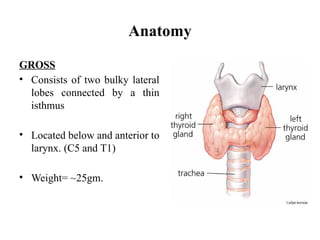
GROSS
• Consists of two bulky lateral
lobes connected by a thin
isthmus
• Located below and anterior to
larynx. (C5 and T1)
• Weight= ~25gm.
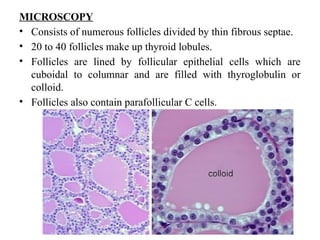
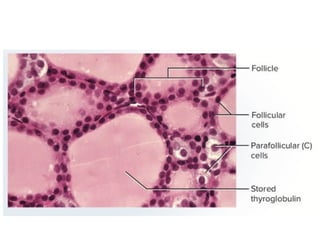
MICROSCOPY
• Consists of numerous follicles divided by thin fibrous septae.
• 20 to 40 follicles make up thyroid lobules.
• Follicles are lined by follicular epithelial cells which are
cuboidal to columnar and are filled with thyroglobulin or
colloid.
• Follicles also contain parafollicular C cells.
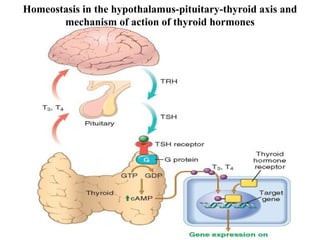
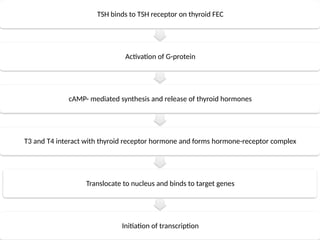
Homeostasis in the hypothalamus-pituitary-thyroid axis and
mechanism of action of thyroid hormones
TSH binds to TSH receptor on thyroid FEC
Activation of G-protein
cAMP- mediated synthesis and release of thyroid hormones
T3 and T4 interact with thyroid receptor hormone and forms hormone-receptor complex
Translocate to nucleus and binds to target genes
Initiation of transcription
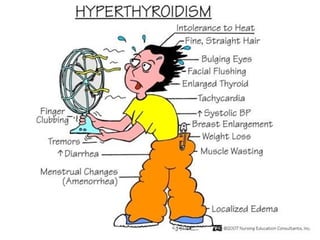
Hyperthyroidism
• Thyrotoxicosis is a hypermetabolic state caused by elevated
circulating levels of free T3 and T4.
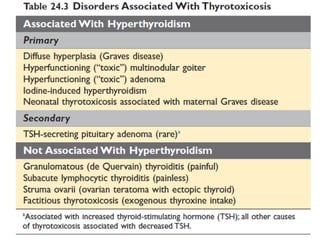
• The three most common causes of thyrotoxicosis associated
with hyperfunction of the gland and include the following:
1. Diffuse hyperplasia of the thyroid associated with Graves
disease (accounts for 85% of cases)
2. Hyperfunctional multinodular goiter
3. Hyperfunctional adenoma of the thyroid
Clinical features:
• Includes changes referable to the hypermetabolic state induced by
excess thyroid hormone and to overactivity of the sympathetic
nervous system.
• Excess thyroid hormone increase in basal metabolic rate
resulting in:
– Soft, warm and flushed skin because of increased blood flow
and peripheral vasodilatation
– Increased sweating because of higher level of calorigenesis
– Weight loss due to heightened catabolic metabolism despite
increased appetite
• Cardiac Manifestations:
– Elevated cardiac contractility and output in response to
increased peripheral oxygen requirement
– Tachycardia
– Palpitations
– Cardiomegaly
– Arrythmias such as atrial fibrillation
– Congestive heart failure
– Myocardial changes:
Focal lymphocytic and eosinophilic infiltrate
Mild fibrosis
Myofibril fatty change
Increase in size and number of mitochondria
• Overactivity of sympathetic nervous system produces:
– Tremor
– Hyperactivity
– Emotional lability
– Anxiety
– Inability to concentrate
– Insomnia
– Proximal muscle weakness and decreased muscle mass
(thyroid myopathy)
– In GI hyperdefecation due to hypermotility and reduced
transit times
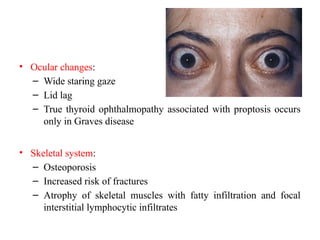
• Ocular changes:
– Wide staring gaze
– Lid lag
– True thyroid ophthalmopathy associated with proptosis occurs
only in Graves disease
• Skeletal system:
– Osteoporosis
– Increased risk of fractures
– Atrophy of skeletal muscles with fatty infiltration and focal
interstitial lymphocytic infiltrates
• Mild hepatomegaly due to hepatic steatosis
• Generalised lymphoid hyperplasia
• Thyroid storm:
– Abrupt onset of severe hyperthyroidism
– It is a medical emergency
– Occurs most commonly in patient with Graves disease
– Results from acute elevation in catecholamines levels as
might be encountered during infection, surgery, cessation
of anti-thyroid medication or any form of stress
– Patient are often febrile and present with tachycardia
Investigation
• TFTS:
Primary: <TSH, >T3 & T4
Secondary: Normal or > TSH,
• Radioiodide scan
• ELISA for anti –TSH receptor/TSI, antimicrosomal ab
• LFTS – elevated
• CBC- mild normocytic anemia, mild neutropenia, < Platelets
• Biopsy- FNA cytology
• USG
• CT/MRI – head/ chest
Graves Disease
• Characterized by a triad of clinical findings:
1.Hyperthyroidism due to diffuse, hyperfunctional enlargement of the
thyroid
2.Infiltrative ophthalmopathy with resultant exophthalmos
3.Localized, infiltrative dermopathy, sometimes called pretibial
myxedema, which is present in a minority of patients
• Peak incidence: 20 and 40 years of age
• Women are affected as much as 10 times more frequently than men.
• Patients are at increased risk for other autoimmune diseases, such
as systemic lupus erythematosus, pernicious anemia, type 1
diabetes, and Addison disease.
Pathogenesis:
• An autoimmune disorder characterized by the production of
autoantibodies against multiple thyroid proteins, most
importantly the TSH receptor. Other: Thyroid peroxisomes
and Thyroglobulin.
• The most common antibody subtype, known as thyroid-
stimulating immunoglobulin (TSI), is observed in
approximately 90% of patients.
• Genetic susceptibility is associated with polymorphisms in
immune-function genes like CTLA4, PTPN22, and IL2RA.
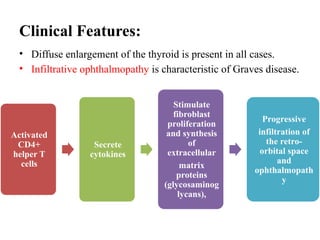
Clinical Features:
• Diffuse enlargement of the thyroid is present in all cases.
• Infiltrative ophthalmopathy is characteristic of Graves disease.
Activated
CD4+
helper T
cells
Secrete
cytokines
Stimulate
fibroblast
proliferation
and synthesis
of
extracellular
matrix
proteins
(glycosaminog
lycans),
Progressive
infiltration of
the retro-
orbital space
and
ophthalmopath
y
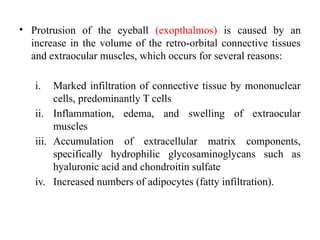
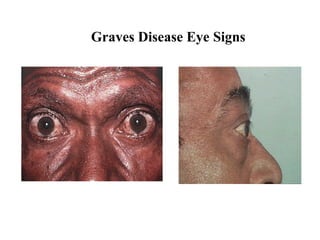
• Protrusion of the eyeball (exopthalmos) is caused by an
increase in the volume of the retro-orbital connective tissues
and extraocular muscles, which occurs for several reasons:
i. Marked infiltration of connective tissue by mononuclear
cells, predominantly T cells
ii. Inflammation, edema, and swelling of extraocular
muscles
iii. Accumulation of extracellular matrix components,
specifically hydrophilic glycosaminoglycans such as
hyaluronic acid and chondroitin sulfate
iv. Increased numbers of adipocytes (fatty infiltration).
Graves Disease Eye Signs
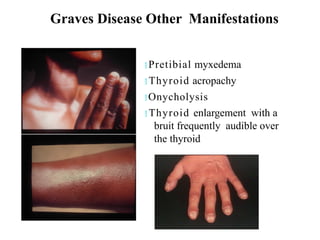
Graves Disease Other Manifestations
 Pretibial myxedema
 Thyroid acropachy
 Onycholysis
 Thyroid enlargement with a
bruit frequently audible over
the thyroid
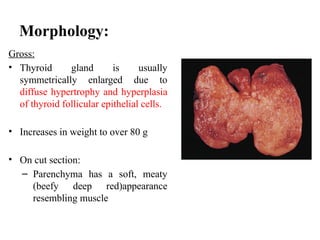
Morphology:
Gross:
• Thyroid gland is usually
symmetrically enlarged due to
diffuse hypertrophy and hyperplasia
of thyroid follicular epithelial cells.
• Increases in weight to over 80 g
• On cut section:
– Parenchyma has a soft, meaty
(beefy deep red)appearance
resembling muscle
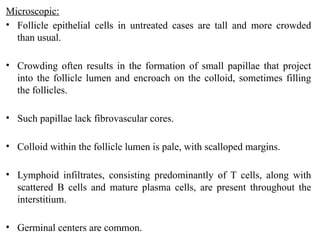
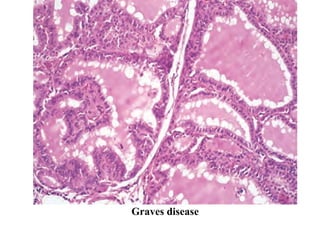
Microscopic:
• Follicle epithelial cells in untreated cases are tall and more crowded
than usual.
• Crowding often results in the formation of small papillae that project
into the follicle lumen and encroach on the colloid, sometimes filling
the follicles.
• Such papillae lack fibrovascular cores.
• Colloid within the follicle lumen is pale, with scalloped margins.
• Lymphoid infiltrates, consisting predominantly of T cells, along with
scattered B cells and mature plasma cells, are present throughout the
interstitium.
• Germinal centers are common.
Graves disease
• Changes in extrathyroidal tissue include:
i. Lymphoid hyperplasia, especially enlargement of the thymus
in younger patients.
ii. Heart may be hypertrophied, and ischemic changes may be
present.
iii. Dermopathy, if present, is characterized by thickening of the
dermis due to deposition of glycosaminoglycans and
lymphocyte infiltration.
Laboratory findings:
• Elevated free T4 and T3 levels
• Depressed TSH levels
• Radioiodine scans show a diffusely increased uptake of iodine
in the thyroid gland.
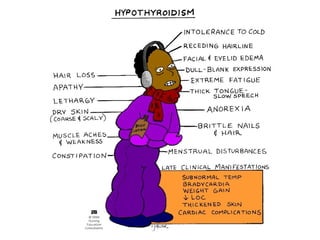
Hypothyroidism
• Fairly common disorder
• Defn: A condition caused by a structural or functional derangement
that interferes with the production of thyroid hormone.
• Divided into primary and secondary categories, depending on whether
the hypothyroidism arises from an intrinsic abnormality in the thyroid
itself, or occurs as a result of pituitary and hypothalamic disease
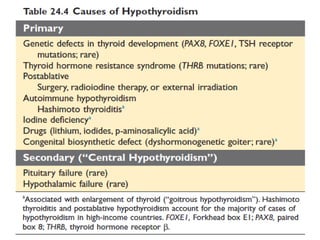
• Primary hypothyroidism can be congenital, acquired, or autoimmune.
• Acquired hypothyroidism can be caused by surgical or radiation-
induced ablation of thyroid parenchyma, Drugs, hypopituitarism
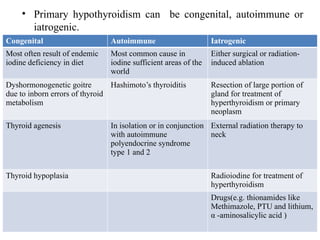
• Primary hypothyroidism can be congenital, autoimmune or
iatrogenic.
Congenital Autoimmune Iatrogenic
Most often result of endemic
iodine deficiency in diet
Most common cause in
iodine sufficient areas of the
world
Either surgical or radiation-
induced ablation
Dyshormonogenetic goitre
due to inborn errors of thyroid
metabolism
Hashimoto’s thyroiditis Resection of large portion of
gland for treatment of
hyperthyroidism or primary
neoplasm
Thyroid agenesis In isolation or in conjunction
with autoimmune
polyendocrine syndrome
type 1 and 2
External radiation therapy to
neck
Thyroid hypoplasia Radioiodine for treatment of
hyperthyroidism
Drugs(e.g. thionamides like
Methimazole, PTU and lithium,
α -aminosalicylic acid )
• Secondary or central hypothyroidism is caused by:
i. Deficiency of TSH
ii. Deficiency of TRH- less common
iii. Any causes of hypopituitarism
iv. Hypothalamic damage
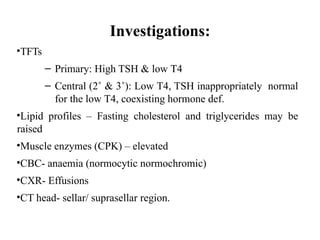
Investigations:
•TFTs
– Primary: High TSH & low T4
– Central (2˚ & 3˚): Low T4, TSH inappropriately normal
for the low T4, coexisting hormone def.
•Lipid profiles – Fasting cholesterol and triglycerides may be
raised
•Muscle enzymes (CPK) – elevated
•CBC- anaemia (normocytic normochromic)
•CXR- Effusions
•CT head- sellar/ suprasellar region.
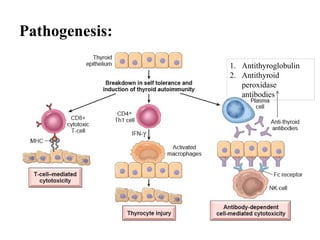
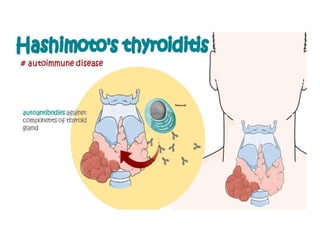
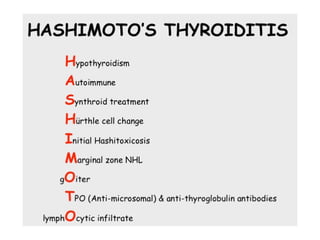
HASHIMOTO THYROIDITIS
• Defn: An autoimmune disease that results in destruction of
thyroid gland and gradual and progressive thyroid failure.
• Most common cause of hypothyroidism.
• Goiter and intense lymphocytic infiltration of the thyroid
(struma lymphomatosa).
• 45 and 65 years of age, common in women than in men. (10:1
to 20:1)
Pathogenesis:
1. Antithyroglobulin
2. Antithyroid
peroxidase
antibodies
Clinical Features:
• Painless enlargement of the thyroid, associated with
hypothyroidism, in a middle-aged woman.
• Symmetric and diffuse enlargement
• Increased risk for developing other autoimmune diseases,
– endocrine: type 1 diabetes, autoimmune adrenalitis
– non- endocrine: systemic lupus erythematosus, myasthenia
gravis and Sjögren syndrome.
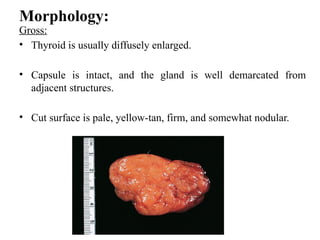
Morphology:
Gross:
• Thyroid is usually diffusely enlarged.
• Capsule is intact, and the gland is well demarcated from
adjacent structures.
• Cut surface is pale, yellow-tan, firm, and somewhat nodular.
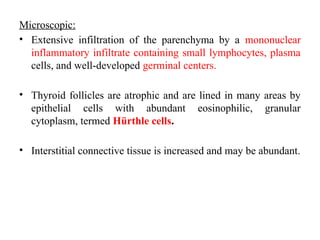
Microscopic:
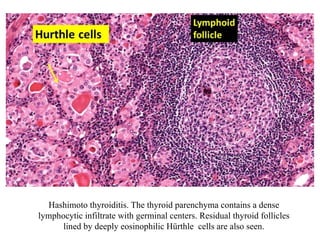
• Extensive infiltration of the parenchyma by a mononuclear
inflammatory infiltrate containing small lymphocytes, plasma
cells, and well-developed germinal centers.
• Thyroid follicles are atrophic and are lined in many areas by
epithelial cells with abundant eosinophilic, granular
cytoplasm, termed Hürthle cells.
• Interstitial connective tissue is increased and may be abundant.
Hashimoto thyroiditis. The thyroid parenchyma contains a dense
lymphocytic infiltrate with germinal centers. Residual thyroid follicles
lined by deeply eosinophilic Hürthle cells are also seen.
THANK YOU

Endocrine abnormalities Hyperthyroidism and Hypothyroidism

  • 1.
    Hypothyroidism and hyperthyroidism DrShikha Pandey Resident CMC-TH, Bharatpur
  • 2.
    Anatomy GROSS • Consists oftwo bulky lateral lobes connected by a thin isthmus • Located below and anterior to larynx. (C5 and T1) • Weight= ~25gm.
  • 3.
    MICROSCOPY • Consists ofnumerous follicles divided by thin fibrous septae. • 20 to 40 follicles make up thyroid lobules. • Follicles are lined by follicular epithelial cells which are cuboidal to columnar and are filled with thyroglobulin or colloid. • Follicles also contain parafollicular C cells.
  • 5.
    Homeostasis in thehypothalamus-pituitary-thyroid axis and mechanism of action of thyroid hormones
  • 6.
    TSH binds toTSH receptor on thyroid FEC Activation of G-protein cAMP- mediated synthesis and release of thyroid hormones T3 and T4 interact with thyroid receptor hormone and forms hormone-receptor complex Translocate to nucleus and binds to target genes Initiation of transcription
  • 7.
    Hyperthyroidism • Thyrotoxicosis isa hypermetabolic state caused by elevated circulating levels of free T3 and T4. • The three most common causes of thyrotoxicosis associated with hyperfunction of the gland and include the following: 1. Diffuse hyperplasia of the thyroid associated with Graves disease (accounts for 85% of cases) 2. Hyperfunctional multinodular goiter 3. Hyperfunctional adenoma of the thyroid
  • 9.
    Clinical features: • Includeschanges referable to the hypermetabolic state induced by excess thyroid hormone and to overactivity of the sympathetic nervous system. • Excess thyroid hormone increase in basal metabolic rate resulting in: – Soft, warm and flushed skin because of increased blood flow and peripheral vasodilatation – Increased sweating because of higher level of calorigenesis – Weight loss due to heightened catabolic metabolism despite increased appetite
  • 11.
    • Cardiac Manifestations: –Elevated cardiac contractility and output in response to increased peripheral oxygen requirement – Tachycardia – Palpitations – Cardiomegaly – Arrythmias such as atrial fibrillation – Congestive heart failure – Myocardial changes: Focal lymphocytic and eosinophilic infiltrate Mild fibrosis Myofibril fatty change Increase in size and number of mitochondria
  • 12.
    • Overactivity ofsympathetic nervous system produces: – Tremor – Hyperactivity – Emotional lability – Anxiety – Inability to concentrate – Insomnia – Proximal muscle weakness and decreased muscle mass (thyroid myopathy) – In GI hyperdefecation due to hypermotility and reduced transit times
  • 13.
    • Ocular changes: –Wide staring gaze – Lid lag – True thyroid ophthalmopathy associated with proptosis occurs only in Graves disease • Skeletal system: – Osteoporosis – Increased risk of fractures – Atrophy of skeletal muscles with fatty infiltration and focal interstitial lymphocytic infiltrates
  • 14.
    • Mild hepatomegalydue to hepatic steatosis • Generalised lymphoid hyperplasia • Thyroid storm: – Abrupt onset of severe hyperthyroidism – It is a medical emergency – Occurs most commonly in patient with Graves disease – Results from acute elevation in catecholamines levels as might be encountered during infection, surgery, cessation of anti-thyroid medication or any form of stress – Patient are often febrile and present with tachycardia
  • 15.
    Investigation • TFTS: Primary: <TSH,>T3 & T4 Secondary: Normal or > TSH, • Radioiodide scan • ELISA for anti –TSH receptor/TSI, antimicrosomal ab • LFTS – elevated • CBC- mild normocytic anemia, mild neutropenia, < Platelets • Biopsy- FNA cytology • USG • CT/MRI – head/ chest
  • 16.
    Graves Disease • Characterizedby a triad of clinical findings: 1.Hyperthyroidism due to diffuse, hyperfunctional enlargement of the thyroid 2.Infiltrative ophthalmopathy with resultant exophthalmos 3.Localized, infiltrative dermopathy, sometimes called pretibial myxedema, which is present in a minority of patients • Peak incidence: 20 and 40 years of age • Women are affected as much as 10 times more frequently than men. • Patients are at increased risk for other autoimmune diseases, such as systemic lupus erythematosus, pernicious anemia, type 1 diabetes, and Addison disease.
  • 17.
    Pathogenesis: • An autoimmunedisorder characterized by the production of autoantibodies against multiple thyroid proteins, most importantly the TSH receptor. Other: Thyroid peroxisomes and Thyroglobulin. • The most common antibody subtype, known as thyroid- stimulating immunoglobulin (TSI), is observed in approximately 90% of patients. • Genetic susceptibility is associated with polymorphisms in immune-function genes like CTLA4, PTPN22, and IL2RA.
  • 18.
    Clinical Features: • Diffuseenlargement of the thyroid is present in all cases. • Infiltrative ophthalmopathy is characteristic of Graves disease. Activated CD4+ helper T cells Secrete cytokines Stimulate fibroblast proliferation and synthesis of extracellular matrix proteins (glycosaminog lycans), Progressive infiltration of the retro- orbital space and ophthalmopath y
  • 19.
    • Protrusion ofthe eyeball (exopthalmos) is caused by an increase in the volume of the retro-orbital connective tissues and extraocular muscles, which occurs for several reasons: i. Marked infiltration of connective tissue by mononuclear cells, predominantly T cells ii. Inflammation, edema, and swelling of extraocular muscles iii. Accumulation of extracellular matrix components, specifically hydrophilic glycosaminoglycans such as hyaluronic acid and chondroitin sulfate iv. Increased numbers of adipocytes (fatty infiltration).
  • 20.
  • 21.
    Graves Disease OtherManifestations  Pretibial myxedema  Thyroid acropachy  Onycholysis  Thyroid enlargement with a bruit frequently audible over the thyroid
  • 22.
    Morphology: Gross: • Thyroid glandis usually symmetrically enlarged due to diffuse hypertrophy and hyperplasia of thyroid follicular epithelial cells. • Increases in weight to over 80 g • On cut section: – Parenchyma has a soft, meaty (beefy deep red)appearance resembling muscle
  • 23.
    Microscopic: • Follicle epithelialcells in untreated cases are tall and more crowded than usual. • Crowding often results in the formation of small papillae that project into the follicle lumen and encroach on the colloid, sometimes filling the follicles. • Such papillae lack fibrovascular cores. • Colloid within the follicle lumen is pale, with scalloped margins. • Lymphoid infiltrates, consisting predominantly of T cells, along with scattered B cells and mature plasma cells, are present throughout the interstitium. • Germinal centers are common.
  • 24.
  • 25.
    • Changes inextrathyroidal tissue include: i. Lymphoid hyperplasia, especially enlargement of the thymus in younger patients. ii. Heart may be hypertrophied, and ischemic changes may be present. iii. Dermopathy, if present, is characterized by thickening of the dermis due to deposition of glycosaminoglycans and lymphocyte infiltration.
  • 26.
    Laboratory findings: • Elevatedfree T4 and T3 levels • Depressed TSH levels • Radioiodine scans show a diffusely increased uptake of iodine in the thyroid gland.
  • 27.
    Hypothyroidism • Fairly commondisorder • Defn: A condition caused by a structural or functional derangement that interferes with the production of thyroid hormone. • Divided into primary and secondary categories, depending on whether the hypothyroidism arises from an intrinsic abnormality in the thyroid itself, or occurs as a result of pituitary and hypothalamic disease • Primary hypothyroidism can be congenital, acquired, or autoimmune. • Acquired hypothyroidism can be caused by surgical or radiation- induced ablation of thyroid parenchyma, Drugs, hypopituitarism
  • 29.
    • Primary hypothyroidismcan be congenital, autoimmune or iatrogenic. Congenital Autoimmune Iatrogenic Most often result of endemic iodine deficiency in diet Most common cause in iodine sufficient areas of the world Either surgical or radiation- induced ablation Dyshormonogenetic goitre due to inborn errors of thyroid metabolism Hashimoto’s thyroiditis Resection of large portion of gland for treatment of hyperthyroidism or primary neoplasm Thyroid agenesis In isolation or in conjunction with autoimmune polyendocrine syndrome type 1 and 2 External radiation therapy to neck Thyroid hypoplasia Radioiodine for treatment of hyperthyroidism Drugs(e.g. thionamides like Methimazole, PTU and lithium, α -aminosalicylic acid )
  • 30.
    • Secondary orcentral hypothyroidism is caused by: i. Deficiency of TSH ii. Deficiency of TRH- less common iii. Any causes of hypopituitarism iv. Hypothalamic damage
  • 31.
    Investigations: •TFTs – Primary: HighTSH & low T4 – Central (2˚ & 3˚): Low T4, TSH inappropriately normal for the low T4, coexisting hormone def. •Lipid profiles – Fasting cholesterol and triglycerides may be raised •Muscle enzymes (CPK) – elevated •CBC- anaemia (normocytic normochromic) •CXR- Effusions •CT head- sellar/ suprasellar region.
  • 33.
    HASHIMOTO THYROIDITIS • Defn:An autoimmune disease that results in destruction of thyroid gland and gradual and progressive thyroid failure. • Most common cause of hypothyroidism. • Goiter and intense lymphocytic infiltration of the thyroid (struma lymphomatosa). • 45 and 65 years of age, common in women than in men. (10:1 to 20:1)
  • 34.
  • 36.
    Clinical Features: • Painlessenlargement of the thyroid, associated with hypothyroidism, in a middle-aged woman. • Symmetric and diffuse enlargement • Increased risk for developing other autoimmune diseases, – endocrine: type 1 diabetes, autoimmune adrenalitis – non- endocrine: systemic lupus erythematosus, myasthenia gravis and Sjögren syndrome.
  • 37.
    Morphology: Gross: • Thyroid isusually diffusely enlarged. • Capsule is intact, and the gland is well demarcated from adjacent structures. • Cut surface is pale, yellow-tan, firm, and somewhat nodular.
  • 38.
    Microscopic: • Extensive infiltrationof the parenchyma by a mononuclear inflammatory infiltrate containing small lymphocytes, plasma cells, and well-developed germinal centers. • Thyroid follicles are atrophic and are lined in many areas by epithelial cells with abundant eosinophilic, granular cytoplasm, termed Hürthle cells. • Interstitial connective tissue is increased and may be abundant.
  • 39.
    Hashimoto thyroiditis. Thethyroid parenchyma contains a dense lymphocytic infiltrate with germinal centers. Residual thyroid follicles lined by deeply eosinophilic Hürthle cells are also seen.
  • 41.