Thyroid & Antithyroid drugs
Dr. M. Ahsan (MBBS, MD)
Thyroid hormones
• Thyroid hormone is essential for normal
development, especially of the CNS.
• In the adult, thyroid hormone maintains
metabolic homeostasis and influences the
functions of virtually all organ systems
• Serum concentrations of thyroid hormones are
precisely regulated by the pituitary hormone
TSH in a negative-feedback system
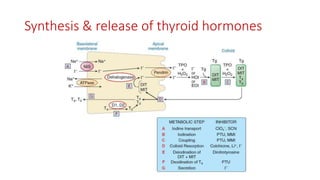
Synthesis & release of thyroid hormones
Synthesis & Release
• Iodide uptake:
Iodine is actively taken up by the follicular cells under the influence of TSH
• Oxidation and iodination of tyrosine
Iodide is oxidised to iodinium ion (I+) by thyroid peroxidase.
I+ combines with tyrosine (on surface of thyroglobulin) to form MIT and DIT
• Coupling reaction
MIT + DIT = T3
DIT + DIT = T4
These reactions are catalysed by thyroid peroxidase
Synthesis & Release
• Storage & release
T3 and T4 formed on surface of
thyroglobulin is transported to inner side
of follicle for storage as thyroid colloid
They are released by proteolysis and
exocytosis under influence of TSH
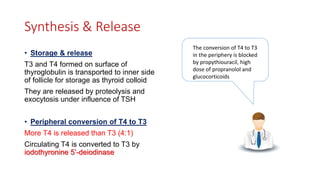
• Peripheral conversion of T4 to T3
More T4 is released than T3 (4:1)
Circulating T4 is converted to T3 by
iodothyronine 5’-deiodinase
The conversion of T4 to T3
in the periphery is blocked
by propythiouracil, high
dose of propranolol and
glucocorticoids
Transport, Metabolism & Excretion
• T3 is 5 times more active than T4
• t ½ of T4 = 6-7 days t ½ of T3 = 1-2 days
• Thyroid hormones are bound to:
Thyroxine binding globulin (TBG)
Thyroxine binding prealbumin
Albumin
• Inactivation occurs by deiodination , decarboxylation and conjugation
mainly in the liver
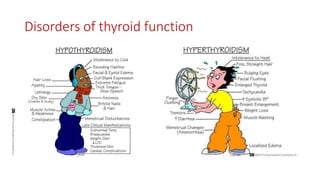
Disorders of thyroid function
Drugs for hypothyroidism
• Levothyroxine (T4)
• Liothyronine (T3)
• Liotrix (T4/T3 combination)
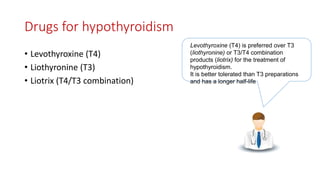
Levothyroxine (T4) is preferred over T3
(liothyronine) or T3/T4 combination
products (liotrix) for the treatment of
hypothyroidism.
It is better tolerated than T3 preparations
and has a longer half-life
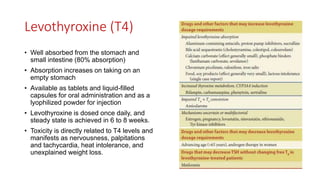
Levothyroxine (T4)
• Well absorbed from the stomach and
small intestine (80% absorption)
• Absorption increases on taking on an
empty stomach
• Available as tablets and liquid-filled
capsules for oral administration and as a
lyophilized powder for injection
• Levothyroxine is dosed once daily, and
steady state is achieved in 6 to 8 weeks.
• Toxicity is directly related to T4 levels and
manifests as nervousness, palpitations
and tachycardia, heat intolerance, and
unexplained weight loss.
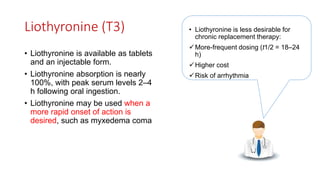
Liothyronine (T3)
• Liothyronine is available as tablets
and an injectable form.
• Liothyronine absorption is nearly
100%, with peak serum levels 2–4
h following oral ingestion.
• Liothyronine may be used when a
more rapid onset of action is
desired, such as myxedema coma
• Liothyronine is less desirable for
chronic replacement therapy:
More-frequent dosing (t1/2 = 18–24
h)
Higher cost
Risk of arrhythmia
Uses of thyroxine
Mainly used as a supplement in hypothyroidism in:
• Children – Cretinism
• Adult hypothyroidism
• Myxoedema
• Simple or non-toxic goitre
• Myxoedema coma
• Subclinical hypothyroidism
• Nodular goitre
• Papillary carcinoma of thyroid
Drugs for hyperthyroidism: Thyroid Inhibitors
I. Hormone Synthesis Inhibitors
(Antithyroid drugs)
Propyltiouracil, Carbimazole,
Methimazole
II. Hormone Release Inhibitors
Iodides (Lugol’s iodine, Sodium
iodide, potassium iodide)
III. Destruction of thyroid tissue
Radioactive iodine
IV. Ionic inhibitors
Thiocynates, perchlorates, nitrates
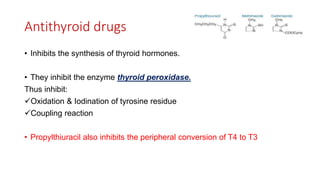
Antithyroid drugs
• Inhibits the synthesis of thyroid hormones.
• They inhibit the enzyme thyroid peroxidase.
Thus inhibit:
Oxidation & Iodination of tyrosine residue
Coupling reaction
• Propylthiuracil also inhibits the peripheral conversion of T4 to T3
Pharmacokinetics of antithyroid drugs
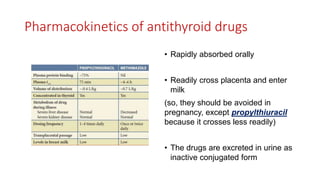
• Rapidly absorbed orally
• Readily cross placenta and enter
milk
(so, they should be avoided in
pregnancy, except propylthiuracil
because it crosses less readily)
• The drugs are excreted in urine as
inactive conjugated form
Uses of antithyroid drugs
• To achieve spontaneous remission and control in:
Grave’s disease
Toxic nodular goitre
• Used prior to radioactive iodine
• Pre-operative control of hyperthyroidism
• Thyroid storm
(PTU is preferred because it can
inhibit peripheral conversion)
Methimazole is
preferred over PTU
because of
once daily dosing
(longer t ½ )
Lower incidence of
adverse effects
[Except in pregnancy: PTU
is preferred]
Adverse effects of antithyroid drugs
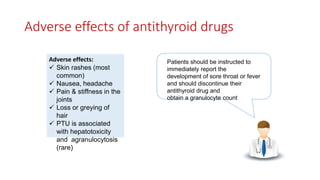
Adverse effects:
 Skin rashes (most
common)
 Nausea, headache
 Pain & stiffness in the
joints
 Loss or greying of
hair
 PTU is associated
with hepatotoxicity
and agranulocytosis
(rare)
Patients should be instructed to
immediately report the
development of sore throat or fever
and should discontinue their
antithyroid drug and
obtain a granulocyte count
Iodine and iodides
• It is the fastest acting agent
• Inhibits the release of thyroid hormones
• The gland shrinks in size and becomes firm and less vascular
The maximal effect occurs after 10–15 days of continuous therapy.
On continuous treatment there is loss of therapeutic effect!!
(thyroid constipation and thyroid escape)
Iodide is the oldest
remedy for disorders of
the thyroid gland. In
high
concentration, iodide
limits its own transport
and acutely and
transiently inhibits the
synthesis of thyroid
hormones.
(the Wolff-Chaikoff
effect)
Iodides
Uses:
• Pre-operative preparation before subtotal thyroidectomy
……given 7-10 days pre-operatively to shrink the gland, make it firm and
less vascular
• Thyroid storm (in conjunction with antithyroid drugs and propranolol)
(Lugol solution) consists of 5% iodine
and 10% potassium iodide
Typical doses include 16–36 mg (2–6 drops) of
Lugol solution
Adverse effect:
Hypersensitivity to iodine: angioedema and laryngeal oedema
Chronic intoxication causes ‘iodism’
Radioactive iodine
I-127: stable isotope
I-131, I-123, I-125: radioactive isotopes
I-131: t ½ = 8 days
• Commonly used iodine isotope for therapeutic and diagnostic purposes
• Emits γ and β particles.
• Taken as sodium salt by oral route
 Sodium iodide 131I is available as a solution or in capsules
containing carrier-free 131I suitable for oral administration.
 Sodium iodide 123I is available for scanning procedures.
Radioactive iodine
• The radioactive iodine is actively taken up by the follicular cells
• It emits β particles which destroys thyroid parenchyma (up to 0.5-2 mm)
• There is negligible damage to adjacent tissue
Uses:
Grave’s disease
In patients who cannot undergo thyroidectomy (elderly patients)
Patients with existing heart disease
Toxic nodular goitre
Radioactive iodine
Advantages
• Risk of complications of surgery is
avoided
No Surgical scar
No injury to recurrent laryngeal nerve
No damage to parathyroid gland
• Cure is permanent
Disadvantages
• Permanent hypothyroidism
• Delayed onset
• Can not be used during pregnancy
• Avoided in young patients
Adjuvant therapy: Symptomatic treatment
• β- blockers (Propranolol):
Antagonize the sympathetic/adrenergic effects of thyrotoxicosis—
Reduce the tachycardia, tremor, and stare—and relieve palpitations,
anxiety, and tension.
Thyroid storm
Thyroid storm is an uncommon but life-threatening
complication of thyrotoxicosis
in which a severe form of the disease is usually
precipitated by an intercurrent medical problem
Treatment:
 Supportive measures
 Antithyroid drugs - PTU is preferred
(PTU impairs peripheral conversion of T4
→ T3)
 Oral iodides
 β -blockers
 Treatment of the underlying
precipitating illness
Thank you
References
• Lippincott Illustrated Reviews: Pharmacology(6th ed.). Philadelphia,
PA: Wolters Kluwer.
• Goodman & Gillman’s: The Pharmacological Basis of Therapeutics,
13th edition. New York: McGraw-Hill, 2018

Thyroid & antithyroid drugs

  • 1.
    Thyroid & Antithyroiddrugs Dr. M. Ahsan (MBBS, MD)
  • 2.
    Thyroid hormones • Thyroidhormone is essential for normal development, especially of the CNS. • In the adult, thyroid hormone maintains metabolic homeostasis and influences the functions of virtually all organ systems • Serum concentrations of thyroid hormones are precisely regulated by the pituitary hormone TSH in a negative-feedback system
  • 3.
    Synthesis & releaseof thyroid hormones
  • 4.
    Synthesis & Release •Iodide uptake: Iodine is actively taken up by the follicular cells under the influence of TSH • Oxidation and iodination of tyrosine Iodide is oxidised to iodinium ion (I+) by thyroid peroxidase. I+ combines with tyrosine (on surface of thyroglobulin) to form MIT and DIT • Coupling reaction MIT + DIT = T3 DIT + DIT = T4 These reactions are catalysed by thyroid peroxidase
  • 5.
    Synthesis & Release •Storage & release T3 and T4 formed on surface of thyroglobulin is transported to inner side of follicle for storage as thyroid colloid They are released by proteolysis and exocytosis under influence of TSH • Peripheral conversion of T4 to T3 More T4 is released than T3 (4:1) Circulating T4 is converted to T3 by iodothyronine 5’-deiodinase The conversion of T4 to T3 in the periphery is blocked by propythiouracil, high dose of propranolol and glucocorticoids
  • 6.
    Transport, Metabolism &Excretion • T3 is 5 times more active than T4 • t ½ of T4 = 6-7 days t ½ of T3 = 1-2 days • Thyroid hormones are bound to: Thyroxine binding globulin (TBG) Thyroxine binding prealbumin Albumin • Inactivation occurs by deiodination , decarboxylation and conjugation mainly in the liver
  • 7.
  • 8.
    Drugs for hypothyroidism •Levothyroxine (T4) • Liothyronine (T3) • Liotrix (T4/T3 combination) Levothyroxine (T4) is preferred over T3 (liothyronine) or T3/T4 combination products (liotrix) for the treatment of hypothyroidism. It is better tolerated than T3 preparations and has a longer half-life
  • 9.
    Levothyroxine (T4) • Wellabsorbed from the stomach and small intestine (80% absorption) • Absorption increases on taking on an empty stomach • Available as tablets and liquid-filled capsules for oral administration and as a lyophilized powder for injection • Levothyroxine is dosed once daily, and steady state is achieved in 6 to 8 weeks. • Toxicity is directly related to T4 levels and manifests as nervousness, palpitations and tachycardia, heat intolerance, and unexplained weight loss.
  • 10.
    Liothyronine (T3) • Liothyronineis available as tablets and an injectable form. • Liothyronine absorption is nearly 100%, with peak serum levels 2–4 h following oral ingestion. • Liothyronine may be used when a more rapid onset of action is desired, such as myxedema coma • Liothyronine is less desirable for chronic replacement therapy: More-frequent dosing (t1/2 = 18–24 h) Higher cost Risk of arrhythmia
  • 11.
    Uses of thyroxine Mainlyused as a supplement in hypothyroidism in: • Children – Cretinism • Adult hypothyroidism • Myxoedema • Simple or non-toxic goitre • Myxoedema coma • Subclinical hypothyroidism • Nodular goitre • Papillary carcinoma of thyroid
  • 12.
    Drugs for hyperthyroidism:Thyroid Inhibitors I. Hormone Synthesis Inhibitors (Antithyroid drugs) Propyltiouracil, Carbimazole, Methimazole II. Hormone Release Inhibitors Iodides (Lugol’s iodine, Sodium iodide, potassium iodide) III. Destruction of thyroid tissue Radioactive iodine IV. Ionic inhibitors Thiocynates, perchlorates, nitrates
  • 13.
    Antithyroid drugs • Inhibitsthe synthesis of thyroid hormones. • They inhibit the enzyme thyroid peroxidase. Thus inhibit: Oxidation & Iodination of tyrosine residue Coupling reaction • Propylthiuracil also inhibits the peripheral conversion of T4 to T3
  • 14.
    Pharmacokinetics of antithyroiddrugs • Rapidly absorbed orally • Readily cross placenta and enter milk (so, they should be avoided in pregnancy, except propylthiuracil because it crosses less readily) • The drugs are excreted in urine as inactive conjugated form
  • 15.
    Uses of antithyroiddrugs • To achieve spontaneous remission and control in: Grave’s disease Toxic nodular goitre • Used prior to radioactive iodine • Pre-operative control of hyperthyroidism • Thyroid storm (PTU is preferred because it can inhibit peripheral conversion) Methimazole is preferred over PTU because of once daily dosing (longer t ½ ) Lower incidence of adverse effects [Except in pregnancy: PTU is preferred]
  • 16.
    Adverse effects ofantithyroid drugs Adverse effects:  Skin rashes (most common)  Nausea, headache  Pain & stiffness in the joints  Loss or greying of hair  PTU is associated with hepatotoxicity and agranulocytosis (rare) Patients should be instructed to immediately report the development of sore throat or fever and should discontinue their antithyroid drug and obtain a granulocyte count
  • 17.
    Iodine and iodides •It is the fastest acting agent • Inhibits the release of thyroid hormones • The gland shrinks in size and becomes firm and less vascular The maximal effect occurs after 10–15 days of continuous therapy. On continuous treatment there is loss of therapeutic effect!! (thyroid constipation and thyroid escape) Iodide is the oldest remedy for disorders of the thyroid gland. In high concentration, iodide limits its own transport and acutely and transiently inhibits the synthesis of thyroid hormones. (the Wolff-Chaikoff effect)
  • 18.
    Iodides Uses: • Pre-operative preparationbefore subtotal thyroidectomy ……given 7-10 days pre-operatively to shrink the gland, make it firm and less vascular • Thyroid storm (in conjunction with antithyroid drugs and propranolol) (Lugol solution) consists of 5% iodine and 10% potassium iodide Typical doses include 16–36 mg (2–6 drops) of Lugol solution Adverse effect: Hypersensitivity to iodine: angioedema and laryngeal oedema Chronic intoxication causes ‘iodism’
  • 19.
    Radioactive iodine I-127: stableisotope I-131, I-123, I-125: radioactive isotopes I-131: t ½ = 8 days • Commonly used iodine isotope for therapeutic and diagnostic purposes • Emits γ and β particles. • Taken as sodium salt by oral route  Sodium iodide 131I is available as a solution or in capsules containing carrier-free 131I suitable for oral administration.  Sodium iodide 123I is available for scanning procedures.
  • 20.
    Radioactive iodine • Theradioactive iodine is actively taken up by the follicular cells • It emits β particles which destroys thyroid parenchyma (up to 0.5-2 mm) • There is negligible damage to adjacent tissue Uses: Grave’s disease In patients who cannot undergo thyroidectomy (elderly patients) Patients with existing heart disease Toxic nodular goitre
  • 21.
    Radioactive iodine Advantages • Riskof complications of surgery is avoided No Surgical scar No injury to recurrent laryngeal nerve No damage to parathyroid gland • Cure is permanent Disadvantages • Permanent hypothyroidism • Delayed onset • Can not be used during pregnancy • Avoided in young patients
  • 22.
    Adjuvant therapy: Symptomatictreatment • β- blockers (Propranolol): Antagonize the sympathetic/adrenergic effects of thyrotoxicosis— Reduce the tachycardia, tremor, and stare—and relieve palpitations, anxiety, and tension.
  • 23.
    Thyroid storm Thyroid stormis an uncommon but life-threatening complication of thyrotoxicosis in which a severe form of the disease is usually precipitated by an intercurrent medical problem Treatment:  Supportive measures  Antithyroid drugs - PTU is preferred (PTU impairs peripheral conversion of T4 → T3)  Oral iodides  β -blockers  Treatment of the underlying precipitating illness
  • 24.
  • 25.
    References • Lippincott IllustratedReviews: Pharmacology(6th ed.). Philadelphia, PA: Wolters Kluwer. • Goodman & Gillman’s: The Pharmacological Basis of Therapeutics, 13th edition. New York: McGraw-Hill, 2018

Editor's Notes

  • #6 The conversion of T4 to T3 in the periphery is blocked by propythiouracil, high dose of propranolol and glucocorticoids
  • #13 The ionic inhibitors are substances that interfere with the concentration of iodide by the thyroid gland. These agents are anions that resemble iodide: thiocyanate, perchlorate, and fluoroborate, all monovalent hydrated anions of a size similar to that of iodide. Lithium decreases secretion of T4 and T3, which can cause overt hypothyroidism in some patients taking Li+ for the treatment of mania
  • #19 The severity of symptoms of chronic intoxication with iodide (iodism) is related to the dose. The symptoms start with an unpleasant brassy taste and burning in the mouth and throat as well as soreness of the teeth and gums. Increased salivation, coryza, sneezing, and irritation of the eyes with swelling of the eyelids commonly occur. Mild
  • #24 Supportive measures such as intravenous fluids, antipyretics, cooling blankets, and sedation