HYPERTENSIVE EMERGENCIES
By: Ackeime Campbell
OBJECTIVES
 To define the different categories of Hypertension.
 To list the main causes of Hypertensive Emergencies.
 To discuss the main conditions associated with
Hypertensive Emergencies.
 To discuss and understand the management of a
Hypertensive Emergency in the emergency department
along with the drugs involved.
INTRODUCTION
 Hypertension is a worldwide epidemic.
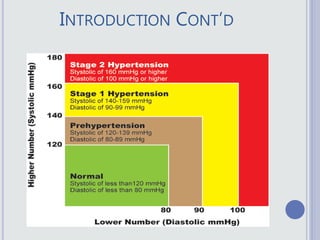
 Systolic Blood Pressure: >= 140mmHg
 Diastolic Blood Pressure: >= 90mmHg
 Someone requiring antihypertensive medications for
control of sustained elevations of blood pressure
 Hypertension can be classified as either Primary or
Secondary hypertension.
INTRODUCTION CONT’D
 Essential/Primary hypertension is idiopathic
but believed to be a multifactorial disease
process with both genetic and
environmental factors at play.
INTRODUCTION CONT’D
HYPERTENSIVE CRISIS
 Not determined by a specific range of elevation in
the blood pressure.
 Usually,
 SBP: >= 180mmHg
 DBP: >= 120mmHg
CATEGORIES
 Hypertensive Crisis:
 Hypertensive Urgency: Acute severe hypertension
without any signs of damage to target organs (heart,
brain, kidneys).
 Hypertensive Emergencies: Acute severe hypertension
with signs of progressive damage to target organs.
EPIDEMIOLOGY
 1% incidence of hypertensive emergencies in
patients with hypertension. (Medscape)
 survival rate >90%
 “Jamaica has a point prevalence of hypertension of
30.8% in the 15-and-over age group”
 Source: Ragoobirsingh D, et al, (2002). The Jamaican hypertension prevalence study.. Journal of the National
Medical Association. 94(7) (), pp.565
 20% prevalence in adults worldwide (Medscape)
ETIOLOGY
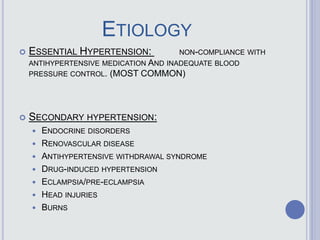
 ESSENTIAL HYPERTENSION: NON-COMPLIANCE WITH
ANTIHYPERTENSIVE MEDICATION AND INADEQUATE BLOOD
PRESSURE CONTROL. (MOST COMMON)
 SECONDARY HYPERTENSION:
 ENDOCRINE DISORDERS
 RENOVASCULAR DISEASE
 ANTIHYPERTENSIVE WITHDRAWAL SYNDROME
 DRUG-INDUCED HYPERTENSION
 ECLAMPSIA/PRE-ECLAMPSIA
 HEAD INJURIES
 BURNS
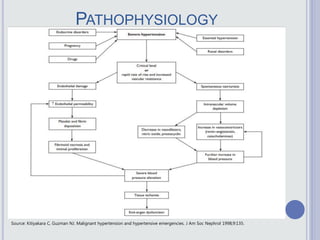
PATHOPHYSIOLOGY
Source: Kitiyakara C, Guzman NJ. Malignant hypertension and hypertensive emergencies. J Am Soc Nephrol 1998;9:135.
DIFFERENTIALS…?
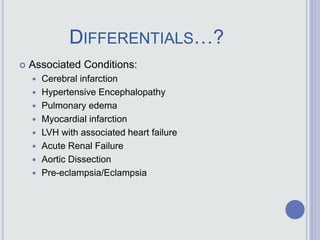
 Associated Conditions:
 Cerebral infarction
 Hypertensive Encephalopathy
 Pulmonary edema
 Myocardial infarction
 LVH with associated heart failure
 Acute Renal Failure
 Aortic Dissection
 Pre-eclampsia/Eclampsia
ASSOCIATED CONDITIONS
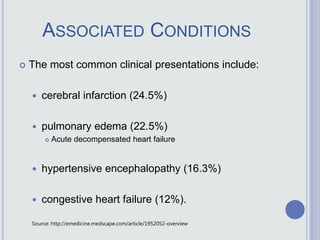
 The most common clinical presentations include:
 cerebral infarction (24.5%)
 pulmonary edema (22.5%)
 Acute decompensated heart failure
 hypertensive encephalopathy (16.3%)
 congestive heart failure (12%).
Source: http://emedicine.medscape.com/article/1952052-overview
ASSOCIATED CONDITIONS
 Aortic dissection
 Pre-eclampsia/ eclampsia
 Acute myocardial infarction
PRESENTATION
 It’s a SPECTRUM
HISTORY
 History of hypertension
 Duration and patient baseline
 Controlled or Uncontrolled
 Compliant or Non-compliant
 High BP readings
 Co-morbidities
 Evidence of any target-organ damage
 Details of current antihypertensive therapy
 Recreational drug use
EXAMINATION FINDINGS
 O2 Saturation
 Cardiovascular system
 Check patient’s blood pressure in both arms
 Heart Rate
 Elevated JVP
 Heart murmurs (ischemic mitral regurgitation)
 Basal lung crepitations
 Central Nervous System
 Altered mental status
 Focal neurological deficits
EXAMINATION FINDINGS
 Abdomen
 Palpate abdominal masses
 Auscultate for renal bruits
 Fundoscopic Examination
INVESTIGATIONS
 Urea & Electrolytes
 Urea and Creatinine
 Urinalysis
 Electrocardiography (ECG)
 Chest X-rays
 CT Brain
 Chest CT/MRI
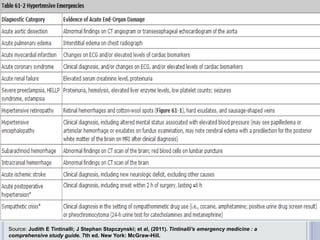
Source: Judith E Tintinalli; J Stephan Stapczynski; et al, (2011). Tintinalli's emergency medicine : a
comprehensive study guide. 7th ed. New York: McGraw-Hill.
MANAGEMENT
WARNING DETOURS
AHEAD!!!
MANAGEMENT
o Hypertensive Emergency Vs. Hypertensive
Urgency
o IV access
o Continuous BP monitoring
• Dynamap
• Arterial Lines
o Supplemental O2
MANAGEMENT
 The initial goal of therapy in hypertensive
emergencies is to reduce mean arterial pressure by
no more than 25% (within minutes to 1 hour), then,
if stable, to 160/100 to 110 mm Hg within the next 2
to 6 hours.
Source: JNC
7
MANAGEMENT
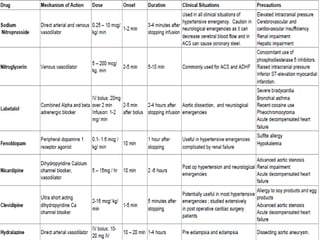
 The choice of anti-hypertensive medication is
usually based on:
 Target organ dysfunction
 Availability
 Ease of administration
 Institutional culture
 Physician’s preference
CEREBRAL INFARCTION
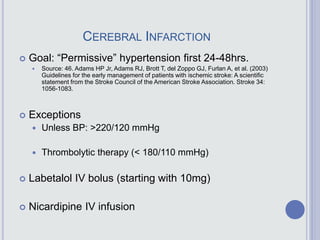
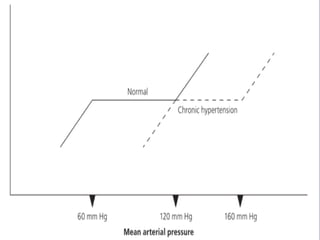
 Goal: “Permissive” hypertension first 24-48hrs.
 Source: 46. Adams HP Jr, Adams RJ, Brott T, del Zoppo GJ, Furlan A, et al. (2003)
Guidelines for the early management of patients with ischemic stroke: A scientific
statement from the Stroke Council of the American Stroke Association. Stroke 34:
1056-1083.
 Exceptions
 Unless BP: >220/120 mmHg
 Thrombolytic therapy (< 180/110 mmHg)
 Labetalol IV bolus (starting with 10mg)
 Nicardipine IV infusion
DETOUR
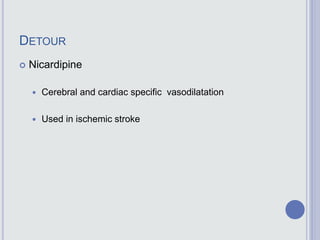
 Nicardipine
 Cerebral and cardiac specific vasodilatation
 Used in ischemic stroke
HYPERTENSIVE ENCEPHALOPATHY
 Decrease MAP by 20-25% or diastolic BP to 100-
110mmHg in 1-2 hr
 Nicardipine
 Labetalol
 Clevidipine
 Fenoldopam
 Sodium Nitroprusside should be used with caution 
Increase intracranial pressure. CPP= MAP - ICP
DETOUR
 Sodium Nitroprusside
 Can cause decreased perfusion in cerebral, cardiac and
renal tissue
 Rapid onset of action and short half life of this potent
drug warrants intra-arterial monitoring in the ICU setting.
 Excreted as thyocyanate  hepatic and renal function
key
ACUTE CORONARY SYNDROME
 Goal is to gradually reduce patient’s BP
 Increase cardiac functioning
 Relieve symptoms
 SL Nitroglycerin
 IV Nitroglycerin
 IV Labetalol Advantageous Arrhythmia prone
 Avoid Sodium Nitroprusside Coronary Steal
Phenomenon
ACUTE DECOMPENSATED HEART FAILURE
 Goal: Reduction of BP by 20% in 1st hr.
 Cardiac function
 Symptom relief
 “Flash pulmonary edema”
 Nitroprusside
 Nitroglycerin
 Avoid Labetolol and Nicardipine
AORTIC DISSECTION
 Goal: Rapidly decrease BP to a normal level.
 SBP: 100-120mmHg (Tintinalli)
 SBP: < 140mmHg
 Labetalol ALWAYS precedes vasodilator
 Nitroprusside (excellent agent)
 Nicardipine
ACUTE KIDNEY INJURY
 Goal: Reduction of BP by no more that 20%
acutely, i.e. first 1-2 hrs.
 Then 10-15% during the next 6-12 hrs.
 Worsening renal impairment with therapy
 Labetalol IV
 Nicardipine IV infusion
 Fenoldopam IV infusion
 Sodium Nitroprusside should be avoided due to
possible toxicity.
DETOUR
 Fenoldopam
 Increases natriurese, diuresis and creatinine clearance
 Nitroprusside used??
 Nitroprusside VS. Fenoldopam
Sources: Shusterman NH, Elliott WJ, White WB (1993) Fenoldopam, but not nitroprusside,
improves renal function in severely hypertensive patients with impaired renal function. Am J Med
95: 161-168.
Elliott WJ, Weber RR, Nelson KS, Oliner CM, Fumo MT, et al. (1990) Renal and hemodynamic
effects of intravenous fenoldopam versus nitroprusside in severe hypertension. Circulation 81: 970-
977.
HYPERTENSIVE EMERGENCIES IN
PREGNANCY
 Pre-eclampsia/Eclapsia
 Magnesium Sulphate
 Delivery is the definitive treatment
 Goal: <160/110 mmHg
 Labetalol IV
 Nicardipine IV
 Hydralazine Unpredictable antihypertensive effects,
but increased blood supply to uterus and non-
teratogenic.
 ACE inhibitors are contraindicated in pregnancy
DETOUR
 Hydralazine:
 Avoid use in Aortic Dissection or suspected cases.
 Fatal
 Difficult to titrate
HYPERTENSIVE EMERGENCY DUE TO
CATECHOLAMINE EXCESS
 Goal: Reduce excessive sympathetic drive and
symptom relief.
 Phentolamine Starting drug
 THEN,
 Beta-blocker if necessary
 Nicardipine and Fenoldopam may also be used.
SPECIAL POPULATION
 Children
 Blood pressure nomograms adjusted for age, sex,
height, and weight.
 If the 95th percentile is exceeded, the
measurement meets the criterion for childhood
hypertension.
 Consultation with a pediatrician is recommended
prior to initiation of oral therapy
HYPERTENSIVE EMERGENCY IN CHILDREN
CONT’D
 Begin therapy at 99th percentile
 Medications for the control of hypertensive
emergencies in children:
 Labetalol, 0.2 to 1.0 mg/kg per dose, up to 40
mg/dose, or an infusion of 0.25 to 3.0 mg/kg/h;
 Nicardipine, 1 to 3 micrograms/kg/min; or, if prior
drugs fail.
 Nitroprusside, 0.5 to 10.0 micrograms/kg/min.
TAKE HOME MESSAGE
 Differentiating between hypertensive urgencies and
hypertensive emergencies is essential as
management varies in both.
 No standard BP necessarily established so look for
target organ damage.
TAKE HOME MESSAGE
 Although management is rapid also remember
careful monitoring must be done.
 Various medications are available for the treatment
of hypertensive emergency; specific target organ
involvement and underlying patient comorbidities
dictate appropriate therapy.
REFERENCES
 Mahadevan S.V. & Garmel G. M., (2005). An Introduction to Clinical
Emergency Medicine Guide for Practitioners in the Emergency
Department. 1st ed. United States of America: Cambridge University
Press.
 Bakris G. L. (2014). Hypertensive Emergencies. [ONLINE] Available
at:
http://www.merckmanuals.com/professional/cardiovascular_disorders
/hypertension/hypertensive_emergencies.html. [Last Accessed 28
December 14].
 Madhur M.S., et al. (2014). Hypertension. [ONLINE] Available at:
http://emedicine.medscape.com/article/241381-
overview#aw2aab6b2b2. [Last Accessed 28/12/14].
 Judith E Tintinalli; J Stephan Stapczynski; et al, (2011). Tintinalli's
emergency medicine : a comprehensive study guide. 7th ed. New
York: McGraw-Hill.
REFERENCES
 Vaidya C.K.& Oullette J.R. (2007). Hypertensive Urgency and
Emergency. [ONLINE] Available at: http://turner-
white.com/memberfile.php?PubCode=hp_mar07_hypertensive.p
df. [Last Accessed 21/1/15].
 Shusterman NH, Elliott WJ, White WB (1993)
Fenoldopam, but not nitroprusside, improves renal
function in severely hypertensive patients with impaired
renal function. Am J Med 95: 161-168.
 Elliott WJ, Weber RR, Nelson KS, Oliner CM, Fumo MT,
et al. (1990) Renal and hemodynamic effects of
intravenous fenoldopam versus nitroprusside in severe
hypertension. Circulation 81: 970-977.
 Hopkins C., et al. (2013). Hypertensive Emergencies. [ONLINE] Available
at: http://emedicine.medscape.com/article/1952052-overview. [Last
Accessed 23/1/15].
 Mallidi J, Penumetsa S, Lotfi A (2013) Management of
Hypertensive Emergencies. J Hypertens 2: 117
THANK YOU

Hypertensive emergencies

  • 1.
  • 2.
    OBJECTIVES  To definethe different categories of Hypertension.  To list the main causes of Hypertensive Emergencies.  To discuss the main conditions associated with Hypertensive Emergencies.  To discuss and understand the management of a Hypertensive Emergency in the emergency department along with the drugs involved.
  • 3.
    INTRODUCTION  Hypertension isa worldwide epidemic.  Systolic Blood Pressure: >= 140mmHg  Diastolic Blood Pressure: >= 90mmHg  Someone requiring antihypertensive medications for control of sustained elevations of blood pressure  Hypertension can be classified as either Primary or Secondary hypertension.
  • 4.
    INTRODUCTION CONT’D  Essential/Primaryhypertension is idiopathic but believed to be a multifactorial disease process with both genetic and environmental factors at play.
  • 5.
  • 6.
    HYPERTENSIVE CRISIS  Notdetermined by a specific range of elevation in the blood pressure.  Usually,  SBP: >= 180mmHg  DBP: >= 120mmHg
  • 7.
    CATEGORIES  Hypertensive Crisis: Hypertensive Urgency: Acute severe hypertension without any signs of damage to target organs (heart, brain, kidneys).  Hypertensive Emergencies: Acute severe hypertension with signs of progressive damage to target organs.
  • 8.
    EPIDEMIOLOGY  1% incidenceof hypertensive emergencies in patients with hypertension. (Medscape)  survival rate >90%  “Jamaica has a point prevalence of hypertension of 30.8% in the 15-and-over age group”  Source: Ragoobirsingh D, et al, (2002). The Jamaican hypertension prevalence study.. Journal of the National Medical Association. 94(7) (), pp.565  20% prevalence in adults worldwide (Medscape)
  • 9.
    ETIOLOGY  ESSENTIAL HYPERTENSION:NON-COMPLIANCE WITH ANTIHYPERTENSIVE MEDICATION AND INADEQUATE BLOOD PRESSURE CONTROL. (MOST COMMON)  SECONDARY HYPERTENSION:  ENDOCRINE DISORDERS  RENOVASCULAR DISEASE  ANTIHYPERTENSIVE WITHDRAWAL SYNDROME  DRUG-INDUCED HYPERTENSION  ECLAMPSIA/PRE-ECLAMPSIA  HEAD INJURIES  BURNS
  • 10.
    PATHOPHYSIOLOGY Source: Kitiyakara C,Guzman NJ. Malignant hypertension and hypertensive emergencies. J Am Soc Nephrol 1998;9:135.
  • 11.
    DIFFERENTIALS…?  Associated Conditions: Cerebral infarction  Hypertensive Encephalopathy  Pulmonary edema  Myocardial infarction  LVH with associated heart failure  Acute Renal Failure  Aortic Dissection  Pre-eclampsia/Eclampsia
  • 12.
    ASSOCIATED CONDITIONS  Themost common clinical presentations include:  cerebral infarction (24.5%)  pulmonary edema (22.5%)  Acute decompensated heart failure  hypertensive encephalopathy (16.3%)  congestive heart failure (12%). Source: http://emedicine.medscape.com/article/1952052-overview
  • 13.
    ASSOCIATED CONDITIONS  Aorticdissection  Pre-eclampsia/ eclampsia  Acute myocardial infarction
  • 14.
  • 15.
    HISTORY  History ofhypertension  Duration and patient baseline  Controlled or Uncontrolled  Compliant or Non-compliant  High BP readings  Co-morbidities  Evidence of any target-organ damage  Details of current antihypertensive therapy  Recreational drug use
  • 16.
    EXAMINATION FINDINGS  O2Saturation  Cardiovascular system  Check patient’s blood pressure in both arms  Heart Rate  Elevated JVP  Heart murmurs (ischemic mitral regurgitation)  Basal lung crepitations  Central Nervous System  Altered mental status  Focal neurological deficits
  • 17.
    EXAMINATION FINDINGS  Abdomen Palpate abdominal masses  Auscultate for renal bruits  Fundoscopic Examination
  • 18.
    INVESTIGATIONS  Urea &Electrolytes  Urea and Creatinine  Urinalysis  Electrocardiography (ECG)  Chest X-rays  CT Brain  Chest CT/MRI
  • 19.
    Source: Judith ETintinalli; J Stephan Stapczynski; et al, (2011). Tintinalli's emergency medicine : a comprehensive study guide. 7th ed. New York: McGraw-Hill.
  • 20.
  • 21.
  • 22.
    MANAGEMENT o Hypertensive EmergencyVs. Hypertensive Urgency o IV access o Continuous BP monitoring • Dynamap • Arterial Lines o Supplemental O2
  • 23.
    MANAGEMENT  The initialgoal of therapy in hypertensive emergencies is to reduce mean arterial pressure by no more than 25% (within minutes to 1 hour), then, if stable, to 160/100 to 110 mm Hg within the next 2 to 6 hours. Source: JNC 7
  • 24.
    MANAGEMENT  The choiceof anti-hypertensive medication is usually based on:  Target organ dysfunction  Availability  Ease of administration  Institutional culture  Physician’s preference
  • 26.
    CEREBRAL INFARCTION  Goal:“Permissive” hypertension first 24-48hrs.  Source: 46. Adams HP Jr, Adams RJ, Brott T, del Zoppo GJ, Furlan A, et al. (2003) Guidelines for the early management of patients with ischemic stroke: A scientific statement from the Stroke Council of the American Stroke Association. Stroke 34: 1056-1083.  Exceptions  Unless BP: >220/120 mmHg  Thrombolytic therapy (< 180/110 mmHg)  Labetalol IV bolus (starting with 10mg)  Nicardipine IV infusion
  • 27.
    DETOUR  Nicardipine  Cerebraland cardiac specific vasodilatation  Used in ischemic stroke
  • 29.
    HYPERTENSIVE ENCEPHALOPATHY  DecreaseMAP by 20-25% or diastolic BP to 100- 110mmHg in 1-2 hr  Nicardipine  Labetalol  Clevidipine  Fenoldopam  Sodium Nitroprusside should be used with caution  Increase intracranial pressure. CPP= MAP - ICP
  • 30.
    DETOUR  Sodium Nitroprusside Can cause decreased perfusion in cerebral, cardiac and renal tissue  Rapid onset of action and short half life of this potent drug warrants intra-arterial monitoring in the ICU setting.  Excreted as thyocyanate  hepatic and renal function key
  • 31.
    ACUTE CORONARY SYNDROME Goal is to gradually reduce patient’s BP  Increase cardiac functioning  Relieve symptoms  SL Nitroglycerin  IV Nitroglycerin  IV Labetalol Advantageous Arrhythmia prone  Avoid Sodium Nitroprusside Coronary Steal Phenomenon
  • 32.
    ACUTE DECOMPENSATED HEARTFAILURE  Goal: Reduction of BP by 20% in 1st hr.  Cardiac function  Symptom relief  “Flash pulmonary edema”  Nitroprusside  Nitroglycerin  Avoid Labetolol and Nicardipine
  • 33.
    AORTIC DISSECTION  Goal:Rapidly decrease BP to a normal level.  SBP: 100-120mmHg (Tintinalli)  SBP: < 140mmHg  Labetalol ALWAYS precedes vasodilator  Nitroprusside (excellent agent)  Nicardipine
  • 34.
    ACUTE KIDNEY INJURY Goal: Reduction of BP by no more that 20% acutely, i.e. first 1-2 hrs.  Then 10-15% during the next 6-12 hrs.  Worsening renal impairment with therapy  Labetalol IV  Nicardipine IV infusion  Fenoldopam IV infusion  Sodium Nitroprusside should be avoided due to possible toxicity.
  • 35.
    DETOUR  Fenoldopam  Increasesnatriurese, diuresis and creatinine clearance  Nitroprusside used??  Nitroprusside VS. Fenoldopam Sources: Shusterman NH, Elliott WJ, White WB (1993) Fenoldopam, but not nitroprusside, improves renal function in severely hypertensive patients with impaired renal function. Am J Med 95: 161-168. Elliott WJ, Weber RR, Nelson KS, Oliner CM, Fumo MT, et al. (1990) Renal and hemodynamic effects of intravenous fenoldopam versus nitroprusside in severe hypertension. Circulation 81: 970- 977.
  • 36.
    HYPERTENSIVE EMERGENCIES IN PREGNANCY Pre-eclampsia/Eclapsia  Magnesium Sulphate  Delivery is the definitive treatment  Goal: <160/110 mmHg  Labetalol IV  Nicardipine IV  Hydralazine Unpredictable antihypertensive effects, but increased blood supply to uterus and non- teratogenic.  ACE inhibitors are contraindicated in pregnancy
  • 37.
    DETOUR  Hydralazine:  Avoiduse in Aortic Dissection or suspected cases.  Fatal  Difficult to titrate
  • 38.
    HYPERTENSIVE EMERGENCY DUETO CATECHOLAMINE EXCESS  Goal: Reduce excessive sympathetic drive and symptom relief.  Phentolamine Starting drug  THEN,  Beta-blocker if necessary  Nicardipine and Fenoldopam may also be used.
  • 39.
    SPECIAL POPULATION  Children Blood pressure nomograms adjusted for age, sex, height, and weight.  If the 95th percentile is exceeded, the measurement meets the criterion for childhood hypertension.  Consultation with a pediatrician is recommended prior to initiation of oral therapy
  • 40.
    HYPERTENSIVE EMERGENCY INCHILDREN CONT’D  Begin therapy at 99th percentile  Medications for the control of hypertensive emergencies in children:  Labetalol, 0.2 to 1.0 mg/kg per dose, up to 40 mg/dose, or an infusion of 0.25 to 3.0 mg/kg/h;  Nicardipine, 1 to 3 micrograms/kg/min; or, if prior drugs fail.  Nitroprusside, 0.5 to 10.0 micrograms/kg/min.
  • 41.
    TAKE HOME MESSAGE Differentiating between hypertensive urgencies and hypertensive emergencies is essential as management varies in both.  No standard BP necessarily established so look for target organ damage.
  • 42.
    TAKE HOME MESSAGE Although management is rapid also remember careful monitoring must be done.  Various medications are available for the treatment of hypertensive emergency; specific target organ involvement and underlying patient comorbidities dictate appropriate therapy.
  • 43.
    REFERENCES  Mahadevan S.V.& Garmel G. M., (2005). An Introduction to Clinical Emergency Medicine Guide for Practitioners in the Emergency Department. 1st ed. United States of America: Cambridge University Press.  Bakris G. L. (2014). Hypertensive Emergencies. [ONLINE] Available at: http://www.merckmanuals.com/professional/cardiovascular_disorders /hypertension/hypertensive_emergencies.html. [Last Accessed 28 December 14].  Madhur M.S., et al. (2014). Hypertension. [ONLINE] Available at: http://emedicine.medscape.com/article/241381- overview#aw2aab6b2b2. [Last Accessed 28/12/14].  Judith E Tintinalli; J Stephan Stapczynski; et al, (2011). Tintinalli's emergency medicine : a comprehensive study guide. 7th ed. New York: McGraw-Hill.
  • 44.
    REFERENCES  Vaidya C.K.&Oullette J.R. (2007). Hypertensive Urgency and Emergency. [ONLINE] Available at: http://turner- white.com/memberfile.php?PubCode=hp_mar07_hypertensive.p df. [Last Accessed 21/1/15].  Shusterman NH, Elliott WJ, White WB (1993) Fenoldopam, but not nitroprusside, improves renal function in severely hypertensive patients with impaired renal function. Am J Med 95: 161-168.  Elliott WJ, Weber RR, Nelson KS, Oliner CM, Fumo MT, et al. (1990) Renal and hemodynamic effects of intravenous fenoldopam versus nitroprusside in severe hypertension. Circulation 81: 970-977.  Hopkins C., et al. (2013). Hypertensive Emergencies. [ONLINE] Available at: http://emedicine.medscape.com/article/1952052-overview. [Last Accessed 23/1/15].  Mallidi J, Penumetsa S, Lotfi A (2013) Management of Hypertensive Emergencies. J Hypertens 2: 117
  • 45.

Editor's Notes

  • #4 JNC-7 = Seventh Report of the Joint National Committee on Prevention, Detection, Evaluation, and Treatment of High Blood Pressure.
  • #17 An interarm blood pressure differential greater than 20 mm Hg should increase the suspicion of aortic dissection
  • #24 JNC-7 = Seventh Report of the Joint National Committee on Prevention, Detection, Evaluation, and Treatment of High Blood Pressure.
  • #27 The guidelines recommend withholding antihypertensive treatment unless the systolic blood pressure is greater than 220 mm Hg or the diastolic blood pressures greater than 120 mm Hg. When the blood pressure exceeds this threshold and antihypertensive therapy is warranted, blood pressure should be cautiously reduced by no more than 15% over the initial 24-hour period.
  • #33 Severe renal dysfunction and recent use of phosphodiesterase inhibitors could preclude the use of nitroprusside and nitroglycerin respectively. Flash pulmonary edema (FPE) is a general clinical term used to describe a particularly dramatic form of acute decompensated heart failure. Normal blood pressure over the next six hours
  • #34 Always use -blocker prior to vasodilators; nitroprusside alone increases wall stress due to reflex tachycardia
  • #37 Both Labetalol and Nicardipine have the added benefit of being easily titratable, efficacious and safe in pregnancy.
  • #39 Caused by 3 typical scenarios: pheochromocytoma, cocaine use and MAO Inhibitor crisis