1
Chapter - 1
INTRODUCTION
Our group has selected the Hydroelectric Generator using floating turbine concept in order to
utilize knowledge and experience obtained from different power engineering classes. The
most difficult part of the project will be synchronizing the speed at which we can spin the
turbine with the optimal speed of the motor/generator. We may need to boost the signal from
the pump in order to obtain our goals. This project will be exciting because it will allow us to
design and build a small hydro-generation system. This system will give insight into the
complex task of finding a reliable energy source for future use.
1.1 How Hydropower Works ?
Hydropower converts the energy in flowing water into electricity. The volume of water flow
determines the quantity of electricity generated and the amount of "head" (the height from
turbines in the power plant to the water surface) created by the dam. The greater the flow and
head, the more electricity produced.
A typical hydropower plant includes a dam, reservoir, penstocks (pipes), a powerhouse and
an electrical power substation. The dam stores water and creates the head; penstocks carry
water from the reservoir to turbines inside the powerhouse; the water rotates the turbines,
which drive generators that produce electricity. The electricity is then transmitted to a
substation where transformers increase voltage to allow transmission to homes, businesses
and factories.
1.2 Types of Hydropower Plants
 Conventional: Most hydropower plants are conventional in design, meaning they use one-
way water flow to generate electricity. There are two categories of conventional plants,
run-of-river and storage plants.
2
 Run-of-river plants - These plants use little, if any, stored water to provide water flow
through the turbines. Although some plants store a day or week's worth of water, weather
changes, especially seasonal changes, cause run-of-river plants to experience significant
fluctuations in power output.
 Storage plants - These plants have enough storage capacity to off-set seasonal fluctuations
in water flow and provide a constant supply of electricity throughout the year. Large dams
can store several years worth of water.
 Pumped Storage: In contrast to conventional hydropower plants, pumped storage plants
reuse water. After water initially produces electricity, it flows from the turbines into a
lower reservoir located below the dam. During off-peak hours (periods of low energy
demand), some of the water is pumped into an upper reservoir and reused during periods of
peak-demand.
 Building Hydropower Plants: Most hydropower plants are built through federal or local
agencies as part of a multi- purpose project. In addition to generating electricity, dams and
reservoirs provide flood control, water supply, irrigation, transportation, recreation and
refuges for fish and birds. Private utilities also build hydropower plants, although not as
many as government agencies.
3
Chapter 2
HISTORY OF HYDROELECTRIC GENERATORS
2.1 HISTORICAL BACKGROUND:
Power plays a great role wherever main lives and works in industry, agriculture etc, Power
provides our homes with light and heat. The living standard and prosperity of a nation very
directly with increases in use of power. As technology is advancing the consumption of power is
steadily rising.
This necessary that in addition to petroleum etc. other sources of energy should be Searched out
and new add more efficient ways of producing energy should be devised. Nuclear energy has
enlarged the world’s power resources. The energy released by Burning one kilogram of uranium
is equivalent to the energy obtained by burning 4500 Tonnes of high grade coal. In our country
the total generating capacity at the beginning Of First Five Year Plan was 2.3 million Kw . This
capacity was raised to 3.4 million KW by the end of first plan, 5.6 million kW by the end of
second plan and 10.5 million Kw by the end of third plan. In 1969-70 it was 15.5 million Kw
during the fourth Abd fufth plan the generating capacity targets are of the order of 20 million kW
Kw respectively.
In our country the natural resources are found in coal, lignite, oil, hydro sources and nuclear
fuels. These resources should be exploited in the most efficient form by using Improved
technology so that power at cheaper rates becomes available, which will help To accelerate the
growth of industry. It is found that these resources are located in an uneven form in the country
which requires interlinking the grid system of adjoining States so that power generation by
hydro, thermal and nuclear plants could be well Co-ordinate. This will ensure a constant supply
of power to all consumers throughout the country. In northern part of the country hydro power is
the main source available] whereas in Madhya Pradesh and Eastern Maharashtra coal and hydro
sources are Available. But in Gujarat and Western Maharashtra practically no resources are
available. Therefore, power should be denerated either by nuclear power plants or byh thermal
Power plants depending upon the relative economics. Mysore and Kerala both hydro And coal
resources and Tamil Nadu depends upon the thermal power at Neyveli. West Bengal, Southern
4
Bihar and Orissa have abundant coal resources and therefore, power Generation by thermal
power stations is cheaper. Solar energy in India has an ideal
Geographical situations. The northern and central parts of the country receive bright Sunshine on
an average for more than 200 MW per square kilometer. This shows That there is an enormous
potential for developing solar power plants.
Thermal power production in India costs more than nuclear power after the Recent rise in oil
prices. So far as nuclear power is concerned India is fwaterly well Endowed Organizationally as
well as resources wise. The resources are available In large quantities in the form of Uranium
and Thorium. Uranium deposits have been Located in Bihar, Rajasthan and Tamil Nadu and
Thorum reserves have been found In Monazite effective prevention of radioactive hazards it is a
clean source of power Which doews not contribute to water pollution. Thus it is observed that in
our country Different power resources are available in different states and, therefore, in order to
Ensure constant supply to all the consumers throughout the year interlinking of Various power
plants is essential so that spare capacity of one power station can be Utilized by the other. With
this objectives in view program for integrated power Generation on regional basis by interlinking
the power stations of adjoining states has Started working and successful functioning of regional
grids may finally give way to National Grid system. Five regions already have interconnected
power systems, The northern power grid system covers U.P., Punjab, Haryana, and M. P>
System with a capacity of 5504 MW. The construction of Badarpur – Jaipur
220 kV line which will connect the Badapur- DESU-BMB system with the Rajasthan system is
being completed. Completion of this line will further stabilize Integrated working in the northern
region. The southern region – Orissa grid covers Andhra Pradesh. Kerala, Karnataka, Tamil-
Nadu and Orissa systems with 5525 MWCapacity. The Western grid covers Maharashtra,
Gujarat and Tarapur systems with 3865 MW capacity. Eastern grid covers West Bengal, Bihar
and DVC systems with 3200 MW capacity. Assam, Meghalaya and Tripura with an installed
capacity of 178 MW are interconnected.
5
An adequate grid systemhas the following advantages :
1. It enable the base load to be supplied by the most economical power stations and peak
demand to be supplied by the more expensive power stations.
2. It provides security against all normal operating hazards with a smaller margins Of spare
capacity thereby saving on overall capital expenditure.
Since the time of ancient Egypt, people have used the energy in flowing water to operate
machinery and grind grain and corn. However, hydropower had a greater influence on people's
lives during the 20th century than at any other time in history. Hydropower played a major role
in making the wonders of electricity a part of everyday life and helped spur industrial
development. Hydropower continues to produce 24 percent of the world's electricity and supply
more than 1 billion people with power.
2.2 Evolution of Hydropower:
The first hydroelectric power plant was built in 1882 in Appleton, Wisconsin to provide 12.5
kilowatts to light two paper mills and a home. Today's hydropower plants generally range in size
from several hundred kilowatts to several hundred megawatts, but a few mammoth plants have
capacities up to 10,000 megawatts and supply electricity to millions of people. Worldwide,
hydropower plants have a combined capacity of 675,000 megawatts and annually produce over
2.3 trillion kilowatt-hours of electricity, the energy equivalent of 3.6 billion barrels of oil.
6
Chapter 3
OVERVIEW
3.1 System Components:
An intake collects the water and a pipeline delivers it to the turbine, The turbine converts
the water's energy into mechanical shaft power. The turbine drives the generator which
converts shaft power into electricity. In an AC system, this power goes directly to the loads.
In a battery-based system, the power is stored in batteries, which feed the loads as needed.
Controllers may be required to regulate the system.
3.2 Pipeline:
Most hydro systems require a pipeline to feed water to the turbine. The exception is a
propeller machine with an open intake. The water should pass first through a simple filter to
block debris that may clog or damage the machine. The intake should be placed off to the
side of the main water flow to protect it from the direct force of the water and debris during
high flows. It is important to use a pipeline of sufficiently large diameter to minimize
friction losses from the moving water. When possible, the pipeline should be buried. This
stabilizes the pipe and prevents critters from chewing it. Pipelines are usually made from
PVC or polyethylene although metal or concrete pipes can also be used.
3.3 Turbines:
Although traditional waterwheels of various types have been used for centuries, they aren't
usually suitable for generating electricity: They are heavy, large and turn at low speeds.
They require complex gearing to reach speeds to run an electric generator. They also have
icing problems in cold climates. Water turbines rotate at higher speeds, are lighter and more
compact. Turbines are more appropriate for electricity generation and are usually more
efficient.
7
There are two basic kinds of turbines: Impulse and Reaction.
 Impulse turbine: Impulse machines use a nozzle at the end of the pipeline that converts
the water under pressure into a fast moving jet. This jet is then directed at the turbine
wheel (also called the runner), which is designed to convert as much of the jet's kinetic
energy as possible into shaft power. Common impulse turbines are Pelton, Turgo and
Cross-Flow.
 Reaction turbine: In reaction turbines, the energy of the water is converted from
pressure to velocity within the guide vanes and the turbine wheel itself. Some lawn
sprinklers are reaction turbines. They spin themselves around as a reaction to the action
of the water squirting from the nozzles in the arms of the rotor. Examples of reaction
turbines are propeller and Francis turbines.
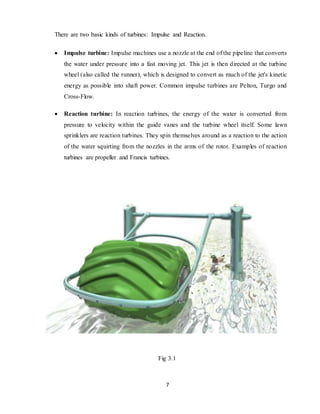
Fig 3.1
8
3.4 Turbine Applications
In the family of impulse machines, the Pelton is used for the lowest flows and highest
heads. The cross-flow is used where flows are highest and heads are lowest. The Turgo is
used for intermediate conditions. Propeller (reaction) turbines can operate on as little as two
feet of head. A Turgo requires at least four feet and a Pelton needs at least ten feet. These
are only rough guidelines with overlap in applications.
The Cross-Flow (impulse) turbine is the only machine that readily lends itself to user
construction. They can be made in modular widths and variable nozzles can be used.
Most developed sites now use impulse turbines. These turbines are very simple and
relatively cheap. As the stream flow varies, water flow to the turbine can be easily
controlled by changing nozzle sizes or by using adjustable nozzles. In contrast, most small
reaction turbines cannot be adjusted to accommodate variable water flow. Those that are
adjustable are very expensive because of the movable guide vanes and blades they require.
If sufficient water is not available for lull operation of a reaction machine, performance
suffers greatly.
An advantage of reaction machines is that they can use the full head available at a site. An
impulse turbine must be mounted above the tail water level and the effective head is
measured down to the nozzle level. For the reaction turbine, the full available head is
measured between the two water levels while the turbine can be mounted well above the
level of the exiting water.
This is possible because the "draft-tube" used with the machine recovers some of the
pressure head after the water exits the turbine. This cone-shaped tube converts the velocity
of the flowing water into pressure as it is decelerated by the draft tube's increasing cross
section. This creates suction on the underside of the runner.
9
Centrifugal pumps are sometimes used as practical substitutes for reaction turbines with
good results. They can have high efficiency and are readily available (both new and used) at
prices much lower than actual reaction turbines. However, it may be difficult to select the
correct pump because data on its performance as a turbine are usually not available or are
not straightforward. One reason more reaction turbines are not in use is the lack of available
machines in small sizes. There are many potential sites with 2 to, 10 feet of head and high
flow that are not served by the market.
10
Chapter 4
POWER CAPACITY
 Calculation of Energy and Power
 Force = mass x acceleration F = ma (Typical Unit -Newton’s)
 Energy = Work (W) = Force (F) x Distance (d) (Typical unit – Joules)
 Power = P = W / time (t) (Typical unit –Watts)
 Power = Torque (Q) x Rotational Speed (Ω)
 Kinetic Energy in the Water
 Kinetic Energy = Work = ½MV2
Where:
M= mass of moving object
V = velocity of moving object
 Mass of moving water
M = density (ρ) x volume (Area x distance)
= ρ x A x d
= (kg/m3) (m2) (m)
= kg
= 1000 x 0.196 x 0.5
M = 98 kg
Water Velocity (v) = 2 m/s
P = 0.5 x A x ρ x v3
11
Chapter 5
DESIGN
5.1 Introduction :
This chapter describes some of the mathematical technique used by designers of complex
structures. Mathematical models and analysis are briefly describe and detail description is
given of the finite – element method of structural analysis. Solution techniques are presented
for static, dynamic & model analysis problems. As part of the design procedure the designer
must be analyses the entire structure and some of its components. To perform this analysis
the designer will develop mathematical models of structure that are approximation of the
real structure, these models are used to determine the important parameters in the design.The
type of structural model the designer uses depends on the information that is needed and the
type of analysis the designer can perform.
Three types of structural models are
 Rigid Members:
The entire structure or parts of the structure are considered to be rigid, hence no
deformation can occur in these members.
 Flexible members:
The entire structure or parts of the structure are modeled by members that can deform,
but in limited ways. Examples of this members trusses, beams and plates.
 Continuum:
A continuum model of structure is the most general, since few if any mathematical
assumptions about the behaviour of the structure need to be made prior to making a
continuum model. A continuum member is besed on the full three – dimensional
equations of continuum models.
12
In selecting a model of the structure, the designer also must consider type of analysis to be
performed. Four typical analysis that designers perform are :
 Static equilibrium :
In this analysis the designer is trying to the determine the overall forces and moments
that the design will undergo. The analysis is usually done with rigid members of model of
structure and is the simplest analysis to perform.
 Deformation :
This analysis is concerned with how much the structure will move when operating under
the design loads. This analysis is usually done with flexible members.
 Stress :
In this analysis the designers wants a very detailed picture of where and at what level the
stresses are in the design. This analysis usually done with continuum members.
 Frequency :
This analysis is concerned with determining the natural frequencies and made shape of a
structure. This analysis can be done with either flexible members of a structure. This
analysis can be done with either flexible members or continuum members but now the
mass of the members is included in the analysis.
13
5.2 MACHINE DESIGN:
The subject of MACHINE DESIGN deals with the art of designing machine of structure. A
machine is a combination of resistance bodies with successfully constrained relative motions
which is used for transforming other forms of energy into mechanical energy or transmitting
and modifying available design is to create new and better machines or structures and
improving the existing ones such that it will convert and control motions either with or
without transmitting power. It is the practical application of machinery to the design and
construction of machine and structure. In order to design simple component satisfactorily, a
sound knowledge of applied science is essential. In addition, strength and properties of
materials including some metrological are of prime importance. Knowledge of theory of
machine and other branch of applied mechanics is also required in order to know the
velocity. Acceleration and inertia force of the various links in motion, mechanics of
machinery involve the design.
5.3 GENERALPROCEDURE IN MACHINE DESIGN
The general steps to be followed in designing the machine are as followed.
 Preparation of a statement of the problem indicating the purpose of the machine.
 Selection of groups of mechanism for the desire motion.
 Calculation of the force and energy on each machine member.
 Selection of material.
 Determining the size of component drawing and sending for Manufacture.
 Preparation of component drawing and sending for manufacture.
 Manufacturing and assembling the machine.
 Testing of the machine and for functioning
14
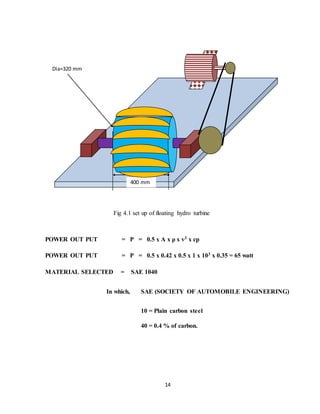
POWER OUT PUT = P = 0.5 x A x ρ x v3 x cp
POWER OUT PUT = P = 0.5 x 0.42 x 0.5 x 1 x 103 x 0.35 = 65 watt
MATERIAL SELECTED = SAE 1040
In which, SAE (SOCIETY OF AUTOMOBILE ENGINEERING)
10 = Plain carbon steel
40 = 0.4 % of carbon.
Fig 4.1 set up of floating hydro turbine
400 mm
Dia=320 mm
15
Following stresses are normally adopted in shaft design
Maxm shear stress = 70 N/mm2
Maxm bending stress = 100 N/mm2
Power = 2 П N T/ 60
0.367 = 2 П x 180 T/ 60
T= 0.0194 N-m
T= 19.42 N-mm
T = 3.14/16 x fs x Ds3
19.42 = 3.14/16 x fs x 203
Fs induced = 0.012 N/ mm2
Fs allowable = 70 N/ mm2
As induced stress is less than allowable stress 70 N/ mm2 the design of shaft dia is safe
The horizontal channel is subjected to bending stress
16
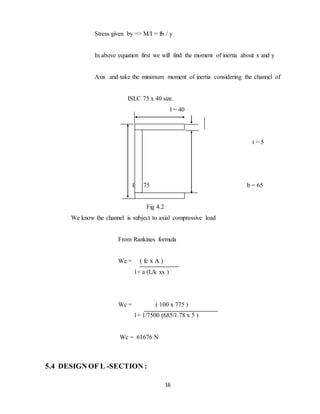
Stress given by => M/I = fb / y
In above equation first we will find the moment of inertia about x and y
Axis and take the minimum moment of inertia considering the channel of
ISLC 75 x 40 size.
l = 40
t = 5
B = 75 b = 65
Fig 4.2
We know the channel is subject to axial compressive load
From Rankines formula
Wc = ( fc x A )
1+ a (L/k xx )
Wc = ( 100 x 775 )
1+ 1/7500 (685/1.78 x 5 )
Wc = 61676 N
5.4 DESIGN OF L -SECTION :
17
Material: - M.S.
The horizontal channel is subjected to bending stress
Stress given by => M/I = fb / y
In above equation first we will find the moment of inertia about x and y
Axis and take the minimum moment of inertia considering the angle of
25 x 25 x 3 mm size.
We know the channel is subject to axial compressive load
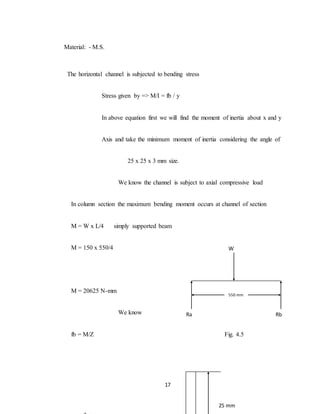
In column section the maximum bending moment occurs at channel of section
M = W x L/4 simply supported beam
M = 150 x 550/4
M = 20625 N-mm
We know
fb = M/Z Fig. 4.5
W
Ra Rb
550 mm
25 mm
18
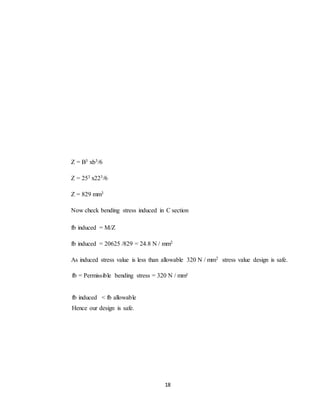
Z = B3 xb3/6
Z = 253 x223/6
Z = 829 mm3
Now check bending stress induced in C section
fb induced = M/Z
fb induced = 20625 /829 = 24.8 N / mm2
As induced stress value is less than allowable 320 N / mm2 stress value design is safe.
fb = Permissible bending stress = 320 N / mm²
fb induced < fb allowable
Hence our design is safe.
19
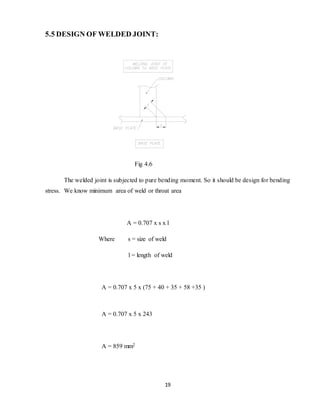
5.5 DESIGN OF WELDED JOINT:
Fig 4.6
The welded joint is subjected to pure bending moment. So it should be design for bending
stress. We know minimum area of weld or throat area
A = 0.707 x s x l
Where s = size of weld
l = length of weld
A = 0.707 x 5 x (75 + 40 + 35 + 58 +35 )
A = 0.707 x 5 x 243
A = 859 mm2
20
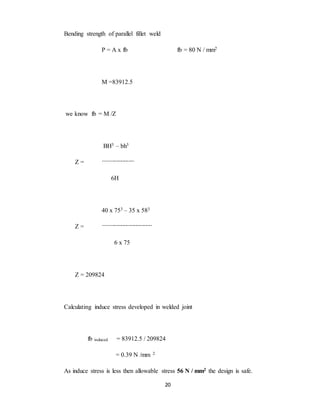
Bending strength of parallel fillet weld
P = A x fb fb = 80 N / mm2
M =83912.5
we know fb = M /Z
BH3 – bh3
Z = ----------------------
6H
40 x 753 – 35 x 583
Z = -----------------------------------
6 x 75
Z = 209824
Calculating induce stress developed in welded joint
fb induced = 83912.5 / 209824
= 0.39 N /mm 2
As induce stress is less then allowable stress 56 N / mm2 the design is safe.
21
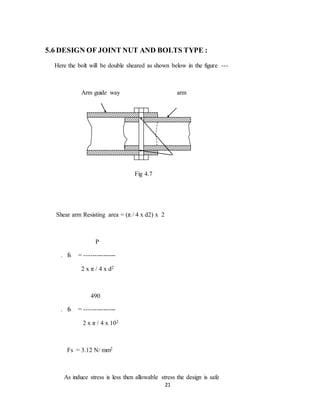
5.6 DESIGN OF JOINT NUT AND BOLTS TYPE :
Here the bolt will be double sheared as shown below in the figure ---
Arm guide way arm
Fig 4.7
Shear arm Resisting area = (π / 4 x d2) x 2
P
. fs = ---------------
2 x π / 4 x d2
490
. fs = ---------------
2 x π / 4 x 10²
Fs = 3.12 N/ mm2
As induce stress is less then allowable stress the design is safe
22
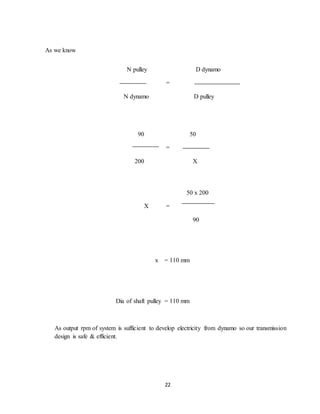
As we know
N pulley D dynamo
=
N dynamo D pulley
90 50
=
200 X
50 x 200
X =
90
x = 110 mm
Dia of shaft pulley = 110 mm
As output rpm of system is sufficient to develop electricity from dynamo so our transmission
design is safe & efficient.
23
Chapter 6
ADVANTAGES AND DISADVATAGES
6.1 Advantages of the Hydroelectric Generatorusing FHP:
 Non-polluting generation for operation in enclosed areas.
 Readily available supply of fuel (water).
 Provides an alternative to gasoline-powered generators.
 Save money by using water instead of gasoline.
 No flammable components.
 Emergency backup power supply.
6.2 Disadvantages ofthe Hydroelectric Generatorusing FHP:
 Not a completely reliable source of electricity.
 Completely depends upon water supply.
 As water is used, there is danger of corrosion in the long run.
6.3 Benefits:
Hydropower is a clean, domestic and renewable source of energy. Hydropower plants
provide inexpensive electricity and produce no pollution. And, unlike other energy sources
such as fossil fuels, water is not destroyed during the production of electricity—it can be
reused for other purposes.
6.4 Obstacles:
Hydropower plants can significantly impact the surrounding area—reservoirs can cover
towns, scenic locations and farmland, as well as affect fish and wildlife habitat. To mitigate
impact on migration patterns and wildlife habitats, dams maintain a steady stream flow and
can be designed or retrofitted with fish ladders and fish ways to help fish migrate upstream to
spawn.
24
Chapter 7
COANDA EFFECT
The design of the FLOATING HYDRO TURBINE evolved from this amphibious vehicle.
Built in the 70's.
On water at speeds of less than 4 mph (6.5 kph) everything rolled along just fine but when
the throttle was opened past this point instead of going faster the vehicle started going down.
This is the Coanda Effect.
How it works?
Clearly some method of overcoming this down-force was needed. A method of breaking the
water suction.
A 3 foot (91cm) diameter ball with axle bearings was made. When towed behind a boat it
was found that at speeds over 4 mph (6.5 kph) the ball began to dive and would behave more
like an anchor even though it was mounted on free rotating axle bearings and was otherwise
very buoyant.
After adding a chevron tread pattern similar to that now shown on the hydro-electric-barrel a
speed of 16 mph (26 kph) was achieved and the ball span readily on the water surface.
A straight tread did not solve the problem effectively due to downward force applied by the
treads as they emerged from the water
About FHT
 The FHT could be used to produce both wave energy and energy from tidal current at the
same time.
 The barrel rolls on the waves, rising and falling to drive both hub and linear or flywheel
permanent magnet generators.
25
Chapter 8
COST ESTIMATION
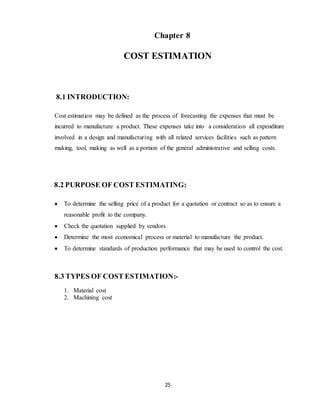
8.1 INTRODUCTION:
Cost estimation may be defined as the process of forecasting the expenses that must be
incurred to manufacture a product. These expenses take into a consideration all expenditure
involved in a design and manufacturing with all related services facilities such as pattern
making, tool, making as well as a portion of the general administrative and selling costs.
8.2 PURPOSE OF COST ESTIMATING:
 To determine the selling price of a product for a quotation or contract so as to ensure a
reasonable profit to the company.
 Check the quotation supplied by vendors.
 Determine the most economical process or material to manufacture the product.
 To determine standards of production performance that may be used to control the cost.
8.3 TYPES OF COST ESTIMATION:-
1. Material cost
2. Machining cost
26
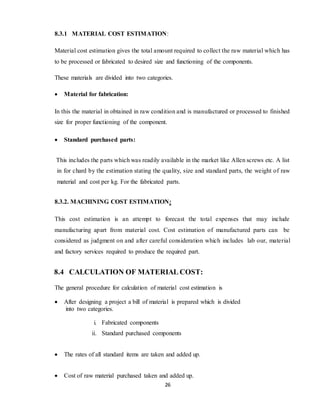
8.3.1 MATERIAL COST ESTIMATION:
Material cost estimation gives the total amount required to collect the raw material which has
to be processed or fabricated to desired size and functioning of the components.
These materials are divided into two categories.
 Material for fabrication:
In this the material in obtained in raw condition and is manufactured or processed to finished
size for proper functioning of the component.
 Standard purchased parts:
This includes the parts which was readily available in the market like Allen screws etc. A list
in for chard by the estimation stating the quality, size and standard parts, the weight of raw
material and cost per kg. For the fabricated parts.
8.3.2. MACHINING COST ESTIMATION:
This cost estimation is an attempt to forecast the total expenses that may include
manufacturing apart from material cost. Cost estimation of manufactured parts can be
considered as judgment on and after careful consideration which includes lab our, material
and factory services required to produce the required part.
8.4 CALCULATION OF MATERIAL COST:
The general procedure for calculation of material cost estimation is
 After designing a project a bill of material is prepared which is divided
into two categories.
i. Fabricated components
ii. Standard purchased components
 The rates of all standard items are taken and added up.
 Cost of raw material purchased taken and added up.
27
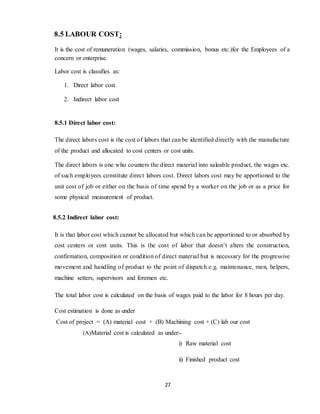
8.5 LABOUR COST:
It is the cost of remuneration (wages, salaries, commission, bonus etc.)for the Employees of a
concern or enterprise.
Labor cost is classifies as:
1. Direct labor cost
2. Indirect labor cost
8.5.1 Direct labor cost:
The direct labors cost is the cost of labors that can be identified directly with the manufacture
of the product and allocated to cost centers or cost units.
The direct labors is one who counters the direct material into saleable product, the wages etc.
of such employees constitute direct labors cost. Direct labors cost may be apportioned to the
unit cost of job or either on the basis of time spend by a worker on the job or as a price for
some physical measurement of product.
8.5.2 Indirect labor cost:
It is that labor cost which cannot be allocated but which can be apportioned to or absorbed by
cost centers or cost units. This is the cost of labor that doesn’t alters the construction,
confirmation, composition or condition of direct material but is necessary for the progressive
movement and handling of product to the point of dispatch e.g. maintenance, men, helpers,
machine setters, supervisors and foremen etc.
The total labor cost is calculated on the basis of wages paid to the labor for 8 hours per day.
Cost estimation is done as under
Cost of project = (A) material cost + (B) Machining cost + (C) lab our cost
(A)Material cost is calculated as under:-
i) Raw material cost
ii) Finished product cost
28
i) Raw material cost:-
It includes the material in the form of the Material supplied by the “ Steel authority of India
limited” as the round bars Channels, angles, square rods , plates along with the strip material
form.
We have to search for the suitable available material as per the requirement of designed safe
values. We have searched the material as follows:-
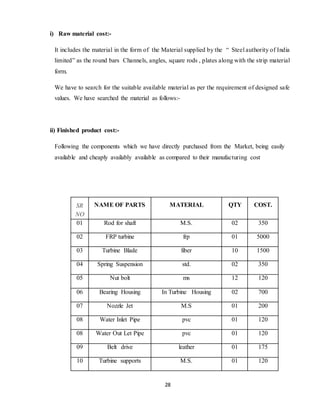
ii) Finished product cost:-
Following the components which we have directly purchased from the Market, being easily
available and cheaply availably available as compared to their manufacturing cost
SR
NO
NAME OF PARTS MATERIAL QTY COST.
01 Rod for shaft M.S. 02 350
02 FRP turbine frp 01 5000
03 Turbine Blade fiber 10 1500
04 Spring Suspension std. 02 350
05 Nut bolt ms 12 120
06 Bearing Housing In Turbine Housing 02 700
07 Nozzle Jet M.S 01 200
08 Water Inlet Pipe pvc 01 120
08 Water Out Let Pipe pvc 01 120
09 Belt drive leather 01 175
10 Turbine supports M.S. 01 120
29
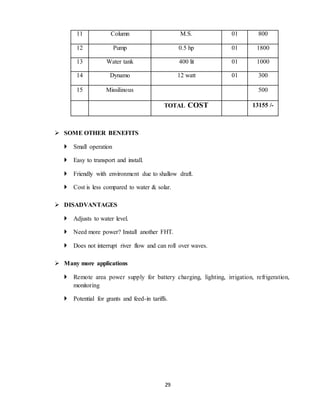
11 Column M.S. 01 800
12 Pump 0.5 hp 01 1800
13 Water tank 400 lit 01 1000
14 Dynamo 12 watt 01 300
15 Missilinous 500
TOTAL COST 13155 /-
 SOME OTHER BENEFITS
 Small operation
 Easy to transport and install.
 Friendly with environment due to shallow draft.
 Cost is less compared to water & solar.
 DISADVANTAGES
 Adjusts to water level.
 Need more power? Install another FHT.
 Does not interrupt river flow and can roll over waves.
 Many more applications
 Remote area power supply for battery charging, lighting, irrigation, refrigeration,
monitoring
 Potential for grants and feed-in tariffs.
30
REFERNCES
 MAGAZINE-ELECTRICAL INDIA,VOL50 NO 2
 MAGAZINE-IIT BOMBAY PULSE
 Energyefficent.com

Final floating hydro turbine

  • 1.
    1 Chapter - 1 INTRODUCTION Ourgroup has selected the Hydroelectric Generator using floating turbine concept in order to utilize knowledge and experience obtained from different power engineering classes. The most difficult part of the project will be synchronizing the speed at which we can spin the turbine with the optimal speed of the motor/generator. We may need to boost the signal from the pump in order to obtain our goals. This project will be exciting because it will allow us to design and build a small hydro-generation system. This system will give insight into the complex task of finding a reliable energy source for future use. 1.1 How Hydropower Works ? Hydropower converts the energy in flowing water into electricity. The volume of water flow determines the quantity of electricity generated and the amount of "head" (the height from turbines in the power plant to the water surface) created by the dam. The greater the flow and head, the more electricity produced. A typical hydropower plant includes a dam, reservoir, penstocks (pipes), a powerhouse and an electrical power substation. The dam stores water and creates the head; penstocks carry water from the reservoir to turbines inside the powerhouse; the water rotates the turbines, which drive generators that produce electricity. The electricity is then transmitted to a substation where transformers increase voltage to allow transmission to homes, businesses and factories. 1.2 Types of Hydropower Plants  Conventional: Most hydropower plants are conventional in design, meaning they use one- way water flow to generate electricity. There are two categories of conventional plants, run-of-river and storage plants.
  • 2.
    2  Run-of-river plants- These plants use little, if any, stored water to provide water flow through the turbines. Although some plants store a day or week's worth of water, weather changes, especially seasonal changes, cause run-of-river plants to experience significant fluctuations in power output.  Storage plants - These plants have enough storage capacity to off-set seasonal fluctuations in water flow and provide a constant supply of electricity throughout the year. Large dams can store several years worth of water.  Pumped Storage: In contrast to conventional hydropower plants, pumped storage plants reuse water. After water initially produces electricity, it flows from the turbines into a lower reservoir located below the dam. During off-peak hours (periods of low energy demand), some of the water is pumped into an upper reservoir and reused during periods of peak-demand.  Building Hydropower Plants: Most hydropower plants are built through federal or local agencies as part of a multi- purpose project. In addition to generating electricity, dams and reservoirs provide flood control, water supply, irrigation, transportation, recreation and refuges for fish and birds. Private utilities also build hydropower plants, although not as many as government agencies.
  • 3.
    3 Chapter 2 HISTORY OFHYDROELECTRIC GENERATORS 2.1 HISTORICAL BACKGROUND: Power plays a great role wherever main lives and works in industry, agriculture etc, Power provides our homes with light and heat. The living standard and prosperity of a nation very directly with increases in use of power. As technology is advancing the consumption of power is steadily rising. This necessary that in addition to petroleum etc. other sources of energy should be Searched out and new add more efficient ways of producing energy should be devised. Nuclear energy has enlarged the world’s power resources. The energy released by Burning one kilogram of uranium is equivalent to the energy obtained by burning 4500 Tonnes of high grade coal. In our country the total generating capacity at the beginning Of First Five Year Plan was 2.3 million Kw . This capacity was raised to 3.4 million KW by the end of first plan, 5.6 million kW by the end of second plan and 10.5 million Kw by the end of third plan. In 1969-70 it was 15.5 million Kw during the fourth Abd fufth plan the generating capacity targets are of the order of 20 million kW Kw respectively. In our country the natural resources are found in coal, lignite, oil, hydro sources and nuclear fuels. These resources should be exploited in the most efficient form by using Improved technology so that power at cheaper rates becomes available, which will help To accelerate the growth of industry. It is found that these resources are located in an uneven form in the country which requires interlinking the grid system of adjoining States so that power generation by hydro, thermal and nuclear plants could be well Co-ordinate. This will ensure a constant supply of power to all consumers throughout the country. In northern part of the country hydro power is the main source available] whereas in Madhya Pradesh and Eastern Maharashtra coal and hydro sources are Available. But in Gujarat and Western Maharashtra practically no resources are available. Therefore, power should be denerated either by nuclear power plants or byh thermal Power plants depending upon the relative economics. Mysore and Kerala both hydro And coal resources and Tamil Nadu depends upon the thermal power at Neyveli. West Bengal, Southern
  • 4.
    4 Bihar and Orissahave abundant coal resources and therefore, power Generation by thermal power stations is cheaper. Solar energy in India has an ideal Geographical situations. The northern and central parts of the country receive bright Sunshine on an average for more than 200 MW per square kilometer. This shows That there is an enormous potential for developing solar power plants. Thermal power production in India costs more than nuclear power after the Recent rise in oil prices. So far as nuclear power is concerned India is fwaterly well Endowed Organizationally as well as resources wise. The resources are available In large quantities in the form of Uranium and Thorium. Uranium deposits have been Located in Bihar, Rajasthan and Tamil Nadu and Thorum reserves have been found In Monazite effective prevention of radioactive hazards it is a clean source of power Which doews not contribute to water pollution. Thus it is observed that in our country Different power resources are available in different states and, therefore, in order to Ensure constant supply to all the consumers throughout the year interlinking of Various power plants is essential so that spare capacity of one power station can be Utilized by the other. With this objectives in view program for integrated power Generation on regional basis by interlinking the power stations of adjoining states has Started working and successful functioning of regional grids may finally give way to National Grid system. Five regions already have interconnected power systems, The northern power grid system covers U.P., Punjab, Haryana, and M. P> System with a capacity of 5504 MW. The construction of Badarpur – Jaipur 220 kV line which will connect the Badapur- DESU-BMB system with the Rajasthan system is being completed. Completion of this line will further stabilize Integrated working in the northern region. The southern region – Orissa grid covers Andhra Pradesh. Kerala, Karnataka, Tamil- Nadu and Orissa systems with 5525 MWCapacity. The Western grid covers Maharashtra, Gujarat and Tarapur systems with 3865 MW capacity. Eastern grid covers West Bengal, Bihar and DVC systems with 3200 MW capacity. Assam, Meghalaya and Tripura with an installed capacity of 178 MW are interconnected.
  • 5.
    5 An adequate gridsystemhas the following advantages : 1. It enable the base load to be supplied by the most economical power stations and peak demand to be supplied by the more expensive power stations. 2. It provides security against all normal operating hazards with a smaller margins Of spare capacity thereby saving on overall capital expenditure. Since the time of ancient Egypt, people have used the energy in flowing water to operate machinery and grind grain and corn. However, hydropower had a greater influence on people's lives during the 20th century than at any other time in history. Hydropower played a major role in making the wonders of electricity a part of everyday life and helped spur industrial development. Hydropower continues to produce 24 percent of the world's electricity and supply more than 1 billion people with power. 2.2 Evolution of Hydropower: The first hydroelectric power plant was built in 1882 in Appleton, Wisconsin to provide 12.5 kilowatts to light two paper mills and a home. Today's hydropower plants generally range in size from several hundred kilowatts to several hundred megawatts, but a few mammoth plants have capacities up to 10,000 megawatts and supply electricity to millions of people. Worldwide, hydropower plants have a combined capacity of 675,000 megawatts and annually produce over 2.3 trillion kilowatt-hours of electricity, the energy equivalent of 3.6 billion barrels of oil.
  • 6.
    6 Chapter 3 OVERVIEW 3.1 SystemComponents: An intake collects the water and a pipeline delivers it to the turbine, The turbine converts the water's energy into mechanical shaft power. The turbine drives the generator which converts shaft power into electricity. In an AC system, this power goes directly to the loads. In a battery-based system, the power is stored in batteries, which feed the loads as needed. Controllers may be required to regulate the system. 3.2 Pipeline: Most hydro systems require a pipeline to feed water to the turbine. The exception is a propeller machine with an open intake. The water should pass first through a simple filter to block debris that may clog or damage the machine. The intake should be placed off to the side of the main water flow to protect it from the direct force of the water and debris during high flows. It is important to use a pipeline of sufficiently large diameter to minimize friction losses from the moving water. When possible, the pipeline should be buried. This stabilizes the pipe and prevents critters from chewing it. Pipelines are usually made from PVC or polyethylene although metal or concrete pipes can also be used. 3.3 Turbines: Although traditional waterwheels of various types have been used for centuries, they aren't usually suitable for generating electricity: They are heavy, large and turn at low speeds. They require complex gearing to reach speeds to run an electric generator. They also have icing problems in cold climates. Water turbines rotate at higher speeds, are lighter and more compact. Turbines are more appropriate for electricity generation and are usually more efficient.
  • 7.
    7 There are twobasic kinds of turbines: Impulse and Reaction.  Impulse turbine: Impulse machines use a nozzle at the end of the pipeline that converts the water under pressure into a fast moving jet. This jet is then directed at the turbine wheel (also called the runner), which is designed to convert as much of the jet's kinetic energy as possible into shaft power. Common impulse turbines are Pelton, Turgo and Cross-Flow.  Reaction turbine: In reaction turbines, the energy of the water is converted from pressure to velocity within the guide vanes and the turbine wheel itself. Some lawn sprinklers are reaction turbines. They spin themselves around as a reaction to the action of the water squirting from the nozzles in the arms of the rotor. Examples of reaction turbines are propeller and Francis turbines. Fig 3.1
  • 8.
    8 3.4 Turbine Applications Inthe family of impulse machines, the Pelton is used for the lowest flows and highest heads. The cross-flow is used where flows are highest and heads are lowest. The Turgo is used for intermediate conditions. Propeller (reaction) turbines can operate on as little as two feet of head. A Turgo requires at least four feet and a Pelton needs at least ten feet. These are only rough guidelines with overlap in applications. The Cross-Flow (impulse) turbine is the only machine that readily lends itself to user construction. They can be made in modular widths and variable nozzles can be used. Most developed sites now use impulse turbines. These turbines are very simple and relatively cheap. As the stream flow varies, water flow to the turbine can be easily controlled by changing nozzle sizes or by using adjustable nozzles. In contrast, most small reaction turbines cannot be adjusted to accommodate variable water flow. Those that are adjustable are very expensive because of the movable guide vanes and blades they require. If sufficient water is not available for lull operation of a reaction machine, performance suffers greatly. An advantage of reaction machines is that they can use the full head available at a site. An impulse turbine must be mounted above the tail water level and the effective head is measured down to the nozzle level. For the reaction turbine, the full available head is measured between the two water levels while the turbine can be mounted well above the level of the exiting water. This is possible because the "draft-tube" used with the machine recovers some of the pressure head after the water exits the turbine. This cone-shaped tube converts the velocity of the flowing water into pressure as it is decelerated by the draft tube's increasing cross section. This creates suction on the underside of the runner.
  • 9.
    9 Centrifugal pumps aresometimes used as practical substitutes for reaction turbines with good results. They can have high efficiency and are readily available (both new and used) at prices much lower than actual reaction turbines. However, it may be difficult to select the correct pump because data on its performance as a turbine are usually not available or are not straightforward. One reason more reaction turbines are not in use is the lack of available machines in small sizes. There are many potential sites with 2 to, 10 feet of head and high flow that are not served by the market.
  • 10.
    10 Chapter 4 POWER CAPACITY Calculation of Energy and Power  Force = mass x acceleration F = ma (Typical Unit -Newton’s)  Energy = Work (W) = Force (F) x Distance (d) (Typical unit – Joules)  Power = P = W / time (t) (Typical unit –Watts)  Power = Torque (Q) x Rotational Speed (Ω)  Kinetic Energy in the Water  Kinetic Energy = Work = ½MV2 Where: M= mass of moving object V = velocity of moving object  Mass of moving water M = density (ρ) x volume (Area x distance) = ρ x A x d = (kg/m3) (m2) (m) = kg = 1000 x 0.196 x 0.5 M = 98 kg Water Velocity (v) = 2 m/s P = 0.5 x A x ρ x v3
  • 11.
    11 Chapter 5 DESIGN 5.1 Introduction: This chapter describes some of the mathematical technique used by designers of complex structures. Mathematical models and analysis are briefly describe and detail description is given of the finite – element method of structural analysis. Solution techniques are presented for static, dynamic & model analysis problems. As part of the design procedure the designer must be analyses the entire structure and some of its components. To perform this analysis the designer will develop mathematical models of structure that are approximation of the real structure, these models are used to determine the important parameters in the design.The type of structural model the designer uses depends on the information that is needed and the type of analysis the designer can perform. Three types of structural models are  Rigid Members: The entire structure or parts of the structure are considered to be rigid, hence no deformation can occur in these members.  Flexible members: The entire structure or parts of the structure are modeled by members that can deform, but in limited ways. Examples of this members trusses, beams and plates.  Continuum: A continuum model of structure is the most general, since few if any mathematical assumptions about the behaviour of the structure need to be made prior to making a continuum model. A continuum member is besed on the full three – dimensional equations of continuum models.
  • 12.
    12 In selecting amodel of the structure, the designer also must consider type of analysis to be performed. Four typical analysis that designers perform are :  Static equilibrium : In this analysis the designer is trying to the determine the overall forces and moments that the design will undergo. The analysis is usually done with rigid members of model of structure and is the simplest analysis to perform.  Deformation : This analysis is concerned with how much the structure will move when operating under the design loads. This analysis is usually done with flexible members.  Stress : In this analysis the designers wants a very detailed picture of where and at what level the stresses are in the design. This analysis usually done with continuum members.  Frequency : This analysis is concerned with determining the natural frequencies and made shape of a structure. This analysis can be done with either flexible members of a structure. This analysis can be done with either flexible members or continuum members but now the mass of the members is included in the analysis.
  • 13.
    13 5.2 MACHINE DESIGN: Thesubject of MACHINE DESIGN deals with the art of designing machine of structure. A machine is a combination of resistance bodies with successfully constrained relative motions which is used for transforming other forms of energy into mechanical energy or transmitting and modifying available design is to create new and better machines or structures and improving the existing ones such that it will convert and control motions either with or without transmitting power. It is the practical application of machinery to the design and construction of machine and structure. In order to design simple component satisfactorily, a sound knowledge of applied science is essential. In addition, strength and properties of materials including some metrological are of prime importance. Knowledge of theory of machine and other branch of applied mechanics is also required in order to know the velocity. Acceleration and inertia force of the various links in motion, mechanics of machinery involve the design. 5.3 GENERALPROCEDURE IN MACHINE DESIGN The general steps to be followed in designing the machine are as followed.  Preparation of a statement of the problem indicating the purpose of the machine.  Selection of groups of mechanism for the desire motion.  Calculation of the force and energy on each machine member.  Selection of material.  Determining the size of component drawing and sending for Manufacture.  Preparation of component drawing and sending for manufacture.  Manufacturing and assembling the machine.  Testing of the machine and for functioning
  • 14.
    14 POWER OUT PUT= P = 0.5 x A x ρ x v3 x cp POWER OUT PUT = P = 0.5 x 0.42 x 0.5 x 1 x 103 x 0.35 = 65 watt MATERIAL SELECTED = SAE 1040 In which, SAE (SOCIETY OF AUTOMOBILE ENGINEERING) 10 = Plain carbon steel 40 = 0.4 % of carbon. Fig 4.1 set up of floating hydro turbine 400 mm Dia=320 mm
  • 15.
    15 Following stresses arenormally adopted in shaft design Maxm shear stress = 70 N/mm2 Maxm bending stress = 100 N/mm2 Power = 2 П N T/ 60 0.367 = 2 П x 180 T/ 60 T= 0.0194 N-m T= 19.42 N-mm T = 3.14/16 x fs x Ds3 19.42 = 3.14/16 x fs x 203 Fs induced = 0.012 N/ mm2 Fs allowable = 70 N/ mm2 As induced stress is less than allowable stress 70 N/ mm2 the design of shaft dia is safe The horizontal channel is subjected to bending stress
  • 16.
    16 Stress given by=> M/I = fb / y In above equation first we will find the moment of inertia about x and y Axis and take the minimum moment of inertia considering the channel of ISLC 75 x 40 size. l = 40 t = 5 B = 75 b = 65 Fig 4.2 We know the channel is subject to axial compressive load From Rankines formula Wc = ( fc x A ) 1+ a (L/k xx ) Wc = ( 100 x 775 ) 1+ 1/7500 (685/1.78 x 5 ) Wc = 61676 N 5.4 DESIGN OF L -SECTION :
  • 17.
    17 Material: - M.S. Thehorizontal channel is subjected to bending stress Stress given by => M/I = fb / y In above equation first we will find the moment of inertia about x and y Axis and take the minimum moment of inertia considering the angle of 25 x 25 x 3 mm size. We know the channel is subject to axial compressive load In column section the maximum bending moment occurs at channel of section M = W x L/4 simply supported beam M = 150 x 550/4 M = 20625 N-mm We know fb = M/Z Fig. 4.5 W Ra Rb 550 mm 25 mm
  • 18.
    18 Z = B3xb3/6 Z = 253 x223/6 Z = 829 mm3 Now check bending stress induced in C section fb induced = M/Z fb induced = 20625 /829 = 24.8 N / mm2 As induced stress value is less than allowable 320 N / mm2 stress value design is safe. fb = Permissible bending stress = 320 N / mm² fb induced < fb allowable Hence our design is safe.
  • 19.
    19 5.5 DESIGN OFWELDED JOINT: Fig 4.6 The welded joint is subjected to pure bending moment. So it should be design for bending stress. We know minimum area of weld or throat area A = 0.707 x s x l Where s = size of weld l = length of weld A = 0.707 x 5 x (75 + 40 + 35 + 58 +35 ) A = 0.707 x 5 x 243 A = 859 mm2
  • 20.
    20 Bending strength ofparallel fillet weld P = A x fb fb = 80 N / mm2 M =83912.5 we know fb = M /Z BH3 – bh3 Z = ---------------------- 6H 40 x 753 – 35 x 583 Z = ----------------------------------- 6 x 75 Z = 209824 Calculating induce stress developed in welded joint fb induced = 83912.5 / 209824 = 0.39 N /mm 2 As induce stress is less then allowable stress 56 N / mm2 the design is safe.
  • 21.
    21 5.6 DESIGN OFJOINT NUT AND BOLTS TYPE : Here the bolt will be double sheared as shown below in the figure --- Arm guide way arm Fig 4.7 Shear arm Resisting area = (π / 4 x d2) x 2 P . fs = --------------- 2 x π / 4 x d2 490 . fs = --------------- 2 x π / 4 x 10² Fs = 3.12 N/ mm2 As induce stress is less then allowable stress the design is safe
  • 22.
    22 As we know Npulley D dynamo = N dynamo D pulley 90 50 = 200 X 50 x 200 X = 90 x = 110 mm Dia of shaft pulley = 110 mm As output rpm of system is sufficient to develop electricity from dynamo so our transmission design is safe & efficient.
  • 23.
    23 Chapter 6 ADVANTAGES ANDDISADVATAGES 6.1 Advantages of the Hydroelectric Generatorusing FHP:  Non-polluting generation for operation in enclosed areas.  Readily available supply of fuel (water).  Provides an alternative to gasoline-powered generators.  Save money by using water instead of gasoline.  No flammable components.  Emergency backup power supply. 6.2 Disadvantages ofthe Hydroelectric Generatorusing FHP:  Not a completely reliable source of electricity.  Completely depends upon water supply.  As water is used, there is danger of corrosion in the long run. 6.3 Benefits: Hydropower is a clean, domestic and renewable source of energy. Hydropower plants provide inexpensive electricity and produce no pollution. And, unlike other energy sources such as fossil fuels, water is not destroyed during the production of electricity—it can be reused for other purposes. 6.4 Obstacles: Hydropower plants can significantly impact the surrounding area—reservoirs can cover towns, scenic locations and farmland, as well as affect fish and wildlife habitat. To mitigate impact on migration patterns and wildlife habitats, dams maintain a steady stream flow and can be designed or retrofitted with fish ladders and fish ways to help fish migrate upstream to spawn.
  • 24.
    24 Chapter 7 COANDA EFFECT Thedesign of the FLOATING HYDRO TURBINE evolved from this amphibious vehicle. Built in the 70's. On water at speeds of less than 4 mph (6.5 kph) everything rolled along just fine but when the throttle was opened past this point instead of going faster the vehicle started going down. This is the Coanda Effect. How it works? Clearly some method of overcoming this down-force was needed. A method of breaking the water suction. A 3 foot (91cm) diameter ball with axle bearings was made. When towed behind a boat it was found that at speeds over 4 mph (6.5 kph) the ball began to dive and would behave more like an anchor even though it was mounted on free rotating axle bearings and was otherwise very buoyant. After adding a chevron tread pattern similar to that now shown on the hydro-electric-barrel a speed of 16 mph (26 kph) was achieved and the ball span readily on the water surface. A straight tread did not solve the problem effectively due to downward force applied by the treads as they emerged from the water About FHT  The FHT could be used to produce both wave energy and energy from tidal current at the same time.  The barrel rolls on the waves, rising and falling to drive both hub and linear or flywheel permanent magnet generators.
  • 25.
    25 Chapter 8 COST ESTIMATION 8.1INTRODUCTION: Cost estimation may be defined as the process of forecasting the expenses that must be incurred to manufacture a product. These expenses take into a consideration all expenditure involved in a design and manufacturing with all related services facilities such as pattern making, tool, making as well as a portion of the general administrative and selling costs. 8.2 PURPOSE OF COST ESTIMATING:  To determine the selling price of a product for a quotation or contract so as to ensure a reasonable profit to the company.  Check the quotation supplied by vendors.  Determine the most economical process or material to manufacture the product.  To determine standards of production performance that may be used to control the cost. 8.3 TYPES OF COST ESTIMATION:- 1. Material cost 2. Machining cost
  • 26.
    26 8.3.1 MATERIAL COSTESTIMATION: Material cost estimation gives the total amount required to collect the raw material which has to be processed or fabricated to desired size and functioning of the components. These materials are divided into two categories.  Material for fabrication: In this the material in obtained in raw condition and is manufactured or processed to finished size for proper functioning of the component.  Standard purchased parts: This includes the parts which was readily available in the market like Allen screws etc. A list in for chard by the estimation stating the quality, size and standard parts, the weight of raw material and cost per kg. For the fabricated parts. 8.3.2. MACHINING COST ESTIMATION: This cost estimation is an attempt to forecast the total expenses that may include manufacturing apart from material cost. Cost estimation of manufactured parts can be considered as judgment on and after careful consideration which includes lab our, material and factory services required to produce the required part. 8.4 CALCULATION OF MATERIAL COST: The general procedure for calculation of material cost estimation is  After designing a project a bill of material is prepared which is divided into two categories. i. Fabricated components ii. Standard purchased components  The rates of all standard items are taken and added up.  Cost of raw material purchased taken and added up.
  • 27.
    27 8.5 LABOUR COST: Itis the cost of remuneration (wages, salaries, commission, bonus etc.)for the Employees of a concern or enterprise. Labor cost is classifies as: 1. Direct labor cost 2. Indirect labor cost 8.5.1 Direct labor cost: The direct labors cost is the cost of labors that can be identified directly with the manufacture of the product and allocated to cost centers or cost units. The direct labors is one who counters the direct material into saleable product, the wages etc. of such employees constitute direct labors cost. Direct labors cost may be apportioned to the unit cost of job or either on the basis of time spend by a worker on the job or as a price for some physical measurement of product. 8.5.2 Indirect labor cost: It is that labor cost which cannot be allocated but which can be apportioned to or absorbed by cost centers or cost units. This is the cost of labor that doesn’t alters the construction, confirmation, composition or condition of direct material but is necessary for the progressive movement and handling of product to the point of dispatch e.g. maintenance, men, helpers, machine setters, supervisors and foremen etc. The total labor cost is calculated on the basis of wages paid to the labor for 8 hours per day. Cost estimation is done as under Cost of project = (A) material cost + (B) Machining cost + (C) lab our cost (A)Material cost is calculated as under:- i) Raw material cost ii) Finished product cost
  • 28.
    28 i) Raw materialcost:- It includes the material in the form of the Material supplied by the “ Steel authority of India limited” as the round bars Channels, angles, square rods , plates along with the strip material form. We have to search for the suitable available material as per the requirement of designed safe values. We have searched the material as follows:- ii) Finished product cost:- Following the components which we have directly purchased from the Market, being easily available and cheaply availably available as compared to their manufacturing cost SR NO NAME OF PARTS MATERIAL QTY COST. 01 Rod for shaft M.S. 02 350 02 FRP turbine frp 01 5000 03 Turbine Blade fiber 10 1500 04 Spring Suspension std. 02 350 05 Nut bolt ms 12 120 06 Bearing Housing In Turbine Housing 02 700 07 Nozzle Jet M.S 01 200 08 Water Inlet Pipe pvc 01 120 08 Water Out Let Pipe pvc 01 120 09 Belt drive leather 01 175 10 Turbine supports M.S. 01 120
  • 29.
    29 11 Column M.S.01 800 12 Pump 0.5 hp 01 1800 13 Water tank 400 lit 01 1000 14 Dynamo 12 watt 01 300 15 Missilinous 500 TOTAL COST 13155 /-  SOME OTHER BENEFITS  Small operation  Easy to transport and install.  Friendly with environment due to shallow draft.  Cost is less compared to water & solar.  DISADVANTAGES  Adjusts to water level.  Need more power? Install another FHT.  Does not interrupt river flow and can roll over waves.  Many more applications  Remote area power supply for battery charging, lighting, irrigation, refrigeration, monitoring  Potential for grants and feed-in tariffs.
  • 30.
    30 REFERNCES  MAGAZINE-ELECTRICAL INDIA,VOL50NO 2  MAGAZINE-IIT BOMBAY PULSE  Energyefficent.com