Chitosan grafted carboxy functionalized polylactide
nanoparticles for multidrugs controlled and sustained
release
Antonio Di Martino
Center of Polymer Systems
Tomas Bata University in Zlin
Czech Republic
dimartino@ft.utb.cz
National Research
Tomsk Polytechnic University
Russia
Drug Delivery Systems (DDS)
 Traditional drug delivery systems
 Oral
 Injection based
 Inhalational/Pulmonary
 Transdermal
 Why new delivery systems?
 Targeted drug delivery
 Maximum efficacy with minimum side sffects
 Controlled drug delivery
 Optimize drug’s therapeutic effects, convenience and dose
 Enhance product life-cycle
 Improve patient compliance
 Control over all healthcare cost
Systems for the delivery of drugs to target sites of pharmacological actions
Nanoparticles as DDS
I) Dispersion or solid form with size in the range 10-700 nm
II) Various morphologies – nanospheres, nanocapsules, nanomicelles, nanoliposomes etc…
III) Drug (s) can be : dissolved, entrapped, encapsulated or attached to the nanoparticle matrix
IV) High Encapsulation Efficiency
V) Drug protection
VI) Controlled Release
VII) Decrease side effects
VIII) Reverse tumor multidrug resistance
IX) Cell Internalization
 Why Nanoparticles ?
Polysaccharides based Nanoparticles
 Polysaccharides have been considered as one of the most promising
material for drug delivery
 Various Sources : Algae , Microbial,
Plants and Animals
 Abundant
 Low Cost
 Large number of Reactive Groups
 Chemical composition
 Wide range of Mw
 Biocompatible
 Biodegradable
 Low Immunogenity
 Not Toxic
Chitosan Hyaluronic Acid
Alginate Cyclodextrin
Dextran
Pectin
Chitosan (CS)
 Physico-chemical properties
 Molecular weight
 Deacetylation degree
 Viscosity
 Solubility
 Antibacterial
 Mucoadhesive
 Reactivity
 Complexation ability
 Conventional formulations
 Compression tablets
 Wet granulation
 Gels
 Films
 Emulsions
 Wetting agent
 Coating agent
 Microspheres
 Microcapsules
 Novel applications
 Bioadhesion
 Drug delivery
 Vaccine delivery
 DNA delivery
Aim of the work
 Preparation and characterization of amphiphilic nanoparticles based
on chitosan grafted carboxy functionalized polylactide
 Encapsulation of Doxorubicin , Temozolomide, 5-Fluorouracil
 Influence of environment on the release trend
Doxorubicin (DOX) Temozolomide (TMZ) 5-Fluorouracil (5-FU)
Polylactide-citric acid synthesis (PLACA)
 Carboxy functionalized PLA has been obtained through direct melt polycondensation
of Lactic acid (LA) and Citric acid (CA)
 Methanesulfonic acid (MSA) as initiator. More effective compared to metal salts
 MSA is adapt to obtain low Mw PLA
Lactic acid
Citric acid
Carboxy functionalized polylactide (PLACA)
Kucharczyk et al. Journal of Applied polymer Science 2011, 122,1275-1285
CS-g-PLACA synthesis
 Coupling reaction between CS amino groups and PLACA carboxy groups
 EDC as COOH activator
R1-NH2 +  HOOC-R2 → R1-NH-CO-R2 + H2O
 Improve chitosan stability in solution
 Encapsulate hydrophobic and hydrophilic drugs simultaneously
Di Martino, Sedlarik, Int. J.Pharm . 2014 Oct 20, 474, 1-2, 134-45
CS-g-PLACA Nanoparticles preparation
 Polyelectrolytes complexation method
 Easy
 Fast
 Low cost
 Solvent-free
 Possibility to modulate size and surface charge
of nanoparticles
 Dextran sulfate ( Mw 50 kDa ) as polyanion
 Polymer to DS ratio (w/w) : from 0.1 to 5
TMZ – DOX – 5-FU : Encapsulation and Release
 EE(%) = (Dt−Df / Dt)×100
Dt = total theoretical amount of drug added (mg/mL)
Df = concentration of free drug after encapsulation (mg/mL)
 Release kinetic mathematical models
 Zero-order
 First order
 Higuchi
 Hixson-Crowell
 Kosmeyer-Peppas
tKQQt 00
tKQQt 10loglog 
5.0
0 tKQQ Ht 
tKQQ HCt 3
0
n
KPt tKQ 
 UV-Vis spectroscopy
DOX 480 nm TMZ 328 nm 5-FU 525 nm
Results
Results : CS-g-PLACA nanoparticles
 Influence of polymer / DS ratio (w/w) on nanoparticles size and z-potential
 pH 5.5
 DLS analysis
-40
-30
-20
-10
0
10
20
30
40
50
60
0 2 4 6
z-pot.(mV) polymer / DS ratio (w/w)
 Dependence of nanoparticles dimension on polymer/DS ratio (w/w)
 Best compromise between size and z-potential is presented at w/w ratio 2
 Change in polymers chains arrangement
0
50
100
150
200
250
0.1 0.5 1 2 5
polymer / DS ratio (w/w)
CS CS-g-PLAСA
Size(nm)
Results : SEM and TEM analysis
CS-g-PLACA Dextran Sulfate
+ -
+
+
+
+
+
+
+
-
-
-
-
-
-
Results : CS-g-PLA nanoparticles
0
50
100
150
200
250
300
0 50 100 150 200 250
Size(nm)
Time (h)
pH 5.5 pH 7.4
CS
0
50
100
150
200
250
300
0 50 100 150 200 250
Size(nm)
Time (h)
pH 5.5 pH 7.4
CS-g-PLACA
 Stability studies : nanoparticles dimension VS time
 Influence of pH
 T : 37 °C
 Polymer / DS (w/w) : 2
 PLACA side chain increases nanoparticles stability
I
II II
I
Results: Single Loading
0
20
40
60
80
100
3.5 5.5 7.4 9
EncapsulationEfficiency
(%)
pH
DOX
TMZ
5-FU
0
20
40
60
80
100
3.5 5.5 7.4 9
Encapsulationefficiency
(%)
pH
DOX
TMZ
5-FU
CS CS-g-PLACA
 Room temperature
 Polymer / DS (w/w) : 2
 pH 5.5 represents the optimal condition
 Drugs are well balanced in both systems
 CS-g-PLACA shows higher encapsulation efficiency than CS
CS CS-g-PLACA5%
0
20
40
60
80
100
3.5 5.5 7.4 9pH
TMZ DOX
0
20
40
60
80
100
3.5 5.5 7.4 9
pH
TMZ DOX
0
20
40
60
80
100
3.5 5.5 7.4 9pH
5-FU DOX
0
20
40
60
80
100
3.5 5.5 7.4 9pH
5-FU TMZ
0
20
40
60
80
100
3.5 5.5 7.4 9pH
5-FU DOX
0
20
40
60
80
100
3.5 5.5 7.4 9pH
5-FU TMZ
Co-EncapsulationEfficiency(%)
Results: Multiple Loading
Results: CS-g-PLACA- Release kinetics
0
20
40
60
80
100
0 100 200 300 400 500
Cumulativerelease(%)
Time (h)
DOX TMZ 5-FU
0
10
20
30
40
50
60
70
0 10 20 30
Cumulativerelease(%)
Time (h)
 DOX, TMZ and 5-FU loaded separately
 Physiological solution (pH 7.4)
 T : 37 °C
 No initial burst effect is observed in all formulations
 Release begin after 5 hours
tlag
Common trend
Results: CS-g-PLACA-Release kinetics
 DOX, TMZ and 5-FU loaded simultaneously
 Physiological solution (pH 7.4)
 T : 37° C
0
20
40
60
80
100
0 100 200 300 400
Cumulativeco-release(%)
Time (h)
DOX TMZ 5-FU
0
10
20
30
40
50
60
70
0 5 10 15 20 25 30
Cumulativeco-release(%)
Time (h)
Common trend
 DOX, TMZ and 5-FU are released concurrently
 No initial burst effect is observed in all formulations
 Release begin after 4 hours
tlag
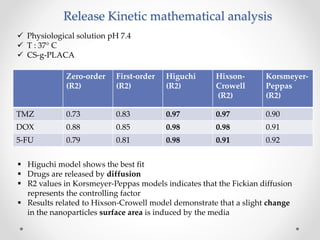
Release Kinetic mathematical analysis
Zero-order
(R2)
First-order
(R2)
Higuchi
(R2)
Hixson-
Crowell
(R2)
Korsmeyer-
Peppas
(R2)
TMZ 0.73 0.83 0.97 0.97 0.90
DOX 0.88 0.85 0.98 0.98 0.91
5-FU 0.79 0.81 0.98 0.91 0.92
 Physiological solution pH 7.4
 T : 37° C
 CS-g-PLACA
 Higuchi model shows the best fit
 Drugs are released by diffusion
 R2 values in Korsmeyer-Peppas models indicates that the Fickian diffusion
represents the controlling factor
 Results related to Hixson-Crowell model demonstrate that a slight change
in the nanoparticles surface area is induced by the media
Conclusions
 CS-g-PLACA based nanoparticles show dimension in the range 100-200 nm
 Nanoparticles show good stability as far as 10 days
 Up to 70% of encapsulation efficiency of TMZ, 5-FU and DOX
 No initial burst effect at physiological condition
 Balanced release of drugs when loaded simultaneously
Outlooks
 Cell uptakes studies
 Evaluation of citotoxicity in different cancer cells lines
 In vivo tests
Results : PLACA
UV-Vis
FTIR-ATR
1H-NMR
300 MHz
Conc : 1% (w/w) in DMSO-d6
90 pulse angle
Zn-Se crystal
Resolution : 2cm-1
Conc: 0.1 mg/mL in CHCl3
Resolution : 0.5 nm
Path 10mm
Results: CS-g-PLACA
FTIR-ATR
1H-NMR

Chitosan grafted carboxy functionalized polylactide nanoparticles for multidrugs controlled and sustained release

  • 1.
    Chitosan grafted carboxyfunctionalized polylactide nanoparticles for multidrugs controlled and sustained release Antonio Di Martino Center of Polymer Systems Tomas Bata University in Zlin Czech Republic dimartino@ft.utb.cz National Research Tomsk Polytechnic University Russia
  • 2.
    Drug Delivery Systems(DDS)  Traditional drug delivery systems  Oral  Injection based  Inhalational/Pulmonary  Transdermal  Why new delivery systems?  Targeted drug delivery  Maximum efficacy with minimum side sffects  Controlled drug delivery  Optimize drug’s therapeutic effects, convenience and dose  Enhance product life-cycle  Improve patient compliance  Control over all healthcare cost Systems for the delivery of drugs to target sites of pharmacological actions
  • 3.
    Nanoparticles as DDS I)Dispersion or solid form with size in the range 10-700 nm II) Various morphologies – nanospheres, nanocapsules, nanomicelles, nanoliposomes etc… III) Drug (s) can be : dissolved, entrapped, encapsulated or attached to the nanoparticle matrix IV) High Encapsulation Efficiency V) Drug protection VI) Controlled Release VII) Decrease side effects VIII) Reverse tumor multidrug resistance IX) Cell Internalization  Why Nanoparticles ?
  • 4.
    Polysaccharides based Nanoparticles Polysaccharides have been considered as one of the most promising material for drug delivery  Various Sources : Algae , Microbial, Plants and Animals  Abundant  Low Cost  Large number of Reactive Groups  Chemical composition  Wide range of Mw  Biocompatible  Biodegradable  Low Immunogenity  Not Toxic Chitosan Hyaluronic Acid Alginate Cyclodextrin Dextran Pectin
  • 5.
    Chitosan (CS)  Physico-chemicalproperties  Molecular weight  Deacetylation degree  Viscosity  Solubility  Antibacterial  Mucoadhesive  Reactivity  Complexation ability  Conventional formulations  Compression tablets  Wet granulation  Gels  Films  Emulsions  Wetting agent  Coating agent  Microspheres  Microcapsules  Novel applications  Bioadhesion  Drug delivery  Vaccine delivery  DNA delivery
  • 6.
    Aim of thework  Preparation and characterization of amphiphilic nanoparticles based on chitosan grafted carboxy functionalized polylactide  Encapsulation of Doxorubicin , Temozolomide, 5-Fluorouracil  Influence of environment on the release trend Doxorubicin (DOX) Temozolomide (TMZ) 5-Fluorouracil (5-FU)
  • 7.
    Polylactide-citric acid synthesis(PLACA)  Carboxy functionalized PLA has been obtained through direct melt polycondensation of Lactic acid (LA) and Citric acid (CA)  Methanesulfonic acid (MSA) as initiator. More effective compared to metal salts  MSA is adapt to obtain low Mw PLA Lactic acid Citric acid Carboxy functionalized polylactide (PLACA) Kucharczyk et al. Journal of Applied polymer Science 2011, 122,1275-1285
  • 8.
    CS-g-PLACA synthesis  Couplingreaction between CS amino groups and PLACA carboxy groups  EDC as COOH activator R1-NH2 +  HOOC-R2 → R1-NH-CO-R2 + H2O  Improve chitosan stability in solution  Encapsulate hydrophobic and hydrophilic drugs simultaneously Di Martino, Sedlarik, Int. J.Pharm . 2014 Oct 20, 474, 1-2, 134-45
  • 9.
    CS-g-PLACA Nanoparticles preparation Polyelectrolytes complexation method  Easy  Fast  Low cost  Solvent-free  Possibility to modulate size and surface charge of nanoparticles  Dextran sulfate ( Mw 50 kDa ) as polyanion  Polymer to DS ratio (w/w) : from 0.1 to 5
  • 10.
    TMZ – DOX– 5-FU : Encapsulation and Release  EE(%) = (Dt−Df / Dt)×100 Dt = total theoretical amount of drug added (mg/mL) Df = concentration of free drug after encapsulation (mg/mL)  Release kinetic mathematical models  Zero-order  First order  Higuchi  Hixson-Crowell  Kosmeyer-Peppas tKQQt 00 tKQQt 10loglog  5.0 0 tKQQ Ht  tKQQ HCt 3 0 n KPt tKQ   UV-Vis spectroscopy DOX 480 nm TMZ 328 nm 5-FU 525 nm
  • 11.
  • 12.
    Results : CS-g-PLACAnanoparticles  Influence of polymer / DS ratio (w/w) on nanoparticles size and z-potential  pH 5.5  DLS analysis -40 -30 -20 -10 0 10 20 30 40 50 60 0 2 4 6 z-pot.(mV) polymer / DS ratio (w/w)  Dependence of nanoparticles dimension on polymer/DS ratio (w/w)  Best compromise between size and z-potential is presented at w/w ratio 2  Change in polymers chains arrangement 0 50 100 150 200 250 0.1 0.5 1 2 5 polymer / DS ratio (w/w) CS CS-g-PLAСA Size(nm)
  • 13.
    Results : SEMand TEM analysis CS-g-PLACA Dextran Sulfate + - + + + + + + + - - - - - -
  • 14.
    Results : CS-g-PLAnanoparticles 0 50 100 150 200 250 300 0 50 100 150 200 250 Size(nm) Time (h) pH 5.5 pH 7.4 CS 0 50 100 150 200 250 300 0 50 100 150 200 250 Size(nm) Time (h) pH 5.5 pH 7.4 CS-g-PLACA  Stability studies : nanoparticles dimension VS time  Influence of pH  T : 37 °C  Polymer / DS (w/w) : 2  PLACA side chain increases nanoparticles stability I II II I
  • 15.
    Results: Single Loading 0 20 40 60 80 100 3.55.5 7.4 9 EncapsulationEfficiency (%) pH DOX TMZ 5-FU 0 20 40 60 80 100 3.5 5.5 7.4 9 Encapsulationefficiency (%) pH DOX TMZ 5-FU CS CS-g-PLACA  Room temperature  Polymer / DS (w/w) : 2  pH 5.5 represents the optimal condition  Drugs are well balanced in both systems  CS-g-PLACA shows higher encapsulation efficiency than CS
  • 16.
    CS CS-g-PLACA5% 0 20 40 60 80 100 3.5 5.57.4 9pH TMZ DOX 0 20 40 60 80 100 3.5 5.5 7.4 9 pH TMZ DOX 0 20 40 60 80 100 3.5 5.5 7.4 9pH 5-FU DOX 0 20 40 60 80 100 3.5 5.5 7.4 9pH 5-FU TMZ 0 20 40 60 80 100 3.5 5.5 7.4 9pH 5-FU DOX 0 20 40 60 80 100 3.5 5.5 7.4 9pH 5-FU TMZ Co-EncapsulationEfficiency(%) Co-EncapsulationEfficiency(%) Results: Multiple Loading
  • 17.
    Results: CS-g-PLACA- Releasekinetics 0 20 40 60 80 100 0 100 200 300 400 500 Cumulativerelease(%) Time (h) DOX TMZ 5-FU 0 10 20 30 40 50 60 70 0 10 20 30 Cumulativerelease(%) Time (h)  DOX, TMZ and 5-FU loaded separately  Physiological solution (pH 7.4)  T : 37 °C  No initial burst effect is observed in all formulations  Release begin after 5 hours tlag Common trend
  • 18.
    Results: CS-g-PLACA-Release kinetics DOX, TMZ and 5-FU loaded simultaneously  Physiological solution (pH 7.4)  T : 37° C 0 20 40 60 80 100 0 100 200 300 400 Cumulativeco-release(%) Time (h) DOX TMZ 5-FU 0 10 20 30 40 50 60 70 0 5 10 15 20 25 30 Cumulativeco-release(%) Time (h) Common trend  DOX, TMZ and 5-FU are released concurrently  No initial burst effect is observed in all formulations  Release begin after 4 hours tlag
  • 19.
    Release Kinetic mathematicalanalysis Zero-order (R2) First-order (R2) Higuchi (R2) Hixson- Crowell (R2) Korsmeyer- Peppas (R2) TMZ 0.73 0.83 0.97 0.97 0.90 DOX 0.88 0.85 0.98 0.98 0.91 5-FU 0.79 0.81 0.98 0.91 0.92  Physiological solution pH 7.4  T : 37° C  CS-g-PLACA  Higuchi model shows the best fit  Drugs are released by diffusion  R2 values in Korsmeyer-Peppas models indicates that the Fickian diffusion represents the controlling factor  Results related to Hixson-Crowell model demonstrate that a slight change in the nanoparticles surface area is induced by the media
  • 20.
    Conclusions  CS-g-PLACA basednanoparticles show dimension in the range 100-200 nm  Nanoparticles show good stability as far as 10 days  Up to 70% of encapsulation efficiency of TMZ, 5-FU and DOX  No initial burst effect at physiological condition  Balanced release of drugs when loaded simultaneously
  • 21.
    Outlooks  Cell uptakesstudies  Evaluation of citotoxicity in different cancer cells lines  In vivo tests
  • 23.
    Results : PLACA UV-Vis FTIR-ATR 1H-NMR 300MHz Conc : 1% (w/w) in DMSO-d6 90 pulse angle Zn-Se crystal Resolution : 2cm-1 Conc: 0.1 mg/mL in CHCl3 Resolution : 0.5 nm Path 10mm
  • 24.