PT 6701 POLYMER BLENDS AND ALLOYS
UNIT -3
WATER SOLUBLE POLYMER BLENDS
Dr.S.Kailash/AP/POLYMER
KAMARAJ COLLEGE OF ENGINEERING AND TECHNOLOGY
VIRUDHUNAGAR -626001
9865569251
•This section will cover blends of polymers, both exhibiting water solubility.
•Many of the water soluble polymers have been noted in earlier sections in this
chapter to exhibit miscibility with non-water soluble polymers.
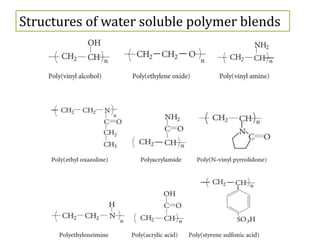
•These water soluble polymers include poly(ethylene oxide), poly(N-vinyl
pyrollidone), poly(vinyl amine), polyacrylamide, poly(N,N-dimethyl acrylamide),
poly(acrylic acid), poly(methacrylic acid), poly(ethyl oxazoline), poly(styrene
sulfonic acid), poly(vinyl pyridine), poly(vinyl alcohol), hydroxyl ethyl cellulose,
hydroxy propyl cellulose, carboxy methyl cellulose, poly(itaconic acid) and
poly(ethyleneimine) (several structures shown below).
Water Soluble Polymer Blends
Structures of water soluble polymer blends
•Many examples exist of water soluble polymers with acidic groups blended with
water soluble polymer with basic groups, yielding strong specific interactions
leading to water insolubility.
•These blends can be hydrogen bonded systems, where proton exchange does not
occur or polyelectrolyte complexes, where the interaction can yield proton
exchange resulting in a polymeric “salt”.
• Hydrogen bonding complexes involving non-ionic “basic” polymers with anionic
polymers include such combinations as poly(acrylic acid)(PAA) with poly(ethylene
oxide)(PEO), poly(vinyl pyrrolidone)(PVP) and poly(ethyloxazoline)(PEOz).
• Strong polyelectrolyte complexes include poly(styrene sulfonic acid)(PSSA)
with poly(vinylbenzyltrimethyl ammonium hydroxide) (PVBTMAOH), PAA
with poly(diallyldimethyl ammonium chloride) (PDADMAC) and
poly(methacrylic acid) (PMAA) with poly(vinyl pyridine) (PVPy).
•These are all examples of highly miscible systems and the strong
intermolecular interactions are capable of replacing the water-polymer
interactions resulting in water immiscibility.
• There are many examples in biological systems where polyanion/polycation
interactions have been observed. These include poly(l-lysine)/poly(l-glutamic
acid), gelatin/gum arabic, and poly(l-lysine)/DNA or RNA.
• These complexes are prevalent in nature as intercellular tissues, naturally
occurring hydrogels, antigen-antibody reactions, self-assembly of proteins
and cellular membranes.
•Some of the extensive earlier studies on polyelectrolyte complexes were
conducted by Michaels and coworkers, primarily involving PSSA/PVBTMAOH or
their neutralized versions. Reviews of polyelectrolyte complexes.
•. Examples of polyelectrolyte complexes noted in the literature include
combinations of synthetic polymers, natural polymer and synthetic/natural
polymers.
•The stoichiometry of polyelectrolyte complexes is an important property,
determined by viscosity measurements in solution (dilute enough such that
precipitation does not occur) or by conductance measurements.
• For non-neutralized acid-base complexes (e.g., PSSA/PVBTAOH), a minimum in
conductance occurs at the stoichiometric equivalence point as the charged
groups are neutralized.
• For neutralized acid-base combinations (e.g., NaPSSA/PVBTACl), a maximum in
conductance occurs as the interacting acid-base pairs release salt (e.g., NaCl),
which is ionized in water yielding high conductance.
•For the examples noted. Poly (4-vinyl pyridine-HCl) blends with poly(sodium(2-
acrylamido-2-methyl propane sulfonate-co-N, N-dimethylacrylamide) also exhibited
equimolar complexes as judged from conductomtetric and potentiometric titrations.
•The complex of PVP and PAA also exhibited stoichiometric complexation based on
conductimetry and light scattering results.
• Most polyelectrolyte complexes exhibit equimolar stoichiometry of the acid-base groups,
unless steric hinderance prevents access of interacting groups.
• PEO complexes with PAA and PMAA, however, are non-stoichiometric. An example of the
use of conductance to estimate the complex stoichiometry is illustrated in Fig. 4.27 for
poly(vinyl amine)/poly(acrylic acid) (PVAm/PAA).
•The minimum in conductance depends on the formation of the complex. In the
forward curve, PAA was added at predetermined increments to a PVAm solution,
followed by 60 s stirring and conductance measurements.
• The reverse curve involved PVAm addition to a PAA solution.
• The minimum in conductance depends on the path chosen to prepare the
complexes, indicating that uncomplexed polymer may be trapped during the
polyelectrolyte complex phase separation process.
•As the minimum points are on both sides of the equimolar position, this complex
appears to be equimolar.
•Strong polyelectrolyte complexes are generally insoluble in conventional polar
organic solvents or water, except at the extremes of pH.
•Ternary component systems comprising water, polar organic solvents and salt have
been employed for solubilization.
•Polyelectrolyte complexes can form many structures, of which ladder-type, chaotic
“scrambled-egg”-type, crystalline complexes formed by template polymerization,
layer-by layer structures, core-shell structures and helical conformations have been
noted.
•Poly(acrylic acid) (PAA) blends with poly(ethylene oxide) (PEO) have been widely
studied since initial observation noted immediate precipitation upon mixing water
solutions of the respective polymers.
•The dry mixtures were found to be miscible with single Tg values observed.
•At higher pH, the water insoluble complex of PAA/PEO will dissolve.
The viscosity of poly(ethylene oxide)/poly(acrylic acid) solutions is illustrated in
Figs. 4.28 and 4.29, which show complex formation below pH of 3.8, with
viscosities above that point much higher than the unblended components.
Interpenetrating (crosslinked) networks of PAA/PEO were prepared to function
as a chemical valve, as the permeability could be controlled by pH and ionic
strength changes.
Mechanochemical response was observed by quilibration of a weighted
membrane in a buffer of neutral pH, followed by stretching with alkali addition or
retraction with acid addition.
Fluorescence of a fluorescent group labeled PAA was studied in PEO/PAA blends
to determine molecular weight effects, copolymer effects and complexation
kinetics.
The complexation rate was reduced with temperature, dilution, and
increased ionic strength. PAA containing acrylamide (9 %) units also
demonstrated complexation with PEO and thus indicated that long sequence
lengths of interacting species are not necessary to have complexation behavior.
Complexation of PEO and poly (methacrylic acid) has also been observed.
Poly(vinyl pyrrolidone) forms water insoluble complexes with PAA and
PMAA (poly(methacrylic acid) at neutral to low pH.
With PVP/PMAA, complexation occurs between pH ranging from 1–5 and
PMAA confirmation changes from hypercoiled to loosely coiled.
The optimum complexation ratio occurs at a molar ratio of PMAA/PVP = 2.
PAA complexes with polyacrylamide (PAAm)and poly(N, N-
dimethylacrylamide) have also been reported.
Poly(acrylic acid) also exhibits miscibility and complex formation with many
other water soluble proton accepting polymers, including poly(ethylene imine) ,
poly(2-ethyl oxazoline), poly(ethylene piperazine), poly(vinyl amine) and
poly(N-isopropylacrylamide).
 Poly(vinyl alcohol) (PVOH) is generally obtained from the hydrolysis of
poly(vinyl acetate) and thus often water soluble versions contain up to 25
mole% vinyl acetate groups.
Fully hydrolyzed PVOH is highly crystalline and has limited water solubility,
unless higher temperatures are utilized. PVOH, with repeating secondary
hydroxyls, offers the ability to be either a proton donor or proton acceptor for
hydrogen bonding interactions with other polymers.
Miscibility of PVOH has been observed with water soluble polymers, such as
poly(N-vinyl pyrrolidone)(PVP):proton acceptor and poly(acrylic acid):proton
donor.
The interaction parameter (PVOH/PVP), 12, was determined to be –0.69 from
melting point depression data.
Several papers discuss the preparation and evaluation of PVOH/PVP and
PVOH/PAA IPNs for hydrogel or superadsorbent applications.
Hydrogels of PVOH and poly(N-isopropylacrylamide) (PNiPAAm) were
prepared by polymerization of N-isopropylacrylamide in the presence of an
aqueous solution of PVOH.
PVOH was crosslinked with glutaraldehyde and PNiPAAm was crosslinked
with N,N’- methylbisacrylamide.
Water soluble polymer

Water soluble polymer

  • 1.
    PT 6701 POLYMERBLENDS AND ALLOYS UNIT -3 WATER SOLUBLE POLYMER BLENDS Dr.S.Kailash/AP/POLYMER KAMARAJ COLLEGE OF ENGINEERING AND TECHNOLOGY VIRUDHUNAGAR -626001 9865569251
  • 2.
    •This section willcover blends of polymers, both exhibiting water solubility. •Many of the water soluble polymers have been noted in earlier sections in this chapter to exhibit miscibility with non-water soluble polymers. •These water soluble polymers include poly(ethylene oxide), poly(N-vinyl pyrollidone), poly(vinyl amine), polyacrylamide, poly(N,N-dimethyl acrylamide), poly(acrylic acid), poly(methacrylic acid), poly(ethyl oxazoline), poly(styrene sulfonic acid), poly(vinyl pyridine), poly(vinyl alcohol), hydroxyl ethyl cellulose, hydroxy propyl cellulose, carboxy methyl cellulose, poly(itaconic acid) and poly(ethyleneimine) (several structures shown below). Water Soluble Polymer Blends
  • 3.
    Structures of watersoluble polymer blends
  • 4.
    •Many examples existof water soluble polymers with acidic groups blended with water soluble polymer with basic groups, yielding strong specific interactions leading to water insolubility. •These blends can be hydrogen bonded systems, where proton exchange does not occur or polyelectrolyte complexes, where the interaction can yield proton exchange resulting in a polymeric “salt”. • Hydrogen bonding complexes involving non-ionic “basic” polymers with anionic polymers include such combinations as poly(acrylic acid)(PAA) with poly(ethylene oxide)(PEO), poly(vinyl pyrrolidone)(PVP) and poly(ethyloxazoline)(PEOz).
  • 5.
    • Strong polyelectrolytecomplexes include poly(styrene sulfonic acid)(PSSA) with poly(vinylbenzyltrimethyl ammonium hydroxide) (PVBTMAOH), PAA with poly(diallyldimethyl ammonium chloride) (PDADMAC) and poly(methacrylic acid) (PMAA) with poly(vinyl pyridine) (PVPy). •These are all examples of highly miscible systems and the strong intermolecular interactions are capable of replacing the water-polymer interactions resulting in water immiscibility. • There are many examples in biological systems where polyanion/polycation interactions have been observed. These include poly(l-lysine)/poly(l-glutamic acid), gelatin/gum arabic, and poly(l-lysine)/DNA or RNA. • These complexes are prevalent in nature as intercellular tissues, naturally occurring hydrogels, antigen-antibody reactions, self-assembly of proteins and cellular membranes.
  • 6.
    •Some of theextensive earlier studies on polyelectrolyte complexes were conducted by Michaels and coworkers, primarily involving PSSA/PVBTMAOH or their neutralized versions. Reviews of polyelectrolyte complexes. •. Examples of polyelectrolyte complexes noted in the literature include combinations of synthetic polymers, natural polymer and synthetic/natural polymers. •The stoichiometry of polyelectrolyte complexes is an important property, determined by viscosity measurements in solution (dilute enough such that precipitation does not occur) or by conductance measurements. • For non-neutralized acid-base complexes (e.g., PSSA/PVBTAOH), a minimum in conductance occurs at the stoichiometric equivalence point as the charged groups are neutralized. • For neutralized acid-base combinations (e.g., NaPSSA/PVBTACl), a maximum in conductance occurs as the interacting acid-base pairs release salt (e.g., NaCl), which is ionized in water yielding high conductance.
  • 7.
    •For the examplesnoted. Poly (4-vinyl pyridine-HCl) blends with poly(sodium(2- acrylamido-2-methyl propane sulfonate-co-N, N-dimethylacrylamide) also exhibited equimolar complexes as judged from conductomtetric and potentiometric titrations. •The complex of PVP and PAA also exhibited stoichiometric complexation based on conductimetry and light scattering results. • Most polyelectrolyte complexes exhibit equimolar stoichiometry of the acid-base groups, unless steric hinderance prevents access of interacting groups. • PEO complexes with PAA and PMAA, however, are non-stoichiometric. An example of the use of conductance to estimate the complex stoichiometry is illustrated in Fig. 4.27 for poly(vinyl amine)/poly(acrylic acid) (PVAm/PAA).
  • 8.
    •The minimum inconductance depends on the formation of the complex. In the forward curve, PAA was added at predetermined increments to a PVAm solution, followed by 60 s stirring and conductance measurements. • The reverse curve involved PVAm addition to a PAA solution. • The minimum in conductance depends on the path chosen to prepare the complexes, indicating that uncomplexed polymer may be trapped during the polyelectrolyte complex phase separation process. •As the minimum points are on both sides of the equimolar position, this complex appears to be equimolar. •Strong polyelectrolyte complexes are generally insoluble in conventional polar organic solvents or water, except at the extremes of pH.
  • 9.
    •Ternary component systemscomprising water, polar organic solvents and salt have been employed for solubilization. •Polyelectrolyte complexes can form many structures, of which ladder-type, chaotic “scrambled-egg”-type, crystalline complexes formed by template polymerization, layer-by layer structures, core-shell structures and helical conformations have been noted. •Poly(acrylic acid) (PAA) blends with poly(ethylene oxide) (PEO) have been widely studied since initial observation noted immediate precipitation upon mixing water solutions of the respective polymers. •The dry mixtures were found to be miscible with single Tg values observed. •At higher pH, the water insoluble complex of PAA/PEO will dissolve.
  • 11.
    The viscosity ofpoly(ethylene oxide)/poly(acrylic acid) solutions is illustrated in Figs. 4.28 and 4.29, which show complex formation below pH of 3.8, with viscosities above that point much higher than the unblended components. Interpenetrating (crosslinked) networks of PAA/PEO were prepared to function as a chemical valve, as the permeability could be controlled by pH and ionic strength changes. Mechanochemical response was observed by quilibration of a weighted membrane in a buffer of neutral pH, followed by stretching with alkali addition or retraction with acid addition. Fluorescence of a fluorescent group labeled PAA was studied in PEO/PAA blends to determine molecular weight effects, copolymer effects and complexation kinetics.
  • 12.
    The complexation ratewas reduced with temperature, dilution, and increased ionic strength. PAA containing acrylamide (9 %) units also demonstrated complexation with PEO and thus indicated that long sequence lengths of interacting species are not necessary to have complexation behavior. Complexation of PEO and poly (methacrylic acid) has also been observed. Poly(vinyl pyrrolidone) forms water insoluble complexes with PAA and PMAA (poly(methacrylic acid) at neutral to low pH. With PVP/PMAA, complexation occurs between pH ranging from 1–5 and PMAA confirmation changes from hypercoiled to loosely coiled. The optimum complexation ratio occurs at a molar ratio of PMAA/PVP = 2. PAA complexes with polyacrylamide (PAAm)and poly(N, N- dimethylacrylamide) have also been reported.
  • 13.
    Poly(acrylic acid) alsoexhibits miscibility and complex formation with many other water soluble proton accepting polymers, including poly(ethylene imine) , poly(2-ethyl oxazoline), poly(ethylene piperazine), poly(vinyl amine) and poly(N-isopropylacrylamide).  Poly(vinyl alcohol) (PVOH) is generally obtained from the hydrolysis of poly(vinyl acetate) and thus often water soluble versions contain up to 25 mole% vinyl acetate groups. Fully hydrolyzed PVOH is highly crystalline and has limited water solubility, unless higher temperatures are utilized. PVOH, with repeating secondary hydroxyls, offers the ability to be either a proton donor or proton acceptor for hydrogen bonding interactions with other polymers. Miscibility of PVOH has been observed with water soluble polymers, such as poly(N-vinyl pyrrolidone)(PVP):proton acceptor and poly(acrylic acid):proton donor.
  • 14.
    The interaction parameter(PVOH/PVP), 12, was determined to be –0.69 from melting point depression data. Several papers discuss the preparation and evaluation of PVOH/PVP and PVOH/PAA IPNs for hydrogel or superadsorbent applications. Hydrogels of PVOH and poly(N-isopropylacrylamide) (PNiPAAm) were prepared by polymerization of N-isopropylacrylamide in the presence of an aqueous solution of PVOH. PVOH was crosslinked with glutaraldehyde and PNiPAAm was crosslinked with N,N’- methylbisacrylamide.