1
Nanogels: synthesis, behavior and applications
R. Gavilán Párraga, A. Pérez Díaz-Mingo Universidad Politécnica de Madrid, 2013
_______________________________________________________________________
Abstract
The develop of nanosized hydrogels with new properties is a growing interesting
research area in pharmaceutical and biomedical fields, as in tissue engineering, drug
delivery, and bionanotechnology, because of their 3D physical structure, mechanical
properties and biocompability, properties which offer significant potential for
nanogels.
Nanogels have also attracted a big interest due to their size and surface properties.
Further, nanogels may entrap drugs and biomolecules and therefore, can be highly
useful for genetic engineering. Recently, the development of hybrid hydrogels has
been of increasing interest in the field of materials science. The combination of a
macroscopic hydrogel and nanogels can offer a very good solution to actual biomedical
challenges.
Keywords: Hydrogel Nanostructured Nanogel Hybrid Drug delivery Nanoparticles
_______________________________________________________________________
Introduction
A gel is a colloidal system
formed by a continuous solid phase
dispersed in a fluid phase. If this fluid is
water, the gel is a hydrogel, which is
the type of nanogel we’re talking about
in this project. Hydrogels are three-
dimensional network structures
obtained from polymers which can
absorb and retain a big amount of
water, and also they’re biocompatible.
Nanogels are nanosized hydrogels, in
the tens to hundreds of nanometers of
diameter.
Synthesis and interactions
Nanogels are composed by
hydrophilic polymeric chains, which
interact with water and tend to absorb
it because of their nature. As all the
hydrogels, nanogels have a cross-linked
structure, forming a three-dimensional
network, a very important parameter
for their properties. These crosslinks
between polymeric chains can be given
by:
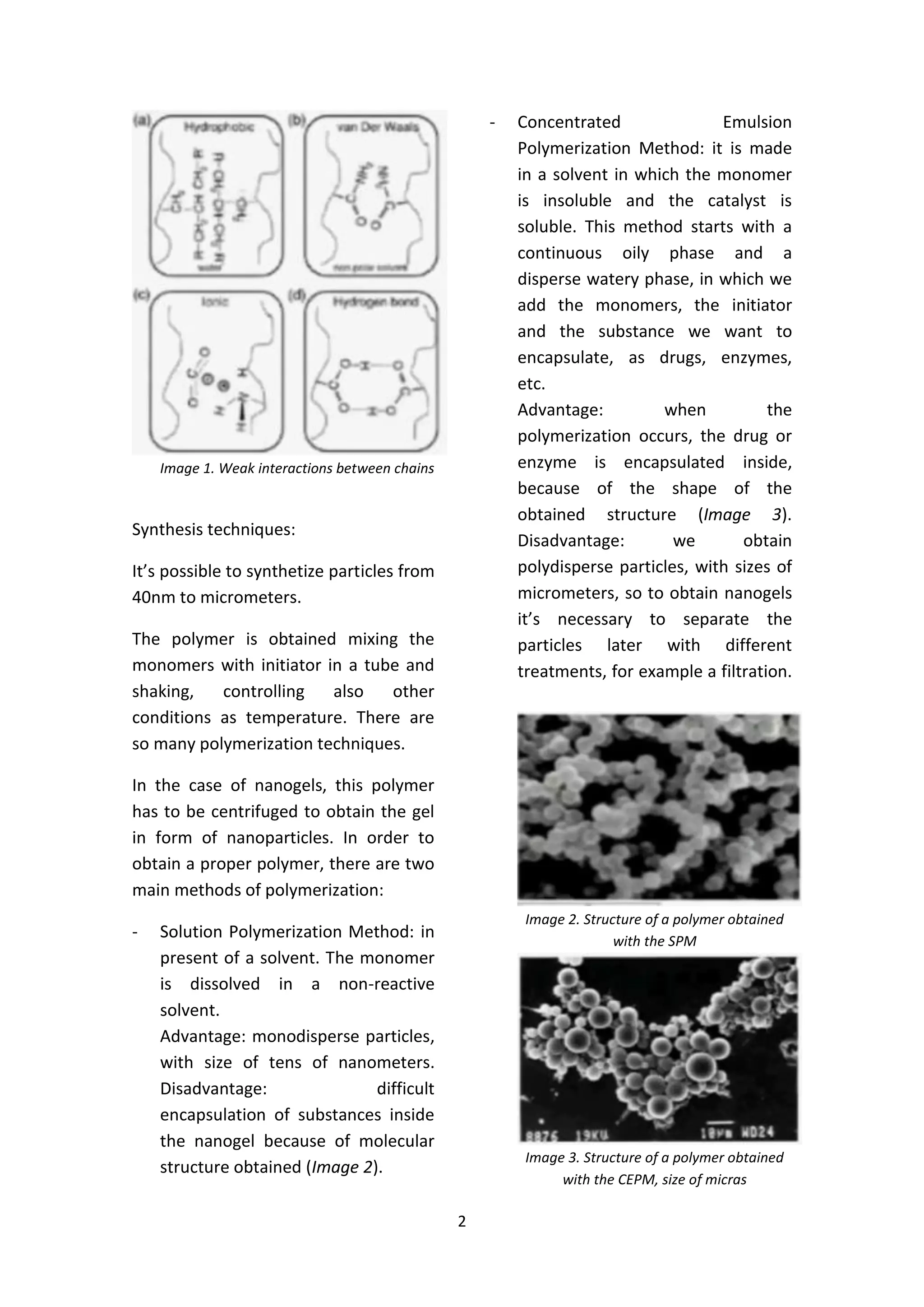
- Weak interactions (Image 1): van
der Waals (b), ionic (c) and
hydrophobic (a) associations,
hydrogen bonds (d).
- Strong interactions, covalent bonds:
chemical reactions between
monomers through a cross-linker,
forming covalent bonds between
them.
2
Image 1. Weak interactions between chains
Synthesis techniques:
It’s possible to synthetize particles from
40nm to micrometers.
The polymer is obtained mixing the
monomers with initiator in a tube and
shaking, controlling also other
conditions as temperature. There are
so many polymerization techniques.
In the case of nanogels, this polymer
has to be centrifuged to obtain the gel
in form of nanoparticles. In order to
obtain a proper polymer, there are two
main methods of polymerization:
- Solution Polymerization Method: in
present of a solvent. The monomer
is dissolved in a non-reactive
solvent.
Advantage: monodisperse particles,
with size of tens of nanometers.
Disadvantage: difficult
encapsulation of substances inside
the nanogel because of molecular
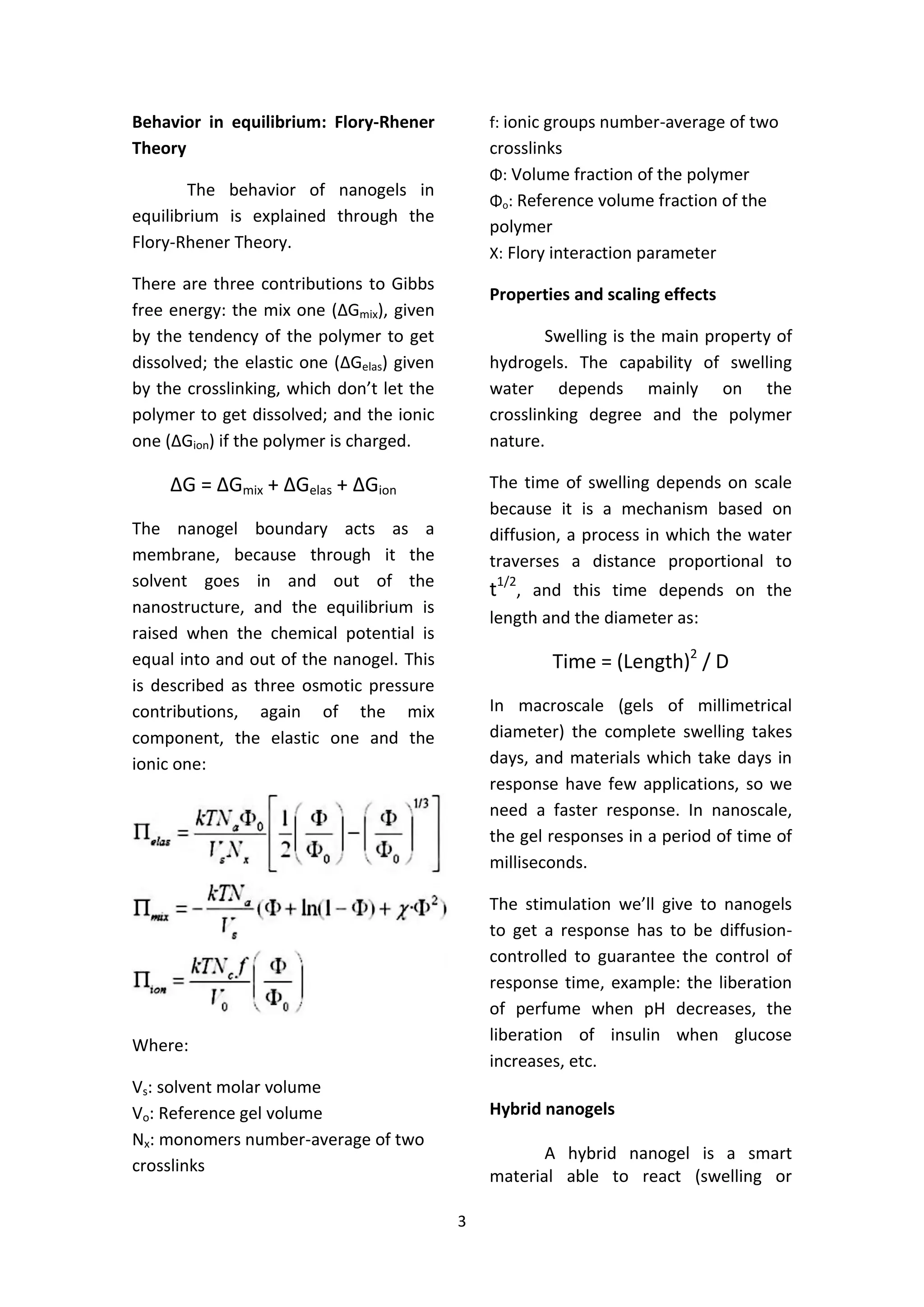
structure obtained (Image 2).
- Concentrated Emulsion
Polymerization Method: it is made
in a solvent in which the monomer
is insoluble and the catalyst is
soluble. This method starts with a
continuous oily phase and a
disperse watery phase, in which we
add the monomers, the initiator
and the substance we want to
encapsulate, as drugs, enzymes,
etc.
Advantage: when the
polymerization occurs, the drug or
enzyme is encapsulated inside,
because of the shape of the
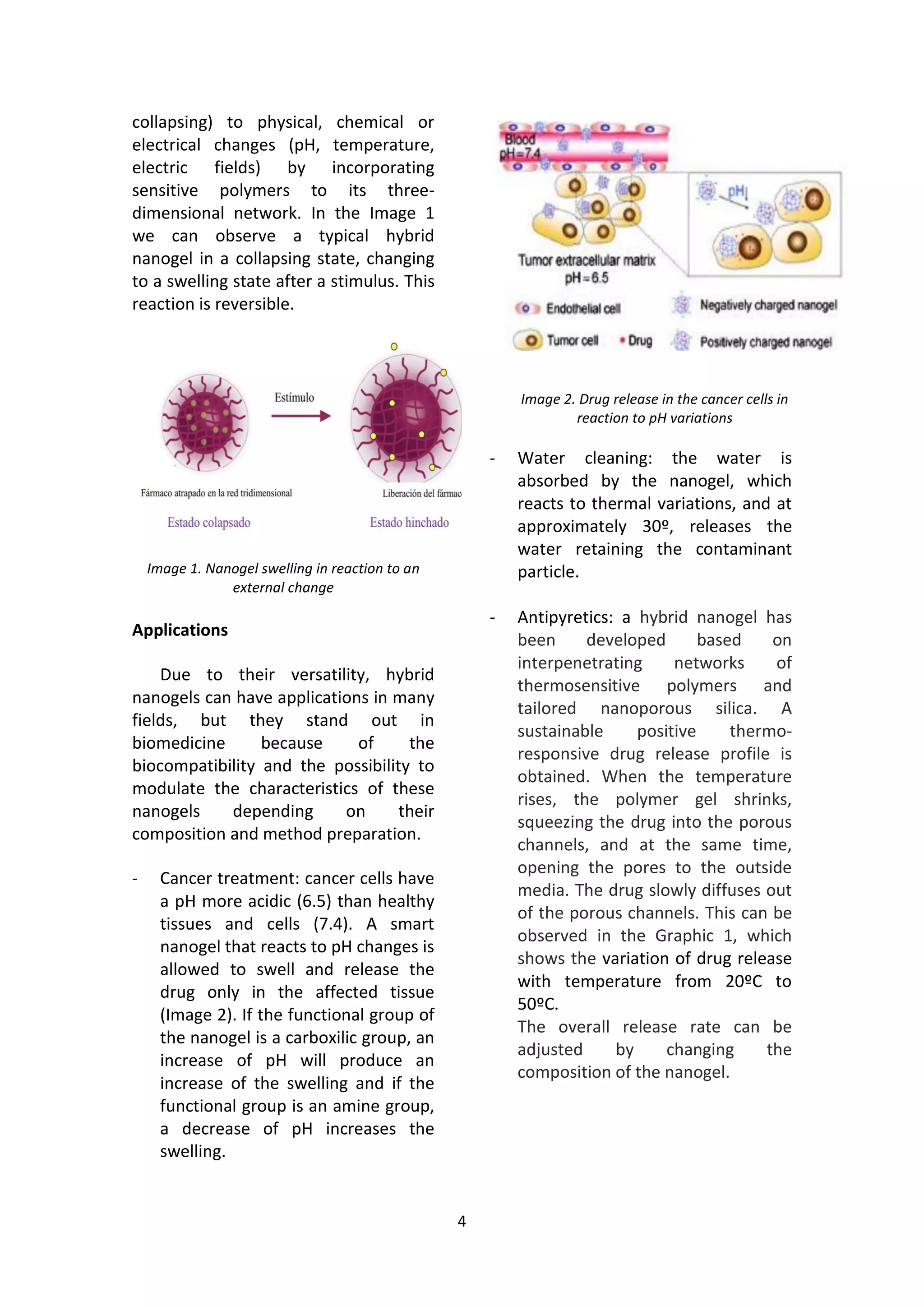
obtained structure (Image 3).
Disadvantage: we obtain
polydisperse particles, with sizes of
micrometers, so to obtain nanogels
it’s necessary to separate the
particles later with different
treatments, for example a filtration.
Image 2. Structure of a polymer obtained
with the SPM
Image 3. Structure of a polymer obtained
with the CEPM, size of micras
3
Behavior in equilibrium: Flory-Rhener
Theory
The behavior of nanogels in
equilibrium is explained through the
Flory-Rhener Theory.
There are three contributions to Gibbs
free energy: the mix one (ΔGmix), given
by the tendency of the polymer to get
dissolved; the elastic one (ΔGelas) given
by the crosslinking, which don’t let the
polymer to get dissolved; and the ionic
one (ΔGion) if the polymer is charged.
ΔG = ΔGmix + ΔGelas + ΔGion
The nanogel boundary acts as a
membrane, because through it the
solvent goes in and out of the
nanostructure, and the equilibrium is
raised when the chemical potential is
equal into and out of the nanogel. This
is described as three osmotic pressure
contributions, again of the mix
component, the elastic one and the
ionic one:
Where:
Vs: solvent molar volume
Vo: Reference gel volume
Nx: monomers number-average of two
crosslinks
f: ionic groups number-average of two
crosslinks
Φ: Volume fraction of the polymer
Φo: Reference volume fraction of the
polymer
Χ: Flory interaction parameter
Properties and scaling effects
Swelling is the main property of
hydrogels. The capability of swelling
water depends mainly on the
crosslinking degree and the polymer
nature.
The time of swelling depends on scale
because it is a mechanism based on
diffusion, a process in which the water
traverses a distance proportional to
t1/2
, and this time depends on the
length and the diameter as:
Time = (Length)2
/ D
In macroscale (gels of millimetrical
diameter) the complete swelling takes
days, and materials which take days in
response have few applications, so we
need a faster response. In nanoscale,
the gel responses in a period of time of
milliseconds.
The stimulation we’ll give to nanogels
to get a response has to be diffusion-
controlled to guarantee the control of
response time, example: the liberation
of perfume when pH decreases, the
liberation of insulin when glucose
increases, etc.
Hybrid nanogels
A hybrid nanogel is a smart
material able to react (swelling or
4
collapsing) to physical, chemical or
electrical changes (pH, temperature,
electric fields) by incorporating
sensitive polymers to its three-
dimensional network. In the Image 1
we can observe a typical hybrid
nanogel in a collapsing state, changing
to a swelling state after a stimulus. This
reaction is reversible.
Image 1. Nanogel swelling in reaction to an
external change
Applications
Due to their versatility, hybrid
nanogels can have applications in many
fields, but they stand out in
biomedicine because of the
biocompatibility and the possibility to
modulate the characteristics of these
nanogels depending on their
composition and method preparation.
- Cancer treatment: cancer cells have
a pH more acidic (6.5) than healthy
tissues and cells (7.4). A smart
nanogel that reacts to pH changes is
allowed to swell and release the
drug only in the affected tissue
(Image 2). If the functional group of
the nanogel is a carboxilic group, an
increase of pH will produce an
increase of the swelling and if the
functional group is an amine group,
a decrease of pH increases the
swelling.
Image 2. Drug release in the cancer cells in
reaction to pH variations
- Water cleaning: the water is
absorbed by the nanogel, which
reacts to thermal variations, and at
approximately 30º, releases the
water retaining the contaminant
particle.
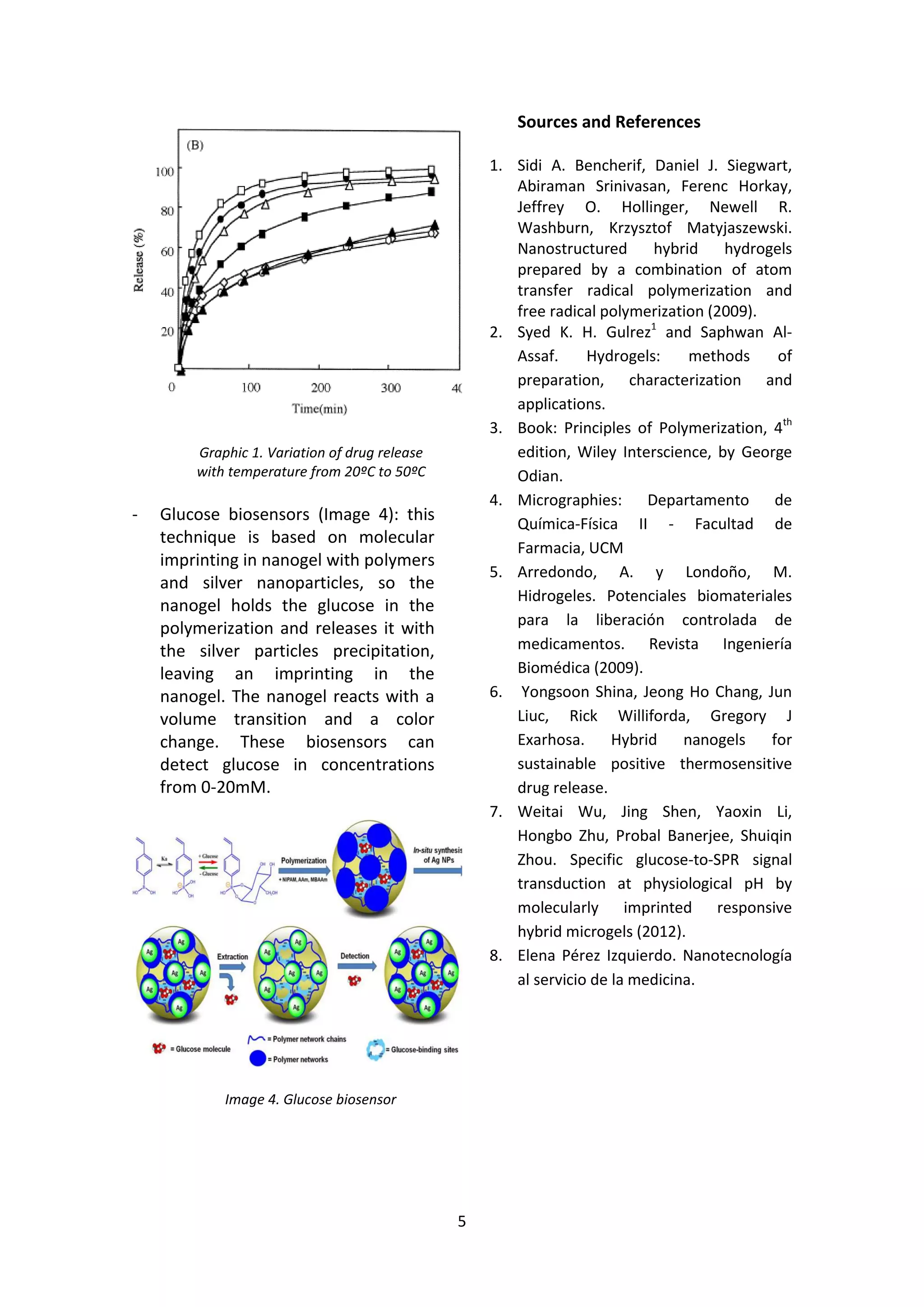
- Antipyretics: a hybrid nanogel has
been developed based on
interpenetrating networks of
thermosensitive polymers and
tailored nanoporous silica. A
sustainable positive thermo-
responsive drug release profile is
obtained. When the temperature
rises, the polymer gel shrinks,
squeezing the drug into the porous
channels, and at the same time,
opening the pores to the outside
media. The drug slowly diffuses out
of the porous channels. This can be
observed in the Graphic 1, which
shows the variation of drug release
with temperature from 20ºC to
50ºC.
The overall release rate can be
adjusted by changing the
composition of the nanogel.
5
Graphic 1. Variation of drug release
with temperature from 20ºC to 50ºC
- Glucose biosensors (Image 4): this
technique is based on molecular
imprinting in nanogel with polymers
and silver nanoparticles, so the
nanogel holds the glucose in the
polymerization and releases it with
the silver particles precipitation,
leaving an imprinting in the
nanogel. The nanogel reacts with a
volume transition and a color
change. These biosensors can
detect glucose in concentrations
from 0-20mM.
Image 4. Glucose biosensor
Sources and References
1. Sidi A. Bencherif, Daniel J. Siegwart,
Abiraman Srinivasan, Ferenc Horkay,
Jeffrey O. Hollinger, Newell R.
Washburn, Krzysztof Matyjaszewski.
Nanostructured hybrid hydrogels
prepared by a combination of atom
transfer radical polymerization and
free radical polymerization (2009).
2. Syed K. H. Gulrez1
and Saphwan Al-
Assaf. Hydrogels: methods of
preparation, characterization and
applications.
3. Book: Principles of Polymerization, 4th
edition, Wiley Interscience, by George
Odian.
4. Micrographies: Departamento de
Química-Física II - Facultad de
Farmacia, UCM
5. Arredondo, A. y Londoño, M.
Hidrogeles. Potenciales biomateriales
para la liberación controlada de
medicamentos. Revista Ingeniería
Biomédica (2009).
6. Yongsoon Shina, Jeong Ho Chang, Jun
Liuc, Rick Williforda, Gregory J
Exarhosa. Hybrid nanogels for
sustainable positive thermosensitive
drug release.
7. Weitai Wu, Jing Shen, Yaoxin Li,
Hongbo Zhu, Probal Banerjee, Shuiqin
Zhou. Specific glucose-to-SPR signal
transduction at physiological pH by
molecularly imprinted responsive
hybrid microgels (2012).
8. Elena Pérez Izquierdo. Nanotecnología
al servicio de la medicina.

Nanogels

  • 1.
    1 Nanogels: synthesis, behaviorand applications R. Gavilán Párraga, A. Pérez Díaz-Mingo Universidad Politécnica de Madrid, 2013 _______________________________________________________________________ Abstract The develop of nanosized hydrogels with new properties is a growing interesting research area in pharmaceutical and biomedical fields, as in tissue engineering, drug delivery, and bionanotechnology, because of their 3D physical structure, mechanical properties and biocompability, properties which offer significant potential for nanogels. Nanogels have also attracted a big interest due to their size and surface properties. Further, nanogels may entrap drugs and biomolecules and therefore, can be highly useful for genetic engineering. Recently, the development of hybrid hydrogels has been of increasing interest in the field of materials science. The combination of a macroscopic hydrogel and nanogels can offer a very good solution to actual biomedical challenges. Keywords: Hydrogel Nanostructured Nanogel Hybrid Drug delivery Nanoparticles _______________________________________________________________________ Introduction A gel is a colloidal system formed by a continuous solid phase dispersed in a fluid phase. If this fluid is water, the gel is a hydrogel, which is the type of nanogel we’re talking about in this project. Hydrogels are three- dimensional network structures obtained from polymers which can absorb and retain a big amount of water, and also they’re biocompatible. Nanogels are nanosized hydrogels, in the tens to hundreds of nanometers of diameter. Synthesis and interactions Nanogels are composed by hydrophilic polymeric chains, which interact with water and tend to absorb it because of their nature. As all the hydrogels, nanogels have a cross-linked structure, forming a three-dimensional network, a very important parameter for their properties. These crosslinks between polymeric chains can be given by: - Weak interactions (Image 1): van der Waals (b), ionic (c) and hydrophobic (a) associations, hydrogen bonds (d). - Strong interactions, covalent bonds: chemical reactions between monomers through a cross-linker, forming covalent bonds between them.
  • 2.
    2 Image 1. Weakinteractions between chains Synthesis techniques: It’s possible to synthetize particles from 40nm to micrometers. The polymer is obtained mixing the monomers with initiator in a tube and shaking, controlling also other conditions as temperature. There are so many polymerization techniques. In the case of nanogels, this polymer has to be centrifuged to obtain the gel in form of nanoparticles. In order to obtain a proper polymer, there are two main methods of polymerization: - Solution Polymerization Method: in present of a solvent. The monomer is dissolved in a non-reactive solvent. Advantage: monodisperse particles, with size of tens of nanometers. Disadvantage: difficult encapsulation of substances inside the nanogel because of molecular structure obtained (Image 2). - Concentrated Emulsion Polymerization Method: it is made in a solvent in which the monomer is insoluble and the catalyst is soluble. This method starts with a continuous oily phase and a disperse watery phase, in which we add the monomers, the initiator and the substance we want to encapsulate, as drugs, enzymes, etc. Advantage: when the polymerization occurs, the drug or enzyme is encapsulated inside, because of the shape of the obtained structure (Image 3). Disadvantage: we obtain polydisperse particles, with sizes of micrometers, so to obtain nanogels it’s necessary to separate the particles later with different treatments, for example a filtration. Image 2. Structure of a polymer obtained with the SPM Image 3. Structure of a polymer obtained with the CEPM, size of micras
  • 3.
    3 Behavior in equilibrium:Flory-Rhener Theory The behavior of nanogels in equilibrium is explained through the Flory-Rhener Theory. There are three contributions to Gibbs free energy: the mix one (ΔGmix), given by the tendency of the polymer to get dissolved; the elastic one (ΔGelas) given by the crosslinking, which don’t let the polymer to get dissolved; and the ionic one (ΔGion) if the polymer is charged. ΔG = ΔGmix + ΔGelas + ΔGion The nanogel boundary acts as a membrane, because through it the solvent goes in and out of the nanostructure, and the equilibrium is raised when the chemical potential is equal into and out of the nanogel. This is described as three osmotic pressure contributions, again of the mix component, the elastic one and the ionic one: Where: Vs: solvent molar volume Vo: Reference gel volume Nx: monomers number-average of two crosslinks f: ionic groups number-average of two crosslinks Φ: Volume fraction of the polymer Φo: Reference volume fraction of the polymer Χ: Flory interaction parameter Properties and scaling effects Swelling is the main property of hydrogels. The capability of swelling water depends mainly on the crosslinking degree and the polymer nature. The time of swelling depends on scale because it is a mechanism based on diffusion, a process in which the water traverses a distance proportional to t1/2 , and this time depends on the length and the diameter as: Time = (Length)2 / D In macroscale (gels of millimetrical diameter) the complete swelling takes days, and materials which take days in response have few applications, so we need a faster response. In nanoscale, the gel responses in a period of time of milliseconds. The stimulation we’ll give to nanogels to get a response has to be diffusion- controlled to guarantee the control of response time, example: the liberation of perfume when pH decreases, the liberation of insulin when glucose increases, etc. Hybrid nanogels A hybrid nanogel is a smart material able to react (swelling or
  • 4.
    4 collapsing) to physical,chemical or electrical changes (pH, temperature, electric fields) by incorporating sensitive polymers to its three- dimensional network. In the Image 1 we can observe a typical hybrid nanogel in a collapsing state, changing to a swelling state after a stimulus. This reaction is reversible. Image 1. Nanogel swelling in reaction to an external change Applications Due to their versatility, hybrid nanogels can have applications in many fields, but they stand out in biomedicine because of the biocompatibility and the possibility to modulate the characteristics of these nanogels depending on their composition and method preparation. - Cancer treatment: cancer cells have a pH more acidic (6.5) than healthy tissues and cells (7.4). A smart nanogel that reacts to pH changes is allowed to swell and release the drug only in the affected tissue (Image 2). If the functional group of the nanogel is a carboxilic group, an increase of pH will produce an increase of the swelling and if the functional group is an amine group, a decrease of pH increases the swelling. Image 2. Drug release in the cancer cells in reaction to pH variations - Water cleaning: the water is absorbed by the nanogel, which reacts to thermal variations, and at approximately 30º, releases the water retaining the contaminant particle. - Antipyretics: a hybrid nanogel has been developed based on interpenetrating networks of thermosensitive polymers and tailored nanoporous silica. A sustainable positive thermo- responsive drug release profile is obtained. When the temperature rises, the polymer gel shrinks, squeezing the drug into the porous channels, and at the same time, opening the pores to the outside media. The drug slowly diffuses out of the porous channels. This can be observed in the Graphic 1, which shows the variation of drug release with temperature from 20ºC to 50ºC. The overall release rate can be adjusted by changing the composition of the nanogel.
  • 5.
    5 Graphic 1. Variationof drug release with temperature from 20ºC to 50ºC - Glucose biosensors (Image 4): this technique is based on molecular imprinting in nanogel with polymers and silver nanoparticles, so the nanogel holds the glucose in the polymerization and releases it with the silver particles precipitation, leaving an imprinting in the nanogel. The nanogel reacts with a volume transition and a color change. These biosensors can detect glucose in concentrations from 0-20mM. Image 4. Glucose biosensor Sources and References 1. Sidi A. Bencherif, Daniel J. Siegwart, Abiraman Srinivasan, Ferenc Horkay, Jeffrey O. Hollinger, Newell R. Washburn, Krzysztof Matyjaszewski. Nanostructured hybrid hydrogels prepared by a combination of atom transfer radical polymerization and free radical polymerization (2009). 2. Syed K. H. Gulrez1 and Saphwan Al- Assaf. Hydrogels: methods of preparation, characterization and applications. 3. Book: Principles of Polymerization, 4th edition, Wiley Interscience, by George Odian. 4. Micrographies: Departamento de Química-Física II - Facultad de Farmacia, UCM 5. Arredondo, A. y Londoño, M. Hidrogeles. Potenciales biomateriales para la liberación controlada de medicamentos. Revista Ingeniería Biomédica (2009). 6. Yongsoon Shina, Jeong Ho Chang, Jun Liuc, Rick Williforda, Gregory J Exarhosa. Hybrid nanogels for sustainable positive thermosensitive drug release. 7. Weitai Wu, Jing Shen, Yaoxin Li, Hongbo Zhu, Probal Banerjee, Shuiqin Zhou. Specific glucose-to-SPR signal transduction at physiological pH by molecularly imprinted responsive hybrid microgels (2012). 8. Elena Pérez Izquierdo. Nanotecnología al servicio de la medicina.