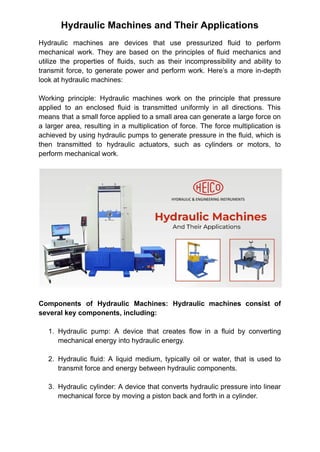
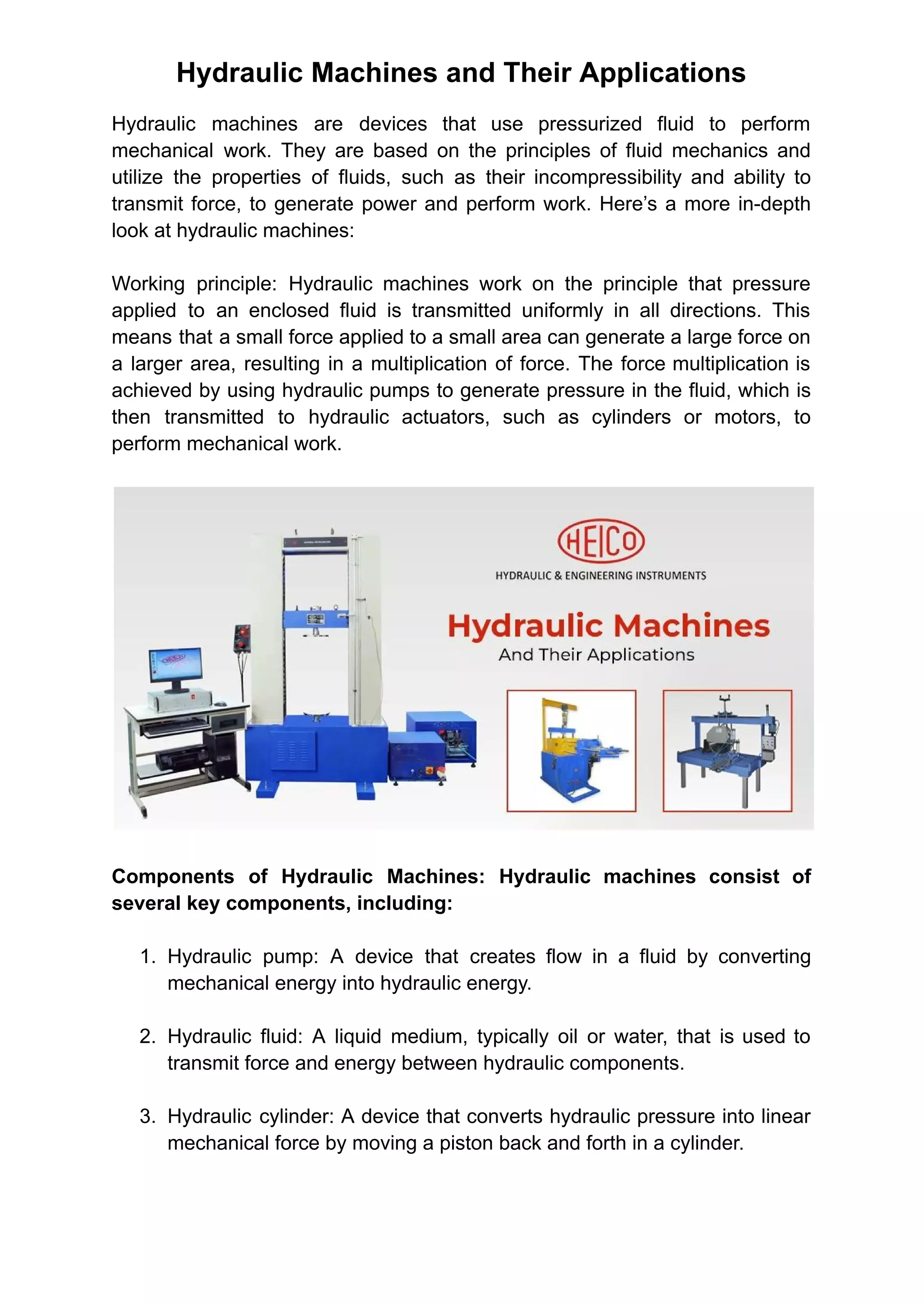
Hydraulic Machines and Their Applications
Hydraulic machines are devices that use pressurized fluid to perform
mechanical work. They are based on the principles of fluid mechanics and
utilize the properties of fluids, such as their incompressibility and ability to
transmit force, to generate power and perform work. Here’s a more in-depth
look at hydraulic machines:
Working principle: Hydraulic machines work on the principle that pressure
applied to an enclosed fluid is transmitted uniformly in all directions. This
means that a small force applied to a small area can generate a large force on
a larger area, resulting in a multiplication of force. The force multiplication is
achieved by using hydraulic pumps to generate pressure in the fluid, which is
then transmitted to hydraulic actuators, such as cylinders or motors, to
perform mechanical work.
Components of Hydraulic Machines: Hydraulic machines consist of
several key components, including:
1. Hydraulic pump: A device that creates flow in a fluid by converting
mechanical energy into hydraulic energy.
2. Hydraulic fluid: A liquid medium, typically oil or water, that is used to
transmit force and energy between hydraulic components.
3. Hydraulic cylinder: A device that converts hydraulic pressure into linear
mechanical force by moving a piston back and forth in a cylinder.
Hydraulic Machines and Their Applications
4. Hydraulic motor: A device that converts hydraulic pressure into
rotational mechanical force by rotating a shaft.
5. Hydraulic valve: A device that controls the flow of fluid in a hydraulic
system, allowing for regulation of pressure, flow rate, and direction of
fluid flow.
Applications of Hydraulic Machines
● Construction equipment: Hydraulic excavators, bulldozers, cranes, and
other heavy machinery rely on hydraulic power to perform their
functions.
● Manufacturing: Hydraulic presses, stamping machines, and other
manufacturing equipment use hydraulic power to shape and form metal
and other materials.
● Transportation: Hydraulic systems are used in cars, trucks, and other
vehicles for power steering, brakes, and suspension systems.
● Agriculture: Tractors, harvesters, and other farming equipment use
hydraulic power to operate their machinery.
● Mining: Hydraulic systems are used in mining equipment to extract and
transport materials from underground.
Benefits of Hydraulic Machines
1. High power density: Hydraulic systems can generate high levels of
power in a compact and efficient package.
2. Precise control: Hydraulic systems can provide precise control over the
amount of force and speed of movement, making them ideal for
applications that require accuracy and repeatability.
3. Reliability: Hydraulic systems are known for their durability and long
service life, requiring less maintenance and downtime than other types
of machinery.
Hydraulic Machines and Their Applications
4. Safety: Hydraulic systems can be designed with safety features, such
as pressure relief valves and fail-safe mechanisms, to prevent accidents
and injuries.
Overall, hydraulic machines are versatile, efficient, and reliable, making them
a popular choice for a wide range of industrial applications.
Source By:-
https://heicodynamics.wordpress.com/2023/04/06/hydraulic-machines-an
d-their-applications/

Hydraulic Machines and Their Applications

  • 1.
    Hydraulic Machines andTheir Applications Hydraulic machines are devices that use pressurized fluid to perform mechanical work. They are based on the principles of fluid mechanics and utilize the properties of fluids, such as their incompressibility and ability to transmit force, to generate power and perform work. Here’s a more in-depth look at hydraulic machines: Working principle: Hydraulic machines work on the principle that pressure applied to an enclosed fluid is transmitted uniformly in all directions. This means that a small force applied to a small area can generate a large force on a larger area, resulting in a multiplication of force. The force multiplication is achieved by using hydraulic pumps to generate pressure in the fluid, which is then transmitted to hydraulic actuators, such as cylinders or motors, to perform mechanical work. Components of Hydraulic Machines: Hydraulic machines consist of several key components, including: 1. Hydraulic pump: A device that creates flow in a fluid by converting mechanical energy into hydraulic energy. 2. Hydraulic fluid: A liquid medium, typically oil or water, that is used to transmit force and energy between hydraulic components. 3. Hydraulic cylinder: A device that converts hydraulic pressure into linear mechanical force by moving a piston back and forth in a cylinder.
  • 2.
    Hydraulic Machines andTheir Applications 4. Hydraulic motor: A device that converts hydraulic pressure into rotational mechanical force by rotating a shaft. 5. Hydraulic valve: A device that controls the flow of fluid in a hydraulic system, allowing for regulation of pressure, flow rate, and direction of fluid flow. Applications of Hydraulic Machines ● Construction equipment: Hydraulic excavators, bulldozers, cranes, and other heavy machinery rely on hydraulic power to perform their functions. ● Manufacturing: Hydraulic presses, stamping machines, and other manufacturing equipment use hydraulic power to shape and form metal and other materials. ● Transportation: Hydraulic systems are used in cars, trucks, and other vehicles for power steering, brakes, and suspension systems. ● Agriculture: Tractors, harvesters, and other farming equipment use hydraulic power to operate their machinery. ● Mining: Hydraulic systems are used in mining equipment to extract and transport materials from underground. Benefits of Hydraulic Machines 1. High power density: Hydraulic systems can generate high levels of power in a compact and efficient package. 2. Precise control: Hydraulic systems can provide precise control over the amount of force and speed of movement, making them ideal for applications that require accuracy and repeatability. 3. Reliability: Hydraulic systems are known for their durability and long service life, requiring less maintenance and downtime than other types of machinery.
  • 3.
    Hydraulic Machines andTheir Applications 4. Safety: Hydraulic systems can be designed with safety features, such as pressure relief valves and fail-safe mechanisms, to prevent accidents and injuries. Overall, hydraulic machines are versatile, efficient, and reliable, making them a popular choice for a wide range of industrial applications. Source By:- https://heicodynamics.wordpress.com/2023/04/06/hydraulic-machines-an d-their-applications/