www.filmeducation.org
©Film Education 2009. Film Education is not responsible for the content of external sites.
1
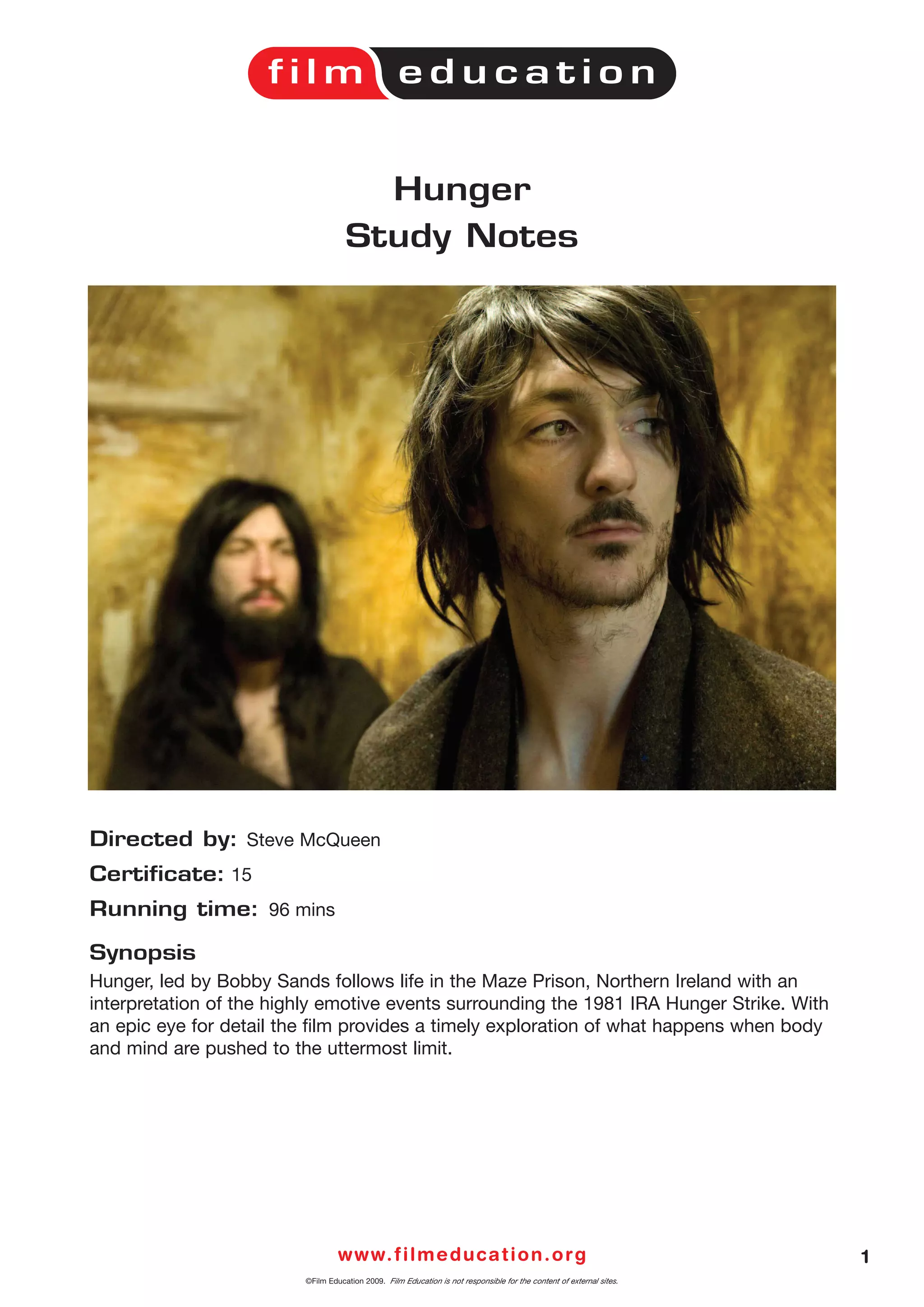
Hunger
Study Notes
Directed by: Steve McQueen
Certificate: 15
Running time: 96 mins
Synopsis
Hunger, led by Bobby Sands follows life in the Maze Prison, Northern Ireland with an
interpretation of the highly emotive events surrounding the 1981 IRA Hunger Strike. With
an epic eye for detail the film provides a timely exploration of what happens when body
and mind are pushed to the uttermost limit.
Factual information in a fictional form
Any film that is telling a true story can only ever give us a flavour of the real-life events on
which it is based. Details such as what individuals actually said to one another during
conversation, or exactly what people thought, are impossible to recreate.
In the case of Hunger, compressing a six-week period in the life of Bobby Sands into a 96-
minute feature inevitably means information will be omitted. The film's focus moves into
the Maze prison, concerning itself primarily with the story of Bobby Sands, but there are
other important moments and characters that function to flesh out the picture of life in the
Maze.
1. At both the beginning and the end of the film, additional information about the actual
events appears onscreen. What does this add to the narrative?
News recordings from the period also feature in the film. Whilst the Prime Minister at the
time, Margaret Thatcher, doesn't actually appear on screen, we often hear the radio
quoting her or reporting the responses of her government to the situation in Northern
Ireland. In this way, policymaking and the broader political landscape are distanced from
the picture as it focuses the day-to-day existence of the prisoners and guards.
2. How does the news inform the narrative? What kinds of reactions do the different
characters have to these bulletins?
3. With any film, choosing what is finally seen on screen is a long and collaborative
process. What questions are raised for you during viewing the film? For example, before
you watched Hunger, what did you know about this period in history? Are there aspects
that you now want to find out more about?
Looking at life in the Maze
Director Steve McQueen says of Hunger that he wanted to make a film that would ‘...bring
everything back.’ His attention to detail and research have been translated into what we
see on screen. His focus on the people living and working in the prison offers a specific
approach to the recent history of Northern Ireland.
McQueen talks about his research with former inmates and prison officers, asking them
about the conditions in the Maze. He says, ‘Usually people ask them the big questions. But
I was more interested in the details you couldn’t find in the books. Like what’s it like waking
up with maggots all over your body? What’s it like with all these bluebottles dancing around
your cell? At what point do you get used to faeces on the wall?’ (New York Times, 6/3/09)
Characters
In the film, there are some characters who occupy significant amounts of screen time but
who have hardly any dialogue.
4. Which of these stand out to you? When these characters appear on screen, what do
you find moving, shocking or interesting about these representations?
www.filmeducation.org
©Film Education 2009. Film Education is not responsible for the content of external sites.
2
For example, from the beginning we observe both the working and home life of one of the
prison guards. We see his chilling daily routine, how he matter-of-factly checks under his
car for bombs, and the struggle he has with everyday life. We never hear what this
character thinks, we hardly hear him speak, and instead we see him at work and at home
struggling on screen in both environments.
5. Why do you think this character’s often-bleeding hands are repeatedly seen immersed
in water?
6. Think about other characters that had an impact on you. How was this achieved by the
director and the actors?
Directing Confinement
The film has very distinct sections, making it almost like a play with a three-act structure.
7. The central scene, the conversation between Father Moran and Bobby Sands, is filmed
as a single take. Where you aware of this technique at the time? What impact did this
scene have on you as a spectator?
8. Can you think of other moments in the film where this technique is employed? What
impact does it have this time, how does it make you feel as a spectator?
Director Steve McQueen talks about the atmosphere that he wanted to create in the film,
saying, ‘If you see a drop of rain on someone’s knuckle, you feel it because you know that
physical sensation, that sensory experience brings you closer to an emotional one.’ (New
York Times 6/3/09)
Inside the prison we see the horrendous conditions that have become everyday life. The final
resource left to these prisoners are their bodies, something they can control and through
which they can generate some of their protest. McQueen talks about ‘...the whole idea of the
body as a weapon. If that’s all you have, how do you use it?’ (New York Times 6/3/09)
9. The film has been described as ‘visceral’. Checking your understanding of this word,
would you agree with this description? Think of key scenes to support your answer.
Interests of a Director
Steve McQueen is an artist and a director. Hunger is his first feature film, but he has
worked in video for some time. In 2003, he started work on a project called Queen and
Country developing a range of stamps featuring those that have died in Iraq.
Use the following links to find out more about the themes his work addresses:
www.guardian.co.uk/film/2008/oct/12/2
www.artfund.org/queenandcountry
www.youtube.com/watch?v=ZCNrqnxYCn8
www.filmeducation.org
©Film Education 2009. Film Education is not responsible for the content of external sites.
3

'Hunger' study guide

  • 1.
    www.filmeducation.org ©Film Education 2009.Film Education is not responsible for the content of external sites. 1 Hunger Study Notes Directed by: Steve McQueen Certificate: 15 Running time: 96 mins Synopsis Hunger, led by Bobby Sands follows life in the Maze Prison, Northern Ireland with an interpretation of the highly emotive events surrounding the 1981 IRA Hunger Strike. With an epic eye for detail the film provides a timely exploration of what happens when body and mind are pushed to the uttermost limit.
  • 2.
    Factual information ina fictional form Any film that is telling a true story can only ever give us a flavour of the real-life events on which it is based. Details such as what individuals actually said to one another during conversation, or exactly what people thought, are impossible to recreate. In the case of Hunger, compressing a six-week period in the life of Bobby Sands into a 96- minute feature inevitably means information will be omitted. The film's focus moves into the Maze prison, concerning itself primarily with the story of Bobby Sands, but there are other important moments and characters that function to flesh out the picture of life in the Maze. 1. At both the beginning and the end of the film, additional information about the actual events appears onscreen. What does this add to the narrative? News recordings from the period also feature in the film. Whilst the Prime Minister at the time, Margaret Thatcher, doesn't actually appear on screen, we often hear the radio quoting her or reporting the responses of her government to the situation in Northern Ireland. In this way, policymaking and the broader political landscape are distanced from the picture as it focuses the day-to-day existence of the prisoners and guards. 2. How does the news inform the narrative? What kinds of reactions do the different characters have to these bulletins? 3. With any film, choosing what is finally seen on screen is a long and collaborative process. What questions are raised for you during viewing the film? For example, before you watched Hunger, what did you know about this period in history? Are there aspects that you now want to find out more about? Looking at life in the Maze Director Steve McQueen says of Hunger that he wanted to make a film that would ‘...bring everything back.’ His attention to detail and research have been translated into what we see on screen. His focus on the people living and working in the prison offers a specific approach to the recent history of Northern Ireland. McQueen talks about his research with former inmates and prison officers, asking them about the conditions in the Maze. He says, ‘Usually people ask them the big questions. But I was more interested in the details you couldn’t find in the books. Like what’s it like waking up with maggots all over your body? What’s it like with all these bluebottles dancing around your cell? At what point do you get used to faeces on the wall?’ (New York Times, 6/3/09) Characters In the film, there are some characters who occupy significant amounts of screen time but who have hardly any dialogue. 4. Which of these stand out to you? When these characters appear on screen, what do you find moving, shocking or interesting about these representations? www.filmeducation.org ©Film Education 2009. Film Education is not responsible for the content of external sites. 2
  • 3.
    For example, fromthe beginning we observe both the working and home life of one of the prison guards. We see his chilling daily routine, how he matter-of-factly checks under his car for bombs, and the struggle he has with everyday life. We never hear what this character thinks, we hardly hear him speak, and instead we see him at work and at home struggling on screen in both environments. 5. Why do you think this character’s often-bleeding hands are repeatedly seen immersed in water? 6. Think about other characters that had an impact on you. How was this achieved by the director and the actors? Directing Confinement The film has very distinct sections, making it almost like a play with a three-act structure. 7. The central scene, the conversation between Father Moran and Bobby Sands, is filmed as a single take. Where you aware of this technique at the time? What impact did this scene have on you as a spectator? 8. Can you think of other moments in the film where this technique is employed? What impact does it have this time, how does it make you feel as a spectator? Director Steve McQueen talks about the atmosphere that he wanted to create in the film, saying, ‘If you see a drop of rain on someone’s knuckle, you feel it because you know that physical sensation, that sensory experience brings you closer to an emotional one.’ (New York Times 6/3/09) Inside the prison we see the horrendous conditions that have become everyday life. The final resource left to these prisoners are their bodies, something they can control and through which they can generate some of their protest. McQueen talks about ‘...the whole idea of the body as a weapon. If that’s all you have, how do you use it?’ (New York Times 6/3/09) 9. The film has been described as ‘visceral’. Checking your understanding of this word, would you agree with this description? Think of key scenes to support your answer. Interests of a Director Steve McQueen is an artist and a director. Hunger is his first feature film, but he has worked in video for some time. In 2003, he started work on a project called Queen and Country developing a range of stamps featuring those that have died in Iraq. Use the following links to find out more about the themes his work addresses: www.guardian.co.uk/film/2008/oct/12/2 www.artfund.org/queenandcountry www.youtube.com/watch?v=ZCNrqnxYCn8 www.filmeducation.org ©Film Education 2009. Film Education is not responsible for the content of external sites. 3