Movie Comparison, Pulp Fiction, Fight Club
The film in question, Pulp Fiction, is a mixture of many different genres and filming types
such as: comedy, gangster, thriller, indie film, crime, black comedy and drama. The director,
Quentin Tarantino (who also co-written the film) has a certain style of direction, he brings a
certain shock factor to all of his films. He combines genres from films he’s seen throughout
his life, possibly even before he was a famous movie director.
The scene in question, the last scene of the film, The Coffee Shop scene was slightly
changed from the original was at the begging of the film. Some of the speech was altered in
the end of the film, as well as that Vincent can be seen leaving the scene at the beginning of
the film to return at the end. The director did this to show the journey the characters took
and the changes they went though.
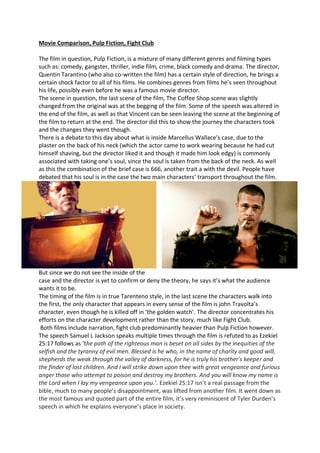
There is a debate to this day about what is inside Marcellus Wallace’s case, due to the
plaster on the back of his neck (which the actor came to work wearing because he had cut
himself shaving, but the director liked it and though it made him look edgy) is commonly
associated with taking one’s soul, since the soul is taken from the back of the neck. As well
as this the combination of the brief case is 666, another trait a with the devil. People have
debated that his soul is in the case the two main characters’ transport throughout the film.
But since we do not see the inside of the
case and the director is yet to confirm or deny the theory, he says it’s what the audience
wants it to be.
The timing of the film is in true Tarenteno style, in the last scene the characters walk into
the first, the only character that appears in every sense of the film is john Travolta’s
character, even though he is killed off in ‘the golden watch’. The director concentrates his
efforts on the character development rather than the story, much like Fight Club.
Both films include narration, fight club predominantly heavier than Pulp Fiction however.
The speech Samuel L Jackson speaks multiple times through the film is refuted to as Ezekiel
25:17 follows as ‘the path of the righteous man is beset on all sides by the inequities of the
selfish and the tyranny of evil men. Blessed is he who, in the name of charity and good will,
shepherds the weak through the valley of darkness, for he is truly his brother's keeper and
the finder of lost children. And I will strike down upon thee with great vengeance and furious
anger those who attempt to poison and destroy my brothers. And you will know my name is
the Lord when I lay my vengeance upon you.’. Ezekiel 25:17 isn’t a real passage from the
bible, much to many people’s disappointment, was lifted from another film. It went down as
the most famous and quoted part of the entire film, it’s very reminiscent of Tyler Durden’s
speech in which he explains everyone’s place in society.
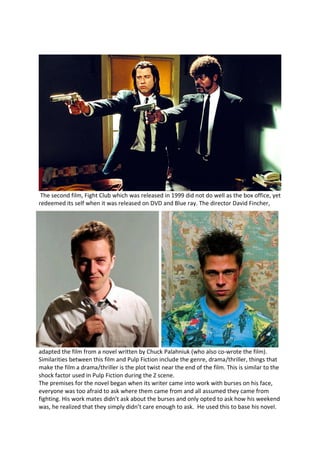
The second film, Fight Club which was released in 1999 did not do well as the box office, yet
redeemed its self when it was released on DVD and Blue ray. The director David Fincher,
adapted the film from a novel written by Chuck Palahniuk (who also co-wrote the film).
Similarities between this film and Pulp Fiction include the genre, drama/thriller, things that
make the film a drama/thriller is the plot twist near the end of the film. This is similar to the
shock factor used in Pulp Fiction during the Z scene.
The premises for the novel began when its writer came into work with burses on his face,
everyone was too afraid to ask where them came from and all assumed they came from
fighting. His work mates didn’t ask about the burses and only opted to ask how his weekend
was, he realized that they simply didn’t care enough to ask. He used this to base his novel.
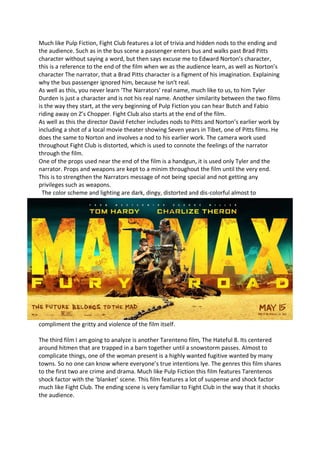
Much like Pulp Fiction, Fight Club features a lot of trivia and hidden nods to the ending and
the audience. Such as in the bus scene a passenger enters bus and walks past Brad Pitts
character without saying a word, but then says excuse me to Edward Norton’s character,
this is a reference to the end of the film when we as the audience learn, as well as Norton’s
character The narrator, that a Brad Pitts character is a figment of his imagination. Explaining
why the bus passenger ignored him, because he isn’t real.
As well as this, you never learn ‘The Narrators’ real name, much like to us, to him Tyler
Durden is just a character and is not his real name. Another similarity between the two films
is the way they start, at the very beginning of Pulp Fiction you can hear Butch and Fabio
riding away on Z’s Chopper. Fight Club also starts at the end of the film.
As well as this the director David Fetcher includes nods to Pitts and Norton’s earlier work by
including a shot of a local movie theater showing Seven years in Tibet, one of Pitts films. He
does the same to Norton and involves a nod to his earlier work. The camera work used
throughout Fight Club is distorted, which is used to connote the feelings of the narrator
through the film.
One of the props used near the end of the film is a handgun, it is used only Tyler and the
narrator. Props and weapons are kept to a minim throughout the film until the very end.
This is to strengthen the Narrators message of not being special and not getting any
privileges such as weapons.
The color scheme and lighting are dark, dingy, distorted and dis-colorful almost to
compliment the gritty and violence of the film itself.
The third film I am going to analyze is another Tarenteno film, The Hateful 8. Its centered
around hitmen that are trapped in a barn together until a snowstorm passes. Almost to
complicate things, one of the woman present is a highly wanted fugitive wanted by many
towns. So no one can know where everyone’s true intentions lye. The genres this film shares
to the first two are crime and drama. Much like Pulp Fiction this film features Tarentenos
shock factor with the ‘blanket’ scene. This film features a lot of suspense and shock factor
much like Fight Club. The ending scene is very familiar to Fight Club in the way that it shocks
the audience.
In true tarenteno style, he shot this film on 65mm film with classic Panavision lenses in the
widest aspect ratio of 2.76. This gives his film depth and meaning. The last time these lenses
were used was in the 196os, due to their wide angle the director can fit more in the shot,
further giving it meaning and depth. All shots of this were performed by Bob Richardson,
him and Tarenteno have a long relationship including Kill Bill and Django Unchanged. Much
like many of the actors starting in this film, the actor portraying ‘The little man’ worked on
Pulp Fiction as the coffee shop robber Ringo.
The opening shot of the film is almost interrupted by a stage coach tearing through the shot
and changing the shot to a wide angle shot. They also changed the colour of the sky from
pure white to different shades of blue, this gives the film a tone. A silhouette is used to
introduce one of the main characters. This is used because rather than use narration, a lot
can be determined from a shot such as this, the audience can tell whether the character is
male or female and can get a general idea of their age. Much like how Samuel Jacksons
character is introduced in Pulp Fiction. This film is a statement showing that a film doesn’t
need a large budget to make it a good one, Tarenteno uses shots that disregard the use for
large lights and lots of equipment. Tarenteno is trying to tell young film makers his message
of not needing a large budget to make a good film.
Unlike the other this film is a western, and is set in a far earlier time period than the rest.
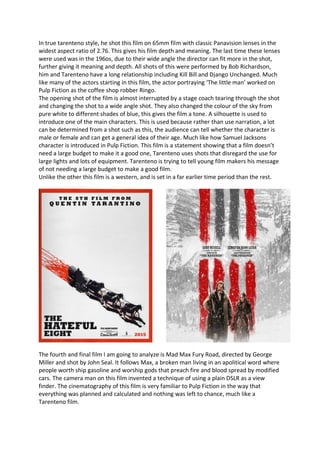
The fourth and final film I am going to analyze is Mad Max Fury Road, directed by George
Miller and shot by John Seal. It follows Max, a broken man living in an apolitical word where
people worth ship gasoline and worship gods that preach fire and blood spread by modified
cars. The camera man on this film invented a technique of using a plain DSLR as a view
finder. The cinematography of this film is very familiar to Pulp Fiction in the way that
everything was planned and calculated and nothing was left to chance, much like a
Tarenteno film.
The target audience of mad max are thrill seekers, which becomes apparent when you
review the genre of the film itself, full of action and action set pieces. As well as practical
rather than CGI special effects to further satisfy thrill seekers and adrenalin addicts making
the experience as real as possible.
The stylistic codes and conventions aren’t followed to the letter in many of the films listed
above, such as in Pulp Fiction the main prop of the film contents is kept secret throughout
the entire film, to this day its contents are still debated about.
The codes and conventions of a genre are the props used, the stereotypes of films and
things always repeated by directors such as a location or again, a stereotype, for example of
a film stereotype is when the director chooses to have the actors being picked off one by
one by some sort of threat.
A stereotypical location would be New York city at somewhere like time square.
Another example of codes and conventions would be foreshadowing, for example, when a
character mentioned a certain object such as a knife, and the lead actor uses the same knife
in the finale.
Another is the camera work used throughout the film. Such as if a director was to use a
close up, we know that this is being used to convey emotion of the character in screen
The genre of pulp fiction when boiled down is a crime film and a thriller, much like fight club
which is also a thriller, these films are similar in the way that they follow the same codes
and conventions. Such as having a twist at the end of the film, as well as changes in camera
angle, quick cuts and the story line being able to relate to the story to make them feel the
same way as the actors do in the scenes themselves. Lighting is often low key in thrillers as
well as the location being an important set piece to the story because it helps the audience
establish the theme. Other thrillers include Mad Max Fury Road and The Hateful 8, these
also follow the quotes and conventions that Pulp Fiction and Fight Club follow. Such as the
ones listed above.
Quotes and conventions of the films listed above are as follows, they use the same method
of building tension and suspense, the purpose of a thriller is to keep the audience on high
alert and keep them there. To achieve this they use shadows and low key lighting, flash
backs and the use of music.
Whereas when on the topic of hair and makeup in these films they are never really over the
top, if they were it wouldn’t really set a realistic tone, which is essential to these films. Make
could however be used to create the illusion of a wound. Hair and makeup isn’t really used,
the villain might be given hair and makeup but this is the only exception.

Film Comparisan Task

  • 1.
    Movie Comparison, PulpFiction, Fight Club The film in question, Pulp Fiction, is a mixture of many different genres and filming types such as: comedy, gangster, thriller, indie film, crime, black comedy and drama. The director, Quentin Tarantino (who also co-written the film) has a certain style of direction, he brings a certain shock factor to all of his films. He combines genres from films he’s seen throughout his life, possibly even before he was a famous movie director. The scene in question, the last scene of the film, The Coffee Shop scene was slightly changed from the original was at the begging of the film. Some of the speech was altered in the end of the film, as well as that Vincent can be seen leaving the scene at the beginning of the film to return at the end. The director did this to show the journey the characters took and the changes they went though. There is a debate to this day about what is inside Marcellus Wallace’s case, due to the plaster on the back of his neck (which the actor came to work wearing because he had cut himself shaving, but the director liked it and though it made him look edgy) is commonly associated with taking one’s soul, since the soul is taken from the back of the neck. As well as this the combination of the brief case is 666, another trait a with the devil. People have debated that his soul is in the case the two main characters’ transport throughout the film. But since we do not see the inside of the case and the director is yet to confirm or deny the theory, he says it’s what the audience wants it to be. The timing of the film is in true Tarenteno style, in the last scene the characters walk into the first, the only character that appears in every sense of the film is john Travolta’s character, even though he is killed off in ‘the golden watch’. The director concentrates his efforts on the character development rather than the story, much like Fight Club. Both films include narration, fight club predominantly heavier than Pulp Fiction however. The speech Samuel L Jackson speaks multiple times through the film is refuted to as Ezekiel 25:17 follows as ‘the path of the righteous man is beset on all sides by the inequities of the selfish and the tyranny of evil men. Blessed is he who, in the name of charity and good will, shepherds the weak through the valley of darkness, for he is truly his brother's keeper and the finder of lost children. And I will strike down upon thee with great vengeance and furious anger those who attempt to poison and destroy my brothers. And you will know my name is the Lord when I lay my vengeance upon you.’. Ezekiel 25:17 isn’t a real passage from the bible, much to many people’s disappointment, was lifted from another film. It went down as the most famous and quoted part of the entire film, it’s very reminiscent of Tyler Durden’s speech in which he explains everyone’s place in society.
  • 2.
    The second film,Fight Club which was released in 1999 did not do well as the box office, yet redeemed its self when it was released on DVD and Blue ray. The director David Fincher, adapted the film from a novel written by Chuck Palahniuk (who also co-wrote the film). Similarities between this film and Pulp Fiction include the genre, drama/thriller, things that make the film a drama/thriller is the plot twist near the end of the film. This is similar to the shock factor used in Pulp Fiction during the Z scene. The premises for the novel began when its writer came into work with burses on his face, everyone was too afraid to ask where them came from and all assumed they came from fighting. His work mates didn’t ask about the burses and only opted to ask how his weekend was, he realized that they simply didn’t care enough to ask. He used this to base his novel.
  • 3.
    Much like PulpFiction, Fight Club features a lot of trivia and hidden nods to the ending and the audience. Such as in the bus scene a passenger enters bus and walks past Brad Pitts character without saying a word, but then says excuse me to Edward Norton’s character, this is a reference to the end of the film when we as the audience learn, as well as Norton’s character The narrator, that a Brad Pitts character is a figment of his imagination. Explaining why the bus passenger ignored him, because he isn’t real. As well as this, you never learn ‘The Narrators’ real name, much like to us, to him Tyler Durden is just a character and is not his real name. Another similarity between the two films is the way they start, at the very beginning of Pulp Fiction you can hear Butch and Fabio riding away on Z’s Chopper. Fight Club also starts at the end of the film. As well as this the director David Fetcher includes nods to Pitts and Norton’s earlier work by including a shot of a local movie theater showing Seven years in Tibet, one of Pitts films. He does the same to Norton and involves a nod to his earlier work. The camera work used throughout Fight Club is distorted, which is used to connote the feelings of the narrator through the film. One of the props used near the end of the film is a handgun, it is used only Tyler and the narrator. Props and weapons are kept to a minim throughout the film until the very end. This is to strengthen the Narrators message of not being special and not getting any privileges such as weapons. The color scheme and lighting are dark, dingy, distorted and dis-colorful almost to compliment the gritty and violence of the film itself. The third film I am going to analyze is another Tarenteno film, The Hateful 8. Its centered around hitmen that are trapped in a barn together until a snowstorm passes. Almost to complicate things, one of the woman present is a highly wanted fugitive wanted by many towns. So no one can know where everyone’s true intentions lye. The genres this film shares to the first two are crime and drama. Much like Pulp Fiction this film features Tarentenos shock factor with the ‘blanket’ scene. This film features a lot of suspense and shock factor much like Fight Club. The ending scene is very familiar to Fight Club in the way that it shocks the audience.
  • 4.
    In true tarentenostyle, he shot this film on 65mm film with classic Panavision lenses in the widest aspect ratio of 2.76. This gives his film depth and meaning. The last time these lenses were used was in the 196os, due to their wide angle the director can fit more in the shot, further giving it meaning and depth. All shots of this were performed by Bob Richardson, him and Tarenteno have a long relationship including Kill Bill and Django Unchanged. Much like many of the actors starting in this film, the actor portraying ‘The little man’ worked on Pulp Fiction as the coffee shop robber Ringo. The opening shot of the film is almost interrupted by a stage coach tearing through the shot and changing the shot to a wide angle shot. They also changed the colour of the sky from pure white to different shades of blue, this gives the film a tone. A silhouette is used to introduce one of the main characters. This is used because rather than use narration, a lot can be determined from a shot such as this, the audience can tell whether the character is male or female and can get a general idea of their age. Much like how Samuel Jacksons character is introduced in Pulp Fiction. This film is a statement showing that a film doesn’t need a large budget to make it a good one, Tarenteno uses shots that disregard the use for large lights and lots of equipment. Tarenteno is trying to tell young film makers his message of not needing a large budget to make a good film. Unlike the other this film is a western, and is set in a far earlier time period than the rest. The fourth and final film I am going to analyze is Mad Max Fury Road, directed by George Miller and shot by John Seal. It follows Max, a broken man living in an apolitical word where people worth ship gasoline and worship gods that preach fire and blood spread by modified cars. The camera man on this film invented a technique of using a plain DSLR as a view finder. The cinematography of this film is very familiar to Pulp Fiction in the way that everything was planned and calculated and nothing was left to chance, much like a Tarenteno film.
  • 5.
    The target audienceof mad max are thrill seekers, which becomes apparent when you review the genre of the film itself, full of action and action set pieces. As well as practical rather than CGI special effects to further satisfy thrill seekers and adrenalin addicts making the experience as real as possible. The stylistic codes and conventions aren’t followed to the letter in many of the films listed above, such as in Pulp Fiction the main prop of the film contents is kept secret throughout the entire film, to this day its contents are still debated about. The codes and conventions of a genre are the props used, the stereotypes of films and things always repeated by directors such as a location or again, a stereotype, for example of a film stereotype is when the director chooses to have the actors being picked off one by one by some sort of threat. A stereotypical location would be New York city at somewhere like time square. Another example of codes and conventions would be foreshadowing, for example, when a character mentioned a certain object such as a knife, and the lead actor uses the same knife in the finale. Another is the camera work used throughout the film. Such as if a director was to use a close up, we know that this is being used to convey emotion of the character in screen The genre of pulp fiction when boiled down is a crime film and a thriller, much like fight club which is also a thriller, these films are similar in the way that they follow the same codes and conventions. Such as having a twist at the end of the film, as well as changes in camera angle, quick cuts and the story line being able to relate to the story to make them feel the same way as the actors do in the scenes themselves. Lighting is often low key in thrillers as well as the location being an important set piece to the story because it helps the audience establish the theme. Other thrillers include Mad Max Fury Road and The Hateful 8, these also follow the quotes and conventions that Pulp Fiction and Fight Club follow. Such as the ones listed above. Quotes and conventions of the films listed above are as follows, they use the same method of building tension and suspense, the purpose of a thriller is to keep the audience on high alert and keep them there. To achieve this they use shadows and low key lighting, flash backs and the use of music. Whereas when on the topic of hair and makeup in these films they are never really over the top, if they were it wouldn’t really set a realistic tone, which is essential to these films. Make could however be used to create the illusion of a wound. Hair and makeup isn’t really used, the villain might be given hair and makeup but this is the only exception.