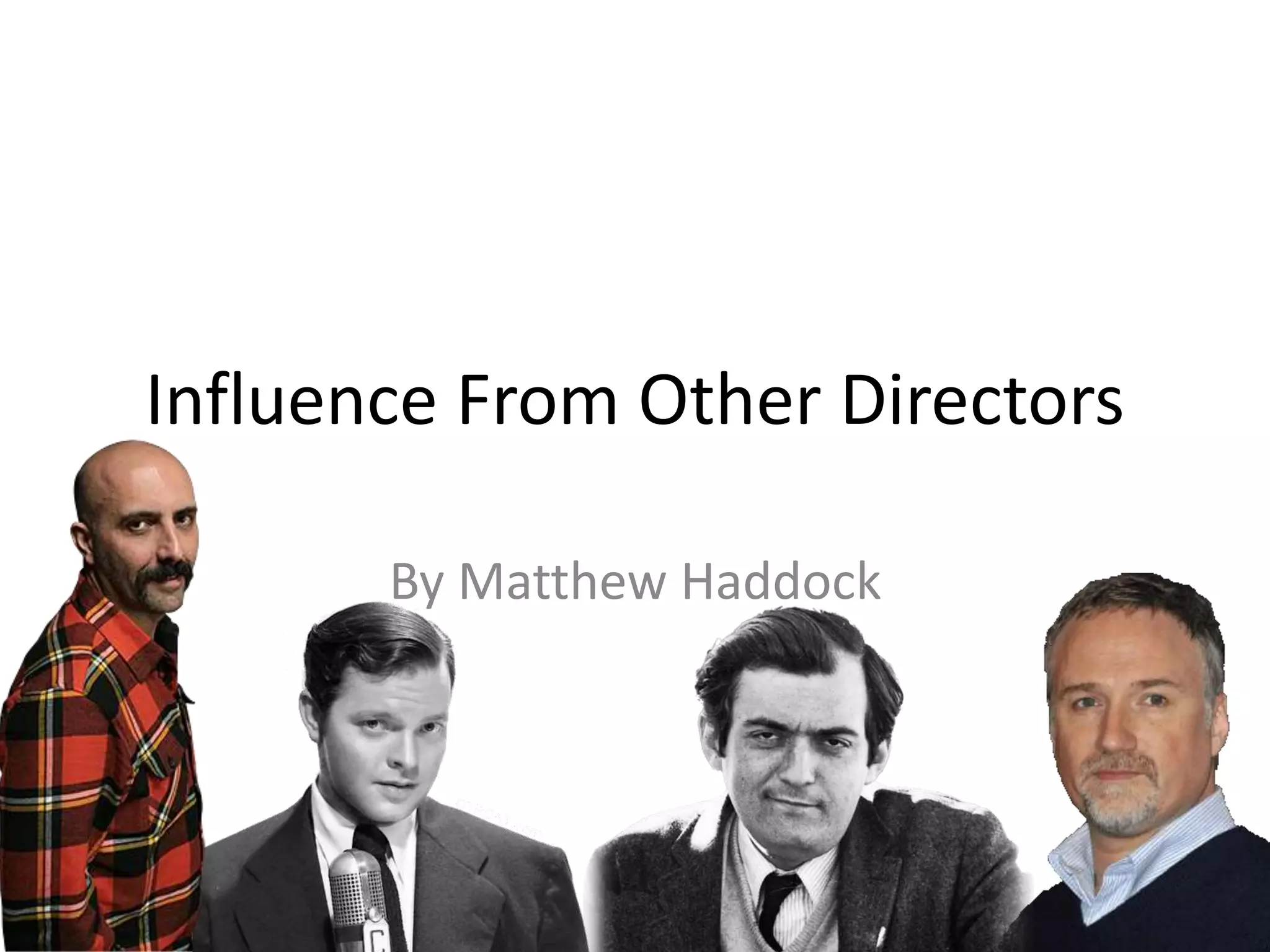
Influence From Other Directors
By Matthew Haddock
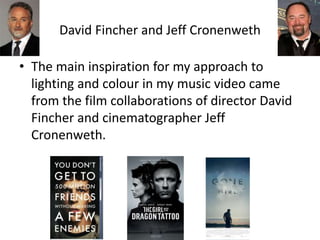
David Fincher and Jeff Cronenweth
• The main inspiration for my approach to
lighting and colour in my music video came
from the film collaborations of director David
Fincher and cinematographer Jeff
Cronenweth.
David Fincher and Jeff Cronenweth:
The Social Network
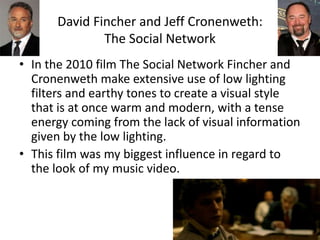
• In the 2010 film The Social Network Fincher and
Cronenweth make extensive use of low lighting
filters and earthy tones to create a visual style
that is at once warm and modern, with a tense
energy coming from the lack of visual information
given by the low lighting.
• This film was my biggest influence in regard to
the look of my music video.
How Fincher and Cronenweth
Influenced My Lighting
• The arresting visual style of The Social Network was my impetus to use colour filters to
change the feeling of my shots. As my phone has on-the-fly image adjustment software I was
able to do this dynamically, in fact there is no colour adjustment done in post-production in
the entire video.
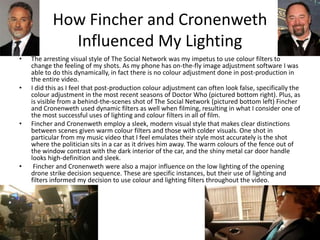
• I did this as I feel that post-production colour adjustment can often look false, specifically the
colour adjustment in the most recent seasons of Doctor Who (pictured bottom right). Plus, as
is visible from a behind-the-scenes shot of The Social Network (pictured bottom left) Fincher
and Cronenweth used dynamic filters as well when filming, resulting in what I consider one of
the most successful uses of lighting and colour filters in all of film.
• Fincher and Cronenweth employ a sleek, modern visual style that makes clear distinctions
between scenes given warm colour filters and those with colder visuals. One shot in
particular from my music video that I feel emulates their style most accurately is the shot
where the politician sits in a car as it drives him away. The warm colours of the fence out of
the window contrast with the dark interior of the car, and the shiny metal car door handle
looks high-definition and sleek.
• Fincher and Cronenweth were also a major influence on the low lighting of the opening
drone strike decision sequence. These are specific instances, but their use of lighting and
filters informed my decision to use colour and lighting filters throughout the video.
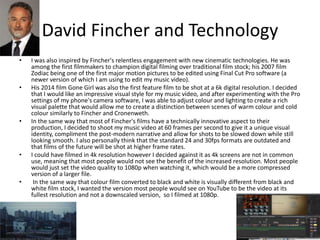
David Fincher and Technology
• I was also inspired by Fincher's relentless engagement with new cinematic technologies. He was
among the first filmmakers to champion digital filming over traditional film stock; his 2007 film
Zodiac being one of the first major motion pictures to be edited using Final Cut Pro software (a
newer version of which I am using to edit my music video).
• His 2014 film Gone Girl was also the first feature film to be shot at a 6k digital resolution. I decided
that I would like an impressive visual style for my music video, and after experimenting with the Pro
settings of my phone's camera software, I was able to adjust colour and lighting to create a rich
visual palette that would allow me to create a distinction between scenes of warm colour and cold
colour similarly to Fincher and Cronenweth.
• In the same way that most of Fincher's films have a technically innovative aspect to their
production, I decided to shoot my music video at 60 frames per second to give it a unique visual
identity, compliment the post-modern narrative and allow for shots to be slowed down while still
looking smooth. I also personally think that the standard 24 and 30fps formats are outdated and
that films of the future will be shot at higher frame rates.
• I could have filmed in 4k resolution however I decided against it as 4k screens are not in common
use, meaning that most people would not see the benefit of the increased resolution. Most people
would just set the video quality to 1080p when watching it, which would be a more compressed
version of a larger file.
• In the same way that colour film converted to black and white is visually different from black and
white film stock, I wanted the version most people would see on YouTube to be the video at its
fullest resolution and not a downscaled version, so I filmed at 1080p.
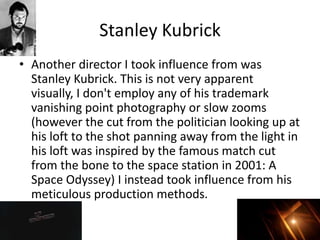
Stanley Kubrick
• Another director I took influence from was
Stanley Kubrick. This is not very apparent
visually, I don't employ any of his trademark
vanishing point photography or slow zooms
(however the cut from the politician looking up at
his loft to the shot panning away from the light in
his loft was inspired by the famous match cut
from the bone to the space station in 2001: A
Space Odyssey) I instead took influence from his
meticulous production methods.
Stanley Kubrick’s Production Methods
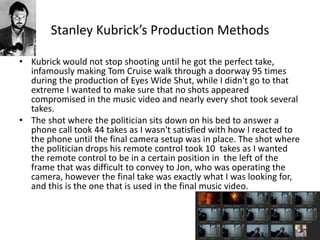
• Kubrick would not stop shooting until he got the perfect take,
infamously making Tom Cruise walk through a doorway 95 times
during the production of Eyes Wide Shut, while I didn't go to that
extreme I wanted to make sure that no shots appeared
compromised in the music video and nearly every shot took several
takes.
• The shot where the politician sits down on his bed to answer a
phone call took 44 takes as I wasn't satisfied with how I reacted to
the phone until the final camera setup was in place. The shot where
the politician drops his remote control took 10 takes as I wanted
the remote control to be in a certain position in the left of the
frame that was difficult to convey to Jon, who was operating the
camera, however the final take was exactly what I was looking for,
and this is the one that is used in the final music video.
Stanley Kubrick and Mise-en-Scene
• Kubrick was also meticulous about mise-en-scene, his films reward close inspection as almost every
element of their mise-en-scene would have been obsessed over by Kubrick, usually with a deeper
relevance to the narrative. I decided to make sure that my mise-en-scene would reward pausing
and looking around by including aspects that are not intended to be noticed on first viewing but
serve to deepen the narrative.
• For example: the newspaper that announces the politician's responsibility for the fatal drone strike
also has a front-page story about poor quality security services in the local area, this explains why,
during the final confrontation scene, the security guards at the meeting do not intervene sooner,
and only arrive in time to catch the politician as he falls.
• I would also try to keep continuity across the mise-en-scene as shots that occur sequentially in the
video were mostly shot days, weeks and even months apart.
• For example: the shot where the politician looks over his balcony was shot several weeks before the
shot earlier in the video where he is driven to work. These scenes occur in the same location and I
made sure that the mise-en-scene was still the same. I noticed that in the area of the fence the car
would drive past, a broom and three wheelie bins were propped against the fence, in the order
black-green-brown going left to right. When it came to shoot the scene in the car I saw that the
wheelie bins were now in a different order, and so moved them around so they were back to the
black-green-brown order that they were in before. While viewers may not notice details like these,
they are necessary to maintain proper continuity.
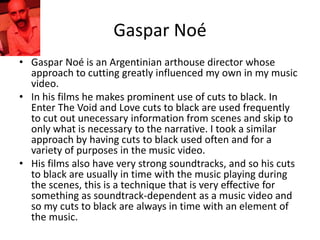
Gaspar Noé
• Gaspar Noé is an Argentinian arthouse director whose
approach to cutting greatly influenced my own in my music
video.
• In his films he makes prominent use of cuts to black. In
Enter The Void and Love cuts to black are used frequently
to cut out unecessary information from scenes and skip to
only what is necessary to the narrative. I took a similar
approach by having cuts to black used often and for a
variety of purposes in the music video.
• His films also have very strong soundtracks, and so his cuts
to black are usually in time with the music playing during
the scenes, this is a technique that is very effective for
something as soundtrack-dependent as a music video and
so my cuts to black are always in time with an element of
the music.
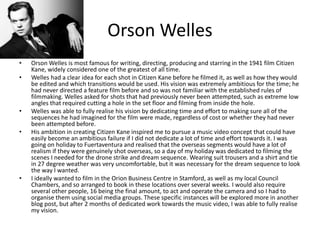
Orson Welles
• Orson Welles is most famous for writing, directing, producing and starring in the 1941 film Citizen
Kane, widely considered one of the greatest of all time.
• Welles had a clear idea for each shot in Citizen Kane before he filmed it, as well as how they would
be edited and which transitions would be used. His vision was extremely ambitious for the time; he
had never directed a feature film before and so was not familiar with the established rules of
filmmaking. Welles asked for shots that had previously never been attempted, such as extreme low
angles that required cutting a hole in the set floor and filming from inside the hole.
• Welles was able to fully realise his vision by dedicating time and effort to making sure all of the
sequences he had imagined for the film were made, regardless of cost or whether they had never
been attempted before.
• His ambition in creating Citizen Kane inspired me to pursue a music video concept that could have
easily become an ambitious failure if I did not dedicate a lot of time and effort towards it. I was
going on holiday to Fuertaventura and realised that the overseas segments would have a lot of
realism if they were genuinely shot overseas, so a day of my holiday was dedicated to filming the
scenes I needed for the drone strike and dream sequence. Wearing suit trousers and a shirt and tie
in 27 degree weather was very uncomfortable, but it was necessary for the dream sequence to look
the way I wanted.
• I ideally wanted to film in the Orion Business Centre in Stamford, as well as my local Council
Chambers, and so arranged to book in these locations over several weeks. I would also require
several other people, 16 being the final amount, to act and operate the camera and so I had to
organise them using social media groups. These specific instances will be explored more in another
blog post, but after 2 months of dedicated work towards the music video, I was able to fully realise
my vision.

Influence From Other Directors

  • 1.
    Influence From OtherDirectors By Matthew Haddock
  • 2.
    David Fincher andJeff Cronenweth • The main inspiration for my approach to lighting and colour in my music video came from the film collaborations of director David Fincher and cinematographer Jeff Cronenweth.
  • 3.
    David Fincher andJeff Cronenweth: The Social Network • In the 2010 film The Social Network Fincher and Cronenweth make extensive use of low lighting filters and earthy tones to create a visual style that is at once warm and modern, with a tense energy coming from the lack of visual information given by the low lighting. • This film was my biggest influence in regard to the look of my music video.
  • 4.
    How Fincher andCronenweth Influenced My Lighting • The arresting visual style of The Social Network was my impetus to use colour filters to change the feeling of my shots. As my phone has on-the-fly image adjustment software I was able to do this dynamically, in fact there is no colour adjustment done in post-production in the entire video. • I did this as I feel that post-production colour adjustment can often look false, specifically the colour adjustment in the most recent seasons of Doctor Who (pictured bottom right). Plus, as is visible from a behind-the-scenes shot of The Social Network (pictured bottom left) Fincher and Cronenweth used dynamic filters as well when filming, resulting in what I consider one of the most successful uses of lighting and colour filters in all of film. • Fincher and Cronenweth employ a sleek, modern visual style that makes clear distinctions between scenes given warm colour filters and those with colder visuals. One shot in particular from my music video that I feel emulates their style most accurately is the shot where the politician sits in a car as it drives him away. The warm colours of the fence out of the window contrast with the dark interior of the car, and the shiny metal car door handle looks high-definition and sleek. • Fincher and Cronenweth were also a major influence on the low lighting of the opening drone strike decision sequence. These are specific instances, but their use of lighting and filters informed my decision to use colour and lighting filters throughout the video.
  • 5.
    David Fincher andTechnology • I was also inspired by Fincher's relentless engagement with new cinematic technologies. He was among the first filmmakers to champion digital filming over traditional film stock; his 2007 film Zodiac being one of the first major motion pictures to be edited using Final Cut Pro software (a newer version of which I am using to edit my music video). • His 2014 film Gone Girl was also the first feature film to be shot at a 6k digital resolution. I decided that I would like an impressive visual style for my music video, and after experimenting with the Pro settings of my phone's camera software, I was able to adjust colour and lighting to create a rich visual palette that would allow me to create a distinction between scenes of warm colour and cold colour similarly to Fincher and Cronenweth. • In the same way that most of Fincher's films have a technically innovative aspect to their production, I decided to shoot my music video at 60 frames per second to give it a unique visual identity, compliment the post-modern narrative and allow for shots to be slowed down while still looking smooth. I also personally think that the standard 24 and 30fps formats are outdated and that films of the future will be shot at higher frame rates. • I could have filmed in 4k resolution however I decided against it as 4k screens are not in common use, meaning that most people would not see the benefit of the increased resolution. Most people would just set the video quality to 1080p when watching it, which would be a more compressed version of a larger file. • In the same way that colour film converted to black and white is visually different from black and white film stock, I wanted the version most people would see on YouTube to be the video at its fullest resolution and not a downscaled version, so I filmed at 1080p.
  • 6.
    Stanley Kubrick • Anotherdirector I took influence from was Stanley Kubrick. This is not very apparent visually, I don't employ any of his trademark vanishing point photography or slow zooms (however the cut from the politician looking up at his loft to the shot panning away from the light in his loft was inspired by the famous match cut from the bone to the space station in 2001: A Space Odyssey) I instead took influence from his meticulous production methods.
  • 7.
    Stanley Kubrick’s ProductionMethods • Kubrick would not stop shooting until he got the perfect take, infamously making Tom Cruise walk through a doorway 95 times during the production of Eyes Wide Shut, while I didn't go to that extreme I wanted to make sure that no shots appeared compromised in the music video and nearly every shot took several takes. • The shot where the politician sits down on his bed to answer a phone call took 44 takes as I wasn't satisfied with how I reacted to the phone until the final camera setup was in place. The shot where the politician drops his remote control took 10 takes as I wanted the remote control to be in a certain position in the left of the frame that was difficult to convey to Jon, who was operating the camera, however the final take was exactly what I was looking for, and this is the one that is used in the final music video.
  • 8.
    Stanley Kubrick andMise-en-Scene • Kubrick was also meticulous about mise-en-scene, his films reward close inspection as almost every element of their mise-en-scene would have been obsessed over by Kubrick, usually with a deeper relevance to the narrative. I decided to make sure that my mise-en-scene would reward pausing and looking around by including aspects that are not intended to be noticed on first viewing but serve to deepen the narrative. • For example: the newspaper that announces the politician's responsibility for the fatal drone strike also has a front-page story about poor quality security services in the local area, this explains why, during the final confrontation scene, the security guards at the meeting do not intervene sooner, and only arrive in time to catch the politician as he falls. • I would also try to keep continuity across the mise-en-scene as shots that occur sequentially in the video were mostly shot days, weeks and even months apart. • For example: the shot where the politician looks over his balcony was shot several weeks before the shot earlier in the video where he is driven to work. These scenes occur in the same location and I made sure that the mise-en-scene was still the same. I noticed that in the area of the fence the car would drive past, a broom and three wheelie bins were propped against the fence, in the order black-green-brown going left to right. When it came to shoot the scene in the car I saw that the wheelie bins were now in a different order, and so moved them around so they were back to the black-green-brown order that they were in before. While viewers may not notice details like these, they are necessary to maintain proper continuity.
  • 9.
    Gaspar Noé • GasparNoé is an Argentinian arthouse director whose approach to cutting greatly influenced my own in my music video. • In his films he makes prominent use of cuts to black. In Enter The Void and Love cuts to black are used frequently to cut out unecessary information from scenes and skip to only what is necessary to the narrative. I took a similar approach by having cuts to black used often and for a variety of purposes in the music video. • His films also have very strong soundtracks, and so his cuts to black are usually in time with the music playing during the scenes, this is a technique that is very effective for something as soundtrack-dependent as a music video and so my cuts to black are always in time with an element of the music.
  • 10.
    Orson Welles • OrsonWelles is most famous for writing, directing, producing and starring in the 1941 film Citizen Kane, widely considered one of the greatest of all time. • Welles had a clear idea for each shot in Citizen Kane before he filmed it, as well as how they would be edited and which transitions would be used. His vision was extremely ambitious for the time; he had never directed a feature film before and so was not familiar with the established rules of filmmaking. Welles asked for shots that had previously never been attempted, such as extreme low angles that required cutting a hole in the set floor and filming from inside the hole. • Welles was able to fully realise his vision by dedicating time and effort to making sure all of the sequences he had imagined for the film were made, regardless of cost or whether they had never been attempted before. • His ambition in creating Citizen Kane inspired me to pursue a music video concept that could have easily become an ambitious failure if I did not dedicate a lot of time and effort towards it. I was going on holiday to Fuertaventura and realised that the overseas segments would have a lot of realism if they were genuinely shot overseas, so a day of my holiday was dedicated to filming the scenes I needed for the drone strike and dream sequence. Wearing suit trousers and a shirt and tie in 27 degree weather was very uncomfortable, but it was necessary for the dream sequence to look the way I wanted. • I ideally wanted to film in the Orion Business Centre in Stamford, as well as my local Council Chambers, and so arranged to book in these locations over several weeks. I would also require several other people, 16 being the final amount, to act and operate the camera and so I had to organise them using social media groups. These specific instances will be explored more in another blog post, but after 2 months of dedicated work towards the music video, I was able to fully realise my vision.