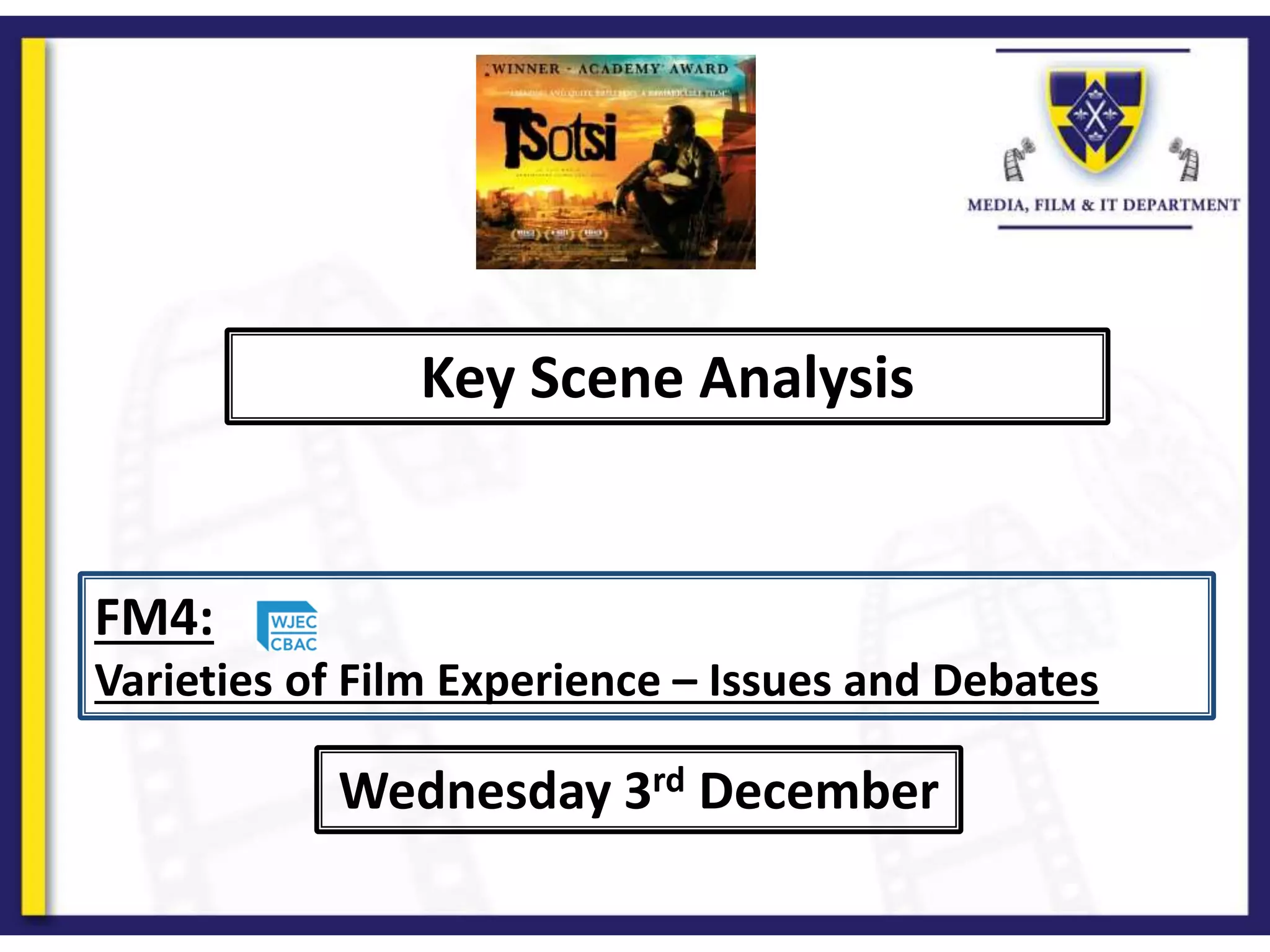
Key Scene Analysis
Wednesday 3rd December
FM4:
Varieties of Film Experience – Issues and Debates
After School Screening – Compulsory
Monday 8th December
Why?
Aims & Objectives
• YOU WILL re-cap prior
learning.
• YOU WILL improve your
understanding of the
text by analyzing 3 key
scenes over the next 2
lessons.
• Review the learning.
AO1
Demonstrate knowledge and
understanding of film as an
audio-visual form of creative
expression together and
AO2
Apply knowledge and
understanding, including
some of the common critical
approaches that characterise
the subject, when exploring
and analysing films.
Starter –
Re-cap Prior Learning
YOU WILL be asked to fill in the missing word in relation to a key theme and/or issue
represented in the text.
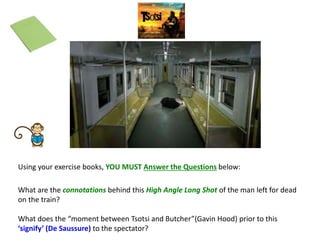
What are the connotations behind this High Angle Long Shot of the man left for dead
on the train?
What does the “moment between Tsotsi and Butcher”(Gavin Hood) prior to this
‘signify’ (De Saussure) to the spectator?
Using your exercise books, YOU MUST Answer the Questions below:
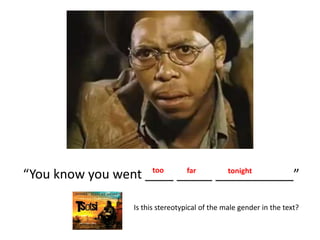
“You know you went ____ _____ ___________”too far tonight
Is this stereotypical of the male gender in the text?
Starter 2) –
Narrative
In your own words, YOU MUST establish HOW the following is represented in ‘Tsotsi’:
Syd Field – Narrative Theory
Act 1) – “The Set Up” = WHAT occurs during the first 10 minutes in terms of establishing
the characters, setting and plot? YOU SHOULD select and recall examples from the text.
Act 2) – “The Confrontation” – WHAT confrontations take place in the narrative? WHY?
HOW are they resolved?
Act 3) – “The Resolution” – HOW is Tsotsi’s situation resolved in the eyes of the spectator?
Key Scene Analysis
YOU MUST – using the handout – answer the questions in relation to the key scenes
we are going to be watching.
YOU SHOULD complete the Film Language boxes as well to help you gain a better
understanding of HOW Gavin Hood uses Film Language to construct the
representation of the characters and a “difficult urban environment”.
What have you learnt?
PLENARY – 2 minutes
YOU MUST write down as
much as you can about what
you have learnt in today’s
lesson.
Extension – YOU COULD
refer to specific examples
from the text OR from what
Gavin Hood said about some
of the “Stylistic choices”
made.

L10 l11 - tsotsi key scene analysis

  • 1.
    Key Scene Analysis Wednesday3rd December FM4: Varieties of Film Experience – Issues and Debates
  • 2.
    After School Screening– Compulsory Monday 8th December
  • 3.
    Why? Aims & Objectives •YOU WILL re-cap prior learning. • YOU WILL improve your understanding of the text by analyzing 3 key scenes over the next 2 lessons. • Review the learning. AO1 Demonstrate knowledge and understanding of film as an audio-visual form of creative expression together and AO2 Apply knowledge and understanding, including some of the common critical approaches that characterise the subject, when exploring and analysing films.
  • 4.
    Starter – Re-cap PriorLearning YOU WILL be asked to fill in the missing word in relation to a key theme and/or issue represented in the text.
  • 5.
    What are theconnotations behind this High Angle Long Shot of the man left for dead on the train? What does the “moment between Tsotsi and Butcher”(Gavin Hood) prior to this ‘signify’ (De Saussure) to the spectator? Using your exercise books, YOU MUST Answer the Questions below:
  • 6.
    “You know youwent ____ _____ ___________”too far tonight Is this stereotypical of the male gender in the text?
  • 7.
    Starter 2) – Narrative Inyour own words, YOU MUST establish HOW the following is represented in ‘Tsotsi’: Syd Field – Narrative Theory Act 1) – “The Set Up” = WHAT occurs during the first 10 minutes in terms of establishing the characters, setting and plot? YOU SHOULD select and recall examples from the text. Act 2) – “The Confrontation” – WHAT confrontations take place in the narrative? WHY? HOW are they resolved? Act 3) – “The Resolution” – HOW is Tsotsi’s situation resolved in the eyes of the spectator?
  • 8.
    Key Scene Analysis YOUMUST – using the handout – answer the questions in relation to the key scenes we are going to be watching. YOU SHOULD complete the Film Language boxes as well to help you gain a better understanding of HOW Gavin Hood uses Film Language to construct the representation of the characters and a “difficult urban environment”.
  • 9.
  • 10.
    PLENARY – 2minutes YOU MUST write down as much as you can about what you have learnt in today’s lesson. Extension – YOU COULD refer to specific examples from the text OR from what Gavin Hood said about some of the “Stylistic choices” made.

Editor's Notes

  • #5 Adapt for other lessons
  • #8 Adapt for other lessons