Responsibility To Protect (R2P)
by
Angela Bellington
Nicholas Metherall
Gibran Malik
What is R2P?
Is a principle aimed at the protection of the worlds
most vulnerable populations from the most heinous
International crimes.
 I.e War crimes, Ethnic Cleansing, Crimes against
humanity and Genocide.
3 key elements of R2P.
When a country is manifestly failing to protect its own
people, then the international community has a
responsibility to protect & may take collective action in
a timely manner or even using force as last resort.
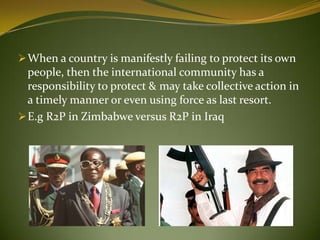
E.g R2P in Zimbabwe versus R2P in Iraq
Context – Military intervention in Libya 2011
Libya’s Human Security Context
 Escalating tensions leading to a civil war
between Gaddafi supporters and rebels
 UN Security Council Resolution 1973
 Negotiations for a ceasefire failed
 Intervention led by a coalition (US, UK, France,
Canada….) – NATO later assumed command
 Involved naval and air-force strikes against
Gaddafi’s military facilities.
 After the death of Gaddafi, NATO set exit date
RtoP – in Libya – justification: protecting the country’s people
 A last resort: failures of negotiation and ceasefire and continuing
threats against citizens and rebels
 State’s failure to safeguard human security
 Basis of protecting of civilians (PoC) in civil war to prevent massacre
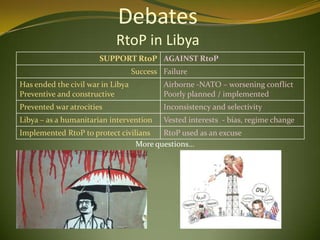
Debates
RtoP in Libya
SUPPORT RtoP AGAINST RtoP
Success Failure
Has ended the civil war in Libya
Preventive and constructive
Airborne -NATO – worsening conflict
Poorly planned / implemented
Prevented war atrocities Inconsistency and selectivity
Libya – as a humanitarian intervention Vested interests - bias, regime change
Implemented RtoP to protect civilians RtoP used as an excuse
More questions…
Conclusion
 R2P –an excuse for economic agenda
 Its political implication
 How far to intervene? Use of force ?
 The case of R2P being legally bound?
 What about famine, poverty, environmental
refugees?

Human security responsibility to protect

  • 1.
    Responsibility To Protect(R2P) by Angela Bellington Nicholas Metherall Gibran Malik
  • 2.
    What is R2P? Isa principle aimed at the protection of the worlds most vulnerable populations from the most heinous International crimes.  I.e War crimes, Ethnic Cleansing, Crimes against humanity and Genocide. 3 key elements of R2P.
  • 3.
    When a countryis manifestly failing to protect its own people, then the international community has a responsibility to protect & may take collective action in a timely manner or even using force as last resort. E.g R2P in Zimbabwe versus R2P in Iraq
  • 4.
    Context – Militaryintervention in Libya 2011 Libya’s Human Security Context  Escalating tensions leading to a civil war between Gaddafi supporters and rebels  UN Security Council Resolution 1973  Negotiations for a ceasefire failed  Intervention led by a coalition (US, UK, France, Canada….) – NATO later assumed command  Involved naval and air-force strikes against Gaddafi’s military facilities.  After the death of Gaddafi, NATO set exit date RtoP – in Libya – justification: protecting the country’s people  A last resort: failures of negotiation and ceasefire and continuing threats against citizens and rebels  State’s failure to safeguard human security  Basis of protecting of civilians (PoC) in civil war to prevent massacre
  • 5.
    Debates RtoP in Libya SUPPORTRtoP AGAINST RtoP Success Failure Has ended the civil war in Libya Preventive and constructive Airborne -NATO – worsening conflict Poorly planned / implemented Prevented war atrocities Inconsistency and selectivity Libya – as a humanitarian intervention Vested interests - bias, regime change Implemented RtoP to protect civilians RtoP used as an excuse More questions…
  • 6.
    Conclusion  R2P –anexcuse for economic agenda  Its political implication  How far to intervene? Use of force ?  The case of R2P being legally bound?  What about famine, poverty, environmental refugees?