Arms Control and Disarmament
SOHAIL NAWAZ
MSc Defense & Strategic Studies
Quaid-i-Azam University Islamabad
DEFINITIONAL ISSUES
What is arms control?
How is this different from Disarmament?
Does one lead to another?
Normative versus practical dimensions.
What causes arms control?
Is disarmament feasible?
DEFINING ARMS CONTROL
Any agreement among states to regulate some
aspects of their military capability or potential.
The agreement may apply to the location,
amount, readiness, and types of military forces,
weapons and facilities.
Arms control is an alternative approach to
achieving international security through military
strategies or ‘peace through manipulation of
force’
DEFINITION…
Participants jointly regulate their abilities to threaten
each other and to drive a bargaining advantage in
their context. So, an arms control agreement allows
states to retain their relative ability to bargain, but at
the same time, reducing the cost of sustaining these
abilities
ARMS CONTROL DEFINED
Jaffrey Larsen: “AC can be defined as any agreement
among states to regulate some aspect of their military
capability or potential. The agreement may apply to the
location, amount, readiness, and types of military
forces, weapons and facilities…all AC presuppose
some form of cooperation or joint action among the
participants regarding their military programs.”
FURTHER DEFINING ARMS CONTROL
1961 - Thomas Schelling & Morton Halprin:
“Adjustments in military postures and
doctrines that induce reciprocal
adjustments by a potential opponent can be
of mutual benefit if they reduce the danger
of a war that neither side wants, or contains
its violence, or otherwise serve the security
of the nation.
ARMS CONTROL
In its general conception, arms control is any type of restraint
on the use of arms, any form of military cooperation between
adversaries. Arms control can be implicit or explicit, formal
or informal, and unilateral, bilateral, or multilateral. It is a
process of jointly managing the weapons-acquisition
processes of the participant states in the hope of reducing
the risk of war… Arms control [refers] to formal agreements
imposing significant restrictions or limitations on the
weapons or security policies of the signatories.
DISARMAMENT
Disarmament rests on a fundamentally different
philosophical premise than arms control. It envisions the
drastic reduction or elimination of all weapons, looking
toward the eradication of war itself. Disarmament is based
on the notion that if there were no more weapons there
would be no more war. This is a compelling proposition, with
enough truth to give it a very long life in the history to
popular impression, it is not necessarily abut reducing arms
levels.
ARMS CONTROL AND DISARMAMENT
Arms control attempts to stabilize the status quo and to
manage conflict, to force. Although many visceral
opponents would be shocked at the thought, arms
control is fundamentally a conservative enterprise.
Disarmament, by contrast, is a radical one.
Disarmament seeks to overturn the status quo; arms
control works to perpetuate it.
MAJOR ARMS CONTROL AGREEMENT
Agreement Signed by Provision Year
Geneva Protocol 100+ Bans use of chemical weapons 1925
Antarctic Treaty Partial
Nuclear
12 Prohibits all military activity in Antarctic area 1959
Test Ban Treaty 131 Prohibits nuclear explosions in the atmosphere
In outer space, and under water
1963
Outer Space Treaty 127 Prohibits all military activity in outer space,
Including on the moon and other celestial
Bodies
1967
Treaty of Tlatelolco 35 Prohibits nuclear weapons in Latin America 1967
Nuclear Nonproliferation
Treaty
191 Prohibits acquisition of nuclear weapons by
Non-nuclear nations
1968
Seabed Arms Control 92 Bans placing nuclear weapons in o under the
seabed
1971
Biological Weapons
Convention
80+ Ban the possession and use of biological
weapons
1972
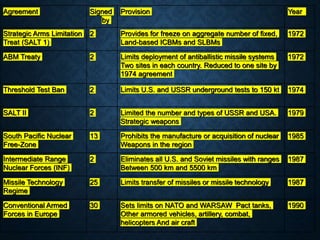
Agreement Signed
by
Provision Year
Strategic Arms Limitation
Treat (SALT 1)
2 Provides for freeze on aggregate number of fixed,
Land-based ICBMs and SLBMs
1972
ABM Treaty 2 Limits deployment of antiballistic missile systems
Two sites in each country. Reduced to one site by
1974 agreement
1972
Threshold Test Ban 2 Limits U.S. and USSR underground tests to 150 kt 1974
SALT II 2 Limited the number and types of USSR and USA.
Strategic weapons
1979
South Pacific Nuclear
Free-Zone
13 Prohibits the manufacture or acquisition of nuclear
Weapons in the region
1985
Intermediate Range
Nuclear Forces (INF)
2 Eliminates all U.S. and Soviet missiles with ranges
Between 500 km and 5500 km
1987
Missile Technology
Regime
25 Limits transfer of missiles or missile technology 1987
Conventional Armed
Forces in Europe
30 Sets limits on NATO and WARSAW Pact tanks,
Other armored vehicles, artillery, combat,
helicopters And air craft
1990
MAJOR ARMS CONTROL AGREEMENTS
Agreement Signatories Provisions Year
CTBT Over 180 Bans nuclear Tests, Allows sub-
critical tests
1996
ARMS CONTROL TREATIES
1925 Washington Naval Treaty, 1922 (as part of the naval
conferences)
Geneva Protocol on chemical and biological weapons,
1925 and its two augmentations:
Biological Weapons Conventions, 1972
Chemical Weapons Conventions, 1993
Outer Space Treaty, 1967
Nuclear Non-Proliferation Treaty, 1968
Anti- Ballistic Missile Treaty, 1972
ARMS CONTROL TREATIES
Environmental Modification Convention, 1976
Intermediate-Range Nuclear Forces Treaty, 1987
Missile Technology Control Regime (MTCR ), 1987
Treaty on Conventional Armed Forces in Europe,
1992
Strategic Arms Reduction Treaty (START I ), 1994
Wassenaar Arrangement, 1996
ARMS CONTROL TREATIES
Comprehensive Test Ban Treaty, 1996
Open Skies Treaty, 2002
Strategic Offensive Reductions Treaty ( SORT),
2003
START Three (2010)
ARMS CONTROL – THE COLD WAR DAYS
Theory developed as an adjunct to national security
from 1958 – 62
Instead of disarmament it emphasized enhancement
of cooperative security arrangements
Numerous institutional mechanisms
Problems of trust
Problems of verification
COLD WAR DAYS…
The driver of arms control agreements was the shared
perception regarding the fear of a nuclear war between
the two powers.
Arms control seen as a prime means of restraining
strategic arms race, especially restraining the use of
certain types of technologies that exacerbated the threat
of war
The objective was also to reduce the cost of war,
And reduce the damage of a war did occur
ARMS CONTROL EXPLAINED
According to Thomas Schelling and Morton Halprin:
“We believe that arms control is a promising, but still
only dimly perceived, enlargement of the scope of our
military strategy. It rests essentially on the recognition
that our military relations with potential enemies is not
one of pure conflict and opposition, but involves strong
elements of mutual interest in the avoidance of a war that
neither side wants, in minimizing the costs and risks of
the arms competition, and in curtailing the scope and
violence of war in the event it occurs.”
IT ACHIEVES…
Reduces possibility of war
Reduces political and economic costs
Minimizes the scope and violence of war
So it primarily depends on cooperation of
some level between adversaries
THE PURPOSE OF ARMS CONTROL
It is a means to an end which is enhancing security, especially
security against nuclear weapons
The three underlying principles of arms control are:
It is a means to an end – national security
States have a common interest in avoiding nuclear war
Arms control and military strategy should work together to
promote national security (deployment of weapons or an
adverse tactical maneuver)
OBJECTIVES OF ARMS CONTROL
Should be in broad harmony with national security
strategy
Arms control theory was developed during the Cold
War to deal with the questions of:
What deters?
How much is enough?
What if deterrence fails?
METHODOLOGY
Institutional mechanisms involving a certain
understanding regarding force buildup, strategic
deployment, etc
Improve strategic signaling
Build channels of communication
Increase exchange of information
INSTITUTIONS
Alliance or agreements - INCSEA, SALT or Indus
Water Treaty
Potential tools but remain on the sidelines of
statecraft (Track-II, III…)
Change preference over outcomes
Institutions are important because they have the
potential of generating powerful impact on the
policymaking process e.g. Anglo-French Entente
1904
Institutional mechanisms create enduring patterns
of shared expectation of behavior that gradually
receive some degree of formal assent – INCSEA or
Indus Water Treaty
INSTITUTIONAL MECHANISMS – ANOTHER
VIEW
Institutions will not have any substantial impact
because, as Charles Glaser Points out:
“Institutions are the product of the same
factors – states interests and the
constraints imposed by the system that
influence whether should cooperate”
ISSUES WITH ARMS CONTROL
Additional information cannot change the strategic
choices
There is also the issue of trust
The concept will not work because relations
between states are driven by their interest in
enhancing their power
Prisoner’s dilemma

Conceptual Arms Control And Disarmament

  • 1.
    Arms Control andDisarmament SOHAIL NAWAZ MSc Defense & Strategic Studies Quaid-i-Azam University Islamabad
  • 2.
    DEFINITIONAL ISSUES What isarms control? How is this different from Disarmament? Does one lead to another? Normative versus practical dimensions. What causes arms control? Is disarmament feasible?
  • 3.
    DEFINING ARMS CONTROL Anyagreement among states to regulate some aspects of their military capability or potential. The agreement may apply to the location, amount, readiness, and types of military forces, weapons and facilities. Arms control is an alternative approach to achieving international security through military strategies or ‘peace through manipulation of force’
  • 4.
    DEFINITION… Participants jointly regulatetheir abilities to threaten each other and to drive a bargaining advantage in their context. So, an arms control agreement allows states to retain their relative ability to bargain, but at the same time, reducing the cost of sustaining these abilities
  • 5.
    ARMS CONTROL DEFINED JaffreyLarsen: “AC can be defined as any agreement among states to regulate some aspect of their military capability or potential. The agreement may apply to the location, amount, readiness, and types of military forces, weapons and facilities…all AC presuppose some form of cooperation or joint action among the participants regarding their military programs.”
  • 6.
    FURTHER DEFINING ARMSCONTROL 1961 - Thomas Schelling & Morton Halprin: “Adjustments in military postures and doctrines that induce reciprocal adjustments by a potential opponent can be of mutual benefit if they reduce the danger of a war that neither side wants, or contains its violence, or otherwise serve the security of the nation.
  • 7.
    ARMS CONTROL In itsgeneral conception, arms control is any type of restraint on the use of arms, any form of military cooperation between adversaries. Arms control can be implicit or explicit, formal or informal, and unilateral, bilateral, or multilateral. It is a process of jointly managing the weapons-acquisition processes of the participant states in the hope of reducing the risk of war… Arms control [refers] to formal agreements imposing significant restrictions or limitations on the weapons or security policies of the signatories.
  • 8.
    DISARMAMENT Disarmament rests ona fundamentally different philosophical premise than arms control. It envisions the drastic reduction or elimination of all weapons, looking toward the eradication of war itself. Disarmament is based on the notion that if there were no more weapons there would be no more war. This is a compelling proposition, with enough truth to give it a very long life in the history to popular impression, it is not necessarily abut reducing arms levels.
  • 9.
    ARMS CONTROL ANDDISARMAMENT Arms control attempts to stabilize the status quo and to manage conflict, to force. Although many visceral opponents would be shocked at the thought, arms control is fundamentally a conservative enterprise. Disarmament, by contrast, is a radical one. Disarmament seeks to overturn the status quo; arms control works to perpetuate it.
  • 10.
    MAJOR ARMS CONTROLAGREEMENT Agreement Signed by Provision Year Geneva Protocol 100+ Bans use of chemical weapons 1925 Antarctic Treaty Partial Nuclear 12 Prohibits all military activity in Antarctic area 1959 Test Ban Treaty 131 Prohibits nuclear explosions in the atmosphere In outer space, and under water 1963 Outer Space Treaty 127 Prohibits all military activity in outer space, Including on the moon and other celestial Bodies 1967 Treaty of Tlatelolco 35 Prohibits nuclear weapons in Latin America 1967 Nuclear Nonproliferation Treaty 191 Prohibits acquisition of nuclear weapons by Non-nuclear nations 1968 Seabed Arms Control 92 Bans placing nuclear weapons in o under the seabed 1971 Biological Weapons Convention 80+ Ban the possession and use of biological weapons 1972
  • 11.
    Agreement Signed by Provision Year StrategicArms Limitation Treat (SALT 1) 2 Provides for freeze on aggregate number of fixed, Land-based ICBMs and SLBMs 1972 ABM Treaty 2 Limits deployment of antiballistic missile systems Two sites in each country. Reduced to one site by 1974 agreement 1972 Threshold Test Ban 2 Limits U.S. and USSR underground tests to 150 kt 1974 SALT II 2 Limited the number and types of USSR and USA. Strategic weapons 1979 South Pacific Nuclear Free-Zone 13 Prohibits the manufacture or acquisition of nuclear Weapons in the region 1985 Intermediate Range Nuclear Forces (INF) 2 Eliminates all U.S. and Soviet missiles with ranges Between 500 km and 5500 km 1987 Missile Technology Regime 25 Limits transfer of missiles or missile technology 1987 Conventional Armed Forces in Europe 30 Sets limits on NATO and WARSAW Pact tanks, Other armored vehicles, artillery, combat, helicopters And air craft 1990
  • 12.
    MAJOR ARMS CONTROLAGREEMENTS Agreement Signatories Provisions Year CTBT Over 180 Bans nuclear Tests, Allows sub- critical tests 1996
  • 13.
    ARMS CONTROL TREATIES 1925Washington Naval Treaty, 1922 (as part of the naval conferences) Geneva Protocol on chemical and biological weapons, 1925 and its two augmentations: Biological Weapons Conventions, 1972 Chemical Weapons Conventions, 1993 Outer Space Treaty, 1967 Nuclear Non-Proliferation Treaty, 1968 Anti- Ballistic Missile Treaty, 1972
  • 14.
    ARMS CONTROL TREATIES EnvironmentalModification Convention, 1976 Intermediate-Range Nuclear Forces Treaty, 1987 Missile Technology Control Regime (MTCR ), 1987 Treaty on Conventional Armed Forces in Europe, 1992 Strategic Arms Reduction Treaty (START I ), 1994 Wassenaar Arrangement, 1996
  • 15.
    ARMS CONTROL TREATIES ComprehensiveTest Ban Treaty, 1996 Open Skies Treaty, 2002 Strategic Offensive Reductions Treaty ( SORT), 2003 START Three (2010)
  • 16.
    ARMS CONTROL –THE COLD WAR DAYS Theory developed as an adjunct to national security from 1958 – 62 Instead of disarmament it emphasized enhancement of cooperative security arrangements Numerous institutional mechanisms Problems of trust Problems of verification
  • 17.
    COLD WAR DAYS… Thedriver of arms control agreements was the shared perception regarding the fear of a nuclear war between the two powers. Arms control seen as a prime means of restraining strategic arms race, especially restraining the use of certain types of technologies that exacerbated the threat of war The objective was also to reduce the cost of war, And reduce the damage of a war did occur
  • 18.
    ARMS CONTROL EXPLAINED Accordingto Thomas Schelling and Morton Halprin: “We believe that arms control is a promising, but still only dimly perceived, enlargement of the scope of our military strategy. It rests essentially on the recognition that our military relations with potential enemies is not one of pure conflict and opposition, but involves strong elements of mutual interest in the avoidance of a war that neither side wants, in minimizing the costs and risks of the arms competition, and in curtailing the scope and violence of war in the event it occurs.”
  • 19.
    IT ACHIEVES… Reduces possibilityof war Reduces political and economic costs Minimizes the scope and violence of war So it primarily depends on cooperation of some level between adversaries
  • 20.
    THE PURPOSE OFARMS CONTROL It is a means to an end which is enhancing security, especially security against nuclear weapons The three underlying principles of arms control are: It is a means to an end – national security States have a common interest in avoiding nuclear war Arms control and military strategy should work together to promote national security (deployment of weapons or an adverse tactical maneuver)
  • 21.
    OBJECTIVES OF ARMSCONTROL Should be in broad harmony with national security strategy Arms control theory was developed during the Cold War to deal with the questions of: What deters? How much is enough? What if deterrence fails?
  • 22.
    METHODOLOGY Institutional mechanisms involvinga certain understanding regarding force buildup, strategic deployment, etc Improve strategic signaling Build channels of communication Increase exchange of information
  • 23.
    INSTITUTIONS Alliance or agreements- INCSEA, SALT or Indus Water Treaty Potential tools but remain on the sidelines of statecraft (Track-II, III…) Change preference over outcomes Institutions are important because they have the potential of generating powerful impact on the policymaking process e.g. Anglo-French Entente 1904 Institutional mechanisms create enduring patterns of shared expectation of behavior that gradually receive some degree of formal assent – INCSEA or Indus Water Treaty
  • 24.
    INSTITUTIONAL MECHANISMS –ANOTHER VIEW Institutions will not have any substantial impact because, as Charles Glaser Points out: “Institutions are the product of the same factors – states interests and the constraints imposed by the system that influence whether should cooperate”
  • 25.
    ISSUES WITH ARMSCONTROL Additional information cannot change the strategic choices There is also the issue of trust The concept will not work because relations between states are driven by their interest in enhancing their power Prisoner’s dilemma