Human Process Planning
Meaning
• Human resource planning (HRP) is the process of determining the number and
type of people an organization needs to meet its goals. It's also known as
workforce planning.
• Human resource planning is the first step in the process of recruitment and
selection of employees after a job analysis has been completed.
• The three basic objectives of any HR planning are:
(i) attracting, developing and retaining an efficient workforce,
(ii) evaluating and rewarding its performance, and
(iii) inventing and controlling HR plans and programmes to optimize the HR cost.
Meaning
HRP helps organizations ensure they have the right people to meet their
needs by aligning HR management with the organization's strategic
goals. It involves:
• Forecasting future needs: Using internal data and market trends to determine
the number of people needed and the level of talent required
• Assessing the current workforce: Evaluating employee skillsets and
identifying gaps
• Developing plans: Creating strategies to meet future HR needs, including
talent development
• Reviewing and evaluating: Reviewing and evaluating the action plan
Process
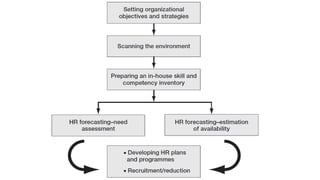
• The steps in a general HR planning process are:
(i) considering organizational objectives and strategies,
(ii) assessment of external environment,
(iii) preparation of an in-house skill and competency inventory,
(iv) HR forecasting— need assessment,
(v) HR forecasting—estimation of availability, and
(vi) developing HR plans and programmes.
1. Considering Organisational Objectives and
strategies
The first step in the HR planning process is the consideration of organizational objectives
and strategies.
The organizational strategy along with the mission and vision statement clearly expresses
the future intent of the organization.
The examination of the organizational strategy would provide a clear indication about the
future HR requirements of the firm. Thus, HR plans are guided by the overall
organizational objectives and strategies.
Each organizational strategy has direct and indirect implications for the human resources of
the organization.
In fact, HR plans are derived from the contents of the organizational objectives and
strategies. Thus, HR managers should consult the organizational objectives and policies for
framing guidelines concerning hiring policy, training policy, promotion policy, union issues
and automation. Certainly, the complete knowledge of the organizational objectives is the
first and the essential prerequisite for an effective HR planning process.
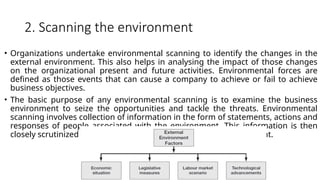
2. Scanning the environment
• Organizations undertake environmental scanning to identify the changes in the
external environment. This also helps in analysing the impact of those changes
on the organizational present and future activities. Environmental forces are
defined as those events that can cause a company to achieve or fail to achieve
business objectives.
• The basic purpose of any environmental scanning is to examine the business
environment to seize the opportunities and tackle the threats. Environmental
scanning involves collection of information in the form of statements, actions and
responses of people associated with the environment. This information is then
closely scrutinized to figure out the likely changes in the environment.
a) Economic Situation
• The economic conditions prevailing at a particular time have a direct and clear influence on the
HR requirements of the organization.
• In fact, the different phases of an economic cycle shape its HR plans. When the country
experiences an economic boom, organizations usually engage in massive hiring to meet the
growing demand for products by expanding their business operation.
• This often leads to labour shortage in the market and a subsequent rise in wage levels of the
employees.
• In contrast, during recessionary trends, organizations reduce the size of their workforce to save
labour costs. Besides, they become more conscious about the cost associated with recruitment,
selection, compensation, and training programmes.
b) Legislative Measure
Generally, the philosophy and policy of the government deeply affect business plans and
preparations.
The business philosophy of the government can be understood through its economic and commerce
policies and also through its various labour and industrial laws.
HR planners must be aware of the attitude of the government towards the business. They should also
know the limitations imposed by the government rules and regulations on the HR practices. Again,
they should take advantage of the relaxation offered by the rules and regulations that come into
being.
For instance, the Government of India amended the Industrial Disputes Act of 1947 as part of the
labour reform process. This decision enabled companies with a strength of up to 1,000 to retrench
employees without getting prior approval from the government. This change has apparently provided
more flexibility to the employers in the labour-separation process.
c) Labour Market Scenario
• The extent of competition in the labour market and the recruitment strategy of the rival
organizations also influence the HR plans of an organization.
• When the HR plans require relocation of employees in the form of transfers or redeployment, the
response of the affected employee would usually be based on the conditions of the labour market.
• When there is a labour shortage, the employee might seek a job change by quitting the company.
In such a situation, the HR planner must be more prudent in implementing sensitive HR decisions.
• Besides, the intensity of the competition and the recruitment strategy of the competitors in the
industry should also be considered while determining the pay scales and incentives.
• In the case of existing employees, the pay scale must be sufficient to protect them from being
poached by the rivals. As regards the new entrants, the compensation package must be adequate to
attract the best persons to the organization. The globalization process has widened the labour
market and thus sharply increased the importance of labour market scanning while devising HR
plans.
d) Technological Advancements
Technological developments have significantly changed the nature and composition
of the present-day workplaces.
The introduction of new technologies warrants a revamp of the work culture and
development of new skills and competencies.
It has also created more high-tech jobs in organizations.
In fact, the increasing presence of knowledge workers in high-tech jobs rendered
several of the existing HR policies and practices obsolete.
Consequently, organizations are now forced to develop creative and resourceful HR
initiatives to satisfy this new breed of employees. Therefore, HR planners must scan
the technological environment before preparing HR plans.
3. Preparation of in house skill and
competency inventory
• A compilation of skills, competencies and qualifications of the entire workforce is described as a skill inventory. Its
preparation may involve the determination of the sum of the employees’ experience, knowledge, education, and skill
levels. Actually, the quality and size of the skill inventory of an organization will influence its business strategy and
HR plans decisively.
• Skill Audit: Before preparing the HR plans, HR managers should know what skills and knowledge the organization
requires and what it possesses currently. In this regard, HR managers usually conduct a skills audit to assess the
current skill levels of the organization. It involves assessing the performance of the employees from the task
perspective. It also helps in identifying the employees’ strengths and weaknesses and the skill gap (skill
requirements) within the organization. Further, it assists in determining whether the present skills inventory is
sufficient to meet the organizational goals.
• Core competency Analysis: Core competencies are the extraordinary abilities of an organization that enables it to
acquire competitive advantage in the market. These abilities may be its advanced technology, well-reputed
management, problem-solving ability, employees’ KSA. From the HR perspective, core competency means the skills
and knowledge of the workforce available within an organization that differentiates it from its rivals in the industry
offer value (some benefits) to the customers. A core competency analysis is basically an internal analysis of the
general strengths and weaknesses of a firm. Organizations conduct it to identify their distinct competencies, systems
and processes suitable for further development necessary to gain a competitive advantage.
4. HR Forecasting- Need Assessment
• The success of HR plans depends on the accuracy of the HR forecasts that are needed to
implement the organizational strategies.
• These forecasts involve estimating the future requirements of the organization in terms of the
nature and the number of people.
• The information gathered through external environmental scanning and internal skill assessments
are used to predict the future HR requirements of the organization.
• However, HR forecasting usually depends on an organization’s estimation of future demand for its
goods or services in the market and the resultant profits.
• In addition to demand forecasting, an organization may also consider several other factors like
management philosophy, absenteeism and labour turnover rates, organizational growth pattern,
planned technological improvements, the proposed changes in product lines, and the financial
capabilities for forecasting HR requirements.
5. HR Forecasting-Estimation of Availability
• Once the human resource requirements of the organization are assessed, the next
critical process is the estimation of the availability of the required number of
employees.
• Usually, organizations have two prominent sources to meet their recruitments:
internal and external. In HR forecasting of the employee availability, three
scenarios are possible:
(i) getting a sufficient number of employees from internal sources;
(ii) getting them from external sources;
(iii) combining both sources to get adequate numbers;
6. Developing HR Plans and Programmes
• Once the organization completes the process of forecasting HR requirements and availability, the next step is its
comparison.
• Comparisons of the HR availability with the requirements help the organization in determining the viability of
the strategic business plans.
• The outcome of such comparisons would be either the recruitment of more employees or a reduction of the
existing workforce. In case of shortage of labour, the organization would undertake HR activities like
recruitment and selection, training and development, and placement of employees.
• In the event of surplus, the organization might resort to employee reduction programmes like a hiring freeze,
downsizing, voluntary retirement schemes, reduced working hours or days, and restricted overtimes.
• It is a difficult task for an organization to properly respond to the situation arising out of the HR forecasting
process. In a surplus scenario, an organization may resort to short-term measures like downsizing and reduced
working hours. However, in shortage scenarios, the organization may require long-range, strategic responses
like training and development to tackle the situation. Therefore, an organization should come up with the HR
policies and programmes necessary to deal with the situation.
7. Recruitment and Selection
• Recruitment is the process of searching for prospective employees
and stimulating and encouraging them to apply for jobs in an
organization.
• Selection is the process of choosing from among the candidates, from
within the organization or from the outside, the most suitable person
for the current position or for the future position.
Job Analysis
• Job analysis is an essential prerequisite for the effective management of the
human resources of an organization. It is the process of gathering relevant
information about a job. It actually specifies the tasks involved in a job and the
factors that influence the performance of that job.
• It acts as the basis for decisions involving human resource planning, recruitment
and selection, training and development, compensation fixation, job evaluation,
performance evaluation, career management, and health and safety of employees.
• Job analysis has applications in almost all the HR activities of an organization. It
acts as the basis for decisions involving human resource planning, recruitment and
selection, training and development, compensation fixation, job evaluation,
performance evaluation, career management, and health and safety of employees.
Features of Job Analysis
• Job analysis is a process of gathering relevant information about various aspects of a job and is concerned with the
identification of tasks required to be performed as part of it.
• It approaches the task of defining the role, context, conditions, human behaviour, performance standards, and
responsibilities of a job systematically.
• It helps in establishing the job’s worth to an organization. In other words, it measures the value and contribution of a job
to the growth of the organization.
• It establishes job relatedness, which is a crucial input for HR decisions involving recruitment, selection, compensations,
training, health and safety.
• It assists in the resource management and strategy formulation process of the organization to help it achieve its business
goals and objectives effectively.
• It helps in developing a job profile for each job and acts as the basis for developing job description and specification
statements.
• It helps in identifying the appropriate job for each employee so that the skills and knowledge of these employees are
utilized for the growth of the organization effectively.
• It facilitates the process of understanding the impact of environmental changes on individual jobs.
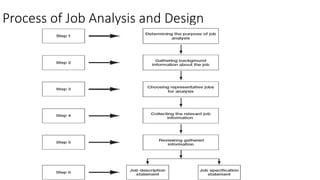
Process of Job Analysis and Design
1. Determining the purpose of Job Analysis
• The first step in the job analysis process is the determination of the end use of the job
analysis. True, job analysis has relevance for almost all HR activities of an organization.
• However, an organization may conduct a job analysis for a specific purpose like hiring the
employees or determining their remuneration.
• Depending upon the purpose of the analysis, the organization may focus specifically on
certain aspects of the job that are considered important. For instance, job analysis may
emphasize more on identifying information relating to the physical hazards, job difficulties
and work environment, when the job analysis is done to decide the safety measure for a job.
• In any case, the identification of the expected uses of the job analysis will enable the
organization to determine the nature and types of data to be collected, the techniques to be
adopted for data collection, and the focus of the analysis.
2. Gathering background information about
the job
• It is essential for an organization to review the background
information about the job to know its relative importance in the
organization.
• While doing so, the job analysis should focus on identifying
information relating to all the important elements of the job. This
information can be gathered with the help of organizational charts,
process charts, and job classification
3. Choosing representatives job for analysis
• Often, organizations choose only a few jobs for analysis
instead of analysing all of them. This is done because many
jobs are similar in nature and have similar characteristics.
Besides, organizations may find it time-consuming and costly
to analyse all their jobs. As a result, it becomes essential for
an organization to identify the representative jobs from a
group of identical jobs.
4. Collecting the relevant job information
• In this step, information pertaining to various aspects of the job is collected.
Specifically, the information about the duties, level of responsibility, authority,
accountability, content and context of the job, desired employee behaviour, critical
knowledge, knowledge skills and abilities (KSA), and training requirements are
gathered.
• These pieces of information can be gathered by contacting the present and
previous employees of the job, the supervisors and the managers. Methods like
structured or open-ended questionnaires, interviews, task inventories, checklists,
and observation are used for data collection.
5. Reviewing gathered information
• At this stage, the collected data is carefully analysed and then a job analysis report is prepared for
the job being reviewed. Generally, the specific job holders and their immediate supervisors are
included in such an analysis process. The opinion of the employee performing the job is
ascertained to verify the correctness and completeness of the job analysis report. In case the
employee or supervisor points out incompleteness or discrepancies in the report, supplementary
information could be collected.
6. Developing a job description and job
specifications
• This is the final stage in the process of job analysis. The two essential documents
of the firm, namely, the job description and job specification, are prepared on the
basis of the job analysis report.
• A job description is a written statement containing information about the duties,
responsibilities, accountabilities, working conditions and risks associated with the
job. Briefly, it is a summary of the various features of a job.
• A job specification is a statement that provides information from the job holder’s
perspective. It usually contains information about the eligibility conditions
required for a job holder in terms of educational qualifications, experience,
knowledge, skills, personal qualities, aptitude and the background required for
getting the job done.
Outcome of Job Analysis
• Job Analysis Ends with the preparation of
a) Job Description and
b) Job Specifications
Job Description
• Job description is a written statement that describes all the aspects of a job. It aims
at simplifying and standardizing the HR activities of an organization. It also
enables the employees to understand clearly what is expected of them in their
jobs. It contains both organizational information (structure, relationship, to name a
few) and functional information relating to the job. But, the description of each
task should be confined to a few sentences with the focus being on results.
• A job description should be comprehensive in every aspect. It should provide
information about job title, alternate title (if any), job position in the
organizational structure, relationship with other jobs, and the tasks, duties,
responsibilities and accountabilities associated with the job. In addition, it should
offer information on working conditions, physical hazard, and special equipments
required for task accomplishment.
Job Specifications
• A job specification can either be part of the job description
or an independent statement. It is actually a document that
specifies the minimum acceptable qualities required for a
person to complete the job satisfactorily. It usually contains
the details of the employee’s characteristics and the
qualifications essential for the job.
• “Job specification sets out the education, qualification,
training, personal attributes, and competencies a job holder
requires to perform her or his job satisfactorily.”
The important components of job specifications are:
• Education and training: A job specification states whether the job requires school- or college-level education.
It mentions the technical or professional qualification requirements of the job holder. Finally, it specifies the
minimum training requirements the job holder must have completed.
• Work Experience: A job specification prescribes the work experience requirements for the job holder and
sometimes also the minimum experience for effective performance.
• Skills and competencies: Under this component head, a job specification states the types of skills necessary
for the satisfactory performance of the job. It indicates the nature of skills required like computer skills,
communication skills, technical skills, and statistical skills.
• Physical strength and stamina: If the job involves physical activities like lifting or moving heavy objects, the
job specification also mentions the physical requirements of the job holder.
• Stress-coping abilities: When the nature of the job requires a lot of stress endurance and involves constant
work pressure in the form of deadlines or night shifts, the stress management ability of the candidate should
be mentioned.
• Special needs: If the job requires any special skills, knowledge and ability like extensive travelling, working
at odd hours, and good memory power, it should be clearly mentioned.
Job Design
• Job design is the specification of the contents, methods, and relationships of jobs in order to satisfy
technological and organisational requirements as well as the social and personal requirements of
the job holders.”
• It is basically a combination of the job content and the work method adopted in the job. Job
content states the tasks to be performed as part of the job while the work method deals with the
mode of performing the job.
• Thus, the basic aim of a job design is to clearly establish the role of each job and the job holder in
the overall system of an organization.
• “Job design is the process of determining the specific tasks to be performed, the methods used in
performing these tasks, and how the job relates to other work in the organization.”
Benefits of Job Design
• It enables the organization to develop a competent, dynamic and responsive workforce.
• It ensures that the customers get high-quality goods and services without any delay and interruptions.
• It helps the firm in achieving cost reduction by eliminating the causes of accidents and injuries
through enhanced health and safety measures.
• It enhances the employees’ satisfaction, motivation, involvement and commitment, leading to
improved cooperation between the management and the employees.
• It offers wide opportunities to the employees to convey their views and opinions to the management
through participative management programmes.
• Its implementation often requires the employees to undergo periodic training to upgrade their skills
and thus helps them in their career growth.
• It contributes effectively to the organizational effectiveness and, as a result, to the competitivenessof
the organization in the market.
Job Enrichment
• Job enrichment refers to the development of work practices that
challenge and motivate the employees to perform better. It often
results in achieving desired improvements in productivity, safety of
work, quality of products/services and job satisfaction. Organizations
also adopt job enrichment to encourage multitasking by the employees
in the job. Job enrichment may include, among others, the formation
of a quality circle, self-directed teams, job rotation and better
communication.
How to enrich jobs
• Encouraging the employees to involve themselves in goal setting and accomplishment activities.
• Enhancing the scope of the job to utilize the diverse skills of the employees.
• Allowing the employees to do the whole job, i.e., from the beginning till the end, so that they could develop a sense of
achievement.
• Providing necessary autonomy to the employees on matters relating to the method,speed and order of doing the job.
• Encouraging the employees to know the significance of their work in terms of its contribution to the accomplishment of the
overall goal of the organization.
• Constantly challenging the employees to adopt innovation in job by acquiring new knowledge and skills.
• Improving the information sharing process by strengthening the existing communication channels and also by introducing
new communication channels.
• Ensuring that the employees get timely and adequate recognition and appreciation for their effective performance and
successful completion of the job.
• Enabling the employees to get constant feedback of their own performance by communicating the results of the work done
by them.
• Making employees believe that the present job is not an end but only a means for better prospects in the organization.
Recruitment
• “Recruitment means attracting candidates, which is primarily a matter of
identifying, evaluating and using the most appropriate source of applicants.”
• Recruitment provides the first contact for an organization with its potential
employees. An organization must have an effective recruitment policy and process
to inform candidates about the job openings and persuade them to apply for the
available positions. The efficacy of the recruitment process may be measured in
terms of the quality and quantity of the applicant pool (the grouping of applicants
based on the type of job) created by it.
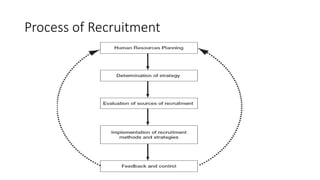
Process of Recruitment
1. Human Resource Planning
• Human resources plans clearly estimate the levels and kinds of human resources required to ensure
the accomplishment of the strategic plan of the organization.
• Human resources planning involves the estimation of how many qualified persons are necessary to
carry out the assigned activities (personnel demand), how many people will be available (internal
supply), and what must be done to ensure that the personnel supply equals the personnel demand
at an appropriate point in the future (the reconciliation process).
• Thus, the first step is the estimation of the future HR requirements of the organization and a
decision to meet the personnel demand with an adequate supply through recruitment.
2. Determination of Strategy
The second step in the process of recruitment is the determination of strategy for
choosing the candidates. It may include, among others, the development of different
sources of recruitment, the preferences to be followed, the recruitment method to be
used and the series of activities to be undertaken.
Job specification reports that specify the quality and quantity of personnel required
for the organization help us in determining the strategy to be adopted. The strategy
must be designed in such a way that it attracts as many applicants as possible.
3. Evaluation of sources of recruitment
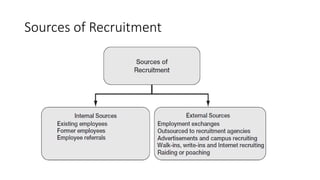
• There are two important sources of recruitment in every firm, namely, internal and
external. Internal sources include, among others, the existing employees, the
former employees and employee referrals, while the external sources refer to all
sources other than the internal ones.
• For instance, employment exchanges, employment associations, professional
associations, public advertisements and educational institutions constitute external
sources. Evaluation refers to the assessment of strengths and weaknesses of the
sources available to an organization. One of the studies 10 mentions that the
measurement refers to finding an answer to the question, “How many applicants did
we generate through each of our recruitment processes?”
• Organizations can attract a good number of qualified applicants by combining one
or more sources
4. Implementation of Recruitment methods
and strategies
• Having evaluated the various sources of recruitment, the next stage is
the finalization of the sources and the actual implementation of
strategies.
• Regardless of whether the organization decides to recruit from internal
or external sources, the recruitment method and strategy must be
implemented in accordance with all relevant laws and regulation.
5. Feedback and Control
• As recruitment is a continuous process, it is essential to evaluate it to enhance its
effectiveness.
• The quality of the applicant pool is an indicator of the efficacy of the recruitment
process.
• If the process discourages the potentially qualified individuals from applying, limits
the size of the applicant pool or results in inferior applicants becoming the
employees of the organization, there is a need for a change in the recruitment
process.
Sources of Recruitment
A. Internal Recruitment
• Internal recruitment usually refers to filling open jobs with the current employees of the
organization. It is a process designed to create sufficient interest among the current employees
to cause them to formally indicate an interest in a given position. The position applied for
may represent a promotion, a transfer, or even a demotion in a few cases.
• 1) Existing Employees:
The most common source of internal recruitment is through existing employees. Organizations
normally maintain inventories of qualifications to choose employees for suitable vacancies.
Such inventories contain data such as the current employee’s performance, educational
background and suitability. The usual method of creating a pool of internal applicants is through
job postings. A job posting refers to the process of advertising available positions to the
employees. They evaluate job opportunities relative to their skills, experience, interests, and
career goals and indicate their interest formally to their immediate supervisor or through the HR
department. Promotions and transfers from among the existing employees are examples of
internal sources of recruitment.
2) Former Employees: Former employees are also considered as an internal source of
recruitment for they are acquainted with the policies and practices of the organization. Besides,
they enjoy familiarity with the present employees in most cases. It is now increasingly
common to take back employees who left the firm for various reasons. This is because the ex-
employees’ performance and attitude are well known to the organization and the risk involved
in choosing them is relatively less.
3) Employee Referral: This method refers to the practice of the present employees providing
information about the candidates who are willing to be considered for the present vacancies.
The applicants may be the friends or relatives of the referring employees. Referral is also a
cost-effective source of recruitment. Its effectiveness lies in the assumption that the present
employees will recommend only suitable candidates for the vacant jobs lest their own
credibility be affected. Employee referrals are also an effective tool to stem the tide of
attrition. When friends work together, they are less likely to leave a company soon. However,
employee referrals may prove to be a major source of irritation in the employer–employee
relations, if such referrals are rejected.
Merits and Limitations of Internal
Recruitment
• It helps the organization in offering career development plans to its employees.
• Internal candidates may require less orientation and training than outside ones.
• Internal recruitment can act as a good motivator and morale-booster if the employees see promotions as a reward for and
recognition of their hard work and efficiency.
• It facilitates better utilization of skills, experience and qualifications of the existing employees.
• Limitations:
• Internal recruitment may restrict the option of recruiting a more diverse workforce, thereby keeping a large pool of potential
employees in the labour market untapped.
• It may provide an organization with a better applicant but not necessarily the best applicant as it may be hard to find the most
suitable person for a job within the organization itself.
• Too much emphasis on internal recruitment may result in in- breeding, which may not be good for the future plans and
prospects of the organization.
• Internal recruitment can affect the unity and integrity of the organization if the employees perceive the selection procedure as
unfair and discriminatory.
• It may be difficult to infuse the organization with fresh talent and creat ivity if there is undue dependence on internal
recruitment. For instance, employees may prefer to maintain the status quo, even if far-reaching changes and entirely new
directions are required in the organization.
External Sources:
• Employment Exchanges Employment exchanges have been established by the
government to act as a liaison between job providers and job seekers.
• The twin tasks of employment exchanges are to help employers locate suitable
candidates for the vacancies arising in their organization and the job seekers get
information about such job opportunities. The Employment Exchanges Act
stipulates that all industrial undertakings with not less than 25 workers should
notify their vacancies to the employment exchanges before filling them up.
Employment exchanges would find a match for these vacancies with the job
aspirants who have registered their names with them. The functioning of these
employment exchanges cannot be termed as effective in India except that they are
helpful to the government institutions in finding appropriate candidates.
• Outsourced to Recruitment Agencies Transferring the whole or a few parts of the recruitment process to an external HR
consultant rendering recruitment services is called outsourcing recruitment. In recent decades, there has been a sizeable
increase in the number of private employment agencies that engage themselves in the task of shortlisting and providing
qualified applicants to the private organizations in need of them. These agencies specialize in recruitment activities and
become professionals. They normally charge fees either from the applicant or from the organization or from both for the
successful placements.
• Advertisements Printed advertisements are a preferred mode of external recruitment for several reasons. As printed
advertisements reach many people in a short period of time, the vacancies can be communicated to the potential candidates
quickly. They enjoy a wider coverage and better reach. They are cost-effective when the vacancies are large in numbers.
Besides, it is possible to place anonymous advertisements and the employers may thus hide their identity if required. In the
case of job positions that require special skills, qualification, knowledge and experience, the advertisements may be placed
in professional or trade journals to reach the target group effectively. However, the success of an advertisement lies on its
attractiveness, comprehensiveness and timing.
• Campus Recruiting When company representatives are sent to college campuses to recruit applicants to create an
applicants’ pool from graduating classes, it is called campus recruiting. In recent times, with the advent of knowledge-based
companies in large numbers, campus recruitment has emerged as an important method of external recruitment in India.
• The aim of any campus recruitment programme is to attract good candidates. Since college graduates have no first-hand
knowledge of the visiting company, they generally go by its reputation and the growth and career prospects it offers.
• Walk-ins and Write-ins When applicants directly write to the organization or just walk in to the office to
state their interest for employment, we call it write-ins and walk-ins. The walk-ins may be self-initiated or in
response to the advertisement placed by the organization in newspapers. Walk-ins and write-ins are helpful in
strengthening the applicants’ pool maintained by the organization and are a suitable method for immediate
selection and placement.
• Internet Recruiting Internet recruiting refers to placing an advertisement on the Internet for inviting
applications from the potential applicants to fill the vacancies specified. In recent times, there has been a
steep rise in the number of Indian companies opting for the Internet as a tool for recruitment. Organizations
can also use computers to scan, digitize and process the applicants’ resumes automatically. Electronic
curriculum vitae (CVs) are used in Internet recruiting to collect information about the candidates. These CVs
are scanned and converted into basic text format by the computer. The computer can also carry out the
analysis of the CVs on pre-determined criteria to list the candidates who satisfy the requirements.
• Raiding or Poaching Raiding or poaching refers to cajoling or attracting the employees of the rival
organizations with attractive offers. Organizations may directly or indirectly contact the talented employees
of their rivals and gradually persuade these employees to join them. Normally, some sort of secrecy is
maintained in these operations till the mission is completed. These days, on-demand recruiting services
(ODRS) vendors, the professional consultants who specialize in raiding and poaching operations, offer these
services to organizations for a fee. Though considered unethical, this practice is widely prevalent in many
Indian organizations, particularly in IT companies.
Selection
• “Selection is the process of choosing from among the candidates, from
within the organisation or from the outside, the most suitable person
for the current position or for the future position”.
• “Selection is a managerial decision making process to predict which
job applicants will be successful if hired”.
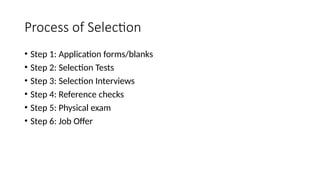
Process of Selection
• Step 1: Application forms/blanks
• Step 2: Selection Tests
• Step 3: Selection Interviews
• Step 4: Reference checks
• Step 5: Physical exam
• Step 6: Job Offer
Step 1: Application Forms
• The purpose of an application form is to collect the necessary information about an applicant in a short span
of time. These bits of information are extremely useful in determining the suitability of the applicants for the
job and also in predicting their likely job performance, if chosen. Therefore, the information collected must
be relevant, reliable and accurate for decision-making. To achieve this, the application form must be prepared
carefully and reviewed regularly to ensure the reliability and validity of the information gathered.
• Application forms normally solicit the following information from the candidates:
• a) Biographical information: includes the name of the applicant, father’s name, date of birth, age, gender,
nationality, physical features (height, weight, and so on), marital status, identification marks, and family
details.
• b) Educational qualifications such as courses completed, year of passing, subjects studied, and percentage
of marks secured, division or rank obtained, name of the educational institutions, and scholarship awarded.
• c) Work experience like positions held, tenure in each position, nature of job, pay and other benefits, details
about the present and previous employers, explanation for break in employment.
• d) Pay and other perquisites such as information about candidate’s expectation about salary and other
benefits.
• e) Additional information like participation in sports, games, cultural activities,
nation building activities such as NSS, NCC, and honours obtained.
• f) References Names and addresses of a few references that have knowledge
about the applicant and who may be contacted by the organization, if required.
2. Selection Tests
• Since there are differences in the abilities, aptitudes, interest and personality traits
of individuals, it is essential to measure these differences effectively and
accurately to determine their suitability for the jobs. This may be done with the
help of selection tests, also called psychological tests. The term test is used here as
a standardized measure of behaviour (for example, attitudes, interest, and
aptitude) of the applicants.
3. Selection Interview
• The selection interview is one of the most widely used means of collecting
necessary information about applicants.
• In fact, it is an indispensable part of any selection procedure. It provides an
opportunity for the employer to have a face–to–face interaction with the
candidate.
• It is used for gathering information that has not been collected through other
selection tools. The organization may require one or more interviews for an
applicant, depending upon the nature and number of job vacancies.
4. Reference Checks
• Many organizations have reference columns in their application forms. They
instruct the applicants to mention a few names as referees. The purpose of
collecting such references is to cross-check the information provided by the
candidates in the different stages of selection process. The persons known to the
candidates are normally cited as referees.
• They may be the friends, relatives, previous employers, faculty of educational
institutions where candidates studied or any other prominent persons familiar with
the candidate.
5. Physical Exam
• Physical examination is the penultimate stage in the selection process.
The aim of this examination is to ensure that the selected candidate
meets the physical requirements of the job. Physical examination can
also protect organizations from employing persons with preexisting
ailments. However, organizations in our country have no uniform
policy regarding physical tests.
6. Job Offer
• The last step in the process of selection, in practice, is intimating the candidates
about their provisional selection.
• A job offer (an appointment order specifying the terms and conditions of
employment) is issued to the candidates who have been successful at the end of
selection process. Once the employee positively responds to the offer of
employment, the process of integrating that employee into the job is set in motion.
Placement
• Placement is the process of finding an appropriate fit between the people and the
positions in an organization. It is actually the determination of the job which an
accepted candidate is to be assigned to, and his assignment to that job.
• Once the employee completes the stipulated orientation and/or training
successfully, the next step is his placement in the job. Based on the employees’
work performance and behaviour in the orientation programme, organizations
choose not only the appropriate jobs but also the appropriate supervisors for
placing the employees.
• Placement is usually the last stage in the recruitment and selection process of an
organization. The organization should find a proper balance between the job
requirements and the employee’s qualifications.
Outsourcing
Human Resource Outsourcing is a practice in which an organisation
hires a third party organisations to handle its human resource activities
and administrative tasks.

Unit 2- Human Resource Planning in Human Resources

  • 1.
  • 2.
    Meaning • Human resourceplanning (HRP) is the process of determining the number and type of people an organization needs to meet its goals. It's also known as workforce planning. • Human resource planning is the first step in the process of recruitment and selection of employees after a job analysis has been completed. • The three basic objectives of any HR planning are: (i) attracting, developing and retaining an efficient workforce, (ii) evaluating and rewarding its performance, and (iii) inventing and controlling HR plans and programmes to optimize the HR cost.
  • 3.
    Meaning HRP helps organizationsensure they have the right people to meet their needs by aligning HR management with the organization's strategic goals. It involves: • Forecasting future needs: Using internal data and market trends to determine the number of people needed and the level of talent required • Assessing the current workforce: Evaluating employee skillsets and identifying gaps • Developing plans: Creating strategies to meet future HR needs, including talent development • Reviewing and evaluating: Reviewing and evaluating the action plan
  • 4.
    Process • The stepsin a general HR planning process are: (i) considering organizational objectives and strategies, (ii) assessment of external environment, (iii) preparation of an in-house skill and competency inventory, (iv) HR forecasting— need assessment, (v) HR forecasting—estimation of availability, and (vi) developing HR plans and programmes.
  • 6.
    1. Considering OrganisationalObjectives and strategies The first step in the HR planning process is the consideration of organizational objectives and strategies. The organizational strategy along with the mission and vision statement clearly expresses the future intent of the organization. The examination of the organizational strategy would provide a clear indication about the future HR requirements of the firm. Thus, HR plans are guided by the overall organizational objectives and strategies. Each organizational strategy has direct and indirect implications for the human resources of the organization. In fact, HR plans are derived from the contents of the organizational objectives and strategies. Thus, HR managers should consult the organizational objectives and policies for framing guidelines concerning hiring policy, training policy, promotion policy, union issues and automation. Certainly, the complete knowledge of the organizational objectives is the first and the essential prerequisite for an effective HR planning process.
  • 7.
    2. Scanning theenvironment • Organizations undertake environmental scanning to identify the changes in the external environment. This also helps in analysing the impact of those changes on the organizational present and future activities. Environmental forces are defined as those events that can cause a company to achieve or fail to achieve business objectives. • The basic purpose of any environmental scanning is to examine the business environment to seize the opportunities and tackle the threats. Environmental scanning involves collection of information in the form of statements, actions and responses of people associated with the environment. This information is then closely scrutinized to figure out the likely changes in the environment.
  • 8.
    a) Economic Situation •The economic conditions prevailing at a particular time have a direct and clear influence on the HR requirements of the organization. • In fact, the different phases of an economic cycle shape its HR plans. When the country experiences an economic boom, organizations usually engage in massive hiring to meet the growing demand for products by expanding their business operation. • This often leads to labour shortage in the market and a subsequent rise in wage levels of the employees. • In contrast, during recessionary trends, organizations reduce the size of their workforce to save labour costs. Besides, they become more conscious about the cost associated with recruitment, selection, compensation, and training programmes.
  • 9.
    b) Legislative Measure Generally,the philosophy and policy of the government deeply affect business plans and preparations. The business philosophy of the government can be understood through its economic and commerce policies and also through its various labour and industrial laws. HR planners must be aware of the attitude of the government towards the business. They should also know the limitations imposed by the government rules and regulations on the HR practices. Again, they should take advantage of the relaxation offered by the rules and regulations that come into being. For instance, the Government of India amended the Industrial Disputes Act of 1947 as part of the labour reform process. This decision enabled companies with a strength of up to 1,000 to retrench employees without getting prior approval from the government. This change has apparently provided more flexibility to the employers in the labour-separation process.
  • 10.
    c) Labour MarketScenario • The extent of competition in the labour market and the recruitment strategy of the rival organizations also influence the HR plans of an organization. • When the HR plans require relocation of employees in the form of transfers or redeployment, the response of the affected employee would usually be based on the conditions of the labour market. • When there is a labour shortage, the employee might seek a job change by quitting the company. In such a situation, the HR planner must be more prudent in implementing sensitive HR decisions. • Besides, the intensity of the competition and the recruitment strategy of the competitors in the industry should also be considered while determining the pay scales and incentives. • In the case of existing employees, the pay scale must be sufficient to protect them from being poached by the rivals. As regards the new entrants, the compensation package must be adequate to attract the best persons to the organization. The globalization process has widened the labour market and thus sharply increased the importance of labour market scanning while devising HR plans.
  • 11.
    d) Technological Advancements Technologicaldevelopments have significantly changed the nature and composition of the present-day workplaces. The introduction of new technologies warrants a revamp of the work culture and development of new skills and competencies. It has also created more high-tech jobs in organizations. In fact, the increasing presence of knowledge workers in high-tech jobs rendered several of the existing HR policies and practices obsolete. Consequently, organizations are now forced to develop creative and resourceful HR initiatives to satisfy this new breed of employees. Therefore, HR planners must scan the technological environment before preparing HR plans.
  • 12.
    3. Preparation ofin house skill and competency inventory • A compilation of skills, competencies and qualifications of the entire workforce is described as a skill inventory. Its preparation may involve the determination of the sum of the employees’ experience, knowledge, education, and skill levels. Actually, the quality and size of the skill inventory of an organization will influence its business strategy and HR plans decisively. • Skill Audit: Before preparing the HR plans, HR managers should know what skills and knowledge the organization requires and what it possesses currently. In this regard, HR managers usually conduct a skills audit to assess the current skill levels of the organization. It involves assessing the performance of the employees from the task perspective. It also helps in identifying the employees’ strengths and weaknesses and the skill gap (skill requirements) within the organization. Further, it assists in determining whether the present skills inventory is sufficient to meet the organizational goals. • Core competency Analysis: Core competencies are the extraordinary abilities of an organization that enables it to acquire competitive advantage in the market. These abilities may be its advanced technology, well-reputed management, problem-solving ability, employees’ KSA. From the HR perspective, core competency means the skills and knowledge of the workforce available within an organization that differentiates it from its rivals in the industry offer value (some benefits) to the customers. A core competency analysis is basically an internal analysis of the general strengths and weaknesses of a firm. Organizations conduct it to identify their distinct competencies, systems and processes suitable for further development necessary to gain a competitive advantage.
  • 13.
    4. HR Forecasting-Need Assessment • The success of HR plans depends on the accuracy of the HR forecasts that are needed to implement the organizational strategies. • These forecasts involve estimating the future requirements of the organization in terms of the nature and the number of people. • The information gathered through external environmental scanning and internal skill assessments are used to predict the future HR requirements of the organization. • However, HR forecasting usually depends on an organization’s estimation of future demand for its goods or services in the market and the resultant profits. • In addition to demand forecasting, an organization may also consider several other factors like management philosophy, absenteeism and labour turnover rates, organizational growth pattern, planned technological improvements, the proposed changes in product lines, and the financial capabilities for forecasting HR requirements.
  • 14.
    5. HR Forecasting-Estimationof Availability • Once the human resource requirements of the organization are assessed, the next critical process is the estimation of the availability of the required number of employees. • Usually, organizations have two prominent sources to meet their recruitments: internal and external. In HR forecasting of the employee availability, three scenarios are possible: (i) getting a sufficient number of employees from internal sources; (ii) getting them from external sources; (iii) combining both sources to get adequate numbers;
  • 15.
    6. Developing HRPlans and Programmes • Once the organization completes the process of forecasting HR requirements and availability, the next step is its comparison. • Comparisons of the HR availability with the requirements help the organization in determining the viability of the strategic business plans. • The outcome of such comparisons would be either the recruitment of more employees or a reduction of the existing workforce. In case of shortage of labour, the organization would undertake HR activities like recruitment and selection, training and development, and placement of employees. • In the event of surplus, the organization might resort to employee reduction programmes like a hiring freeze, downsizing, voluntary retirement schemes, reduced working hours or days, and restricted overtimes. • It is a difficult task for an organization to properly respond to the situation arising out of the HR forecasting process. In a surplus scenario, an organization may resort to short-term measures like downsizing and reduced working hours. However, in shortage scenarios, the organization may require long-range, strategic responses like training and development to tackle the situation. Therefore, an organization should come up with the HR policies and programmes necessary to deal with the situation.
  • 16.
    7. Recruitment andSelection • Recruitment is the process of searching for prospective employees and stimulating and encouraging them to apply for jobs in an organization. • Selection is the process of choosing from among the candidates, from within the organization or from the outside, the most suitable person for the current position or for the future position.
  • 17.
    Job Analysis • Jobanalysis is an essential prerequisite for the effective management of the human resources of an organization. It is the process of gathering relevant information about a job. It actually specifies the tasks involved in a job and the factors that influence the performance of that job. • It acts as the basis for decisions involving human resource planning, recruitment and selection, training and development, compensation fixation, job evaluation, performance evaluation, career management, and health and safety of employees. • Job analysis has applications in almost all the HR activities of an organization. It acts as the basis for decisions involving human resource planning, recruitment and selection, training and development, compensation fixation, job evaluation, performance evaluation, career management, and health and safety of employees.
  • 18.
    Features of JobAnalysis • Job analysis is a process of gathering relevant information about various aspects of a job and is concerned with the identification of tasks required to be performed as part of it. • It approaches the task of defining the role, context, conditions, human behaviour, performance standards, and responsibilities of a job systematically. • It helps in establishing the job’s worth to an organization. In other words, it measures the value and contribution of a job to the growth of the organization. • It establishes job relatedness, which is a crucial input for HR decisions involving recruitment, selection, compensations, training, health and safety. • It assists in the resource management and strategy formulation process of the organization to help it achieve its business goals and objectives effectively. • It helps in developing a job profile for each job and acts as the basis for developing job description and specification statements. • It helps in identifying the appropriate job for each employee so that the skills and knowledge of these employees are utilized for the growth of the organization effectively. • It facilitates the process of understanding the impact of environmental changes on individual jobs.
  • 19.
    Process of JobAnalysis and Design
  • 20.
    1. Determining thepurpose of Job Analysis • The first step in the job analysis process is the determination of the end use of the job analysis. True, job analysis has relevance for almost all HR activities of an organization. • However, an organization may conduct a job analysis for a specific purpose like hiring the employees or determining their remuneration. • Depending upon the purpose of the analysis, the organization may focus specifically on certain aspects of the job that are considered important. For instance, job analysis may emphasize more on identifying information relating to the physical hazards, job difficulties and work environment, when the job analysis is done to decide the safety measure for a job. • In any case, the identification of the expected uses of the job analysis will enable the organization to determine the nature and types of data to be collected, the techniques to be adopted for data collection, and the focus of the analysis.
  • 21.
    2. Gathering backgroundinformation about the job • It is essential for an organization to review the background information about the job to know its relative importance in the organization. • While doing so, the job analysis should focus on identifying information relating to all the important elements of the job. This information can be gathered with the help of organizational charts, process charts, and job classification
  • 22.
    3. Choosing representativesjob for analysis • Often, organizations choose only a few jobs for analysis instead of analysing all of them. This is done because many jobs are similar in nature and have similar characteristics. Besides, organizations may find it time-consuming and costly to analyse all their jobs. As a result, it becomes essential for an organization to identify the representative jobs from a group of identical jobs.
  • 23.
    4. Collecting therelevant job information • In this step, information pertaining to various aspects of the job is collected. Specifically, the information about the duties, level of responsibility, authority, accountability, content and context of the job, desired employee behaviour, critical knowledge, knowledge skills and abilities (KSA), and training requirements are gathered. • These pieces of information can be gathered by contacting the present and previous employees of the job, the supervisors and the managers. Methods like structured or open-ended questionnaires, interviews, task inventories, checklists, and observation are used for data collection.
  • 24.
    5. Reviewing gatheredinformation • At this stage, the collected data is carefully analysed and then a job analysis report is prepared for the job being reviewed. Generally, the specific job holders and their immediate supervisors are included in such an analysis process. The opinion of the employee performing the job is ascertained to verify the correctness and completeness of the job analysis report. In case the employee or supervisor points out incompleteness or discrepancies in the report, supplementary information could be collected.
  • 25.
    6. Developing ajob description and job specifications • This is the final stage in the process of job analysis. The two essential documents of the firm, namely, the job description and job specification, are prepared on the basis of the job analysis report. • A job description is a written statement containing information about the duties, responsibilities, accountabilities, working conditions and risks associated with the job. Briefly, it is a summary of the various features of a job. • A job specification is a statement that provides information from the job holder’s perspective. It usually contains information about the eligibility conditions required for a job holder in terms of educational qualifications, experience, knowledge, skills, personal qualities, aptitude and the background required for getting the job done.
  • 26.
    Outcome of JobAnalysis • Job Analysis Ends with the preparation of a) Job Description and b) Job Specifications
  • 27.
    Job Description • Jobdescription is a written statement that describes all the aspects of a job. It aims at simplifying and standardizing the HR activities of an organization. It also enables the employees to understand clearly what is expected of them in their jobs. It contains both organizational information (structure, relationship, to name a few) and functional information relating to the job. But, the description of each task should be confined to a few sentences with the focus being on results. • A job description should be comprehensive in every aspect. It should provide information about job title, alternate title (if any), job position in the organizational structure, relationship with other jobs, and the tasks, duties, responsibilities and accountabilities associated with the job. In addition, it should offer information on working conditions, physical hazard, and special equipments required for task accomplishment.
  • 28.
    Job Specifications • Ajob specification can either be part of the job description or an independent statement. It is actually a document that specifies the minimum acceptable qualities required for a person to complete the job satisfactorily. It usually contains the details of the employee’s characteristics and the qualifications essential for the job. • “Job specification sets out the education, qualification, training, personal attributes, and competencies a job holder requires to perform her or his job satisfactorily.”
  • 29.
    The important componentsof job specifications are: • Education and training: A job specification states whether the job requires school- or college-level education. It mentions the technical or professional qualification requirements of the job holder. Finally, it specifies the minimum training requirements the job holder must have completed. • Work Experience: A job specification prescribes the work experience requirements for the job holder and sometimes also the minimum experience for effective performance. • Skills and competencies: Under this component head, a job specification states the types of skills necessary for the satisfactory performance of the job. It indicates the nature of skills required like computer skills, communication skills, technical skills, and statistical skills. • Physical strength and stamina: If the job involves physical activities like lifting or moving heavy objects, the job specification also mentions the physical requirements of the job holder. • Stress-coping abilities: When the nature of the job requires a lot of stress endurance and involves constant work pressure in the form of deadlines or night shifts, the stress management ability of the candidate should be mentioned. • Special needs: If the job requires any special skills, knowledge and ability like extensive travelling, working at odd hours, and good memory power, it should be clearly mentioned.
  • 30.
    Job Design • Jobdesign is the specification of the contents, methods, and relationships of jobs in order to satisfy technological and organisational requirements as well as the social and personal requirements of the job holders.” • It is basically a combination of the job content and the work method adopted in the job. Job content states the tasks to be performed as part of the job while the work method deals with the mode of performing the job. • Thus, the basic aim of a job design is to clearly establish the role of each job and the job holder in the overall system of an organization. • “Job design is the process of determining the specific tasks to be performed, the methods used in performing these tasks, and how the job relates to other work in the organization.”
  • 31.
    Benefits of JobDesign • It enables the organization to develop a competent, dynamic and responsive workforce. • It ensures that the customers get high-quality goods and services without any delay and interruptions. • It helps the firm in achieving cost reduction by eliminating the causes of accidents and injuries through enhanced health and safety measures. • It enhances the employees’ satisfaction, motivation, involvement and commitment, leading to improved cooperation between the management and the employees. • It offers wide opportunities to the employees to convey their views and opinions to the management through participative management programmes. • Its implementation often requires the employees to undergo periodic training to upgrade their skills and thus helps them in their career growth. • It contributes effectively to the organizational effectiveness and, as a result, to the competitivenessof the organization in the market.
  • 32.
    Job Enrichment • Jobenrichment refers to the development of work practices that challenge and motivate the employees to perform better. It often results in achieving desired improvements in productivity, safety of work, quality of products/services and job satisfaction. Organizations also adopt job enrichment to encourage multitasking by the employees in the job. Job enrichment may include, among others, the formation of a quality circle, self-directed teams, job rotation and better communication.
  • 33.
    How to enrichjobs • Encouraging the employees to involve themselves in goal setting and accomplishment activities. • Enhancing the scope of the job to utilize the diverse skills of the employees. • Allowing the employees to do the whole job, i.e., from the beginning till the end, so that they could develop a sense of achievement. • Providing necessary autonomy to the employees on matters relating to the method,speed and order of doing the job. • Encouraging the employees to know the significance of their work in terms of its contribution to the accomplishment of the overall goal of the organization. • Constantly challenging the employees to adopt innovation in job by acquiring new knowledge and skills. • Improving the information sharing process by strengthening the existing communication channels and also by introducing new communication channels. • Ensuring that the employees get timely and adequate recognition and appreciation for their effective performance and successful completion of the job. • Enabling the employees to get constant feedback of their own performance by communicating the results of the work done by them. • Making employees believe that the present job is not an end but only a means for better prospects in the organization.
  • 34.
    Recruitment • “Recruitment meansattracting candidates, which is primarily a matter of identifying, evaluating and using the most appropriate source of applicants.” • Recruitment provides the first contact for an organization with its potential employees. An organization must have an effective recruitment policy and process to inform candidates about the job openings and persuade them to apply for the available positions. The efficacy of the recruitment process may be measured in terms of the quality and quantity of the applicant pool (the grouping of applicants based on the type of job) created by it.
  • 35.
  • 36.
    1. Human ResourcePlanning • Human resources plans clearly estimate the levels and kinds of human resources required to ensure the accomplishment of the strategic plan of the organization. • Human resources planning involves the estimation of how many qualified persons are necessary to carry out the assigned activities (personnel demand), how many people will be available (internal supply), and what must be done to ensure that the personnel supply equals the personnel demand at an appropriate point in the future (the reconciliation process). • Thus, the first step is the estimation of the future HR requirements of the organization and a decision to meet the personnel demand with an adequate supply through recruitment.
  • 37.
    2. Determination ofStrategy The second step in the process of recruitment is the determination of strategy for choosing the candidates. It may include, among others, the development of different sources of recruitment, the preferences to be followed, the recruitment method to be used and the series of activities to be undertaken. Job specification reports that specify the quality and quantity of personnel required for the organization help us in determining the strategy to be adopted. The strategy must be designed in such a way that it attracts as many applicants as possible.
  • 38.
    3. Evaluation ofsources of recruitment • There are two important sources of recruitment in every firm, namely, internal and external. Internal sources include, among others, the existing employees, the former employees and employee referrals, while the external sources refer to all sources other than the internal ones. • For instance, employment exchanges, employment associations, professional associations, public advertisements and educational institutions constitute external sources. Evaluation refers to the assessment of strengths and weaknesses of the sources available to an organization. One of the studies 10 mentions that the measurement refers to finding an answer to the question, “How many applicants did we generate through each of our recruitment processes?” • Organizations can attract a good number of qualified applicants by combining one or more sources
  • 39.
    4. Implementation ofRecruitment methods and strategies • Having evaluated the various sources of recruitment, the next stage is the finalization of the sources and the actual implementation of strategies. • Regardless of whether the organization decides to recruit from internal or external sources, the recruitment method and strategy must be implemented in accordance with all relevant laws and regulation.
  • 40.
    5. Feedback andControl • As recruitment is a continuous process, it is essential to evaluate it to enhance its effectiveness. • The quality of the applicant pool is an indicator of the efficacy of the recruitment process. • If the process discourages the potentially qualified individuals from applying, limits the size of the applicant pool or results in inferior applicants becoming the employees of the organization, there is a need for a change in the recruitment process.
  • 41.
  • 42.
    A. Internal Recruitment •Internal recruitment usually refers to filling open jobs with the current employees of the organization. It is a process designed to create sufficient interest among the current employees to cause them to formally indicate an interest in a given position. The position applied for may represent a promotion, a transfer, or even a demotion in a few cases. • 1) Existing Employees: The most common source of internal recruitment is through existing employees. Organizations normally maintain inventories of qualifications to choose employees for suitable vacancies. Such inventories contain data such as the current employee’s performance, educational background and suitability. The usual method of creating a pool of internal applicants is through job postings. A job posting refers to the process of advertising available positions to the employees. They evaluate job opportunities relative to their skills, experience, interests, and career goals and indicate their interest formally to their immediate supervisor or through the HR department. Promotions and transfers from among the existing employees are examples of internal sources of recruitment.
  • 43.
    2) Former Employees:Former employees are also considered as an internal source of recruitment for they are acquainted with the policies and practices of the organization. Besides, they enjoy familiarity with the present employees in most cases. It is now increasingly common to take back employees who left the firm for various reasons. This is because the ex- employees’ performance and attitude are well known to the organization and the risk involved in choosing them is relatively less. 3) Employee Referral: This method refers to the practice of the present employees providing information about the candidates who are willing to be considered for the present vacancies. The applicants may be the friends or relatives of the referring employees. Referral is also a cost-effective source of recruitment. Its effectiveness lies in the assumption that the present employees will recommend only suitable candidates for the vacant jobs lest their own credibility be affected. Employee referrals are also an effective tool to stem the tide of attrition. When friends work together, they are less likely to leave a company soon. However, employee referrals may prove to be a major source of irritation in the employer–employee relations, if such referrals are rejected.
  • 44.
    Merits and Limitationsof Internal Recruitment • It helps the organization in offering career development plans to its employees. • Internal candidates may require less orientation and training than outside ones. • Internal recruitment can act as a good motivator and morale-booster if the employees see promotions as a reward for and recognition of their hard work and efficiency. • It facilitates better utilization of skills, experience and qualifications of the existing employees. • Limitations: • Internal recruitment may restrict the option of recruiting a more diverse workforce, thereby keeping a large pool of potential employees in the labour market untapped. • It may provide an organization with a better applicant but not necessarily the best applicant as it may be hard to find the most suitable person for a job within the organization itself. • Too much emphasis on internal recruitment may result in in- breeding, which may not be good for the future plans and prospects of the organization. • Internal recruitment can affect the unity and integrity of the organization if the employees perceive the selection procedure as unfair and discriminatory. • It may be difficult to infuse the organization with fresh talent and creat ivity if there is undue dependence on internal recruitment. For instance, employees may prefer to maintain the status quo, even if far-reaching changes and entirely new directions are required in the organization.
  • 45.
    External Sources: • EmploymentExchanges Employment exchanges have been established by the government to act as a liaison between job providers and job seekers. • The twin tasks of employment exchanges are to help employers locate suitable candidates for the vacancies arising in their organization and the job seekers get information about such job opportunities. The Employment Exchanges Act stipulates that all industrial undertakings with not less than 25 workers should notify their vacancies to the employment exchanges before filling them up. Employment exchanges would find a match for these vacancies with the job aspirants who have registered their names with them. The functioning of these employment exchanges cannot be termed as effective in India except that they are helpful to the government institutions in finding appropriate candidates.
  • 46.
    • Outsourced toRecruitment Agencies Transferring the whole or a few parts of the recruitment process to an external HR consultant rendering recruitment services is called outsourcing recruitment. In recent decades, there has been a sizeable increase in the number of private employment agencies that engage themselves in the task of shortlisting and providing qualified applicants to the private organizations in need of them. These agencies specialize in recruitment activities and become professionals. They normally charge fees either from the applicant or from the organization or from both for the successful placements. • Advertisements Printed advertisements are a preferred mode of external recruitment for several reasons. As printed advertisements reach many people in a short period of time, the vacancies can be communicated to the potential candidates quickly. They enjoy a wider coverage and better reach. They are cost-effective when the vacancies are large in numbers. Besides, it is possible to place anonymous advertisements and the employers may thus hide their identity if required. In the case of job positions that require special skills, qualification, knowledge and experience, the advertisements may be placed in professional or trade journals to reach the target group effectively. However, the success of an advertisement lies on its attractiveness, comprehensiveness and timing. • Campus Recruiting When company representatives are sent to college campuses to recruit applicants to create an applicants’ pool from graduating classes, it is called campus recruiting. In recent times, with the advent of knowledge-based companies in large numbers, campus recruitment has emerged as an important method of external recruitment in India. • The aim of any campus recruitment programme is to attract good candidates. Since college graduates have no first-hand knowledge of the visiting company, they generally go by its reputation and the growth and career prospects it offers.
  • 47.
    • Walk-ins andWrite-ins When applicants directly write to the organization or just walk in to the office to state their interest for employment, we call it write-ins and walk-ins. The walk-ins may be self-initiated or in response to the advertisement placed by the organization in newspapers. Walk-ins and write-ins are helpful in strengthening the applicants’ pool maintained by the organization and are a suitable method for immediate selection and placement. • Internet Recruiting Internet recruiting refers to placing an advertisement on the Internet for inviting applications from the potential applicants to fill the vacancies specified. In recent times, there has been a steep rise in the number of Indian companies opting for the Internet as a tool for recruitment. Organizations can also use computers to scan, digitize and process the applicants’ resumes automatically. Electronic curriculum vitae (CVs) are used in Internet recruiting to collect information about the candidates. These CVs are scanned and converted into basic text format by the computer. The computer can also carry out the analysis of the CVs on pre-determined criteria to list the candidates who satisfy the requirements. • Raiding or Poaching Raiding or poaching refers to cajoling or attracting the employees of the rival organizations with attractive offers. Organizations may directly or indirectly contact the talented employees of their rivals and gradually persuade these employees to join them. Normally, some sort of secrecy is maintained in these operations till the mission is completed. These days, on-demand recruiting services (ODRS) vendors, the professional consultants who specialize in raiding and poaching operations, offer these services to organizations for a fee. Though considered unethical, this practice is widely prevalent in many Indian organizations, particularly in IT companies.
  • 48.
    Selection • “Selection isthe process of choosing from among the candidates, from within the organisation or from the outside, the most suitable person for the current position or for the future position”. • “Selection is a managerial decision making process to predict which job applicants will be successful if hired”.
  • 49.
    Process of Selection •Step 1: Application forms/blanks • Step 2: Selection Tests • Step 3: Selection Interviews • Step 4: Reference checks • Step 5: Physical exam • Step 6: Job Offer
  • 50.
    Step 1: ApplicationForms • The purpose of an application form is to collect the necessary information about an applicant in a short span of time. These bits of information are extremely useful in determining the suitability of the applicants for the job and also in predicting their likely job performance, if chosen. Therefore, the information collected must be relevant, reliable and accurate for decision-making. To achieve this, the application form must be prepared carefully and reviewed regularly to ensure the reliability and validity of the information gathered. • Application forms normally solicit the following information from the candidates: • a) Biographical information: includes the name of the applicant, father’s name, date of birth, age, gender, nationality, physical features (height, weight, and so on), marital status, identification marks, and family details. • b) Educational qualifications such as courses completed, year of passing, subjects studied, and percentage of marks secured, division or rank obtained, name of the educational institutions, and scholarship awarded. • c) Work experience like positions held, tenure in each position, nature of job, pay and other benefits, details about the present and previous employers, explanation for break in employment. • d) Pay and other perquisites such as information about candidate’s expectation about salary and other benefits.
  • 51.
    • e) Additionalinformation like participation in sports, games, cultural activities, nation building activities such as NSS, NCC, and honours obtained. • f) References Names and addresses of a few references that have knowledge about the applicant and who may be contacted by the organization, if required.
  • 52.
    2. Selection Tests •Since there are differences in the abilities, aptitudes, interest and personality traits of individuals, it is essential to measure these differences effectively and accurately to determine their suitability for the jobs. This may be done with the help of selection tests, also called psychological tests. The term test is used here as a standardized measure of behaviour (for example, attitudes, interest, and aptitude) of the applicants.
  • 53.
    3. Selection Interview •The selection interview is one of the most widely used means of collecting necessary information about applicants. • In fact, it is an indispensable part of any selection procedure. It provides an opportunity for the employer to have a face–to–face interaction with the candidate. • It is used for gathering information that has not been collected through other selection tools. The organization may require one or more interviews for an applicant, depending upon the nature and number of job vacancies.
  • 54.
    4. Reference Checks •Many organizations have reference columns in their application forms. They instruct the applicants to mention a few names as referees. The purpose of collecting such references is to cross-check the information provided by the candidates in the different stages of selection process. The persons known to the candidates are normally cited as referees. • They may be the friends, relatives, previous employers, faculty of educational institutions where candidates studied or any other prominent persons familiar with the candidate.
  • 55.
    5. Physical Exam •Physical examination is the penultimate stage in the selection process. The aim of this examination is to ensure that the selected candidate meets the physical requirements of the job. Physical examination can also protect organizations from employing persons with preexisting ailments. However, organizations in our country have no uniform policy regarding physical tests.
  • 56.
    6. Job Offer •The last step in the process of selection, in practice, is intimating the candidates about their provisional selection. • A job offer (an appointment order specifying the terms and conditions of employment) is issued to the candidates who have been successful at the end of selection process. Once the employee positively responds to the offer of employment, the process of integrating that employee into the job is set in motion.
  • 57.
    Placement • Placement isthe process of finding an appropriate fit between the people and the positions in an organization. It is actually the determination of the job which an accepted candidate is to be assigned to, and his assignment to that job. • Once the employee completes the stipulated orientation and/or training successfully, the next step is his placement in the job. Based on the employees’ work performance and behaviour in the orientation programme, organizations choose not only the appropriate jobs but also the appropriate supervisors for placing the employees. • Placement is usually the last stage in the recruitment and selection process of an organization. The organization should find a proper balance between the job requirements and the employee’s qualifications.
  • 58.
    Outsourcing Human Resource Outsourcingis a practice in which an organisation hires a third party organisations to handle its human resource activities and administrative tasks.