Human Resources
Planning
www.humanikaconsulting.com
“Research from London's school of economics has identified that a company’s culture
is eight times more influential on performance variance than a company's strategy or
business plan, yet while over 90% of all organizations have a business plan or strategy,
less than 5% have a plan for developing their organizational culture.”
Benjamin Tonna, in Minessence eZine No. 47 —22 Sep, 2011
Organizational Life-cycle
• In the beginning the values are the values of the founders.
• If society values what the organization does as a result if it living the
founders’ values then it will become successful and norms will emerge
around the founding values in relation to “how-things-are-done-
around-here”. It will be a highly cohesive organization.
• The organization’s success could go on for years, however, often
complacency sets in.
• During the complacency phase one of two things may happen: (a) the
organization loses touch with the values of its founders and strays to
some other path which its clients don’t value, or (b) the values of
society change and the organization ignores this, continuing to believe
that what made it successful in the past will always make it successful.
• After complacency, if no attention is given to the organization’s values,
comes decline.
• There are now only three possible destinies for the organization: (i) it
ceases to exist, (ii) it continues to barely exist with none of its former
glory, or (iii) it gives attention to the values of its founders, its people,
its clients and society, and re-invents itself around new values.
Organizational Life-Cycle Stages and HR Activities
Organizational
LIFECYCLE
STAGE
HR - LIFE-
CYCLE STAGE STAFFING COMPENSATION
TRAINING AND
DEVELOPMENT
LABOR /
EMPLOYEE
RELATIONS
Foundation Introduction Attract best technical
and professional
talent.
Meet or exceed labor
market rates to attract
needed talent.
Define future skill
requirements and
begin establishing
career ladders.
Set basic
employee-
relations
philosophy of
organization.
Boom Growth Recruit adequate
numbers and mix of
qualifies workers. Plan
management
succession. Mange
rapid internal labor
market movements
Meet external market but
consider internal equity
effects. Establish formal
compensation structures.
Mold effective
management team
through
management
development and
organizational
development.
Maintain labor
peace, employee
motivation, and
morale.
Organizational Life-Cycle Stages and HR Activities
(cont’d)
Organizational
LIFE CYCLE
STAGE
HR LIFE-
CYCLE STAGE STAFFING COMPENSATION
TRAINING AND
DEVELOPMENT
LABOR /
EMPLOYEE
RELATIONS
Stable Maturity Encourage sufficient
turnover to minimize
layoffs and provide new
openings. Encourage
mobility as
reorganizations shift
jobs around.
Control compensation
costs.
Maintain flexibility and
skills of an aging
workforce.
Control labor costs
and maintain labor
peace. Improve
productivity.
Decline Decline Plan and implement
workforce reductions
and reallocations,
downsizing and
outplacement may
occur during this stage.
Implement tighter
cost control.
Implement retraining
and career consulting
services.
Improve productivity
and achieve flexibility
in work rules.
Negotiate job security
and employment-
adjustment policies
Human Resources Functions :
• Planning,
• Staffing,
• Employee development, and
• Employee maintenance.
Planning,
Staffing,
Employee
development,
and
Employee
maintenance.
7
Strategic Planning
The process by which top management
determines overall organizational purposes
and objectives and how they are to be
achieved
8
Human Resource Planning
The process of systematically
reviewing HR requirements to
ensure that the required
number of employees, with the
required skills, are available
when they are needed
9
Human Resource Planning Process
External Environment
Internal Environment
Strategic Planning
Human Resource Planning
Forecasting
Human
Resource
Requirements
Comparing
Requirements
and Availability
Forecasting
Human Resource
Availability
Surplus of
Workers
Demand =
Supply
No Action Restricted Hiring,
Reduced Hours,
Early Retirement,
Layoff, Downsizing
Shortage of
Workers
Recruitment
Selection
10
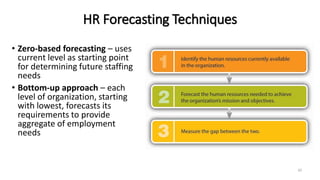
HR Forecasting Techniques
• Zero-based forecasting – uses
current level as starting point
for determining future staffing
needs
• Bottom-up approach – each
level of organization, starting
with lowest, forecasts its
requirements to provide
aggregate of employment
needs
11
HR Forecasting Techniques (Continued)
• Mathematical models –Assist in
forecasting. Relationship
between sales demand and
number of employees needed is
positive one.
• Simulation – technique with
experimenting with real-world
situation through a
mathematical model
12
The Relationship of Sales Volume to Number of Employees
Number of
Employees
500
400
300
200
100
0 10 20 30 40 50 60
Sales (thousands)
13
Forecasting HR Requirements
• Estimate of numbers and
kinds of employees the
organization will need at
future dates
• Demand for firm’s goods
or services must be
forecast
• Forecast is then converted
into people requirements
14
Forecasting HR Availability
• Determining whether the firm will be able to
secure employees with the necessary skills,
and from what sources these individuals may
be obtained
• Show whether the needed employees may be
obtained from within the company, from
outside the organization, or from a
combination of the two sources
15
Surplus of Employees
• Restricted hiring – employees
who leave are not replaced
• Reduced hours
• Early retirement
• Layoffs
16
Shortage of Workers Forecasted
• Creative recruiting
• Compensation incentives – premium
pay is one method
• Training programs – prepare previously
unemployable people for positions
• Different selection standards – alter
current criteria
Learning and Giving for
Better Indonesia

Human Resources Planning

  • 1.
  • 2.
    “Research from London'sschool of economics has identified that a company’s culture is eight times more influential on performance variance than a company's strategy or business plan, yet while over 90% of all organizations have a business plan or strategy, less than 5% have a plan for developing their organizational culture.” Benjamin Tonna, in Minessence eZine No. 47 —22 Sep, 2011
  • 3.
    Organizational Life-cycle • Inthe beginning the values are the values of the founders. • If society values what the organization does as a result if it living the founders’ values then it will become successful and norms will emerge around the founding values in relation to “how-things-are-done- around-here”. It will be a highly cohesive organization. • The organization’s success could go on for years, however, often complacency sets in. • During the complacency phase one of two things may happen: (a) the organization loses touch with the values of its founders and strays to some other path which its clients don’t value, or (b) the values of society change and the organization ignores this, continuing to believe that what made it successful in the past will always make it successful. • After complacency, if no attention is given to the organization’s values, comes decline. • There are now only three possible destinies for the organization: (i) it ceases to exist, (ii) it continues to barely exist with none of its former glory, or (iii) it gives attention to the values of its founders, its people, its clients and society, and re-invents itself around new values.
  • 4.
    Organizational Life-Cycle Stagesand HR Activities Organizational LIFECYCLE STAGE HR - LIFE- CYCLE STAGE STAFFING COMPENSATION TRAINING AND DEVELOPMENT LABOR / EMPLOYEE RELATIONS Foundation Introduction Attract best technical and professional talent. Meet or exceed labor market rates to attract needed talent. Define future skill requirements and begin establishing career ladders. Set basic employee- relations philosophy of organization. Boom Growth Recruit adequate numbers and mix of qualifies workers. Plan management succession. Mange rapid internal labor market movements Meet external market but consider internal equity effects. Establish formal compensation structures. Mold effective management team through management development and organizational development. Maintain labor peace, employee motivation, and morale.
  • 5.
    Organizational Life-Cycle Stagesand HR Activities (cont’d) Organizational LIFE CYCLE STAGE HR LIFE- CYCLE STAGE STAFFING COMPENSATION TRAINING AND DEVELOPMENT LABOR / EMPLOYEE RELATIONS Stable Maturity Encourage sufficient turnover to minimize layoffs and provide new openings. Encourage mobility as reorganizations shift jobs around. Control compensation costs. Maintain flexibility and skills of an aging workforce. Control labor costs and maintain labor peace. Improve productivity. Decline Decline Plan and implement workforce reductions and reallocations, downsizing and outplacement may occur during this stage. Implement tighter cost control. Implement retraining and career consulting services. Improve productivity and achieve flexibility in work rules. Negotiate job security and employment- adjustment policies
  • 6.
    Human Resources Functions: • Planning, • Staffing, • Employee development, and • Employee maintenance. Planning, Staffing, Employee development, and Employee maintenance.
  • 7.
    7 Strategic Planning The processby which top management determines overall organizational purposes and objectives and how they are to be achieved
  • 8.
    8 Human Resource Planning Theprocess of systematically reviewing HR requirements to ensure that the required number of employees, with the required skills, are available when they are needed
  • 9.
    9 Human Resource PlanningProcess External Environment Internal Environment Strategic Planning Human Resource Planning Forecasting Human Resource Requirements Comparing Requirements and Availability Forecasting Human Resource Availability Surplus of Workers Demand = Supply No Action Restricted Hiring, Reduced Hours, Early Retirement, Layoff, Downsizing Shortage of Workers Recruitment Selection
  • 10.
    10 HR Forecasting Techniques •Zero-based forecasting – uses current level as starting point for determining future staffing needs • Bottom-up approach – each level of organization, starting with lowest, forecasts its requirements to provide aggregate of employment needs
  • 11.
    11 HR Forecasting Techniques(Continued) • Mathematical models –Assist in forecasting. Relationship between sales demand and number of employees needed is positive one. • Simulation – technique with experimenting with real-world situation through a mathematical model
  • 12.
    12 The Relationship ofSales Volume to Number of Employees Number of Employees 500 400 300 200 100 0 10 20 30 40 50 60 Sales (thousands)
  • 13.
    13 Forecasting HR Requirements •Estimate of numbers and kinds of employees the organization will need at future dates • Demand for firm’s goods or services must be forecast • Forecast is then converted into people requirements
  • 14.
    14 Forecasting HR Availability •Determining whether the firm will be able to secure employees with the necessary skills, and from what sources these individuals may be obtained • Show whether the needed employees may be obtained from within the company, from outside the organization, or from a combination of the two sources
  • 15.
    15 Surplus of Employees •Restricted hiring – employees who leave are not replaced • Reduced hours • Early retirement • Layoffs
  • 16.
    16 Shortage of WorkersForecasted • Creative recruiting • Compensation incentives – premium pay is one method • Training programs – prepare previously unemployable people for positions • Different selection standards – alter current criteria
  • 17.
    Learning and Givingfor Better Indonesia