HRM CH-1.pptx Human Resource Management Class Notes
1.
Wachemo University
College ofBusiness and Economics
Department of Public Administration
and
Development Management
Lecture
on
Human Resource Management
2.
CHAPTER ONE
HUMAN RESOURCEMANAGEMENT: AN OVERVIEW
After completing this unit, students will be able to:
Define and understand the idea of Human Resource Management
Identify the importance of HRM
Point out the objectives of HRM
Introduction
An organization is a human grouping in which work is done
for the accomplishment of some specific goals or mission.
To achieve organizational objectives, there is a need to
coordinate the basic resources of the organization, Like: -
Financial; material; machinery; and human resources.
3.
CONT’D…………..
The organizational resourcesby themselves will not help
the organization to accomplish its objectives, unless
there is an effective coordination and utilization of these
human and non-human resources. It means HR is an
important (critical) resource in coordinating the non-
human resources.
The success or failure of an organization is largely
dependent up on the ability/quality of the employees of
the organization.
In other words, without positive and creative
contributions from people, organizations cannot progress
and prosper, because human resources are initiators and
determinants of all activities in a given organization.
4.
CONT’D…………..
So, the principalcomponent (asset) of any
organization is its “Human Resources or People at
work”.
If the human element is managed improperly, the
result will be ineffective and inefficient. Thus,
human resources at work are the most important
assets (capital) of the organization.
Based on this fact managing this resource is a
central and critical task in any organization.
5.
1.1. DEFINITION OFHRM
What is Human Resource?
Human resources may be defined as the total knowledge,
skills, creative abilities, talents and aptitudes of an
organization’s workforce as well as the values, attitudes,
approaches and beliefs of individuals involved in the affairs
of the organization.
Human resource is a paramount importance in the success
of any organization. Because these people who provide the
knowledge and much of the energy through which
organizational objectives are accomplished.
So, the people in the organization, the human resources,
are perhaps the most important aspect of any
organization/enterprise.
6.
CONT’D………..
Human resource managementhas been defined in various
ways by many scholars: The following are few definitions
by different scholars:
Human Resource management is management functions
that helps managers’ recruit, select, train and develop
members for an organization. It is concerned with the
people’s dimension in organizations.
Human Resource Management deals with the design of
formal systems in an organization to ensure the effective
and efficient use of human talent to accomplish the
organizational goals. It includes philosophy, policies,
procedures and practices related to the management of people
within an organization.
7.
CONT’D……
Human Resource Managementconcerns the human side of
the management of enterprise and employees relations with
their firms. Its purpose is to ensure that the employees of the
company are used in such a way that the employer obtains
the greatest possible benefit from their abilities and the
employees obtain both material and psychological rewards
from their work.
Human Resource Management is the process of recruitment,
selection of employee, providing proper orientation and
induction, providing proper training and the developing skills,
assessment of employee (performance of appraisal), providing
proper compensation and benefits, motivating, maintaining
proper relations with labour and with trade unions, maintaining
employee’s safety, welfare and health by complying with labour
laws of concern state or country.
8.
Cont’d………
The National Instituteof Personal Management (NIPM) of India
has defined human resources – personal management as “that
part of management which is concerned with people at work
and with their relationship within an enterprise. Its aim is to
bring together and develop into an effective organization of the
men and women who make up enterprise and having regard for
the well – being of the individuals and of working groups, to
enable them to make their best contribution to its success”.
According to Edwin B Flippo, Human Resource Management is
the planning, organizing, directing and controlling of the
Recruitment, procurement, development, compensation,
integration, maintenance and separation of human resource to
the achievement or accomplishment of individual, organizational
and social objectives.
9.
CONT’D………
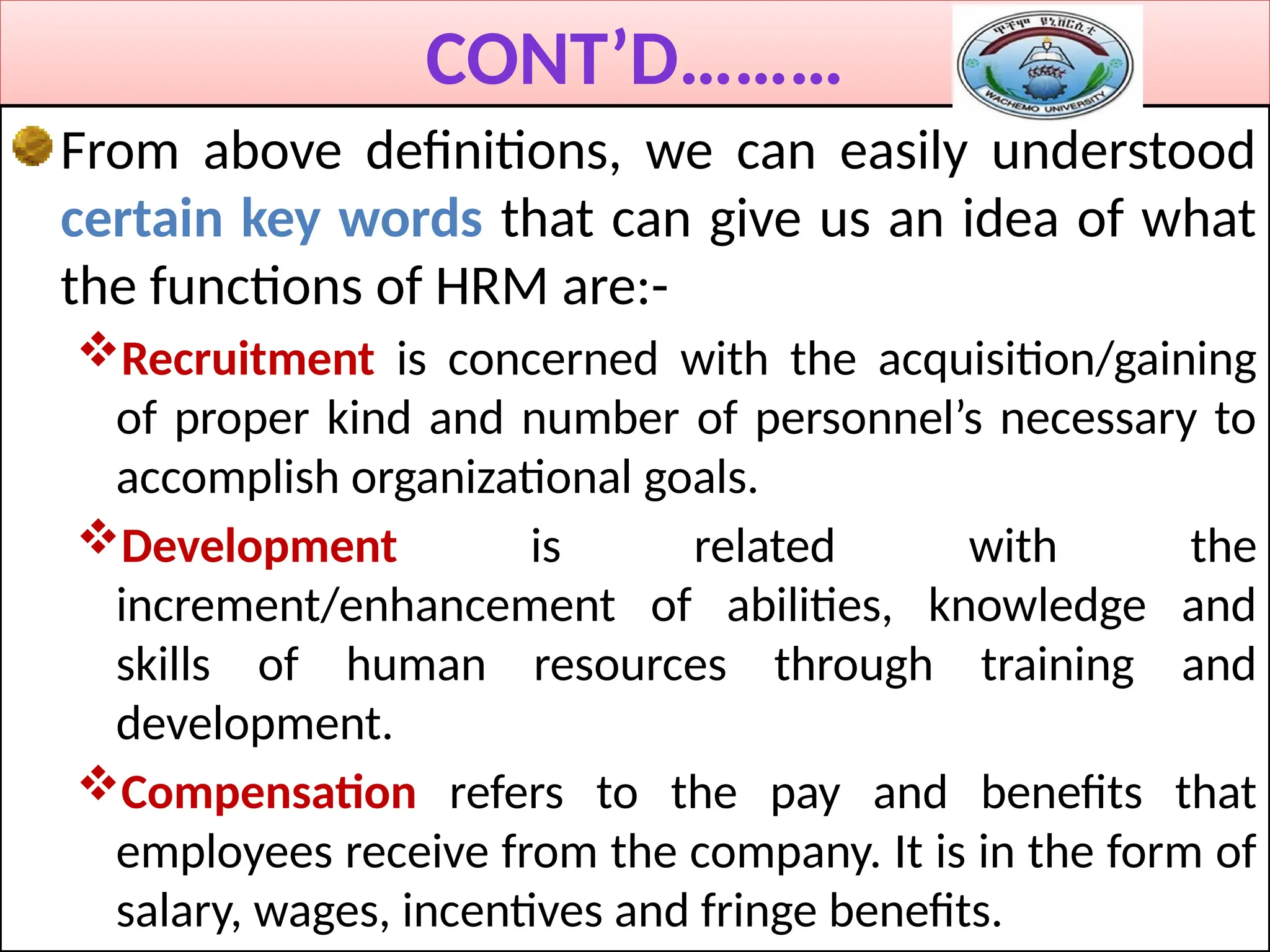
From above definitions,we can easily understood
certain key words that can give us an idea of what
the functions of HRM are:-
Recruitment is concerned with the acquisition/gaining
of proper kind and number of personnel’s necessary to
accomplish organizational goals.
Development is related with the
increment/enhancement of abilities, knowledge and
skills of human resources through training and
development.
Compensation refers to the pay and benefits that
employees receive from the company. It is in the form of
salary, wages, incentives and fringe benefits.
10.
CONT’D……….
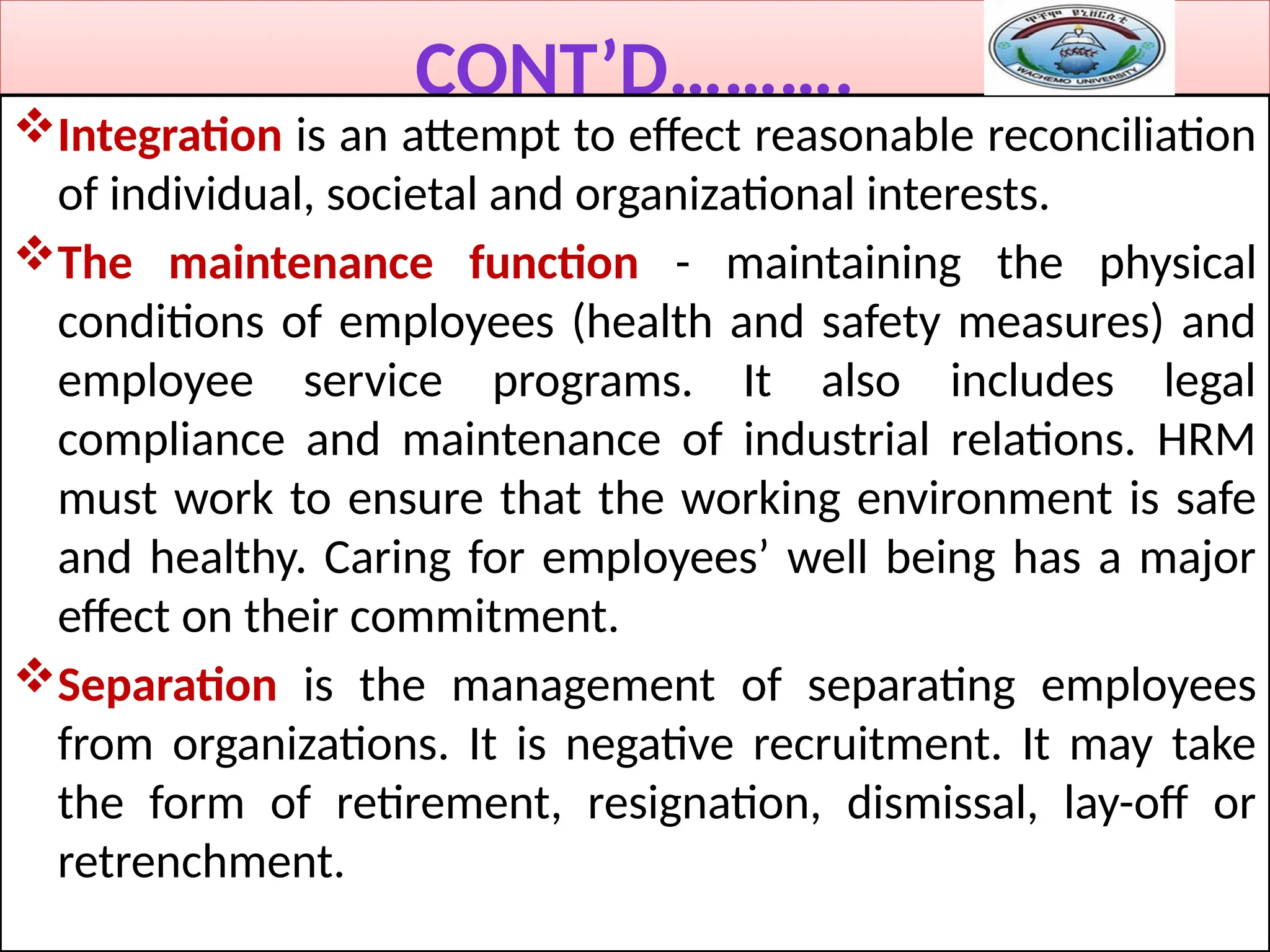
Integration is anattempt to effect reasonable reconciliation
of individual, societal and organizational interests.
The maintenance function - maintaining the physical
conditions of employees (health and safety measures) and
employee service programs. It also includes legal
compliance and maintenance of industrial relations. HRM
must work to ensure that the working environment is safe
and healthy. Caring for employees’ well being has a major
effect on their commitment.
Separation is the management of separating employees
from organizations. It is negative recruitment. It may take
the form of retirement, resignation, dismissal, lay-off or
retrenchment.
11.
CONT’D………..
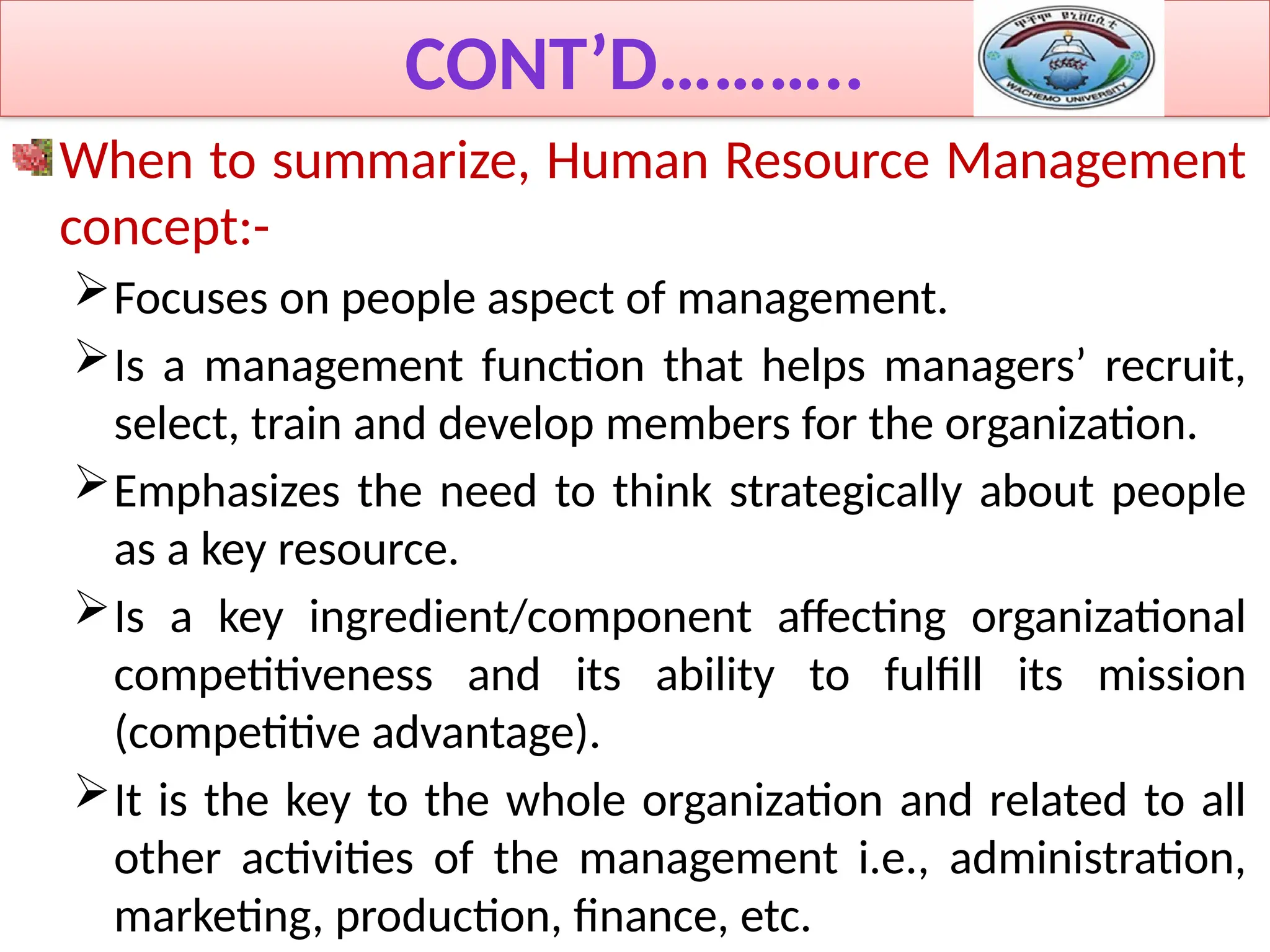
When to summarize,Human Resource Management
concept:-
Focuses on people aspect of management.
Is a management function that helps managers’ recruit,
select, train and develop members for the organization.
Emphasizes the need to think strategically about people
as a key resource.
Is a key ingredient/component affecting organizational
competitiveness and its ability to fulfill its mission
(competitive advantage).
It is the key to the whole organization and related to all
other activities of the management i.e., administration,
marketing, production, finance, etc.
12.
CONT’D………
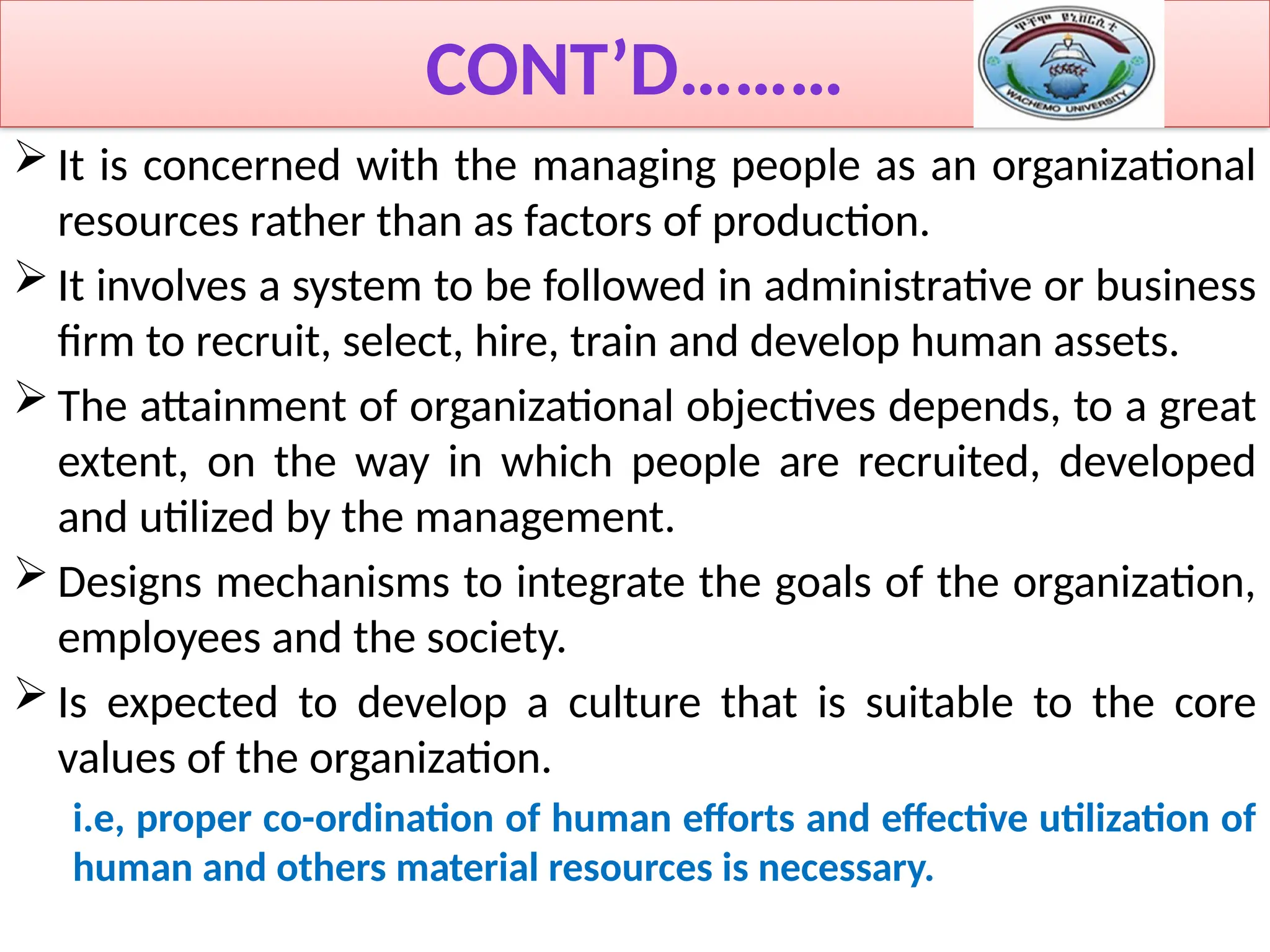
It isconcerned with the managing people as an organizational
resources rather than as factors of production.
It involves a system to be followed in administrative or business
firm to recruit, select, hire, train and develop human assets.
The attainment of organizational objectives depends, to a great
extent, on the way in which people are recruited, developed
and utilized by the management.
Designs mechanisms to integrate the goals of the organization,
employees and the society.
Is expected to develop a culture that is suitable to the core
values of the organization.
i.e, proper co-ordination of human efforts and effective utilization of
human and others material resources is necessary.
13.
1.2. HUMAN RESOURCEMANAGEMENT: OBJECTIVES
The objectives of human resource management are the
following:
(I)Development of employees (Personal objectives): An
employee does not come alone into the organization.
He/she brings with himself/herself abilities, attitude,
behaviour, personality etc... She/he has the objective of
enhancing his/her personal growth and seeks the
organization for realization of this personal growth.
On the other hand, organization needs employees for
fulfilment of organization objectives.
There is an element of mutuality of interests here. Individual
and organization need each other for fulfilment of their
objectives.
14.
CONT’D……..
If attention isgiven for employees’ growth, it will lead to
efficient working, proper maintenance, motivation and
retention of work force.
However, if personal growths of employees are hindered,
absenteeism and turnover will increase and performance
and satisfaction will come down.
Hence, HRM aims and strives for the development of the
employees.
15.
CONT’D……….
The development andcare of Human Resources is done
by the HRM.
In other words, HRM maintains the dignity of the
employee as a “human being” and provides maximum
opportunities for personal development.
Thus, personal objectives of employees must be met if
workers are to be maintained, retained and motivated.
Otherwise, employee performance and satisfaction may
decline and employees may leave the organization.
Some of the supporting functions are training and
development, appraisal, placement, compensation and
assessment.
16.
CONT’D…………
(II)Growth and developmentof the organization (Organizational objectives):
HRM objective is to bring about the overall development and growth of the
organization.
In other words, HRM is critical for development and growth of the
organization. How? It enables the organization to acquire competent and
qualified employees. It also develops individual capabilities so as to attain
organizational objectives.
Also, it ensures that well qualified employees are retained and worked to
satisfy goals of the organization. It is not possible to think of
organizational growth and development without HRM.
Goals of the organization are met by HRM - by effective motivation and
excellent utilization of employees.
HRM helps in utilizing effectively the available human resources.
It also improves the employees’ working skill and capacity. In addition, it
provides healthy relationship between different work groups so that work
is effectively performed.
17.
CONT’D…………
(III)The development ofHR function and climate (Functional
Objectives): The objective of HRM is to develop an effective HR
function for development and maintenance of human resource
functions.
HRM also has the objective of maintaining an excellent HR culture.
(IV) Objectives for the welfare of the society (Societal objectives):
Every organization faces the societal impact.
HRM seeks to do maximum good to the society and also tries to
minimize the effects of the social problems.
These social objectives are planned and needed to satisfy the
ethical and social needs of the society.
HRM has the societal objective of doing well to society, complying
with legal formalities and building good industrial relations.
18.
CONT’D……….
Specifically, the followingare HRM objectives:-
To ensure effective utilisation of human resources, all other
organizational resources will be efficiently utilised by the
human resources.
To establish and maintain an adequate organizational
structure of relationship among all the members of an
organization by dividing of organization tasks into functions,
positions and jobs, and by defining clearly the responsibility,
accountability, authority for each job and its relation with
other jobs in the organization.
To generate maximum development of human resources
within the organization by offering opportunities for
advancement to employees through training and education.
19.
CONT’D………
To ensure respectfor human beings by providing various
services and welfare facilities to the personnel.
To ensure reconciliation of individual/group goals with
those of the organization in such a manner that the
personnel feel a sense of commitment and loyalty towards
it.
To identify and satisfy the needs of individuals by offering
various monetary and non-monetary rewards.
To increase to the fullest the employee’s job satisfaction
and self-actualization.
20.
CONT’D……
To develop andmaintain a quality of work life.
To be ethically and socially responsive to the needs of
society.
To develop overall personality of each employee in its
multidimensional aspect.
To enhance employee’s capabilities to perform the present
job.
To equip the employees with precision and clarity in
transactions of business.
To inculcate the sense of team spirit, team work and inter-
team collaboration.
21.
CONT’D……..
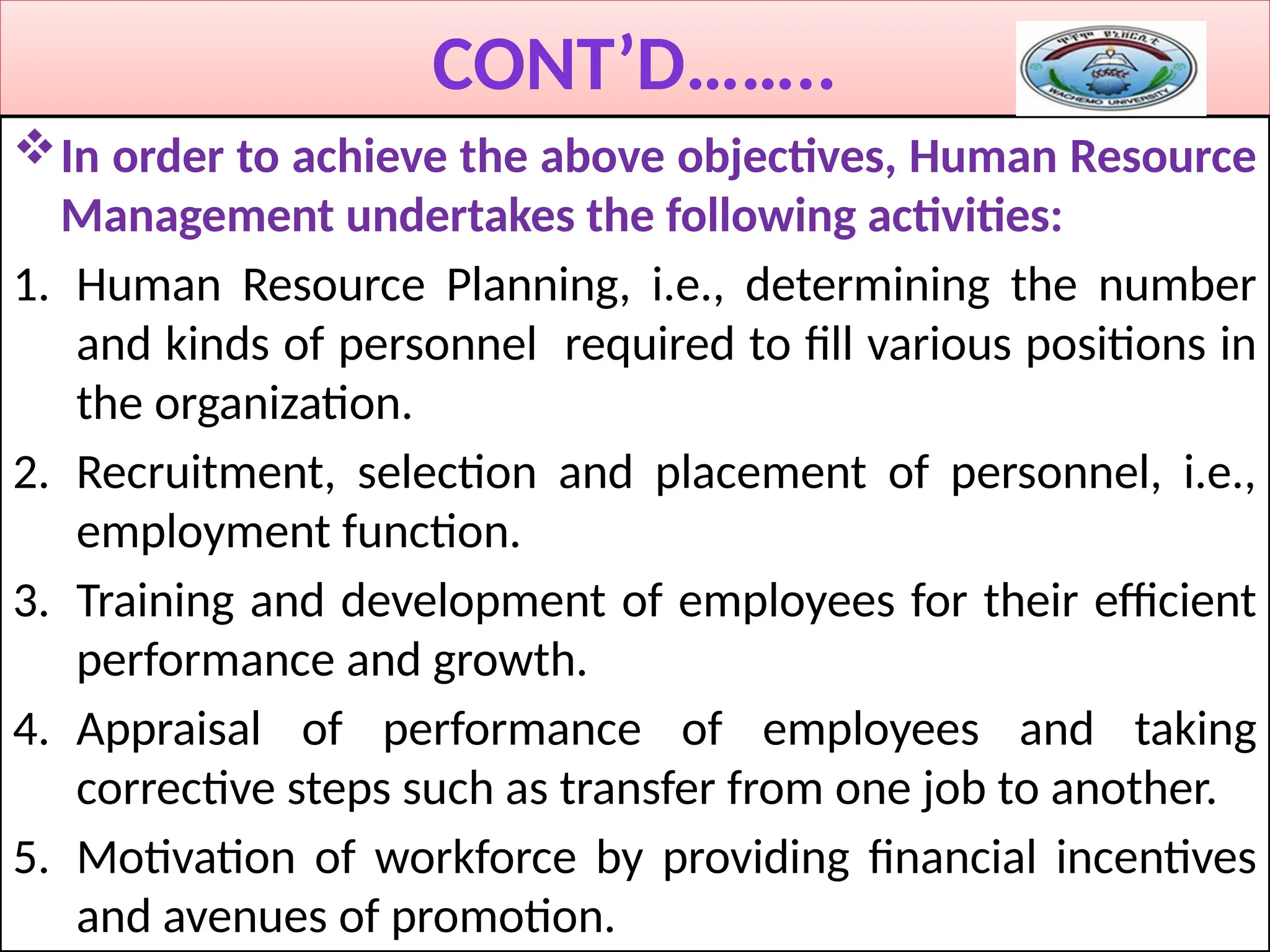
In order toachieve the above objectives, Human Resource
Management undertakes the following activities:
1. Human Resource Planning, i.e., determining the number
and kinds of personnel required to fill various positions in
the organization.
2. Recruitment, selection and placement of personnel, i.e.,
employment function.
3. Training and development of employees for their efficient
performance and growth.
4. Appraisal of performance of employees and taking
corrective steps such as transfer from one job to another.
5. Motivation of workforce by providing financial incentives
and avenues of promotion.
22.
CONT’D………..
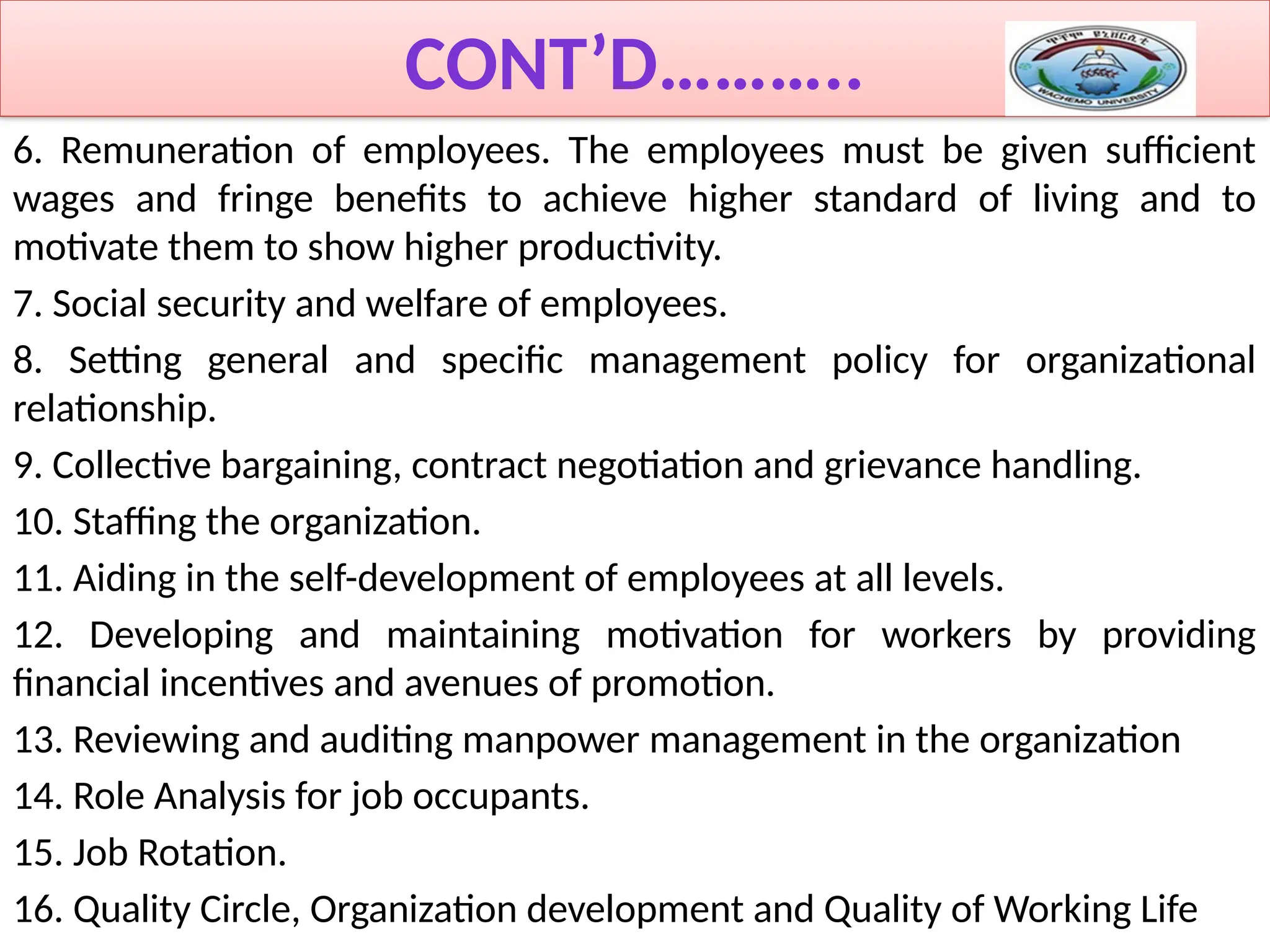
6. Remuneration ofemployees. The employees must be given sufficient
wages and fringe benefits to achieve higher standard of living and to
motivate them to show higher productivity.
7. Social security and welfare of employees.
8. Setting general and specific management policy for organizational
relationship.
9. Collective bargaining, contract negotiation and grievance handling.
10. Staffing the organization.
11. Aiding in the self-development of employees at all levels.
12. Developing and maintaining motivation for workers by providing
financial incentives and avenues of promotion.
13. Reviewing and auditing manpower management in the organization
14. Role Analysis for job occupants.
15. Job Rotation.
16. Quality Circle, Organization development and Quality of Working Life
23.
1.2. HRM FUNCTION
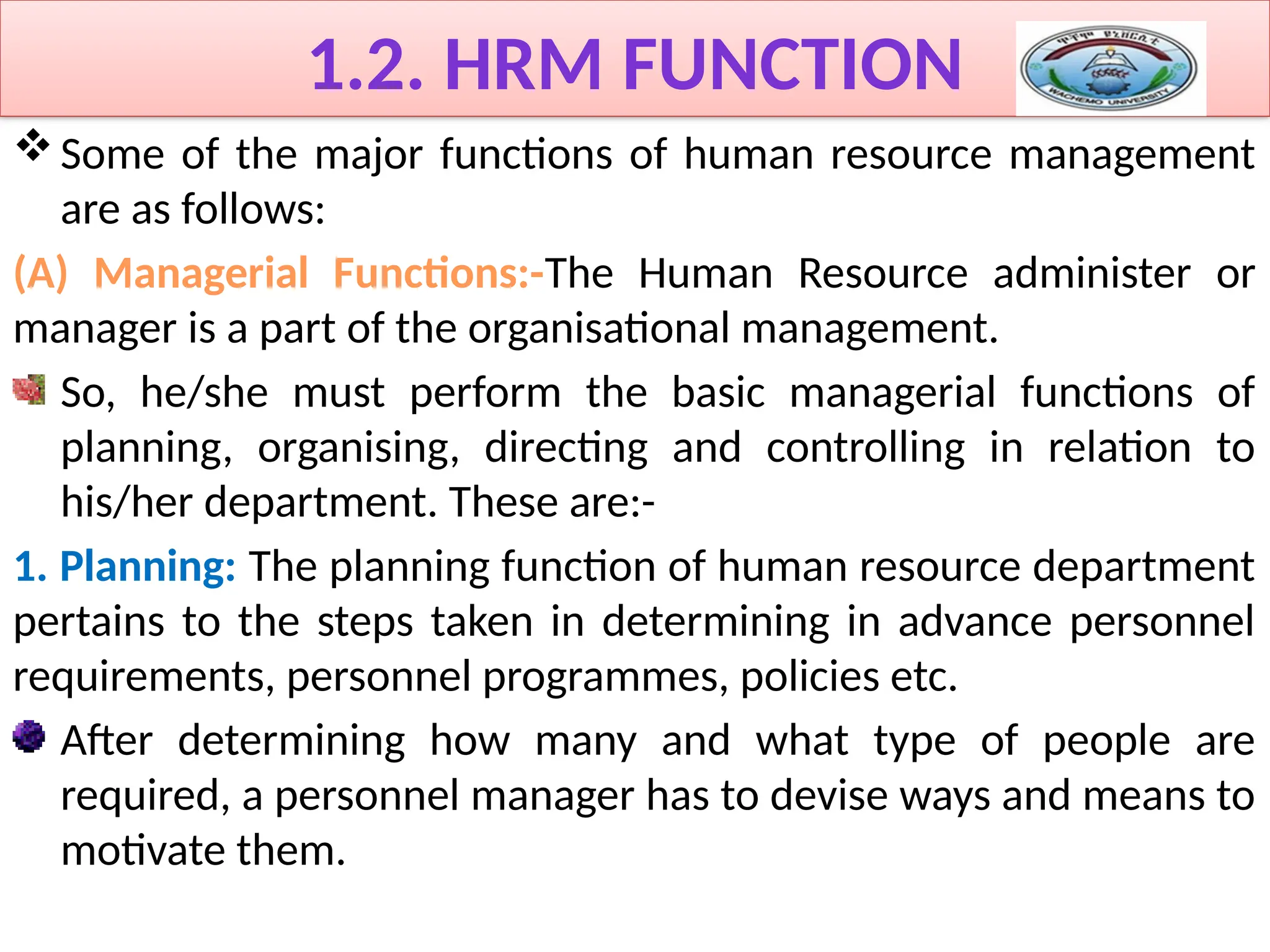
Someof the major functions of human resource management
are as follows:
(A) Managerial Functions:-The Human Resource administer or
manager is a part of the organisational management.
So, he/she must perform the basic managerial functions of
planning, organising, directing and controlling in relation to
his/her department. These are:-
1. Planning: The planning function of human resource department
pertains to the steps taken in determining in advance personnel
requirements, personnel programmes, policies etc.
After determining how many and what type of people are
required, a personnel manager has to devise ways and means to
motivate them.
24.
CONT’D…….
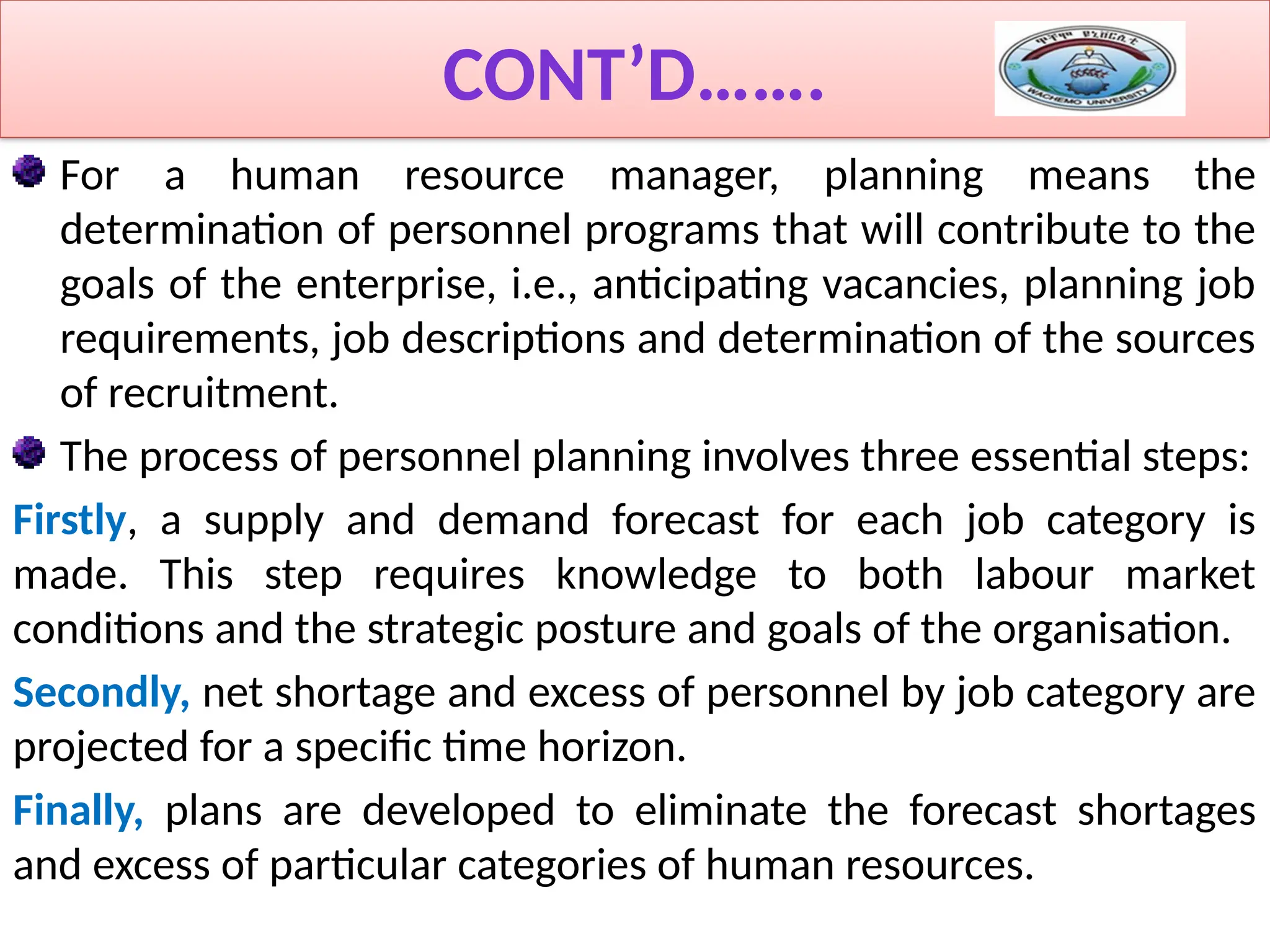
For a humanresource manager, planning means the
determination of personnel programs that will contribute to the
goals of the enterprise, i.e., anticipating vacancies, planning job
requirements, job descriptions and determination of the sources
of recruitment.
The process of personnel planning involves three essential steps:
Firstly, a supply and demand forecast for each job category is
made. This step requires knowledge to both labour market
conditions and the strategic posture and goals of the organisation.
Secondly, net shortage and excess of personnel by job category are
projected for a specific time horizon.
Finally, plans are developed to eliminate the forecast shortages
and excess of particular categories of human resources.
25.
CONT’D……….
2. Organization: Underorganization, the human resource manager has to
organise the operative functions by designing structure of relationship among
jobs, personnel and physical factors in such a way so as to have maximum
contribution towards organizational objectives.
Once the human resource manager has established objectives and developed
plans and programs to reach them, he/she must design and develop
organisation structure to carry out the various operations.
In this way a personnel manager performs following functions:
(a) preparation of task force or grouping of personnel activity logically into
functions or positions;
(b) allocation of work to individuals or assignment of different functions to
different individuals;
(c) integration of the efforts of the task force or delegation of authority according
to the tasks assigned and responsibilities involved;
(d) coordination of work of individual with that of the department or Co-
ordination of activities of different individuals.
26.
CONT’D………
3. Directing: Directingis concerned with initiation of organised action
and stimulating the people to work.
The personnel manager directs the activities of people of the
organization to get its function performed properly.
A personnel manager guides and motivates the staff of the
organization to follow the path laid down in advance.
The direction function of the personnel manager involves
encouraging people to work willingly and effectively for the goals
of the enterprise.
In other words, the direction function is meant to guide and
motivate the people to accomplish the personnel programs.
The personnel administer or manager can motivate the employees
in an organisation through career planning, salary administration,
ensuring employee morale, developing cordial relationships and
provision of safety requirements and welfare of employees.
27.
CONT’D……..
The motivational functionposes a great challenge
for any manager.
The personnel administer or manager must have
the ability to identify the needs of employees and
the means and methods of satisfy those needs.
Motivation is a continuous process as new needs
and expectations emerge among employees when
old ones are satisfied.
28.
CONT’D………
4. Controlling: Controllingis concerned with the regulation of
activities in accordance with the plans, which in turn have been
formulated on the basis of the objectives of the organisation.
It provides basic data for establishing standards, makes job analysis
and performance appraisal, etc.
It involves the observation and comparison of results with the
standards and correction of deviations that may occur.
Controlling helps the personnel manager to evaluate the control
the performance of the personnel department in terms of various
operative functions.
It involves performance appraisal, critical examination of personnel
records and statistics and personnel audit.
All these techniques assist in effective control of the qualities, time
and efforts of workers. Therefore, controlling completes the cycle
and leads back to planning.
29.
CONT’D……..
(b) Operative Functions:The operative functions are those tasks or
duties which are specifically entrusted to the human resource or
personnel department. The following are the Operative Functions of
Human Resource Management:-
1. Employment of Personnel: The first operative function of the
human resource of personnel department is the employment of
proper kind and number of persons necessary to achieve the
objectives of the organisation.
It is concerned with the obtaining of the proper kind and number of
personnel necessary to accomplish organization goals. This involves
the determination of manpower requirements, their recruitment,
selecting, placement and orientation, etc. of the personnel.
Therefore, before these processes are performed, it is better to
determine the manpower requirements both in terms of number
and quality of the personnel.
30.
CONT’D……..
2. Development ofPersonnel: Training and development of
personnel is a follow up of the employment function.
It is a duty of management to train each employee property
to develop technical skills for the job for which he has been
employed and also to develop him for the higher jobs in the
organisation.
Proper development of personnel is necessary to increase
their skills in doing their jobs and in satisfying their growth
need.
For this purpose, the personnel departments will device
appropriate training programs.
There are several on- the-job and off-the-job methods
available for training purposes.
31.
CONT’D……
A good trainingprogram should include a mixture of both
types of methods. It is important to point out that
personnel department arranges for training not only of new
employees but also of old employees to update their
knowledge in the use of latest techniques.
Framing a sound promotion policy, determination of the
basis of promotion and making performance appraisal are
the elements of personnel development function.
32.
CONT’D……..
3. Compensation toPersonnel: Compensation means
determination of adequate and equitable remuneration of
personnel for their contribution to organization objectives.
This function is concerned with the determination of adequate
and equitable remuneration of the employees in the
organisation of their contribution to the organisational goals.
The personnel can be compensated both in terms of monetary
as well as non-monetary rewards.
Factors which must be borne in mind while fixing the
remuneration of personnel are their basic needs, requirements
of jobs, legal provisions regarding minimum wages, capacity of
the organisation to pay, wage level afforded by competitors
etc.
33.
CONT’D…….
For fixing thewage levels, the personnel department can
make use of certain techniques like job evaluation and
performance appraisal.
To determine the monetary compensation for various jobs
is one of the most difficult and important function of the
personnel management.
A number of decisions are taken into the function, viz., job-
evaluation, remuneration, policy, inventive and premium
plans, bonus policy and co-partnership, etc.
It also assists the organization for adopting the suitable
wages and salaries, policy and payment of wages and
salaries in right time.
34.
CONT’D…….
4. Maintaining GoodIndustrial Relation: Human Resource Management
covers a wide field.
These days, the responsibility of maintaining good industrial relations
is mainly discharged by the human resource manager.
The human resource manager can help in collective bargaining, joint
consultation and settlement of disputes, if the need arises. This is
because of the fact that he is in possession of full information relating
to personnel and has the working knowledge of various labour
enactments.
The human resource manager can do a great deal in maintaining
industrial peace in the organisation as he is deeply associated with
various committees on discipline, labour welfare, safety, grievance,
etc.
He/she helps in laying down the grievance procedure to redress the
grievances of the employees.
35.
CONT’D……..
He /she alsogives authentic information to the trade union
leaders and conveys their views on various labour problems to
the top management.
It is intended to reduce strifies, promote industrial peace,
provide fair deal to workers and establish industrial democracy.
It the personnel manager is unable to make harmonious
relations between management and labour industrial unrest
will take place and millions of man-days will be lost.
If labour management relations are not good the moral and
physical condition of the employee will suffer, and it will be a
loss to an organization vis-a-visa nation.
Hence, the personnel manager must create harmonious
relations with the help of sufficient communication system and
co-partnership.
36.
CONT’D………..
5. Record Keeping:In record-keeping the personnel manager collects
and maintains information concerned with the staff of the organization.
It is essential for every organization because it assists the
management in decision making such as in promotions.
The human resource or personnel department maintains the records
of the employees working in the enterprise. It keeps full records of
their training, achievements, transfer, promotion, etc. It also
preserves many other records relating to the behaviour of personnel
like absenteeism and labour turnover and the personnel programs
and policies of the organisation.
6. Personnel Planning and Evaluation: Under this system different type
of activities are evaluated such as evaluation of performance, personnel
policy of an organization and its practices, personnel audit, morale,
survey and performance appraisal, etc.
37.
CONT’D……..
7.Maintenance (Working Conditionsand Welfare):Merely
appointment and training of people is not sufficient; they
must be provided with good working, conditions so that they
may like their work and workplace and maintain their
efficiency.
Working conditions certainly influence the motivation and
morale of the employees. These include measures taken for
health, safety, and comfort of the workforce.
The personnel department also provides for various welfare
services which relate to the physical and social well- being
of the employees. These may include provision of cafeteria,
rest rooms, counseling, group insurance, education for
children of employees, recreational facilities, etc.
38.
CONT’D…….
8. Motivation: Employeeswork in the organisation for
the satisfaction of their needs.
In many of the cases, it is found that they do not
contribute towards the organisational goals as
much as they can.
This happens because employees are not
adequately motivated. The human resource
manager helps the various departmental managers
to design a system of financial and non-financial
rewards to motivate the employees.
39.
CONT’D………
9. Separation: Sincethe first function of human
resource management is to procure the employees, it
is logical that the last should be the separation and
return of that person to society.
Most people do not die on the job.
The organisation is responsible for meeting certain
requirements of due process in separation, as well
as assuring that the returned person is in as good
shape as possible.
The personnel manager has to ensure the release of
retirement benefits to the retiring personnel in time.
40.
CONT’D…….
3. Advisory Functions:Human resource manager has specialized
education and training in managing human resources. He/she is an
expert in his area and so can give advice on matters relating to human
resources of the organization.
He/she offers his advice to:
1. Advised to Top Management:
• Personnel manager advises the top management in formulation and
evaluation of personnel programs, policies and procedures. He/she
also gives advice for achieving and maintaining good human relations
and high employee morale.
2. Advised to Departmental Heads:
• Personnel manager offers advice to the heads of various departments
on matters such as manpower planning, job analysis and design,
recruitment and selection, placement, training, performance appraisal,
etc.
41.
1.3. IMPORTANCE/SIGNIFICANCE
OF HRM
Thesignificance of HRM can be discussed in four
dimensions: corporate, professional, social and national.
Significance for an Organization
HRM can help an organization in achieving its goals
more efficiently and effectively in the following ways:
Attracting and retaining the required talents ---
through effective HRP, recruitment, selection,
placement, orientation, compensation and promotion
polices.
42.
CONT’D……..
Developing the necessaryskill and the right
attitudes among employees—through training,
development, performance appraisal etc.
Secures co-operation of all employee of the
organization for achieving goals through motivation,
participation, grievance handling, etc.
Utilizing effectively the available human resource.
Ensuring that the enterprise will have in future a
team of competent and dedicated employees.
43.
CONT’D……..
Professional Significance
Effective managementof human resources helps to
improve the quality of work life. It permits team work
among employees by providing a healthy working
environment. It contributes to professional growth in the
following ways:
Provide maximum opportunities for personal development
of each employee
Maintain healthy relationship between individuals, and
different work groups
Proper allocation of work among employees.
Providing training facilities for the individual development
of employees.
44.
CONT’D……….
Social or SocietalSignificance
Proper Human Resource Management has a great significance
for the society. It helps to enhance the dignity or self-respect of
labor in the following ways:
Provides suitable job to suitable person and it will help to satisfy the
psychological and social satisfaction of employees.
Maintaining a balance between the jobs available and the job-seekers
in terms of numbers, qualifications, needs and aptitudes (abilities,
skills).
Helps to provide reasonable compensation to workers, which leads
them to have a good standard of living.
Eliminating wastage of human resources through conservation
of physical and mental health or Takes health and safety measures
which ensures physical and mental health of the employees.
45.
CONT’D………..
National Significance
Human resourcesand their management play a vital role in the
development of a nation.
The effective exploitation/manipulation/running and utilization
of a nation’s natural, physical and financial resources require or
necessitate an efficient and committed man power.
There are wide differences in development between countries
with similar resources due to difference in the quality of their
people. Countries are underdeveloped because of their peoples
are backward or regressive.
The level of development in the country depends primarily
on the skills, attitudes and values of its human resources.
Effective management of human resources helps to speed up the
process of economic growth which intern leads to higher
standard of living and fuller employment.
46.
CONT’D……….
Specifically, the importanceof HRM can be discussed as:
It helps management in the preparation adoption and
continuing evolution of personnel programmes and
policies.
It supplies skilled workers through scientific selection
process.
It ensures maximum benefit out of the expenditure on
training and development and appreciates the human
assets.
It prepares workers according to the changing needs of
industry and environment.
47.
CONT’D……..
It motivates workersand upgrades them so as to enable
them to accomplish the organization goals.
Through innovation and experimentation in the fields of
personnel, it helps in reducing casts and helps in increasing
productivity.
It contributes a lot in restoring the industrial harmony and
healthy employer-employee relations.
It establishes mechanism for the administration of
personnel services that are delegated to the personnel
department.
48.
1.4. HUMAN RESOURCEMANAGEMENT:
ENVIRONMENTAL CHALLENGES
The term 'environment‘ refers to the "totality of all factors which
influence both the organization and human resources sub-system"
Environment may be understood as all those forces which have
their bearing on the functioning of the human resource
department, this environmental forces may affect the functions of
HR department either positively or negatively.
It is desirable to know what the environment is and how it
influences HR functions in an organization.
So, HR program in an organization does not operate in a vacuum.
It is influenced by and has influence on the external (outside the
organization) and the internal (inside the organization)
environments.
The environmental forces are:
49.
CONT’D…………
(I)The External Environment(Macro-environmental
factors):
The macro-environment includes all factors, conditions,
and situations a given enterprise is incapable of
influencing on its own while impacting the firm’s
operation and human resource management.
Macro-environment is the external environment of a
given company. Since the option of influencing the macro-
environment is limited at best, most firms adapt to the
respective changes.
Factors impacting human resource management include
economic, social, demographic, geographical, political-
legal and technological features.
50.
CONT’D………..
1. Political-legal factors:
Thepolitical and legal environment regulates employment
and labour relations while its impact is felt on human
resource management as a given firm has to meet the
respective regulations including mandatory minimal wage,
regulation of work time, industrial safety specifications.
The government regulates and influences some aspects of
personnel more directly than others. The major areas of
legislation and regulation include:
Equal employment opportunity and human rights
legislation-which directly affects recruitment, selection,
evaluation, promotion, employment planning, orientation,
career planning, training and development.
51.
CONT’D………..
Compensation regulation-which affectspay, hours of work,
unemployment, and similar conditions.
Benefits regulation-which affects pension and retirement.
Workers’ compensation and safety laws-which affect health and
safety.
Labour relations laws and regulations-which affect the conduct of
collective bargaining.
Privacy laws.
Therefore, laws and regulations have a direct effect in the
management of HR.
Legal issues affect almost all aspects of HRM, from the initial
recruitment and selection of applicants to their discharge,
retirement or lay off.
In other words, there are almost no HR decisions that remain
unaffected by government rules and regulations.
52.
CONT’D……….
2. Economic forces:
Economicenvironment refers to all those economic forces,
which have a bearing on the HR function.
There is a great amount of variation between highly
trained employees and those who are motivated by
economic need even risking under-employment in return
for a salary.
The components of the economic environment are:
Growth strategy, Industrial production (productivity),
Agriculture,
Population, National and per capita income,
Money and capital markets,
Suppliers, Competitors, Customers and Industrial labour.
53.
CONT’D…….
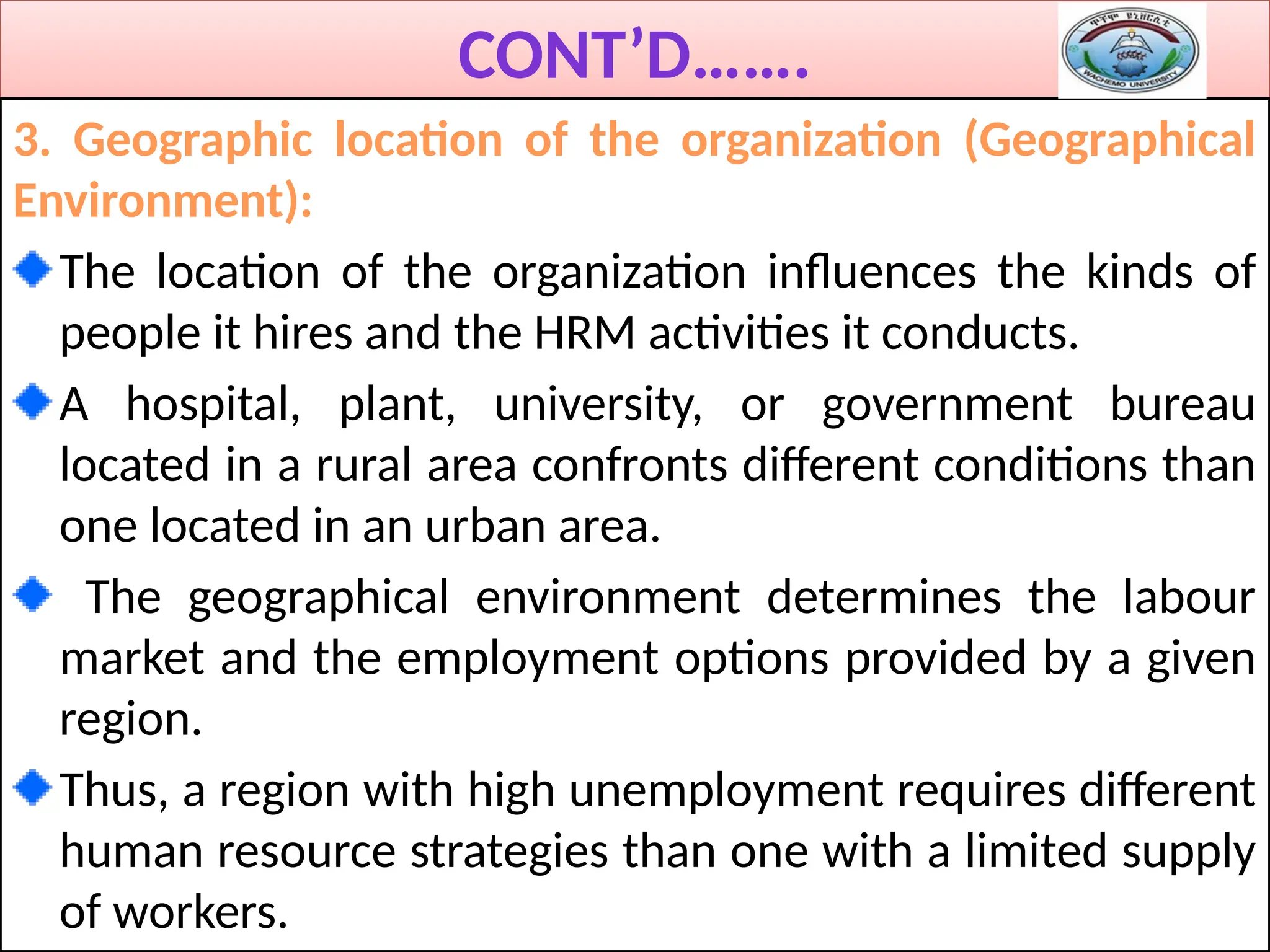
3. Geographic locationof the organization (Geographical
Environment):
The location of the organization influences the kinds of
people it hires and the HRM activities it conducts.
A hospital, plant, university, or government bureau
located in a rural area confronts different conditions than
one located in an urban area.
The geographical environment determines the labour
market and the employment options provided by a given
region.
Thus, a region with high unemployment requires different
human resource strategies than one with a limited supply
of workers.
54.
CONT’D……..
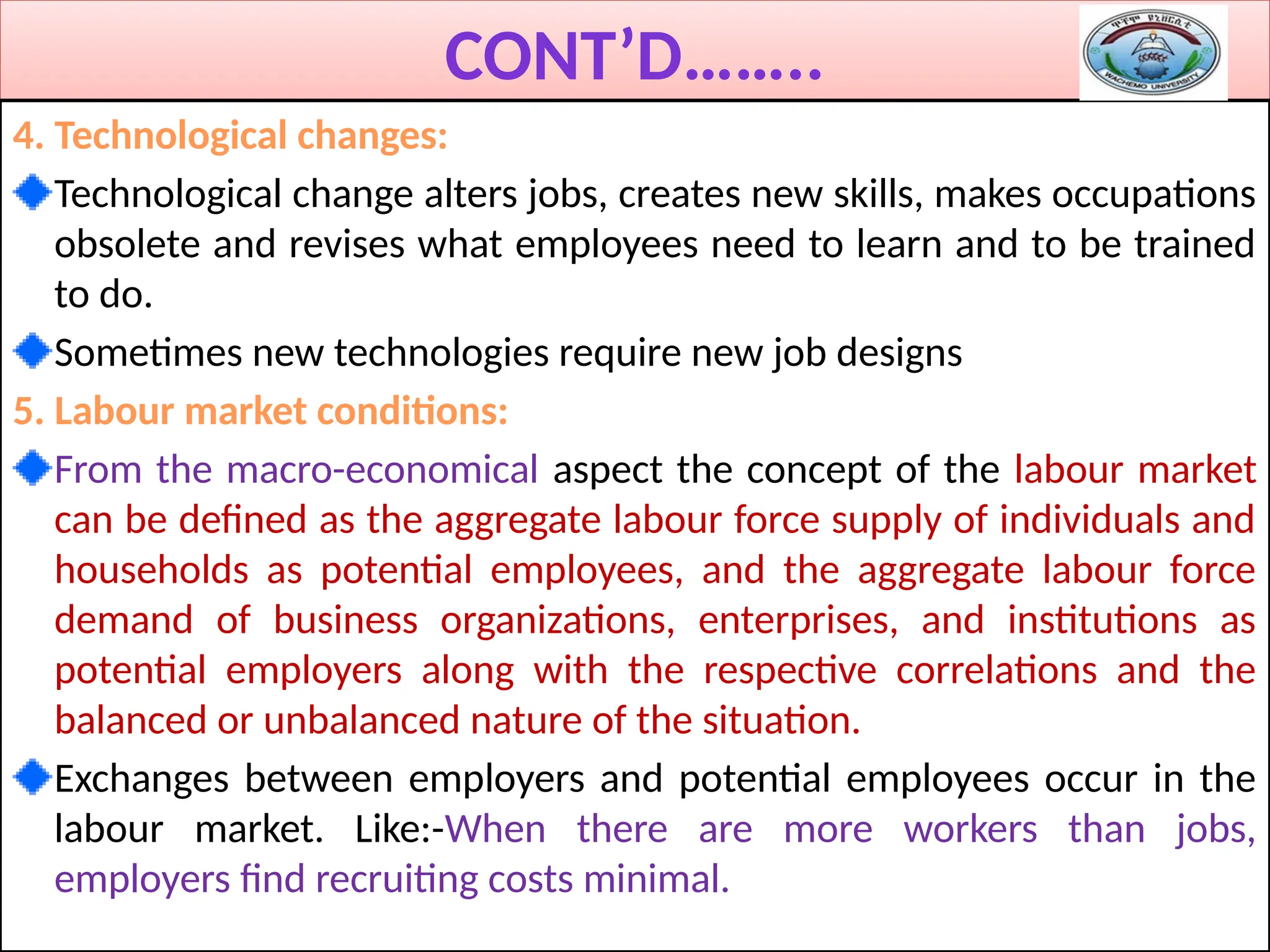
4. Technological changes:
Technologicalchange alters jobs, creates new skills, makes occupations
obsolete and revises what employees need to learn and to be trained
to do.
Sometimes new technologies require new job designs
5. Labour market conditions:
From the macro-economical aspect the concept of the labour market
can be defined as the aggregate labour force supply of individuals and
households as potential employees, and the aggregate labour force
demand of business organizations, enterprises, and institutions as
potential employers along with the respective correlations and the
balanced or unbalanced nature of the situation.
Exchanges between employers and potential employees occur in the
labour market. Like:-When there are more workers than jobs,
employers find recruiting costs minimal.
55.
CONT’D…….
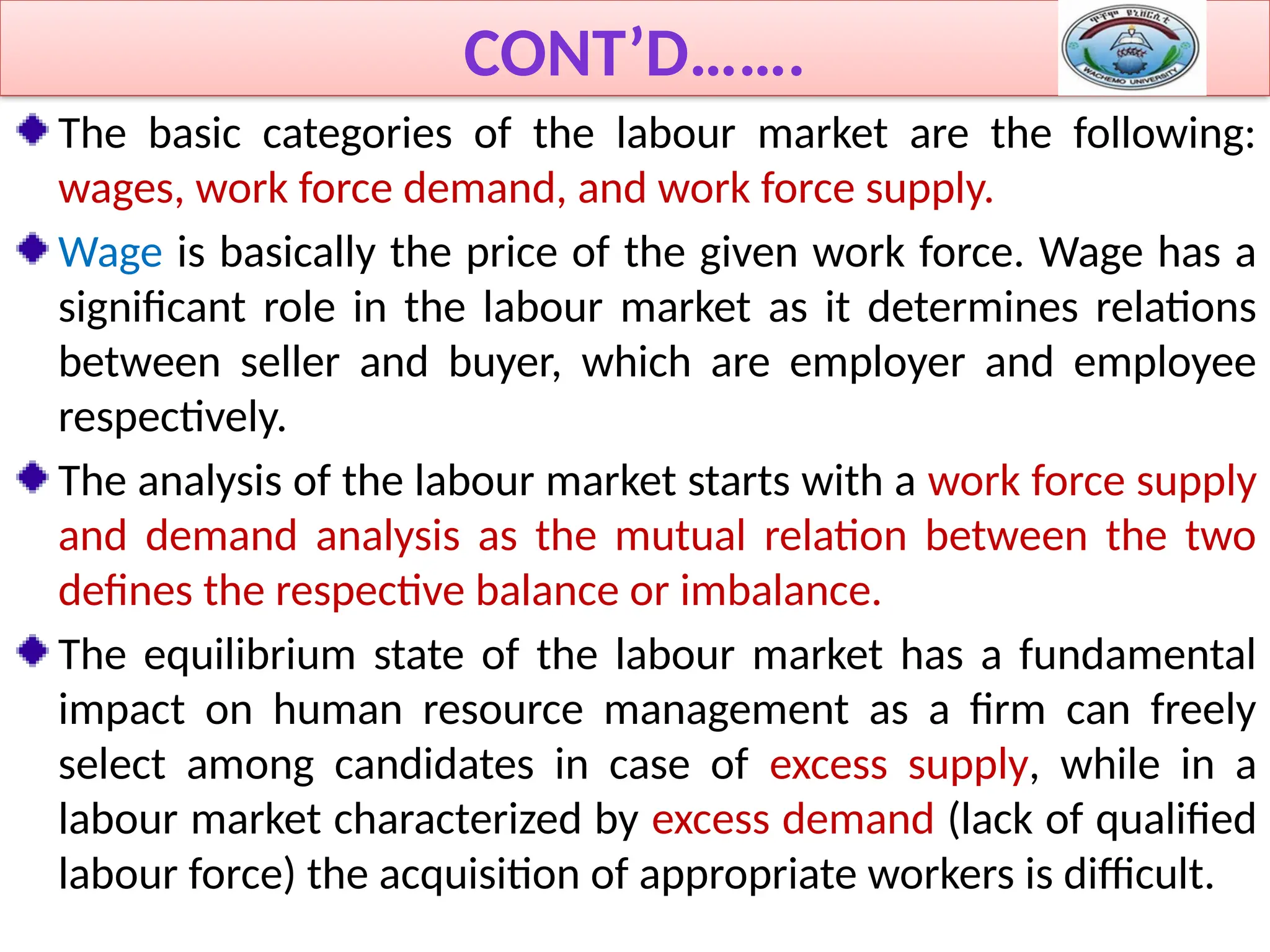
The basic categoriesof the labour market are the following:
wages, work force demand, and work force supply.
Wage is basically the price of the given work force. Wage has a
significant role in the labour market as it determines relations
between seller and buyer, which are employer and employee
respectively.
The analysis of the labour market starts with a work force supply
and demand analysis as the mutual relation between the two
defines the respective balance or imbalance.
The equilibrium state of the labour market has a fundamental
impact on human resource management as a firm can freely
select among candidates in case of excess supply, while in a
labour market characterized by excess demand (lack of qualified
labour force) the acquisition of appropriate workers is difficult.
56.
CONT’D……
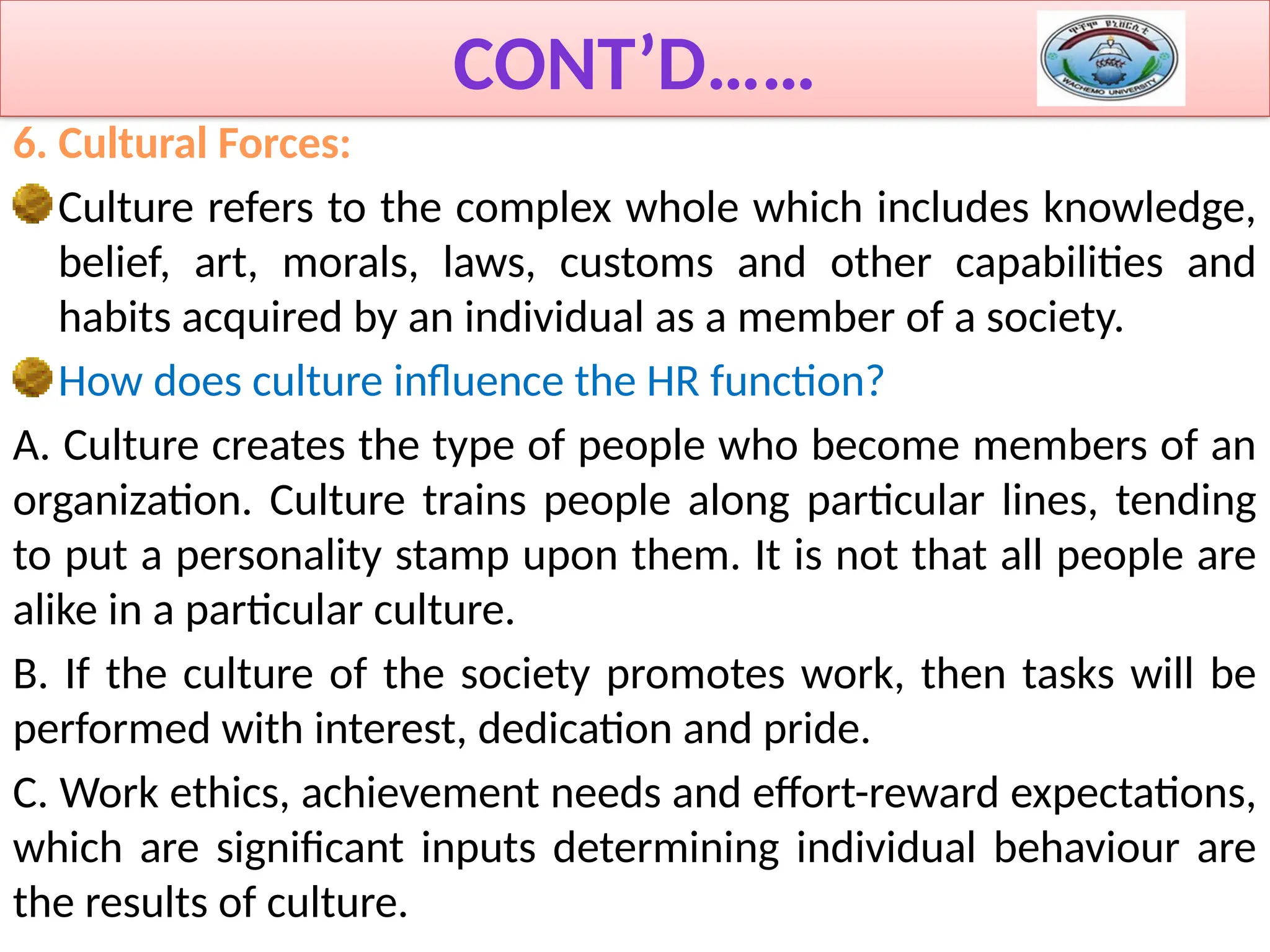
6. Cultural Forces:
Culturerefers to the complex whole which includes knowledge,
belief, art, morals, laws, customs and other capabilities and
habits acquired by an individual as a member of a society.
How does culture influence the HR function?
A. Culture creates the type of people who become members of an
organization. Culture trains people along particular lines, tending
to put a personality stamp upon them. It is not that all people are
alike in a particular culture.
B. If the culture of the society promotes work, then tasks will be
performed with interest, dedication and pride.
C. Work ethics, achievement needs and effort-reward expectations,
which are significant inputs determining individual behaviour are
the results of culture.
57.
CONT’D…….
The social environmentdetermines employment-related customs,
traditions, and motivations.
i.e. certain people choose an occupation based on traditions, and
even generations can be employed at the same company.
2 The Internal Environment (Micro-environmental factors):
The internal environment also affects the job of a HR
manager/administrator. The functional areas, structural changes,
specific cultural issues irregular to a unit, HR systems, corporate
policies and a lot of other factors influence the way the HR function is
carried out.
The HR manager/administrator has to work closely with these
constituent parts, understand the internal dynamics properly and
devise ways and means to survive and progress.
In addition to these, the personnel have to cope with the problem of
workforce diversity.
58.
CONT’D……
Some of theinternal factors include labour union, goals and
policies of the organization, organizational style, and nature
of the task, work group, leadership style and experience.
1. Labour unions: A trade union (labour union) may be
understood as an association of workers formed to protect
their own individual interests.
The presence of a union directly affects most aspects of HR
activities. Because most of the HR activities like recruitment,
selection, training, compensation and separation - are
carried out in consultation with union leaders.
The role of unions becomes pronounced when a new wage
agreement needs to be signed.
59.
CONT’D………..
2. Organizational Goals:
Thegoals of organizations differ within and between departments.
All departments probably have goals that include employee
satisfaction, survival, and adaptability to change.
The differences arise in the importance the decision makers place
on the different goals.
For Example: -if some organizations, HRM-related goals are highly
regarded by decision makers. Thus, how much the HRM function is
valued and how it is implemented is affected by these goals.
3. Organizational style:
Some organizations are likely to prefer more formalized HRM
policies, direct controls on employees; more direct job related
training, compensation policies tied to actual performance, and so
on.
60.
CONT’D……..
It seems reasonableto hypothesize that truly bureaucratic and
truly participative organizations would have different HRM
policies. In these ways, the organization’s style influences the
HRM program.
4. Nature of The Task:
Many experts believe that the task to be performed is one of
the most vital factors affecting HRM.
They describe HRM as the effective matching of the nature of
the task with the nature of the employee performing the task.
5. Work Group: Groups play a major role in the life of an
individual.
Once a person joins an organization, his or her experiences are
largely influenced by a work group.
61.
CONT’D……….
If the workgroup is effective and works with
management, the manager’s job is easier, and
objectives are more likely to be achieved.
On the other hand, if the group is working against
the manager, an effort must be made to change the
group’s norms and behaviour by the use of the
manager’s leadership, discipline, and reward powers,
or by the transfer of some group members.
Therefore, work groups are directly related to the
success of HRM activities. Examples of HRM activities
in this regard are incentive compensation, profit
sharing, and safety and labour relations.
62.
CONT’D……..
6. Leadership styleand experience:
The experience and leadership style of the operating manager/leader
directly affects HRM activities because many HRM programs must be
implemented at the work unit level.
Thus, the operating manager–leader is a crucial link in the HRM
function.
Leaders must demonstrate distinctive skills, experiences, personalities
and motives of individuals. They must also facilitate the intergroup
interactions that occur within work groups.
In his/her role a leader provides direction, encouragement, and
authority to evoke desired employee behaviour.
In addition, leaders reinforce desirable behaviour so that it is sustained
and enhanced. Because the leader is an important source of knowledge
about the tasks, the organization, the HRM policies, programs and goals.
Therefore, the experience and operating style of a leader will influence
which HRM program are communicated, implemented and effective.