HIGHER NATIONALDIPLOMA
IN BUSINESS
Unit 3:
Human Resource Management
By: Oguchi Martins Egbujor 1
The Aim of HRM
The aim of this unit is to equip students with the
understanding, skills and techniques of
identifying, acquiring and retaining the right
workforce that is effective, productive and
competitive in meeting an organisation
objectives.
By: Oguchi Martins Egbujor 2
LO1
Explain the purpose and scope of Human
Resource Management in terms of resourcing an
organisation with talent and skills appropriate to
fulfil business objectives
By: Oguchi Martins Egbujor 3
Human Resource Management
Human Resource Management is the process
of anticipating and identifying the human
requirements of an organisation to meets its
current and future corporate objectives.
By: Oguchi Martins Egbujor 4
Human Resource Management
Human Resource Management (HRM) is the
formal systems devised for the management
of people within an organization. The
responsibilities of a human resource manager
fall into three major areas:
 Staffing
 Employee compensation and benefits
 Defining and designing work.
By: Oguchi Martins Egbujor 5
The concepts of ‘best practice’ and
‘best fit
The concept of best practice is based on the
assumption that there is a set of best HRM
practices that are universal in the sense that
they are best in any situation, and that adopting
them will lead to superior organizational
performance. This concept of universality is
criticized because it takes no account of the
local context.
By: Oguchi Martins Egbujor 6
The Concept of Best Fit
The concept of best fit emphasizes that HR
strategies should be congruent (agreement,
Harmony or identical) with the context and
circumstances of the organization. Best fit can
be perceived in terms of vertical integration or
alignment between the organization’s business
and HR strategies.
• It is generally accepted that best fit is more
important than best practice.
By: Oguchi Martins Egbujor 7
Vertical Integration
Backward Integration
• This is a business strategy
whereby an organisation
acquires its suppliers to
ensure steady flow of
materials to meet the needs
of the organisation in order
to control input for greater
productivity.
Forward Integration
• This is a business strategy
whereby an organisation
acquires the distribution
channel in order to control
its manufacturing,
wholesale and retail outlets
so as to meet it objectives
of maximising output.
By: Oguchi Martins Egbujor 8
Hard and Soft Model of HRM
Two of the most widely adopted models of human
resource management are the hard and soft versions.
These are based on opposing views of human nature and
managerial control strategies. The hard model is based on
notions of tight strategic control, and an economic model
of man according to Theory X, while the soft model is
based on control through commitment and Theory Y. We
argue that because these assumptions are so divergent,
they cannot both properly be incorporated within a single
model of human resource management.
(Storey, 1989)
By: Oguchi Martins Egbujor 9
Soft and Hard Model
The tenets of the soft, commitment model,
while the reality experienced by employees is
more concerned with strategic control, similar to
the hard model.
By: Oguchi Martins Egbujor 10
P1
Explain the purpose and functions of HRM,
applicable to workforce planning and resourcing
an organisation
By: Oguchi Martins Egbujor 11
The Purpose of HRM
The purpose of HRM is to maximize the productivity
of an organization by optimizing the effectiveness
of its employees. Essentially therefore, the basic
mission of human resource management will
always be to acquire, develop, and retain talent;
align the workforce with the business; and be an
excellent contributor to the business
(Edward L. Gubman)
Journal of Business Strategy
By: Oguchi Martins Egbujor 12
The Function of HRM
The major function of human resource
management is to maximise the skills,
experience and knowledge of the workforce to
achieve organisational objectives. This will also
include the enhancement of human potentials
to meet corporate objectives.
By: Oguchi Martins Egbujor 13
Workforce Planning
Workforce Planning is a system with the process
of identifying and analysing an organisation’s
current and future objectives, and identifying
and acquiring the right skills to meet them
productively and profitably.
By: Oguchi Martins Egbujor 14
Human Resource Planning
HR Planning is the process by which an
organisation ensures that it has the right
number and kind of people, at the right place, at
the right time, capable of effectively and
efficiently completing those tasks that will help
the organisation achieve its overall objectives.
(Decenzo and Robbins, 2010)
By: Oguchi Martins Egbujor 15
Succession Planning
Succession Planning is a process of identifying,
motivating and developing employees with
the required talents to be future leaders of an
organisation. The planning is usually for
medium and long terms in accordance with
the organisational needs. Succession planning
is relevant to a “learning organisation” that
pays particular attention to employee
development.
By: Oguchi Martins Egbujor 16
Functions and Scope of HRM
• Liaising with management to align human
requirement to its objectives
• Staffing
• Retention
• Induction, Training and development
• Motivating and Rewarding
• Discipline
• Appraisal
• Employee welfare, etc.
By: Oguchi Martins Egbujor 17
Legislations
• Data Protection Act 1998
• Employment Act 2008
• National Minimum Wage Act 1998
• Employment Relations 2004
• Sex Discrimination Act 1995/97
• Equality Act 2010
• Disability Discrimination Act 1995/2005
• DBS
• Working Time (Amendment) Regulations 2003
• Freedom of Information Act 2000
By: Oguchi Martins Egbujor 18
P2
Explain the strengths and weaknesses of
different approaches to recruitment and
selection
By: Oguchi Martins Egbujor 19
Recruitment
Recruitment is the process of attracting the right
candidates to the right job and at the right time.
This involves following the job market trend, and
analysing the human resource needs of the
organisation and attracting suitable candidates
to meet the objectives.
By: Oguchi Martins Egbujor 20
Selection
Selection is the process of identifying and
choosing the right candidate with the right skills
at the right time to meet the organisational
objectives. The right candidate must be suitable
to the needs of the organisation
By: Oguchi Martins Egbujor 21
Recruitment and Selection
Approaches
• Identify and analysing job vacancies
• Prepare for Job Analysis
• Advertising the vacancy (the right channel)
• Managing Responses (CVs and Applications)
• Shortlisting the Suitable Candidates
• Arranging and Conducting Interviews
• Selecting the right candidates
By: Oguchi Martins Egbujor 22
Job Analysis
Job Analysis is the Process of studying and
collecting information relating to the operations
and responsibilities of a specific job. The
immediate products of job analysis are job
description and job specification.
By: Oguchi Martins Egbujor 23
Job Analysis
Job Description
• Job Title
• Pay
• Location
• Summary
• Duties
• Machinery and Materials
• Supervision
• Working Conditions
• Hazards
Person Specification
• Education/Qualification
• Experience
• Training
• Skills
• Physical demand
• Initiative
• Responsibilities
• Communication skills
• Attitude
• Emotional Characteristics
By: Oguchi Martins Egbujor 24
Job Analysis Video
https://www.youtube.com/watch?v=D2_U_vsfr
6I
By: Oguchi Martins Egbujor 25
Sources of Recruitment
Internal
• Current employees
• Former employee
• Database of applicants
• Referrals from employees
• Internal job vacancy
External
• Advertisement
• Job Centre Plus
• Employment Agencies
• Referrals from friends
• College recruitment
• Company’s website
By: Oguchi Martins Egbujor 26
Selection Approaches
• Application
• CV matching
• Shortlisting
• Aptitude tests/or Psychometric tests
• Telephone surveys
• E-Assessment
• Interviews
• Group selection techniques-panel, tasks, role
play, presentation, observation, etc.
• Assessment centres/or Assessment Agencies
By: Oguchi Martins Egbujor 27
Recruitment and Selection
Different Approaches
Strengths
• Organisational image
• Advertising widely
• Experience HRM
• Shortlisting the best
candidate
• Targeting the right
candidates
• Ability to ask the right
question at interviews
Weaknesses
• Advertising is expensive
• Using wrong channel of
communication
• CV and Applications forms
may be written by
professional
• Stereotyping
• Inexperience HRM analysing
the job wrongly
By: Oguchi Martins Egbujor 28
M1
Assess how the functions of HRM can provide
talent and skills appropriate to fulfil business
objectives
By: Oguchi Martins Egbujor 29
Process
• Aligning business objectives and HR strategy
• Analysing labour market trend/environment
• Attracting the best candidates
• Motivating workforce
• Training workforce
• Retaining workforce
• Rewarding workforce
By: Oguchi Martins Egbujor 30
Demand Forecast
Demand Forecast is a system with the process of
analysing the direction and the objectives of an
organisation, and establishing the skills, talent
and the required number of people to meet the
current and future needs.
By: Oguchi Martins Egbujor 31
Supply Forecast
• Supply forecast is to determine whether the
HR department will be able to procure the
required skills and number of workforce
needed at any particular point in time to
achieve business objectives:
• Internal Sources of Supply
• External Sources of Supply
• Current Employees
By: Oguchi Martins Egbujor 32
Labour Market Trend
HR will be focusing on the behaviour of labour
market and what is driving the behaviour. The
should also look at what is obtainable within
their industry regarding the development of
skills and knowledge:
• PESTLE
• SWOT
By: Oguchi Martins Egbujor 33
By: Oguchi Martins Egbujor 34
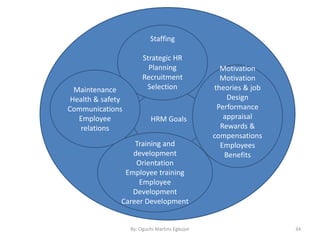
HRM Goals
Staffing
Strategic HR
Planning
Recruitment
Selection
Motivation
Motivation
theories & job
Design
Performance
appraisal
Rewards &
compensations
Employees
Benefits
Maintenance
Health & safety
Communications
Employee
relations
Training and
development
Orientation
Employee training
Employee
Development
Career Development
M2
Evaluate the strengths and weaknesses of
different approaches to recruitment and
selection
By: Oguchi Martins Egbujor 35
Evaluate Approaches
• Draw on varied information
• Strengths and weaknesses
• Advantages and disadvantages
• The relevance or importance
• Make supported judgements
By: Oguchi Martins Egbujor 36
D1
• Critically evaluate the strengths and
weaknesses of different approaches to
recruitment and selection, supported by
specific examples
By: Oguchi Martins Egbujor 37
Critically Evaluate Approaches
• Make clear strengths and weaknesses
• Reflect P1, P2, M1 and M2
• Intelligent argument (pros and cons)
• Definite and Precise account
• Give examples
• Support your judgement
• Conclude possible outcomes
• Use variety of information
By: Oguchi Martins Egbujor 38
Employee Induction
Employee induction is the process used within
an organisation to welcome new employees and
to prepare them for their new role. Induction
training includes the development of theoretical
and practical skills, and also meet interaction
needs that exist among the new employees
By: Oguchi Martins Egbujor 39
Onboarding
• This is a process of acclimatising and
integrating new employees into the
organisational system. Onboarding ensures
that new hires feel welcome and prepared in
their new positions, in turn giving them the
confidence and resources to make an impact
within the organization, and ultimately
allowing the company to continue carrying out
its mission.
By: Oguchi Martins Egbujor 40
The 10 Commandments of
Onboarding
Thou shalt not bear false witness against thy
employee. Few things are more disappointing
than the realization that the job you thought
you were hired to do is sorely different than
what you're actually doing
• http://employer.careerbuilder.com/jobposter/
small-
business/article.aspx?articleid=atl_0192onboa
rdingtips_s
By: Oguchi Martins Egbujor 41
Socialisation
Socialization is the on-going process of learning
the social culture of the organization and how to
get along with others in the organization
O’Nell et al. (2001)
By: Oguchi Martins Egbujor 42
Onboarding and Socialisation
• Starting a new job can be stressful
• Newcomers are in an unfamiliar work
environment surrounded by people they do
not know
• New employee must establish relationships
and learn new behaviors, facts, procedures,
expectations, and values
By: Oguchi Martins Egbujor 43
Socialisation and Reorientation
• New employees can also expect surprises
• not anticipating the emotional impact of
greater responsibility
• underestimating the difficulty of adjusting to a
new work schedule
• New employees may also need to “unlearn”
things that helped them succeed in previous
settings
By: Oguchi Martins Egbujor 44
LO2
Evaluate the effectiveness of the key
elements of Human Resource
Management in an organisation
By: Oguchi Martins Egbujor 45
P3
Explain the benefits of different HRM practices
within an organisation for both the employer
and employee.
By: Oguchi Martins Egbujor 46
HRM Practices
• Articulation of Vision, Mission and Values
(VMV)
• Drawing up HRM Plan
• Manpower Planning
• Performance Management System
• Training and Development
• Service Quality Enhancement
By: Oguchi Martins Egbujor 47
Good HRM Practice
• Managing people effectively for
performance through an open Performance
Management System (PMS) that will call for
individual objectives tied to departmental
objectives, regular coaching, and developing
staff on the job
By: Oguchi Martins Egbujor 48
Good HRM Practices
• Enhancing staff's competencies to perform
better through effectively training people to
achieve departmental objectives and results
• Delivering quality service through training
and engaging staff in developing a service
culture in addition to business process re-
engineering and work streamlining.
By: Oguchi Martins Egbujor 49
Key Elements of HRM
• Workforce Planning
• Recruitment and retention
• Training and Development
• Health and Safety
• Organisational Culture
• Motivation and reward
• Performance Appraisal
• Employee relation, Complaint, Discipline
By: Oguchi Martins Egbujor 50
Types of training
• On-the-job Training
• Job rotation
• Job Mentoring
• Shadowing
• Coaching
By: Oguchi Martins Egbujor 51
Types of Training
http://study.com/academy/lesson/methods-for-
training-employees-mentoring-on-the-job-job-
rotation.html
By: Oguchi Martins Egbujor 52
P4
Evaluate the effectiveness of different HRM
practices in terms of raising organisational profit
and productivity
By: Oguchi Martins Egbujor 53
Reward Management
• Extrinsic and Intrinsic Reward
• Motivational Theory and Reward
• Job Design
• Flexible Organisation
• Flexible Working Practice
• Performance and Reward
• Payment and Reward System
By: Oguchi Martins Egbujor 54
Organisational Flexibility
• Numerical Flexibility
• Structural Flexibility
• Functional Flexibility
• http://study.com/academy/lesson/bureaucrati
c-organizations-mechanic-organic-
bureacracies.html
By: Oguchi Martins Egbujor 55
Numerical Flexibility
Is the policy of ensuring that the appropriate amount of
labour is employed for the needs of the organization.
This involves putting people on a variety of contracts to
ensure that fluctuations in the demand for employees
across the working day, week, or year are matched with
the appropriate supply of labour. The most common
forms of numerical flexibility are: (a) part-time working,
(b) temporary/fixed-term contracts, and (c)
subcontracting.
By: Oguchi Martins Egbujor 56
Flexibility HRM Practices
• Benchmarking
• Best Practice
• Business Environment
• Business Process Reengineering
• Centralization
• Change Strategy
• Competitive Advantage
• Comprehensiveness
By: Oguchi Martins Egbujor 57
HRM Flexibility Practices
• De-layering
• Division of Labour
• Divisional Structure
• Downsizing
• Soft HRM
• Soft Planning
• Strategic HRM
• Talent Management
By: Oguchi Martins Egbujor 58
Structural Flexibility
Flexible business structures are those structures
that develop within an organization in response
to existing employee relations and the way that
employees interact with one another
throughout the daily course of business. Flexible
structures are informal by nature; they generally
result from workers discovering ways to carry
out business that are more efficient than those
mandated by the formal organizational structure
By: Oguchi Martins Egbujor 59
Functional Flexibility
This is the ability of an organization to move employees
to other duties or responsibilities within the company.
Functional flexibility reflects an organization's ability to
adapt to changing conditions and requirements, and is
affected by issues such as training, management, and
outsourcing
http://www.businessdictionary.com/definition/functio
nal-flexibility.html
By: Oguchi Martins Egbujor 60
Organisational Flexibility
• Hierarchical Structure
• Flat Structure
• Functional Units
• Communication channel
• Style of Management
• Motivation
• Learning Organisation
• Productivity
By: Oguchi Martins Egbujor 61
Motivational Theories
• Maslow Hierarchy of Needs
• Herzberg Two Factor Theory
• Mayo Human relation Theory
• McGregor Theory X Theory Y
By: Oguchi Martins Egbujor 62
Motivation and Reward system
Extrinsic and Intrinsic Reward
• http://study.com/academy/lesson/extrinsic-
rewards-for-students-definition-examples-
quiz.html
Maslow and Herzberg Motivation Theories
• https://www.youtube.com/watch?v=rbqn_P2
aKNo
• https://www.youtube.com/watch?v=3Ub8R5c
6tkE
By: Oguchi Martins Egbujor 63
Employee Performance
Performance monitoring is a system of appraisal
that is carried out periodically to rate an
employee’s excellence in matters pertaining to
his or her present job and his or her potential
for a better job.
• (Edwin B, 1980)
By: Oguchi Martins Egbujor 64
Performance Monitoring
• SWOT Analysis
• MBO (Management by Objectives)
• Appraisal (Staff and Work)
• 360 Degree Feedback process
• Mentoring
• Benchmarking
• Actual Versus Target (League Table)
• Job Review
By: Oguchi Martins Egbujor 65
M3
Explore the different methods used in HRM
practices, providing specific examples to support
evaluation within an organisational context
By: Oguchi Martins Egbujor 66
HR Methods
• standard administrative
times
• work standards
determination
• the scenario
• extrapolation
• the correlation
coefficient
• jobs analysis
• workday tasks analysis
• instantaneous
observation
• time recording
• workday shooting
• ▪ physical and/or value
work productivity
By: Oguchi Martins Egbujor 67
HR Methods
By: Oguchi Martins Egbujor 68
D2
Critically evaluate HRM practices and application
within an organisational context, using a range
of specific examples.
By: Oguchi Martins Egbujor 69
LO3
Analyse internal and external factors
that affect Human Resource
Management decision-making,
including employment legislation
By: Oguchi Martins Egbujor 70
Factors Affecting HR Decision
Making
• Employee Relation and the Law
• Purpose of Employment Law
• Data Protection
• Health & Safety
• Dismissal and Employment Contract
• Equality
• Ethical and Social Responsibility
By: Oguchi Martins Egbujor 71
Trade Union and the
Workplace Representation
• The Role of trade Union (local/national)
• Collective agreements
• Discipline
• Grievance
• Redundancy
• Best Practice
By: Oguchi Martins Egbujor 72
P5
P5 Analyse the importance of
employee relations in respect to
influencing HRM decision making.
By: Oguchi Martins Egbujor 73
Employee Relations
• Employment Relations Act 2004
• Employee Engagement
• Trade Union affiliation
• Involving Employee
• Employee Representation
• Employee welfare
• Discipline
• Grievances
By: Oguchi Martins Egbujor 74
P6
P6 Identify the key elements of
employment legislation and the
impact it has upon HRM decision
making.
By: Oguchi Martins Egbujor 75
Employment Law
• Data Protection Act 1998
• Employment Act 2008
• National Minimum Wage Act 1998
• Employment Relations 2004
• Sex Discrimination Act 1995/97
• Equality Act 2010
• Disability Discrimination Act 1995/2005
• DBS
• Working Time (Amendment) Regulations 2003
• Freedom of Information Act 2000
By: Oguchi Martins Egbujor 76
M4
M4 Evaluate the key aspects of
employee relations management and
employment legislation that affect
HRM decision-making in an
organisational context
By: Oguchi Martins Egbujor 77
D3
LO3 & 4 D3 Critically evaluate
employee relations and the
application of HRM practices that
inform and influence decision-
making in an organisational context.
By: Oguchi Martins Egbujor 78
Employee Relations and the
Best Practice
• Employee Relations
• Employee Engagement
• Trade Union Employee Welfare
• Motivation, training and Reward
• Recognition
• Working practice
• Job Design and best fit
By: Oguchi Martins Egbujor 79
LO4
Apply Human Resource
Management practices in a work-
related context
By: Oguchi Martins Egbujor 80
Work-Based HRM Practices
• Job and Person Specification
• Recruitment and Selection
• Design and Place Job Advertisement
• Shortlisting and Processing Applications
• Interviewing Preparation and Best Practtice
• Selection Best Practice
• Technology
• Social Networking
By: Oguchi Martins Egbujor 81
P7
P7 Illustrate the application of HRM
practices in a work-related context,
using specific examples.
By: Oguchi Martins Egbujor 82
Work-Based HR Application
• Aligning business objectives with HR Plan
• Environmental analysis
• Workforce Planning
• Identify, Attracting and Recruitment
• Selection of Best Candidates
• Induction and Onboarding
• Training and Development
• Motivation, Rewarding and Retention
By: Oguchi Martins Egbujor 83
M5
M5 Provide a rationale for the
application of specific HRM practices
in a work related context.
By: Oguchi Martins Egbujor 84

Human Resource Management

  • 1.
    HIGHER NATIONALDIPLOMA IN BUSINESS Unit3: Human Resource Management By: Oguchi Martins Egbujor 1
  • 2.
    The Aim ofHRM The aim of this unit is to equip students with the understanding, skills and techniques of identifying, acquiring and retaining the right workforce that is effective, productive and competitive in meeting an organisation objectives. By: Oguchi Martins Egbujor 2
  • 3.
    LO1 Explain the purposeand scope of Human Resource Management in terms of resourcing an organisation with talent and skills appropriate to fulfil business objectives By: Oguchi Martins Egbujor 3
  • 4.
    Human Resource Management HumanResource Management is the process of anticipating and identifying the human requirements of an organisation to meets its current and future corporate objectives. By: Oguchi Martins Egbujor 4
  • 5.
    Human Resource Management HumanResource Management (HRM) is the formal systems devised for the management of people within an organization. The responsibilities of a human resource manager fall into three major areas:  Staffing  Employee compensation and benefits  Defining and designing work. By: Oguchi Martins Egbujor 5
  • 6.
    The concepts of‘best practice’ and ‘best fit The concept of best practice is based on the assumption that there is a set of best HRM practices that are universal in the sense that they are best in any situation, and that adopting them will lead to superior organizational performance. This concept of universality is criticized because it takes no account of the local context. By: Oguchi Martins Egbujor 6
  • 7.
    The Concept ofBest Fit The concept of best fit emphasizes that HR strategies should be congruent (agreement, Harmony or identical) with the context and circumstances of the organization. Best fit can be perceived in terms of vertical integration or alignment between the organization’s business and HR strategies. • It is generally accepted that best fit is more important than best practice. By: Oguchi Martins Egbujor 7
  • 8.
    Vertical Integration Backward Integration •This is a business strategy whereby an organisation acquires its suppliers to ensure steady flow of materials to meet the needs of the organisation in order to control input for greater productivity. Forward Integration • This is a business strategy whereby an organisation acquires the distribution channel in order to control its manufacturing, wholesale and retail outlets so as to meet it objectives of maximising output. By: Oguchi Martins Egbujor 8
  • 9.
    Hard and SoftModel of HRM Two of the most widely adopted models of human resource management are the hard and soft versions. These are based on opposing views of human nature and managerial control strategies. The hard model is based on notions of tight strategic control, and an economic model of man according to Theory X, while the soft model is based on control through commitment and Theory Y. We argue that because these assumptions are so divergent, they cannot both properly be incorporated within a single model of human resource management. (Storey, 1989) By: Oguchi Martins Egbujor 9
  • 10.
    Soft and HardModel The tenets of the soft, commitment model, while the reality experienced by employees is more concerned with strategic control, similar to the hard model. By: Oguchi Martins Egbujor 10
  • 11.
    P1 Explain the purposeand functions of HRM, applicable to workforce planning and resourcing an organisation By: Oguchi Martins Egbujor 11
  • 12.
    The Purpose ofHRM The purpose of HRM is to maximize the productivity of an organization by optimizing the effectiveness of its employees. Essentially therefore, the basic mission of human resource management will always be to acquire, develop, and retain talent; align the workforce with the business; and be an excellent contributor to the business (Edward L. Gubman) Journal of Business Strategy By: Oguchi Martins Egbujor 12
  • 13.
    The Function ofHRM The major function of human resource management is to maximise the skills, experience and knowledge of the workforce to achieve organisational objectives. This will also include the enhancement of human potentials to meet corporate objectives. By: Oguchi Martins Egbujor 13
  • 14.
    Workforce Planning Workforce Planningis a system with the process of identifying and analysing an organisation’s current and future objectives, and identifying and acquiring the right skills to meet them productively and profitably. By: Oguchi Martins Egbujor 14
  • 15.
    Human Resource Planning HRPlanning is the process by which an organisation ensures that it has the right number and kind of people, at the right place, at the right time, capable of effectively and efficiently completing those tasks that will help the organisation achieve its overall objectives. (Decenzo and Robbins, 2010) By: Oguchi Martins Egbujor 15
  • 16.
    Succession Planning Succession Planningis a process of identifying, motivating and developing employees with the required talents to be future leaders of an organisation. The planning is usually for medium and long terms in accordance with the organisational needs. Succession planning is relevant to a “learning organisation” that pays particular attention to employee development. By: Oguchi Martins Egbujor 16
  • 17.
    Functions and Scopeof HRM • Liaising with management to align human requirement to its objectives • Staffing • Retention • Induction, Training and development • Motivating and Rewarding • Discipline • Appraisal • Employee welfare, etc. By: Oguchi Martins Egbujor 17
  • 18.
    Legislations • Data ProtectionAct 1998 • Employment Act 2008 • National Minimum Wage Act 1998 • Employment Relations 2004 • Sex Discrimination Act 1995/97 • Equality Act 2010 • Disability Discrimination Act 1995/2005 • DBS • Working Time (Amendment) Regulations 2003 • Freedom of Information Act 2000 By: Oguchi Martins Egbujor 18
  • 19.
    P2 Explain the strengthsand weaknesses of different approaches to recruitment and selection By: Oguchi Martins Egbujor 19
  • 20.
    Recruitment Recruitment is theprocess of attracting the right candidates to the right job and at the right time. This involves following the job market trend, and analysing the human resource needs of the organisation and attracting suitable candidates to meet the objectives. By: Oguchi Martins Egbujor 20
  • 21.
    Selection Selection is theprocess of identifying and choosing the right candidate with the right skills at the right time to meet the organisational objectives. The right candidate must be suitable to the needs of the organisation By: Oguchi Martins Egbujor 21
  • 22.
    Recruitment and Selection Approaches •Identify and analysing job vacancies • Prepare for Job Analysis • Advertising the vacancy (the right channel) • Managing Responses (CVs and Applications) • Shortlisting the Suitable Candidates • Arranging and Conducting Interviews • Selecting the right candidates By: Oguchi Martins Egbujor 22
  • 23.
    Job Analysis Job Analysisis the Process of studying and collecting information relating to the operations and responsibilities of a specific job. The immediate products of job analysis are job description and job specification. By: Oguchi Martins Egbujor 23
  • 24.
    Job Analysis Job Description •Job Title • Pay • Location • Summary • Duties • Machinery and Materials • Supervision • Working Conditions • Hazards Person Specification • Education/Qualification • Experience • Training • Skills • Physical demand • Initiative • Responsibilities • Communication skills • Attitude • Emotional Characteristics By: Oguchi Martins Egbujor 24
  • 25.
  • 26.
    Sources of Recruitment Internal •Current employees • Former employee • Database of applicants • Referrals from employees • Internal job vacancy External • Advertisement • Job Centre Plus • Employment Agencies • Referrals from friends • College recruitment • Company’s website By: Oguchi Martins Egbujor 26
  • 27.
    Selection Approaches • Application •CV matching • Shortlisting • Aptitude tests/or Psychometric tests • Telephone surveys • E-Assessment • Interviews • Group selection techniques-panel, tasks, role play, presentation, observation, etc. • Assessment centres/or Assessment Agencies By: Oguchi Martins Egbujor 27
  • 28.
    Recruitment and Selection DifferentApproaches Strengths • Organisational image • Advertising widely • Experience HRM • Shortlisting the best candidate • Targeting the right candidates • Ability to ask the right question at interviews Weaknesses • Advertising is expensive • Using wrong channel of communication • CV and Applications forms may be written by professional • Stereotyping • Inexperience HRM analysing the job wrongly By: Oguchi Martins Egbujor 28
  • 29.
    M1 Assess how thefunctions of HRM can provide talent and skills appropriate to fulfil business objectives By: Oguchi Martins Egbujor 29
  • 30.
    Process • Aligning businessobjectives and HR strategy • Analysing labour market trend/environment • Attracting the best candidates • Motivating workforce • Training workforce • Retaining workforce • Rewarding workforce By: Oguchi Martins Egbujor 30
  • 31.
    Demand Forecast Demand Forecastis a system with the process of analysing the direction and the objectives of an organisation, and establishing the skills, talent and the required number of people to meet the current and future needs. By: Oguchi Martins Egbujor 31
  • 32.
    Supply Forecast • Supplyforecast is to determine whether the HR department will be able to procure the required skills and number of workforce needed at any particular point in time to achieve business objectives: • Internal Sources of Supply • External Sources of Supply • Current Employees By: Oguchi Martins Egbujor 32
  • 33.
    Labour Market Trend HRwill be focusing on the behaviour of labour market and what is driving the behaviour. The should also look at what is obtainable within their industry regarding the development of skills and knowledge: • PESTLE • SWOT By: Oguchi Martins Egbujor 33
  • 34.
    By: Oguchi MartinsEgbujor 34 HRM Goals Staffing Strategic HR Planning Recruitment Selection Motivation Motivation theories & job Design Performance appraisal Rewards & compensations Employees Benefits Maintenance Health & safety Communications Employee relations Training and development Orientation Employee training Employee Development Career Development
  • 35.
    M2 Evaluate the strengthsand weaknesses of different approaches to recruitment and selection By: Oguchi Martins Egbujor 35
  • 36.
    Evaluate Approaches • Drawon varied information • Strengths and weaknesses • Advantages and disadvantages • The relevance or importance • Make supported judgements By: Oguchi Martins Egbujor 36
  • 37.
    D1 • Critically evaluatethe strengths and weaknesses of different approaches to recruitment and selection, supported by specific examples By: Oguchi Martins Egbujor 37
  • 38.
    Critically Evaluate Approaches •Make clear strengths and weaknesses • Reflect P1, P2, M1 and M2 • Intelligent argument (pros and cons) • Definite and Precise account • Give examples • Support your judgement • Conclude possible outcomes • Use variety of information By: Oguchi Martins Egbujor 38
  • 39.
    Employee Induction Employee inductionis the process used within an organisation to welcome new employees and to prepare them for their new role. Induction training includes the development of theoretical and practical skills, and also meet interaction needs that exist among the new employees By: Oguchi Martins Egbujor 39
  • 40.
    Onboarding • This isa process of acclimatising and integrating new employees into the organisational system. Onboarding ensures that new hires feel welcome and prepared in their new positions, in turn giving them the confidence and resources to make an impact within the organization, and ultimately allowing the company to continue carrying out its mission. By: Oguchi Martins Egbujor 40
  • 41.
    The 10 Commandmentsof Onboarding Thou shalt not bear false witness against thy employee. Few things are more disappointing than the realization that the job you thought you were hired to do is sorely different than what you're actually doing • http://employer.careerbuilder.com/jobposter/ small- business/article.aspx?articleid=atl_0192onboa rdingtips_s By: Oguchi Martins Egbujor 41
  • 42.
    Socialisation Socialization is theon-going process of learning the social culture of the organization and how to get along with others in the organization O’Nell et al. (2001) By: Oguchi Martins Egbujor 42
  • 43.
    Onboarding and Socialisation •Starting a new job can be stressful • Newcomers are in an unfamiliar work environment surrounded by people they do not know • New employee must establish relationships and learn new behaviors, facts, procedures, expectations, and values By: Oguchi Martins Egbujor 43
  • 44.
    Socialisation and Reorientation •New employees can also expect surprises • not anticipating the emotional impact of greater responsibility • underestimating the difficulty of adjusting to a new work schedule • New employees may also need to “unlearn” things that helped them succeed in previous settings By: Oguchi Martins Egbujor 44
  • 45.
    LO2 Evaluate the effectivenessof the key elements of Human Resource Management in an organisation By: Oguchi Martins Egbujor 45
  • 46.
    P3 Explain the benefitsof different HRM practices within an organisation for both the employer and employee. By: Oguchi Martins Egbujor 46
  • 47.
    HRM Practices • Articulationof Vision, Mission and Values (VMV) • Drawing up HRM Plan • Manpower Planning • Performance Management System • Training and Development • Service Quality Enhancement By: Oguchi Martins Egbujor 47
  • 48.
    Good HRM Practice •Managing people effectively for performance through an open Performance Management System (PMS) that will call for individual objectives tied to departmental objectives, regular coaching, and developing staff on the job By: Oguchi Martins Egbujor 48
  • 49.
    Good HRM Practices •Enhancing staff's competencies to perform better through effectively training people to achieve departmental objectives and results • Delivering quality service through training and engaging staff in developing a service culture in addition to business process re- engineering and work streamlining. By: Oguchi Martins Egbujor 49
  • 50.
    Key Elements ofHRM • Workforce Planning • Recruitment and retention • Training and Development • Health and Safety • Organisational Culture • Motivation and reward • Performance Appraisal • Employee relation, Complaint, Discipline By: Oguchi Martins Egbujor 50
  • 51.
    Types of training •On-the-job Training • Job rotation • Job Mentoring • Shadowing • Coaching By: Oguchi Martins Egbujor 51
  • 52.
  • 53.
    P4 Evaluate the effectivenessof different HRM practices in terms of raising organisational profit and productivity By: Oguchi Martins Egbujor 53
  • 54.
    Reward Management • Extrinsicand Intrinsic Reward • Motivational Theory and Reward • Job Design • Flexible Organisation • Flexible Working Practice • Performance and Reward • Payment and Reward System By: Oguchi Martins Egbujor 54
  • 55.
    Organisational Flexibility • NumericalFlexibility • Structural Flexibility • Functional Flexibility • http://study.com/academy/lesson/bureaucrati c-organizations-mechanic-organic- bureacracies.html By: Oguchi Martins Egbujor 55
  • 56.
    Numerical Flexibility Is thepolicy of ensuring that the appropriate amount of labour is employed for the needs of the organization. This involves putting people on a variety of contracts to ensure that fluctuations in the demand for employees across the working day, week, or year are matched with the appropriate supply of labour. The most common forms of numerical flexibility are: (a) part-time working, (b) temporary/fixed-term contracts, and (c) subcontracting. By: Oguchi Martins Egbujor 56
  • 57.
    Flexibility HRM Practices •Benchmarking • Best Practice • Business Environment • Business Process Reengineering • Centralization • Change Strategy • Competitive Advantage • Comprehensiveness By: Oguchi Martins Egbujor 57
  • 58.
    HRM Flexibility Practices •De-layering • Division of Labour • Divisional Structure • Downsizing • Soft HRM • Soft Planning • Strategic HRM • Talent Management By: Oguchi Martins Egbujor 58
  • 59.
    Structural Flexibility Flexible businessstructures are those structures that develop within an organization in response to existing employee relations and the way that employees interact with one another throughout the daily course of business. Flexible structures are informal by nature; they generally result from workers discovering ways to carry out business that are more efficient than those mandated by the formal organizational structure By: Oguchi Martins Egbujor 59
  • 60.
    Functional Flexibility This isthe ability of an organization to move employees to other duties or responsibilities within the company. Functional flexibility reflects an organization's ability to adapt to changing conditions and requirements, and is affected by issues such as training, management, and outsourcing http://www.businessdictionary.com/definition/functio nal-flexibility.html By: Oguchi Martins Egbujor 60
  • 61.
    Organisational Flexibility • HierarchicalStructure • Flat Structure • Functional Units • Communication channel • Style of Management • Motivation • Learning Organisation • Productivity By: Oguchi Martins Egbujor 61
  • 62.
    Motivational Theories • MaslowHierarchy of Needs • Herzberg Two Factor Theory • Mayo Human relation Theory • McGregor Theory X Theory Y By: Oguchi Martins Egbujor 62
  • 63.
    Motivation and Rewardsystem Extrinsic and Intrinsic Reward • http://study.com/academy/lesson/extrinsic- rewards-for-students-definition-examples- quiz.html Maslow and Herzberg Motivation Theories • https://www.youtube.com/watch?v=rbqn_P2 aKNo • https://www.youtube.com/watch?v=3Ub8R5c 6tkE By: Oguchi Martins Egbujor 63
  • 64.
    Employee Performance Performance monitoringis a system of appraisal that is carried out periodically to rate an employee’s excellence in matters pertaining to his or her present job and his or her potential for a better job. • (Edwin B, 1980) By: Oguchi Martins Egbujor 64
  • 65.
    Performance Monitoring • SWOTAnalysis • MBO (Management by Objectives) • Appraisal (Staff and Work) • 360 Degree Feedback process • Mentoring • Benchmarking • Actual Versus Target (League Table) • Job Review By: Oguchi Martins Egbujor 65
  • 66.
    M3 Explore the differentmethods used in HRM practices, providing specific examples to support evaluation within an organisational context By: Oguchi Martins Egbujor 66
  • 67.
    HR Methods • standardadministrative times • work standards determination • the scenario • extrapolation • the correlation coefficient • jobs analysis • workday tasks analysis • instantaneous observation • time recording • workday shooting • ▪ physical and/or value work productivity By: Oguchi Martins Egbujor 67
  • 68.
    HR Methods By: OguchiMartins Egbujor 68
  • 69.
    D2 Critically evaluate HRMpractices and application within an organisational context, using a range of specific examples. By: Oguchi Martins Egbujor 69
  • 70.
    LO3 Analyse internal andexternal factors that affect Human Resource Management decision-making, including employment legislation By: Oguchi Martins Egbujor 70
  • 71.
    Factors Affecting HRDecision Making • Employee Relation and the Law • Purpose of Employment Law • Data Protection • Health & Safety • Dismissal and Employment Contract • Equality • Ethical and Social Responsibility By: Oguchi Martins Egbujor 71
  • 72.
    Trade Union andthe Workplace Representation • The Role of trade Union (local/national) • Collective agreements • Discipline • Grievance • Redundancy • Best Practice By: Oguchi Martins Egbujor 72
  • 73.
    P5 P5 Analyse theimportance of employee relations in respect to influencing HRM decision making. By: Oguchi Martins Egbujor 73
  • 74.
    Employee Relations • EmploymentRelations Act 2004 • Employee Engagement • Trade Union affiliation • Involving Employee • Employee Representation • Employee welfare • Discipline • Grievances By: Oguchi Martins Egbujor 74
  • 75.
    P6 P6 Identify thekey elements of employment legislation and the impact it has upon HRM decision making. By: Oguchi Martins Egbujor 75
  • 76.
    Employment Law • DataProtection Act 1998 • Employment Act 2008 • National Minimum Wage Act 1998 • Employment Relations 2004 • Sex Discrimination Act 1995/97 • Equality Act 2010 • Disability Discrimination Act 1995/2005 • DBS • Working Time (Amendment) Regulations 2003 • Freedom of Information Act 2000 By: Oguchi Martins Egbujor 76
  • 77.
    M4 M4 Evaluate thekey aspects of employee relations management and employment legislation that affect HRM decision-making in an organisational context By: Oguchi Martins Egbujor 77
  • 78.
    D3 LO3 & 4D3 Critically evaluate employee relations and the application of HRM practices that inform and influence decision- making in an organisational context. By: Oguchi Martins Egbujor 78
  • 79.
    Employee Relations andthe Best Practice • Employee Relations • Employee Engagement • Trade Union Employee Welfare • Motivation, training and Reward • Recognition • Working practice • Job Design and best fit By: Oguchi Martins Egbujor 79
  • 80.
    LO4 Apply Human Resource Managementpractices in a work- related context By: Oguchi Martins Egbujor 80
  • 81.
    Work-Based HRM Practices •Job and Person Specification • Recruitment and Selection • Design and Place Job Advertisement • Shortlisting and Processing Applications • Interviewing Preparation and Best Practtice • Selection Best Practice • Technology • Social Networking By: Oguchi Martins Egbujor 81
  • 82.
    P7 P7 Illustrate theapplication of HRM practices in a work-related context, using specific examples. By: Oguchi Martins Egbujor 82
  • 83.
    Work-Based HR Application •Aligning business objectives with HR Plan • Environmental analysis • Workforce Planning • Identify, Attracting and Recruitment • Selection of Best Candidates • Induction and Onboarding • Training and Development • Motivation, Rewarding and Retention By: Oguchi Martins Egbujor 83
  • 84.
    M5 M5 Provide arationale for the application of specific HRM practices in a work related context. By: Oguchi Martins Egbujor 84