ENVIORNMENTAL HEALTH
SCHOOL OF PUBLIC HEALTH
KIIT DEEMED TO BE UNIVERSITY
BHUBANESWAR, ODISHA
LEARNING OBJECTIVE
• To introduce the general links between the states of the
environment and human health
• To assess the environmental health related estimation of
burden of disease
• To know various risk factors associated with environmental
health and
• To understand the key interventions support by national and
international organization to improve environmental health
• The human health and quality of the life depend upon the
global and local ecology and the way it is managed
WHO DEFINATION OF ENVIORNMENTAL
HEALTH (1993, SOFIA, BULGARIA)
• “ Environmental health comprises of those aspects of human
health, including quality of life, that are determined by
physical, chemical, biological, social and psychological factors
in the environment….”
• It also refers to the theory and practice of assessing,
correcting, controlling and preventing those factors in the
environment that can potentially affect adversely the health
of present and future generation”.
GLOBAL BURDEN OF DISEASE LINKED WITH
ENVIORNMENTAL FACTOR
In 2006, the WHO published a report titled ‘Preventing the
disease through healthy environment’. This report presented
the key questions –
(a) How much disease burden can be prevented by
environmental interventions?
• The report says the 24% of the Global Disease Burden is
linked to Environmental Risk Factor.
• The report states the major fractions of attributable to
modifiable environmental factors include, diarrhoeal
diseases (94% infection) and lower respiratory infections,
malaria, unintended injuries, all these diseases attributable
to modifiable environmental factors around 40%
• In children, 34% of disease burden is attributed to the
environment, and much of these disease placed in low
income country.
ENVIORNMENTAL FACTORS IMPACTING
HUMAN HEALTH
• POOR WATER QUALITY
• INSUFFICIENT ACCESS TO WATER
• LACK OF APPROPRIATE SANITATION AND POOR PERSONAL
HYGIENE
Such factors greatly increase the diarroheal disease, intestinal
worm infections, skin and eye diseases and a number of water
and sanitation related problems.
• In addition, lack of access to basic sanitation, insufficient
water supply significantly impact quality of life and school
performance by preventing girl especially from attending
school.
• Increased access to appropriate water and sanitation is a
human right.
• 2013 updated report of WHO, UNICEF and Joint Monitoring
Program on water supply and sanitation reported that 89%
of the world population has access to safe drinking water.
• Also 770 million people still depends on the unimproved
drinking water sources
• Most household lack water supply living in Africa and Sub-
Saharan Africa.
• By the end of 2020, there was nearly 2.8 billion people who
did not used the improved sanitation facility and another 1.6
billion do not have access to safe drinking water mainly from
the South Asia, Africa and Sub-Saharan countries.
ENVIORNMENTAL RISK FACTORS
• Air quality (In-door household air pollution and out-door air
pollution)
• Increased use of motor vehicles
• Industrial production
• Burning of waste
• Insufficient local energy production
• Use of solid fossil fuel
• Urbanization – It is the next issue to address
- It is a process of on-going and rapid pace of changing society
and environmental land scale in every continent.
- It is a result of population migration from rural to urban
areas and urban demographic growth, rapid unplanned and
unsustainable patterns of urban development and making
developing cities focal points for emerging many
environmental hazards.
- This includes solid waste disposal, waste water management,
provision of safe water, sanitation, noise, food safety, traffic
and occupational injury and air quality.
Another risk factor
• Water Resource Development
- Irrigation schemes
- Water reservoirs
- Large dams
NATURAL RESOURCES
• Shrinking forest cover
• Unstainable production system
• Climate change
• Poor management of natural resources
• A particular concern is the ‘loss of biodiversity’ .
• Responding the need to protect land fertility and
biodiversity, two key conventions have been developed as a
result of Rio Earth Summit (1992).
(a) United Nations Conventions to Combat Desertification
(UNCCD) that brought attention to land degradation in dry
land.
(b) Convention on Biological Diversity dedicated to the
protection of global-diversity.
INTERVENTION OF AGRICULTURE
• In many parts of the world, the agricultural system is more
and more intense.
• Increased focused on monoculture, cash crops and
dependency on inputs such as fertilizer, pesticides and
advanced seeds have been seen.
• This has both positive and negative impact to the income
level of farming household.
• However, at the same time, it increases the level of
contamination of water and land
• There is also transboundary movement of ‘Persistent
Organic Pollutants’ such as DDT (addressed in the Stockholm
convention) and reduction of mercury emission.
• Mercury is recognized as chemical of Global Health concern
• One area where international collaboration is needed that is
occupational health and health rights
• Another area where international collaboration is needed i.e.
growing trade with waste products.
• The Basal Convention was adapted in 1989 is set to control
the transboundary movement of hazardous waste and their
disposal.
• There are other modalities that has to be continuously
updated and expanded to deal with new waste categories
such as trade with electronic waste.
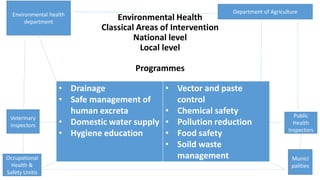
Environmental Health
Classical Areas of Intervention
National level
Local level
Programmes
• Drainage
• Safe management of
human excreta
• Domestic water supply
• Hygiene education
• Vector and paste
control
• Chemical safety
• Pollution reduction
• Food safety
• Soild waste
management
Environmental health
department
Veterinary
Inspectors
Occupational
Health &
Safety Unitis
Department of Agriculture
Public
Health
Inspectors
Munici
palities
Role of Computer Science/Engineering
students to save environment
• Computer modeling
• Simulation
• Machine learning
• Computer scientists in partnership with environmental scientists employ an
array of information technology tools to help fight climate change.
• Computer Scientists utilize all areas of computing, including data science
and software engineering, to formulate sustainable solutions to combat
global warming.
• For Example "Machine-learning-based evidence and attribution mapping
of 100,000 climate impact studies" published in Nature Climate Change
reflecting sustainable solution for global warming.
ASSISGNMENT
How various environmental risk factors impacting human
health? Discuss with appropriate examples.
THANK YOU
QUESTIONS & ANSWER SESSION

PPT2_Env health 2022.pdf

  • 1.
    ENVIORNMENTAL HEALTH SCHOOL OFPUBLIC HEALTH KIIT DEEMED TO BE UNIVERSITY BHUBANESWAR, ODISHA
  • 2.
    LEARNING OBJECTIVE • Tointroduce the general links between the states of the environment and human health • To assess the environmental health related estimation of burden of disease • To know various risk factors associated with environmental health and • To understand the key interventions support by national and international organization to improve environmental health
  • 3.
    • The humanhealth and quality of the life depend upon the global and local ecology and the way it is managed
  • 4.
    WHO DEFINATION OFENVIORNMENTAL HEALTH (1993, SOFIA, BULGARIA) • “ Environmental health comprises of those aspects of human health, including quality of life, that are determined by physical, chemical, biological, social and psychological factors in the environment….” • It also refers to the theory and practice of assessing, correcting, controlling and preventing those factors in the environment that can potentially affect adversely the health of present and future generation”.
  • 5.
    GLOBAL BURDEN OFDISEASE LINKED WITH ENVIORNMENTAL FACTOR In 2006, the WHO published a report titled ‘Preventing the disease through healthy environment’. This report presented the key questions – (a) How much disease burden can be prevented by environmental interventions?
  • 6.
    • The reportsays the 24% of the Global Disease Burden is linked to Environmental Risk Factor. • The report states the major fractions of attributable to modifiable environmental factors include, diarrhoeal diseases (94% infection) and lower respiratory infections, malaria, unintended injuries, all these diseases attributable to modifiable environmental factors around 40% • In children, 34% of disease burden is attributed to the environment, and much of these disease placed in low income country.
  • 7.
    ENVIORNMENTAL FACTORS IMPACTING HUMANHEALTH • POOR WATER QUALITY • INSUFFICIENT ACCESS TO WATER • LACK OF APPROPRIATE SANITATION AND POOR PERSONAL HYGIENE Such factors greatly increase the diarroheal disease, intestinal worm infections, skin and eye diseases and a number of water and sanitation related problems.
  • 8.
    • In addition,lack of access to basic sanitation, insufficient water supply significantly impact quality of life and school performance by preventing girl especially from attending school. • Increased access to appropriate water and sanitation is a human right. • 2013 updated report of WHO, UNICEF and Joint Monitoring Program on water supply and sanitation reported that 89% of the world population has access to safe drinking water. • Also 770 million people still depends on the unimproved drinking water sources
  • 9.
    • Most householdlack water supply living in Africa and Sub- Saharan Africa. • By the end of 2020, there was nearly 2.8 billion people who did not used the improved sanitation facility and another 1.6 billion do not have access to safe drinking water mainly from the South Asia, Africa and Sub-Saharan countries.
  • 10.
    ENVIORNMENTAL RISK FACTORS •Air quality (In-door household air pollution and out-door air pollution) • Increased use of motor vehicles • Industrial production • Burning of waste • Insufficient local energy production • Use of solid fossil fuel
  • 11.
    • Urbanization –It is the next issue to address - It is a process of on-going and rapid pace of changing society and environmental land scale in every continent. - It is a result of population migration from rural to urban areas and urban demographic growth, rapid unplanned and unsustainable patterns of urban development and making developing cities focal points for emerging many environmental hazards. - This includes solid waste disposal, waste water management, provision of safe water, sanitation, noise, food safety, traffic and occupational injury and air quality.
  • 12.
    Another risk factor •Water Resource Development - Irrigation schemes - Water reservoirs - Large dams
  • 13.
    NATURAL RESOURCES • Shrinkingforest cover • Unstainable production system • Climate change • Poor management of natural resources
  • 14.
    • A particularconcern is the ‘loss of biodiversity’ . • Responding the need to protect land fertility and biodiversity, two key conventions have been developed as a result of Rio Earth Summit (1992). (a) United Nations Conventions to Combat Desertification (UNCCD) that brought attention to land degradation in dry land. (b) Convention on Biological Diversity dedicated to the protection of global-diversity.
  • 15.
    INTERVENTION OF AGRICULTURE •In many parts of the world, the agricultural system is more and more intense. • Increased focused on monoculture, cash crops and dependency on inputs such as fertilizer, pesticides and advanced seeds have been seen. • This has both positive and negative impact to the income level of farming household. • However, at the same time, it increases the level of contamination of water and land
  • 16.
    • There isalso transboundary movement of ‘Persistent Organic Pollutants’ such as DDT (addressed in the Stockholm convention) and reduction of mercury emission. • Mercury is recognized as chemical of Global Health concern • One area where international collaboration is needed that is occupational health and health rights
  • 17.
    • Another areawhere international collaboration is needed i.e. growing trade with waste products. • The Basal Convention was adapted in 1989 is set to control the transboundary movement of hazardous waste and their disposal. • There are other modalities that has to be continuously updated and expanded to deal with new waste categories such as trade with electronic waste.
  • 18.
    Environmental Health Classical Areasof Intervention National level Local level Programmes • Drainage • Safe management of human excreta • Domestic water supply • Hygiene education • Vector and paste control • Chemical safety • Pollution reduction • Food safety • Soild waste management Environmental health department Veterinary Inspectors Occupational Health & Safety Unitis Department of Agriculture Public Health Inspectors Munici palities
  • 19.
    Role of ComputerScience/Engineering students to save environment • Computer modeling • Simulation • Machine learning • Computer scientists in partnership with environmental scientists employ an array of information technology tools to help fight climate change. • Computer Scientists utilize all areas of computing, including data science and software engineering, to formulate sustainable solutions to combat global warming. • For Example "Machine-learning-based evidence and attribution mapping of 100,000 climate impact studies" published in Nature Climate Change reflecting sustainable solution for global warming.
  • 20.
    ASSISGNMENT How various environmentalrisk factors impacting human health? Discuss with appropriate examples.
  • 21.
    THANK YOU QUESTIONS &ANSWER SESSION