Taking the Pulse of the City
Next Generation Hybrid Learning and Analysis
Emil	Lupu
Imperial	College	London
e.c.lupu@imperial.ac.uk
1ŠEmil	Lupu
RISSwww.rissgroup.org
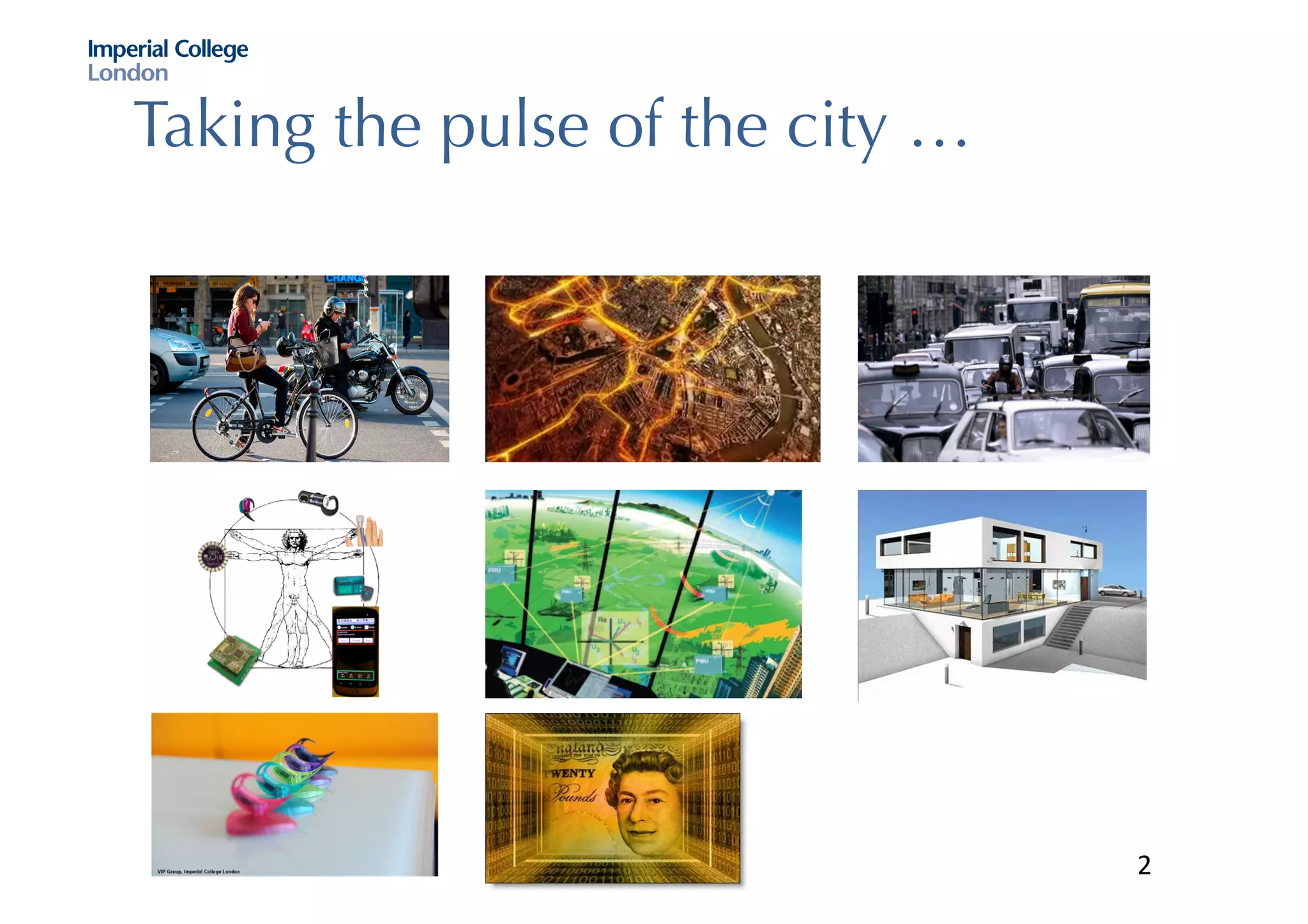
Taking the pulse of the city …
2
Improve	users	quality	of	life	whilst	simultaneously	optimise
resource	utilisation.
3
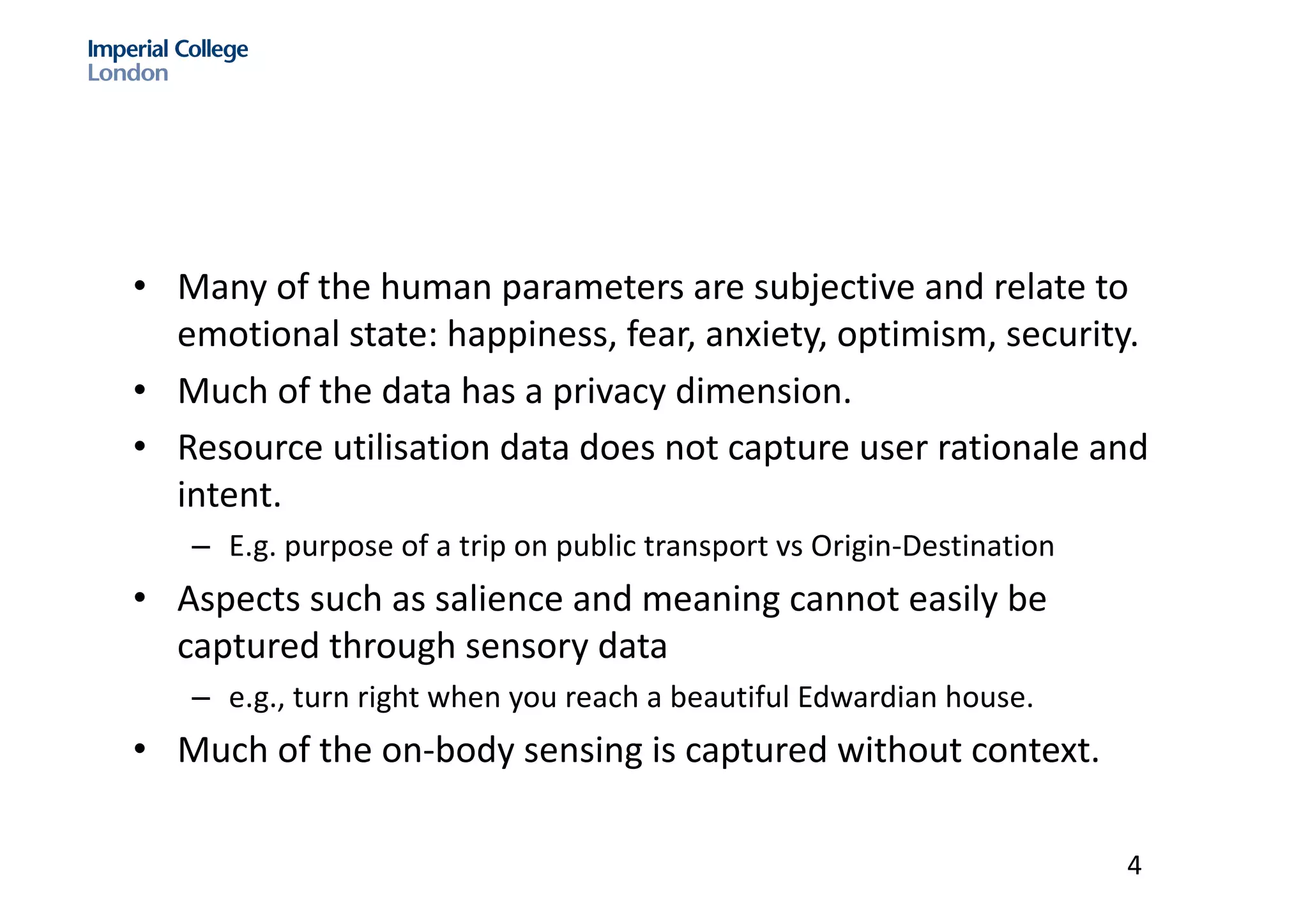
• Many	of	the	human	parameters	are	subjective	and	relate	to	
emotional	state:	happiness,	fear,	anxiety,	optimism,	security.	
• Much	of	the	data	has	a	privacy	dimension.
• Resource	utilisation data	does	not	capture	user	rationale	and	
intent.
– E.g.	purpose	of	a	trip	on	public	transport	vs Origin-Destination	
• Aspects	such	as	salience	and	meaning	cannot	easily	be	
captured	through	sensory	data	
– e.g.,	turn	right	when	you	reach	a	beautiful	Edwardian	house.	
• Much	of	the	on-body	sensing	is	captured	without	context.	
4
Extracting Knowledge from Data
• Analytics,	typically	assume	that:
– The	semantics	of	the	data	is	known.	
– The	questions	that	we	ask	of	the	data	are	known.	
• Machine	Learning	algorithms	can	uncover	new	patterns	and	
semantics	from	data	but:
– Require	data	appropriately	labeled.	
– Require	tuning	and	refinement	iterations	with	feedback.	
5
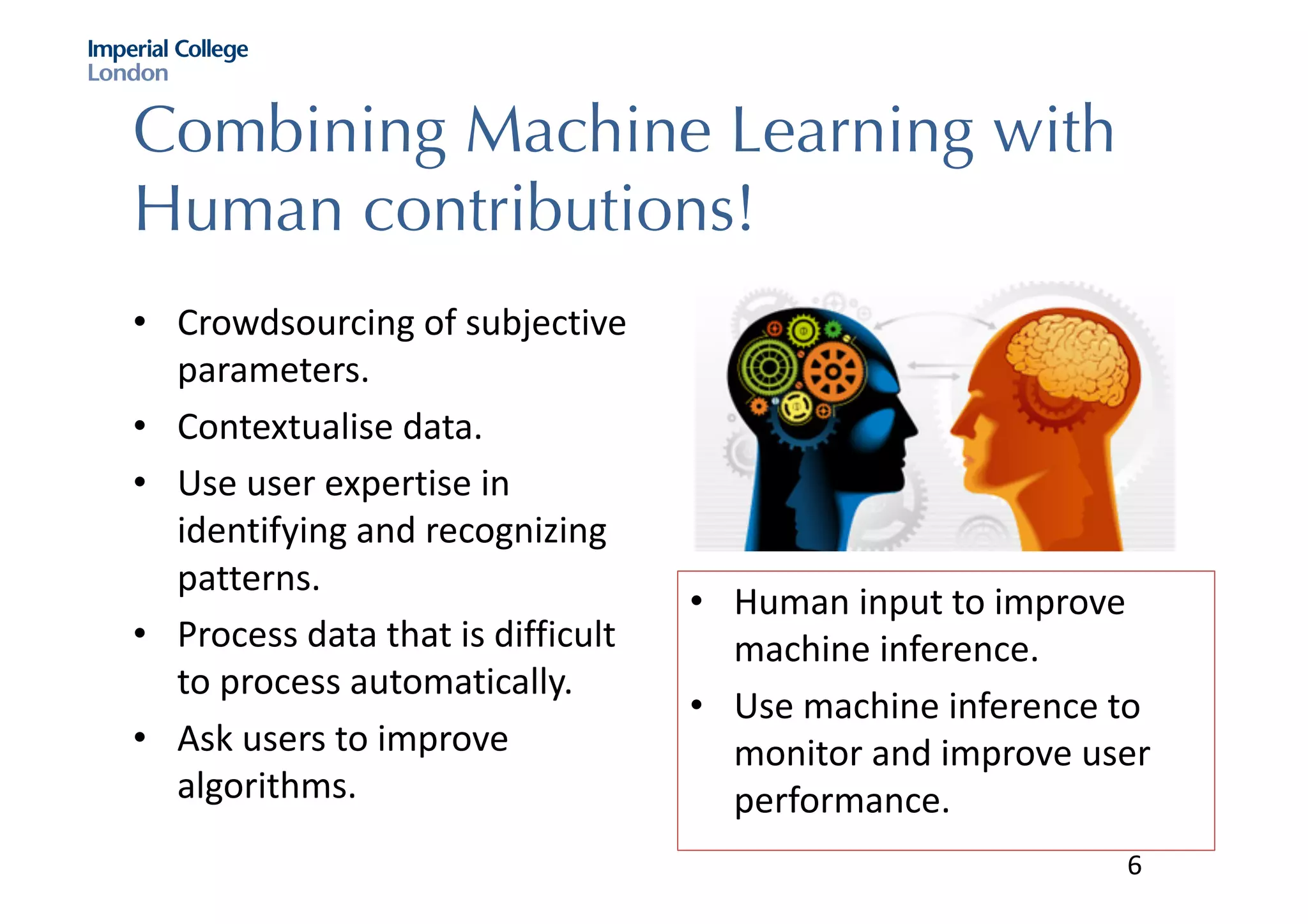
Combining Machine Learning with
Human contributions!
• Crowdsourcing	of	subjective	
parameters.
• Contextualise data.	
• Use	user	expertise	in	
identifying	and	recognizing	
patterns.	
• Process	data	that	is	difficult	
to	process	automatically.
• Ask	users	to	improve	
algorithms.
• Human	input	to	improve	
machine	inference.	
• Use	machine	inference	to	
monitor	and	improve	user	
performance.	
6
Application Areas
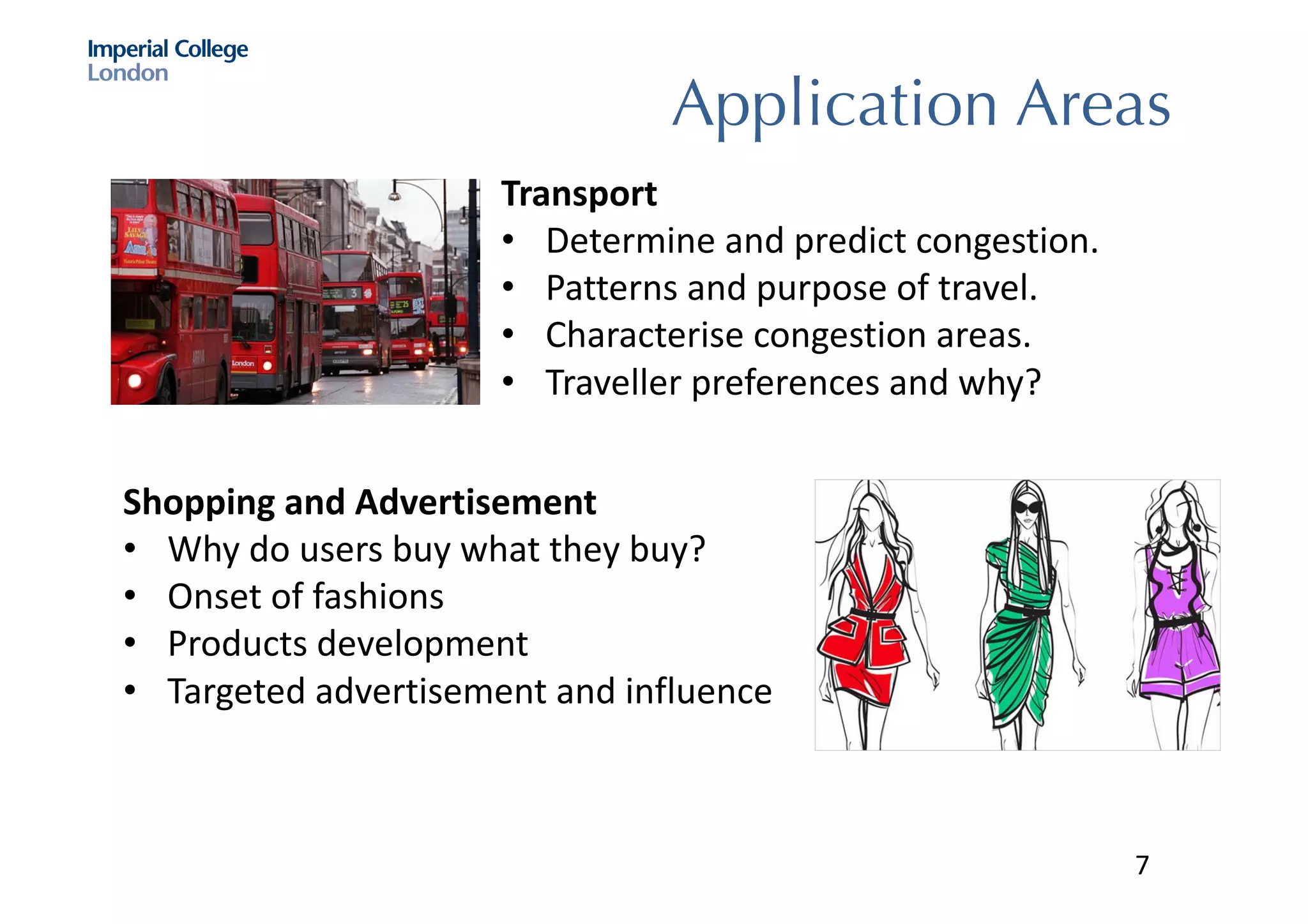
Transport
• Determine	and	predict	congestion.	
• Patterns	and	purpose	of	travel.	
• Characterise congestion	areas.	
• Traveller	preferences	and	why?
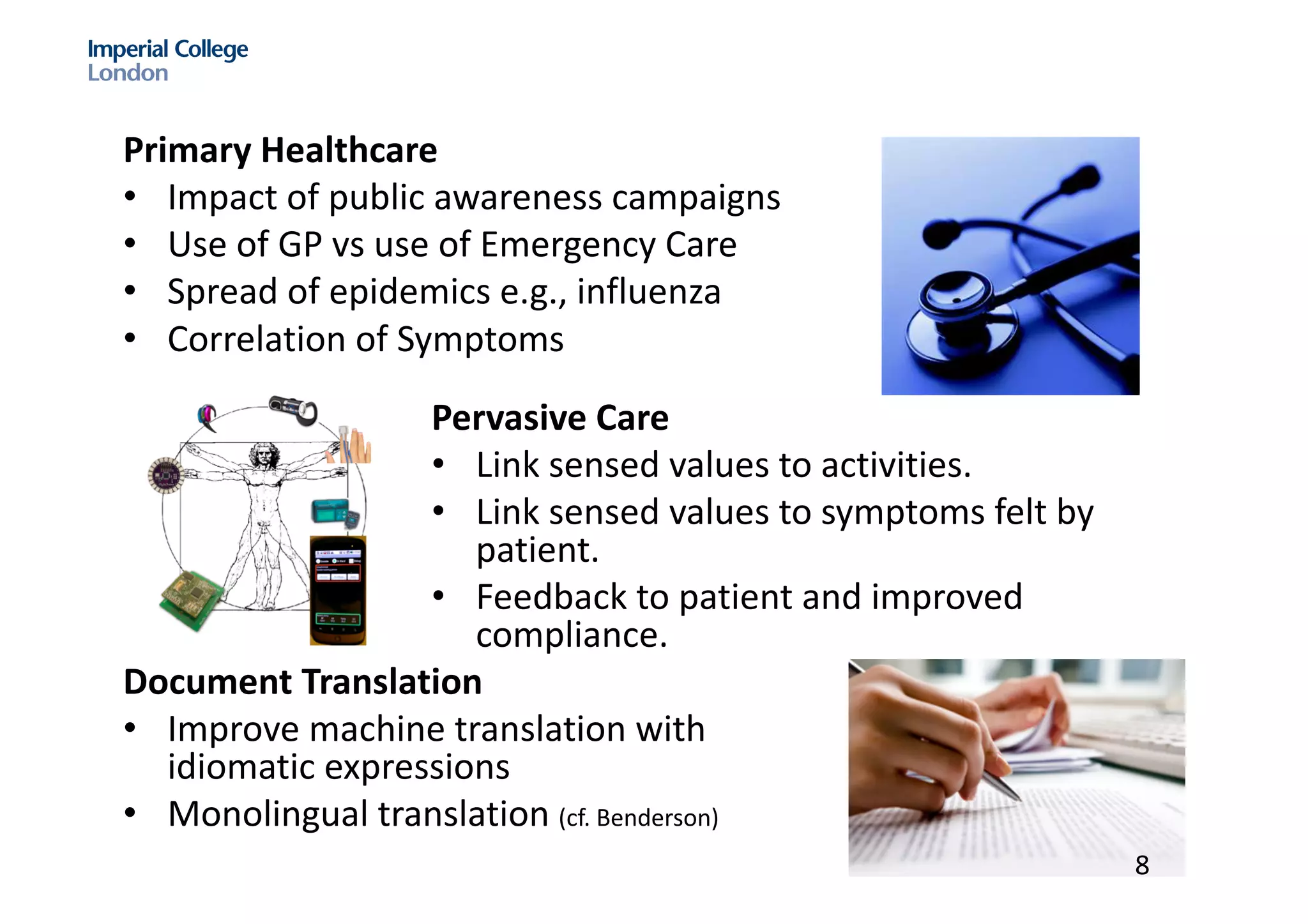
Shopping	and	Advertisement
• Why	do	users	buy	what	they	buy?
• Onset	of	fashions
• Products	development
• Targeted	advertisement	and	influence
7
Primary	Healthcare
• Impact	of	public	awareness	campaigns
• Use	of	GP	vs use	of	Emergency	Care
• Spread	of	epidemics	e.g.,	influenza
• Correlation	of	Symptoms
Pervasive	Care
• Link	sensed	values	to	activities.	
• Link	sensed	values	to	symptoms	felt	by	
patient.	
• Feedback	to	patient	and	improved	
compliance.	
Document	Translation
• Improve	machine	translation	with	
idiomatic	expressions
• Monolingual	translation	(cf.	Benderson)
8
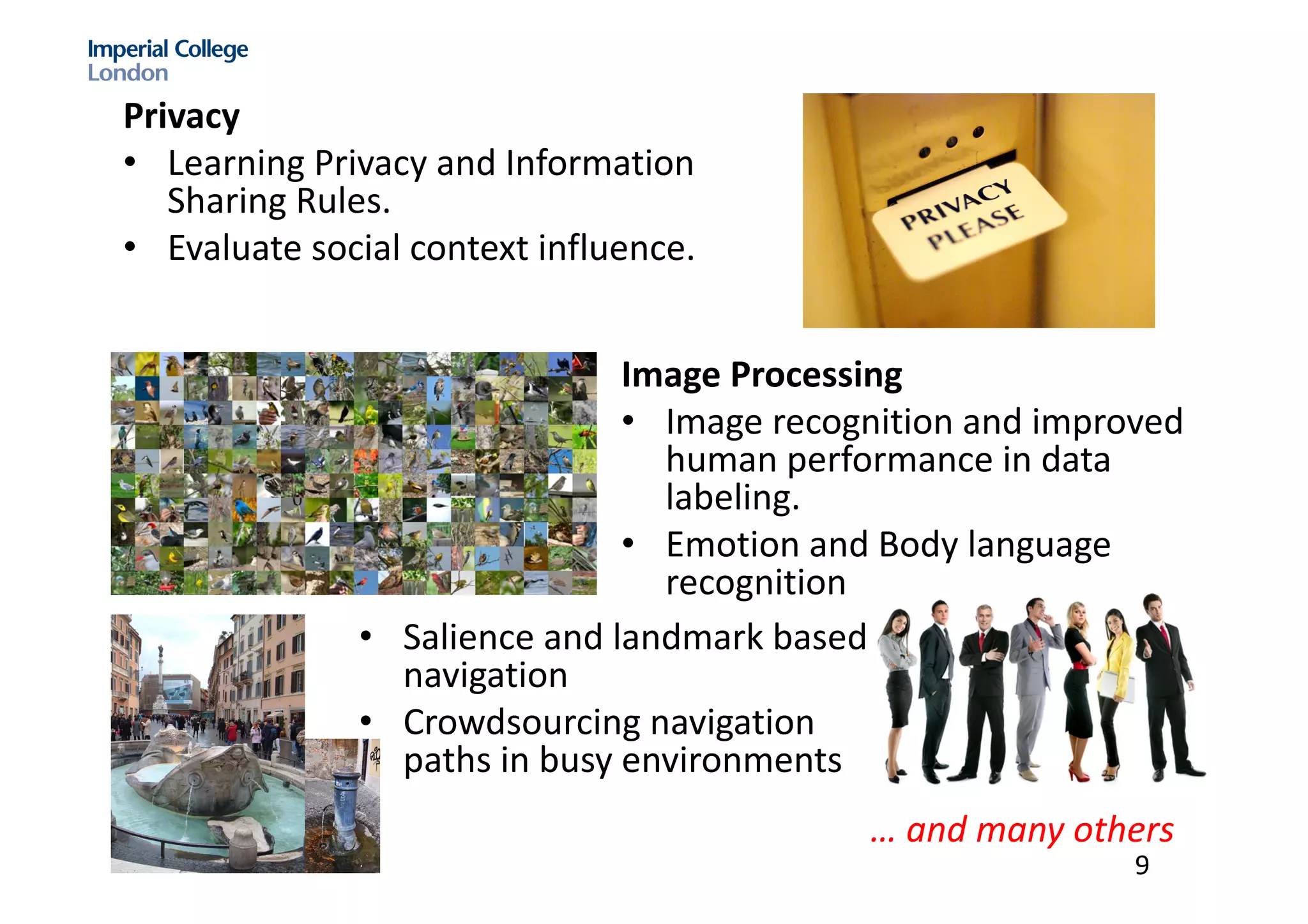
Privacy
• Learning	Privacy	and	Information	
Sharing	Rules.	
• Evaluate	social	context	influence.	
Image	Processing
• Image	recognition	and	improved	
human	performance	in	data	
labeling.	
• Emotion	and	Body	language	
recognition
• Salience	and	landmark	based	
navigation
• Crowdsourcing	navigation	
paths	in	busy	environments
…	and	many	others	
9
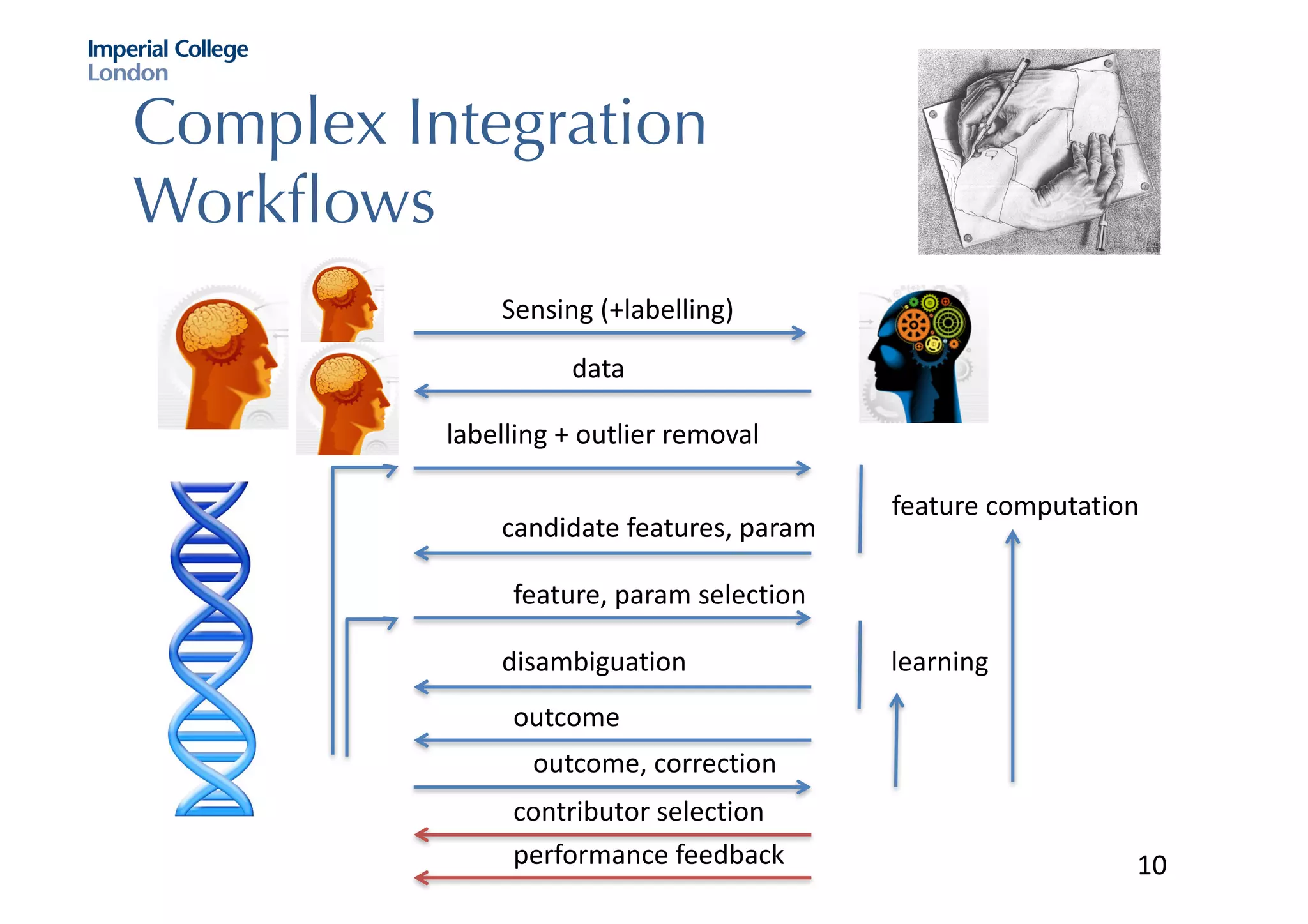
Complex Integration
Workflows
Sensing	(+labelling)
data
labelling +	outlier	removal
feature	computation
candidate	features,	param
feature,	param selection
learningdisambiguation
outcome
contributor	selection
performance	feedback
outcome,	correction
10
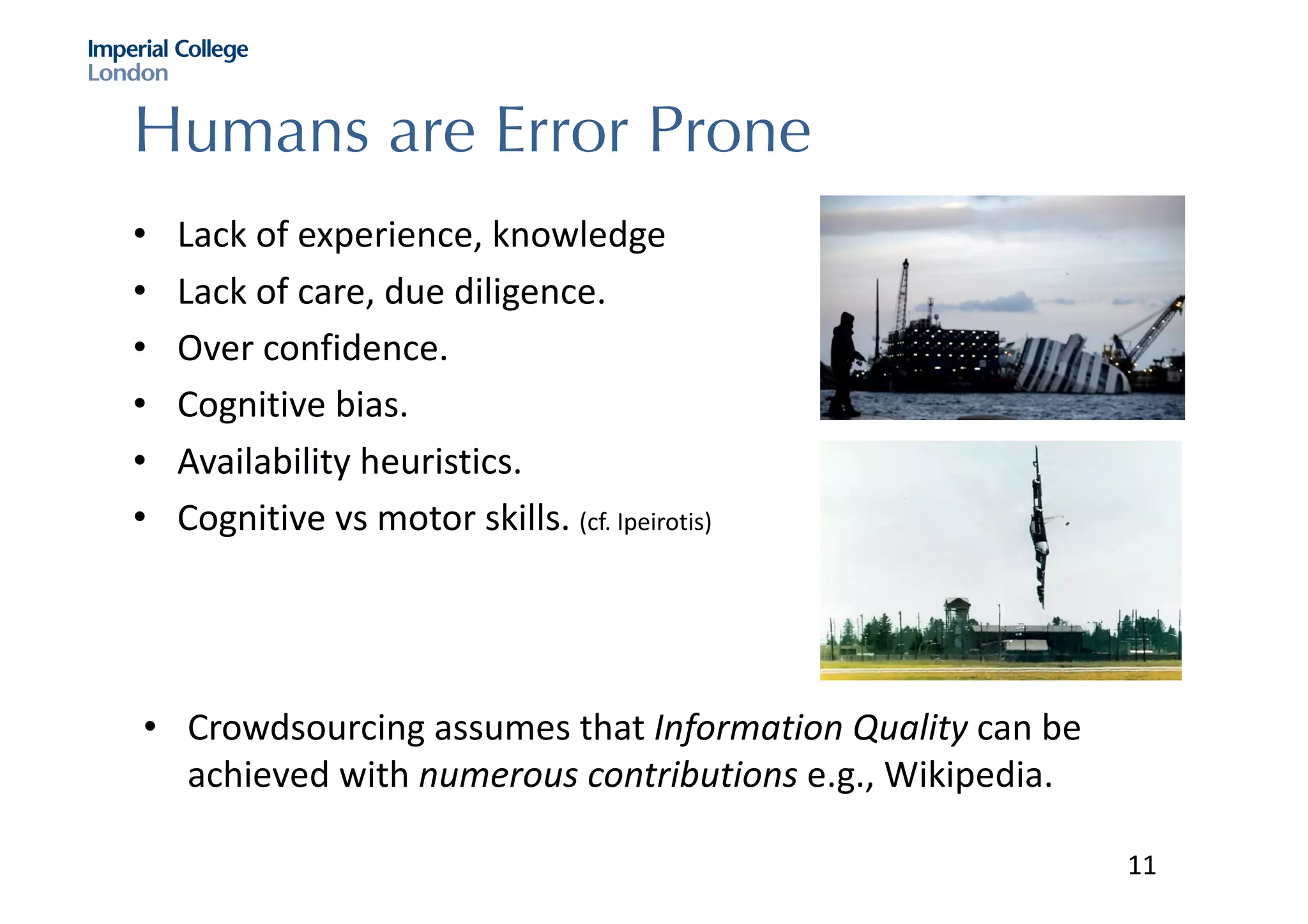
Humans are Error Prone
• Lack	of	experience,	knowledge
• Lack	of	care,	due	diligence.
• Over	confidence.	
• Cognitive	bias.	
• Availability	heuristics.
• Cognitive	vs motor	skills.	(cf.	Ipeirotis)
• Crowdsourcing	assumes	that	Information	Quality	can	be	
achieved	with	numerous	contributions	e.g.,	Wikipedia.	
11
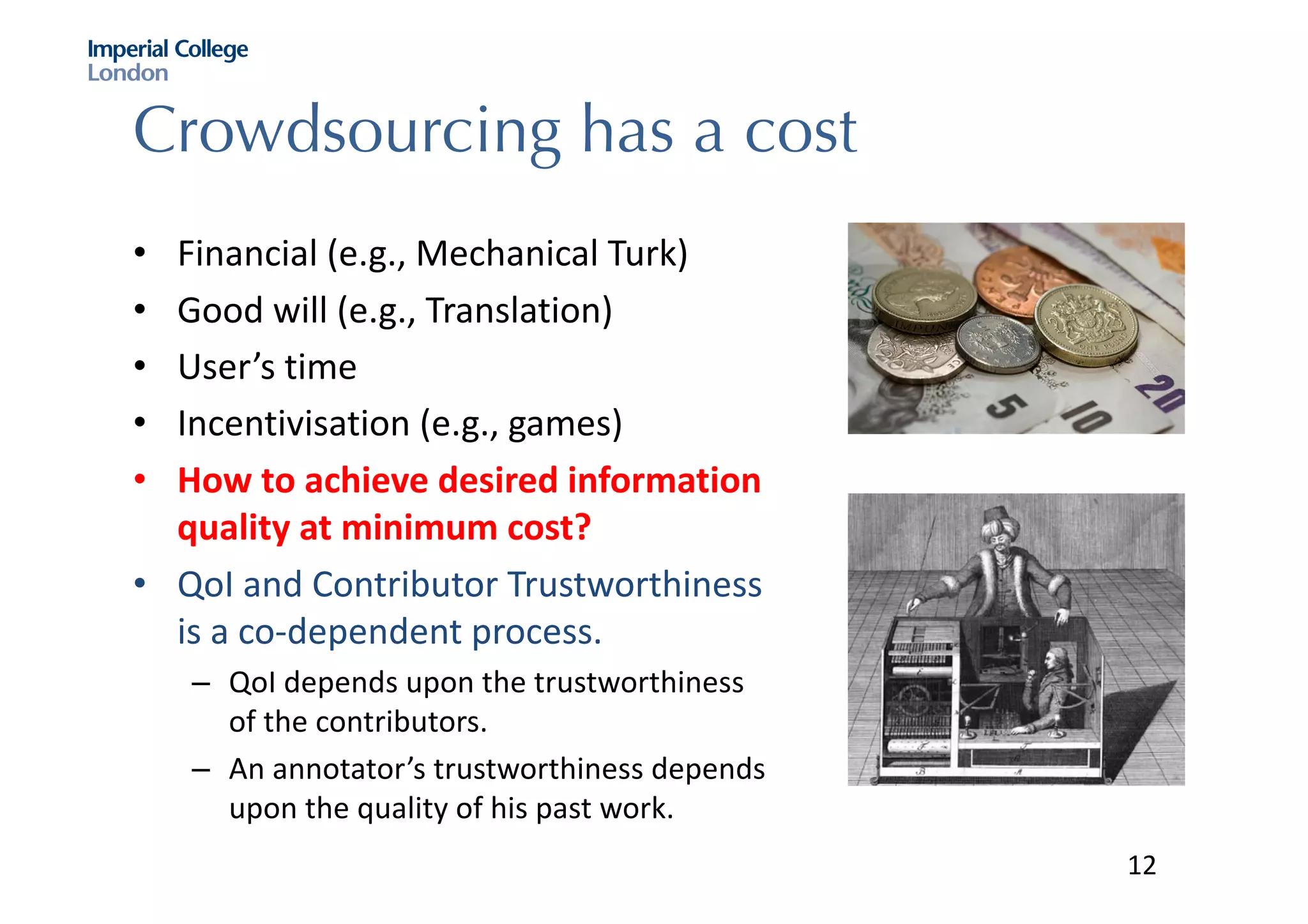
Crowdsourcing has a cost
• Financial	(e.g.,	Mechanical	Turk)
• Good	will	(e.g.,	Translation)
• User’s	time	
• Incentivisation (e.g.,	games)
• How	to	achieve	desired	information	
quality	at	minimum	cost?
• QoI and	Contributor	Trustworthiness	
is	a	co-dependent	process.	
– QoI depends	upon	the	trustworthiness	
of	the	contributors.	
– An	annotator’s	trustworthiness	depends	
upon	the	quality	of	his	past	work.	
12
Engineering Hybrid Learning
• How	to	structure	workflows	that	interweave	
Machine	Learning	and	human	input?
• How	to	link	QoI to	number	of	contributions?
• How	to	determine	trustworthiness	of	users?
• How	to	improve	human	input?
• How	to	rapidly	deploy	crowdsourcing	tasks?
• How	to	best	allocate	tasks?
• How	to	predict	time	to	answer?
• How	to	resist	malicious	use	and	collusions?
13
SOME OF THE THINGS WE HAVE
DONE SO FAR
14
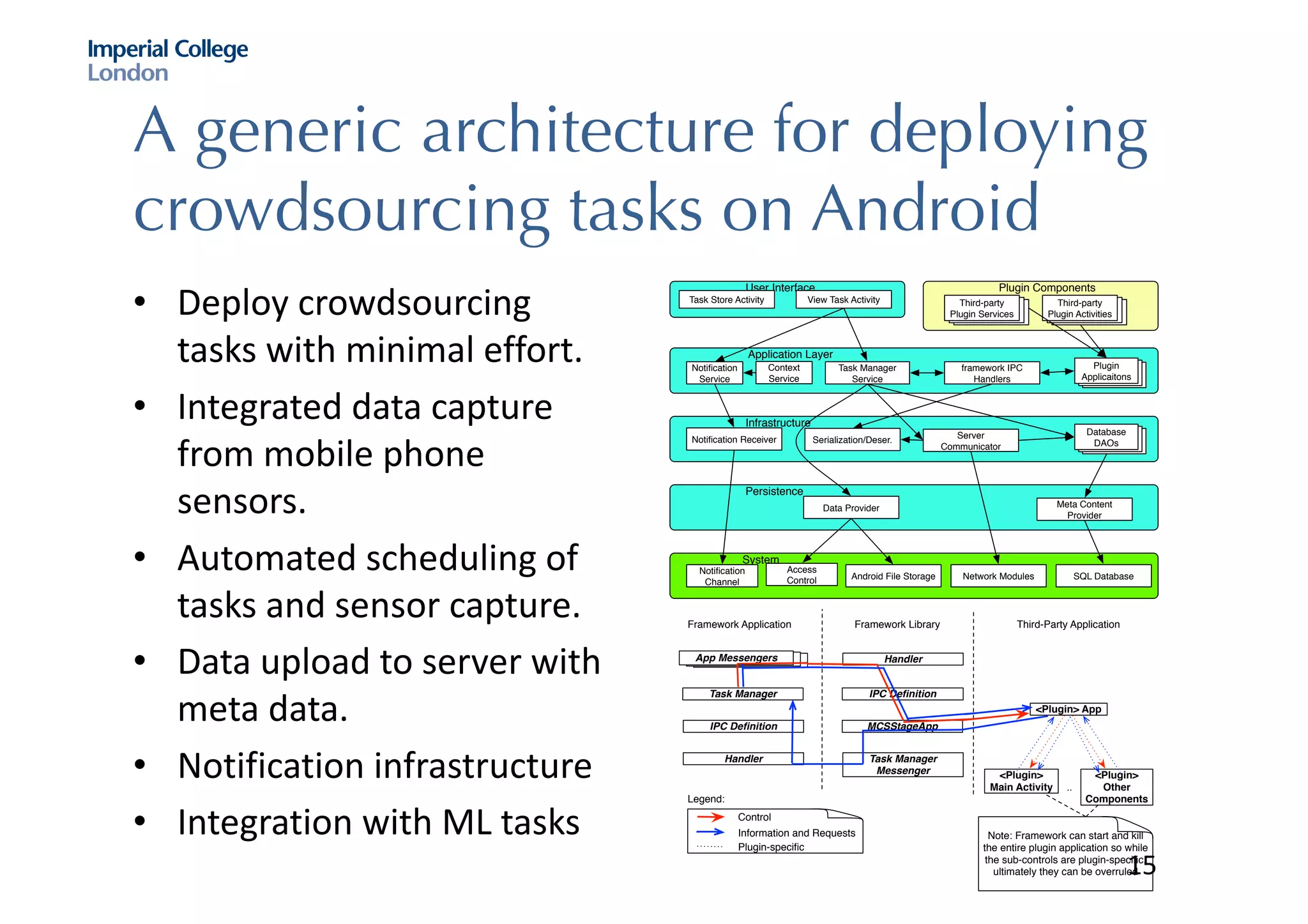
A generic architecture for deploying
crowdsourcing tasks on Android
• Deploy	crowdsourcing	
tasks	with	minimal	effort.	
• Integrated	data	capture	
from	mobile	phone	
sensors.
• Automated	scheduling	of	
tasks	and	sensor	capture.	
• Data	upload	to	server	with	
meta	data.	
• Notification	infrastructure
• Integration	with	ML	tasks
34 CHAPTER 3. DESIGN
Persistence
System
Plugin ComponentsUser Interface
Task Store Activity View Task Activity
Infrastructure
Application Layer
Task Manager
Service
framework IPC
Handlers
Plugin
Applicaitons
Third-party
Plugin Activities
Third-party
Plugin Services
Notication
Service
Server
Communicator
Notication Receiver
Android
Legend:
Framework
Plugin
Data Provider
Database
DAOs
Notication
Channel
Android File Storage
Meta Content
Provider
SQL DatabaseNetwork Modules
Access
Control
Serialization/Deser.
Context
Service
Figure 3.2: Client Architecture
The User Interface layer contains only visual representation meant for the user. It does not
contain any functionality other than what’s needed for interacting with lower layers and presenting
information to the user. The user interacts with the UI to see, for example, what the available
tasks are, view their descriptions and obtain information on the tasks’ progress.
The framework’s main funcitonality is in the layers beneath the UI layer. The Task Manager
is the service that orchestrates behind the scenes the entire task execution and acts as a mediator
between other components.
There are several modules meant for creating, accessing and modifying both meta informa-
tion and generated data. The data model used by the modules has been discussed separately in
§3.2. In terms of the modules’ purpose, they provide di↵erent levels of storage abstraction in or-
3.5. CLIENT 37
dened purpose and the singleton is the logical entity that embeds all the functionality needed to
achieve this purpose. Concretely, this means that each and every one part of the plugin application
is actively working towards the fulllment of this one goal; all of these components are children
of the stage application singleton in the plugin’s logical hierarchy. They should only exist as
long as the singleton exists, and should only work towards furthering its progress. Note that, as
shown on the Figure 3.2, the application singleton is shown to be part of the framework. This
is so because it is essential for the control and information exchange to happen according to the
well-dened communication protocol and therefore the implementation should be provided by the
framework. However, the information provision of the stage’s progress, how stage progress is
internally coordinated between the plugin’s components (for example, exposed global state or an
internal interface), and how some of the control orders are passed along to these components should
be left to the plugin developer.
The provided IPC protocol facilitates control and information exchange. Its implementation
comprises of several parts and the overall design is presented in Figure 3.3.
MCSStageApp
<Plugin> App
Framework Library Third-Party ApplicationFramework Application
<Plugin>
Main Activity
<Plugin>
Other
Components
..
Task Manager
Messenger
HandlerApp Messengers
IPC DenitionTask Manager
IPC Denition
Handler
Legend:
Control
Information and Requests
Plugin-specic
Note: Framework can start and kill
the entire plugin application so while
the sub-controls are plugin-specic,
ultimately they can be overruled
Figure 3.3: Role of the provided library in the control and information exchange between the
15
• Data	uploat
42 CHAPTER 3. DESIGN
Server
REST Resources
Web Client
REST API
Smartphone
Client
Tasks
Stage Data
Client
Notication
ML
Static HTML
and
Javascript
Participant
Meta
Specications
Persistence &
Infrastructure
Meta DAO
ML Box
Blob DAO
Task DAO
External
Notication
Server
Partiicipant
DAO
File
System
(Blobs)
NoSQL
Google
Notication
Server
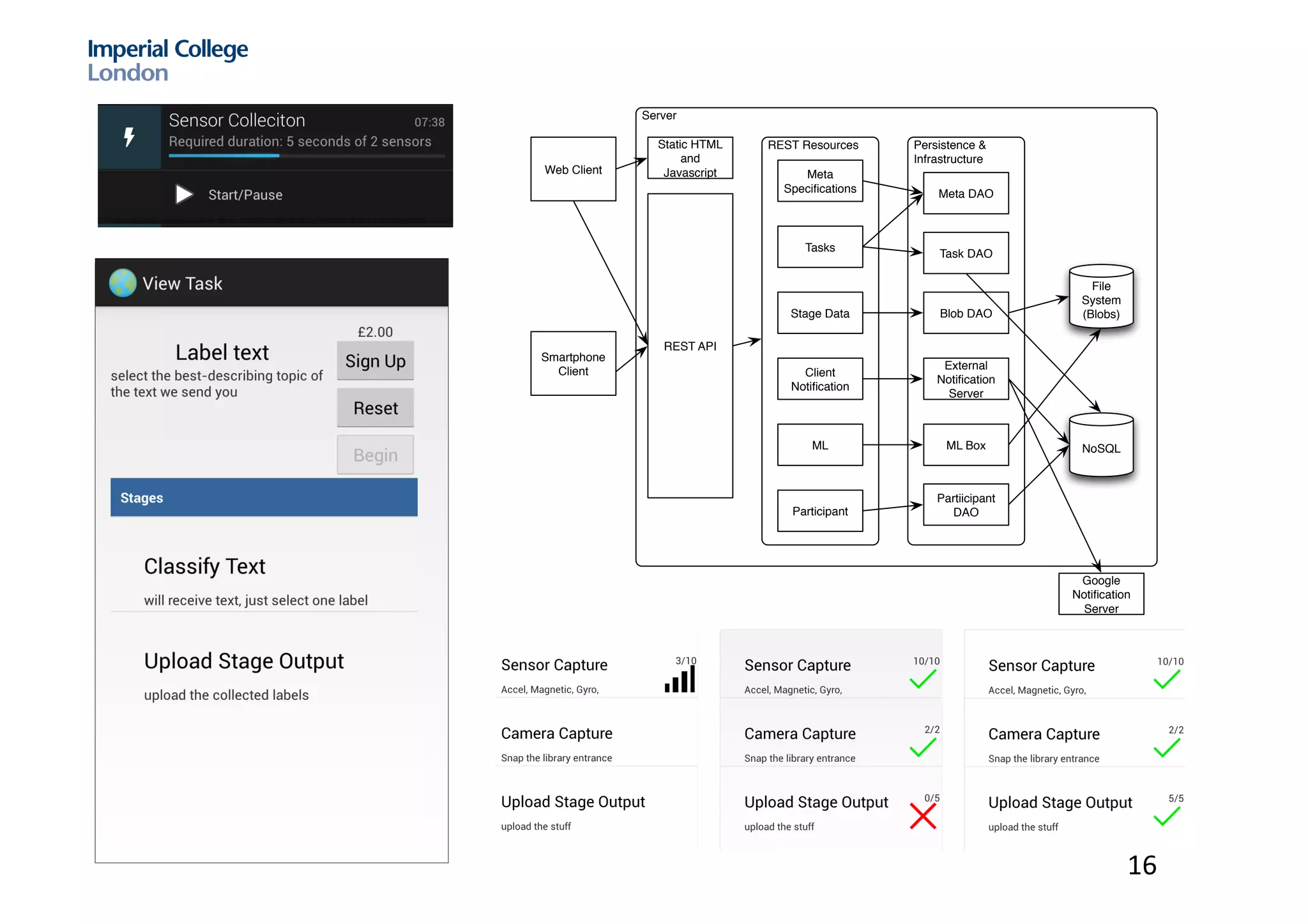
Figure 3.4: Server Architecture
The Meta Specifications is the resource representing the description of plugin stages.
This includes the required and optionally accepted parameters needed for the execution of the
described plugin. The resource also contains the unique name of the Android Intent action
that the framework application should use to invoke the plugin. The resource is to be used by
third-party developers when registering their new plugin. It is also to be used by the task creation
client through which new tasks are to be submitted. The client’s UI can be dynamically populated
depending on the stages the user selects to specify in the new task. The client can then locally
verify that the provided input parameters meet the plugins’ requirements. If the test passes, then
the representation of a Task resource is sent via POST to the Tasks resource.
The Tasks resource is a collection of children Task resources. It represents all the Generalized
Task meta specications that have been input in the system. Upon receiving the POST request
from the task creation client, the Tasks resource also veries the input after which it creates a full
49
sk Store and View Task screens.
milliseconds) should its value be recorded, and for how long (seconds) should there
us recording. These are all specied upon task creation through the web interface
task server resource. So is the case with all the parameters for the other plugins
t.
Figure 4.9: Actionable notication of an ongoing sensor collection.
n requests one le per sensor from the framework with the provided le request API.
at the readings are stored and later can be used by other stages. It has an optional
y that displays the collected data. The UI also allows to start and stop collection
also be done through the Notication shown to the user as shown on Figure 4.9. The
apture showcases the framework’s ability to support plugins that request files to
run in the background while having a UI with which the background process is tied
oreground running notication also controlling the background service.
a Upload
oadData plugin stage has the purpose of taking the produced data from any other
oading it to the framework’s server. The ids of the stages is the required input for
he plugin also allows to specify an alternative URL to which to perform the upload.
ust point to a service supporting a multiform POST HTTP request. This is used
plugin does not know in advance how many output les there are, nor their MIME
are established dynamically which provides the flexibility of being able to upload any
s of any kind. The POST is done over a secure connection and also contains the user
which helps protect their privacy since the data stored on the server is grouped per
y permission that the plugin uses is the Internet. It does not even require access to
se permissions are visible to the user and make it clear what the plugin does. It is
ell-defined purpose that is intended for the framework’s plugins. A user can see the
the plugin and decide if its functionality matches the permissions the application
n runs entirely in the background, only showing a notication of its progress to the
same progress that is also reported to the main application upon changes, and hence,
ored from the framework’s application, too.
t Labeling
50 CHAPTER 4. IMPLEMENTATION
Figure 4.2: Visual and Textual progress feedback.
16
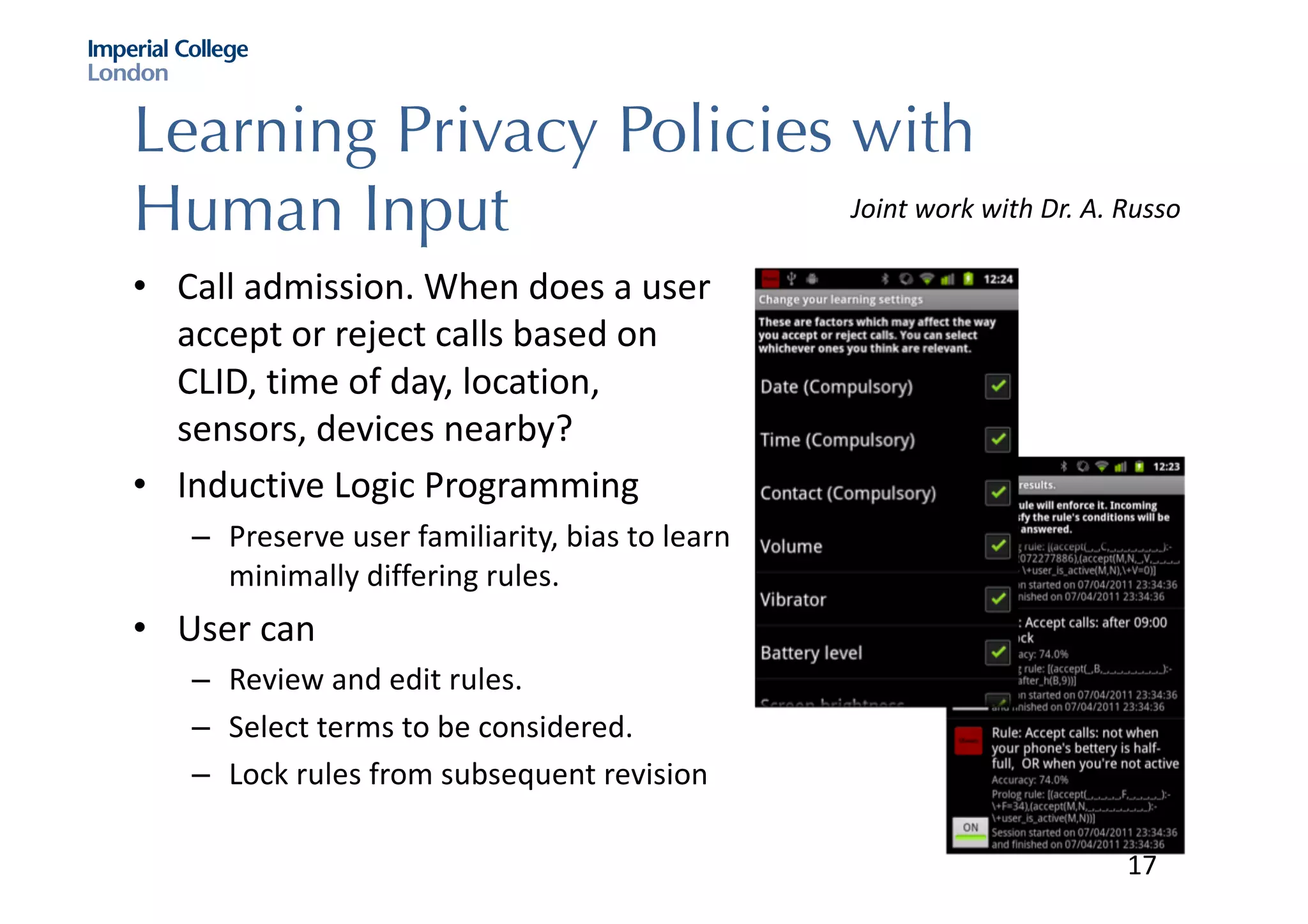
Learning Privacy Policies with
Human Input
• Call	admission.	When	does	a	user	
accept	or	reject	calls	based	on	
CLID,	time	of	day,	location,	
sensors,	devices	nearby?
• Inductive	Logic	Programming
– Preserve	user	familiarity,	bias	to	learn	
minimally	differing	rules.	
• User	can	
– Review	and	edit	rules.
– Select	terms	to	be	considered.
– Lock	rules	from	subsequent	revision
Joint	work	with	Dr.	A.	Russo
17
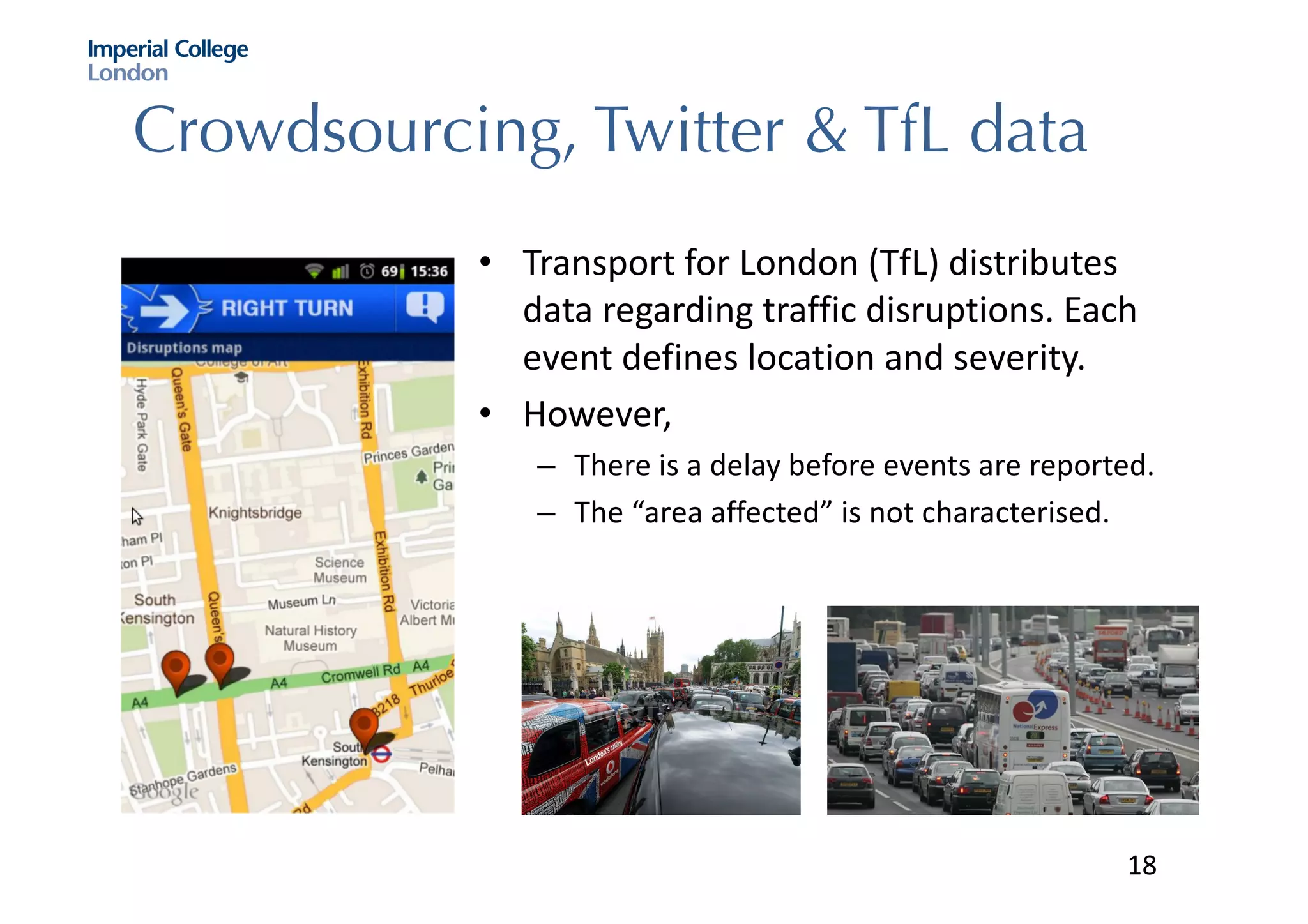
Crowdsourcing, Twitter & TfL data
• Transport	for	London	(TfL)	distributes	
data	regarding	traffic	disruptions.	Each	
event	defines	location	and	severity.	
• However,	
– There	is	a	delay	before	events	are	reported.
– The	“area	affected”	is	not	characterised.	
18
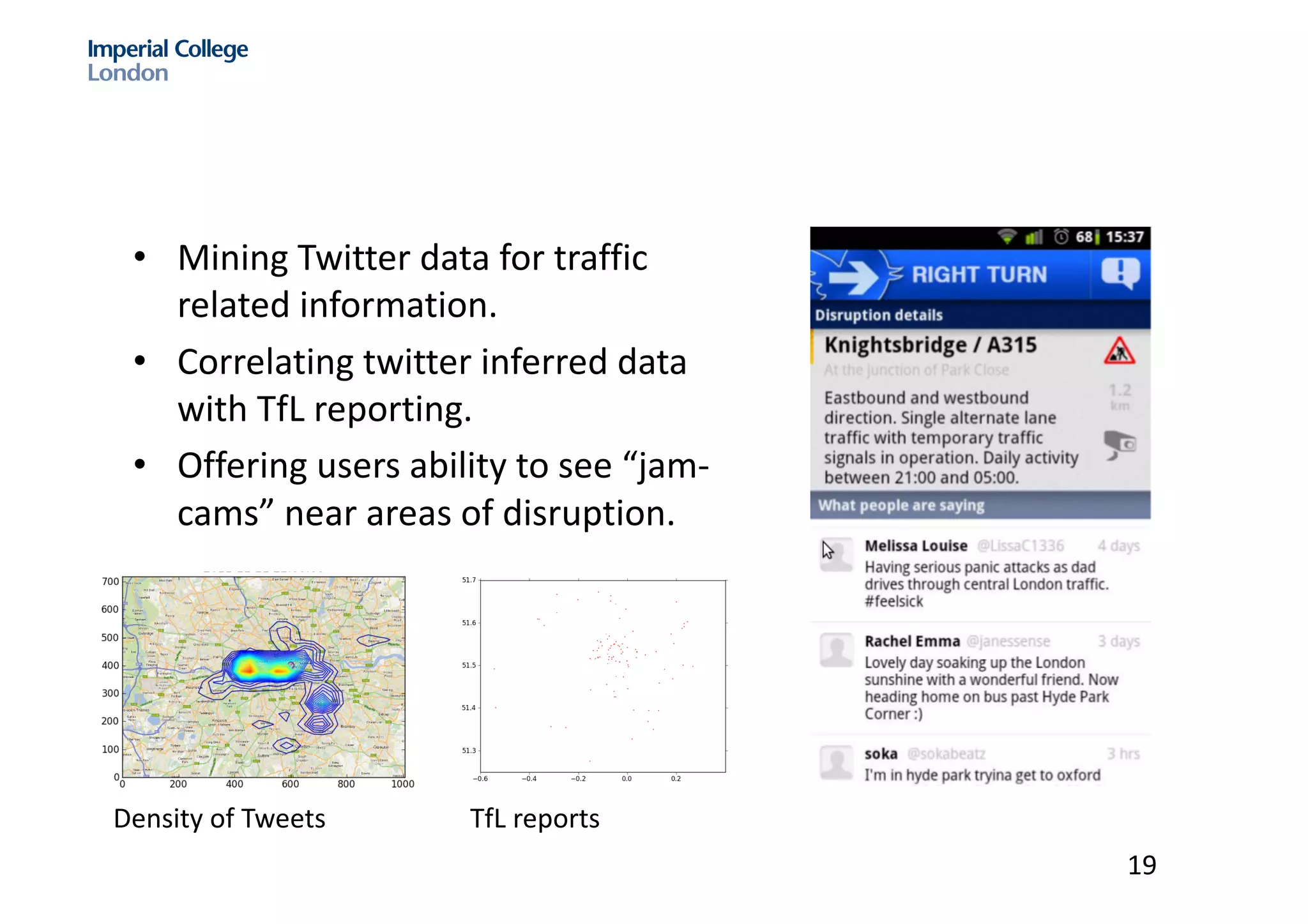
• Mining	Twitter	data	for	traffic	
related	information.	
• Correlating	twitter	inferred	data	
with	TfL reporting.	
• Offering	users	ability	to	see	“jam-
cams”	near	areas	of	disruption.	
witter for local tra c prediction September 3, 2012
Figure 43: The density of tra c tweets with the EM.
Density	of	Tweets
Mining Twitter for local tra c prediction September 3, 2012
Figure 43: The density of tra c tweets with the EM.
Figure 44: The TfL disruptions for this time (10:00).
Again, the second method using the EM algorithm shows a more detailed view of tra c in
London, which corresponds to the TfL disruptions too.
5.6.9 Conclusion of the HeatMap representation
TfL reports
19
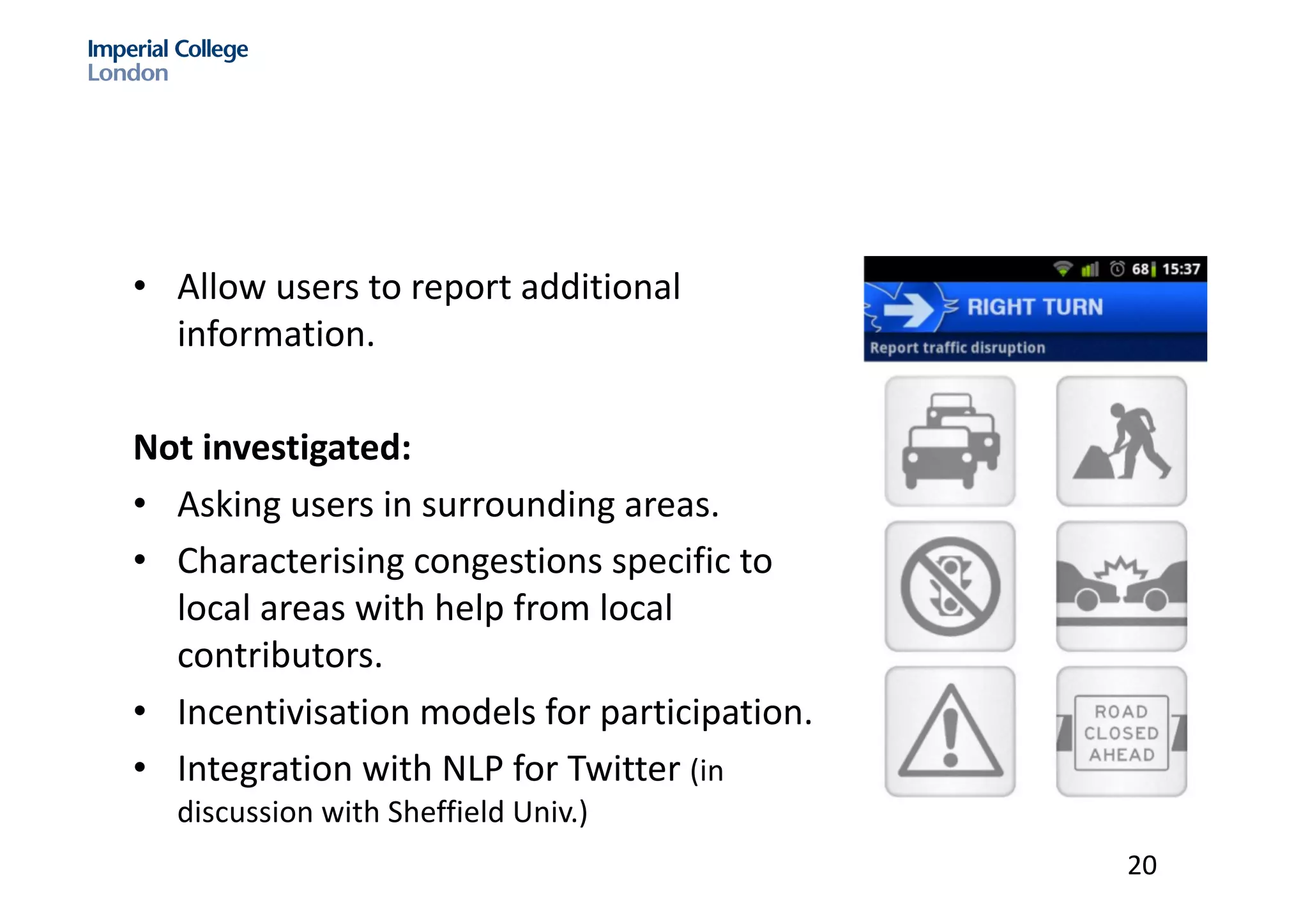
• Allow	users	to	report	additional	
information.	
Not	investigated:	
• Asking	users	in	surrounding	areas.	
• Characterising congestions	specific	to	
local	areas	with	help	from	local	
contributors.	
• Incentivisation models	for	participation.
• Integration	with	NLP	for	Twitter	(in	
discussion	with	Sheffield	Univ.)
20
Ground truth and trustworthiness
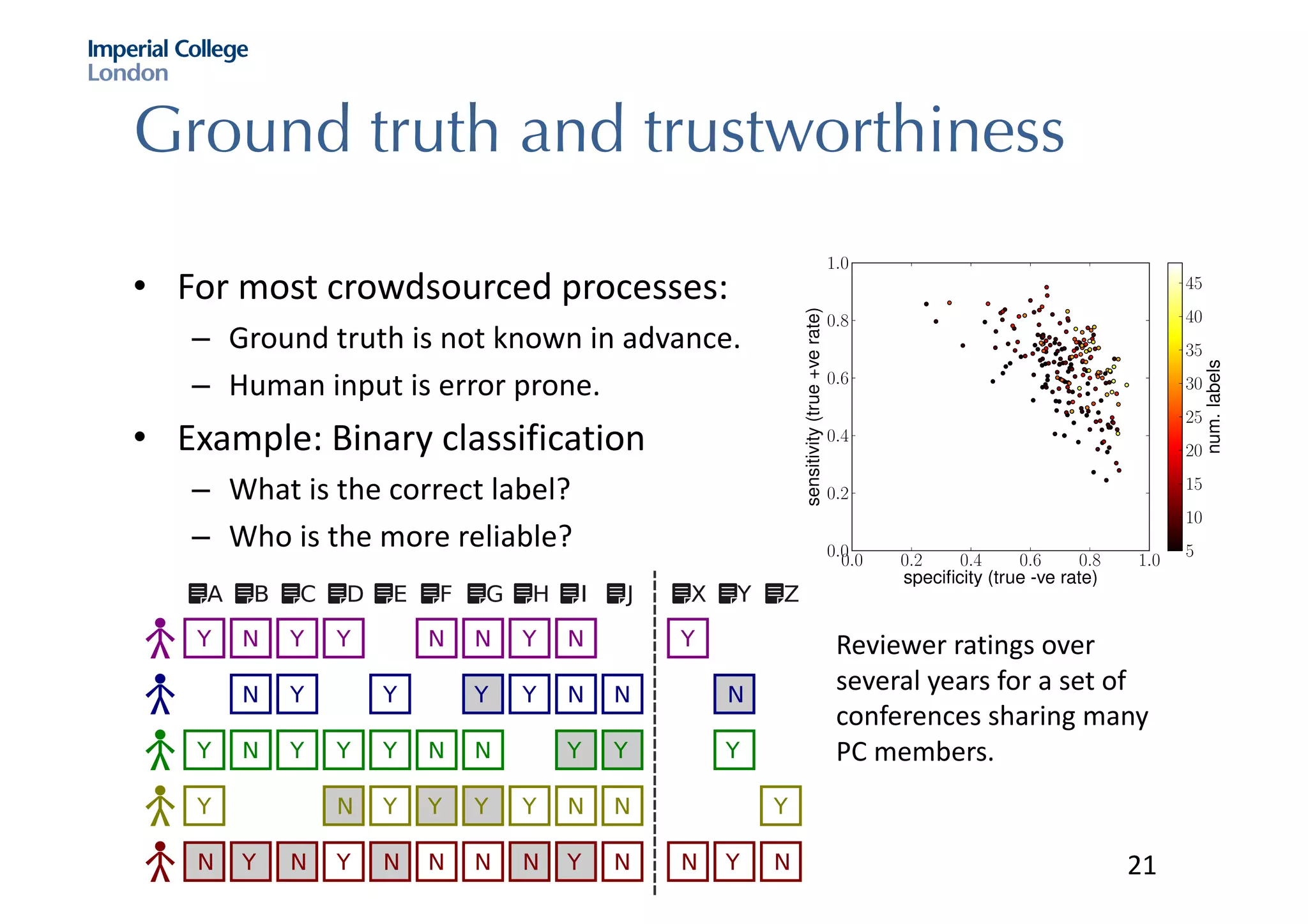
• For	most	crowdsourced processes:
– Ground	truth	is	not	known	in	advance.	
– Human	input	is	error	prone.	
• Example:	Binary	classification
– What	is	the	correct	label?
– Who	is	the	more	reliable?
0.0 0.2 0.4 0.6 0.8 1.0
specicity (true -ve rate)
0.0
0.2
0.4
0.6
0.8
1.0
sensitivity(true+verate)
5
10
15
20
25
30
35
40
45
num.labels
Reviewer	ratings	over	
several	years	for	a	set	of	
conferences	sharing	many	
PC	members.
21
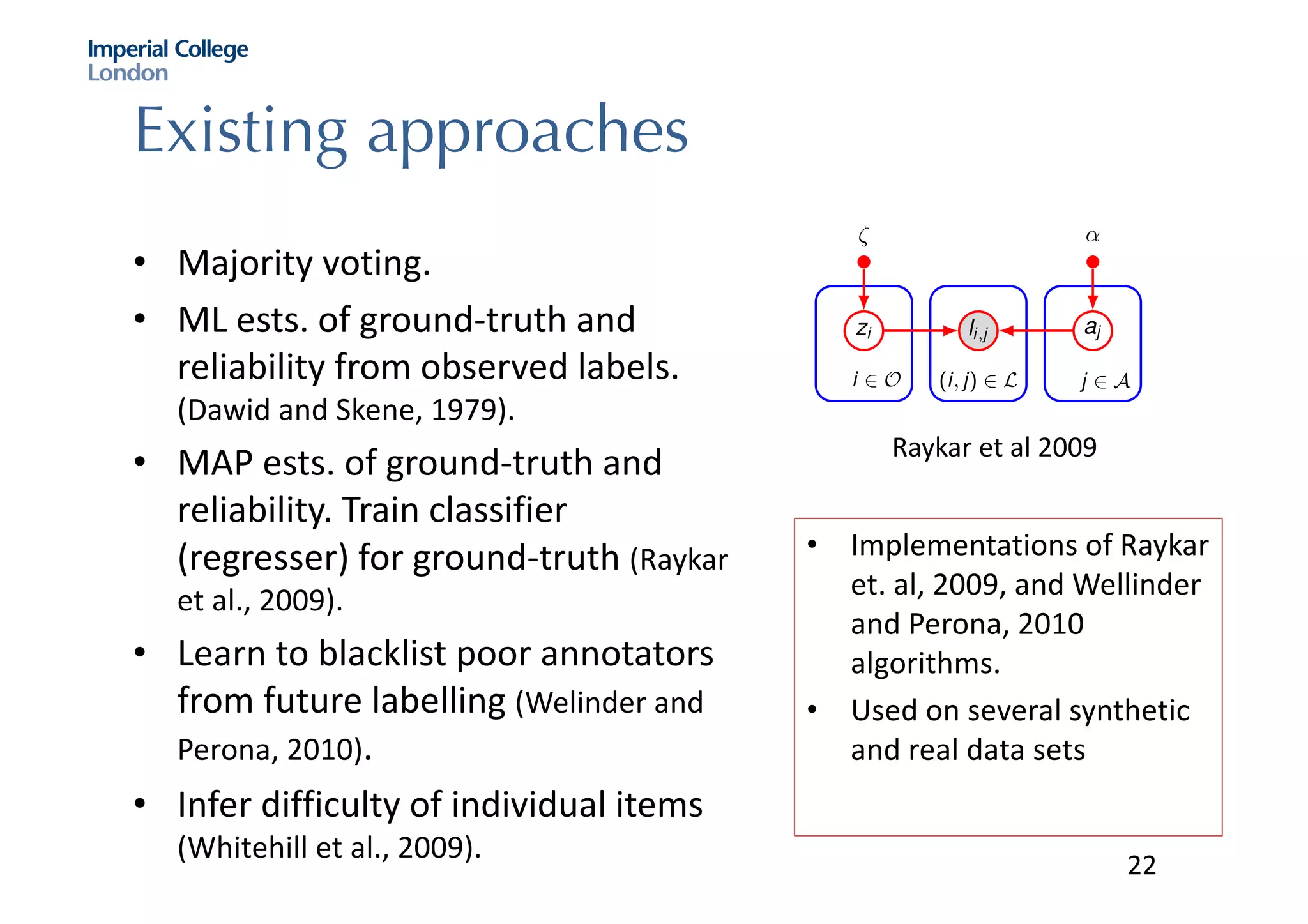
Existing approaches
• Majority	voting.
• ML	ests.	of	ground-truth	and	
reliability	from	observed	labels.	
(Dawid and	Skene,	1979).
• MAP	ests.	of	ground-truth	and	
reliability.	Train	classifier	
(regresser)	for	ground-truth	(Raykar
et	al.,	2009).
• Learn	to	blacklist	poor	annotators	
from	future	labelling (Welinder and	
Perona,	2010).
• Infer	difficulty	of	individual	items	
(Whitehill et	al.,	2009).
I Objects, O
I Annotators, A
I Semi-trusted labels, L
I Estimate: ground-truths, zi
and reliabilities, aj
i 2 O
zi
(i, j) 2 L
li,j
j 2 A
aj
⇣ ↵
Simple probabilistic model of trust
0
0.0
0.2
0.4
0.6
0.8
sensitivity(true+verat
S
Raykar et	al	2009
• Implementations	of	Raykar
et.	al,	2009,	and	Wellinder
and	Perona,	2010	
algorithms.	
• Used	on	several	synthetic	
and	real	data	sets
22
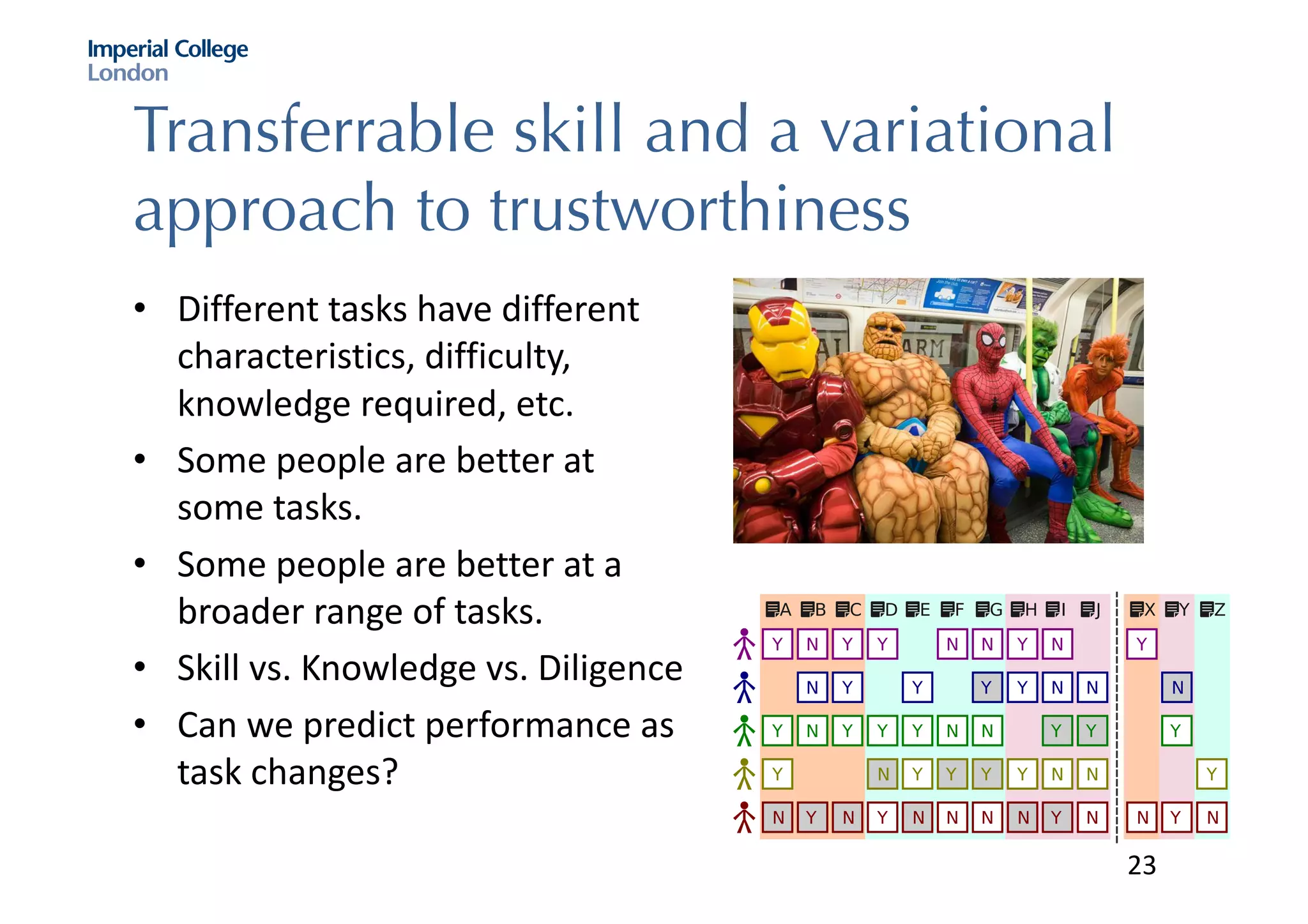
Transferrable skill and a variational
approach to trustworthiness
• Different	tasks	have	different	
characteristics,	difficulty,	
knowledge	required,	etc.		
• Some	people	are	better	at	
some	tasks.	
• Some	people	are	better	at	a	
broader	range	of	tasks.
• Skill	vs.	Knowledge	vs.	Diligence
• Can	we	predict	performance	as	
task	changes?
23
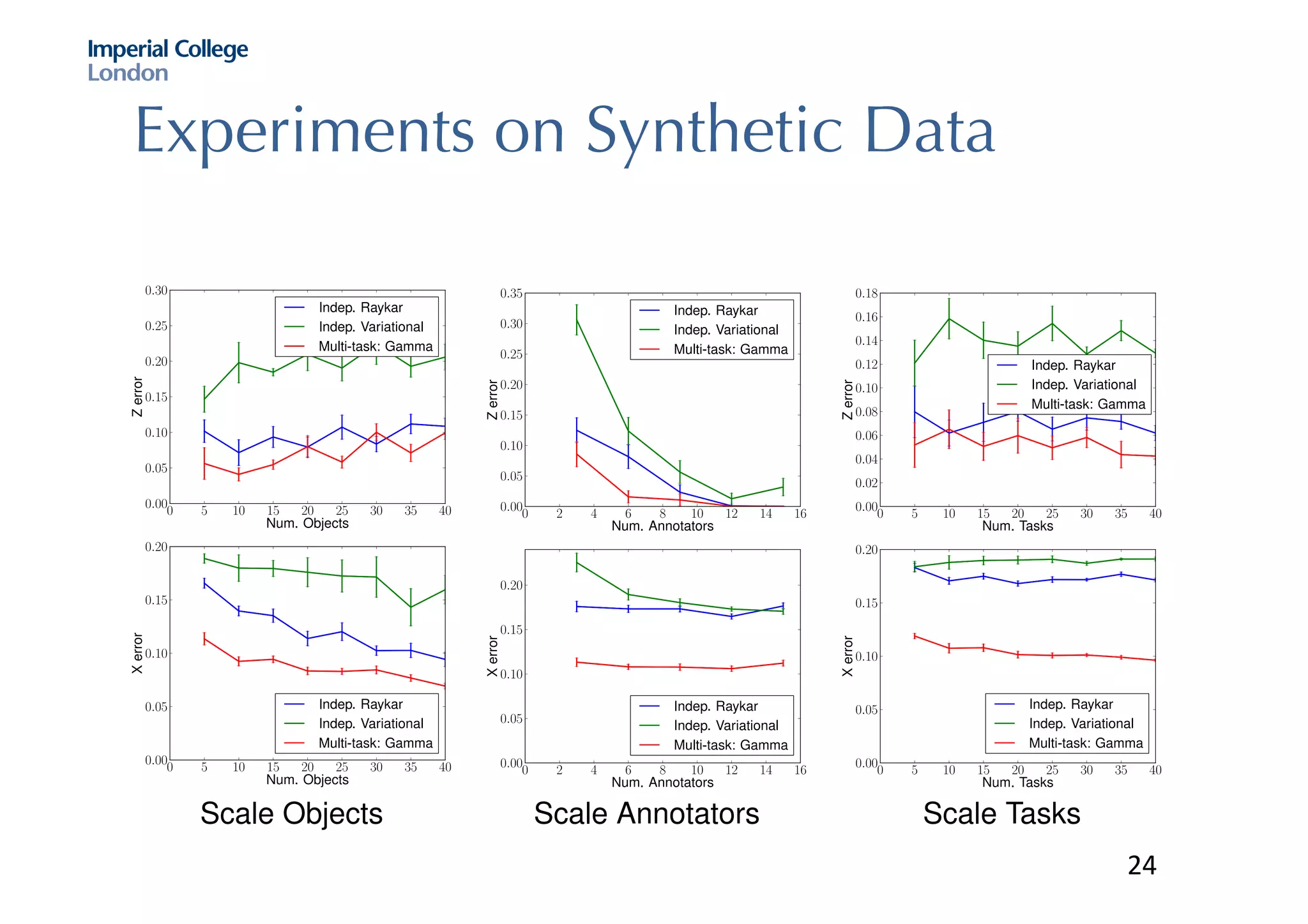
Experiments on Synthetic Data
Scale Objects Scale Annotators Scale Tasks
24
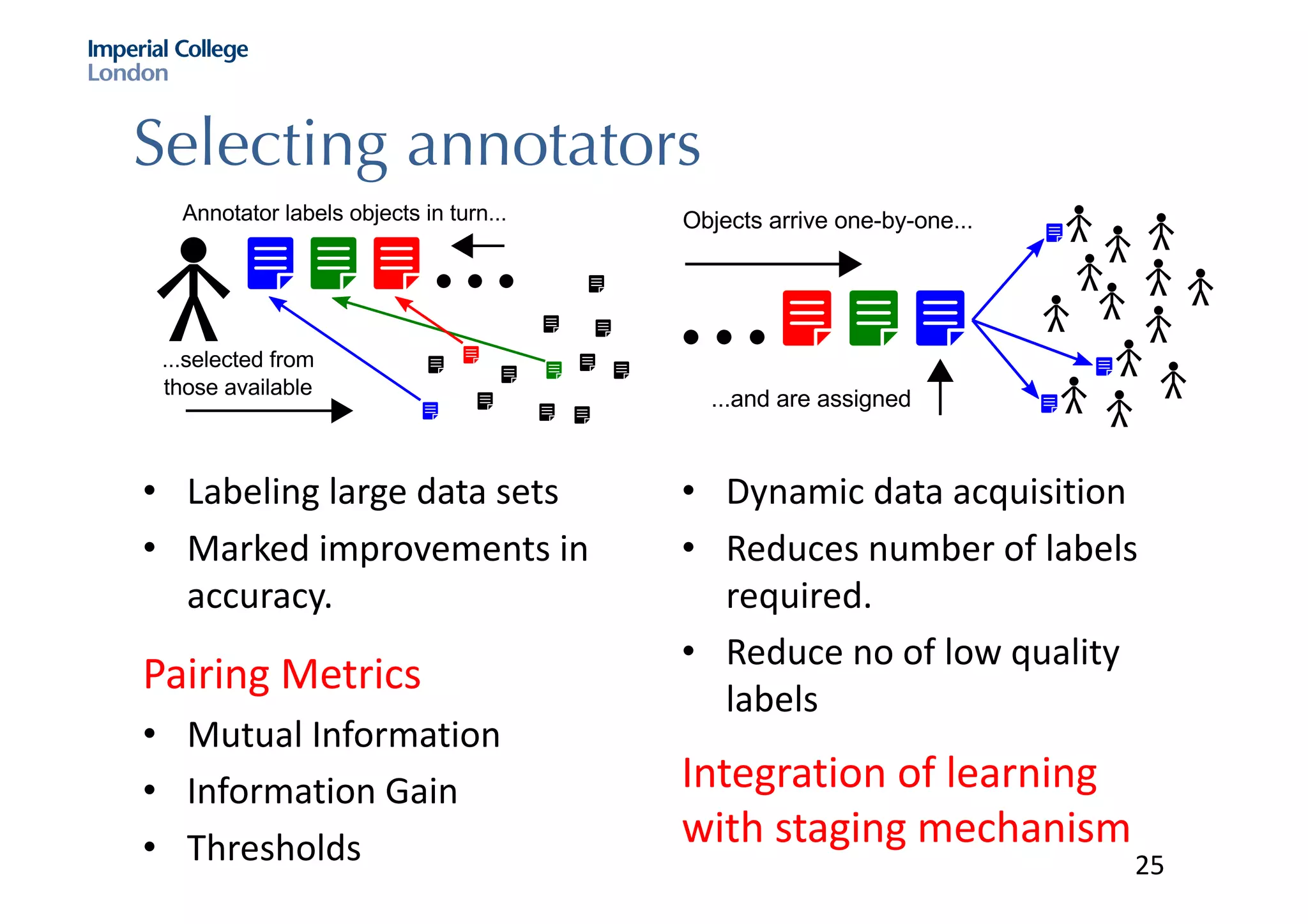
Selecting annotators
• Labeling	large	data	sets
• Marked	improvements	in	
accuracy.	
• Dynamic	data	acquisition
• Reduces	number	of	labels	
required.	
• Reduce	no	of	low	quality	
labels
Pairing	Metrics
• Mutual	Information
• Information	Gain
• Thresholds
Integration	of	learning	
with	staging	mechanism
25
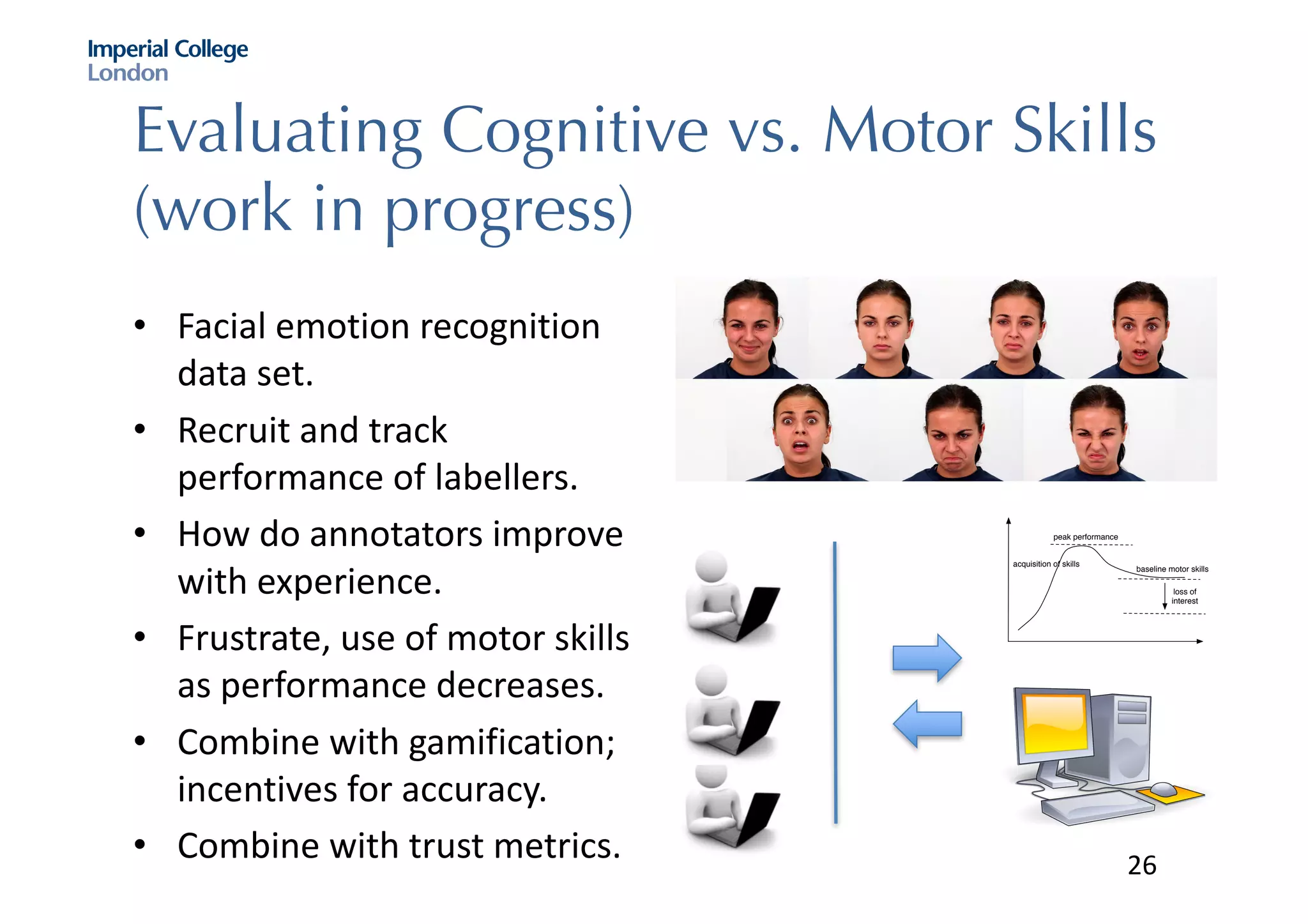
Evaluating Cognitive vs. Motor Skills
(work in progress)
• Facial	emotion	recognition	
data	set.	
• Recruit	and	track	
performance	of	labellers.	
• How	do	annotators	improve	
with	experience.
• Frustrate,	use	of	motor	skills	
as	performance	decreases.	
• Combine	with	gamification;	
incentives	for	accuracy.	
• Combine	with	trust	metrics.	
acquisition of skills
peak performance
baseline motor skills
loss of
interest
26
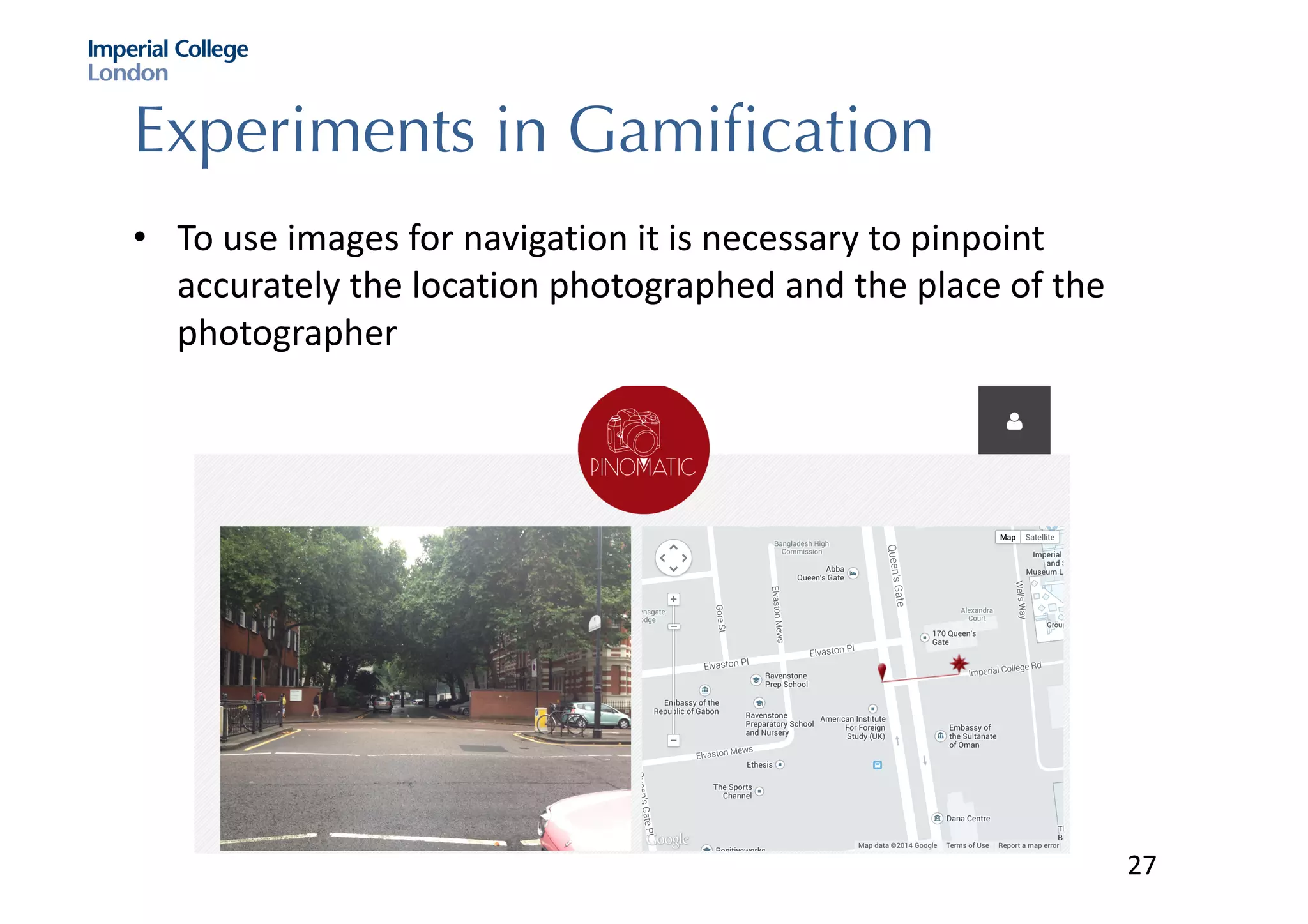
Experiments in Gamification
• To	use	images	for	navigation	it	is	necessary	to	pinpoint	
accurately	the	location	photographed	and	the	place	of	the	
photographer
27
References
• Luke	Dickens,	Emil	Lupu:On efficient	meta-data	collection	for	
crowdsensing.	PerCom Workshops	2014:	62-67
• Domenico	Corapi,	Alessandra	Russo,	Emil	Lupu:Inductive Logic	
Programming	in	Answer	Set	Programming.	ILP	2011:	91-97
• Domenico	Corapi,	Oliver	Ray,	Alessandra	Russo,	Arosha K.	
Bandara,	Emil	C.	Lupu:Learning Rules	from	User	Behaviour.	
AIAI	2009:	459-468
28
29

Human Machine Learning and Analysis

  • 1.
    Taking the Pulseof the City Next Generation Hybrid Learning and Analysis Emil Lupu Imperial College London e.c.lupu@imperial.ac.uk 1ŠEmil Lupu RISSwww.rissgroup.org
  • 2.
    Taking the pulseof the city … 2
  • 3.
  • 4.
    • Many of the human parameters are subjective and relate to emotional state: happiness, fear, anxiety, optimism, security. • Much of the data has a privacy dimension. •Resource utilisation data does not capture user rationale and intent. – E.g. purpose of a trip on public transport vs Origin-Destination • Aspects such as salience and meaning cannot easily be captured through sensory data – e.g., turn right when you reach a beautiful Edwardian house. • Much of the on-body sensing is captured without context. 4
  • 5.
    Extracting Knowledge fromData • Analytics, typically assume that: – The semantics of the data is known. – The questions that we ask of the data are known. • Machine Learning algorithms can uncover new patterns and semantics from data but: – Require data appropriately labeled. – Require tuning and refinement iterations with feedback. 5
  • 6.
    Combining Machine Learningwith Human contributions! • Crowdsourcing of subjective parameters. • Contextualise data. • Use user expertise in identifying and recognizing patterns. • Process data that is difficult to process automatically. • Ask users to improve algorithms. • Human input to improve machine inference. • Use machine inference to monitor and improve user performance. 6
  • 7.
    Application Areas Transport • Determine and predict congestion. •Patterns and purpose of travel. • Characterise congestion areas. • Traveller preferences and why? Shopping and Advertisement • Why do users buy what they buy? • Onset of fashions • Products development • Targeted advertisement and influence 7
  • 8.
    Primary Healthcare • Impact of public awareness campaigns • Use of GP vsuse of Emergency Care • Spread of epidemics e.g., influenza • Correlation of Symptoms Pervasive Care • Link sensed values to activities. • Link sensed values to symptoms felt by patient. • Feedback to patient and improved compliance. Document Translation • Improve machine translation with idiomatic expressions • Monolingual translation (cf. Benderson) 8
  • 9.
    Privacy • Learning Privacy and Information Sharing Rules. • Evaluate social context influence. Image Processing •Image recognition and improved human performance in data labeling. • Emotion and Body language recognition • Salience and landmark based navigation • Crowdsourcing navigation paths in busy environments … and many others 9
  • 10.
    Complex Integration Workflows Sensing (+labelling) data labelling + outlier removal feature computation candidate features, param feature, paramselection learningdisambiguation outcome contributor selection performance feedback outcome, correction 10
  • 11.
    Humans are ErrorProne • Lack of experience, knowledge • Lack of care, due diligence. • Over confidence. • Cognitive bias. • Availability heuristics. • Cognitive vs motor skills. (cf. Ipeirotis) • Crowdsourcing assumes that Information Quality can be achieved with numerous contributions e.g., Wikipedia. 11
  • 12.
    Crowdsourcing has acost • Financial (e.g., Mechanical Turk) • Good will (e.g., Translation) • User’s time • Incentivisation (e.g., games) • How to achieve desired information quality at minimum cost? • QoI and Contributor Trustworthiness is a co-dependent process. – QoI depends upon the trustworthiness of the contributors. – An annotator’s trustworthiness depends upon the quality of his past work. 12
  • 13.
    Engineering Hybrid Learning •How to structure workflows that interweave Machine Learning and human input? • How to link QoI to number of contributions? • How to determine trustworthiness of users? • How to improve human input? • How to rapidly deploy crowdsourcing tasks? • How to best allocate tasks? • How to predict time to answer? • How to resist malicious use and collusions? 13
  • 14.
    SOME OF THETHINGS WE HAVE DONE SO FAR 14
  • 15.
    A generic architecturefor deploying crowdsourcing tasks on Android • Deploy crowdsourcing tasks with minimal effort. • Integrated data capture from mobile phone sensors. • Automated scheduling of tasks and sensor capture. • Data upload to server with meta data. • Notification infrastructure • Integration with ML tasks 34 CHAPTER 3. DESIGN Persistence System Plugin ComponentsUser Interface Task Store Activity View Task Activity Infrastructure Application Layer Task Manager Service framework IPC Handlers Plugin Applicaitons Third-party Plugin Activities Third-party Plugin Services Notification Service Server Communicator Notification Receiver Android Legend: Framework Plugin Data Provider Database DAOs Notification Channel Android File Storage Meta Content Provider SQL DatabaseNetwork Modules Access Control Serialization/Deser. Context Service Figure 3.2: Client Architecture The User Interface layer contains only visual representation meant for the user. It does not contain any functionality other than what’s needed for interacting with lower layers and presenting information to the user. The user interacts with the UI to see, for example, what the available tasks are, view their descriptions and obtain information on the tasks’ progress. The framework’s main funcitonality is in the layers beneath the UI layer. The Task Manager is the service that orchestrates behind the scenes the entire task execution and acts as a mediator between other components. There are several modules meant for creating, accessing and modifying both meta informa- tion and generated data. The data model used by the modules has been discussed separately in §3.2. In terms of the modules’ purpose, they provide di↵erent levels of storage abstraction in or- 3.5. CLIENT 37 defined purpose and the singleton is the logical entity that embeds all the functionality needed to achieve this purpose. Concretely, this means that each and every one part of the plugin application is actively working towards the fulfillment of this one goal; all of these components are children of the stage application singleton in the plugin’s logical hierarchy. They should only exist as long as the singleton exists, and should only work towards furthering its progress. Note that, as shown on the Figure 3.2, the application singleton is shown to be part of the framework. This is so because it is essential for the control and information exchange to happen according to the well-defined communication protocol and therefore the implementation should be provided by the framework. However, the information provision of the stage’s progress, how stage progress is internally coordinated between the plugin’s components (for example, exposed global state or an internal interface), and how some of the control orders are passed along to these components should be left to the plugin developer. The provided IPC protocol facilitates control and information exchange. Its implementation comprises of several parts and the overall design is presented in Figure 3.3. MCSStageApp <Plugin> App Framework Library Third-Party ApplicationFramework Application <Plugin> Main Activity <Plugin> Other Components .. Task Manager Messenger HandlerApp Messengers IPC DefinitionTask Manager IPC Definition Handler Legend: Control Information and Requests Plugin-specific Note: Framework can start and kill the entire plugin application so while the sub-controls are plugin-specific, ultimately they can be overruled Figure 3.3: Role of the provided library in the control and information exchange between the 15
  • 16.
    • Data uploat 42 CHAPTER3. DESIGN Server REST Resources Web Client REST API Smartphone Client Tasks Stage Data Client Notification ML Static HTML and Javascript Participant Meta Specifications Persistence & Infrastructure Meta DAO ML Box Blob DAO Task DAO External Notification Server Partiicipant DAO File System (Blobs) NoSQL Google Notification Server Figure 3.4: Server Architecture The Meta Specifications is the resource representing the description of plugin stages. This includes the required and optionally accepted parameters needed for the execution of the described plugin. The resource also contains the unique name of the Android Intent action that the framework application should use to invoke the plugin. The resource is to be used by third-party developers when registering their new plugin. It is also to be used by the task creation client through which new tasks are to be submitted. The client’s UI can be dynamically populated depending on the stages the user selects to specify in the new task. The client can then locally verify that the provided input parameters meet the plugins’ requirements. If the test passes, then the representation of a Task resource is sent via POST to the Tasks resource. The Tasks resource is a collection of children Task resources. It represents all the Generalized Task meta specifications that have been input in the system. Upon receiving the POST request from the task creation client, the Tasks resource also verifies the input after which it creates a full 49 sk Store and View Task screens. milliseconds) should its value be recorded, and for how long (seconds) should there us recording. These are all specified upon task creation through the web interface task server resource. So is the case with all the parameters for the other plugins t. Figure 4.9: Actionable notification of an ongoing sensor collection. n requests one file per sensor from the framework with the provided file request API. at the readings are stored and later can be used by other stages. It has an optional y that displays the collected data. The UI also allows to start and stop collection also be done through the Notification shown to the user as shown on Figure 4.9. The apture showcases the framework’s ability to support plugins that request files to run in the background while having a UI with which the background process is tied oreground running notification also controlling the background service. a Upload oadData plugin stage has the purpose of taking the produced data from any other oading it to the framework’s server. The ids of the stages is the required input for he plugin also allows to specify an alternative URL to which to perform the upload. ust point to a service supporting a multiform POST HTTP request. This is used plugin does not know in advance how many output files there are, nor their MIME are established dynamically which provides the flexibility of being able to upload any s of any kind. The POST is done over a secure connection and also contains the user which helps protect their privacy since the data stored on the server is grouped per y permission that the plugin uses is the Internet. It does not even require access to se permissions are visible to the user and make it clear what the plugin does. It is ell-defined purpose that is intended for the framework’s plugins. A user can see the the plugin and decide if its functionality matches the permissions the application n runs entirely in the background, only showing a notification of its progress to the same progress that is also reported to the main application upon changes, and hence, ored from the framework’s application, too. t Labeling 50 CHAPTER 4. IMPLEMENTATION Figure 4.2: Visual and Textual progress feedback. 16
  • 17.
    Learning Privacy Policieswith Human Input • Call admission. When does a user accept or reject calls based on CLID, time of day, location, sensors, devices nearby? • Inductive Logic Programming – Preserve user familiarity, bias to learn minimally differing rules. • User can – Review and edit rules. – Select terms to be considered. – Lock rules from subsequent revision Joint work with Dr. A. Russo 17
  • 18.
    Crowdsourcing, Twitter &TfL data • Transport for London (TfL) distributes data regarding traffic disruptions. Each event defines location and severity. • However, – There is a delay before events are reported. – The “area affected” is not characterised. 18
  • 19.
    • Mining Twitter data for traffic related information. • Correlating twitter inferred data with TfLreporting. • Offering users ability to see “jam- cams” near areas of disruption. witter for local tra c prediction September 3, 2012 Figure 43: The density of tra c tweets with the EM. Density of Tweets Mining Twitter for local tra c prediction September 3, 2012 Figure 43: The density of tra c tweets with the EM. Figure 44: The TfL disruptions for this time (10:00). Again, the second method using the EM algorithm shows a more detailed view of tra c in London, which corresponds to the TfL disruptions too. 5.6.9 Conclusion of the HeatMap representation TfL reports 19
  • 20.
    • Allow users to report additional information. Not investigated: • Asking users in surrounding areas. •Characterising congestions specific to local areas with help from local contributors. • Incentivisation models for participation. • Integration with NLP for Twitter (in discussion with Sheffield Univ.) 20
  • 21.
    Ground truth andtrustworthiness • For most crowdsourced processes: – Ground truth is not known in advance. – Human input is error prone. • Example: Binary classification – What is the correct label? – Who is the more reliable? 0.0 0.2 0.4 0.6 0.8 1.0 specificity (true -ve rate) 0.0 0.2 0.4 0.6 0.8 1.0 sensitivity(true+verate) 5 10 15 20 25 30 35 40 45 num.labels Reviewer ratings over several years for a set of conferences sharing many PC members. 21
  • 22.
    Existing approaches • Majority voting. •ML ests. of ground-truth and reliability from observed labels. (Dawid and Skene, 1979). • MAP ests. of ground-truth and reliability. Train classifier (regresser) for ground-truth (Raykar et al., 2009). • Learn to blacklist poor annotators from future labelling (Welinder and Perona, 2010). • Infer difficulty of individual items (Whitehill et al., 2009). I Objects, O I Annotators, A I Semi-trusted labels, L I Estimate: ground-truths, zi and reliabilities, aj i 2 O zi (i, j) 2 L li,j j 2 A aj ⇣ ↵ Simple probabilistic model of trust 0 0.0 0.2 0.4 0.6 0.8 sensitivity(true+verat S Raykar et al 2009 • Implementations of Raykar et. al, 2009, and Wellinder and Perona, 2010 algorithms. • Used on several synthetic and real data sets 22
  • 23.
    Transferrable skill anda variational approach to trustworthiness • Different tasks have different characteristics, difficulty, knowledge required, etc. • Some people are better at some tasks. • Some people are better at a broader range of tasks. • Skill vs. Knowledge vs. Diligence • Can we predict performance as task changes? 23
  • 24.
    Experiments on SyntheticData Experiments on Synthetic Data Scale Objects Scale Annotators Scale Tasks 24
  • 25.
    Selecting annotators • Labeling large data sets •Marked improvements in accuracy. • Dynamic data acquisition • Reduces number of labels required. • Reduce no of low quality labels Pairing Metrics • Mutual Information • Information Gain • Thresholds Integration of learning with staging mechanism 25
  • 26.
    Evaluating Cognitive vs.Motor Skills (work in progress) • Facial emotion recognition data set. • Recruit and track performance of labellers. • How do annotators improve with experience. • Frustrate, use of motor skills as performance decreases. • Combine with gamification; incentives for accuracy. • Combine with trust metrics. acquisition of skills peak performance baseline motor skills loss of interest 26
  • 27.
    Experiments in Gamification •To use images for navigation it is necessary to pinpoint accurately the location photographed and the place of the photographer 27
  • 28.
    References • Luke Dickens, Emil Lupu:On efficient meta-data collection for crowdsensing. PerComWorkshops 2014: 62-67 • Domenico Corapi, Alessandra Russo, Emil Lupu:Inductive Logic Programming in Answer Set Programming. ILP 2011: 91-97 • Domenico Corapi, Oliver Ray, Alessandra Russo, Arosha K. Bandara, Emil C. Lupu:Learning Rules from User Behaviour. AIAI 2009: 459-468 28
  • 29.