Application Development for the
Internet of Things
Outline
• Characteristics of IoT
• Application development challenges
• Related work
• Contribution
• Conclusion
• Ongoing and future work
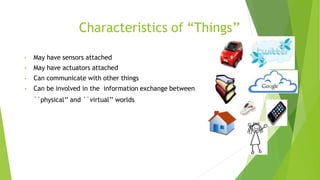
Characteristics of “Things’’
• May have sensors attached
• May have actuators attached
• Can communicate with other things
• Can be involved in the information exchange between
``physical’’ and ``virtual’’ worlds
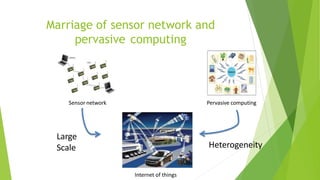
Marriage of sensor network and
pervasive computing
Sensor network Pervasive computing
Internet of things
Large
Scale Heterogeneity
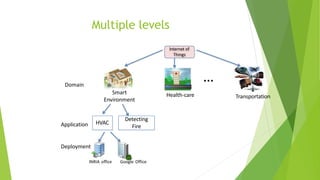
Multiple levels
Internet of
Things
Smart
Environment
Transportation
Domain
HVAC
Detecting
Fire
Application
INRIA office Google Office
Deployment
…
Health-care
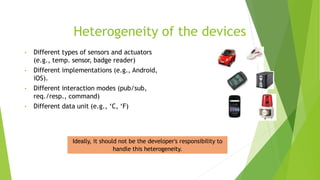
Heterogeneity of the devices
• Different types of sensors and actuators
(e.g., temp. sensor, badge reader)
• Different implementations (e.g., Android,
iOS).
• Different interaction modes (pub/sub,
req./resp., command)
• Different data unit (e.g., ‘C, ‘F)
Ideally, it should not be the developer's responsibility to
handle this heterogeneity.
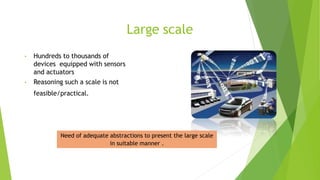
Large scale
• Hundreds to thousands of
devices equipped with sensors
and actuators
• Reasoning such a scale is not
feasible/practical.
Need of adequate abstractions to present the large scale
in suitable manner .
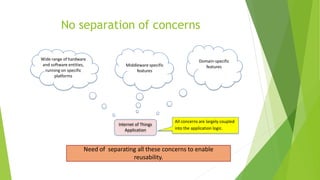
No separation of concerns
Internet of Things
Application
Domain-specific
features
Middleware specific
features
Wide range of hardware
and software entities,
running on specific
platforms
All concerns are largely coupled
into the application logic.
Need of separating all these concerns to enable
reusability.
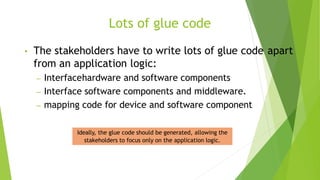
Lots of glue code
• The stakeholders have to write lots of glue code apart
from an application logic:
– Interfacehardware and software components
– Interface software components and middleware.
– mapping code for device and software component
Ideally, the glue code should be generated, allowing the
stakeholders to focus only on the application logic.
Life-cycle and future changes
– Development: The application logic has to be analysed and separated into a set of
distributed tasks for the underlying network.
– Deployment : The tasks have to be implemented for the specific hardware.
– Evolution:Future changes in the infrastructure and application requirements.
Covering application development life-
cycle
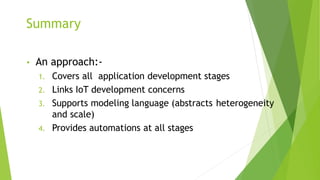
Summary
• An approach:-
1. Covers all application development stages
2. Links IoT development concerns
3. Supports modeling language (abstracts heterogeneity
and scale)
4. Provides automations at all stages
Outline
• Characteristics of IoT
• Application development challenges
• Related work
• Contribution
• Conclusion
• Ongoing and future work
Related work
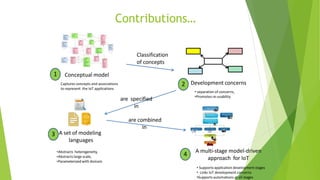
Contributions…
1 Conceptual model
Captures concepts and associations
to represent the IoT applications
Development concerns
• separation of concerns,
•Promotes re-usability
2
Classification
of concepts
A set of modeling
languages
are specified
in
•Abstracts heterogeneity,
•Abstracts large scale,
•Parameterized with domain
3
4
A multi-stage model-driven
approach for IoT
• Supports application development stages
• Links IoT development concerns
•Supports automations at all stages
are combined
in
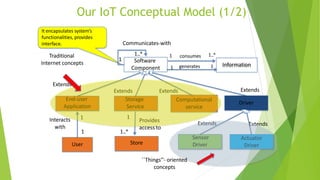
Our IoT Conceptual Model (1/2)
Software
Component
It encapsulates system’s
functionalities, provides
interface.
End-user
Application
Storage
Service
Computational
service
Driver
Extends
Extends Extends Extends
Sensor
Driver
Actuator
Driver
User Store
Provides
access to
Interacts
with
1
1..*
1
1
Communicates-with
1
1..*
Information
consumes
1 1..*
generates 1
1
Extends
Extends
Traditional
Internet concepts
``Things’’- oriented
concepts
Our IoT Conceptual Model (2/2)
Entity of
Interest
Phenomenon
affects
Actuator
Actuator
Driver
actuates
Command
consumes
Sensor
Observes
Sensor
Driver
accesses
Sensor
Measurement
generates
Consists of
Resource
Device
Hosts
User
Software
Component
Runs-on
End-user
Application
Storage
Service
Store
Computational
Service
Driver
Information
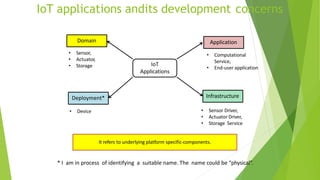
IoT applications andits development concerns
IoT
Applications
Domain Application
Deployment* Infrastructure
• Sensor,
• Actuator,
• Storage
• Computational
Service,
• End-user application
• Sensor Driver,
• Actuator Driver,
• Storage Service
• Device
* I am in process of identifying a suitable name. The name could be “physical”.
This concern describes the concepts that are specific to the application
domain (e.g., building automation, transport)
This concerns describes how the software components are connected for
specifying the application logic.
This concerns supply information about how the devices are grouped
and physically distributed.
It refers to underlying platform specific-components.
Vocabulary Language (1/2)
structs:
TempStruct
tempValue : double;
unitOfMeasurement : String;
resources:
sensors:
TemperatureSensor
generate tempMeasurement : TempStruct;
actuators:
Heater
action Off();
action SetTemp(setTemp: TempStruct);
storages:
ProfileDB
generate profile : TempStruct accessed-by badgeID : String;
One resource description for many
instances.
As a first step of abstracting heterogeneity, sensing and actuating entities are
specified in high-level manner.
One resource description for
many implementations.
Vocabulary Language (2/2)
Floor : Integer;
Room : Integer;
[SINA] Srisathapornphat, C. and Jaikaeo, C. and Shen, C. , Sensor information networking architecture and
applications, 2001
To address scalable operations within IoT system, hierarchical clustering should
be specified [SINA].
Building:03
regions:
Building : Integer;
Floor: 10 Floor: 15
...
Room: 5 Room: 6
Use of region construct:
• Enables system partition at logical level
• Defines scope from which software components will
produce/consume data
Architecture Language
RoomAvgTemp
consume tempMeasurement from hops : 0: Room ;
generate avgTemp : TempStruct ;
in-region : Room ;
Temperature
Sensor
Scope of consuming
data.
Scope of
deployment
Enables
Hierarchical
Clustering
Room
AvgTemp
tempMeasurement
avgTemp
hops:0:Room
In-region
: room
Deployment Language
Temperature-Sensing-Device :
region :
Building : 15 ;
Floor : 11;
Room : 0;
abilities : TemperatureSensor;
type : sunspot;
Badge-Scanner :
region :
Building : 15 ;
Floor : 11;
Room : 0;
abilities : BadgeReader ;
type : android;
Device Name
Attached sensor/
actuator/storage
with device
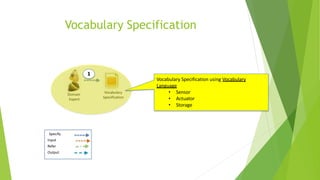
Vocabulary Specification
Domain
Expert
Vocabulary
Specification
1
Vocabulary Specification using Vocabulary
Language
• Sensor
• Actuator
• Storage
Specify
Input
Refer
Output
Architecture Specification
Application
Designer
Architecture
Specification
He defines architecture of an application
using Architecture Language.
• Computational service
• End-user application
2
Specify
Input
Refer
Output
Domain
Expert
Vocabulary
Specification
1
Implementing Software Component
System
Designer
Architecture
Specification
2
Specify
Input
Refer
Output
Application
Logic
Application
Developer
Application
Framework
Framework
Generator
3
4
It allows application developers to focus on
software component logic.
Domain
Expert
Vocabulary
Specification
1
Target Deployment Specification
System
Designer
Architecture
Specification
2
Specify
Input
Refer
Output
Application
Logic
Application
Developer
Application
Framework
4
Network
Manager
Network
description
He specifies target deployment scenario
using Deployment Language.
•Device
Domain
Expert
Vocabulary
Specification
1
Framework
Generator
3
5
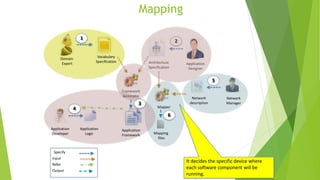
Mapping
Application
Designer
Architecture
Specification
2
Specify
Input
Refer
Output
Application
Logic
Application
Developer
Framework
Generator
Application
Framework
3
4
Network
Manager
5
Network
description
Mapper
Mapping
files
6
It decides the specific device where
each software component will be
running.
Domain
Expert
Vocabulary
Specification
1
Writing Device-Drivers
Application
Designer
Architecture
Specification
2
Specify
Input
Refer
Output
Application
Logic
Application
Developer
Framework
Generator
Application
Framework
3
4
Network
Manager
Mapper
Mapping
files
6
Domain
Expert
Vocabulary
Specification
1
Device
Developer
Device
Drivers
7
5
He writes device drivers
• sensor driver
• networkdevice
• Storage device
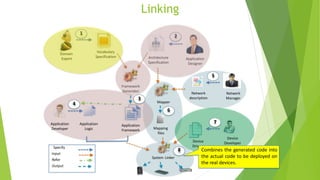
Linking
Application
Designer
Architecture
Specification
2
Specify
Input
Refer
Output
Application
Logic
Application
Developer
Framework
Generator
Application
Framework
3
4
7
Device
Developer
Device
Drivers
Network
Manager
5
Network
description
Mapper
Mapping
files
6
System Linker
8 Combines the generated code into
the actual code to be deployed on
the real devices.
Domain
Expert
Vocabulary
Specification
1
Maintenance and evolution(1/2)
E.g., Adding a new applications in the existing infrastructure. E.g., Moving an application
from one deployment to other.
E.g., Implementing and plugging new device drivers.
Defining
Application
concern
Defining
Domain
Concern
Defining
deployment
concern
Defining
infrastructure
concern
Compiler
Change in
Any requirements?
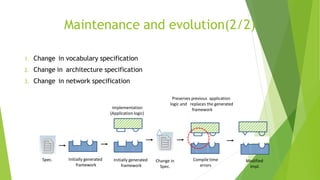
Maintenance and evolution(2/2)
1. Change in vocabulary specification
2. Change in architecture specification
3. Change in network specification
Spec. Initially generated
framework
Implementation
(Application logic)
Initially generated
framework
Change in
Spec.
Compile time
errors
Modified
Impl.
Preserves previous application
logic and replaces the generated
framework
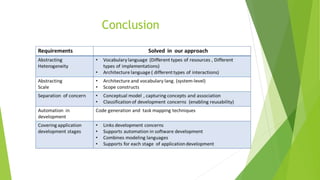
Conclusion
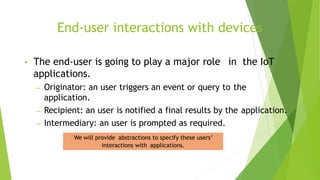
End-user interactions with devices
• The end-user is going to play a major role in the IoT
applications.
– Originator: an user triggers an event or query to the
application.
– Recipient: an user is notified a final results by the application.
– Intermediary: an user is prompted as required.
We will provide abstractions to specify these users’
interactions with applications.
Mobility of devices**
The current version of our modeling language considers only static topology
where the devices do not move once they are deployed.
We will support mobile devices in our future version of
modeling languages.
Evaluating expressiveness of modeling
languages
It explores the subset ofIoT applications characteristics that may
be suitably developed in the framework.
What are the characteristics of IoT applications that can
modeled by our approach ?
Evaluating development effort in the real-
world
• It evaluates the time required to develop an application.
• To measure the development effort, we plan to give our framework to our lab members
with a suitable application.
• From this experiment, we will measure the total time to develop an application.
Tentative time-line
What will an Intern do with the help of me ? (next slide)
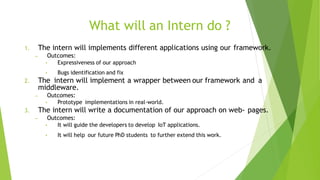
What will an Intern do ?
1. The intern will implements different applications using our framework.
– Outcomes:
• Expressiveness of our approach
• Bugs identification and fix
2. The intern will implement a wrapper between our framework and a
middleware.
– Outcomes:
• Prototype implementations in real-world.
3. The intern will write a documentation of our approach on web- pages.
– Outcomes:
• It will guide the developers to develop IoT applications.
• It will help our future PhD students to further extend this work.

Application Development for the Internet of Things.pptx