1
TOPIC
IoT in salsa
Serverless
Massimo Bonanni
Paranormal Trainer, with the head in the Cloud and all
the REST in microservices!
massimo.bonanni@microsoft.com
@massimobonanni
2
Photo by Karolina Grabowska from Pexels
3
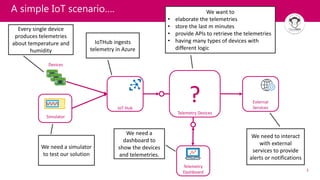
A simple IoT scenario….
Simulator
IoT Hub
Telemetry
Dashboard
Telemetry Devices
?
Devices
Every single device
produces telemetries
about temperature and
humidity
IoTHub ingests
telemetry in Azure
We need a simulator
to test our solution
We want to
• elaborate the telemetries
• store the last m minutes
• provide APIs to retrieve the telemetries
• having many types of devices with
different logic
We need a
dashboard to
show the devices
and telemetries.
External
Services
We need to interact
with external
services to provide
alerts or notifications
4
Photo by Tim Gouw on Unsplash
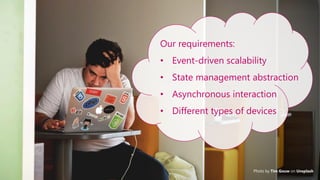
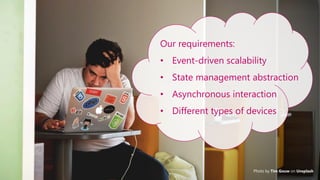
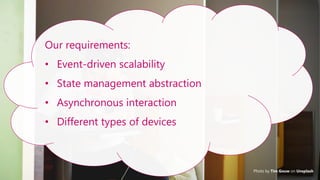
Our requirements:
• Event-driven scalability
• State management abstraction
• Asynchronous interaction
• Different types of devices
5
Photo by Andrea Piacquadio from Pexels
Durable
Entities….
why not?
6
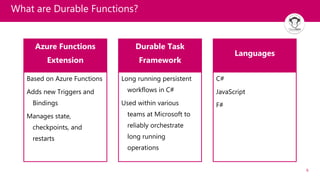
Azure Functions
Extension
Based on Azure Functions
Adds new Triggers and
Bindings
Manages state,
checkpoints, and
restarts
Durable Task
Framework
Long running persistent
workflows in C#
Used within various
teams at Microsoft to
reliably orchestrate
long running
operations
Languages
C#
JavaScript
F#
What are Durable Functions?
7
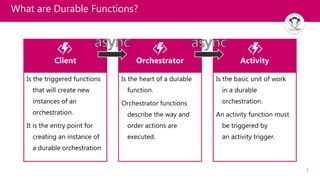
Client
Is the triggered functions
that will create new
instances of an
orchestration.
It is the entry point for
creating an instance of
a durable orchestration
Orchestrator
Is the heart of a durable
function.
Orchestrator functions
describe the way and
order actions are
executed.
Activity
Is the basic unit of work
in a durable
orchestration.
An activity function must
be triggered by
an activity trigger.
What are Durable Functions?
8
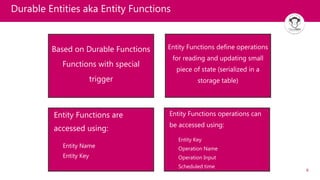
Based on Durable Functions
Functions with special
trigger
Entity Functions define operations
for reading and updating small
piece of state (serialized in a
storage table)
Entity Functions are
accessed using:
Entity Name
Entity Key
Entity Functions operations can
be accessed using:
Entity Key
Operation Name
Operation Input
Scheduled time
Durable Entities aka Entity Functions
9
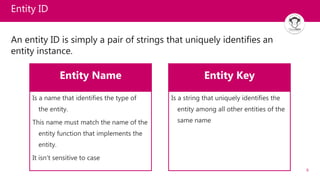
Entity ID
An entity ID is simply a pair of strings that uniquely identifies an
entity instance.
Entity Name
Is a name that identifies the type of
the entity.
This name must match the name of the
entity function that implements the
entity.
It isn't sensitive to case
Entity Key
Is a string that uniquely identifies the
entity among all other entities of the
same name
10
Define the entity
Function-
based syntax
Class-based
syntax
11
Define the entity
Function-
based syntax
Class-based
syntax
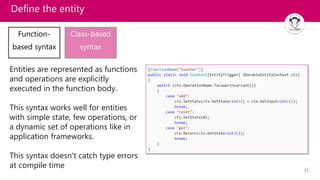
Entities are represented as functions
and operations are explicitly
executed in the function body.
This syntax works well for entities
with simple state, few operations, or
a dynamic set of operations like in
application frameworks.
This syntax doesn't catch type errors
at compile time
12
Define the entity
Function-
based syntax
Class-based
syntax
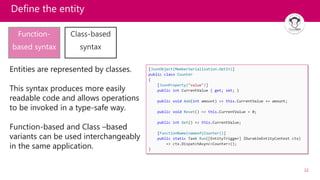
Entities are represented by classes.
This syntax produces more easily
readable code and allows operations
to be invoked in a type-safe way.
Function-based and Class –based
variants can be used interchangeably
in the same application.
13
Define the entity
Function-
based syntax
Class-based
syntax
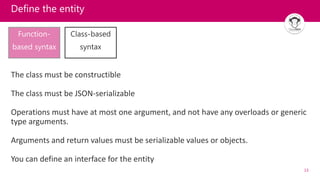
The class must be constructible
The class must be JSON-serializable
Operations must have at most one argument, and not have any overloads or generic
type arguments.
Arguments and return values must be serializable values or objects.
You can define an interface for the entity
14
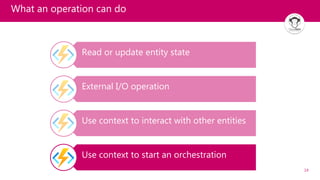
What an operation can do
Read or update entity state
External I/O operation
Use context to interact with other entities
Use context to start an orchestration
15
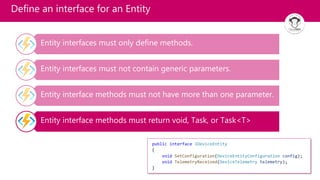
Define an interface for an Entity
Entity interfaces must only define methods.
Entity interfaces must not contain generic parameters.
Entity interface methods must not have more than one parameter.
Entity interface methods must return void, Task, or Task<T>
16
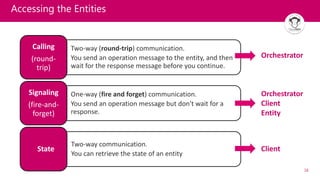
Accessing the Entities
Two-way (round-trip) communication.
You send an operation message to the entity, and then
wait for the response message before you continue.
Calling
(round-
trip)
One-way (fire and forget) communication.
You send an operation message but don't wait for a
response.
Signaling
(fire-and-
forget)
Two-way communication.
You can retrieve the state of an entity
State
Orchestrator
Orchestrator
Client
Entity
Client
17
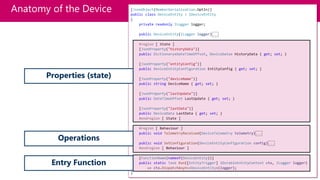
Anatomy of the Device
Properties (state)
Operations
Entry Function
18
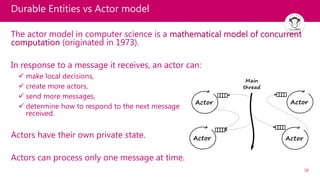
Durable Entities vs Actor model
The actor model in computer science is a mathematical model of concurrent
computation (originated in 1973).
In response to a message it receives, an actor can:
✓ make local decisions,
✓ create more actors,
✓ send more messages,
✓ determine how to respond to the next message
received.
Actors have their own private state.
Actors can process only one message at time.
19
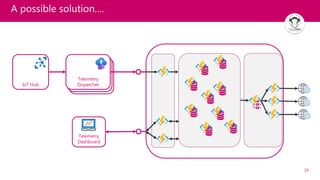
A possible solution….
IoT Hub
Telemetry
Dashboard
Telemetry
Dispatcher
20
A possible solution….
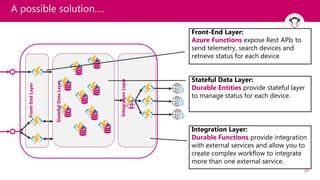
Front-End Layer:
Azure Functions expose Rest APIs to
send telemetry, search devices and
retrieve status for each device
Stateful Data Layer:
Durable Entities provide stateful layer
to manage status for each device.
Integration Layer:
Durable Functions provide integration
with external services and allow you to
create complex workflow to integrate
more than one external service.
Front-End
Layer
Stateful
Data
Layer
Integration
Layer
21
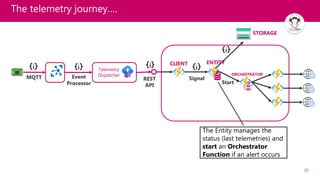
The telemetry journey….
Telemetry
Dispatcher
MQTT Event
Processor
REST
API
CLIENT
Signal
ORCHESTRATOR
Start
ENTITY
STORAGE
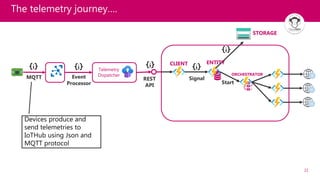
Devices produce and
send telemetries to
IoTHub using Json and
MQTT protocol
22
The telemetry journey….
Telemetry
Dispatcher
MQTT Event
Processor
REST
API
CLIENT
Signal
ORCHESTRATOR
Start
ENTITY
STORAGE
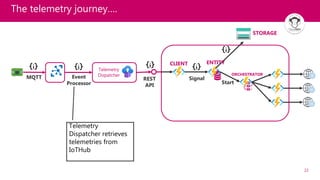
Telemetry
Dispatcher retrieves
telemetries from
IoTHub
23
The telemetry journey….
Telemetry
Dispatcher
MQTT Event
Processor
REST
API
CLIENT
Signal
ORCHESTRATOR
Start
ENTITY
STORAGE
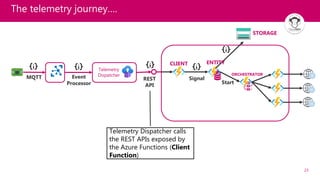
Telemetry Dispatcher calls
the REST APIs exposed by
the Azure Functions (Client
Function)
24
The telemetry journey….
Telemetry
Dispatcher
MQTT Event
Processor
REST
API
CLIENT
Signal
ORCHESTRATOR
Start
ENTITY
STORAGE
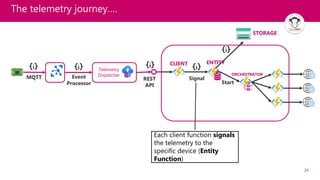
Each client function signals
the telemetry to the
specific device (Entity
Function)
25
The telemetry journey….
Telemetry
Dispatcher
MQTT Event
Processor
REST
API
CLIENT
Signal
ORCHESTRATOR
Start
ENTITY
STORAGE
The Entity manages the
status (last telemetries) and
start an Orchestrator
Function if an alert occurs
Serverless IoT
Platform
27
Photo by Tim Gouw on Unsplash
Our requirements:
• Event-driven scalability
• State management abstraction
• Asynchronous interaction
• Different types of devices
28
Photo by Tim Gouw on Unsplash
Our requirements:
• Event-driven scalability
• State management abstraction
• Asynchronous interaction
• Different types of devices
29
Photo by Tim Gouw on Unsplash
Our requirements:
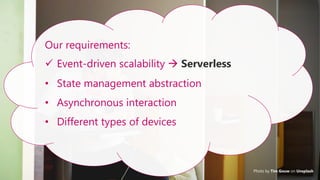
✓ Event-driven scalability → Serverless
• State management abstraction
• Asynchronous interaction
• Different types of devices
30
Photo by Tim Gouw on Unsplash
Our requirements:
✓ Event-driven scalability → Serverless
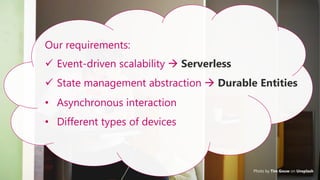
✓ State management abstraction → Durable Entities
• Asynchronous interaction
• Different types of devices
31
Photo by Tim Gouw on Unsplash
Our requirements:
✓ Event-driven scalability → Serverless
✓ State management abstraction → Durable Entities
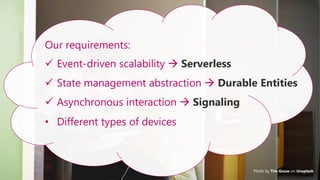
✓ Asynchronous interaction → Signaling
• Different types of devices
32
Photo by Tim Gouw on Unsplash
Our requirements:
✓ Event-driven scalability → Serverless
✓ State management abstraction → Durable Entities
✓ Asynchronous interaction → Signaling
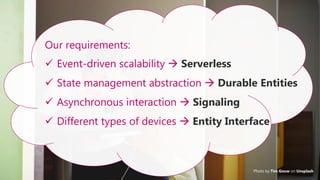
✓ Different types of devices → Entity Interface
33
Thanks for your
attention!!!!!
Massimo Bonanni
Azure Technical Trainer
massimo.bonanni@microsoft.com
@massimobonanni
Connect with meonLinkedIn
linkedin.com/in/massimobonanni/
http://bit.ly/MasteringServerless
References
Photo by Ashim D’Silva on Unsplash
Azure Functions
Documentation
https://docs.microsoft.com/en-
US/azure/azure-functions/
Durable Functions overview
https://docs.microsoft.com/en-
us/azure/azure-
functions/durable/durable-
functions-overview?tabs=csharp
Developer's guide to
durable entities in .NET
https://docs.microsoft.com/en-
us/azure/azure-
functions/durable/durable-
functions-dotnet-entities
Entity Functions
https://docs.microsoft.com/en-
us/azure/azure-
functions/durable/durable-
functions-entities?tabs=csharp
Durable Task Framework
https://github.com/Azure/durableta
sk
GitHub ServerlessIoT Demo
https://github.com/massimobonann
i/ServerlessIoT
@cloudgen_verona
#CodeGen2021

IoT in salsa Serverless

  • 1.
    1 TOPIC IoT in salsa Serverless MassimoBonanni Paranormal Trainer, with the head in the Cloud and all the REST in microservices! massimo.bonanni@microsoft.com @massimobonanni
  • 2.
    2 Photo by KarolinaGrabowska from Pexels
  • 3.
    3 A simple IoTscenario…. Simulator IoT Hub Telemetry Dashboard Telemetry Devices ? Devices Every single device produces telemetries about temperature and humidity IoTHub ingests telemetry in Azure We need a simulator to test our solution We want to • elaborate the telemetries • store the last m minutes • provide APIs to retrieve the telemetries • having many types of devices with different logic We need a dashboard to show the devices and telemetries. External Services We need to interact with external services to provide alerts or notifications
  • 4.
    4 Photo by TimGouw on Unsplash Our requirements: • Event-driven scalability • State management abstraction • Asynchronous interaction • Different types of devices
  • 5.
    5 Photo by AndreaPiacquadio from Pexels Durable Entities…. why not?
  • 6.
    6 Azure Functions Extension Based onAzure Functions Adds new Triggers and Bindings Manages state, checkpoints, and restarts Durable Task Framework Long running persistent workflows in C# Used within various teams at Microsoft to reliably orchestrate long running operations Languages C# JavaScript F# What are Durable Functions?
  • 7.
    7 Client Is the triggeredfunctions that will create new instances of an orchestration. It is the entry point for creating an instance of a durable orchestration Orchestrator Is the heart of a durable function. Orchestrator functions describe the way and order actions are executed. Activity Is the basic unit of work in a durable orchestration. An activity function must be triggered by an activity trigger. What are Durable Functions?
  • 8.
    8 Based on DurableFunctions Functions with special trigger Entity Functions define operations for reading and updating small piece of state (serialized in a storage table) Entity Functions are accessed using: Entity Name Entity Key Entity Functions operations can be accessed using: Entity Key Operation Name Operation Input Scheduled time Durable Entities aka Entity Functions
  • 9.
    9 Entity ID An entityID is simply a pair of strings that uniquely identifies an entity instance. Entity Name Is a name that identifies the type of the entity. This name must match the name of the entity function that implements the entity. It isn't sensitive to case Entity Key Is a string that uniquely identifies the entity among all other entities of the same name
  • 10.
    10 Define the entity Function- basedsyntax Class-based syntax
  • 11.
    11 Define the entity Function- basedsyntax Class-based syntax Entities are represented as functions and operations are explicitly executed in the function body. This syntax works well for entities with simple state, few operations, or a dynamic set of operations like in application frameworks. This syntax doesn't catch type errors at compile time
  • 12.
    12 Define the entity Function- basedsyntax Class-based syntax Entities are represented by classes. This syntax produces more easily readable code and allows operations to be invoked in a type-safe way. Function-based and Class –based variants can be used interchangeably in the same application.
  • 13.
    13 Define the entity Function- basedsyntax Class-based syntax The class must be constructible The class must be JSON-serializable Operations must have at most one argument, and not have any overloads or generic type arguments. Arguments and return values must be serializable values or objects. You can define an interface for the entity
  • 14.
    14 What an operationcan do Read or update entity state External I/O operation Use context to interact with other entities Use context to start an orchestration
  • 15.
    15 Define an interfacefor an Entity Entity interfaces must only define methods. Entity interfaces must not contain generic parameters. Entity interface methods must not have more than one parameter. Entity interface methods must return void, Task, or Task<T>
  • 16.
    16 Accessing the Entities Two-way(round-trip) communication. You send an operation message to the entity, and then wait for the response message before you continue. Calling (round- trip) One-way (fire and forget) communication. You send an operation message but don't wait for a response. Signaling (fire-and- forget) Two-way communication. You can retrieve the state of an entity State Orchestrator Orchestrator Client Entity Client
  • 17.
    17 Anatomy of theDevice Properties (state) Operations Entry Function
  • 18.
    18 Durable Entities vsActor model The actor model in computer science is a mathematical model of concurrent computation (originated in 1973). In response to a message it receives, an actor can: ✓ make local decisions, ✓ create more actors, ✓ send more messages, ✓ determine how to respond to the next message received. Actors have their own private state. Actors can process only one message at time.
  • 19.
    19 A possible solution…. IoTHub Telemetry Dashboard Telemetry Dispatcher
  • 20.
    20 A possible solution…. Front-EndLayer: Azure Functions expose Rest APIs to send telemetry, search devices and retrieve status for each device Stateful Data Layer: Durable Entities provide stateful layer to manage status for each device. Integration Layer: Durable Functions provide integration with external services and allow you to create complex workflow to integrate more than one external service. Front-End Layer Stateful Data Layer Integration Layer
  • 21.
    21 The telemetry journey…. Telemetry Dispatcher MQTTEvent Processor REST API CLIENT Signal ORCHESTRATOR Start ENTITY STORAGE Devices produce and send telemetries to IoTHub using Json and MQTT protocol
  • 22.
    22 The telemetry journey…. Telemetry Dispatcher MQTTEvent Processor REST API CLIENT Signal ORCHESTRATOR Start ENTITY STORAGE Telemetry Dispatcher retrieves telemetries from IoTHub
  • 23.
    23 The telemetry journey…. Telemetry Dispatcher MQTTEvent Processor REST API CLIENT Signal ORCHESTRATOR Start ENTITY STORAGE Telemetry Dispatcher calls the REST APIs exposed by the Azure Functions (Client Function)
  • 24.
    24 The telemetry journey…. Telemetry Dispatcher MQTTEvent Processor REST API CLIENT Signal ORCHESTRATOR Start ENTITY STORAGE Each client function signals the telemetry to the specific device (Entity Function)
  • 25.
    25 The telemetry journey…. Telemetry Dispatcher MQTTEvent Processor REST API CLIENT Signal ORCHESTRATOR Start ENTITY STORAGE The Entity manages the status (last telemetries) and start an Orchestrator Function if an alert occurs
  • 26.
  • 27.
    27 Photo by TimGouw on Unsplash Our requirements: • Event-driven scalability • State management abstraction • Asynchronous interaction • Different types of devices
  • 28.
    28 Photo by TimGouw on Unsplash Our requirements: • Event-driven scalability • State management abstraction • Asynchronous interaction • Different types of devices
  • 29.
    29 Photo by TimGouw on Unsplash Our requirements: ✓ Event-driven scalability → Serverless • State management abstraction • Asynchronous interaction • Different types of devices
  • 30.
    30 Photo by TimGouw on Unsplash Our requirements: ✓ Event-driven scalability → Serverless ✓ State management abstraction → Durable Entities • Asynchronous interaction • Different types of devices
  • 31.
    31 Photo by TimGouw on Unsplash Our requirements: ✓ Event-driven scalability → Serverless ✓ State management abstraction → Durable Entities ✓ Asynchronous interaction → Signaling • Different types of devices
  • 32.
    32 Photo by TimGouw on Unsplash Our requirements: ✓ Event-driven scalability → Serverless ✓ State management abstraction → Durable Entities ✓ Asynchronous interaction → Signaling ✓ Different types of devices → Entity Interface
  • 33.
    33 Thanks for your attention!!!!! MassimoBonanni Azure Technical Trainer massimo.bonanni@microsoft.com @massimobonanni Connect with meonLinkedIn linkedin.com/in/massimobonanni/ http://bit.ly/MasteringServerless
  • 34.
    References Photo by AshimD’Silva on Unsplash Azure Functions Documentation https://docs.microsoft.com/en- US/azure/azure-functions/ Durable Functions overview https://docs.microsoft.com/en- us/azure/azure- functions/durable/durable- functions-overview?tabs=csharp Developer's guide to durable entities in .NET https://docs.microsoft.com/en- us/azure/azure- functions/durable/durable- functions-dotnet-entities Entity Functions https://docs.microsoft.com/en- us/azure/azure- functions/durable/durable- functions-entities?tabs=csharp Durable Task Framework https://github.com/Azure/durableta sk GitHub ServerlessIoT Demo https://github.com/massimobonann i/ServerlessIoT
  • 35.