1
Quality Management Systems
Aviation Industry - Maintenance
Dr Ali AL-Zubaidi FCQI CQP
Integrated Management Systems Associates (IMSA)
2
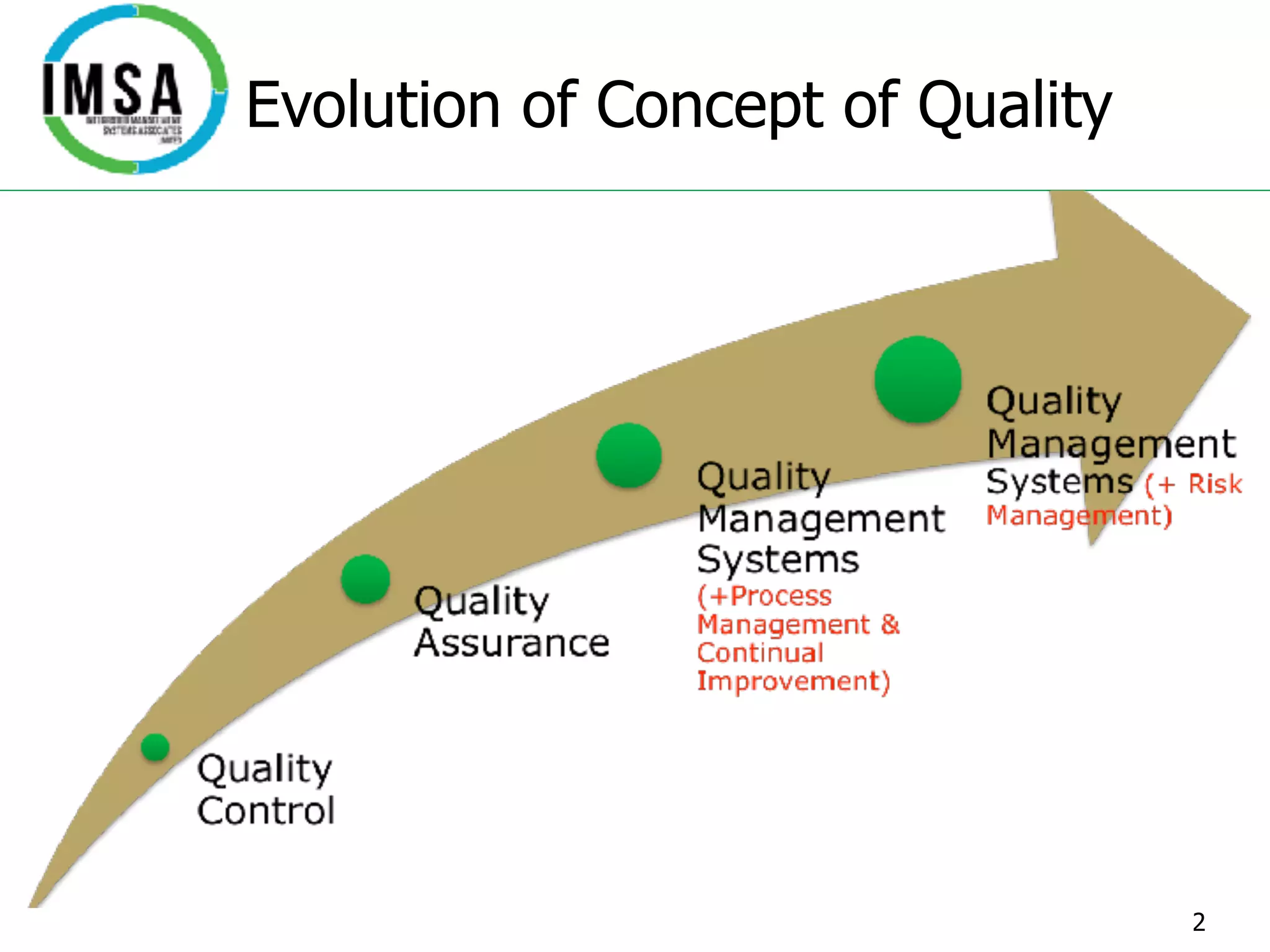
Evolution of Concept of Quality
3
Evolution of Quality Management Systems &
Supporting Standards
1979: BS 5750 (Quality Control)
1987: ISO 9001 (enhanced Quality Control)
1994: ISO 9001 (Quality Assurance)
2000: ISO 9000 Family (Quality Management System
(incorporating Process Approach & Continual Improvement)
2008: ISO 9000 Family (Quality Management System
(re-enforced)
2015: ISO 9000 Family (Quality Management System
(incorporating Risk Management)
BAEKSA/QCDP/Module No.1/Functional Competency Element No. 1/February 2017 4
Quality Management
Quality Management
17
Quality Improvement
Quality Planning
Quality Policy & Objectives
Quality Assurance
Quality
Control
5
Management Principles
Current (7)
Customer focus
Leadership
Engagement of people
Process approach
Improvement
Evidence-based decision
making
Relationship management
Old (8)
Customer focus
Leadership
Involvement of people
Process approach
System approach to management
(now incorporated in the process approach)
Continual improvement
Factual approach to decision making
Mutually beneficial supplier
relationships
53
BAEKSA/QCDP/Module No.2/Functional Competency Element No. 5/February 2017 6
???
???
???
??? ???
Quality Management System Standard
Structure
BAEKSA/QCDP/Module No.2/Functional Competency Element No. 5/February 2017 7
1. Improvement
2. Leadership
3. Support
4. Operation
5. Performance Evaluation
6. Planning
ISO 9001:2015 Provisions
34
8
Quality Management System Standard
Structure
Leadership
(5)
Improvement
(10)
Support (7) &
Operation (8)
Planning (6)
Performance
Evaluation (9)
Plan Do
Check
Act
9
▪ Less prescriptive, but with greater focus on achieving conforming
products and services
▪ More user friendly for service providers and knowledge-based
organisations
▪ Greater leadership engagement
▪ More structured planning for setting objectives
▪ Management review is aligned to organisational results
▪ Opportunity for more flexible documented information
▪ Addresses organisational risks and opportunities in a structured
manner
▪ Addresses supply chain management more effectively
▪ Provide opportunity to establish an integrated management system
that addresses other elements such as environment, health &
safety, business continuity, etc.
Quality Management Systems Standards
Summary Features
111
10
Annex SL
ISO 9001
(QMS)
AS 9100 AS 911O AS 912O AS 9115
Quality Management Systems
Standards – Aviation, Space & Defence
Industries
11
▪ AS 9100: Quality management systems - Requirements
for aviation, space and defence organisations
▪ AS 9110: Quality management systems - Requirements
for aviation maintenance organisations
▪ AS 9120: Quality management systems - Requirements
for aviation, space and defence distributors
▪ AS 9115: Quality management systems - Requirements
for aviation, space and defence organisations -
deliverable software
Quality Management Systems Standards –
Aviation, Space & Defence Industries
117
12
System
Set of interrelated or interacting elements
(processes)
Management System
Set of interrelated or interacting elements of an
organisation to establish policies and objectives and
processes to achieve those objectives
Quality Management System
Part of management system with regard to quality
Quality Management Systems
16
BAEKSA/QCDP/Module No.1/Functional Competency Element No. 2/February 2017 13
Management
Systems (MS)
Management Systems vs. Management
Standards
14
NOT ONLY
MS ≠ Standards
MS = Standards+++++
Standards are Generic
while
MS is Specific
Standards
(Requirements
& Guidelines)
Stakeholders
Requirements
(Needs &
Expectations)
Statutory &
Legal
Requirements
Specific
Business
Requirements
Management
Systems
(MS)
Management Systems vs. Management
Standards
15
Quality Management System
▪ A quality management system is dynamic enveloping over
time through concept of continual improvement.
▪ Every organisation has quality management activities,
however, these need to be planned and managed in a
systemic way.
▪ Developing a quality management system enables
organisation to focus on activities that really add value to the
organisation and its stakeholders.
▪ Such a system provides framework for planning, executing,
monitoring and improving performance activities within
organisation.
16
▪Comprises activities by which the organisation identifies its
objectives and determines the processes and resources required
to achieve desired results.
▪Manages processes and their interactions, together with
resources required to provide value and realize results for
relevant interested parties (stakeholders).
▪Enables top management to optimize the use of resources
considering the long and short term consequences of their
decisions.
▪Provides the means to identify actions to address intended and
unintended consequences providing products and services.
Quality Management Systems (QMS)
19
✓ Deliver customer (stakeholders) satisfaction
✓ Deliver safe products and operations
✓ Deliver business assurance
✓ Enable continual improve through lessons learned
★ It is not simply about obtaining certification
★ Do you agree?
Why do we need a quality
management systems?
18
Management Leadership & Role
▪Determining critical (core & supporting) processes and their
interactions.
▪Determining & evaluating of risks associated with processes
and interactions
▪Ensure effective strategic, system and operational planning.
▪Provision of adequate resources (human & infrastructure).
▪Ensure competency of human resources and capability of
infrastructure.
▪Implementing appropriate control measures.
▪Monitoring of processes performance.
▪Effective internal and external communication.
▪Performing planned reviews to ensure effective performance of
implemented quality management system.
19
Management Systems Key Elements
Context of Organisation
Stakeholders Needs
Process
Management
Risk
Management
Continual
Improvement
Management
20
Process
Set of interrelated or interacting activities that use
inputs to deliver an intended result
▪Processes are planned & managed under
controlled conditions for effectiveness &
efficiency
▪Outputs from processes could be inputs to
other processes & vise-versa
▪Some processes (special) have outputs which
cannot be readily or economically verified
Process Management
67
21
42
Process Management
22
Implementation considerations
▪ Use a risk-driven approach throughout your organisational
processes
▪ Identify and prioritize what the risks are in your organisation
(it depends on context: product or process complexity,
organizational complexity)
✓ what is acceptable?
✓ what is unacceptable?
▪ Plan actions to address the risks
✓ how can I avoid, eliminate or mitigate risks?
▪ Implement the plan; take action
▪ Check the effectiveness of the action; does it work?
▪ Learn from experience; improve
Risk-based Thinking
82
23
47
Process Risk Profile
Process Controls
24
Plan, implement, and control processes needed to assure product safety, as
appropriate to organisation.
These processes can include:
✓hazard identification, including reactive and proactive methods;
✓analysis, assessment, and control of safety risks associated with identified
hazards;
✓identification and management of changes that may impact product safety;
✓assessment of the effectiveness of safety management processes;
✓provision of training on product safety responsibilities to relevant personnel;
✓communication of product safety information, including safety-critical
information, safety events, and changes to safety procedures, as applicable;
✓reporting of safety events to the customer, authorities, and type certificate
holder in accordance with customer and regulatory requirements.
Product Safety
131
25
• Addresses need to determine and manage the knowledge
maintained by the organisation to ensure effective operation
of its processes. ︎︎︎ ︎︎︎
• Organisational knowledge requires protection as it:
➢Safeguard organisation from loss of knowledge, through
staff turnover and failure to capture and share information
➢Encourage organisation to acquire knowledge, through
learning from experience, mentoring & benchmarking
▪ Capturing of knowledge from lessons learned and introducing
relevant change
▪ Identification of experts able to transfer knowledge, on job
training, tutorial sessions
▪ Implement succession planning activities
Organisational Knowledge
98
26
Plan, implement, and control processes,
appropriate to the organisation and the product,
for the prevention of counterfeit or suspect
counterfeit part use and their inclusion in
product(s) delivered to the customer.
Plan, implement, and control a process
appropriate to the organisation and its scope of
work that identifies and prevents the use of
unapproved and suspected unapproved parts.
Counterfeit Parts
134
27
Establish, implement, and maintain a process that ensures approved parts:
a. properly identified, as appropriate for product or to which they are to be
fitted;
b. acceptable for installation on product or article, in accordance with applicable
requirements from competent authority or the customer;
c. if used, are in a satisfactory condition and that their airworthiness is
ascertained, in particular applicable airworthiness directives have been
accomplished;
d. if life limited, do not exceed those limits and that all related documented
information is available;
e. if removed from an aircraft involved in an accident or incident, are processed
per a specific work order including all inspections and repairs deemed
necessary to ensure parts are airworthy prior to installation;
f.if dismantled, have been managed by an organisation that:
✴holds the required approvals;
✴complies with applicable requirements related to environmental impact;
✴is able to manage the necessary documented information.
Counterfeit Parts
134
28
Persons doing work under the organisation’s control are aware of:
a.quality policy & relevant quality objectives;
c. their contribution to the effectiveness of the quality management
system, including the benefits of improved performance;
d.implications of not conforming with quality management system
requirements;
e.relevant quality management system documented
information and changes thereto;
f. their contribution to product or service conformity;
g.their contribution to product safety;
h.importance of ethical behaviour;
i. safety policy and safety objectives related to the product;
j. Human factors and their potential consequences on
maintenance activities.
Awareness
144
29
• Standard now refers to only “documented information”,
covering all types of documentation, i.e no mention of
“documents”, “documented procedures” or “records”.
• These types of documentation can still be used but it is
the decision of the organisation.
• Organisation is responsible for determining what
documented information needs to be maintained
(documented procedure) and retained (records) and
period of time for which it is to be retained and media
to be used for its retention
Documented Information
103
30
5

Quality Management Systems - Aviation Industry

  • 1.
    1 Quality Management Systems AviationIndustry - Maintenance Dr Ali AL-Zubaidi FCQI CQP Integrated Management Systems Associates (IMSA)
  • 2.
  • 3.
    3 Evolution of QualityManagement Systems & Supporting Standards 1979: BS 5750 (Quality Control) 1987: ISO 9001 (enhanced Quality Control) 1994: ISO 9001 (Quality Assurance) 2000: ISO 9000 Family (Quality Management System (incorporating Process Approach & Continual Improvement) 2008: ISO 9000 Family (Quality Management System (re-enforced) 2015: ISO 9000 Family (Quality Management System (incorporating Risk Management)
  • 4.
    BAEKSA/QCDP/Module No.1/Functional CompetencyElement No. 1/February 2017 4 Quality Management Quality Management 17 Quality Improvement Quality Planning Quality Policy & Objectives Quality Assurance Quality Control
  • 5.
    5 Management Principles Current (7) Customerfocus Leadership Engagement of people Process approach Improvement Evidence-based decision making Relationship management Old (8) Customer focus Leadership Involvement of people Process approach System approach to management (now incorporated in the process approach) Continual improvement Factual approach to decision making Mutually beneficial supplier relationships 53
  • 6.
    BAEKSA/QCDP/Module No.2/Functional CompetencyElement No. 5/February 2017 6 ??? ??? ??? ??? ??? Quality Management System Standard Structure
  • 7.
    BAEKSA/QCDP/Module No.2/Functional CompetencyElement No. 5/February 2017 7 1. Improvement 2. Leadership 3. Support 4. Operation 5. Performance Evaluation 6. Planning ISO 9001:2015 Provisions 34
  • 8.
    8 Quality Management SystemStandard Structure Leadership (5) Improvement (10) Support (7) & Operation (8) Planning (6) Performance Evaluation (9) Plan Do Check Act
  • 9.
    9 ▪ Less prescriptive,but with greater focus on achieving conforming products and services ▪ More user friendly for service providers and knowledge-based organisations ▪ Greater leadership engagement ▪ More structured planning for setting objectives ▪ Management review is aligned to organisational results ▪ Opportunity for more flexible documented information ▪ Addresses organisational risks and opportunities in a structured manner ▪ Addresses supply chain management more effectively ▪ Provide opportunity to establish an integrated management system that addresses other elements such as environment, health & safety, business continuity, etc. Quality Management Systems Standards Summary Features 111
  • 10.
    10 Annex SL ISO 9001 (QMS) AS9100 AS 911O AS 912O AS 9115 Quality Management Systems Standards – Aviation, Space & Defence Industries
  • 11.
    11 ▪ AS 9100:Quality management systems - Requirements for aviation, space and defence organisations ▪ AS 9110: Quality management systems - Requirements for aviation maintenance organisations ▪ AS 9120: Quality management systems - Requirements for aviation, space and defence distributors ▪ AS 9115: Quality management systems - Requirements for aviation, space and defence organisations - deliverable software Quality Management Systems Standards – Aviation, Space & Defence Industries 117
  • 12.
    12 System Set of interrelatedor interacting elements (processes) Management System Set of interrelated or interacting elements of an organisation to establish policies and objectives and processes to achieve those objectives Quality Management System Part of management system with regard to quality Quality Management Systems 16
  • 13.
    BAEKSA/QCDP/Module No.1/Functional CompetencyElement No. 2/February 2017 13 Management Systems (MS) Management Systems vs. Management Standards
  • 14.
    14 NOT ONLY MS ≠Standards MS = Standards+++++ Standards are Generic while MS is Specific Standards (Requirements & Guidelines) Stakeholders Requirements (Needs & Expectations) Statutory & Legal Requirements Specific Business Requirements Management Systems (MS) Management Systems vs. Management Standards
  • 15.
    15 Quality Management System ▪A quality management system is dynamic enveloping over time through concept of continual improvement. ▪ Every organisation has quality management activities, however, these need to be planned and managed in a systemic way. ▪ Developing a quality management system enables organisation to focus on activities that really add value to the organisation and its stakeholders. ▪ Such a system provides framework for planning, executing, monitoring and improving performance activities within organisation.
  • 16.
    16 ▪Comprises activities bywhich the organisation identifies its objectives and determines the processes and resources required to achieve desired results. ▪Manages processes and their interactions, together with resources required to provide value and realize results for relevant interested parties (stakeholders). ▪Enables top management to optimize the use of resources considering the long and short term consequences of their decisions. ▪Provides the means to identify actions to address intended and unintended consequences providing products and services. Quality Management Systems (QMS) 19
  • 17.
    ✓ Deliver customer(stakeholders) satisfaction ✓ Deliver safe products and operations ✓ Deliver business assurance ✓ Enable continual improve through lessons learned ★ It is not simply about obtaining certification ★ Do you agree? Why do we need a quality management systems?
  • 18.
    18 Management Leadership &Role ▪Determining critical (core & supporting) processes and their interactions. ▪Determining & evaluating of risks associated with processes and interactions ▪Ensure effective strategic, system and operational planning. ▪Provision of adequate resources (human & infrastructure). ▪Ensure competency of human resources and capability of infrastructure. ▪Implementing appropriate control measures. ▪Monitoring of processes performance. ▪Effective internal and external communication. ▪Performing planned reviews to ensure effective performance of implemented quality management system.
  • 19.
    19 Management Systems KeyElements Context of Organisation Stakeholders Needs Process Management Risk Management Continual Improvement Management
  • 20.
    20 Process Set of interrelatedor interacting activities that use inputs to deliver an intended result ▪Processes are planned & managed under controlled conditions for effectiveness & efficiency ▪Outputs from processes could be inputs to other processes & vise-versa ▪Some processes (special) have outputs which cannot be readily or economically verified Process Management 67
  • 21.
  • 22.
    22 Implementation considerations ▪ Usea risk-driven approach throughout your organisational processes ▪ Identify and prioritize what the risks are in your organisation (it depends on context: product or process complexity, organizational complexity) ✓ what is acceptable? ✓ what is unacceptable? ▪ Plan actions to address the risks ✓ how can I avoid, eliminate or mitigate risks? ▪ Implement the plan; take action ▪ Check the effectiveness of the action; does it work? ▪ Learn from experience; improve Risk-based Thinking 82
  • 23.
  • 24.
    24 Plan, implement, andcontrol processes needed to assure product safety, as appropriate to organisation. These processes can include: ✓hazard identification, including reactive and proactive methods; ✓analysis, assessment, and control of safety risks associated with identified hazards; ✓identification and management of changes that may impact product safety; ✓assessment of the effectiveness of safety management processes; ✓provision of training on product safety responsibilities to relevant personnel; ✓communication of product safety information, including safety-critical information, safety events, and changes to safety procedures, as applicable; ✓reporting of safety events to the customer, authorities, and type certificate holder in accordance with customer and regulatory requirements. Product Safety 131
  • 25.
    25 • Addresses needto determine and manage the knowledge maintained by the organisation to ensure effective operation of its processes. ︎︎︎ ︎︎︎ • Organisational knowledge requires protection as it: ➢Safeguard organisation from loss of knowledge, through staff turnover and failure to capture and share information ➢Encourage organisation to acquire knowledge, through learning from experience, mentoring & benchmarking ▪ Capturing of knowledge from lessons learned and introducing relevant change ▪ Identification of experts able to transfer knowledge, on job training, tutorial sessions ▪ Implement succession planning activities Organisational Knowledge 98
  • 26.
    26 Plan, implement, andcontrol processes, appropriate to the organisation and the product, for the prevention of counterfeit or suspect counterfeit part use and their inclusion in product(s) delivered to the customer. Plan, implement, and control a process appropriate to the organisation and its scope of work that identifies and prevents the use of unapproved and suspected unapproved parts. Counterfeit Parts 134
  • 27.
    27 Establish, implement, andmaintain a process that ensures approved parts: a. properly identified, as appropriate for product or to which they are to be fitted; b. acceptable for installation on product or article, in accordance with applicable requirements from competent authority or the customer; c. if used, are in a satisfactory condition and that their airworthiness is ascertained, in particular applicable airworthiness directives have been accomplished; d. if life limited, do not exceed those limits and that all related documented information is available; e. if removed from an aircraft involved in an accident or incident, are processed per a specific work order including all inspections and repairs deemed necessary to ensure parts are airworthy prior to installation; f.if dismantled, have been managed by an organisation that: ✴holds the required approvals; ✴complies with applicable requirements related to environmental impact; ✴is able to manage the necessary documented information. Counterfeit Parts 134
  • 28.
    28 Persons doing workunder the organisation’s control are aware of: a.quality policy & relevant quality objectives; c. their contribution to the effectiveness of the quality management system, including the benefits of improved performance; d.implications of not conforming with quality management system requirements; e.relevant quality management system documented information and changes thereto; f. their contribution to product or service conformity; g.their contribution to product safety; h.importance of ethical behaviour; i. safety policy and safety objectives related to the product; j. Human factors and their potential consequences on maintenance activities. Awareness 144
  • 29.
    29 • Standard nowrefers to only “documented information”, covering all types of documentation, i.e no mention of “documents”, “documented procedures” or “records”. • These types of documentation can still be used but it is the decision of the organisation. • Organisation is responsible for determining what documented information needs to be maintained (documented procedure) and retained (records) and period of time for which it is to be retained and media to be used for its retention Documented Information 103
  • 30.