Crew Resource
Management &
Communication
Crew Resource
Management &
Communication
 ...or being human in a
challenging environment
Describe
a
resuscitation
scenario
you
have
witnessed
that

left
 you
 feeling
 bad
 afterwards,
 but
 not
 necessarily

because
of
the
clinical
factors.


What
 do
you
think
the
main
 differences
between
this
 job

and
your
hospital
job
will
be?


What
 are
you
most
 anxious
/
nervous
/
concerned
about

in
starting
this
post?


Have
 you
 ever
 seen
 a
 senior
 colleague
 do
 something

wrong?
What
 did
you
 say
 or
 do?
 If
nothing,
how
did
 you

feel?
Crew resource management

  • Leadership
  • Problem solving
  • Situational awareness
  • Resource utilisation
  • Communication
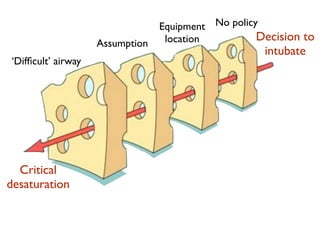
Equipment No policy
                                  location          Decision to
                    Assumption
                                                     intubate
‘Difficult’ airway


  Critical
desaturation
xygenation, extrication and transport
vailable. It is essential to prepare this

or use and this will usually include a
 le powered suction as well as a hand
MON REASON for intubation failure
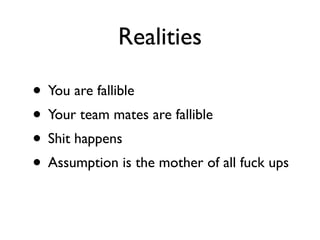
Realities

• You are fallible
• Your team mates are fallible
• Shit happens
• Assumption is the mother of all fuck ups
Scenario.....
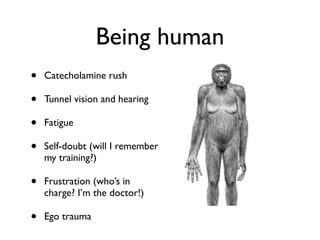
Being human
•   Catecholamine rush

•   Tunnel vision and hearing

•   Fatigue

•   Self-doubt (will I remember
    my training?)

•   Frustration (who’s in
    charge? I’m the doctor!)

•   Ego trauma
You will be challenged
       and questioned
•   A Safety Tool
•   An educational approach


•   NOT a judgement on you or your
    competence
Summary
•   Be aware of the human limitations of the team
•   Acknowledge your own psychological and
    emotional reactions
•   Ask questions
•   Speak up
•   Situational awareness: get your ‘shit’ together
•   Know HOPs
•   Communicate (two ways!)
•   Don’t take challenges personally
Messages to Take Home
•   You are human and your reactions are normal
    ➡   More of your organs will be involved in this
        kind of medicine

•   Listen to the little voice
    ➡   Do what is in the best interests of the
        patient

•   Assume nothing and communicate +++
    ➡   There is plenty of help - ask!
Crm and-communication.key

Crm and-communication.key

  • 1.
  • 2.
    Crew Resource Management & Communication ...or being human in a challenging environment
  • 3.
    Describe
a
resuscitation
scenario
you
have
witnessed
that
 left
 you
 feeling
bad
 afterwards,
 but
 not
 necessarily
 because
of
the
clinical
factors. What
 do
you
think
the
main
 differences
between
this
 job
 and
your
hospital
job
will
be? What
 are
you
most
 anxious
/
nervous
/
concerned
about
 in
starting
this
post? Have
 you
 ever
 seen
 a
 senior
 colleague
 do
 something
 wrong?
What
 did
you
 say
 or
 do?
 If
nothing,
how
did
 you
 feel?
  • 6.
    Crew resource management • Leadership • Problem solving • Situational awareness • Resource utilisation • Communication
  • 13.
    Equipment No policy location Decision to Assumption intubate ‘Difficult’ airway Critical desaturation
  • 14.
    xygenation, extrication andtransport vailable. It is essential to prepare this or use and this will usually include a le powered suction as well as a hand MON REASON for intubation failure
  • 18.
    Realities • You arefallible • Your team mates are fallible • Shit happens • Assumption is the mother of all fuck ups
  • 20.
  • 27.
    Being human • Catecholamine rush • Tunnel vision and hearing • Fatigue • Self-doubt (will I remember my training?) • Frustration (who’s in charge? I’m the doctor!) • Ego trauma
  • 28.
    You will bechallenged and questioned • A Safety Tool • An educational approach • NOT a judgement on you or your competence
  • 29.
    Summary • Be aware of the human limitations of the team • Acknowledge your own psychological and emotional reactions • Ask questions • Speak up • Situational awareness: get your ‘shit’ together • Know HOPs • Communicate (two ways!) • Don’t take challenges personally
  • 31.
    Messages to TakeHome • You are human and your reactions are normal ➡ More of your organs will be involved in this kind of medicine • Listen to the little voice ➡ Do what is in the best interests of the patient • Assume nothing and communicate +++ ➡ There is plenty of help - ask!

Editor's Notes

  • #2 To introduce CRM into your thinking, and to prepare you for some of the psychological and emotional reactions you may have during this post.\n\n \n \nBrainstorn: what do you think will be different from hospital medicine in this post?\n\n \n \n\n What do you think the main differences between this job and your hospital job will be?\n \n\n \n \n \n \n\n Describe a resuscitation scenario you have witnessed that left you feeling bad afterwards, but not because of the clinical factors.\n \n\n \n \n \n \n\n what are you most anxious / nervous / concerned about in starting this post?\n \n\n \n \n \n \n\n Have you ever done something against your better judgement and regretted it?\n \n
  • #3 \n \n
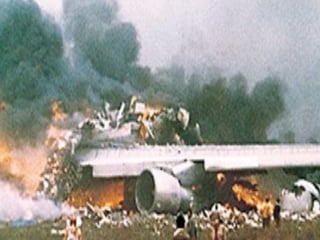
  • #4 It’s the people who understand and concentrate on these overarching prinicples who excel and become the leaders in this specialty\n\n \n \nNow a story - UA 173\n
  • #5 United Airlines Flight 173 was on final approach to Portland International Airport after an uneventful flight on December 28, 1978. The cockpit crew of three consisted of an experienced DC-8 pilot, first officer and flight engineer. Eight flight attendants and 181 passengers occupied the cabin. The pilot noticed that he had not received the usual “three down and green” indicator telling him that all landing gear was properly deployed. The nose gear light failed to illuminate green. The pilot notified the air traffic control center and requested additional flight time to resolve the situation. He went through his checklists while circling. In spite of the crew’s efforts, the nose gear landing light continued to glow “red” indicating the gear was not locked into position.\nThroughout the troubleshooting the first officer and flight engineer had informed the pilot that the plane was running low on fuel. The pilot either ignored the warnings or did not comprehend the messages. Approximately six miles southeast of the airport runway the perfectly capable, but fuel starved plane\ncrashed into a wooded residential area. Eight passengers and two crew members were killed, and 23 people were seriously injured. The lack of a post crash fire kept the death toll mercifully low. The lack of communication skills under stress, situational awareness, team building, decision making and task\nallocation sent the plane into the ground. The post crash analysis determined that the green light indicator for the nose landing gear had a burned-out bulb. The nose gear had been down and locked the entire time. Flight 173’s disaster was the catalyst for the aviation industry’s recognition that technology alone was not the cause of air mishaps. A bold, new thinking evolved. The DC-8 used by Flight 173 was a fully functional, mechanically sound airframe that crashed because the humans flying the machine became over-engrossed in a burned-out light bulb. The pilot became so absorbed in the burned-out bulb that he forgot to fly the plane.\nAs a result, a new training program was implemented that sought to capture and minimize human frailty. Cockpit Resource Management had arrived. The industry’s senior pilots initially rejected the program. The airline “chain of command” had a traditionally rigid hierarchy with an autocratic captain and subservient flight crew. The cabin crew was not even considered part of the flying team. This tradition closely mirrored the maritime industry’s concept of the captain being “master of the ship.”\n\n \n \nCRM has been standard training for all members of civilian aviation flight crews for over 20 years. Since CRM was introduced to the commercial aviation industry, air disasters have fallen from an average of 10 to 15 to two to three per year, and for several years, no commercial air disasters were experienced. Averted errors credited to CRM rank in the hundreds per year. The United States Coast Guard reports a 74 percent reduction in injuries since it began using CRM. \n
  • #6 SkillChallengeResponse\nSituational awarenessDistractionFocus, dismissal, deferral or delegation\nChanging clinical statusActive seeking of mission status, modify plan\nRandom team activityReestablish shared mission goal and task allocation\nTeam member decompensationIdentify, relieve, reassure, reallocate, physical contact\nPersonal performance limitationIdentify fatigue / stress / illness\nLeadershipTeam discoordinationBody language, verbal asserting of command\nPersonal preparationAccess state, visualise, physiology of leadership, performance curve\nEntropyPrioritise, eliminate distraction, time-limit goals\nTeam managementSupport, thank, monitor wellbeing/fatigue/distress/stress, acknowledge experience, openly value them\nCommunicationTeam leader malperformanceQuestion, support, challenge, assert\nTeam disagreementAcknowledge view, agree goal, pace/lead/presuppose, what not who. disarm, distract\nTeam confusionCommunicate clearly, verify understanding\nCrisis managementSudden unexpected patient/ eventAnalyse, prioritise, enlist aid, delegate\n\n \n \n \n
  • #7 \n \n
  • #8 \n \n
  • #9 \n \n
  • #10 \n \n
  • #11 \n \n
  • #12 \n \n
  • #13 introduce concept of redundancy\n
  • #14 \n \n
  • #15 \n \n
  • #16 Not just bad emotions - times when you’ll be exhilarated...\n
  • #17 \n \n
  • #18 Have been talking mainly about challenges of pre-hospital cases....\n\n \n
  • #19 \n \n
  • #20 \n \n
  • #21 \n \n
  • #22 \n \n
  • #23 one link in the system\n
  • #24 \n \n
  • #25 \n \n
  • #26 \n \n
  • #27 \n "Ardi," a hominid who lived 4.4 million years ago in what is now Ethiopia.\n \n\n Ardipithecus ramidus — which means root of the ground ape\n \n\n It represents a genus plausibly ancestral to Australopithecus — itself ancestral to our genus Homo\n \n\n In Ardipithecus we have an unspecialized form that hasn't evolved very far in the direction of Australopithecus. So when you go from head to toe, you're seeing a mosaic creature that is neither chimpanzee, nor is it human. It is Ardipithecus\n \n\n \n
  • #28 \n \n
  • #29 \n \n
  • #30 \n \n
  • #31 \n \n
  • #32 \n \n