1Built environment & land-use planning - End term assignment
Human Dimension & City
T H E H U M A N S C A L E
“human scale is something which takes its point of
departure in the human body and the human senses”
– Jan Gehl
by - Pratham Pincha & Jay Parikh – M.Plan – CEPT University – 2013-2015
2Built environment & land-use planning - End term assignment
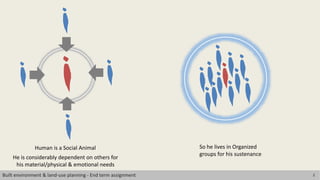
Human is a Social Animal
He is considerably dependent on others for
his material/physical & emotional needs
So he lives in Organized
groups for his sustenance
3
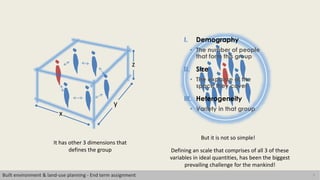
But it is not so simple!
It has other 3 dimensions that
defines the group
z
y
x
I. Demography
• The number of people
that form this group
II. Size
• The expanse of the
space they cover
III. Heterogeneity
• Variety in that group
Defining an scale that comprises of all 3 of these
variables in ideal quantities, has been the biggest
prevailing challenge for the mankind!
Built environment & land-use planning - End term assignment
4
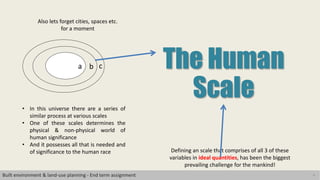
The Human
Scale
Defining an scale that comprises of all 3 of these
variables in ideal quantities, has been the biggest
prevailing challenge for the mankind!
a b c
• In this universe there are a series of
similar process at various scales
• One of these scales determines the
physical & non-physical world of
human significance
• And it possesses all that is needed and
of significance to the human race
Also lets forget cities, spaces etc.
for a moment
Built environment & land-use planning - End term assignment
5
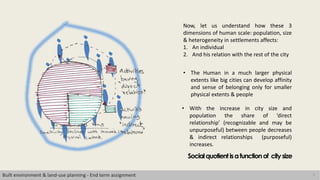
Now, let us understand how these 3
dimensions of human scale: population, size
& heterogeneity in settlements affects:
1. An individual
2. And his relation with the rest of the city
• The Human in a much larger physical
extents like big cities can develop affinity
and sense of belonging only for smaller
physical extents & people
• With the increase in city size and
population the share of ‘direct
relationship’ (recognizable and may be
unpurposeful) between people decreases
& indirect relationships (purposeful)
increases.
Socialquotientisafunctionof citysize
Built environment & land-use planning - End term assignment
6
c i t y s i z e │ p o p u l a t i o n │ h u m a n s c a l e │ s o c i a l q u o t i e n t
“Aristotle once explained that increase in
the number of people in a settlement
beyond a certain limit will affect the
interrelationship between them and the
character of the city”
Built environment & land-use planning - End term assignment
7
SO IS SIZE THE ONLY VARIABLE THAT
GOVERNS SOCIAL QUOTIENT?
The case of India…
Although “Human” being common in all
human beings, we find difference &
diversity of numerous types and at various
levels.
Some of these can be commonly identified
on the basis of gender, race, religion,
ethnicity, occupation, caste, nationality,
economic class, interests, beliefs etc.
SIZE – VARIETY – PROBLEMS
No, the other major variable of an
individual’s relation with the larger
surrounding is the degree of heterogeneity
of the place.
Almost all Indian cities fall in the
most deadly combination
Built environment & land-use planning - End term assignment
8
Efforts in the past by planners to define an appropriate limits to these
variables
Talked about decongestion of cities
Setting up of a new town after a
population is reached
kautilya/Chanakya’s Arthashastra
Built environment & land-use planning - End term assignment
9
Efforts in the past by planners to define an appropriate limits to these
variables
Limited population in each city to 32,000 &
site of 6,000 acres
He designed a module – for a certain
population
Considering efficiency in resource
consumption & in human action
Garden city – Ebenezer Howard
Built environment & land-use planning - End term assignment
10
So, historically it is realized that real world doesn’t function like mathematics
Wherein we have a formula eg. a+b=c
No matter what value between 0 to infinity is
fed, it functions in the same manner
But with the change in city size & population
behavior of the city & its people changes
considerably
Built environment & land-use planning - End term assignment
11
Amos Rapoport – author ‘house, form & culture'
Built environment & land-use planning - End term assignment
A partially dark caved
ancient market place
somewhere in Africa with slits
to admit slight light for
activities to take place
 Relating the human scale to safety issues
 Amos Rapoport takes an eg from African
Market to explain that even deficient light &
visibility in terms of modern safety norms
doesn’t affect the safety of visitors or any
kind of anti-social activities in the market.
 for a simple reason that all the people who
used the market as a seller or buyer know
each other
12
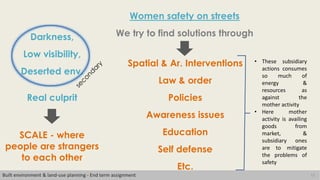
Women safety on streets
Built environment & land-use planning - End term assignment
We try to find solutions through
Spatial & Ar. Interventions
Law & order
Policies
Awareness issues
Education
Self defense
Etc.
Real culprit
Darkness,
Low visibility,
Deserted env.
SCALE - where
people are strangers
to each other
• These subsidiary
actions consumes
so much of
energy &
resources as
against the
mother activity
• Here mother
activity is availing
goods from
market, &
subsidiary ones
are to mitigate
the problems of
safety
13
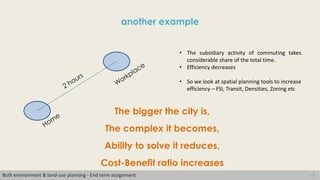
another example
Built environment & land-use planning - End term assignment
• The subsidiary activity of commuting takes
considerable share of the total time.
• Efficiency decreases
• So we look at spatial planning tools to increase
efficiency – FSI, Transit, Densities, Zoning etc
The bigger the city is,
The complex it becomes,
Ability to solve it reduces,
Cost-Benefit ratio increases
14
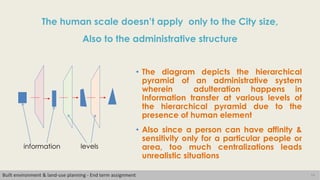
The human scale doesn’t apply only to the City size,
Also to the administrative structure
Built environment & land-use planning - End term assignment
• The diagram depicts the hierarchical
pyramid of an administrative system
wherein adulteration happens in
Information transfer at various levels of
the hierarchical pyramid due to the
presence of human element
• Also since a person can have affinity &
sensitivity only for a particular people or
area, too much centralizations leads
unrealistic situations
information levels
15
The appropriate scale
Built environment & land-use planning - End term assignment
• Even extreme decentralization does not
guarantee efficiency
• The point which falls appropriately
between the two need to be achieved
• This presentation emphasizes on the
significance of human scale
• And hence we need to move a level
above in our approach
• We need to take into consideration a
higher order dimension i.e. SCALE, to
identify that Human Scale
16
Thank you

Human dimension & cities - The Human Scale

  • 1.
    1Built environment &land-use planning - End term assignment Human Dimension & City T H E H U M A N S C A L E “human scale is something which takes its point of departure in the human body and the human senses” – Jan Gehl by - Pratham Pincha & Jay Parikh – M.Plan – CEPT University – 2013-2015
  • 2.
    2Built environment &land-use planning - End term assignment Human is a Social Animal He is considerably dependent on others for his material/physical & emotional needs So he lives in Organized groups for his sustenance
  • 3.
    3 But it isnot so simple! It has other 3 dimensions that defines the group z y x I. Demography • The number of people that form this group II. Size • The expanse of the space they cover III. Heterogeneity • Variety in that group Defining an scale that comprises of all 3 of these variables in ideal quantities, has been the biggest prevailing challenge for the mankind! Built environment & land-use planning - End term assignment
  • 4.
    4 The Human Scale Defining anscale that comprises of all 3 of these variables in ideal quantities, has been the biggest prevailing challenge for the mankind! a b c • In this universe there are a series of similar process at various scales • One of these scales determines the physical & non-physical world of human significance • And it possesses all that is needed and of significance to the human race Also lets forget cities, spaces etc. for a moment Built environment & land-use planning - End term assignment
  • 5.
    5 Now, let usunderstand how these 3 dimensions of human scale: population, size & heterogeneity in settlements affects: 1. An individual 2. And his relation with the rest of the city • The Human in a much larger physical extents like big cities can develop affinity and sense of belonging only for smaller physical extents & people • With the increase in city size and population the share of ‘direct relationship’ (recognizable and may be unpurposeful) between people decreases & indirect relationships (purposeful) increases. Socialquotientisafunctionof citysize Built environment & land-use planning - End term assignment
  • 6.
    6 c i ty s i z e │ p o p u l a t i o n │ h u m a n s c a l e │ s o c i a l q u o t i e n t “Aristotle once explained that increase in the number of people in a settlement beyond a certain limit will affect the interrelationship between them and the character of the city” Built environment & land-use planning - End term assignment
  • 7.
    7 SO IS SIZETHE ONLY VARIABLE THAT GOVERNS SOCIAL QUOTIENT? The case of India… Although “Human” being common in all human beings, we find difference & diversity of numerous types and at various levels. Some of these can be commonly identified on the basis of gender, race, religion, ethnicity, occupation, caste, nationality, economic class, interests, beliefs etc. SIZE – VARIETY – PROBLEMS No, the other major variable of an individual’s relation with the larger surrounding is the degree of heterogeneity of the place. Almost all Indian cities fall in the most deadly combination Built environment & land-use planning - End term assignment
  • 8.
    8 Efforts in thepast by planners to define an appropriate limits to these variables Talked about decongestion of cities Setting up of a new town after a population is reached kautilya/Chanakya’s Arthashastra Built environment & land-use planning - End term assignment
  • 9.
    9 Efforts in thepast by planners to define an appropriate limits to these variables Limited population in each city to 32,000 & site of 6,000 acres He designed a module – for a certain population Considering efficiency in resource consumption & in human action Garden city – Ebenezer Howard Built environment & land-use planning - End term assignment
  • 10.
    10 So, historically itis realized that real world doesn’t function like mathematics Wherein we have a formula eg. a+b=c No matter what value between 0 to infinity is fed, it functions in the same manner But with the change in city size & population behavior of the city & its people changes considerably Built environment & land-use planning - End term assignment
  • 11.
    11 Amos Rapoport –author ‘house, form & culture' Built environment & land-use planning - End term assignment A partially dark caved ancient market place somewhere in Africa with slits to admit slight light for activities to take place  Relating the human scale to safety issues  Amos Rapoport takes an eg from African Market to explain that even deficient light & visibility in terms of modern safety norms doesn’t affect the safety of visitors or any kind of anti-social activities in the market.  for a simple reason that all the people who used the market as a seller or buyer know each other
  • 12.
    12 Women safety onstreets Built environment & land-use planning - End term assignment We try to find solutions through Spatial & Ar. Interventions Law & order Policies Awareness issues Education Self defense Etc. Real culprit Darkness, Low visibility, Deserted env. SCALE - where people are strangers to each other • These subsidiary actions consumes so much of energy & resources as against the mother activity • Here mother activity is availing goods from market, & subsidiary ones are to mitigate the problems of safety
  • 13.
    13 another example Built environment& land-use planning - End term assignment • The subsidiary activity of commuting takes considerable share of the total time. • Efficiency decreases • So we look at spatial planning tools to increase efficiency – FSI, Transit, Densities, Zoning etc The bigger the city is, The complex it becomes, Ability to solve it reduces, Cost-Benefit ratio increases
  • 14.
    14 The human scaledoesn’t apply only to the City size, Also to the administrative structure Built environment & land-use planning - End term assignment • The diagram depicts the hierarchical pyramid of an administrative system wherein adulteration happens in Information transfer at various levels of the hierarchical pyramid due to the presence of human element • Also since a person can have affinity & sensitivity only for a particular people or area, too much centralizations leads unrealistic situations information levels
  • 15.
    15 The appropriate scale Builtenvironment & land-use planning - End term assignment • Even extreme decentralization does not guarantee efficiency • The point which falls appropriately between the two need to be achieved • This presentation emphasizes on the significance of human scale • And hence we need to move a level above in our approach • We need to take into consideration a higher order dimension i.e. SCALE, to identify that Human Scale
  • 16.