ADDIS ABABA SCIENCEAND TECHNOLOGY
UNIVERSITY
Introduction to Urban Planning (Arch 4133)
Lecture-1 Introduction
Department of Architecture
2.
Key Words?
• UrbanArea, City, Town
• Urbanization
• Urban Planning
• Urban Design
3.
What is Plan?
•An act of formulating a program for a definite course of action
• The act or process of drawing up plans or layouts for some project or
enterprise
• The cognitive process of thinking about what you will do in the event of
something happening
A plan must have three characteristics, namely
1.Futurity,
2.Action and
3.Personal or organizational responsibilities for its implementation are necessary
elements of every plan.
4.
Planning Perspectives
• Intime horizon
Short-, medium- and long-term planning
• In spatial terms:
National, Regional, Metropolitan, city/town, neighborhood planning… in
relation with different variables
Planner
Somebody who plans something, especially the development of an
area. peter hall, 2002.
5.
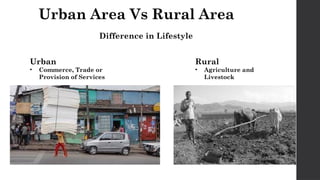
Urban Area VsRural Area
Difference in Lifestyle
Urban
• Commerce, Trade or
Provision of Services
Rural
• Agriculture and
Livestock
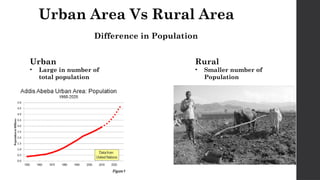
6.
Urban Area VsRural Area
Difference in Population
Urban
• Large in number of
total population
Rural
• Smaller number of
Population
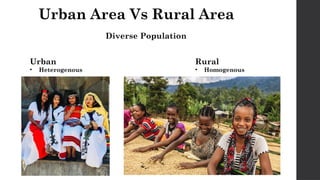
7.
Urban Area VsRural Area
Diverse Population
Urban
• Heterogenous
Rural
• Homogenous
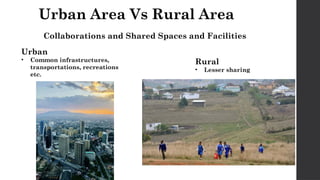
8.
Urban Area VsRural Area
Collaborations and Shared Spaces and Facilities
Urban
• Common infrastructures,
transportations, recreations
etc.
Rural
• Lesser sharing
9.
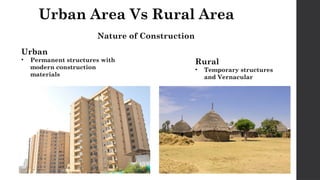
Urban Area VsRural Area
Nature of Construction
Urban
• Permanent structures with
modern construction
materials
Rural
• Temporary structures
and Vernacular
10.
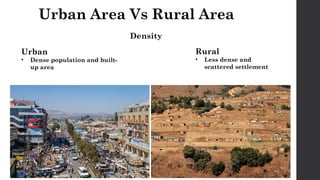
Urban Area VsRural Area
Density
Urban
• Dense population and built-
up area
Rural
• Less dense and
scattered settlement
11.
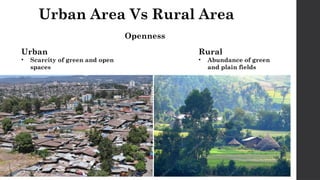
Urban Area VsRural Area
Openness
Urban
• Scarcity of green and open
spaces
Rural
• Abundance of green
and plain fields
12.
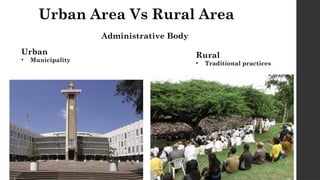
Urban Area VsRural Area
Administrative Body
Urban
• Municipality
Rural
• Traditional practices
13.
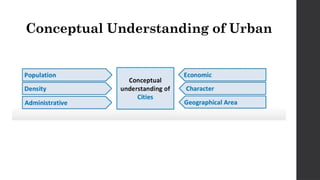
Conceptual Understanding ofUrban
Can be described referring a social, economic, political and physical
terms..
Social: surpassing a certain population threshold.
• 2000 - 2500 people.
• Other criteria is based on compactness and density
Economic: engaged in non-agricultural activities
• Relies on service sector
Political/Administrative: Administrative boundary
• local government areas, municipalities and other political
agglomeration
14.
Conceptual Understanding ofUrban
Spatial/Physical: Availability of service and amenities
• piped water supply, electric lighting, sewer lines, local transport
system, hospital, police station, court of low…
Urban areas are created through a process called Urbanization and
are categorized by their population and morphology (built form) as
Towns, Cities and Suburbs
Other categories of Urban areas includes a metropolitan area and
region:-that constitutes densely populated urban agglomeration and its
surrounding territories including satellite cities, towns and intervening
rural areas that are socioeconomically tied to the principal cites or
urban core.
15.
Conceptual Understanding ofUrban
Cities are the basic element of an urban area and can be defined as:
• a permanent and densely settled place with administratively
defined boundaries whose members work primarily on non-
agricultural tasks.
• Opportunity for a diversified living environment and diverse
lifestyle (Gallion and Eisner,2003)
• It’s a geographic lexus, an economic organization, an institutional
process, theatre of social actions, and an aesthetic symbol of
collective unity (Mumford,1937)
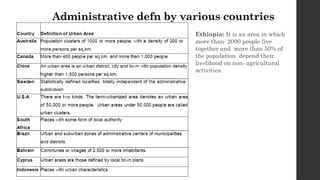
Administrative defn byvarious countries
Different countries use administrative designation or
population size and density to characterize cities
Most commonly population size and density is used to characterize
cities,
• In France: an area containing an agglomeration of more than 2000
inhabitants not more than 200 meters between houses.
• Australia: Population clusters of 1000 or more people, with a
density of 200 or more persons per sq.km.
18.
Administrative defn byvarious countries
Ethiopia: It is an area in which
more than 2000 people live
together and more than 50% of
the population depend their
livelihood on non- agricultural
activities.
19.
What is UrbanPlanning?
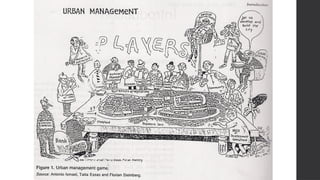
There are several definitions for urban planning, in general terms UP
can be defined as:-
• Process by which resources are distributed, Eversley, David. The
Planner in Society, Faber & Faber, London, 1973
• These definitions elevate planning to the political arena, that is,
deciding who gets what, where and when.
• Technical definitions of planning restrict the subject to the
organization of land uses, transportation and infrastructural
networks both for efficient functioning and the creation of a pleasant
and well-ordered environment.
20.
Technical Definition Cont..
•The science of managing and directing city growth.
• The discipline of distributing urban or suburban functions spatially,
in terms of activity patterns of people in the physical setting.
• The branch of architecture dealing with the design and organization
of urban space and activities
• City planning: determining and drawing up plans for the future
physical arrangement and condition of a community
• Urban, city, or town planning is the discipline of land use planning
which explores a very wide range of aspects of the built and social
environments of urbanized municipalities and communities.
21.
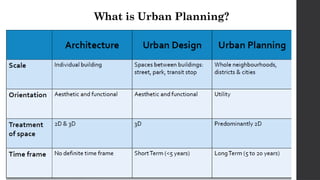
What is UrbanPlanning?
• Allocation of resources
• Formulation of policies, programs and projects to address public
concern and interest
• Not a goal by itself but a tool for development
• Planning is a political process
Why Urban Planning?
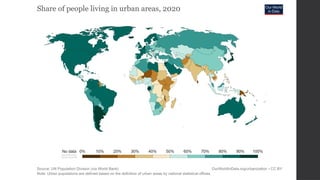
•The world is becoming increasingly urbanized
• Today, more than half of the global population lives in urban areas
(55%)
• it is expected to increase to 68% by 2050 add another 2.5 billion people
to urban areas by 2050, close to 7 billion people.
• with close to 90% of this increase-taking place in Asia and Africa (UN,
2018).
What is Urbanization?
•refers to the population shift from rural areas to urban areas or is
process by which population becomes concentrated in cities or
urban areas.
• Urbanization is about the relative proportion of people residing in
urban areas in a given area (such as a region, country or
continent).
• Whereas urban growth reflects a general increase in either the
land area or the population size of an urban area.
• Urbanization Can take place in either of two ways
an increase in the proportion of urban areas
Through an increase in proportion of population residing in urban
areas.
27.
What is Urbanization?
•Increase in population takes place either
Natural growth
Migration from rural to urban areas
• The degree or level of urbanization (U) is normally measured by the
index that is some kind of ratio between the urban population (PU)
and the total population (pt).
• U = Pu* 100/Pt
Rate of urbanization - the rate at which it grows
Urban sprawl: uncontrolled growth of urban areas
Urban expansion: the physical growth of urban areas
28.
Problem of Urbanization
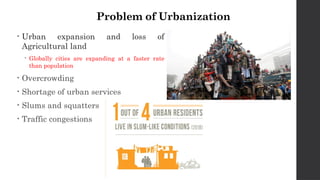
•Urban expansion and loss of
Agricultural land
Globally cities are expanding at a faster rate
than population
• Overcrowding
• Shortage of urban services
• Slums and squatters
• Traffic congestions
29.
Problem of Urbanization
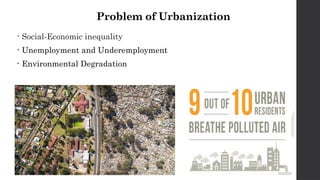
•Social-Economic inequality
• Unemployment and Underemployment
• Environmental Degradation
30.
Problem of Urbanization
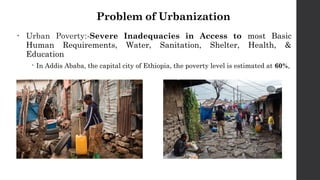
•Urban Poverty:-Severe Inadequacies in Access to most Basic
Human Requirements, Water, Sanitation, Shelter, Health, &
Education
In Addis Ababa, the capital city of Ethiopia, the poverty level is estimated at 60%,
31.
The need forUrban Planning
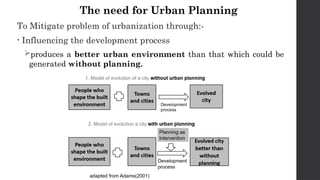
To Mitigate problem of urbanization through:-
• Influencing the development process
produces a better urban environment than that which could be
generated without planning.
32.
The need forUrban Planning
• Efficient use of scarce resource (urban land) to balance the
claim of one interest group against another by urban
planning
This avoids economic, social, environmental and physical
chaos.
• Promote health, safety and welfare (Quality of Life)
Limit overcrowding
Sets level for adequacy and capacity of utilities
construction regulations
Rules for environmental degradation
33.
The need forUrban Planning
• Equitable distribution of resources
Avoids privilege and exclusion between the society /regardless
of race, age, gender, social status/ regarding access to urban
resources specially land /spatial inequalities
• Establish regulations and controls to adapt to urban
development and its consequences
Managing urban sprawl, protecting the environment
34.
The need forUrban Planning
• Risk Management
Predict disaster (Pandemic, global warming, natural and man-
made disasters)
• Guidance
Direct the development and growth of urban centers in
efficient way
35.
Quotes about UrbanPlanning
• “First we shape the cities – then they shape us.” “The city
throughout the history of mankind has been the meeting
place for people. Jan Gehl
• “Dull, inert cities, it is true, do contain the seeds of their own
destruction and little else. But lively, diverse, intense cities
contain the seeds of their own regeneration, with energy
enough to carry over for problems and needs outside
themselves.” – Jane Jacobs
36.
Quotes about UrbanPlanning
• ‘a key role of the planning system is to enable the provision of
homes and buildings, investment and jobs in such a way which
is consistent with the principles of sustainable
development. It needs to be positive in promoting
competitiveness while being protective towards the environment and
amenity.’
(DTLR quoted in Syms Paul,2007)
37.
Assignment for nextweek!
Select a any neighborhood, suburbs, town or city and describe the
main urban problems and discuss how to remedy the existing
problems.




![[LECTURE 1] introduction to design and planning](https://cdn.slidesharecdn.com/ss_thumbnails/lecture1introduction-250325070206-d2d6d69b-thumbnail.jpg?width=640&height=640&fit=bounds)


![Urban planning and development:in the context of nepal [compatibility mode]](https://cdn.slidesharecdn.com/ss_thumbnails/urbanplanninganddevelopment-inthecontextofnepalcompatibilitymode-141227074431-conversion-gate01-thumbnail.jpg?width=640&height=640&fit=bounds)


