Revisiting the Optimal City Size argument
Dissertation 2015
03-02-2015 1
Pratham Pincha, PP0007013 │ Masters in Planning │ Dissertation 2015 │ FP, CEPT University, Ahmedabad
Guided by – Prof. Shivanand Swamy
He is considerably dependent on others for
his material/physical & emotional needs
So he lives in Organized
groups for his sustenance
Human is a Social Animal
03-02-2015 2
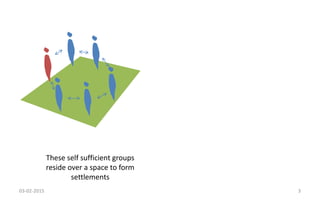
These self sufficient groups
reside over a space to form
settlements
03-02-2015 3
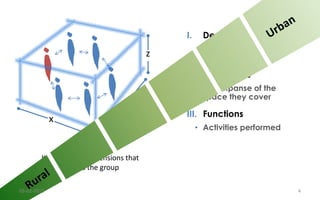
It has other 3 dimensions that
defines the group
z
y
x
I. Demography
• The number of people
that form this group
II. Spatial Size
• The expanse of the
space they cover
III. Functions
• Activities performed
03-02-2015 4
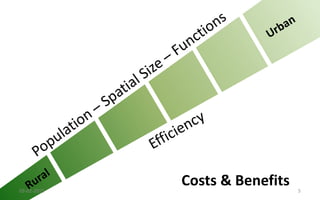
Costs & Benefits03-02-2015 5
To name a few:
Chanakya Plato Aristotle
Ebenezer
Howard
74th CAA Capello
Alonso
Geoffrey
West
Henderson
Aristotle
74th CAA
03-02-2015 6
Chanakya Plato Aristotle
Ebenezer
Howard
74th CAA Capello
Alonso
Geoffrey
West
Henderson
Chanakya
On his ideas of town & country
planning – decongestion of
towns & setting up of new
towns
03-02-2015 7Source - Town and Country planning in Arthashastra composed by Chanakya in the Maurya period
Chanakya Plato Aristotle
Ebenezer
Howard
74th CAA Capello
Alonso
Geoffrey
West
Henderson
Plato
In his book The Republic wanted
his republic to be small
Need of expansion – desire of
wealth & luxury – evil
Ideal state population = 5040
03-02-2015 8Source - Plato in The Republic, In book 2, just before he talks about the characteristics of guardians
Chanakya Plato Aristotle
Ebenezer
Howard
74th CAA Capello
Alonso
Geoffrey
West
Henderson
Aristotle
In his book Politics – had a
moderate stand
03-02-2015 9Source - Aristotle, in book 7, chapter 4 Politics
Chanakya Plato Aristotle
Ebenezer
Howard
74th CAA Capello
Alonso
Geoffrey
West
Henderson
Aristotle
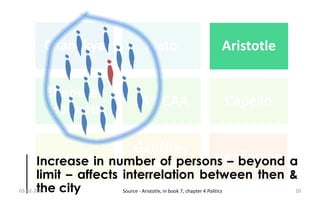
Increase in number of persons – beyond a
limit – affects interrelation between then &
the city03-02-2015 10Source - Aristotle, in book 7, chapter 4 Politics
Chanakya Plato Aristotle
Ebenezer
Howard
74th CAA Capello
Alonso
Geoffrey
West
Henderson
Aristotle
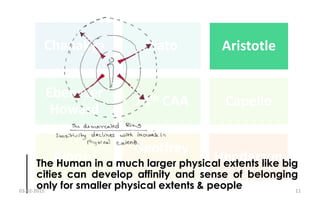
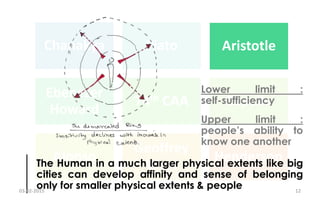
The Human in a much larger physical extents like big
cities can develop affinity and sense of belonging
only for smaller physical extents & people03-02-2015 11
Chanakya Plato Aristotle
Ebenezer
Howard
74th CAA Capello
Alonso
Geoffrey
West
Henderson
Aristotle
The Human in a much larger physical extents like big
cities can develop affinity and sense of belonging
only for smaller physical extents & people
Lower limit :
self-sufficiency
Upper limit :
people’s ability to
know one another
03-02-2015 12
Chanakya Plato Aristotle
Ebenezer
Howard
74th CAA Capello
Alonso
Geoffrey
West
Henderson
Aristotle
To know the officials without personally
knowing them is ‘haphazard’
“….the largest number which suffices
for the purposes of life, and can be
taken in at a single view”
03-02-2015 13Source - Aristotle, in book 7, chapter 4 Politics
Chanakya Plato Aristotle
Ebenezer
Howard
74th CAA Capello
Alonso
Geoffrey
West
Henderson
Ebenezer
Howard
Limits population in each garden city to
32,000.
Though no empirical evidence was given
Modern Planning example of the Garden
city concept
03-02-2015 14
Chanakya Plato Aristotle
Ebenezer
Howard
74th CAA Capello
Alonso
Geoffrey
West
Henderson
74th CAA
For Efficient Governance
Better Voice to citizens
Accountability of authority directly to citizens
Realizes the need for smaller decentralized units
called Area Sabha – legitimate units
Footprint of a polling station
03-02-2015 15Source - Ramanathan Ramesh, Federalism, Urban Decentralisation and Citizen Participation, 2007,
Economic & Political weekly
Chanakya Plato Aristotle
Ebenezer
Howard
74th CAA Capello
Alonso
Geoffrey
West
Henderson
Capello
Alonso
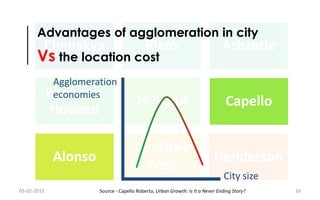
Advantages of agglomeration in city
Vs the location cost
City size
Agglomeration
economies
03-02-2015 16Source - Capello Roberta, Urban Growth: Is It a Never Ending Story?
Chanakya Plato Aristotle
Ebenezer
Howard
74th CAA Capello
Alonso
Geoffrey
West
Henderson
Geoffrey
West
In his work – Growth, innovation, scaling &
pace of life in cities
Interestingly metamorphosed cities with
living organisms over the concept of
Economies of scale , Pace of life &
Productivity
03-02-2015 17Source - West Geoffrey, Growth, innovation, scaling, and the pace of life in cities, PNAS, (2007)
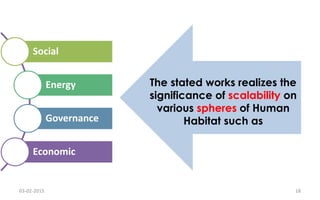
The stated works realizes the
significance of scalability on
various spheres of Human
Habitat such as
Social
Energy
Governance
Economic
03-02-2015 18
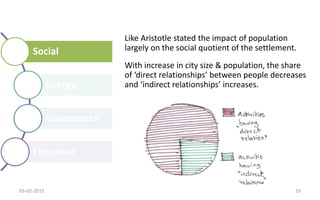
Like Aristotle stated the impact of population
largely on the social quotient of the settlement.
With increase in city size & population, the share
of ‘direct relationships’ between people decreases
and ‘indirect relationships’ increases.
Social
Energy
Governance
Economic
03-02-2015 19
Social
Energy
Governance
Economic
 Is social quotient a function of City size?
 What does the human mental & physical limits
renders to the scalability issues of the city?
 How city size can be viewed as a solution to
social problems of safety over other solution of
architecture, planning and law & order?
03-02-2015 20
Social
Energy
Governance
Economic
Increase in city size leads to centralization
centralization leads to complexities
And complexities leads to inefficiencies
How?
03-02-2015 21
Social
Energy
Governance
Economic
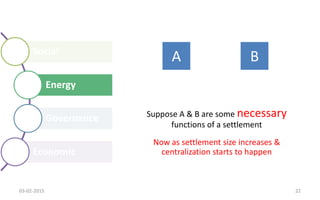
Suppose A & B are some necessary
functions of a settlement
Now as settlement size increases &
centralization starts to happen
A B
03-02-2015 22
Social
Energy
Governance
Economic
A B
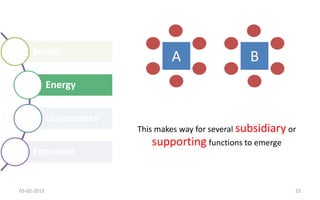
This makes way for several subsidiary or
supporting functions to emerge
03-02-2015 23
Social
Energy
Governance
Economic
A B
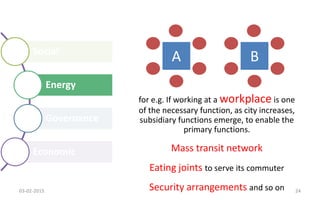
for e.g. If working at a workplace is one
of the necessary function, as city increases,
subsidiary functions emerge, to enable the
primary functions.
Mass transit network
Eating joints to serve its commuter
Security arrangements and so on03-02-2015 24
Social
Energy
Governance
Economic
• So with the increase in the settlement size
does the complexity increases and the
problems too?
• If yes, what is the cost that we bear for
mitigating those additional problems?
03-02-2015 25
Social
Energy
Governance
Economic
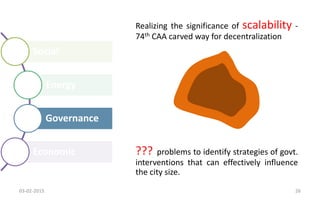
Realizing the significance of scalability -
74th CAA carved way for decentralization
??? problems to identify strategies of govt.
interventions that can effectively influence
the city size.
03-02-2015 26
Social
Energy
Governance
Economic
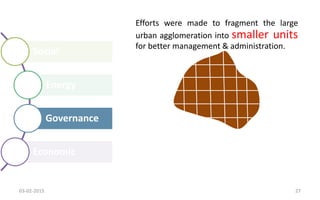
Efforts were made to fragment the large
urban agglomeration into smaller units
for better management & administration.
03-02-2015 27
Social
Energy
Governance
Economic
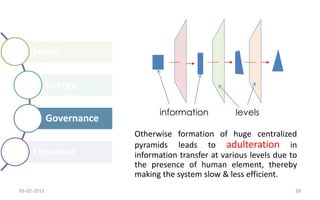
information levels
Otherwise formation of huge centralized
pyramids leads to adulteration in
information transfer at various levels due to
the presence of human element, thereby
making the system slow & less efficient.
03-02-2015 28
Social
Energy
Governance
Economic
Also since the civil officials can have
affinity & sensitivity only for a particular
number of people and area, centralization
beyond a limit leads to unrealistic
solutions.
03-02-2015 29
Social
Energy
Governance
Economic
• The questions that arise from this are what
are those appropriate levels of
decentralization for most efficient governance
practices?
• Does it provide much louder voice to the
citizens of the city to participate in the issues
of governance?
• And catalyse their participation in the
development of society?
03-02-2015 30
Social
Energy
Governance
Economic
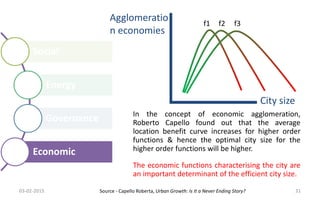
In the concept of economic agglomeration,
Roberto Capello found out that the average
location benefit curve increases for higher order
functions & hence the optimal city size for the
higher order functions will be higher.
The economic functions characterising the city are
an important determinant of the efficient city size.
City size
Agglomeratio
n economies
f1 f2 f3
03-02-2015 31Source - Capello Roberta, Urban Growth: Is It a Never Ending Story?
Social
Energy
Governance
Economic
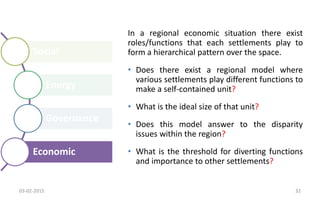
In a regional economic situation there exist
roles/functions that each settlements play to
form a hierarchical pattern over the space.
• Does there exist a regional model where
various settlements play different functions to
make a self-contained unit?
• What is the ideal size of that unit?
• Does this model answer to the disparity
issues within the region?
• What is the threshold for diverting functions
and importance to other settlements?
03-02-2015 32
Research proposal
Aim:
To explore the concept of scalability alongside the well established Optimal
City Size argument for accessing its significance on the social, Economic,
Environment & Institutional Quotient of Human Habitats.
Objectives:
1. To devise a framework for accessing cost & benefit of complexities
arising out of Urban Growth.
2. To derive the significance of physical & mental limits of human on
scalability of human habitats.
3. To formulate a framework to access the social cost due to increasing
settlement size.
4. To explore Scalability as a concept to answer the problems of intra-
regional disparities.
03-02-2015 33
Literature Review
03-02-2015 34
Alonso posed the questions
‘how big is big enough?’ and
‘how big is too big?’
The main question was to identify whether increasing
returns to urban size exist?
The argument of Optimal City Size Theory
03-02-2015 35
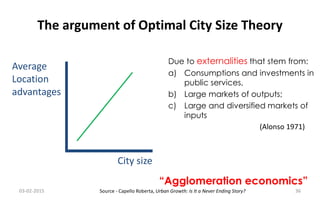
The argument of Optimal City Size Theory
City size
Average
Location
advantages
Due to externalities that stem from:
a) Consumptions and investments in
public services,
b) Large markets of outputs;
c) Large and diversified markets of
inputs
(Alonso 1971)
“Agglomeration economics”
03-02-2015 36Source - Capello Roberta, Urban Growth: Is It a Never Ending Story?
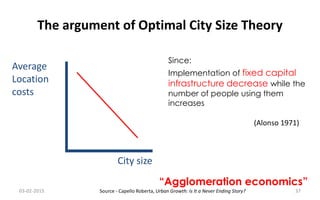
The argument of Optimal City Size Theory
City size
Average
Location
costs
Since:
Implementation of fixed capital
infrastructure decrease while the
number of people using them
increases
“Agglomeration economics”
03-02-2015 37
(Alonso 1971)
Source - Capello Roberta, Urban Growth: Is It a Never Ending Story?
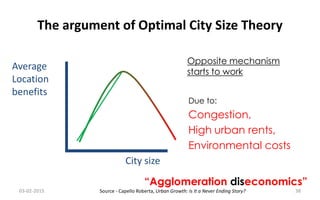
The argument of Optimal City Size Theory
City size
Average
Location
benefits
Due to:
Congestion,
High urban rents,
Environmental costs
“Agglomeration diseconomics”
Opposite mechanism
starts to work
03-02-2015 38Source - Capello Roberta, Urban Growth: Is It a Never Ending Story?
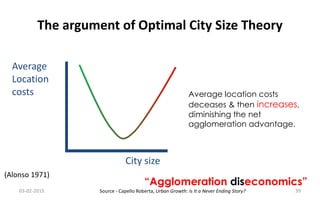
The argument of Optimal City Size Theory
City size
Average
Location
costs Average location costs
deceases & then increases,
diminishing the net
agglomeration advantage.
(Alonso 1971)
“Agglomeration diseconomics”
03-02-2015 39Source - Capello Roberta, Urban Growth: Is It a Never Ending Story?
“The size of the city for which the difference between
location total costs and advantages is the size that
maximizes the net benefits, and for this reason it is
identified as the ‘optimal city size’”
The argument of Optimal City Size Theory
(Capello 2011)
03-02-2015 40Source - Capello Roberta, Urban Growth: Is It a Never Ending Story?
Capello explores the relationship between
Size of the city & its Functions
By SOUDY (supply oriented dynamic approach) model
- Camagni et al. 1986
The argument against Optimal City Size Theory
Although large number of empirical evidences, there are many
criticisms of the neo classical approach to the optimal city size theory.
03-02-2015 41Source - Capello Roberta, Urban Growth: Is It a Never Ending Story?
The argument against Optimal City Size Theory
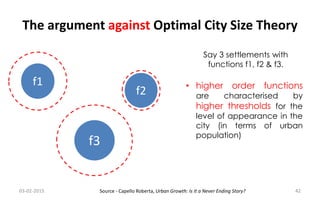
f1
f2
f3
Say 3 settlements with
functions f1, f2 & f3.
• higher order functions
are characterised by
higher thresholds for the
level of appearance in the
city (in terms of urban
population)
03-02-2015 42Source - Capello Roberta, Urban Growth: Is It a Never Ending Story?
The argument against Optimal City Size Theory
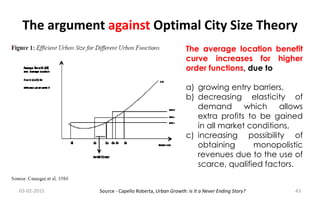
The average location benefit
curve increases for higher
order functions, due to
a) growing entry barriers,
b) decreasing elasticity of
demand which allows
extra profits to be gained
in all market conditions,
c) increasing possibility of
obtaining monopolistic
revenues due to the use of
scarce, qualified factors.
03-02-2015 43Source - Capello Roberta, Urban Growth: Is It a Never Ending Story?
The argument against Optimal City Size Theory
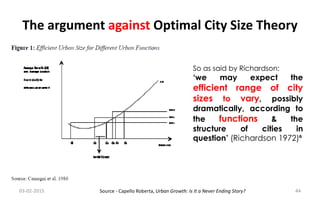
So as said by Richardson:
‘we may expect the
efficient range of city
sizes to vary, possibly
dramatically, according to
the functions & the
structure of cities in
question’ (Richardson 1972)⁶
03-02-2015 44Source - Capello Roberta, Urban Growth: Is It a Never Ending Story?
The argument against Optimum City Size Theory
Other limitations of optimal city size theory include:
• Cities exist in interurban environment. The theory of optimal city size
does not consider the spatial context in which the
cities operate.
• In 1967, Chinitz expressed some doubts over the fact that urban
productivity is mainly dependent on the city size. He found out the
importance of diversified and competitive urban
production system on the urban productivity.
“In the time when the urbanization has been drastically affected by
urban growth, it has become a necessity to overcome the limits of
optimal size theory.”
-Capello 2011
03-02-2015 45Source - Capello Roberta, Urban Growth: Is It a Never Ending Story?
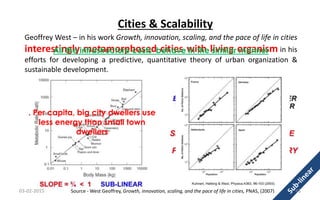
Geoffrey West – in his work Growth, innovation, scaling, and the pace of life in cities
interestingly metamorphosed cities with living organism in his
efforts for developing a predictive, quantitative theory of urban organization &
sustainable development.
. Per capita, big city dwellers use
less energy than small town
dwellers
All the infrastructure costs behave in the similar manner
03-02-2015 46Source - West Geoffrey, Growth, innovation, scaling, and the pace of life in cities, PNAS, (2007)
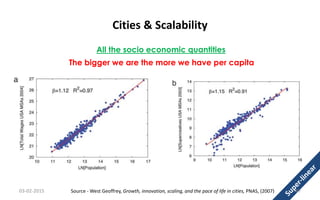
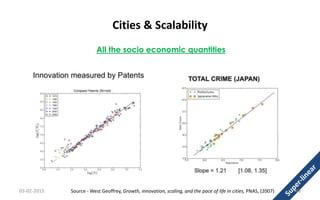
Cities & Scalability
All the socio economic quantities
The bigger we are the more we have per capita
03-02-2015 47Source - West Geoffrey, Growth, innovation, scaling, and the pace of life in cities, PNAS, (2007)
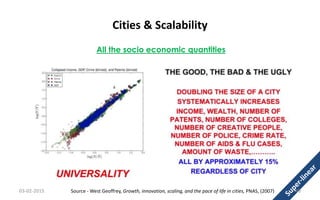
Cities & Scalability
All the socio economic quantities
03-02-2015 48Source - West Geoffrey, Growth, innovation, scaling, and the pace of life in cities, PNAS, (2007)
Cities & Scalability
All the socio economic quantities
03-02-2015 49Source - West Geoffrey, Growth, innovation, scaling, and the pace of life in cities, PNAS, (2007)
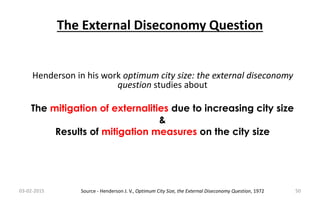
The External Diseconomy Question
03-02-2015 50
Henderson in his work optimum city size: the external diseconomy
question studies about
The mitigation of externalities due to increasing city size
&
Results of mitigation measures on the city size
Source - Henderson J. V., Optimum City Size, the External Diseconomy Question, 1972
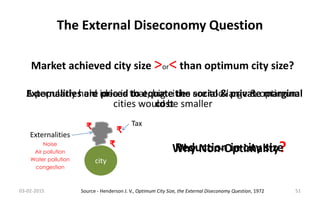
The External Diseconomy Question
03-02-2015 51
Market achieved city size >or< than optimum city size?
Source - Henderson J. V., Optimum City Size, the External Diseconomy Question, 1972
A popularly held idea is that, big cities are too large & optimum
cities would be smaller
city
Why Non-Optimality?
Externalities
Noise
Air pollution
Water pollution
congestion
₹
₹
₹ Tax
Reduction in city size
Externalities are priced to equate the social & private marginal
cost
The External Diseconomy Question
03-02-2015 52
The study shows that reduction in pollution due to
taxation & shift towards consumption of non-polluting
goods will make city inhabitants better off.
This increased welfare of city inhabitants will result
in immigration to the city
Source - Henderson J. V., Optimum City Size, the External Diseconomy Question, 1972
Questions about the significance of Scalability & City sizes have come time
and again, since ancient to modern times.
Though changing ideologies with change in time, people & place have
mended the direction of research in various spheres of Human Habitats.
With the limited knowledge I’ve gained in this subject through
observations, realizations, and readings it is almost my conviction that the
implication of Human scale (scalability) in settlements is to a considerable
extent . And due to limitations of information & understanding, significance
of settlement size on the social quotient is less explored.
So I’d like to explore and contribute with a few more variables of social well
being adhering to the subject.
Way forward…
03-02-2015 53
References
• ¹Town and Country planning in Arthashastra composed by Chanakya in the Maurya period
• ²Plato in The Republic, In book 2, just before he talks about the characteristics of guardians
• ³Aristotle, in book 7, chapter 4 Politics
• ⁴Ramanathan Ramesh, Federalism, Urban Decentralisation and Citizen Participation, 2007,
Economic & Political weekly
•
• ⁵From Wikipedia, the free encyclopaedia
• ⁶Capello Roberta, Urban Growth: Is It a Never Ending Story?, Symphonya. Emerging Issues in
Management (www.unimib.it/symphonya), n. 1, 2011, pp. 19-28
• ⁷West Geoffrey, Growth, innovation, scaling, and the pace of life in cities, PNAS, (2007), vol. 104,
no. 17, 7301-7306, www.pnas.org_cgi_doi_10.1073_pnas.0610172104
• ⁸Bharthi Ravinthra, Optimal City Size, an enquiry in the cities of Tamil Nadu, theses, 1981, School of
Planning, CEPT University, Ahmedabad
• ⁹Henderson J. V., Optimum City Size, the External Diseconomy Question, 1972, Queen’s University,
Discussion paper no. 91
03-02-2015 54

Revisiting the Optimal City Size argument

  • 1.
    Revisiting the OptimalCity Size argument Dissertation 2015 03-02-2015 1 Pratham Pincha, PP0007013 │ Masters in Planning │ Dissertation 2015 │ FP, CEPT University, Ahmedabad Guided by – Prof. Shivanand Swamy
  • 2.
    He is considerablydependent on others for his material/physical & emotional needs So he lives in Organized groups for his sustenance Human is a Social Animal 03-02-2015 2
  • 3.
    These self sufficientgroups reside over a space to form settlements 03-02-2015 3
  • 4.
    It has other3 dimensions that defines the group z y x I. Demography • The number of people that form this group II. Spatial Size • The expanse of the space they cover III. Functions • Activities performed 03-02-2015 4
  • 5.
  • 6.
    To name afew: Chanakya Plato Aristotle Ebenezer Howard 74th CAA Capello Alonso Geoffrey West Henderson Aristotle 74th CAA 03-02-2015 6
  • 7.
    Chanakya Plato Aristotle Ebenezer Howard 74thCAA Capello Alonso Geoffrey West Henderson Chanakya On his ideas of town & country planning – decongestion of towns & setting up of new towns 03-02-2015 7Source - Town and Country planning in Arthashastra composed by Chanakya in the Maurya period
  • 8.
    Chanakya Plato Aristotle Ebenezer Howard 74thCAA Capello Alonso Geoffrey West Henderson Plato In his book The Republic wanted his republic to be small Need of expansion – desire of wealth & luxury – evil Ideal state population = 5040 03-02-2015 8Source - Plato in The Republic, In book 2, just before he talks about the characteristics of guardians
  • 9.
    Chanakya Plato Aristotle Ebenezer Howard 74thCAA Capello Alonso Geoffrey West Henderson Aristotle In his book Politics – had a moderate stand 03-02-2015 9Source - Aristotle, in book 7, chapter 4 Politics
  • 10.
    Chanakya Plato Aristotle Ebenezer Howard 74thCAA Capello Alonso Geoffrey West Henderson Aristotle Increase in number of persons – beyond a limit – affects interrelation between then & the city03-02-2015 10Source - Aristotle, in book 7, chapter 4 Politics
  • 11.
    Chanakya Plato Aristotle Ebenezer Howard 74thCAA Capello Alonso Geoffrey West Henderson Aristotle The Human in a much larger physical extents like big cities can develop affinity and sense of belonging only for smaller physical extents & people03-02-2015 11
  • 12.
    Chanakya Plato Aristotle Ebenezer Howard 74thCAA Capello Alonso Geoffrey West Henderson Aristotle The Human in a much larger physical extents like big cities can develop affinity and sense of belonging only for smaller physical extents & people Lower limit : self-sufficiency Upper limit : people’s ability to know one another 03-02-2015 12
  • 13.
    Chanakya Plato Aristotle Ebenezer Howard 74thCAA Capello Alonso Geoffrey West Henderson Aristotle To know the officials without personally knowing them is ‘haphazard’ “….the largest number which suffices for the purposes of life, and can be taken in at a single view” 03-02-2015 13Source - Aristotle, in book 7, chapter 4 Politics
  • 14.
    Chanakya Plato Aristotle Ebenezer Howard 74thCAA Capello Alonso Geoffrey West Henderson Ebenezer Howard Limits population in each garden city to 32,000. Though no empirical evidence was given Modern Planning example of the Garden city concept 03-02-2015 14
  • 15.
    Chanakya Plato Aristotle Ebenezer Howard 74thCAA Capello Alonso Geoffrey West Henderson 74th CAA For Efficient Governance Better Voice to citizens Accountability of authority directly to citizens Realizes the need for smaller decentralized units called Area Sabha – legitimate units Footprint of a polling station 03-02-2015 15Source - Ramanathan Ramesh, Federalism, Urban Decentralisation and Citizen Participation, 2007, Economic & Political weekly
  • 16.
    Chanakya Plato Aristotle Ebenezer Howard 74thCAA Capello Alonso Geoffrey West Henderson Capello Alonso Advantages of agglomeration in city Vs the location cost City size Agglomeration economies 03-02-2015 16Source - Capello Roberta, Urban Growth: Is It a Never Ending Story?
  • 17.
    Chanakya Plato Aristotle Ebenezer Howard 74thCAA Capello Alonso Geoffrey West Henderson Geoffrey West In his work – Growth, innovation, scaling & pace of life in cities Interestingly metamorphosed cities with living organisms over the concept of Economies of scale , Pace of life & Productivity 03-02-2015 17Source - West Geoffrey, Growth, innovation, scaling, and the pace of life in cities, PNAS, (2007)
  • 18.
    The stated worksrealizes the significance of scalability on various spheres of Human Habitat such as Social Energy Governance Economic 03-02-2015 18
  • 19.
    Like Aristotle statedthe impact of population largely on the social quotient of the settlement. With increase in city size & population, the share of ‘direct relationships’ between people decreases and ‘indirect relationships’ increases. Social Energy Governance Economic 03-02-2015 19
  • 20.
    Social Energy Governance Economic  Is socialquotient a function of City size?  What does the human mental & physical limits renders to the scalability issues of the city?  How city size can be viewed as a solution to social problems of safety over other solution of architecture, planning and law & order? 03-02-2015 20
  • 21.
    Social Energy Governance Economic Increase in citysize leads to centralization centralization leads to complexities And complexities leads to inefficiencies How? 03-02-2015 21
  • 22.
    Social Energy Governance Economic Suppose A &B are some necessary functions of a settlement Now as settlement size increases & centralization starts to happen A B 03-02-2015 22
  • 23.
    Social Energy Governance Economic A B This makesway for several subsidiary or supporting functions to emerge 03-02-2015 23
  • 24.
    Social Energy Governance Economic A B for e.g.If working at a workplace is one of the necessary function, as city increases, subsidiary functions emerge, to enable the primary functions. Mass transit network Eating joints to serve its commuter Security arrangements and so on03-02-2015 24
  • 25.
    Social Energy Governance Economic • So withthe increase in the settlement size does the complexity increases and the problems too? • If yes, what is the cost that we bear for mitigating those additional problems? 03-02-2015 25
  • 26.
    Social Energy Governance Economic Realizing the significanceof scalability - 74th CAA carved way for decentralization ??? problems to identify strategies of govt. interventions that can effectively influence the city size. 03-02-2015 26
  • 27.
    Social Energy Governance Economic Efforts were madeto fragment the large urban agglomeration into smaller units for better management & administration. 03-02-2015 27
  • 28.
    Social Energy Governance Economic information levels Otherwise formationof huge centralized pyramids leads to adulteration in information transfer at various levels due to the presence of human element, thereby making the system slow & less efficient. 03-02-2015 28
  • 29.
    Social Energy Governance Economic Also since thecivil officials can have affinity & sensitivity only for a particular number of people and area, centralization beyond a limit leads to unrealistic solutions. 03-02-2015 29
  • 30.
    Social Energy Governance Economic • The questionsthat arise from this are what are those appropriate levels of decentralization for most efficient governance practices? • Does it provide much louder voice to the citizens of the city to participate in the issues of governance? • And catalyse their participation in the development of society? 03-02-2015 30
  • 31.
    Social Energy Governance Economic In the conceptof economic agglomeration, Roberto Capello found out that the average location benefit curve increases for higher order functions & hence the optimal city size for the higher order functions will be higher. The economic functions characterising the city are an important determinant of the efficient city size. City size Agglomeratio n economies f1 f2 f3 03-02-2015 31Source - Capello Roberta, Urban Growth: Is It a Never Ending Story?
  • 32.
    Social Energy Governance Economic In a regionaleconomic situation there exist roles/functions that each settlements play to form a hierarchical pattern over the space. • Does there exist a regional model where various settlements play different functions to make a self-contained unit? • What is the ideal size of that unit? • Does this model answer to the disparity issues within the region? • What is the threshold for diverting functions and importance to other settlements? 03-02-2015 32
  • 33.
    Research proposal Aim: To explorethe concept of scalability alongside the well established Optimal City Size argument for accessing its significance on the social, Economic, Environment & Institutional Quotient of Human Habitats. Objectives: 1. To devise a framework for accessing cost & benefit of complexities arising out of Urban Growth. 2. To derive the significance of physical & mental limits of human on scalability of human habitats. 3. To formulate a framework to access the social cost due to increasing settlement size. 4. To explore Scalability as a concept to answer the problems of intra- regional disparities. 03-02-2015 33
  • 34.
  • 35.
    Alonso posed thequestions ‘how big is big enough?’ and ‘how big is too big?’ The main question was to identify whether increasing returns to urban size exist? The argument of Optimal City Size Theory 03-02-2015 35
  • 36.
    The argument ofOptimal City Size Theory City size Average Location advantages Due to externalities that stem from: a) Consumptions and investments in public services, b) Large markets of outputs; c) Large and diversified markets of inputs (Alonso 1971) “Agglomeration economics” 03-02-2015 36Source - Capello Roberta, Urban Growth: Is It a Never Ending Story?
  • 37.
    The argument ofOptimal City Size Theory City size Average Location costs Since: Implementation of fixed capital infrastructure decrease while the number of people using them increases “Agglomeration economics” 03-02-2015 37 (Alonso 1971) Source - Capello Roberta, Urban Growth: Is It a Never Ending Story?
  • 38.
    The argument ofOptimal City Size Theory City size Average Location benefits Due to: Congestion, High urban rents, Environmental costs “Agglomeration diseconomics” Opposite mechanism starts to work 03-02-2015 38Source - Capello Roberta, Urban Growth: Is It a Never Ending Story?
  • 39.
    The argument ofOptimal City Size Theory City size Average Location costs Average location costs deceases & then increases, diminishing the net agglomeration advantage. (Alonso 1971) “Agglomeration diseconomics” 03-02-2015 39Source - Capello Roberta, Urban Growth: Is It a Never Ending Story?
  • 40.
    “The size ofthe city for which the difference between location total costs and advantages is the size that maximizes the net benefits, and for this reason it is identified as the ‘optimal city size’” The argument of Optimal City Size Theory (Capello 2011) 03-02-2015 40Source - Capello Roberta, Urban Growth: Is It a Never Ending Story?
  • 41.
    Capello explores therelationship between Size of the city & its Functions By SOUDY (supply oriented dynamic approach) model - Camagni et al. 1986 The argument against Optimal City Size Theory Although large number of empirical evidences, there are many criticisms of the neo classical approach to the optimal city size theory. 03-02-2015 41Source - Capello Roberta, Urban Growth: Is It a Never Ending Story?
  • 42.
    The argument againstOptimal City Size Theory f1 f2 f3 Say 3 settlements with functions f1, f2 & f3. • higher order functions are characterised by higher thresholds for the level of appearance in the city (in terms of urban population) 03-02-2015 42Source - Capello Roberta, Urban Growth: Is It a Never Ending Story?
  • 43.
    The argument againstOptimal City Size Theory The average location benefit curve increases for higher order functions, due to a) growing entry barriers, b) decreasing elasticity of demand which allows extra profits to be gained in all market conditions, c) increasing possibility of obtaining monopolistic revenues due to the use of scarce, qualified factors. 03-02-2015 43Source - Capello Roberta, Urban Growth: Is It a Never Ending Story?
  • 44.
    The argument againstOptimal City Size Theory So as said by Richardson: ‘we may expect the efficient range of city sizes to vary, possibly dramatically, according to the functions & the structure of cities in question’ (Richardson 1972)⁶ 03-02-2015 44Source - Capello Roberta, Urban Growth: Is It a Never Ending Story?
  • 45.
    The argument againstOptimum City Size Theory Other limitations of optimal city size theory include: • Cities exist in interurban environment. The theory of optimal city size does not consider the spatial context in which the cities operate. • In 1967, Chinitz expressed some doubts over the fact that urban productivity is mainly dependent on the city size. He found out the importance of diversified and competitive urban production system on the urban productivity. “In the time when the urbanization has been drastically affected by urban growth, it has become a necessity to overcome the limits of optimal size theory.” -Capello 2011 03-02-2015 45Source - Capello Roberta, Urban Growth: Is It a Never Ending Story?
  • 46.
    Geoffrey West –in his work Growth, innovation, scaling, and the pace of life in cities interestingly metamorphosed cities with living organism in his efforts for developing a predictive, quantitative theory of urban organization & sustainable development. . Per capita, big city dwellers use less energy than small town dwellers All the infrastructure costs behave in the similar manner 03-02-2015 46Source - West Geoffrey, Growth, innovation, scaling, and the pace of life in cities, PNAS, (2007) Cities & Scalability
  • 47.
    Cities & Scalability Allthe socio economic quantities The bigger we are the more we have per capita 03-02-2015 47Source - West Geoffrey, Growth, innovation, scaling, and the pace of life in cities, PNAS, (2007)
  • 48.
    Cities & Scalability Allthe socio economic quantities 03-02-2015 48Source - West Geoffrey, Growth, innovation, scaling, and the pace of life in cities, PNAS, (2007)
  • 49.
    Cities & Scalability Allthe socio economic quantities 03-02-2015 49Source - West Geoffrey, Growth, innovation, scaling, and the pace of life in cities, PNAS, (2007)
  • 50.
    The External DiseconomyQuestion 03-02-2015 50 Henderson in his work optimum city size: the external diseconomy question studies about The mitigation of externalities due to increasing city size & Results of mitigation measures on the city size Source - Henderson J. V., Optimum City Size, the External Diseconomy Question, 1972
  • 51.
    The External DiseconomyQuestion 03-02-2015 51 Market achieved city size >or< than optimum city size? Source - Henderson J. V., Optimum City Size, the External Diseconomy Question, 1972 A popularly held idea is that, big cities are too large & optimum cities would be smaller city Why Non-Optimality? Externalities Noise Air pollution Water pollution congestion ₹ ₹ ₹ Tax Reduction in city size Externalities are priced to equate the social & private marginal cost
  • 52.
    The External DiseconomyQuestion 03-02-2015 52 The study shows that reduction in pollution due to taxation & shift towards consumption of non-polluting goods will make city inhabitants better off. This increased welfare of city inhabitants will result in immigration to the city Source - Henderson J. V., Optimum City Size, the External Diseconomy Question, 1972
  • 53.
    Questions about thesignificance of Scalability & City sizes have come time and again, since ancient to modern times. Though changing ideologies with change in time, people & place have mended the direction of research in various spheres of Human Habitats. With the limited knowledge I’ve gained in this subject through observations, realizations, and readings it is almost my conviction that the implication of Human scale (scalability) in settlements is to a considerable extent . And due to limitations of information & understanding, significance of settlement size on the social quotient is less explored. So I’d like to explore and contribute with a few more variables of social well being adhering to the subject. Way forward… 03-02-2015 53
  • 54.
    References • ¹Town andCountry planning in Arthashastra composed by Chanakya in the Maurya period • ²Plato in The Republic, In book 2, just before he talks about the characteristics of guardians • ³Aristotle, in book 7, chapter 4 Politics • ⁴Ramanathan Ramesh, Federalism, Urban Decentralisation and Citizen Participation, 2007, Economic & Political weekly • • ⁵From Wikipedia, the free encyclopaedia • ⁶Capello Roberta, Urban Growth: Is It a Never Ending Story?, Symphonya. Emerging Issues in Management (www.unimib.it/symphonya), n. 1, 2011, pp. 19-28 • ⁷West Geoffrey, Growth, innovation, scaling, and the pace of life in cities, PNAS, (2007), vol. 104, no. 17, 7301-7306, www.pnas.org_cgi_doi_10.1073_pnas.0610172104 • ⁸Bharthi Ravinthra, Optimal City Size, an enquiry in the cities of Tamil Nadu, theses, 1981, School of Planning, CEPT University, Ahmedabad • ⁹Henderson J. V., Optimum City Size, the External Diseconomy Question, 1972, Queen’s University, Discussion paper no. 91 03-02-2015 54