LIGHTING
BY Rupesh Kumar Bisoi
BSc community science
Contents
Introduction to lighting
Source of light
Types of lighting
Factors affecting lighting
Benefits of effective lighting
Health and lighting
Introduction
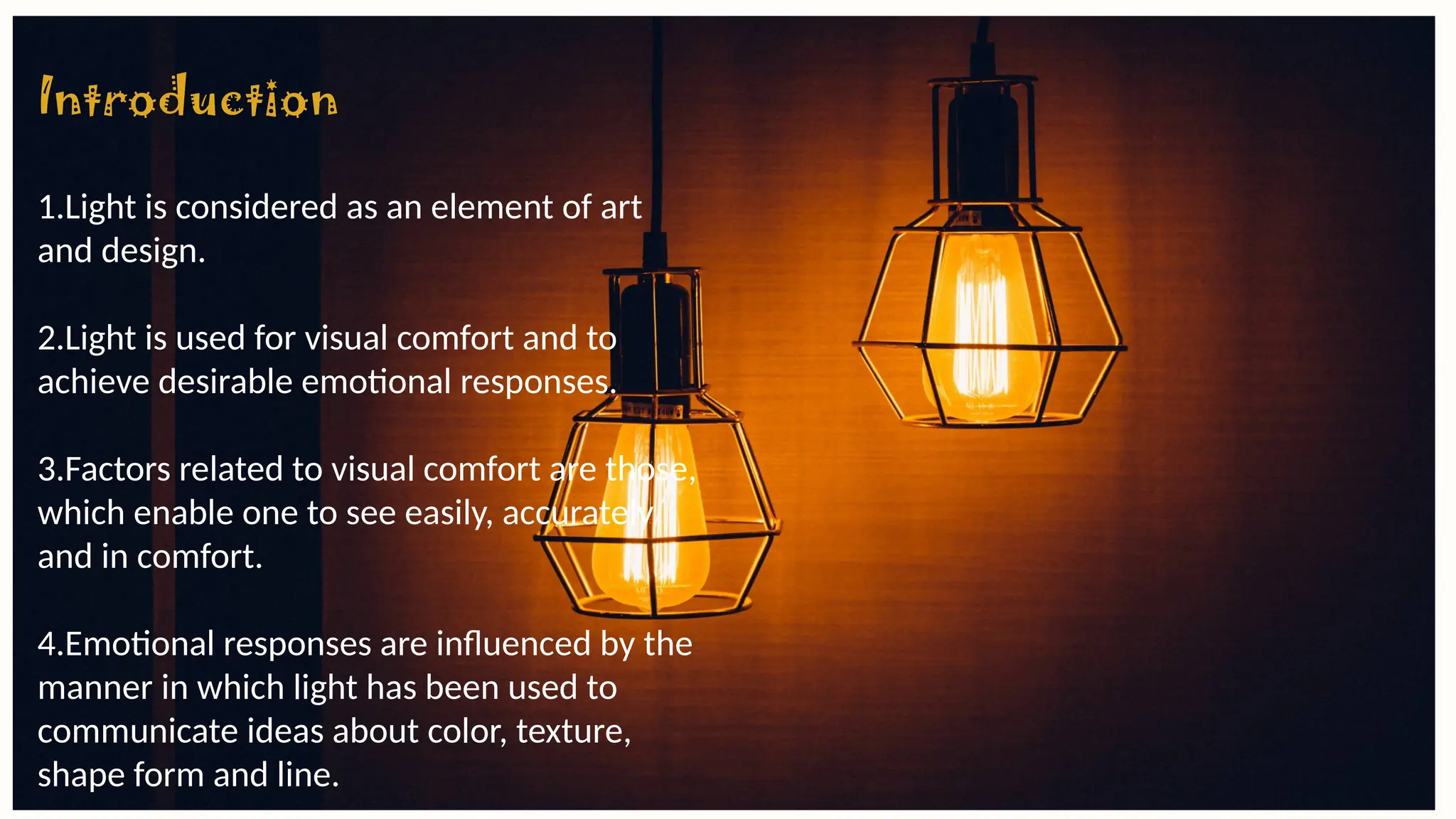
1.Light is considered as an element of art
and design.
2.Light is used for visual comfort and to
achieve desirable emotional responses.
3.Factors related to visual comfort are those,
which enable one to see easily, accurately
and in comfort.
4.Emotional responses are influenced by the
manner in which light has been used to
communicate ideas about color, texture,
shape form and line.
Sources of lights
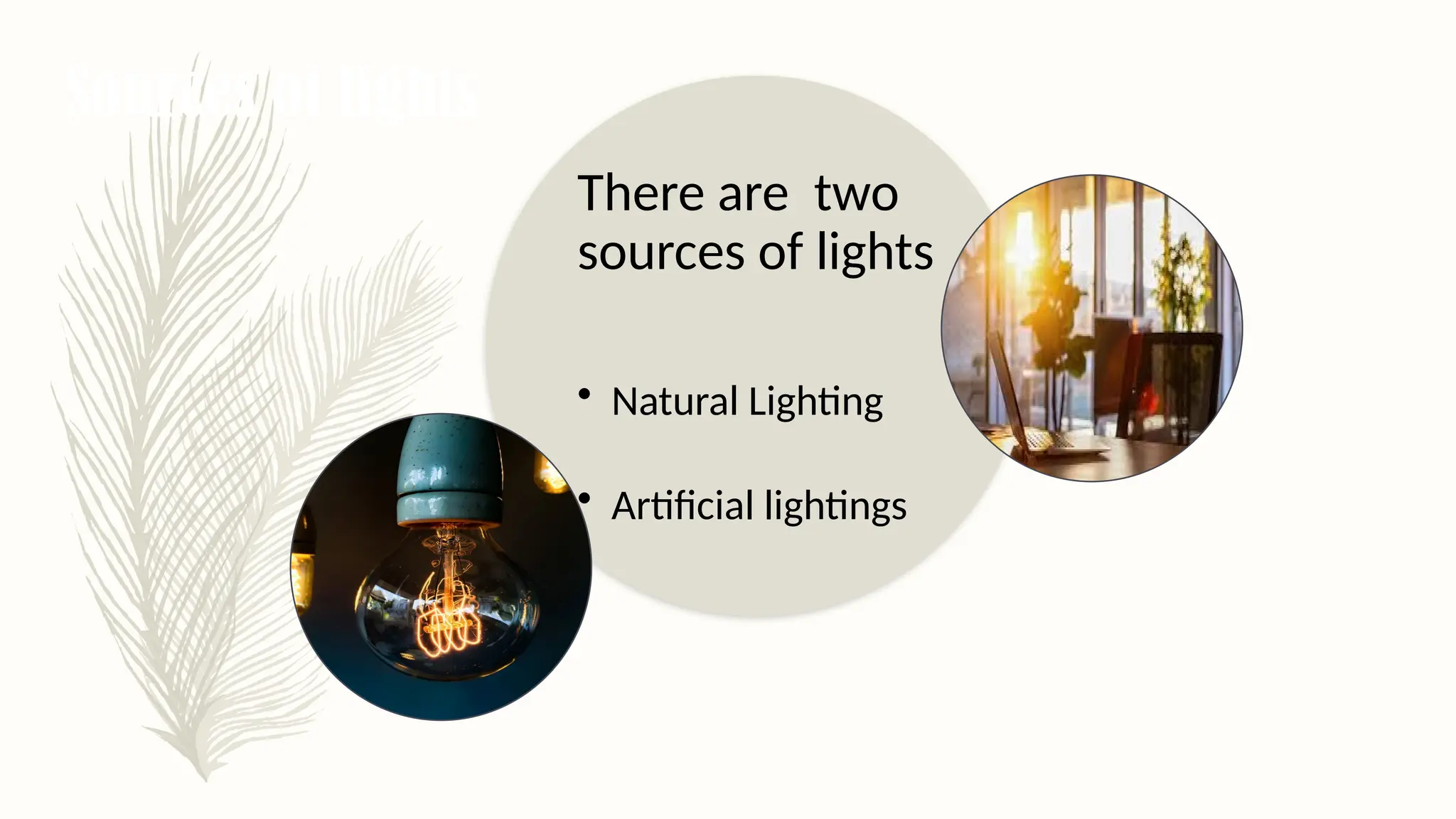
There are two
sources of lights
• Natural Lighting
• Artificial lightings
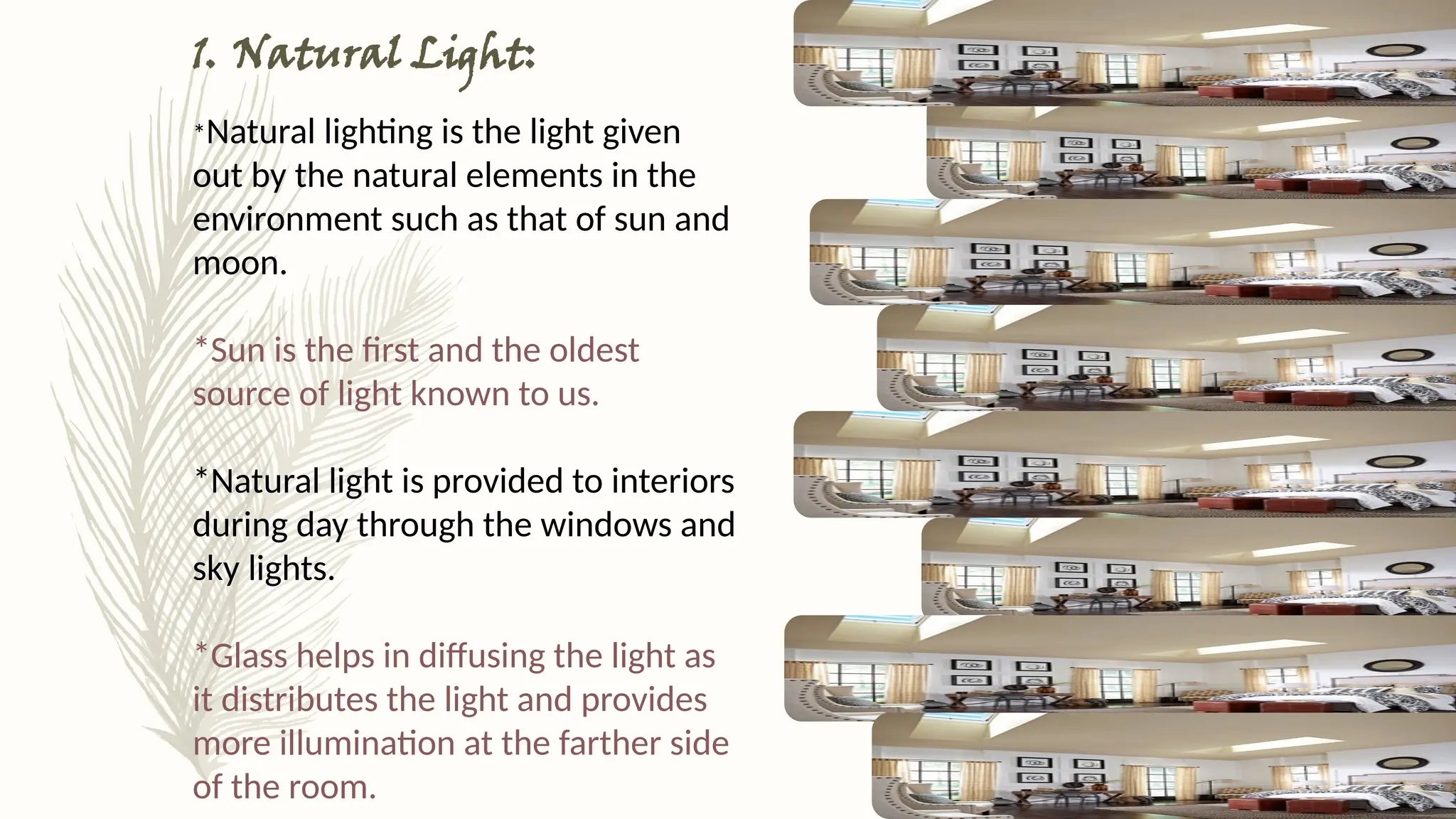
1. Natural Light:
*Natural lighting is the light given
out by the natural elements in the
environment such as that of sun and
moon.
*Sun is the first and the oldest
source of light known to us.
*Natural light is provided to interiors
during day through the windows and
sky lights.
*Glass helps in diffusing the light as
it distributes the light and provides
more illumination at the farther side
of the room.
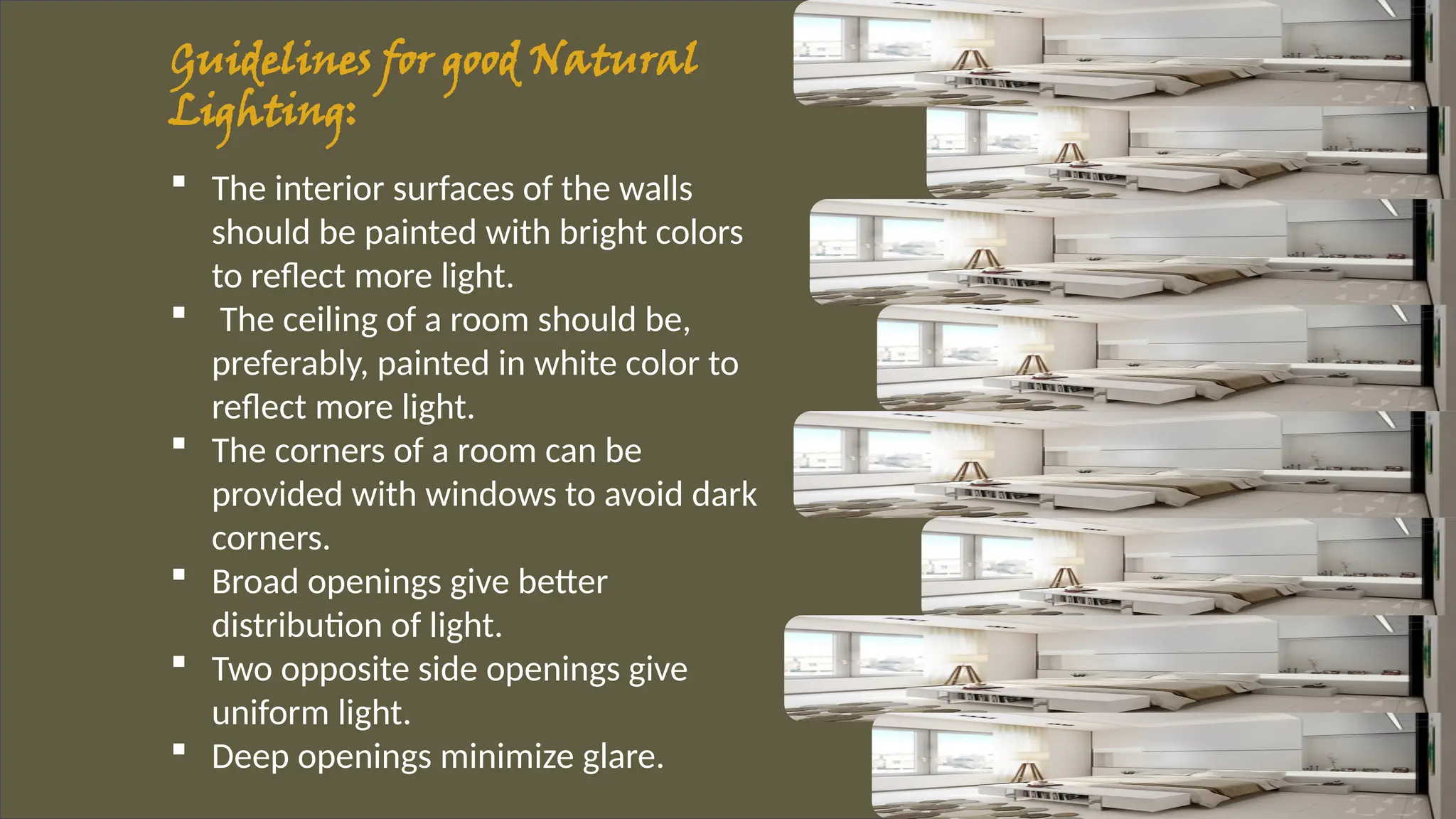
Guidelines for good Natural
Lighting:
 The interior surfaces of the walls
should be painted with bright colors
to reflect more light.
 The ceiling of a room should be,
preferably, painted in white color to
reflect more light.
 The corners of a room can be
provided with windows to avoid dark
corners.
 Broad openings give better
distribution of light.
 Two opposite side openings give
uniform light.
 Deep openings minimize glare.
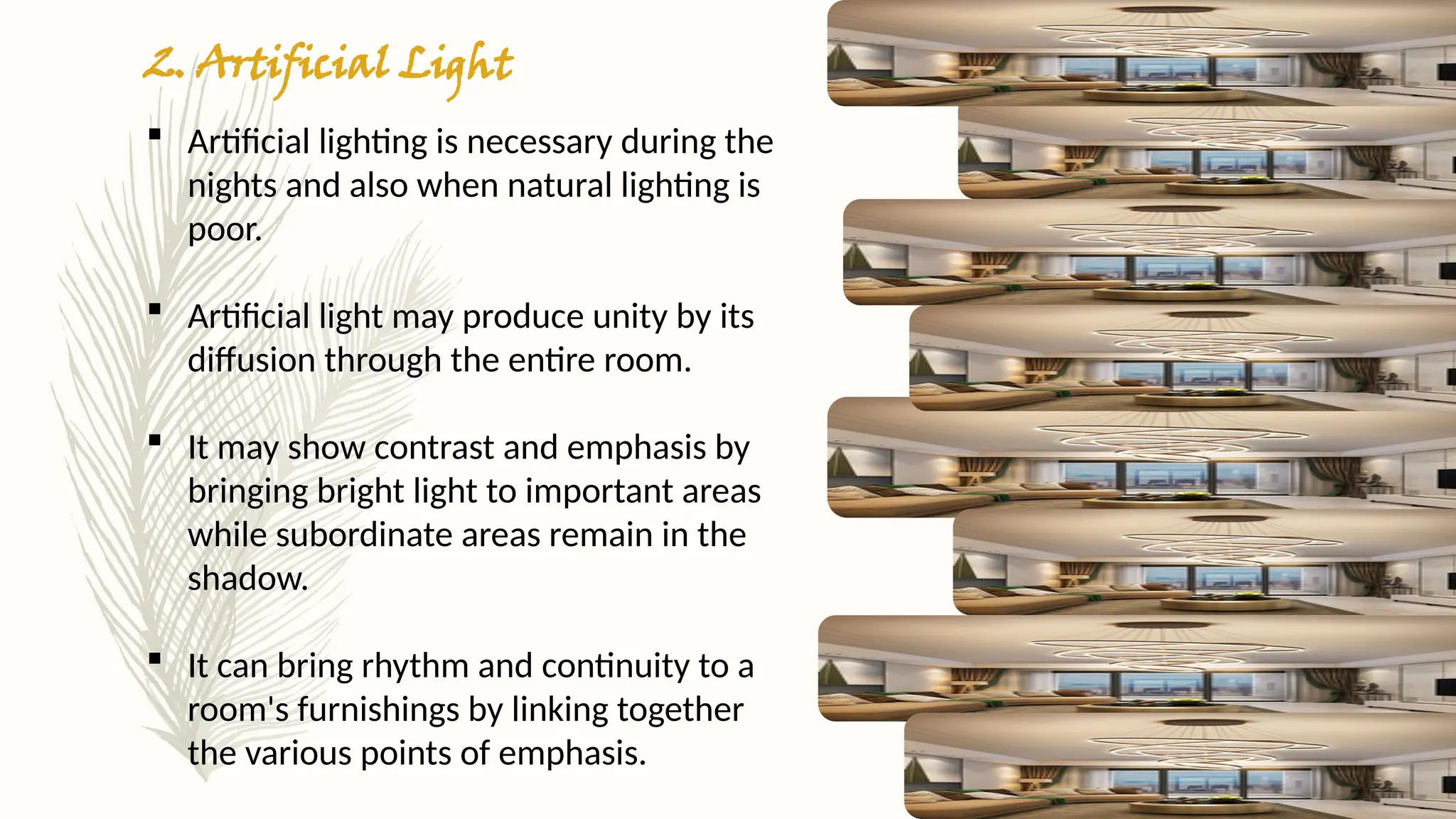
2. Artificial Light
 Artificial lighting is necessary during the
nights and also when natural lighting is
poor.
 Artificial light may produce unity by its
diffusion through the entire room.
 It may show contrast and emphasis by
bringing bright light to important areas
while subordinate areas remain in the
shadow.
 It can bring rhythm and continuity to a
room's furnishings by linking together
the various points of emphasis.
Guidelines for good Artificial lighting :
 Fluorescent lamps produce 50 to 60 lumens
per watt, where as incandescent lamps
produce 10 to 17 lumens per watt.
 The life of fluorescent lamp is four times longer
than the incandescent lamp.
 Luminaries should be located at a height of
minimum 2.1 m above the floor level, except for
some special reasons.
 The normal reflectance may be assumed for
ceiling (white) as 0.7 watts (off white) as 0.5
watts and floor (grey) as 0.3 watts.
 Periodic cleaning of luminaires is necessary to
keep up their efficiency.
Let's take a closer look at some common
types of lighting used in interior design:
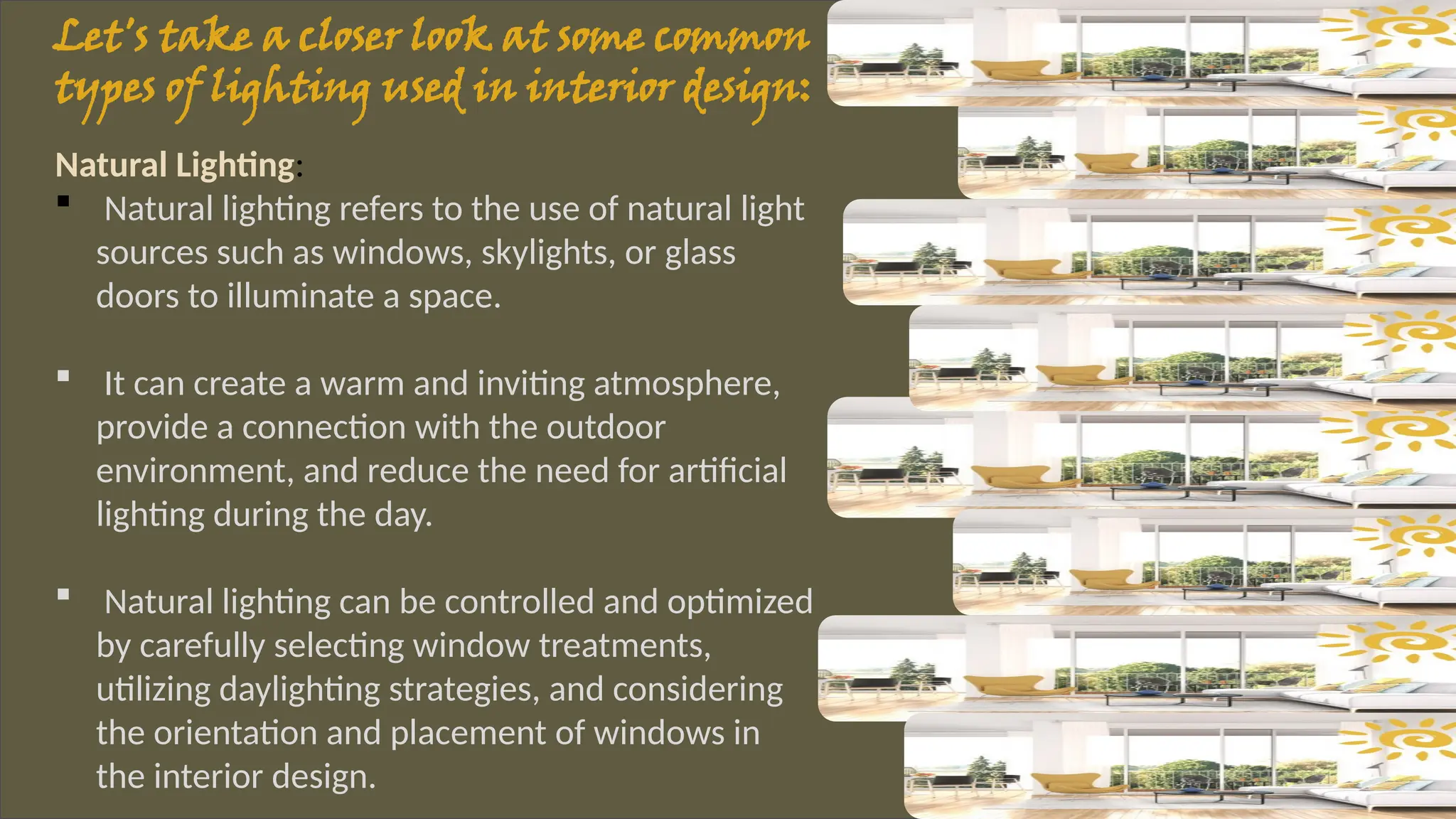
Natural Lighting:
 Natural lighting refers to the use of natural light
sources such as windows, skylights, or glass
doors to illuminate a space.
 It can create a warm and inviting atmosphere,
provide a connection with the outdoor
environment, and reduce the need for artificial
lighting during the day.
 Natural lighting can be controlled and optimized
by carefully selecting window treatments,
utilizing daylighting strategies, and considering
the orientation and placement of windows in
the interior design.
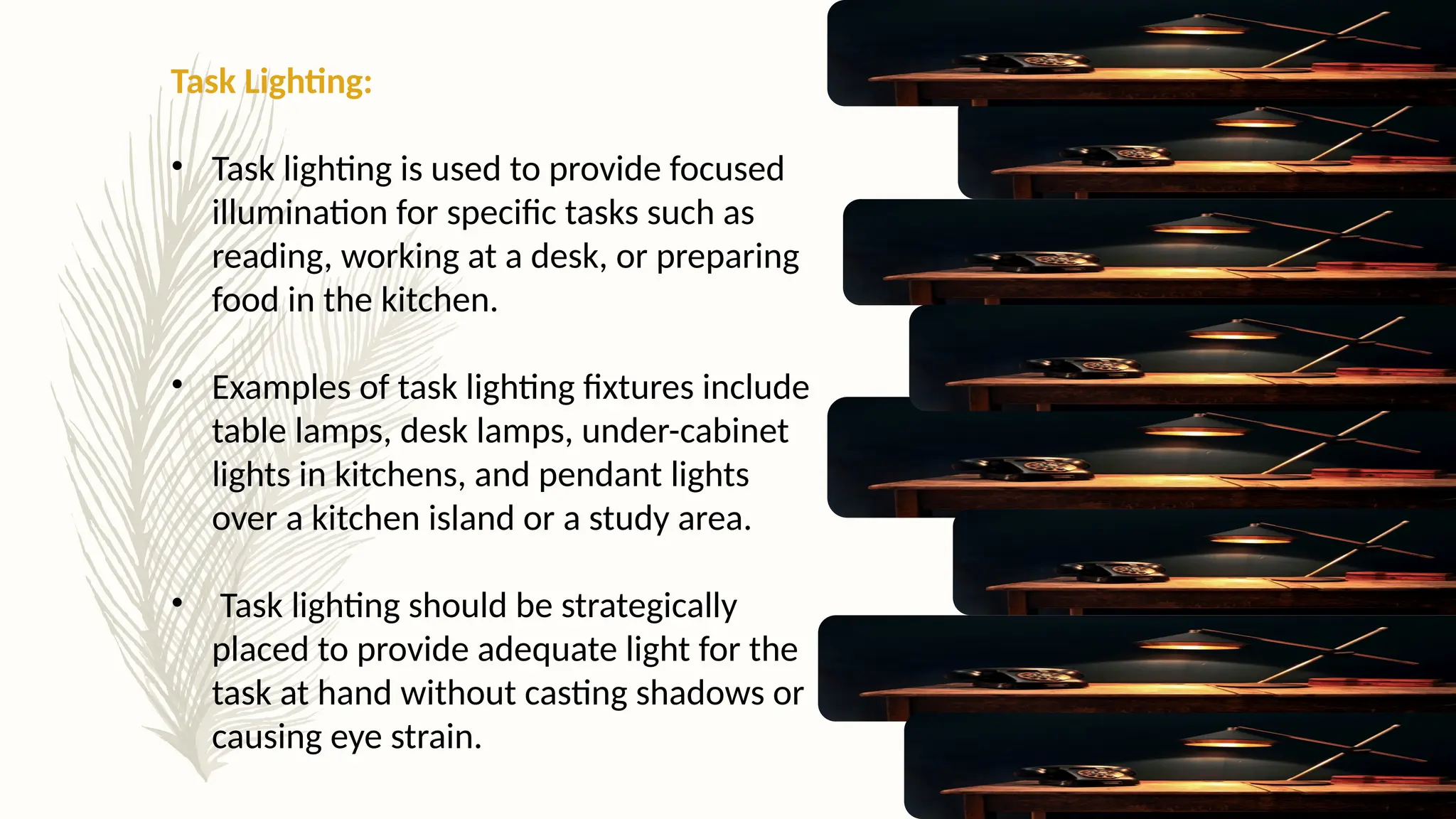
Task Lighting:
• Task lighting is used to provide focused
illumination for specific tasks such as
reading, working at a desk, or preparing
food in the kitchen.
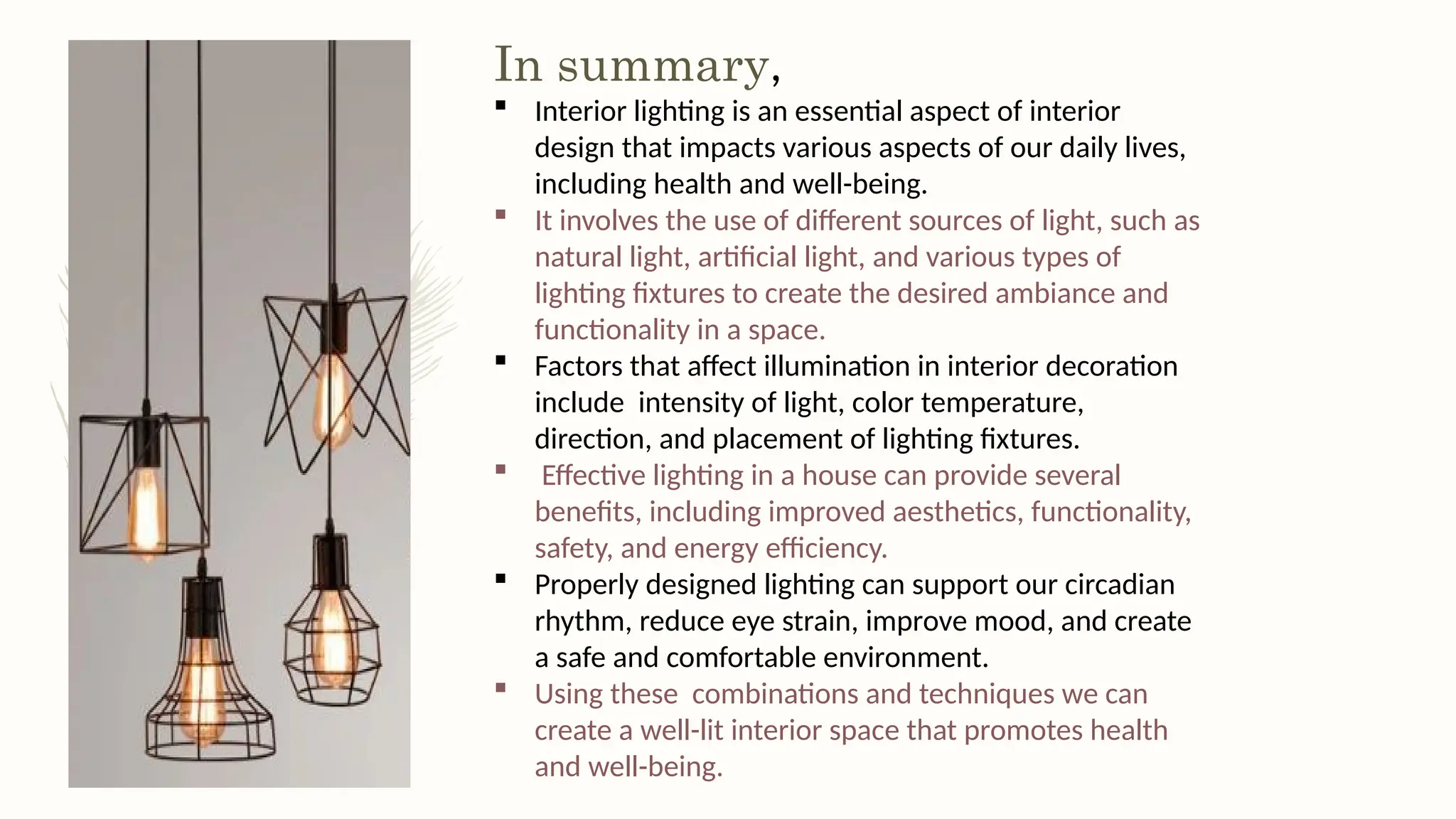
• Examples of task lighting fixtures include
table lamps, desk lamps, under-cabinet
lights in kitchens, and pendant lights
over a kitchen island or a study area.
• Task lighting should be strategically
placed to provide adequate light for the
task at hand without casting shadows or
causing eye strain.
Accent Lighting:
 Accent lighting is used to
highlight specific feature, as
objects, or architectural elements
in a space to create visual
interest and add depth to the
room.
 It can draw attention to artwork,
sculptures, or focal points in a
room.
 Accent lighting can be achieved
using track lights, wall-mounted
fixtures, picture lights, or
recessed lights with adjustable
aiming angles.
Decorative Lighting:
 Decorative lighting is used purely
for aesthetic purposes and adds
style and personality to a space.
 It can be in the form of
statement fixtures such as
chandeliers, pendant lights, or
wall sconces that serve as focal
points and contribute to the
overall design of a room.
 Decorative lighting can come in
various styles, materials, and
shapes to complement the
interior design and add a touch
of elegance or visual interest.
Ambient Lighting:
 Ambient lighting, also known as
general lighting, provides overall
illumination to a space and sets the
mood for the room.
 It is usually the primary source of
light in a room and ensures that the
space is adequately lit for general
activities.
 Examples of ambient lighting fixtures
include ceiling-mounted fixtures,
chandeliers, pendant lights, and
recessed lights.
 Ambient lighting can be adjusted to
different levels of brightness to
create different moods or to suit
different activities in the space.
Specific factors affecting
lighting
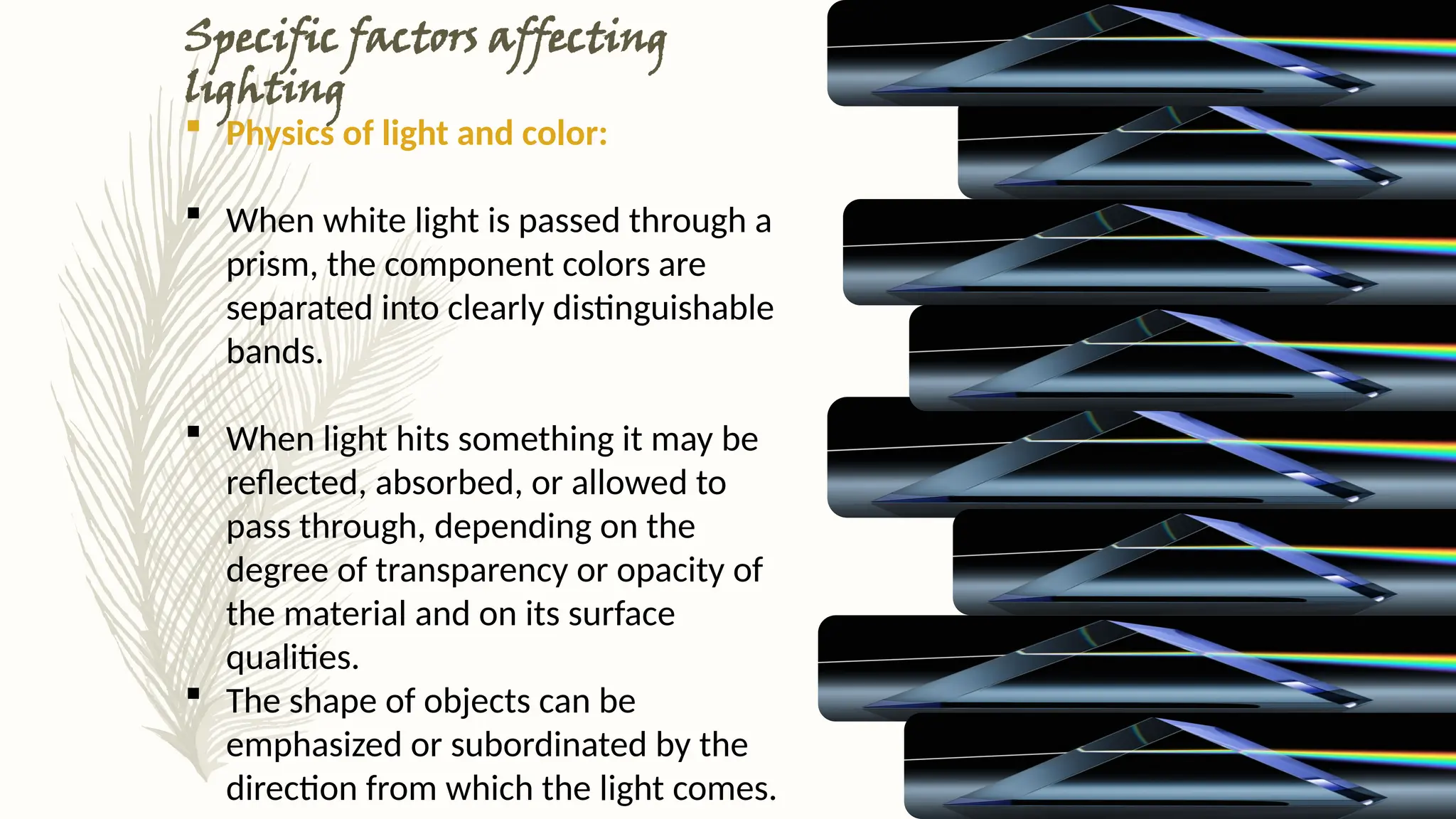
 Physics of light and color:
 When white light is passed through a
prism, the component colors are
separated into clearly distinguishable
bands.
 When light hits something it may be
reflected, absorbed, or allowed to
pass through, depending on the
degree of transparency or opacity of
the material and on its surface
qualities.
 The shape of objects can be
emphasized or subordinated by the
direction from which the light comes.
2. Brightness of light:
*Bright light is stimulating, calls forth energy
and makes us feel as though we should be up
and about.
*Low levels of brightness may seem relaxing
and restful, romantic, dingy and depressing or
even frightening, depending on the context.
*Moderately bright light brings no pronounced
feeling other than general well-being.
3.Glare:Glare is to be avoided. Glare may be
from exposed bright sources of light,
incorrectly designed fixtures, too much light,
especially from one direction and excessive
contrast.
4. Tips to avoid glare:
 To avoid glare shade the lamp to
screen it from the eye.
 Do not place lamps and objects to
be viewed too close together.
 Provide a proper degree of
illumination for the space to be
seen.
 With dimmers, brightness of light
from almost any fixture can be
instantly and smoothly adjusted
from a candle- like glow to full
brightness.
5.Benefit Effective lighting in
homes:
 Enable us to see quickly and easily.
 Prevent accidents, especially at such
hazards as stairways.
 Protect our health by minimizing
eyestrain and by disclosing
potentially harmful dirt.
 Contribute to the attractiveness of
our homes.
 Sufficient and glare less light where
ever needed for close work is
essential.
 Adequate, pleasant general
illumination to reduce fatiguing
contrasts.
 An overall pattern that is rhythmic
and balanced, is essential.
Interior lighting can have a
significant impact on health and
well-being in various ways:
 Circadian Rhythm Regulation: Our bodies
have a natural internal clock called the
circadian rhythm. Exposure to natural
light during the day and appropriate
lighting in the evening can help maintain
a healthy circadian rhythm, which is
crucial for our physical and mental
health.
 Eye Health: Poor lighting can strain our
eyes and lead to discomfort, eye fatigue,
and even long-term eye health issues.
Insufficient lighting or harsh glare can
cause eye strain, headaches, and visual
 Mental Health: Dim lighting can
create a depressing atmosphere, while
bright and well-designed lighting can
create a positive ambiance.
 Safety: Insufficient lighting or poor
visibility can increase the risk of
accidents or injuries, such as tripping,
falling, or bumping into objects.
 Sleep Quality: Using warmer and
dimmer lighting in the evening,
particularly in the bedroom, can help
create a more conducive environment
for quality sleep.
In summary,
 Interior lighting is an essential aspect of interior
design that impacts various aspects of our daily lives,
including health and well-being.
 It involves the use of different sources of light, such as
natural light, artificial light, and various types of
lighting fixtures to create the desired ambiance and
functionality in a space.
 Factors that affect illumination in interior decoration
include intensity of light, color temperature,
direction, and placement of lighting fixtures.
 Effective lighting in a house can provide several
benefits, including improved aesthetics, functionality,
safety, and energy efficiency.
 Properly designed lighting can support our circadian
rhythm, reduce eye strain, improve mood, and create
a safe and comfortable environment.
 Using these combinations and techniques we can
create a well-lit interior space that promotes health
and well-being.
 References
 Ray Faulkner and Sarah Faulkner 1968 (3rd edition) Inside Today’s Home, Holt,
Rinehart and Winston, Inc, New York.
 M.Pratop Rao 2005 Interior Design (Principles and Practice) N.C Jain.
 Louise J. Peet, Mary S. Pickett and Mildred G. Armold (1975), Household Equipment
7th edition, John Wiley and Sons, InC.Canada.
 P.Parimalam, A.Andal and M.R. Premalatha (2008) A text book of Interior Decoration,
Satish Serial Publishing House, Delhi.
 Premavathy Seetharaman and Parveen Pannu(2009) Interior Design and Decoration.
CBS Publishers and Distributors Pvt Ltd. New Delhi.
 Terence Conran, The House Book, Crown Publishers, Inc, New York.
 Etienne Grandjean, 1978, Ergonomics of the Home, Taylor and Francis Ltd, London
Ask
Questions
THANK YOU
Rupesh kumar Bisoi

LIGHTING.Lighting is a crucial element in home design that affects both the functionality and the ambiance of a space.

  • 1.
    LIGHTING BY Rupesh KumarBisoi BSc community science
  • 2.
    Contents Introduction to lighting Sourceof light Types of lighting Factors affecting lighting Benefits of effective lighting Health and lighting
  • 3.
    Introduction 1.Light is consideredas an element of art and design. 2.Light is used for visual comfort and to achieve desirable emotional responses. 3.Factors related to visual comfort are those, which enable one to see easily, accurately and in comfort. 4.Emotional responses are influenced by the manner in which light has been used to communicate ideas about color, texture, shape form and line.
  • 4.
    Sources of lights Thereare two sources of lights • Natural Lighting • Artificial lightings
  • 5.
    1. Natural Light: *Naturallighting is the light given out by the natural elements in the environment such as that of sun and moon. *Sun is the first and the oldest source of light known to us. *Natural light is provided to interiors during day through the windows and sky lights. *Glass helps in diffusing the light as it distributes the light and provides more illumination at the farther side of the room.
  • 6.
    Guidelines for goodNatural Lighting:  The interior surfaces of the walls should be painted with bright colors to reflect more light.  The ceiling of a room should be, preferably, painted in white color to reflect more light.  The corners of a room can be provided with windows to avoid dark corners.  Broad openings give better distribution of light.  Two opposite side openings give uniform light.  Deep openings minimize glare.
  • 7.
    2. Artificial Light Artificial lighting is necessary during the nights and also when natural lighting is poor.  Artificial light may produce unity by its diffusion through the entire room.  It may show contrast and emphasis by bringing bright light to important areas while subordinate areas remain in the shadow.  It can bring rhythm and continuity to a room's furnishings by linking together the various points of emphasis.
  • 8.
    Guidelines for goodArtificial lighting :  Fluorescent lamps produce 50 to 60 lumens per watt, where as incandescent lamps produce 10 to 17 lumens per watt.  The life of fluorescent lamp is four times longer than the incandescent lamp.  Luminaries should be located at a height of minimum 2.1 m above the floor level, except for some special reasons.  The normal reflectance may be assumed for ceiling (white) as 0.7 watts (off white) as 0.5 watts and floor (grey) as 0.3 watts.  Periodic cleaning of luminaires is necessary to keep up their efficiency.
  • 9.
    Let's take acloser look at some common types of lighting used in interior design: Natural Lighting:  Natural lighting refers to the use of natural light sources such as windows, skylights, or glass doors to illuminate a space.  It can create a warm and inviting atmosphere, provide a connection with the outdoor environment, and reduce the need for artificial lighting during the day.  Natural lighting can be controlled and optimized by carefully selecting window treatments, utilizing daylighting strategies, and considering the orientation and placement of windows in the interior design.
  • 10.
    Task Lighting: • Tasklighting is used to provide focused illumination for specific tasks such as reading, working at a desk, or preparing food in the kitchen. • Examples of task lighting fixtures include table lamps, desk lamps, under-cabinet lights in kitchens, and pendant lights over a kitchen island or a study area. • Task lighting should be strategically placed to provide adequate light for the task at hand without casting shadows or causing eye strain.
  • 11.
    Accent Lighting:  Accentlighting is used to highlight specific feature, as objects, or architectural elements in a space to create visual interest and add depth to the room.  It can draw attention to artwork, sculptures, or focal points in a room.  Accent lighting can be achieved using track lights, wall-mounted fixtures, picture lights, or recessed lights with adjustable aiming angles.
  • 12.
    Decorative Lighting:  Decorativelighting is used purely for aesthetic purposes and adds style and personality to a space.  It can be in the form of statement fixtures such as chandeliers, pendant lights, or wall sconces that serve as focal points and contribute to the overall design of a room.  Decorative lighting can come in various styles, materials, and shapes to complement the interior design and add a touch of elegance or visual interest.
  • 13.
    Ambient Lighting:  Ambientlighting, also known as general lighting, provides overall illumination to a space and sets the mood for the room.  It is usually the primary source of light in a room and ensures that the space is adequately lit for general activities.  Examples of ambient lighting fixtures include ceiling-mounted fixtures, chandeliers, pendant lights, and recessed lights.  Ambient lighting can be adjusted to different levels of brightness to create different moods or to suit different activities in the space.
  • 14.
    Specific factors affecting lighting Physics of light and color:  When white light is passed through a prism, the component colors are separated into clearly distinguishable bands.  When light hits something it may be reflected, absorbed, or allowed to pass through, depending on the degree of transparency or opacity of the material and on its surface qualities.  The shape of objects can be emphasized or subordinated by the direction from which the light comes.
  • 15.
    2. Brightness oflight: *Bright light is stimulating, calls forth energy and makes us feel as though we should be up and about. *Low levels of brightness may seem relaxing and restful, romantic, dingy and depressing or even frightening, depending on the context. *Moderately bright light brings no pronounced feeling other than general well-being. 3.Glare:Glare is to be avoided. Glare may be from exposed bright sources of light, incorrectly designed fixtures, too much light, especially from one direction and excessive contrast.
  • 16.
    4. Tips toavoid glare:  To avoid glare shade the lamp to screen it from the eye.  Do not place lamps and objects to be viewed too close together.  Provide a proper degree of illumination for the space to be seen.  With dimmers, brightness of light from almost any fixture can be instantly and smoothly adjusted from a candle- like glow to full brightness.
  • 17.
    5.Benefit Effective lightingin homes:  Enable us to see quickly and easily.  Prevent accidents, especially at such hazards as stairways.  Protect our health by minimizing eyestrain and by disclosing potentially harmful dirt.  Contribute to the attractiveness of our homes.  Sufficient and glare less light where ever needed for close work is essential.  Adequate, pleasant general illumination to reduce fatiguing contrasts.  An overall pattern that is rhythmic and balanced, is essential.
  • 18.
    Interior lighting canhave a significant impact on health and well-being in various ways:  Circadian Rhythm Regulation: Our bodies have a natural internal clock called the circadian rhythm. Exposure to natural light during the day and appropriate lighting in the evening can help maintain a healthy circadian rhythm, which is crucial for our physical and mental health.  Eye Health: Poor lighting can strain our eyes and lead to discomfort, eye fatigue, and even long-term eye health issues. Insufficient lighting or harsh glare can cause eye strain, headaches, and visual
  • 19.
     Mental Health:Dim lighting can create a depressing atmosphere, while bright and well-designed lighting can create a positive ambiance.  Safety: Insufficient lighting or poor visibility can increase the risk of accidents or injuries, such as tripping, falling, or bumping into objects.  Sleep Quality: Using warmer and dimmer lighting in the evening, particularly in the bedroom, can help create a more conducive environment for quality sleep.
  • 20.
    In summary,  Interiorlighting is an essential aspect of interior design that impacts various aspects of our daily lives, including health and well-being.  It involves the use of different sources of light, such as natural light, artificial light, and various types of lighting fixtures to create the desired ambiance and functionality in a space.  Factors that affect illumination in interior decoration include intensity of light, color temperature, direction, and placement of lighting fixtures.  Effective lighting in a house can provide several benefits, including improved aesthetics, functionality, safety, and energy efficiency.  Properly designed lighting can support our circadian rhythm, reduce eye strain, improve mood, and create a safe and comfortable environment.  Using these combinations and techniques we can create a well-lit interior space that promotes health and well-being.
  • 21.
     References  RayFaulkner and Sarah Faulkner 1968 (3rd edition) Inside Today’s Home, Holt, Rinehart and Winston, Inc, New York.  M.Pratop Rao 2005 Interior Design (Principles and Practice) N.C Jain.  Louise J. Peet, Mary S. Pickett and Mildred G. Armold (1975), Household Equipment 7th edition, John Wiley and Sons, InC.Canada.  P.Parimalam, A.Andal and M.R. Premalatha (2008) A text book of Interior Decoration, Satish Serial Publishing House, Delhi.  Premavathy Seetharaman and Parveen Pannu(2009) Interior Design and Decoration. CBS Publishers and Distributors Pvt Ltd. New Delhi.  Terence Conran, The House Book, Crown Publishers, Inc, New York.  Etienne Grandjean, 1978, Ergonomics of the Home, Taylor and Francis Ltd, London
  • 22.
  • 23.