Healthy, Comfortable, and
Energy-Efficient Buildings
Design Considerations
By Dr. Mohammed Alhaji Mohammed
Assistant Professor, Architectural Engineering Department
Organized by KFUPM Environmental Club (KEC)
OUTLINE
 Introduction
 Sustainable Building Design
 Healthy Buildings
 Comfortable Buildings
 Energy efficient buildings
 Conclusion
INTRODUCTION
 The provision of suitable indoor environmental conditions are requirements for comfort
and health of human beings, since people spend more than 90% of their time indoors.
 The importance of indoor environmental quality (IEQ) is its impacts on building energy
usage and health and productivity of occupants.
 The actual cost of running buildings should consider the comfort, health and
productivity of people in those buildings.
 In the U.S. alone, the savings and productivity gains from improved quality of building
indoor environments are estimated at $25 to $150 billion per year.
 Globally the building sector accounts for more electricity use than any other sector, 42
per cent.
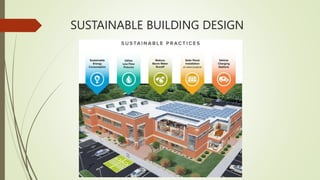
SUSTAINABLE BUILDING DESIGN
 What is Sustainable Building Design
 The sustainable building or green building is a design philosophy that focuses
on increasing the efficiency of the usage of resources like energy, water, and
materials along with reducing building impacts on human health and the
environment during and after the construction.
 The process is planned through creating better siting, design, construction,
operation, maintenance, renovation and demolition.
 The main aim of sustainable building is to minimize the adverse effects of
building components on the environment. It starts with optimized building
design, material selection, and taking energy conservative measures.
SUSTAINABLE BUILDING DESIGN
 Six Fundamental Principles of Sustainable Building Design
 While the definition of sustainable building design is ever changing, the
National Institute of Building Sciences defines six fundamental principles.
1. Optimize Site Potential
2. Optimize Energy Use
3. Protect and Conserve Water
4. Optimize Building Space and Material Use
5. Enhance Indoor Environmental Quality (IEQ)
6. Optimize Operational and Maintenance Practices
HEALTHY BUILDINGS
 Healthy building refers to an emerging area of interest that supports the
physical, psychological, and social health and well-being of people in
buildings and the built environment.
 According to the National Center for Biotechnology Information,
a healthy building not only includes environmentally responsible and
resource-efficient building concepts, but it also integrates human
health elements like the reduction of air and sound pollution and access
to healthy, sustainable light.
HEALTHY BUILDINGS
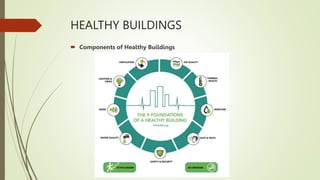
 Components of Healthy Buildings
HEALTHY BUILDINGS
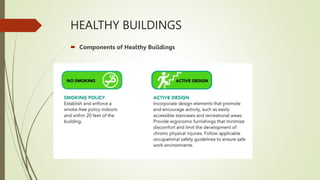
 Components of Healthy Buildings
COMFORTABLE BUILDINGS
 Aspects of human comfort in buildings include; personal factors, health
and wellbeing, thermal comfort, indoor air quality, visual comfort, noise
nuisance, ergonomics etc.
 Indoor environmental quality (IEQ) refers to the quality of a building's
environment in relation to the health and wellbeing of its occupants.
 IEQ is determined by many factors, including lighting, air quality, and
other conditions.
COMFORTABLE BUILDINGS
 CRITICAL COMPONENTS of IEQ
Indoor air quality
– odors, indoor air pollution, fresh air supply,…
Thermal comfort or indoor climate
–Temperature, moisture, air velocity
Visual or lighting quality
–View, illuminance, luminance ratios, reflection,…
Acoustical quality
–Outside and indoor noise and vibrations
COMFORTABLE BUILDINGS
 Goals of IEQ
 Minimize the risk of building‐related health problems
 Maintain high‐quality indoor environments
COMFORTABLE BUILDINGS
 IEQ Improvement Strategies
 Control pollutants
 Introduce daylight and views
 Provide occupants with controls
 Acoustic and Noise Control
 Provide thermal comfort
COMFORTABLE BUILDINGS
 IEQ: Indoor air quality
 American Society of Heating, Refrigerating and Air-Conditioning
Engineers (ASHRAE) defines acceptable IAQ as:
“Air in which there are no known contaminants at harmful
concentrations and which a substantial majority (usually 80%) of
the people exposed do not express dissatisfaction”
COMFORTABLE BUILDINGS
 IEQ: Indoor air quality
 Most of people spend up to 90% of their time indoors
 Many spend most of their working hours in an office environment
 Pollutants in an indoor environment can increase the risk of illness
 Levels of pollutants may be 200% to 500% higher indoors than outdoors, even in
cities with a lot of air pollution.
COMFORTABLE BUILDINGS
 Indoor air quality: Indoor air Contaminants
 Volatile Organic Compounds (VOCs)
 Carbon Dioxide (CO2)
 Particulates
 Tobacco Smoke
COMFORTABLE BUILDINGS
 Indoor air quality: Ventilation
 In order to achieve acceptable IAQ, proper ventilation is required.
 Ventilation in buildings is required to bring fresh air in from outside and
dilute occupant-generated pollutants (e.g., carbon dioxide) and product-
generated pollutants (e.g., volatile organic compounds).
 If mechanically ventilated, a building’s mechanical system is designed to
bring in outdoor air, filter that air, and deliver it to occupants.
COMFORTABLE BUILDINGS
 Visual or lighting quality
 Daylighting :
 It is to ensure connectivity between the interior and the exterior
environment , by providing adequate daylighting.
 Visual discomfort
 Visual discomfort may reveal itself in the following complaints:
 Too little daylight or artificial light;
 Dazzling daylight or artificial light;
 Inadequate visibility.
COMFORTABLE BUILDINGS
 Visual or lighting quality
 Poor lighting may also contribute for example to:
 Eye irritations;
 Neck and shoulder problems;
 Fatigue.
 Students in classrooms with access to green views through their windows
have been observed to experience significantly faster recovery from stress
and mental fatigue and performed significantly higher on tests of
attentional functioning, compared to students in classrooms with no
windows or windows looking out onto other buildings facades.
COMFORTABLE BUILDINGS
 IEQ: Thermal Comfort
 Thermal comfort is defined as “the condition of mind that expresses
satisfaction with the thermal environment and is assessed by
subjective evaluation”.
 Thermal comfort is influenced by objective factors like air temperature,
mean radiant temperature, air speed, and humidity, as well as
personal factors like metabolic activity level and thermal insulation
from clothing.
 Humans generally feel comfortable between temperatures of 22 °C to
27 °C and a relative humidity of 40% to 60%.
COMFORTABLE BUILDINGS
 IEQ: Thermal Comfort
 The impacts of thermal conditions extend beyond comfort.
 Temperature and humidity can also have a drastic effect on health, as
evidenced by the heat wave in France in 2003, which claimed nearly
15,000 lives.
 Humidity influences the evaporative cooling mechanisms of our
physiology. That is, if the humidity is too high because the air is more
saturated, our body has a reduced capacity to cool itself through
sweating.
 Thermal comfort has been suggested to be more important to office
workers’ performance than job stress or job satisfaction.
COMFORTABLE BUILDINGS
 IEQ: Acoustic and Noise Control
 What is ‘noise’?
 Noise is defined as “unwanted or disturbing sound” that interferes with
normal activities such as work, sleeping and conversation.
 Noise enters building interiors from outside sources such as aircraft,
road traffic, trains, lawn mowers, snow blowers, and the operation of
heavy equipment at construction sites.
 Indoors, noise can be generated from a building’s mechanical and
HVAC systems, office equipment, vacuum cleaners, industrial
machinery, or conversations among occupants.
COMFORTABLE BUILDINGS
 IEQ: Acoustic and Noise Control
 Each year in the US, around 30 million people are occupationally
exposed to hazardous noise levels and another 26 million ages 20-69
have hearing loss that may have been induced by noise exposure in the
workplace or leisure activities.
 Studies of the non-auditory effects of noise exposure have observed
that increased noise levels are associated with higher systolic and
diastolic blood pressure, changes in heart rate, and hypertension.
 A recent survey of more than 1,200 senior executives and non-
executive employees found that 53% of employees report that ambient
noise reduces their work satisfaction and productivity.
ENERGY-EFFICIENT BUILDINGS
 The concept of energy efficiency in buildings is related to the energy supply
needed to achieve desirable environmental conditions that minimize energy
consumption.
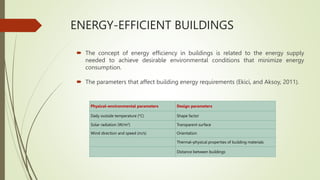
 The parameters that affect building energy requirements (Ekici, and Aksoy, 2011).
Physical–environmental parameters Design parameters
Daily outside temperature (°C) Shape factor
Solar radiation (W/m2) Transparent surface
Wind direction and speed (m/s) Orientation
Thermal–physical properties of building materials
Distance between buildings
ENERGY-EFFICIENT BUILDINGS
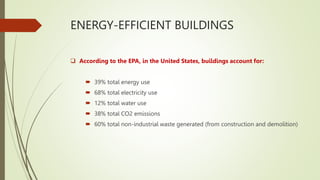
 According to the EPA, in the United States, buildings account for:
 39% total energy use
 68% total electricity use
 12% total water use
 38% total CO2 emissions
 60% total non-industrial waste generated (from construction and demolition)
ENERGY-EFFICIENT BUILDINGS
 Strategies for achieving energy efficient buildings:
 bioclimatic architecture: shape and orientation of the building,
solar protections, passive solar systems
 high performing building envelope: thorough insulation, high
performing glazing and windows, air-sealed construction, avoidance
of thermal bridges
 high performance controlled ventilation: mechanical insulation,
heat recovery
CONCLUSION
 Professional in building construction industry should consider
health and safety of building occupants, while integrating
energy conservation measures.
 Acceptable IEQ is essential for healthy and comfortable indoor
environment.
 Integration of Passive strategies is a key in achieving sustainable
buildings.
Thank you: Questions?

Healthy, Comfortable, and Energy-Efficient Buildings.pptx

  • 1.
    Healthy, Comfortable, and Energy-EfficientBuildings Design Considerations By Dr. Mohammed Alhaji Mohammed Assistant Professor, Architectural Engineering Department Organized by KFUPM Environmental Club (KEC)
  • 2.
    OUTLINE  Introduction  SustainableBuilding Design  Healthy Buildings  Comfortable Buildings  Energy efficient buildings  Conclusion
  • 3.
    INTRODUCTION  The provisionof suitable indoor environmental conditions are requirements for comfort and health of human beings, since people spend more than 90% of their time indoors.  The importance of indoor environmental quality (IEQ) is its impacts on building energy usage and health and productivity of occupants.  The actual cost of running buildings should consider the comfort, health and productivity of people in those buildings.  In the U.S. alone, the savings and productivity gains from improved quality of building indoor environments are estimated at $25 to $150 billion per year.  Globally the building sector accounts for more electricity use than any other sector, 42 per cent.
  • 4.
    SUSTAINABLE BUILDING DESIGN What is Sustainable Building Design  The sustainable building or green building is a design philosophy that focuses on increasing the efficiency of the usage of resources like energy, water, and materials along with reducing building impacts on human health and the environment during and after the construction.  The process is planned through creating better siting, design, construction, operation, maintenance, renovation and demolition.  The main aim of sustainable building is to minimize the adverse effects of building components on the environment. It starts with optimized building design, material selection, and taking energy conservative measures.
  • 5.
  • 6.
    SUSTAINABLE BUILDING DESIGN Six Fundamental Principles of Sustainable Building Design  While the definition of sustainable building design is ever changing, the National Institute of Building Sciences defines six fundamental principles. 1. Optimize Site Potential 2. Optimize Energy Use 3. Protect and Conserve Water 4. Optimize Building Space and Material Use 5. Enhance Indoor Environmental Quality (IEQ) 6. Optimize Operational and Maintenance Practices
  • 7.
    HEALTHY BUILDINGS  Healthybuilding refers to an emerging area of interest that supports the physical, psychological, and social health and well-being of people in buildings and the built environment.  According to the National Center for Biotechnology Information, a healthy building not only includes environmentally responsible and resource-efficient building concepts, but it also integrates human health elements like the reduction of air and sound pollution and access to healthy, sustainable light.
  • 8.
  • 9.
  • 10.
    COMFORTABLE BUILDINGS  Aspectsof human comfort in buildings include; personal factors, health and wellbeing, thermal comfort, indoor air quality, visual comfort, noise nuisance, ergonomics etc.  Indoor environmental quality (IEQ) refers to the quality of a building's environment in relation to the health and wellbeing of its occupants.  IEQ is determined by many factors, including lighting, air quality, and other conditions.
  • 11.
    COMFORTABLE BUILDINGS  CRITICALCOMPONENTS of IEQ Indoor air quality – odors, indoor air pollution, fresh air supply,… Thermal comfort or indoor climate –Temperature, moisture, air velocity Visual or lighting quality –View, illuminance, luminance ratios, reflection,… Acoustical quality –Outside and indoor noise and vibrations
  • 12.
    COMFORTABLE BUILDINGS  Goalsof IEQ  Minimize the risk of building‐related health problems  Maintain high‐quality indoor environments
  • 13.
    COMFORTABLE BUILDINGS  IEQImprovement Strategies  Control pollutants  Introduce daylight and views  Provide occupants with controls  Acoustic and Noise Control  Provide thermal comfort
  • 14.
    COMFORTABLE BUILDINGS  IEQ:Indoor air quality  American Society of Heating, Refrigerating and Air-Conditioning Engineers (ASHRAE) defines acceptable IAQ as: “Air in which there are no known contaminants at harmful concentrations and which a substantial majority (usually 80%) of the people exposed do not express dissatisfaction”
  • 15.
    COMFORTABLE BUILDINGS  IEQ:Indoor air quality  Most of people spend up to 90% of their time indoors  Many spend most of their working hours in an office environment  Pollutants in an indoor environment can increase the risk of illness  Levels of pollutants may be 200% to 500% higher indoors than outdoors, even in cities with a lot of air pollution.
  • 16.
    COMFORTABLE BUILDINGS  Indoorair quality: Indoor air Contaminants  Volatile Organic Compounds (VOCs)  Carbon Dioxide (CO2)  Particulates  Tobacco Smoke
  • 17.
    COMFORTABLE BUILDINGS  Indoorair quality: Ventilation  In order to achieve acceptable IAQ, proper ventilation is required.  Ventilation in buildings is required to bring fresh air in from outside and dilute occupant-generated pollutants (e.g., carbon dioxide) and product- generated pollutants (e.g., volatile organic compounds).  If mechanically ventilated, a building’s mechanical system is designed to bring in outdoor air, filter that air, and deliver it to occupants.
  • 18.
    COMFORTABLE BUILDINGS  Visualor lighting quality  Daylighting :  It is to ensure connectivity between the interior and the exterior environment , by providing adequate daylighting.  Visual discomfort  Visual discomfort may reveal itself in the following complaints:  Too little daylight or artificial light;  Dazzling daylight or artificial light;  Inadequate visibility.
  • 19.
    COMFORTABLE BUILDINGS  Visualor lighting quality  Poor lighting may also contribute for example to:  Eye irritations;  Neck and shoulder problems;  Fatigue.  Students in classrooms with access to green views through their windows have been observed to experience significantly faster recovery from stress and mental fatigue and performed significantly higher on tests of attentional functioning, compared to students in classrooms with no windows or windows looking out onto other buildings facades.
  • 20.
    COMFORTABLE BUILDINGS  IEQ:Thermal Comfort  Thermal comfort is defined as “the condition of mind that expresses satisfaction with the thermal environment and is assessed by subjective evaluation”.  Thermal comfort is influenced by objective factors like air temperature, mean radiant temperature, air speed, and humidity, as well as personal factors like metabolic activity level and thermal insulation from clothing.  Humans generally feel comfortable between temperatures of 22 °C to 27 °C and a relative humidity of 40% to 60%.
  • 21.
    COMFORTABLE BUILDINGS  IEQ:Thermal Comfort  The impacts of thermal conditions extend beyond comfort.  Temperature and humidity can also have a drastic effect on health, as evidenced by the heat wave in France in 2003, which claimed nearly 15,000 lives.  Humidity influences the evaporative cooling mechanisms of our physiology. That is, if the humidity is too high because the air is more saturated, our body has a reduced capacity to cool itself through sweating.  Thermal comfort has been suggested to be more important to office workers’ performance than job stress or job satisfaction.
  • 22.
    COMFORTABLE BUILDINGS  IEQ:Acoustic and Noise Control  What is ‘noise’?  Noise is defined as “unwanted or disturbing sound” that interferes with normal activities such as work, sleeping and conversation.  Noise enters building interiors from outside sources such as aircraft, road traffic, trains, lawn mowers, snow blowers, and the operation of heavy equipment at construction sites.  Indoors, noise can be generated from a building’s mechanical and HVAC systems, office equipment, vacuum cleaners, industrial machinery, or conversations among occupants.
  • 23.
    COMFORTABLE BUILDINGS  IEQ:Acoustic and Noise Control  Each year in the US, around 30 million people are occupationally exposed to hazardous noise levels and another 26 million ages 20-69 have hearing loss that may have been induced by noise exposure in the workplace or leisure activities.  Studies of the non-auditory effects of noise exposure have observed that increased noise levels are associated with higher systolic and diastolic blood pressure, changes in heart rate, and hypertension.  A recent survey of more than 1,200 senior executives and non- executive employees found that 53% of employees report that ambient noise reduces their work satisfaction and productivity.
  • 24.
    ENERGY-EFFICIENT BUILDINGS  Theconcept of energy efficiency in buildings is related to the energy supply needed to achieve desirable environmental conditions that minimize energy consumption.  The parameters that affect building energy requirements (Ekici, and Aksoy, 2011). Physical–environmental parameters Design parameters Daily outside temperature (°C) Shape factor Solar radiation (W/m2) Transparent surface Wind direction and speed (m/s) Orientation Thermal–physical properties of building materials Distance between buildings
  • 25.
    ENERGY-EFFICIENT BUILDINGS  Accordingto the EPA, in the United States, buildings account for:  39% total energy use  68% total electricity use  12% total water use  38% total CO2 emissions  60% total non-industrial waste generated (from construction and demolition)
  • 26.
    ENERGY-EFFICIENT BUILDINGS  Strategiesfor achieving energy efficient buildings:  bioclimatic architecture: shape and orientation of the building, solar protections, passive solar systems  high performing building envelope: thorough insulation, high performing glazing and windows, air-sealed construction, avoidance of thermal bridges  high performance controlled ventilation: mechanical insulation, heat recovery
  • 27.
    CONCLUSION  Professional inbuilding construction industry should consider health and safety of building occupants, while integrating energy conservation measures.  Acceptable IEQ is essential for healthy and comfortable indoor environment.  Integration of Passive strategies is a key in achieving sustainable buildings.
  • 28.