ACS Critical Pathways  2007 Teleconferences This activity is supported by an educational grant from  the Bristol-Myers Squibb/Sanofi Pharmaceuticals Partnership. February 14, 2007
Faculty Gregg C. Fonarow, M D Eliot Corday Professor of Medicine and Cardiovascular Science Director, Ahmanson-UCLA Cardiomyopathy Center UCLA Division of Cardiology UCLA Medical Center Los Angeles, California
Disclosure Statement The Network for Continuing Medical Education requires that CME faculty disclose, during the planning of an activity, the existence of any personal financial or other relationships they or their spouses/partners have with the commercial supporter of the activity or with the manufacturer of any commercial product or service discussed in the activity.
Faculty Disclosure Statement Gregg C. Fonarow, MD , has served as a consultant to and has received research support and honoraria from Bristol-Myers Squibb Company, GlaxoSmithKline, Merck & Co., Inc., Pfizer Inc, sanofi-aventis, Schering-Plough Corporation, and Scios, Inc. Gary S. Ledley, MD,  of Albert Einstein Medical Center and Thomas Jefferson University, reports no such relationships.
The NCDR-ACTION Registry: Combining the Power and Resources of CRUSADE and NRMI Gregg C. Fonarow, MD
Polling Question #1 Yes No Does your institution currently participate in an acute coronary syndromes registry?
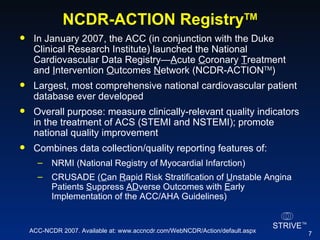
NCDR-ACTION Registry TM In January 2007, the ACC (in conjunction with the Duke Clinical Research Institute) launched the National Cardiovascular Data Registry— A cute  C oronary  T reatment and  I ntervention  O utcomes  N etwork (NCDR-ACTION TM )  Largest, most comprehensive national cardiovascular patient database ever developed Overall purpose: measure clinically-relevant quality indicators in the treatment of ACS (STEMI and NSTEMI); promote national quality improvement  Combines data collection/quality reporting features of: NRMI (National Registry of Myocardial Infarction) CRUSADE ( C an  R apid Risk Stratification of  U nstable Angina Patients  S uppress  AD verse Outcomes with  E arly Implementation of the ACC/AHA Guidelines) ACC-NCDR 2007. Available at: www.accncdr.com/WebNCDR/Action/default.aspx
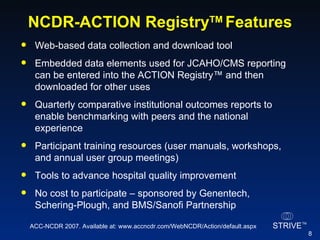
NCDR-ACTION Registry TM  Features Web-based data collection and download tool Embedded data elements used for JCAHO/CMS reporting can be entered into the ACTION Registry™ and then downloaded for other uses  Quarterly comparative institutional outcomes reports to enable benchmarking with peers and the national experience Participant training resources (user manuals, workshops, and annual user group meetings) Tools to advance hospital quality improvement No cost to participate – sponsored by Genentech, Schering-Plough, and BMS/Sanofi Partnership ACC-NCDR 2007. Available at: www.accncdr.com/WebNCDR/Action/default.aspx
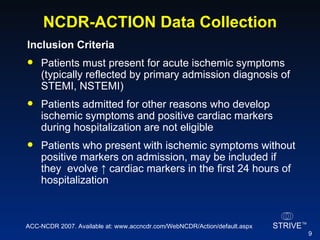
NCDR-ACTION Data Collection Inclusion Criteria Patients must present for acute ischemic symptoms (typically reflected by primary admission diagnosis of STEMI, NSTEMI) Patients admitted for other reasons who develop ischemic symptoms and positive cardiac markers during hospitalization are not eligible Patients who present with ischemic symptoms without positive markers on admission, may be included if they  evolve  ↑  cardiac markers in the first 24 hours of hospitalization ACC-NCDR 2007. Available at: www.accncdr.com/WebNCDR/Action/default.aspx
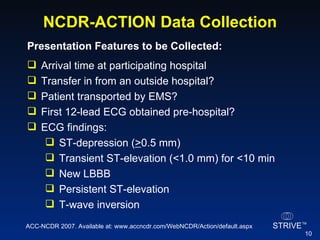
NCDR-ACTION Data Collection Presentation Features to be Collected:   Arrival time at participating hospital Transfer in from an outside hospital? Patient transported by EMS? First 12-lead ECG obtained pre-hospital? ECG findings: ST-depression ( > 0.5 mm) Transient ST-elevation (<1.0 mm) for <10 min New LBBB Persistent ST-elevation T-wave inversion ACC-NCDR 2007. Available at: www.accncdr.com/WebNCDR/Action/default.aspx
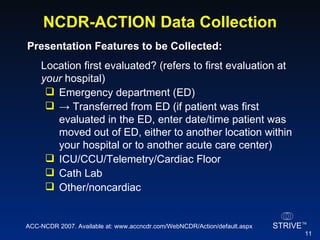
NCDR-ACTION Data Collection Presentation Features to be Collected:   Location first evaluated? (refers to first evaluation at  your  hospital) Emergency department (ED) ->  Transferred from ED (if patient was first evaluated in the ED, enter date/time patient was moved out of ED, either to another location within your hospital or to another acute care center) ICU/CCU/Telemetry/Cardiac Floor Cath Lab Other/noncardiac ACC-NCDR 2007. Available at: www.accncdr.com/WebNCDR/Action/default.aspx
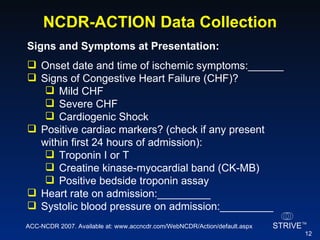
NCDR-ACTION Data Collection Signs and Symptoms at Presentation:   Onset date and time of ischemic symptoms:______ Signs of Congestive Heart Failure (CHF)? Mild CHF Severe CHF Cardiogenic Shock Positive cardiac markers? (check if any present within first 24 hours of admission): Troponin I or T Creatine kinase-myocardial band (CK-MB) Positive bedside troponin assay Heart rate on admission:_________ Systolic blood pressure on admission:_________ ACC-NCDR 2007. Available at: www.accncdr.com/WebNCDR/Action/default.aspx
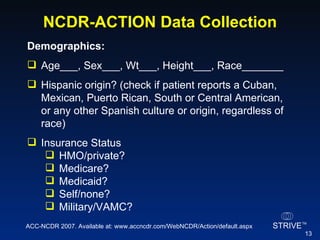
NCDR-ACTION Data Collection Demographics:   Age___, Sex___, Wt___, Height___, Race_______ Hispanic origin? (check if patient reports a Cuban, Mexican, Puerto Rican, South or Central American, or any other Spanish culture or origin, regardless of race) Insurance Status HMO/private? Medicare? Medicaid? Self/none? Military/VAMC? ACC-NCDR 2007. Available at: www.accncdr.com/WebNCDR/Action/default.aspx
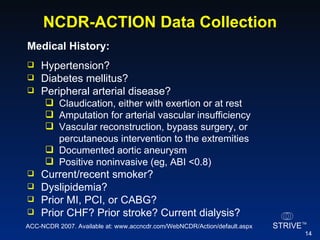
NCDR-ACTION Data Collection Medical History:   Hypertension? Diabetes mellitus? Peripheral arterial disease? Claudication, either with exertion or at rest Amputation for arterial vascular insufficiency Vascular reconstruction, bypass surgery, or percutaneous intervention to the extremities Documented aortic aneurysm Positive noninvasive (eg, ABI <0.8) Current/recent smoker? Dyslipidemia? Prior MI, PCI, or CABG? Prior CHF? Prior stroke? Current dialysis? ACC-NCDR 2007. Available at: www.accncdr.com/WebNCDR/Action/default.aspx
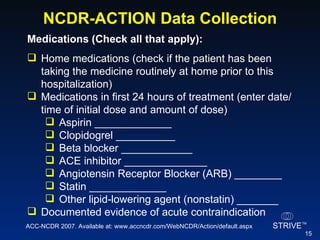
NCDR-ACTION Data Collection Medications (Check all that apply):   Home medications (check if the patient has been taking the medicine routinely at home prior to this hospitalization) Medications in first 24 hours of treatment (enter date/time of initial dose and amount of dose)  Aspirin _____________ Clopidogrel __________ Beta blocker ____________ ACE inhibitor ______________ Angiotensin Receptor Blocker (ARB) ________ Statin _____________ Other lipid-lowering agent (nonstatin) _______ Documented evidence of acute contraindication ACC-NCDR 2007. Available at: www.accncdr.com/WebNCDR/Action/default.aspx
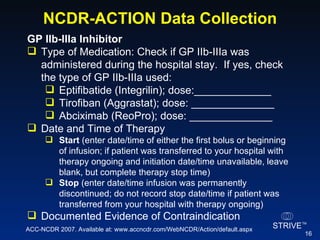
NCDR-ACTION Data Collection GP IIb-IIIa Inhibitor  Type of Medication: Check if GP IIb-IIIa was administered during the hospital stay.  If yes, check the type of GP IIb-IIIa used: Eptifibatide (Integrilin); dose:_____________ Tirofiban (Aggrastat); dose: ______________ Abciximab (ReoPro); dose: ______________ Date and Time of Therapy Start  (enter date/time of either the first bolus or beginning of infusion; if patient was transferred to your hospital with therapy ongoing and initiation date/time unavailable, leave blank, but complete therapy stop time) Stop  (enter date/time infusion was permanently discontinued; do not record stop date/time if patient was transferred from your hospital with therapy ongoing) Documented Evidence of Contraindication  ACC-NCDR 2007. Available at: www.accncdr.com/WebNCDR/Action/default.aspx
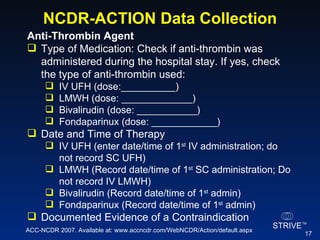
NCDR-ACTION Data Collection Anti-Thrombin Agent  Type of Medication: Check if anti-thrombin was administered during the hospital stay. If yes, check the type of anti-thrombin used: IV UFH (dose:__________) LMWH (dose: _____________) Bivalirudin (dose: ___________) Fondaparinux (dose: ____________) Date and Time of Therapy IV UFH (enter date/time of 1 st  IV administration; do not record SC UFH)  LMWH (Record date/time of 1 st  SC administration; Do not record IV LMWH) Bivalirudin (Record date/time of 1 st  admin) Fondaparinux (Record date/time of 1 st  admin) Documented Evidence of a Contraindication ACC-NCDR 2007. Available at: www.accncdr.com/WebNCDR/Action/default.aspx
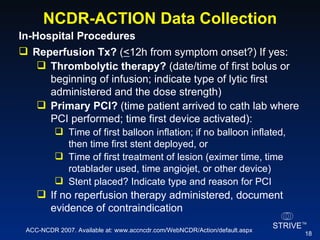
NCDR-ACTION Data Collection In-Hospital Procedures  Reperfusion Tx?  ( < 12h from symptom onset?) If yes: Thrombolytic therapy?  (date/time of first bolus or beginning of infusion; indicate type of lytic first administered and the dose strength) Primary PCI?  (time patient arrived to cath lab where PCI performed; time first device activated): Time of first balloon inflation; if no balloon inflated, then time first stent deployed, or Time of first treatment of lesion (eximer time, time rotablader used, time angiojet, or other device) Stent placed? Indicate type and reason for PCI  If no reperfusion therapy administered, document evidence of contraindication ACC-NCDR 2007. Available at: www.accncdr.com/WebNCDR/Action/default.aspx
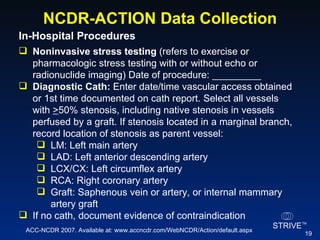
NCDR-ACTION Data Collection In-Hospital Procedures  Noninvasive stress testing  (refers to exercise or pharmacologic stress testing with or without echo or radionuclide imaging) Date of procedure: _________  Diagnostic Cath:  Enter date/time vascular access obtained or 1st time documented on cath report. Select all vessels with  > 50% stenosis, including native stenosis in vessels perfused by a graft. If stenosis located in a marginal branch, record location of stenosis as parent vessel: LM: Left main artery LAD: Left anterior descending artery LCX/CX: Left circumflex artery RCA: Right coronary artery Graft: Saphenous vein or artery, or internal mammary artery graft If no cath, document evidence of contraindication ACC-NCDR 2007. Available at: www.accncdr.com/WebNCDR/Action/default.aspx
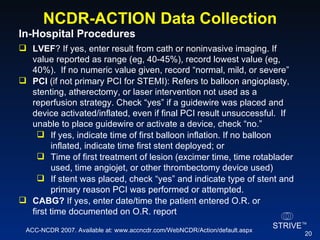
NCDR-ACTION Data Collection In-Hospital Procedures  LVEF ? If yes, enter result from cath or noninvasive imaging. If value reported as range (eg, 40-45%), record lowest value (eg, 40%).  If no numeric value given, record “normal, mild, or severe” PCI  (if not primary PCI for STEMI): Refers to balloon angioplasty, stenting, atherectomy, or laser intervention not used as a reperfusion strategy. Check “yes” if a guidewire was placed and device activated/inflated, even if final PCI result unsuccessful.  If unable to place guidewire or activate a device, check “no.” If yes, indicate time of first balloon inflation. If no balloon inflated, indicate time first stent deployed; or Time of first treatment of lesion (excimer time, time rotablader used, time angiojet, or other thrombectomy device used) If stent was placed, check “yes” and indicate type of stent and primary reason PCI was performed or attempted. CABG?  If yes, enter date/time the patient entered O.R. or first time documented on O.R. report ACC-NCDR 2007. Available at: www.accncdr.com/WebNCDR/Action/default.aspx
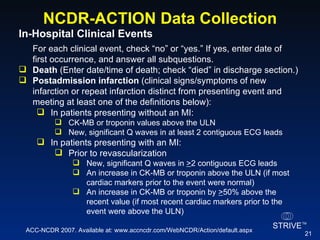
NCDR-ACTION Data Collection In-Hospital Clinical Events  For each clinical event, check “no” or “yes.” If yes, enter date of first occurrence, and answer all subquestions. Death  (Enter date/time of death; check “died” in discharge section.) Postadmission infarction  (clinical signs/symptoms of new infarction or repeat infarction distinct from presenting event and meeting at least one of the definitions below): In patients presenting without an MI: CK-MB or troponin values above the ULN New, significant Q waves in at least 2 contiguous ECG leads In patients presenting with an MI: Prior to revascularization New, significant Q waves in  > 2 contiguous ECG leads An increase in CK-MB or troponin above the ULN (if most cardiac markers prior to the event were normal) An increase in CK-MB or troponin by  > 50% above the recent value (if most recent cardiac markers prior to the event were above the ULN) ACC-NCDR 2007. Available at: www.accncdr.com/WebNCDR/Action/default.aspx
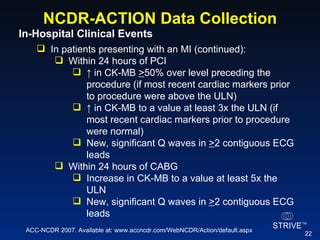
NCDR-ACTION Data Collection In-Hospital Clinical Events  In patients presenting with an MI (continued): Within 24 hours of PCI ↑  in CK-MB  > 50% over level preceding the procedure (if most recent cardiac markers prior to procedure were above the ULN) ↑  in CK-MB to a value at least 3x the ULN (if most recent cardiac markers prior to procedure were normal) New, significant Q waves in  > 2 contiguous ECG leads Within 24 hours of CABG Increase in CK-MB to a value at least 5x the ULN New, significant Q waves in  > 2 contiguous ECG leads ACC-NCDR 2007. Available at: www.accncdr.com/WebNCDR/Action/default.aspx
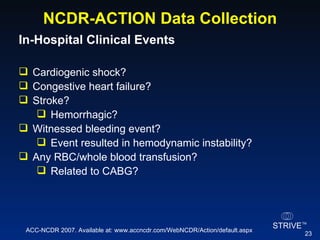
NCDR-ACTION Data Collection In-Hospital Clinical Events  Cardiogenic shock?  Congestive heart failure? Stroke? Hemorrhagic? Witnessed bleeding event? Event resulted in hemodynamic instability? Any RBC/whole blood transfusion? Related to CABG? ACC-NCDR 2007. Available at: www.accncdr.com/WebNCDR/Action/default.aspx
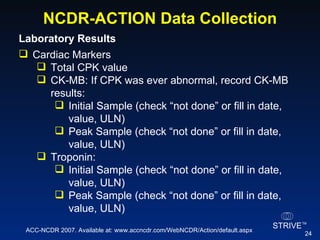
NCDR-ACTION Data Collection Laboratory Results  Cardiac Markers  Total CPK value  CK-MB: If CPK was ever abnormal, record CK-MB results: Initial Sample (check “not done” or fill in date, value, ULN) Peak Sample (check “not done” or fill in date, value, ULN) Troponin: Initial Sample (check “not done” or fill in date, value, ULN) Peak Sample (check “not done” or fill in date, value, ULN) ACC-NCDR 2007. Available at: www.accncdr.com/WebNCDR/Action/default.aspx
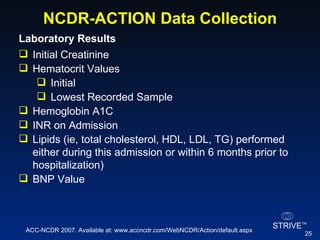
NCDR-ACTION Data Collection Laboratory Results  Initial Creatinine Hematocrit Values Initial Lowest Recorded Sample Hemoglobin A1C INR on Admission Lipids (ie, total cholesterol, HDL, LDL, TG) performed either during this admission or within 6 months prior to  hospitalization) BNP Value ACC-NCDR 2007. Available at: www.accncdr.com/WebNCDR/Action/default.aspx
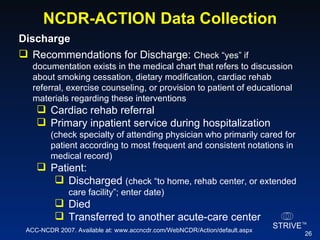
NCDR-ACTION Data Collection Discharge  Recommendations for Discharge:  Check “yes” if documentation exists in the medical chart that refers to discussion about smoking cessation, dietary modification, cardiac rehab referral, exercise counseling, or provision to patient of educational materials regarding these interventions Cardiac rehab referral Primary inpatient service during hospitalization  (check specialty of attending physician who primarily cared for patient according to most frequent and consistent notations in medical record) Patient:  Discharged  (check “to home, rehab center, or extended care facility”; enter date) Died Transferred to another acute-care center ACC-NCDR 2007. Available at: www.accncdr.com/WebNCDR/Action/default.aspx
NCDR-ACTION Registry TM Enrollment and data collection has started First NCDR-ACTION Registry report will include first quarter 2007 (January to March 2007) data and is tentatively scheduled to be distributed in August 2007 and quarterly from that time forward Current CRUSADE  and NRMI participants will receive FAQs unique to their participation For more information, contact the NCDR-ACTION Registry by e-mail or phone: ncdr@acc.org  1-800-257-4737 ACC-NCDR 2007. Available at: www.accncdr.com/WebNCDR/Action/default.aspx
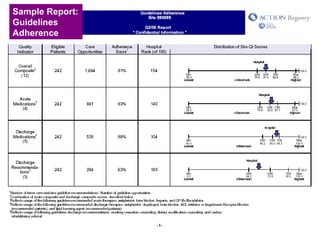
NCDR-ACTION Registry Sample Report: Guidelines Adherence Sample Report: Guidelines Adherence
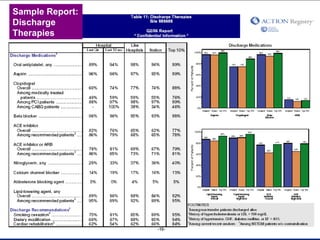
NCDR-ACTION Registry Sample Report: Discharge Therapies Sample Report: Discharge Therapies
CRUSADE Update  C an  R apid Risk Stratification of  U nstable Angina  Patients  S uppress  AD verse Outcomes with  E arly Implementation of the ACC/AHA Guidelines
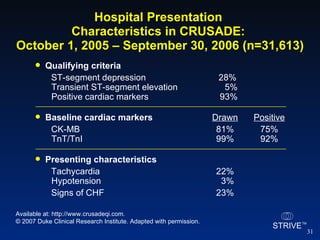
Hospital Presentation  Characteristics in CRUSADE:  October 1, 2005 – September 30, 2006 (n=31,613) Qualifying criteria ST-segment depression   28% Transient ST-segment elevation   5% Positive cardiac markers   93% Baseline cardiac markers Drawn Positive CK-MB 81% 75% TnT/TnI 99% 92% Presenting characteristics   Tachycardia 22% Hypotension   3% Signs of CHF 23% Available at: http://www.crusadeqi.com. © 2007 Duke Clinical Research Institute. Adapted with permission.
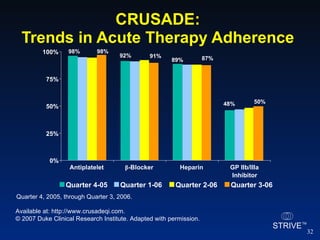
CRUSADE:  Trends in Acute Therapy Adherence  Available at: http://www.crusadeqi.com. © 2007 Duke Clinical Research Institute. Adapted with permission.  98% 92% 89% 48% 98% 91% 87% 50% 0% 25% 50% 75% 100% Antiplatelet β - Blocker Heparin GP IIb/IIIa Inhibitor Quarter 4, 2005, through Quarter 3, 2006.  Quarter 4-05 Quarter 1-06 Quarter 2-06 Quarter 3-06
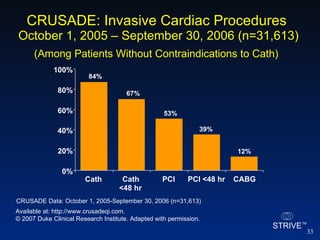
CRUSADE Data: October 1, 2005-September 30, 2006 (n=31,613) CRUSADE: Invasive Cardiac Procedures   October 1, 2005 – September 30, 2006 (n=31,613) (Among Patients Without Contraindications to Cath)   Available at: http://www.crusadeqi.com. © 2007 Duke Clinical Research Institute. Adapted with permission.  84% 67% 53% 39% 12% 0% 20% 40% 60% 80% 100% Cath Cath <48 hr PCI PCI <48 hr CABG
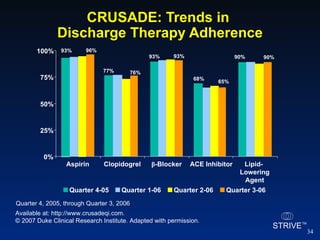
CRUSADE: Trends in  Discharge Therapy Adherence Quarter 4, 2005, through Quarter 3, 2006 Available at: http://www.crusadeqi.com. © 2007 Duke Clinical Research Institute. Adapted with permission.  93% 77% 93% 68% 90% 76% 93% 65% 90% 96% 0% 25% 50% 75% 100% Aspirin Clopidogrel β - Blocker ACE Inhibitor Lipid-  Lowering Agent Quarter 4-05 Quarter 1-06 Quarter 2-06 Quarter 3-06
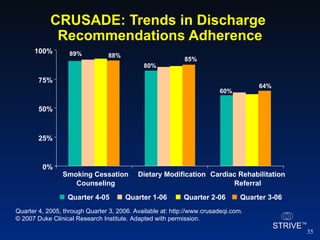
CRUSADE: Trends in Discharge  Recommendations Adherence 89% 80% 60% 85% 64% 88% 0% 25% 50% 75% 100% Smoking Cessation Counseling Dietary Modification Cardiac Rehabilitation Referral Quarter 4, 2005, through Quarter 3, 2006. Available at: http://www.crusadeqi.com. © 2007 Duke Clinical Research Institute. Adapted with permission.  Quarter 4-05 Quarter 1-06 Quarter 2-06 Quarter 3-06
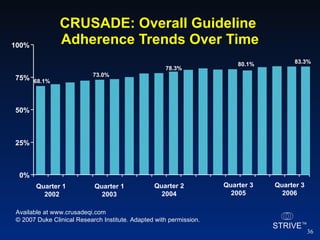
CRUSADE: Overall Guideline  Adherence Trends Over Time Available at www.crusadeqi.com  © 2007 Duke Clinical Research Institute. Adapted with permission.  Quarter 1  2002 Quarter 1 2003 Quarter 2 2004 Quarter 3 2005 Quarter 3 2006 68.1% 73.0% 78.3% 80.1% 83.3% 0% 25% 50% 75% 100%
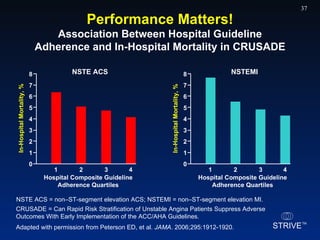
Performance Matters!   Association Between Hospital Guideline  Adherence and In-Hospital Mortality in CRUSADE Adapted with permission from Peterson ED, et al.  JAMA . 2006;295:1912-1920. NSTE ACS = non–ST-segment elevation ACS; NSTEMI = non–ST-segment elevation MI. 8 7 6 5 4 3 2 1 0 1 2 3 4 In-Hospital Mortality, % Hospital Composite Guideline Adherence Quartiles NSTE ACS 8 7 6 5 4 3 2 1 0 1 2 3 4 In-Hospital Mortality, % Hospital Composite Guideline Adherence Quartiles NSTEMI CRUSADE =  Can Rapid Risk Stratification of Unstable Angina Patients Suppress Adverse Outcomes With Early Implementation of the ACC/AHA Guidelines.
Featured Institution Albert Einstein Medical Center Philadelphia, Pennsylvania
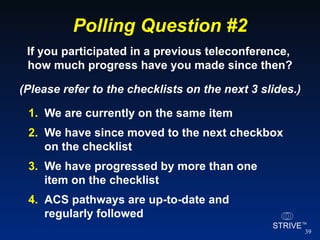
Polling Question #2 We are currently on the same item We have since moved to the next checkbox on the checklist We have progressed by more than one  item on the checklist ACS pathways are up-to-date and  regularly followed If you participated in a previous teleconference,  how much progress have you made since then? (Please refer to the checklists on the next 3 slides.)
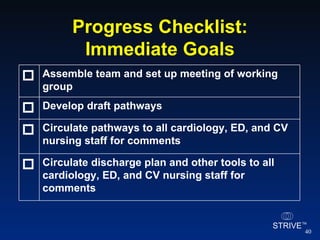
Progress Checklist: Immediate Goals Circulate discharge plan and other tools to all cardiology, ED, and CV nursing staff for comments  Circulate pathways to all cardiology, ED, and CV nursing staff for comments   Develop draft pathways  Assemble team and set up meeting of working group 
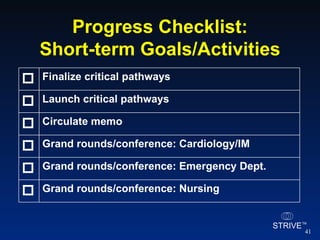
Progress Checklist: Short-term Goals/Activities Grand rounds/conference: Cardiology/IM  Grand rounds/conference: Emergency Dept.  Grand rounds/conference: Nursing  Circulate memo   Launch critical pathways  Finalize critical pathways 
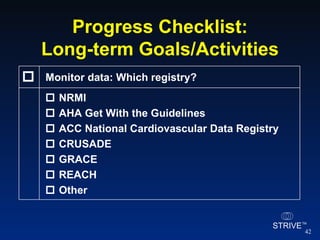
Progress Checklist: Long-term Goals/Activities    NRMI    AHA Get With the Guidelines    ACC National Cardiovascular Data Registry    CRUSADE    GRACE    REACH    Other Monitor data: Which registry? 
Question-and-Answer  Session
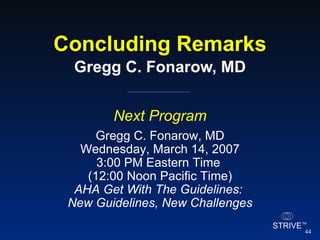
Concluding Remarks Gregg C. Fonarow, MD Next Program Gregg C. Fonarow, MD Wednesday, March 14, 2007 3:00 PM Eastern Time  (12:00 Noon Pacific Time) AHA Get With The Guidelines:  New Guidelines, New Challenges

Strive Teleconf Presentation Feb14 2007

  • 1.
    ACS Critical Pathways 2007 Teleconferences This activity is supported by an educational grant from the Bristol-Myers Squibb/Sanofi Pharmaceuticals Partnership. February 14, 2007
  • 2.
    Faculty Gregg C.Fonarow, M D Eliot Corday Professor of Medicine and Cardiovascular Science Director, Ahmanson-UCLA Cardiomyopathy Center UCLA Division of Cardiology UCLA Medical Center Los Angeles, California
  • 3.
    Disclosure Statement TheNetwork for Continuing Medical Education requires that CME faculty disclose, during the planning of an activity, the existence of any personal financial or other relationships they or their spouses/partners have with the commercial supporter of the activity or with the manufacturer of any commercial product or service discussed in the activity.
  • 4.
    Faculty Disclosure StatementGregg C. Fonarow, MD , has served as a consultant to and has received research support and honoraria from Bristol-Myers Squibb Company, GlaxoSmithKline, Merck & Co., Inc., Pfizer Inc, sanofi-aventis, Schering-Plough Corporation, and Scios, Inc. Gary S. Ledley, MD, of Albert Einstein Medical Center and Thomas Jefferson University, reports no such relationships.
  • 5.
    The NCDR-ACTION Registry:Combining the Power and Resources of CRUSADE and NRMI Gregg C. Fonarow, MD
  • 6.
    Polling Question #1Yes No Does your institution currently participate in an acute coronary syndromes registry?
  • 7.
    NCDR-ACTION Registry TMIn January 2007, the ACC (in conjunction with the Duke Clinical Research Institute) launched the National Cardiovascular Data Registry— A cute C oronary T reatment and I ntervention O utcomes N etwork (NCDR-ACTION TM ) Largest, most comprehensive national cardiovascular patient database ever developed Overall purpose: measure clinically-relevant quality indicators in the treatment of ACS (STEMI and NSTEMI); promote national quality improvement Combines data collection/quality reporting features of: NRMI (National Registry of Myocardial Infarction) CRUSADE ( C an R apid Risk Stratification of U nstable Angina Patients S uppress AD verse Outcomes with E arly Implementation of the ACC/AHA Guidelines) ACC-NCDR 2007. Available at: www.accncdr.com/WebNCDR/Action/default.aspx
  • 8.
    NCDR-ACTION Registry TM Features Web-based data collection and download tool Embedded data elements used for JCAHO/CMS reporting can be entered into the ACTION Registry™ and then downloaded for other uses Quarterly comparative institutional outcomes reports to enable benchmarking with peers and the national experience Participant training resources (user manuals, workshops, and annual user group meetings) Tools to advance hospital quality improvement No cost to participate – sponsored by Genentech, Schering-Plough, and BMS/Sanofi Partnership ACC-NCDR 2007. Available at: www.accncdr.com/WebNCDR/Action/default.aspx
  • 9.
    NCDR-ACTION Data CollectionInclusion Criteria Patients must present for acute ischemic symptoms (typically reflected by primary admission diagnosis of STEMI, NSTEMI) Patients admitted for other reasons who develop ischemic symptoms and positive cardiac markers during hospitalization are not eligible Patients who present with ischemic symptoms without positive markers on admission, may be included if they evolve ↑ cardiac markers in the first 24 hours of hospitalization ACC-NCDR 2007. Available at: www.accncdr.com/WebNCDR/Action/default.aspx
  • 10.
    NCDR-ACTION Data CollectionPresentation Features to be Collected: Arrival time at participating hospital Transfer in from an outside hospital? Patient transported by EMS? First 12-lead ECG obtained pre-hospital? ECG findings: ST-depression ( > 0.5 mm) Transient ST-elevation (<1.0 mm) for <10 min New LBBB Persistent ST-elevation T-wave inversion ACC-NCDR 2007. Available at: www.accncdr.com/WebNCDR/Action/default.aspx
  • 11.
    NCDR-ACTION Data CollectionPresentation Features to be Collected: Location first evaluated? (refers to first evaluation at your hospital) Emergency department (ED) -> Transferred from ED (if patient was first evaluated in the ED, enter date/time patient was moved out of ED, either to another location within your hospital or to another acute care center) ICU/CCU/Telemetry/Cardiac Floor Cath Lab Other/noncardiac ACC-NCDR 2007. Available at: www.accncdr.com/WebNCDR/Action/default.aspx
  • 12.
    NCDR-ACTION Data CollectionSigns and Symptoms at Presentation: Onset date and time of ischemic symptoms:______ Signs of Congestive Heart Failure (CHF)? Mild CHF Severe CHF Cardiogenic Shock Positive cardiac markers? (check if any present within first 24 hours of admission): Troponin I or T Creatine kinase-myocardial band (CK-MB) Positive bedside troponin assay Heart rate on admission:_________ Systolic blood pressure on admission:_________ ACC-NCDR 2007. Available at: www.accncdr.com/WebNCDR/Action/default.aspx
  • 13.
    NCDR-ACTION Data CollectionDemographics: Age___, Sex___, Wt___, Height___, Race_______ Hispanic origin? (check if patient reports a Cuban, Mexican, Puerto Rican, South or Central American, or any other Spanish culture or origin, regardless of race) Insurance Status HMO/private? Medicare? Medicaid? Self/none? Military/VAMC? ACC-NCDR 2007. Available at: www.accncdr.com/WebNCDR/Action/default.aspx
  • 14.
    NCDR-ACTION Data CollectionMedical History: Hypertension? Diabetes mellitus? Peripheral arterial disease? Claudication, either with exertion or at rest Amputation for arterial vascular insufficiency Vascular reconstruction, bypass surgery, or percutaneous intervention to the extremities Documented aortic aneurysm Positive noninvasive (eg, ABI <0.8) Current/recent smoker? Dyslipidemia? Prior MI, PCI, or CABG? Prior CHF? Prior stroke? Current dialysis? ACC-NCDR 2007. Available at: www.accncdr.com/WebNCDR/Action/default.aspx
  • 15.
    NCDR-ACTION Data CollectionMedications (Check all that apply): Home medications (check if the patient has been taking the medicine routinely at home prior to this hospitalization) Medications in first 24 hours of treatment (enter date/time of initial dose and amount of dose) Aspirin _____________ Clopidogrel __________ Beta blocker ____________ ACE inhibitor ______________ Angiotensin Receptor Blocker (ARB) ________ Statin _____________ Other lipid-lowering agent (nonstatin) _______ Documented evidence of acute contraindication ACC-NCDR 2007. Available at: www.accncdr.com/WebNCDR/Action/default.aspx
  • 16.
    NCDR-ACTION Data CollectionGP IIb-IIIa Inhibitor Type of Medication: Check if GP IIb-IIIa was administered during the hospital stay. If yes, check the type of GP IIb-IIIa used: Eptifibatide (Integrilin); dose:_____________ Tirofiban (Aggrastat); dose: ______________ Abciximab (ReoPro); dose: ______________ Date and Time of Therapy Start (enter date/time of either the first bolus or beginning of infusion; if patient was transferred to your hospital with therapy ongoing and initiation date/time unavailable, leave blank, but complete therapy stop time) Stop (enter date/time infusion was permanently discontinued; do not record stop date/time if patient was transferred from your hospital with therapy ongoing) Documented Evidence of Contraindication ACC-NCDR 2007. Available at: www.accncdr.com/WebNCDR/Action/default.aspx

  • 17.
    NCDR-ACTION Data CollectionAnti-Thrombin Agent Type of Medication: Check if anti-thrombin was administered during the hospital stay. If yes, check the type of anti-thrombin used: IV UFH (dose:__________) LMWH (dose: _____________) Bivalirudin (dose: ___________) Fondaparinux (dose: ____________) Date and Time of Therapy IV UFH (enter date/time of 1 st IV administration; do not record SC UFH) LMWH (Record date/time of 1 st SC administration; Do not record IV LMWH) Bivalirudin (Record date/time of 1 st admin) Fondaparinux (Record date/time of 1 st admin) Documented Evidence of a Contraindication ACC-NCDR 2007. Available at: www.accncdr.com/WebNCDR/Action/default.aspx
  • 18.
    NCDR-ACTION Data CollectionIn-Hospital Procedures Reperfusion Tx? ( < 12h from symptom onset?) If yes: Thrombolytic therapy? (date/time of first bolus or beginning of infusion; indicate type of lytic first administered and the dose strength) Primary PCI? (time patient arrived to cath lab where PCI performed; time first device activated): Time of first balloon inflation; if no balloon inflated, then time first stent deployed, or Time of first treatment of lesion (eximer time, time rotablader used, time angiojet, or other device) Stent placed? Indicate type and reason for PCI If no reperfusion therapy administered, document evidence of contraindication ACC-NCDR 2007. Available at: www.accncdr.com/WebNCDR/Action/default.aspx
  • 19.
    NCDR-ACTION Data CollectionIn-Hospital Procedures Noninvasive stress testing (refers to exercise or pharmacologic stress testing with or without echo or radionuclide imaging) Date of procedure: _________ Diagnostic Cath: Enter date/time vascular access obtained or 1st time documented on cath report. Select all vessels with > 50% stenosis, including native stenosis in vessels perfused by a graft. If stenosis located in a marginal branch, record location of stenosis as parent vessel: LM: Left main artery LAD: Left anterior descending artery LCX/CX: Left circumflex artery RCA: Right coronary artery Graft: Saphenous vein or artery, or internal mammary artery graft If no cath, document evidence of contraindication ACC-NCDR 2007. Available at: www.accncdr.com/WebNCDR/Action/default.aspx
  • 20.
    NCDR-ACTION Data CollectionIn-Hospital Procedures LVEF ? If yes, enter result from cath or noninvasive imaging. If value reported as range (eg, 40-45%), record lowest value (eg, 40%). If no numeric value given, record “normal, mild, or severe” PCI (if not primary PCI for STEMI): Refers to balloon angioplasty, stenting, atherectomy, or laser intervention not used as a reperfusion strategy. Check “yes” if a guidewire was placed and device activated/inflated, even if final PCI result unsuccessful. If unable to place guidewire or activate a device, check “no.” If yes, indicate time of first balloon inflation. If no balloon inflated, indicate time first stent deployed; or Time of first treatment of lesion (excimer time, time rotablader used, time angiojet, or other thrombectomy device used) If stent was placed, check “yes” and indicate type of stent and primary reason PCI was performed or attempted. CABG? If yes, enter date/time the patient entered O.R. or first time documented on O.R. report ACC-NCDR 2007. Available at: www.accncdr.com/WebNCDR/Action/default.aspx
  • 21.
    NCDR-ACTION Data CollectionIn-Hospital Clinical Events For each clinical event, check “no” or “yes.” If yes, enter date of first occurrence, and answer all subquestions. Death (Enter date/time of death; check “died” in discharge section.) Postadmission infarction (clinical signs/symptoms of new infarction or repeat infarction distinct from presenting event and meeting at least one of the definitions below): In patients presenting without an MI: CK-MB or troponin values above the ULN New, significant Q waves in at least 2 contiguous ECG leads In patients presenting with an MI: Prior to revascularization New, significant Q waves in > 2 contiguous ECG leads An increase in CK-MB or troponin above the ULN (if most cardiac markers prior to the event were normal) An increase in CK-MB or troponin by > 50% above the recent value (if most recent cardiac markers prior to the event were above the ULN) ACC-NCDR 2007. Available at: www.accncdr.com/WebNCDR/Action/default.aspx
  • 22.
    NCDR-ACTION Data CollectionIn-Hospital Clinical Events In patients presenting with an MI (continued): Within 24 hours of PCI ↑ in CK-MB > 50% over level preceding the procedure (if most recent cardiac markers prior to procedure were above the ULN) ↑ in CK-MB to a value at least 3x the ULN (if most recent cardiac markers prior to procedure were normal) New, significant Q waves in > 2 contiguous ECG leads Within 24 hours of CABG Increase in CK-MB to a value at least 5x the ULN New, significant Q waves in > 2 contiguous ECG leads ACC-NCDR 2007. Available at: www.accncdr.com/WebNCDR/Action/default.aspx
  • 23.
    NCDR-ACTION Data CollectionIn-Hospital Clinical Events Cardiogenic shock? Congestive heart failure? Stroke? Hemorrhagic? Witnessed bleeding event? Event resulted in hemodynamic instability? Any RBC/whole blood transfusion? Related to CABG? ACC-NCDR 2007. Available at: www.accncdr.com/WebNCDR/Action/default.aspx
  • 24.
    NCDR-ACTION Data CollectionLaboratory Results Cardiac Markers Total CPK value CK-MB: If CPK was ever abnormal, record CK-MB results: Initial Sample (check “not done” or fill in date, value, ULN) Peak Sample (check “not done” or fill in date, value, ULN) Troponin: Initial Sample (check “not done” or fill in date, value, ULN) Peak Sample (check “not done” or fill in date, value, ULN) ACC-NCDR 2007. Available at: www.accncdr.com/WebNCDR/Action/default.aspx
  • 25.
    NCDR-ACTION Data CollectionLaboratory Results Initial Creatinine Hematocrit Values Initial Lowest Recorded Sample Hemoglobin A1C INR on Admission Lipids (ie, total cholesterol, HDL, LDL, TG) performed either during this admission or within 6 months prior to hospitalization) BNP Value ACC-NCDR 2007. Available at: www.accncdr.com/WebNCDR/Action/default.aspx
  • 26.
    NCDR-ACTION Data CollectionDischarge Recommendations for Discharge: Check “yes” if documentation exists in the medical chart that refers to discussion about smoking cessation, dietary modification, cardiac rehab referral, exercise counseling, or provision to patient of educational materials regarding these interventions Cardiac rehab referral Primary inpatient service during hospitalization (check specialty of attending physician who primarily cared for patient according to most frequent and consistent notations in medical record) Patient: Discharged (check “to home, rehab center, or extended care facility”; enter date) Died Transferred to another acute-care center ACC-NCDR 2007. Available at: www.accncdr.com/WebNCDR/Action/default.aspx
  • 27.
    NCDR-ACTION Registry TMEnrollment and data collection has started First NCDR-ACTION Registry report will include first quarter 2007 (January to March 2007) data and is tentatively scheduled to be distributed in August 2007 and quarterly from that time forward Current CRUSADE and NRMI participants will receive FAQs unique to their participation For more information, contact the NCDR-ACTION Registry by e-mail or phone: ncdr@acc.org 1-800-257-4737 ACC-NCDR 2007. Available at: www.accncdr.com/WebNCDR/Action/default.aspx
  • 28.
    NCDR-ACTION Registry SampleReport: Guidelines Adherence Sample Report: Guidelines Adherence
  • 29.
    NCDR-ACTION Registry SampleReport: Discharge Therapies Sample Report: Discharge Therapies
  • 30.
    CRUSADE Update C an R apid Risk Stratification of U nstable Angina Patients S uppress AD verse Outcomes with E arly Implementation of the ACC/AHA Guidelines
  • 31.
    Hospital Presentation Characteristics in CRUSADE: October 1, 2005 – September 30, 2006 (n=31,613) Qualifying criteria ST-segment depression 28% Transient ST-segment elevation 5% Positive cardiac markers 93% Baseline cardiac markers Drawn Positive CK-MB 81% 75% TnT/TnI 99% 92% Presenting characteristics Tachycardia 22% Hypotension 3% Signs of CHF 23% Available at: http://www.crusadeqi.com. © 2007 Duke Clinical Research Institute. Adapted with permission.
  • 32.
    CRUSADE: Trendsin Acute Therapy Adherence Available at: http://www.crusadeqi.com. © 2007 Duke Clinical Research Institute. Adapted with permission. 98% 92% 89% 48% 98% 91% 87% 50% 0% 25% 50% 75% 100% Antiplatelet β - Blocker Heparin GP IIb/IIIa Inhibitor Quarter 4, 2005, through Quarter 3, 2006. Quarter 4-05 Quarter 1-06 Quarter 2-06 Quarter 3-06
  • 33.
    CRUSADE Data: October1, 2005-September 30, 2006 (n=31,613) CRUSADE: Invasive Cardiac Procedures October 1, 2005 – September 30, 2006 (n=31,613) (Among Patients Without Contraindications to Cath) Available at: http://www.crusadeqi.com. © 2007 Duke Clinical Research Institute. Adapted with permission. 84% 67% 53% 39% 12% 0% 20% 40% 60% 80% 100% Cath Cath <48 hr PCI PCI <48 hr CABG
  • 34.
    CRUSADE: Trends in Discharge Therapy Adherence Quarter 4, 2005, through Quarter 3, 2006 Available at: http://www.crusadeqi.com. © 2007 Duke Clinical Research Institute. Adapted with permission. 93% 77% 93% 68% 90% 76% 93% 65% 90% 96% 0% 25% 50% 75% 100% Aspirin Clopidogrel β - Blocker ACE Inhibitor Lipid- Lowering Agent Quarter 4-05 Quarter 1-06 Quarter 2-06 Quarter 3-06
  • 35.
    CRUSADE: Trends inDischarge Recommendations Adherence 89% 80% 60% 85% 64% 88% 0% 25% 50% 75% 100% Smoking Cessation Counseling Dietary Modification Cardiac Rehabilitation Referral Quarter 4, 2005, through Quarter 3, 2006. Available at: http://www.crusadeqi.com. © 2007 Duke Clinical Research Institute. Adapted with permission. Quarter 4-05 Quarter 1-06 Quarter 2-06 Quarter 3-06
  • 36.
    CRUSADE: Overall Guideline Adherence Trends Over Time Available at www.crusadeqi.com © 2007 Duke Clinical Research Institute. Adapted with permission. Quarter 1 2002 Quarter 1 2003 Quarter 2 2004 Quarter 3 2005 Quarter 3 2006 68.1% 73.0% 78.3% 80.1% 83.3% 0% 25% 50% 75% 100%
  • 37.
    Performance Matters! Association Between Hospital Guideline Adherence and In-Hospital Mortality in CRUSADE Adapted with permission from Peterson ED, et al. JAMA . 2006;295:1912-1920. NSTE ACS = non–ST-segment elevation ACS; NSTEMI = non–ST-segment elevation MI. 8 7 6 5 4 3 2 1 0 1 2 3 4 In-Hospital Mortality, % Hospital Composite Guideline Adherence Quartiles NSTE ACS 8 7 6 5 4 3 2 1 0 1 2 3 4 In-Hospital Mortality, % Hospital Composite Guideline Adherence Quartiles NSTEMI CRUSADE = Can Rapid Risk Stratification of Unstable Angina Patients Suppress Adverse Outcomes With Early Implementation of the ACC/AHA Guidelines.
  • 38.
    Featured Institution AlbertEinstein Medical Center Philadelphia, Pennsylvania
  • 39.
    Polling Question #2We are currently on the same item We have since moved to the next checkbox on the checklist We have progressed by more than one item on the checklist ACS pathways are up-to-date and regularly followed If you participated in a previous teleconference, how much progress have you made since then? (Please refer to the checklists on the next 3 slides.)
  • 40.
    Progress Checklist: ImmediateGoals Circulate discharge plan and other tools to all cardiology, ED, and CV nursing staff for comments  Circulate pathways to all cardiology, ED, and CV nursing staff for comments  Develop draft pathways  Assemble team and set up meeting of working group 
  • 41.
    Progress Checklist: Short-termGoals/Activities Grand rounds/conference: Cardiology/IM  Grand rounds/conference: Emergency Dept.  Grand rounds/conference: Nursing  Circulate memo  Launch critical pathways  Finalize critical pathways 
  • 42.
    Progress Checklist: Long-termGoals/Activities  NRMI  AHA Get With the Guidelines  ACC National Cardiovascular Data Registry  CRUSADE  GRACE  REACH  Other Monitor data: Which registry? 
  • 43.
  • 44.
    Concluding Remarks GreggC. Fonarow, MD Next Program Gregg C. Fonarow, MD Wednesday, March 14, 2007 3:00 PM Eastern Time (12:00 Noon Pacific Time) AHA Get With The Guidelines: New Guidelines, New Challenges