HUM10
World
Religions
CHRISTIANIT
Y
1. Christianity’s
origin story
 Grows out of story of Jesus
 Begun by Jesus’s followers after his
death (circa 33 C.E.)
 Jesus himself didn’t attempt to
found a new religion
 Jesus did attempt to seek a new
social order (Smith 206)
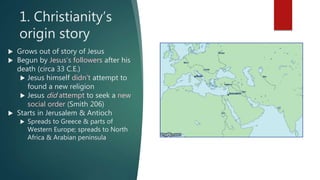
 Starts in Jerusalem & Antioch
 Spreads to Greece & parts of
Western Europe; spreads to North
Africa & Arabian peninsula
2. The Historical Jesus
 Born Palestine – 4 B.C.E. – during reign of Caesar
Augustus (Roman empire)
 raised in Nazareth
 Jewish
 Adult public ministry can be understood in reference to
Jewish prophetic tradition
 Question: Why is it important to understand “the
historical Jesus” & the context out of which he came?
3. Historical Jesus the Prophet
 Smith describes 3 examples of Jesus in Jewish
prophetic tradition:
 (1) Baptized as prophet by John the Baptist (207)
Fasting & solitude  access to divine power
 (2) Utilized power of supernatural realm (divine) to
perform miracles – aim was to heal humanity (207)
Spirit > nature
 (3) Sought to disrupt social order by emphasizing
Yahweh’s compassion (208)
Rejection of Jewish social order via Pharisaical
holiness code (social stratification)  tearing down
social barriers
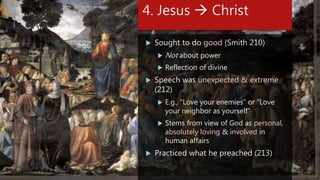
4. Jesus  Christ
 Sought to do good (Smith 210)
 Not about power
 Reflection of divine
 Speech was unexpected & extreme
(212)
 E.g., “Love your enemies” or “Love
your neighbor as yourself”
 Stems from view of God as personal,
absolutely loving & involved in
human affairs
 Practiced what he preached (213)
“
”
…it seemed to those who knew him best that
here was a man in whom the human ego had
disappeared, leaving his life so completely
under the will of God that it was transparent
to that will.
HUSTON SMITH, 213
Smith reminds us that we don’t quite know what Jesus thought
of himself because he didn’t really talk much about himself.
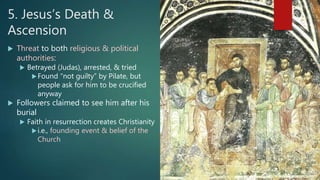
5. Jesus’s Death &
Ascension
 Threat to both religious & political
authorities:
 Betrayed (Judas), arrested, & tried
Found “not guilty” by Pilate, but
people ask for him to be crucified
anyway
 Followers claimed to see him after his
burial
 Faith in resurrection creates Christianity
i.e., founding event & belief of the
Church
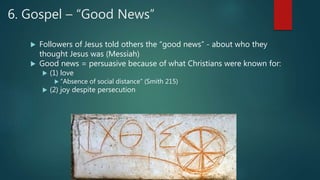
6. Gospel – “Good News”
 Followers of Jesus told others the “good news” - about who they
thought Jesus was (Messiah)
 Good news = persuasive because of what Christians were known for:
 (1) love
 “Absence of social distance” (Smith 215)
 (2) joy despite persecution
7. Humanity’s problem + solution
 Problem: sin / disconnection
from God; misdirected or
misaligned affection
 Solution: salvation through
faith/works/combo
 Faith in God / salvific power of
Christ’s death & resurrection
 Good works
 Original sin:
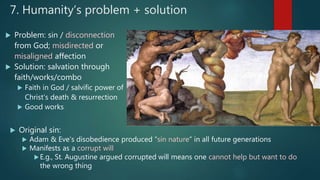
 Adam & Eve’s disobedience produced “sin nature” in all future generations
 Manifests as a corrupt will
E.g., St. Augustine argued corrupted will means one cannot help but want to do
the wrong thing
8. Distinguishing
Characteristics
 Differences in views of God & humanity
 Trinity
 Original Sin
 Incarnation
 Atonement theories
 “Body of Christ”
9. Picture of God / Humanity
 Christianity’s picture of God & humanity is similar in some ways to Jewish
picture – shared tradition
 Monotheistic God as personal, omnipotent (all-powerful), omnibenevolent (all-
good); omniscient (all-knowing)
 Shared view of humanity as made in image of God (rooted in Genesis 1)
 But it has significant differences from Jewish view:
 Doctrine of Incarnation:
God became human (Jesus)
Therefore, Jesus = God
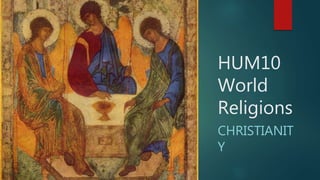
 Doctrine of Trinity:
God is one and God is three – One eternal God existing in three persons:
Father (Parent), Son (Child), and Holy Spirit
 Doctrine of original sin  humans are corrupted; “sinners”
10. What do these differences imply?
Unlike many of the other traditions we’ve looked at thus far,
belief is really important for Christianity.
Relatedly, theology is also important for Christianity.
(Theology = “systematization of thoughts about the symbols
that religious experience gives rise to,” (Smith 218)
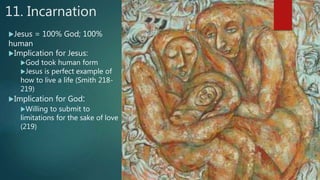
11. Incarnation
Jesus = 100% God; 100%
human
Implication for Jesus:
God took human form
Jesus is perfect example of
how to live a life (Smith 218-
219)
Implication for God:
Willing to submit to
limitations for the sake of love
(219)
12. What is Atonement?
 Atonement: “At-one-ment’ – explanation of the reconciliation of humanity
to God through Christ
 Smith calls it a recovering of wholeness (220)
 Smith offers two primary metaphors of atonement:
 Legalistic (disobedience caused distance that must be rectified)
 Bondage (to sin/self-love)
13. Orthodox View of Atonement
 Orthodox: Recapitulation Theory:
 Jesus' death & resurrection restored God's image in humankind; healed the
relationship between God & humanity
 focus on resurrection, unity of God & humanity through Jesus' 2 natures
 Christians --> deification
14. Catholic view of Atonement
 Roman Catholic:
 Ransom theory (earliest theory):
 Jesus’ death and resurrection were the ransom for humanity’s souls on account of
their sin
 Satisfaction theory:
 Jesus’ death & resurrection satisfied God's need for justice in light of sin
 focus on Christ's suffering
 Christians --> repentance, following God's law
 Moral Exemplar theory:
 Jesus’ life was meant to be an example for people on how to live according to
God’s will; his death as a martyr would draw all people to model love
15. Protestant View of Atonement
 Protestant: Penal Substitution
 Jesus’ death paid the price for sin – Jesus took humanity’s place as perfect
sacrifice
 Focus on accounting for sin
 Christians  repentance + faith
 Scapegoat/Mirror Theory:
 Jesus’ death makes us confront our sin & violence that don’t get anywhere.
 Humans repent and Jesus should be the last scapegoat.
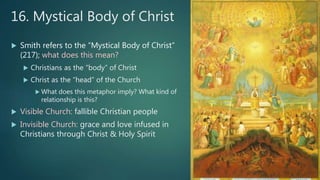
16. Mystical Body of Christ
 Smith refers to the “Mystical Body of Christ”
(217); what does this mean?
 Christians as the “body” of Christ
 Christ as the “head” of the Church
 What does this metaphor imply? What kind of
relationship is this?
 Visible Church: fallible Christian people
 Invisible Church: grace and love infused in
Christians through Christ & Holy Spirit
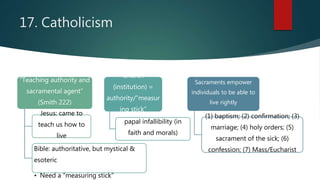
17. Catholicism
“Teaching authority and
sacramental agent”
(Smith 222)
Jesus: came to
teach us how to
live
Bible: authoritative, but mystical &
esoteric
• Need a ”measuring stick”
Church
(institution) =
authority/”measur
ing stick”
papal infallibility (in
faith and morals)
Sacraments empower
individuals to be able to
live rightly
(1) baptism; (2) confirmation; (3)
marriage; (4) holy orders; (5)
sacrament of the sick; (6)
confession; (7) Mass/Eucharist
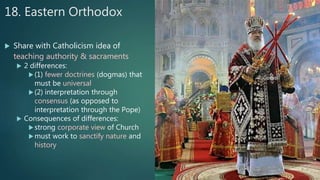
18. Eastern Orthodox
 Share with Catholicism idea of
teaching authority & sacraments
 2 differences:
(1) fewer doctrines (dogmas) that
must be universal
(2) interpretation through
consensus (as opposed to
interpretation through the Pope)
 Consequences of differences:
strong corporate view of Church
must work to sanctify nature and
history
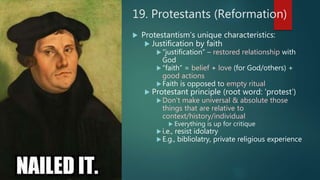
19. Protestants (Reformation)
 Protestantism’s unique characteristics:
 Justification by faith
“justification” – restored relationship with
God
“faith” = belief + love (for God/others) +
good actions
Faith is opposed to empty ritual
 Protestant principle (root word: ‘protest’)
Don’t make universal & absolute those
things that are relative to
context/history/individual
 Everything is up for critique
i.e., resist idolatry
E.g., bibliolatry, private religious experience

HUM10 Smith chapter on Christianity

  • 1.
  • 2.
    1. Christianity’s origin story Grows out of story of Jesus  Begun by Jesus’s followers after his death (circa 33 C.E.)  Jesus himself didn’t attempt to found a new religion  Jesus did attempt to seek a new social order (Smith 206)  Starts in Jerusalem & Antioch  Spreads to Greece & parts of Western Europe; spreads to North Africa & Arabian peninsula
  • 3.
    2. The HistoricalJesus  Born Palestine – 4 B.C.E. – during reign of Caesar Augustus (Roman empire)  raised in Nazareth  Jewish  Adult public ministry can be understood in reference to Jewish prophetic tradition  Question: Why is it important to understand “the historical Jesus” & the context out of which he came?
  • 4.
    3. Historical Jesusthe Prophet  Smith describes 3 examples of Jesus in Jewish prophetic tradition:  (1) Baptized as prophet by John the Baptist (207) Fasting & solitude  access to divine power  (2) Utilized power of supernatural realm (divine) to perform miracles – aim was to heal humanity (207) Spirit > nature  (3) Sought to disrupt social order by emphasizing Yahweh’s compassion (208) Rejection of Jewish social order via Pharisaical holiness code (social stratification)  tearing down social barriers
  • 5.
    4. Jesus Christ  Sought to do good (Smith 210)  Not about power  Reflection of divine  Speech was unexpected & extreme (212)  E.g., “Love your enemies” or “Love your neighbor as yourself”  Stems from view of God as personal, absolutely loving & involved in human affairs  Practiced what he preached (213)
  • 6.
    “ ” …it seemed tothose who knew him best that here was a man in whom the human ego had disappeared, leaving his life so completely under the will of God that it was transparent to that will. HUSTON SMITH, 213 Smith reminds us that we don’t quite know what Jesus thought of himself because he didn’t really talk much about himself.
  • 7.
    5. Jesus’s Death& Ascension  Threat to both religious & political authorities:  Betrayed (Judas), arrested, & tried Found “not guilty” by Pilate, but people ask for him to be crucified anyway  Followers claimed to see him after his burial  Faith in resurrection creates Christianity i.e., founding event & belief of the Church
  • 8.
    6. Gospel –“Good News”  Followers of Jesus told others the “good news” - about who they thought Jesus was (Messiah)  Good news = persuasive because of what Christians were known for:  (1) love  “Absence of social distance” (Smith 215)  (2) joy despite persecution
  • 9.
    7. Humanity’s problem+ solution  Problem: sin / disconnection from God; misdirected or misaligned affection  Solution: salvation through faith/works/combo  Faith in God / salvific power of Christ’s death & resurrection  Good works  Original sin:  Adam & Eve’s disobedience produced “sin nature” in all future generations  Manifests as a corrupt will E.g., St. Augustine argued corrupted will means one cannot help but want to do the wrong thing
  • 10.
    8. Distinguishing Characteristics  Differencesin views of God & humanity  Trinity  Original Sin  Incarnation  Atonement theories  “Body of Christ”
  • 11.
    9. Picture ofGod / Humanity  Christianity’s picture of God & humanity is similar in some ways to Jewish picture – shared tradition  Monotheistic God as personal, omnipotent (all-powerful), omnibenevolent (all- good); omniscient (all-knowing)  Shared view of humanity as made in image of God (rooted in Genesis 1)  But it has significant differences from Jewish view:  Doctrine of Incarnation: God became human (Jesus) Therefore, Jesus = God  Doctrine of Trinity: God is one and God is three – One eternal God existing in three persons: Father (Parent), Son (Child), and Holy Spirit  Doctrine of original sin  humans are corrupted; “sinners”
  • 12.
    10. What dothese differences imply? Unlike many of the other traditions we’ve looked at thus far, belief is really important for Christianity. Relatedly, theology is also important for Christianity. (Theology = “systematization of thoughts about the symbols that religious experience gives rise to,” (Smith 218)
  • 13.
    11. Incarnation Jesus =100% God; 100% human Implication for Jesus: God took human form Jesus is perfect example of how to live a life (Smith 218- 219) Implication for God: Willing to submit to limitations for the sake of love (219)
  • 14.
    12. What isAtonement?  Atonement: “At-one-ment’ – explanation of the reconciliation of humanity to God through Christ  Smith calls it a recovering of wholeness (220)  Smith offers two primary metaphors of atonement:  Legalistic (disobedience caused distance that must be rectified)  Bondage (to sin/self-love)
  • 15.
    13. Orthodox Viewof Atonement  Orthodox: Recapitulation Theory:  Jesus' death & resurrection restored God's image in humankind; healed the relationship between God & humanity  focus on resurrection, unity of God & humanity through Jesus' 2 natures  Christians --> deification
  • 16.
    14. Catholic viewof Atonement  Roman Catholic:  Ransom theory (earliest theory):  Jesus’ death and resurrection were the ransom for humanity’s souls on account of their sin  Satisfaction theory:  Jesus’ death & resurrection satisfied God's need for justice in light of sin  focus on Christ's suffering  Christians --> repentance, following God's law  Moral Exemplar theory:  Jesus’ life was meant to be an example for people on how to live according to God’s will; his death as a martyr would draw all people to model love
  • 17.
    15. Protestant Viewof Atonement  Protestant: Penal Substitution  Jesus’ death paid the price for sin – Jesus took humanity’s place as perfect sacrifice  Focus on accounting for sin  Christians  repentance + faith  Scapegoat/Mirror Theory:  Jesus’ death makes us confront our sin & violence that don’t get anywhere.  Humans repent and Jesus should be the last scapegoat.
  • 18.
    16. Mystical Bodyof Christ  Smith refers to the “Mystical Body of Christ” (217); what does this mean?  Christians as the “body” of Christ  Christ as the “head” of the Church  What does this metaphor imply? What kind of relationship is this?  Visible Church: fallible Christian people  Invisible Church: grace and love infused in Christians through Christ & Holy Spirit
  • 19.
    17. Catholicism “Teaching authorityand sacramental agent” (Smith 222) Jesus: came to teach us how to live Bible: authoritative, but mystical & esoteric • Need a ”measuring stick” Church (institution) = authority/”measur ing stick” papal infallibility (in faith and morals) Sacraments empower individuals to be able to live rightly (1) baptism; (2) confirmation; (3) marriage; (4) holy orders; (5) sacrament of the sick; (6) confession; (7) Mass/Eucharist
  • 20.
    18. Eastern Orthodox Share with Catholicism idea of teaching authority & sacraments  2 differences: (1) fewer doctrines (dogmas) that must be universal (2) interpretation through consensus (as opposed to interpretation through the Pope)  Consequences of differences: strong corporate view of Church must work to sanctify nature and history
  • 21.
    19. Protestants (Reformation) Protestantism’s unique characteristics:  Justification by faith “justification” – restored relationship with God “faith” = belief + love (for God/others) + good actions Faith is opposed to empty ritual  Protestant principle (root word: ‘protest’) Don’t make universal & absolute those things that are relative to context/history/individual  Everything is up for critique i.e., resist idolatry E.g., bibliolatry, private religious experience