Shihong Huang
Department of Computer & Electrical Engineering
and Computer Science
Florida Atlantic University
Emmanuelle Tognoli
Center for Complex Systems & Brain Sciences
Florida Atlantic University
BRAINWARE:
Synergizing
software systems & neural inputs
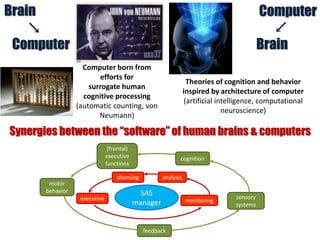
Computer born from
efforts for
surrogate human
cognitive processing
(automatic counting, von
Neumann)
Computer
Brain Computer
Brain
Theories of cognition and behavior
inspired by architecture of computer
(artificial intelligence, computational
neuroscience)
Synergies between the “software” of human brains & computers
SAS
manager monitoring
analysisplanning
executive sensory
systems
cognition
(frontal)
executive
functions
motor
behavior
feedback
GOALS:
A leap forward in Human Computer Interaction
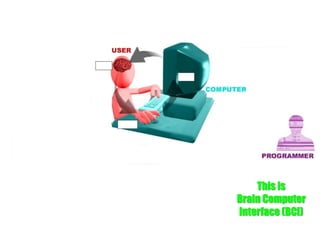
This is
Brain Computer
Interface (BCI)
BRAIN COMPUTER INTERFACE:
Principles and state of the art
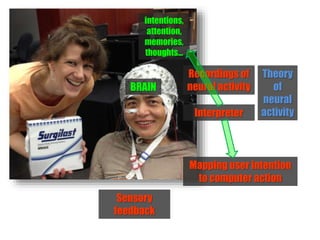
BRAIN
Recordings of
neural activity
Interpreter
Theory
of
neural
activity
Sensory
feedback
Mapping user intention
to computer action
intentions,
attention,
memories,
thoughts…
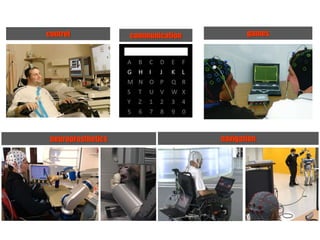
control communication
neuroprosthetics navigation
games
EXAMPLARY NEURAL INPUT:
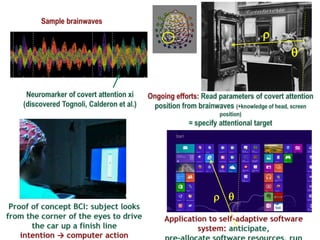
Tracking covert attention to know user’s
intention/forthcoming actions
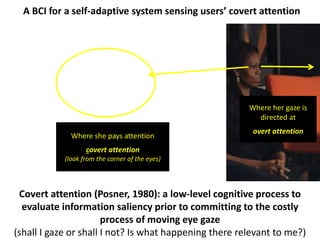
A BCI for a self-adaptive system sensing users’ covert attention
Where her gaze is
directed at
overt attention
Where she pays attention
covert attention
(look from the corner of the eyes)
Covert attention (Posner, 1980): a low-level cognitive process to
evaluate information saliency prior to committing to the costly
process of moving eye gaze
(shall I gaze or shall I not? Is what happening there relevant to me?)
q
r
qr
GENERALIZATION:
Blueprint for Software Systems that are
“Neural Input”-ready
k
l
TAKE-HOME MESSAGE:
Self-Adaptive Systems: a natural basis for the
integration of neural inputs

Huang & Tognoli: brainware Cise2014