Analysis of a relative phase
2019
Emmanuelle Tognoli – Center for Complex Systems & Brain Sciences – Florida Atlantic University
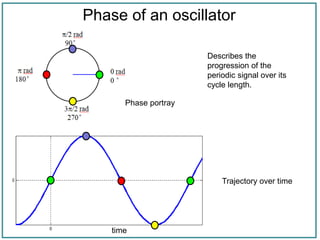
Phase of an oscillator
time
Describes the
progression of the
periodic signal over its
cycle length.
Phase portray
Trajectory over time
Coordination Variable: relative phase
Coordination inphase
Coordination
antiphase
If rpt=rpt+1=rpt+2…
Oscillations are phase-
locked
Example interpretation of the relative phase:
find periods of coordination + find the attractor(s)/attracting tendencies
Coordination (phase locking) can happen at different phase angles
Inphase (also referred
as zero lag synchrony)
(beware, “synchrony” stricto
sensu remains to be proven)
Antiphase All the others
(sometimes referred as “out-
of-phase” but read carefully,
same is also used to
designate oscillations which
are NOT phase locked)
On the good way to display the
relative phase
“The art of Behavioral Scientists”
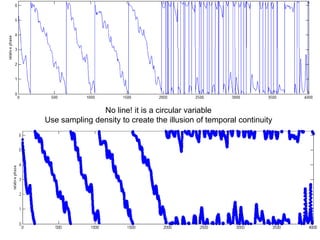
No line! it is a circular variable
Use sampling density to create the illusion of temporal continuity
Plenty of evidence suggest attractors at zero and pi radians,
offset the edge to prevent its splitting
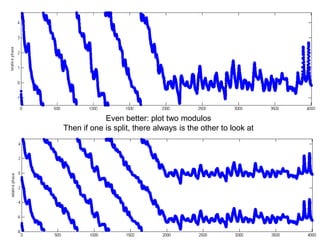
Even better: plot two modulos
Then if one is split, there always is the other to look at
Interpretation
This is called phase
wrapping:
Oscillators have different
frequencies, therefore the
angle between them
continuously grow
This is called sync or
dwell (former if
attractor is suspected,
latter for metastability).
This is metastability, the alternation of
dwells (tendencies to synchronize) and
escapes (tendencies to segregate)
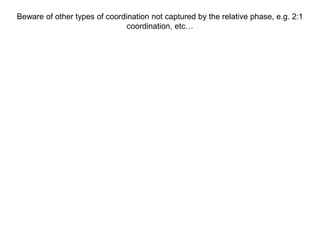
Beware of other types of coordination not captured by the relative phase, e.g. 2:1
coordination, etc…

Tognoli - analysis of the relative phase 2019

  • 1.
    Analysis of arelative phase 2019 Emmanuelle Tognoli – Center for Complex Systems & Brain Sciences – Florida Atlantic University
  • 2.
    Phase of anoscillator time Describes the progression of the periodic signal over its cycle length. Phase portray Trajectory over time
  • 3.
    Coordination Variable: relativephase Coordination inphase Coordination antiphase If rpt=rpt+1=rpt+2… Oscillations are phase- locked Example interpretation of the relative phase: find periods of coordination + find the attractor(s)/attracting tendencies
  • 4.
    Coordination (phase locking)can happen at different phase angles Inphase (also referred as zero lag synchrony) (beware, “synchrony” stricto sensu remains to be proven) Antiphase All the others (sometimes referred as “out- of-phase” but read carefully, same is also used to designate oscillations which are NOT phase locked)
  • 5.
    On the goodway to display the relative phase “The art of Behavioral Scientists”
  • 6.
    No line! itis a circular variable Use sampling density to create the illusion of temporal continuity
  • 7.
    Plenty of evidencesuggest attractors at zero and pi radians, offset the edge to prevent its splitting
  • 8.
    Even better: plottwo modulos Then if one is split, there always is the other to look at
  • 9.
    Interpretation This is calledphase wrapping: Oscillators have different frequencies, therefore the angle between them continuously grow This is called sync or dwell (former if attractor is suspected, latter for metastability). This is metastability, the alternation of dwells (tendencies to synchronize) and escapes (tendencies to segregate)
  • 10.
    Beware of othertypes of coordination not captured by the relative phase, e.g. 2:1 coordination, etc…