Brain-Machine Intelligence :
Past, Present and Future
Prof Dr Jelena Mladenović
Computing Faculty, Union University
Belgrade, Serbia
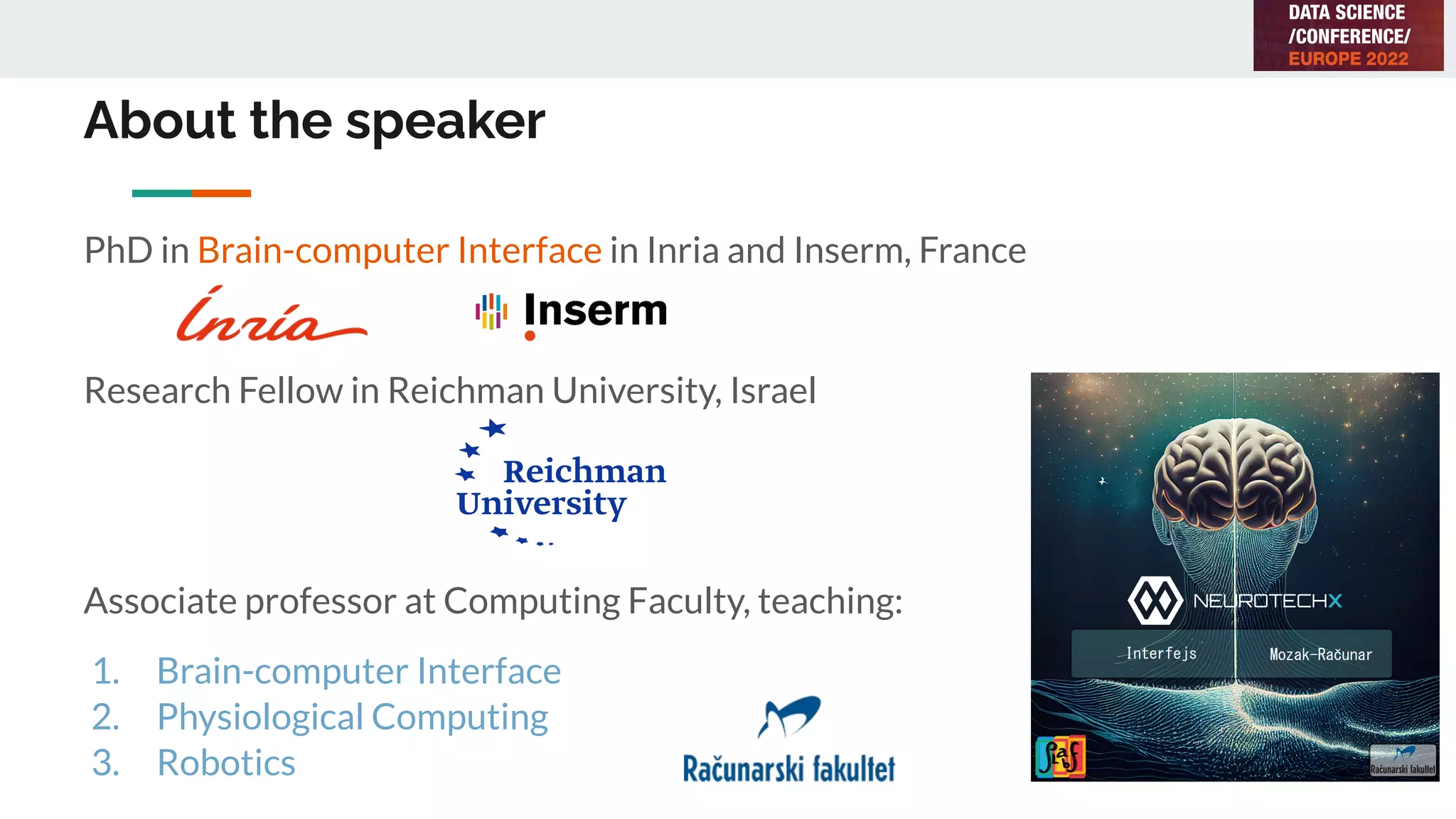
About the speaker
PhD in Brain-computer Interface in Inria and Inserm, France
Research Fellow in Reichman University, Israel
Associate professor at Computing Faculty, teaching:
1. Brain-computer Interface
2. Physiological Computing
3. Robotics
Ongoing projects on the brain
1. Connectomics – 3D road map of the brain (MIT)
2. Brainbow – colourful genetically modified brain (Harvard)
3. Optogenetics – light activated brain circuits (genetically modified)
4. Computer simulations of the brain :
– EU Blue Brain Project – EPFL
– Obama BRAIN Initiative – USA
5. Brain-computer/machine Interfaces – interacting with the machine
via only neural activity
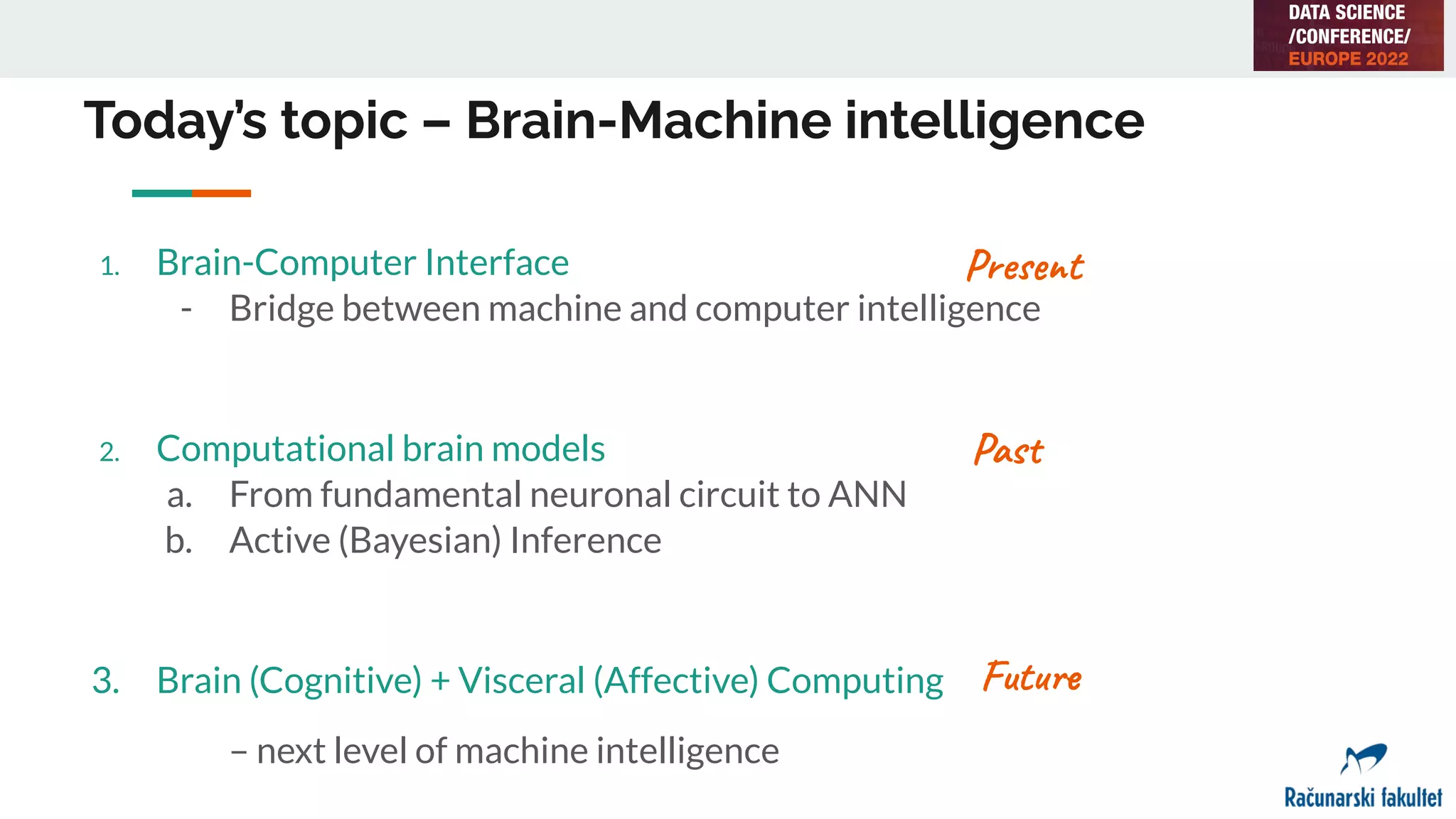
Today’s topic – Brain-Machine intelligence
1. Brain-Computer Interface
- Bridge between machine and computer intelligence
2. Computational brain models
a. From fundamental neuronal circuit to ANN
b. Active (Bayesian) Inference
3. Brain (Cognitive) + Visceral (Affective) Computing
– next level of machine intelligence
Present
Past
Future
Today’s topic – Brain-Machine intelligence
1. Brain-Computer Interface
- Bridge between machine and computer intelligence
2. Computational brain models
a. From fundamental neuronal circuit to ANN
b. Active (Bayesian) Inference
3. Brain (Cognitive) + Visceral (Affective) Computing
– next level of machine intelligence
Present
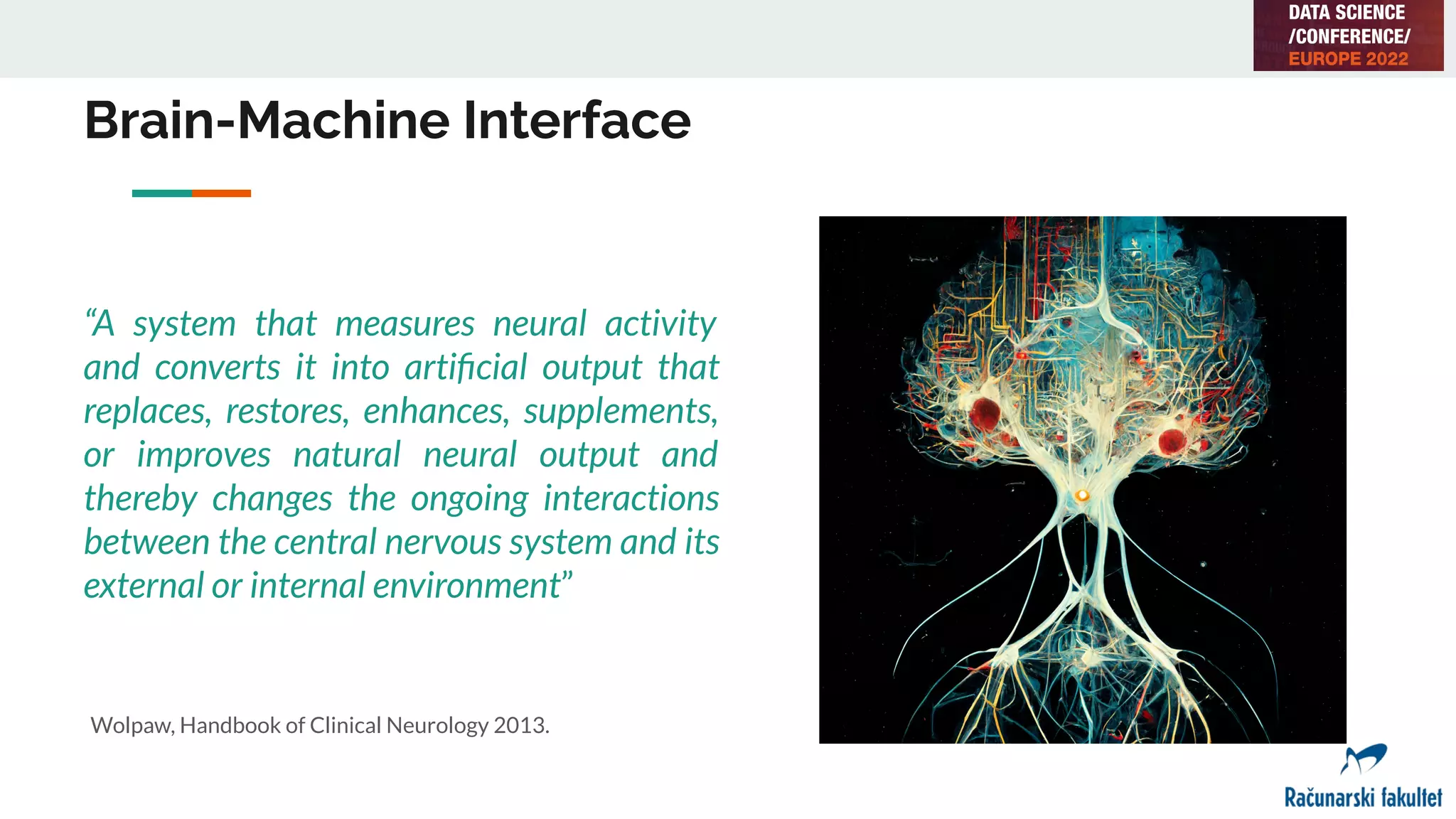
Brain-Machine Interface
“A system that measures neural activity
and converts it into artificial output that
replaces, restores, enhances, supplements,
or improves natural neural output and
thereby changes the ongoing interactions
between the central nervous system and its
external or internal environment”
Wolpaw, Handbook of Clinical Neurology 2013.
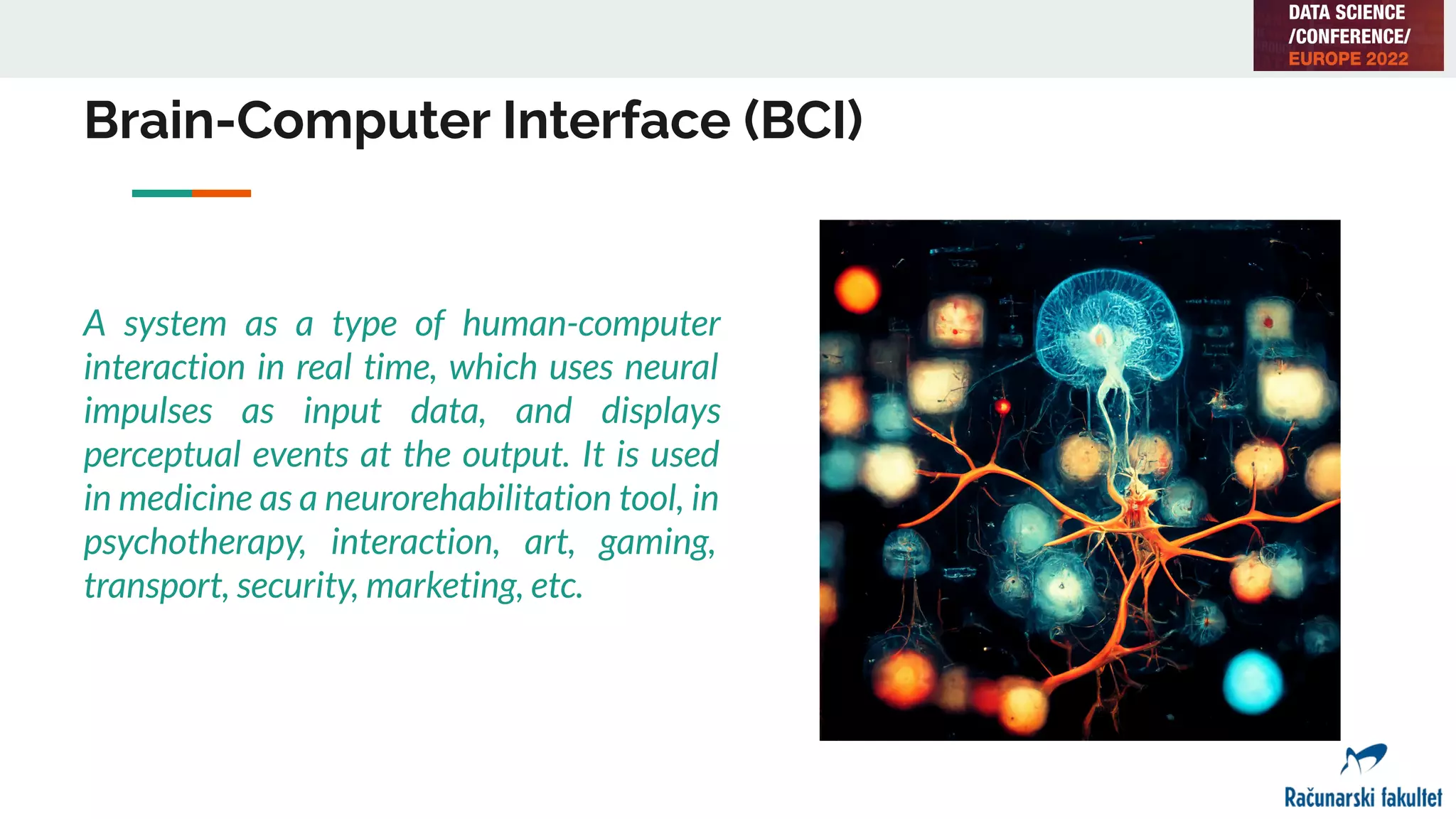
Brain-Computer Interface (BCI)
A system as a type of human-computer
interaction in real time, which uses neural
impulses as input data, and displays
perceptual events at the output. It is used
in medicine as a neurorehabilitation tool, in
psychotherapy, interaction, art, gaming,
transport, security, marketing, etc.
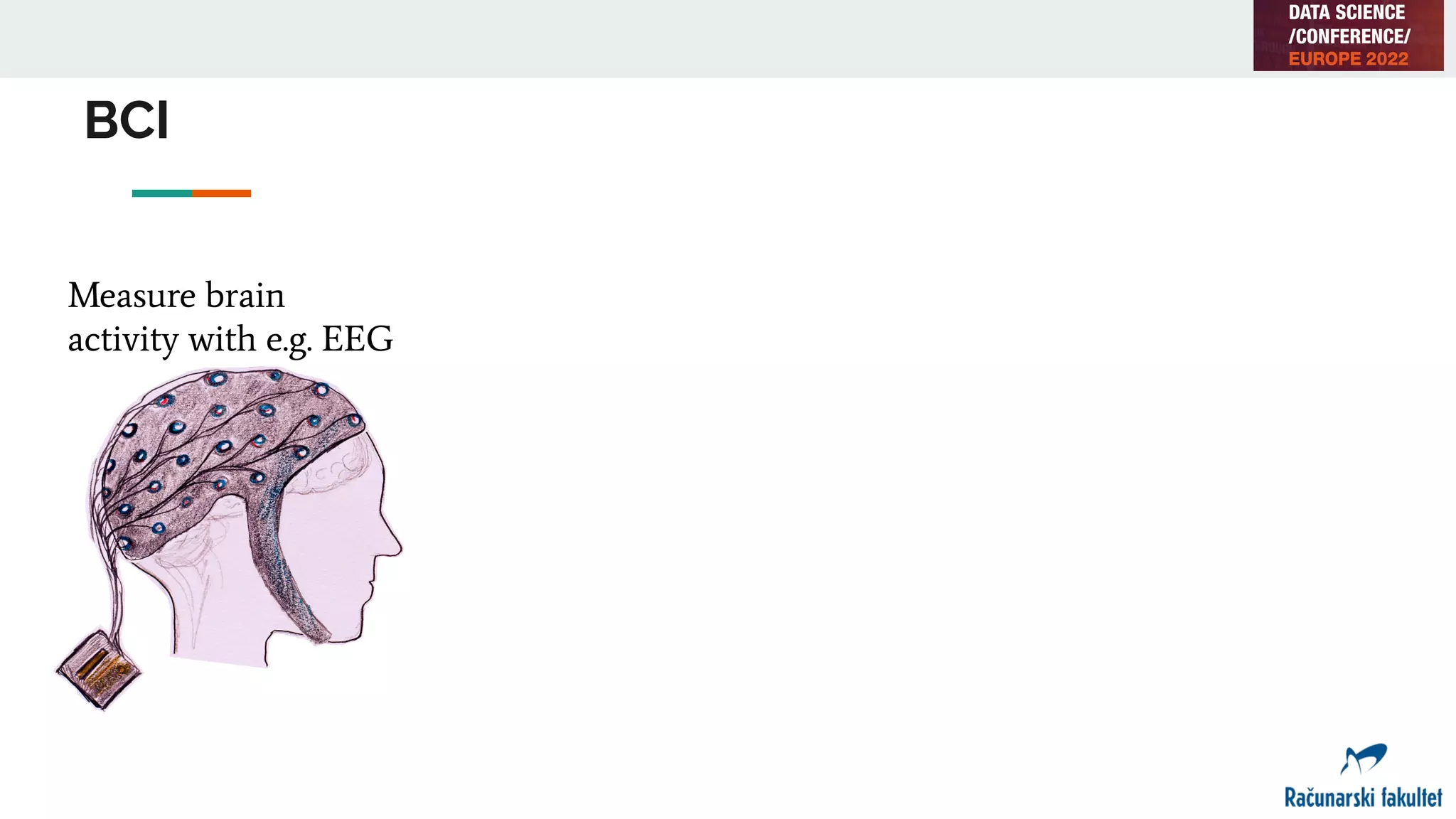
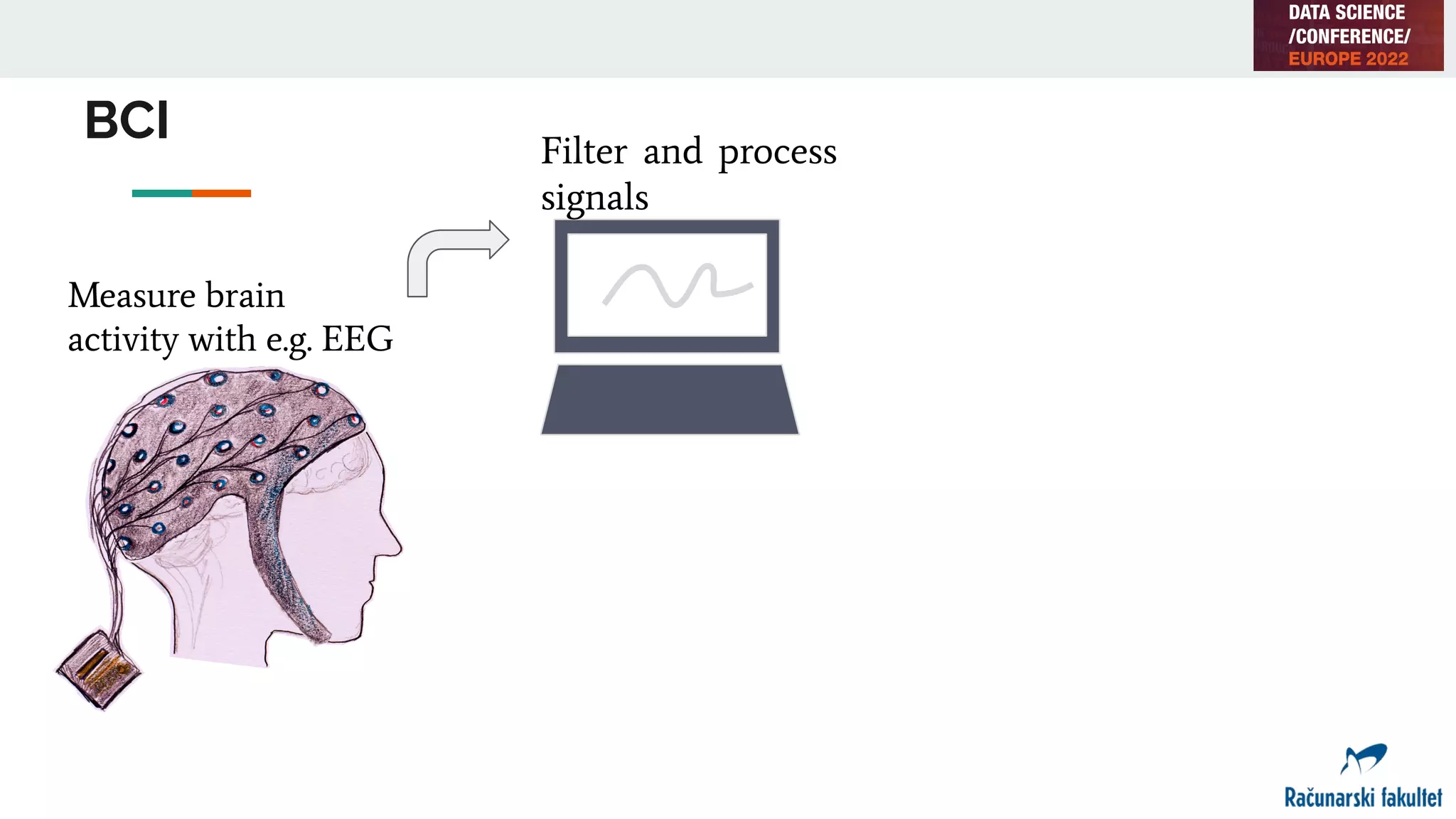
BCI
Measure brain
activity with e.g. EEG
BCI
Measure brain
activity with e.g. EEG
Filter and process
signals
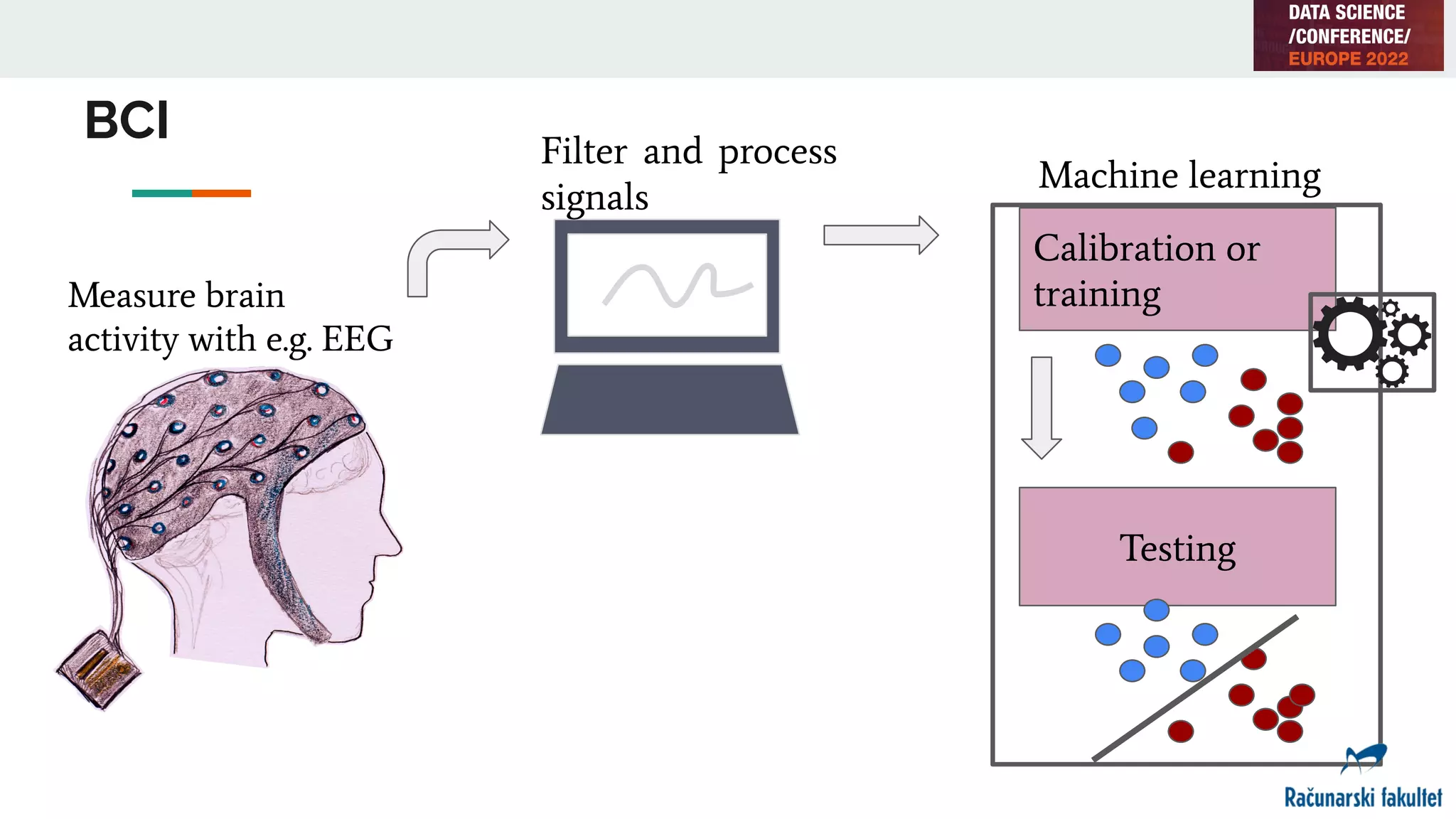
BCI
Measure brain
activity with e.g. EEG
Filter and process
signals
Machine learning
Calibration or
training
Testing
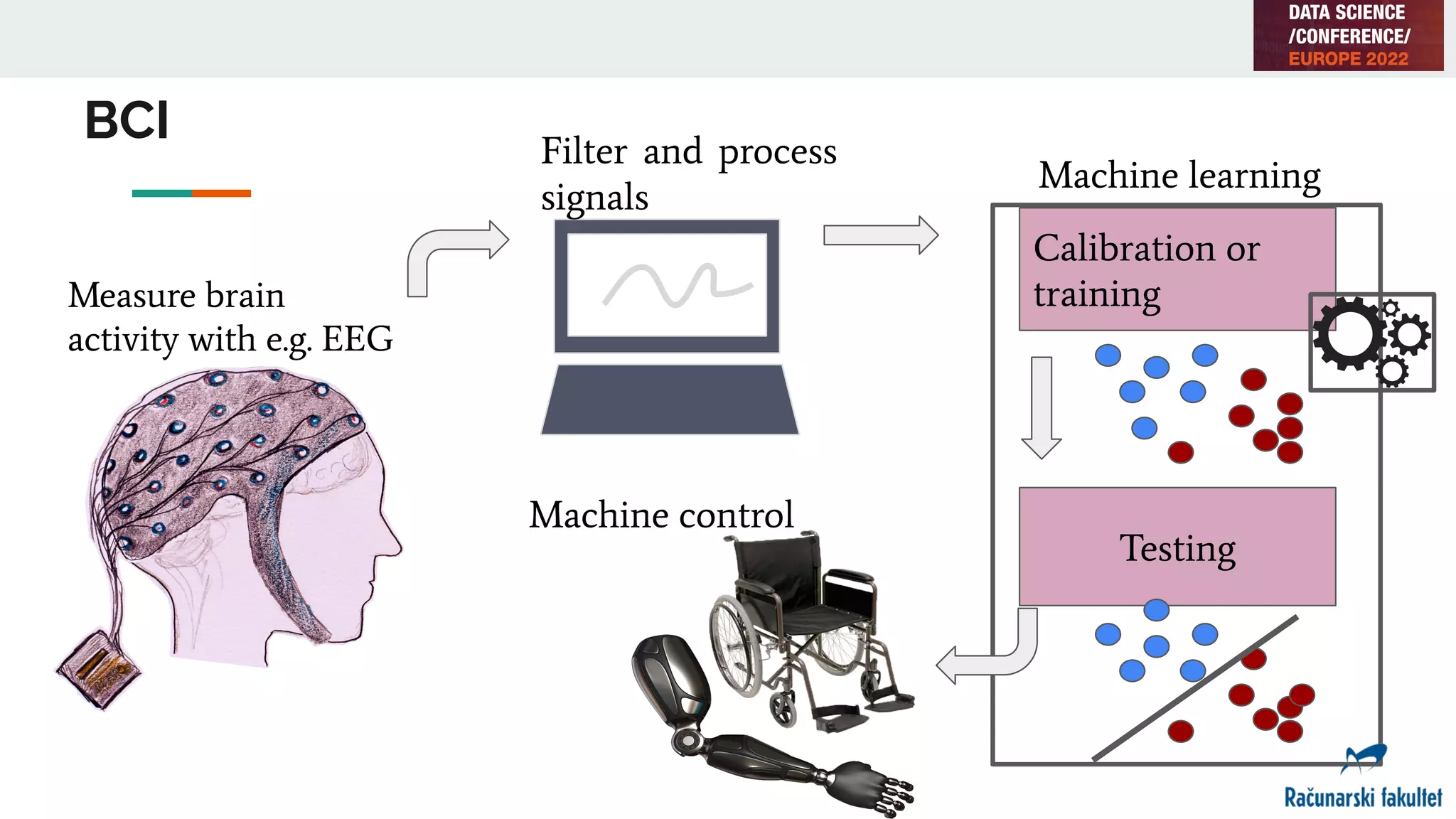
BCI
Measure brain
activity with e.g. EEG
Filter and process
signals
Machine learning
Calibration or
training
Testing
Machine control
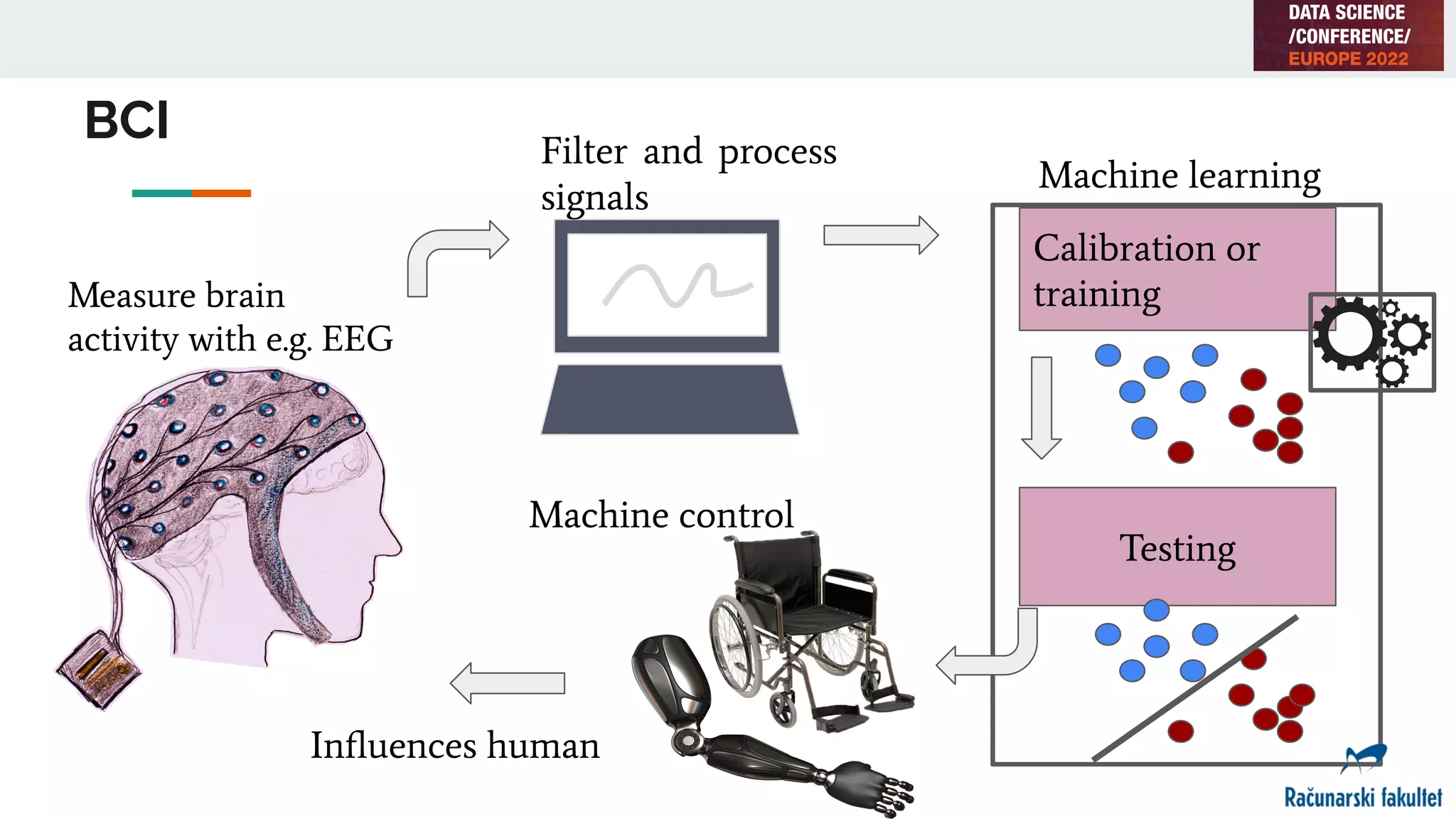
BCI
Measure brain
activity with e.g. EEG
Filter and process
signals
Machine learning
Calibration or
training
Testing
Machine control
Influences human
BCI
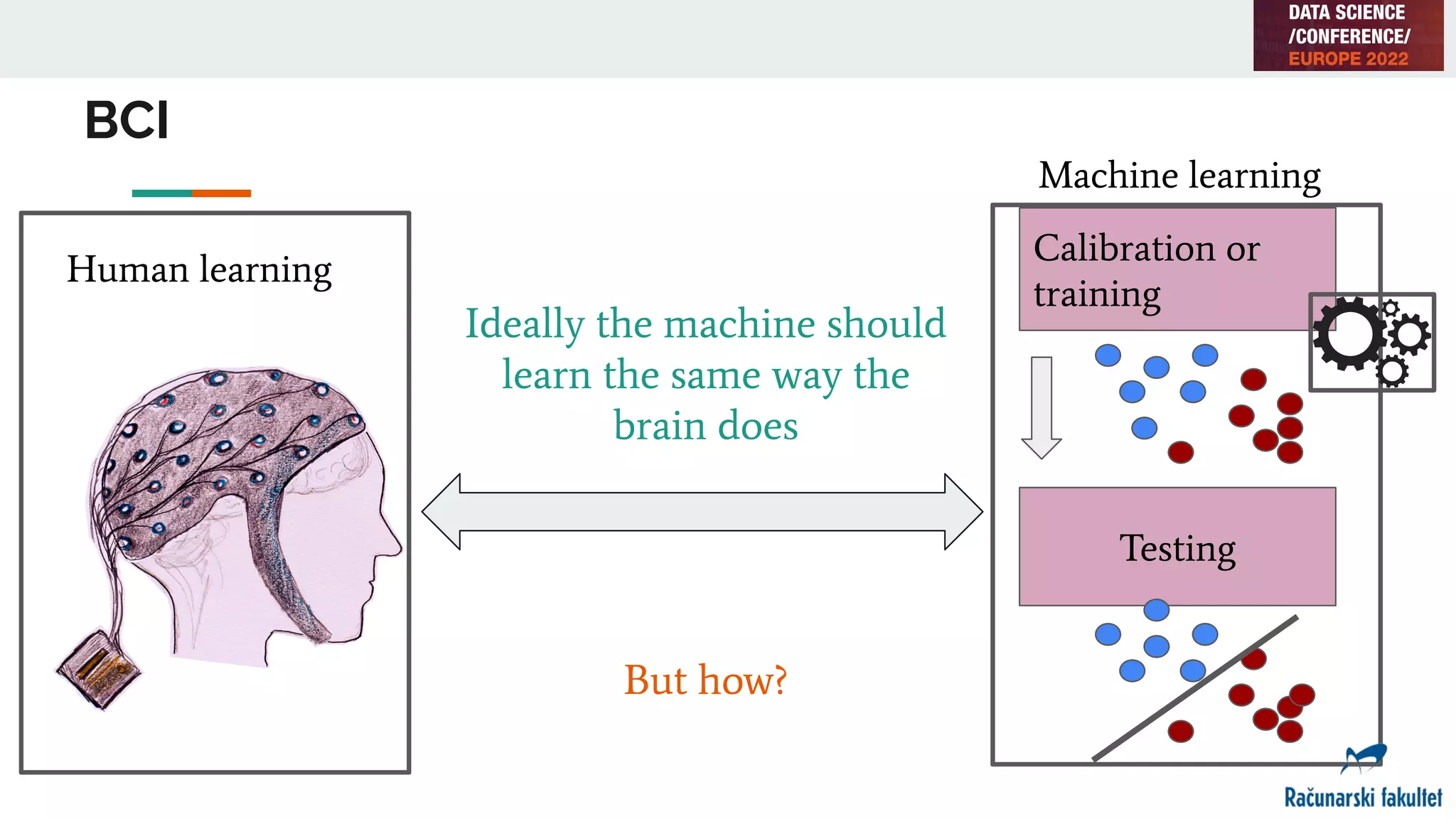
Machine learning
Calibration or
training
Testing
Human learning
Ideally the machine should
learn the same way the
brain does
But how?
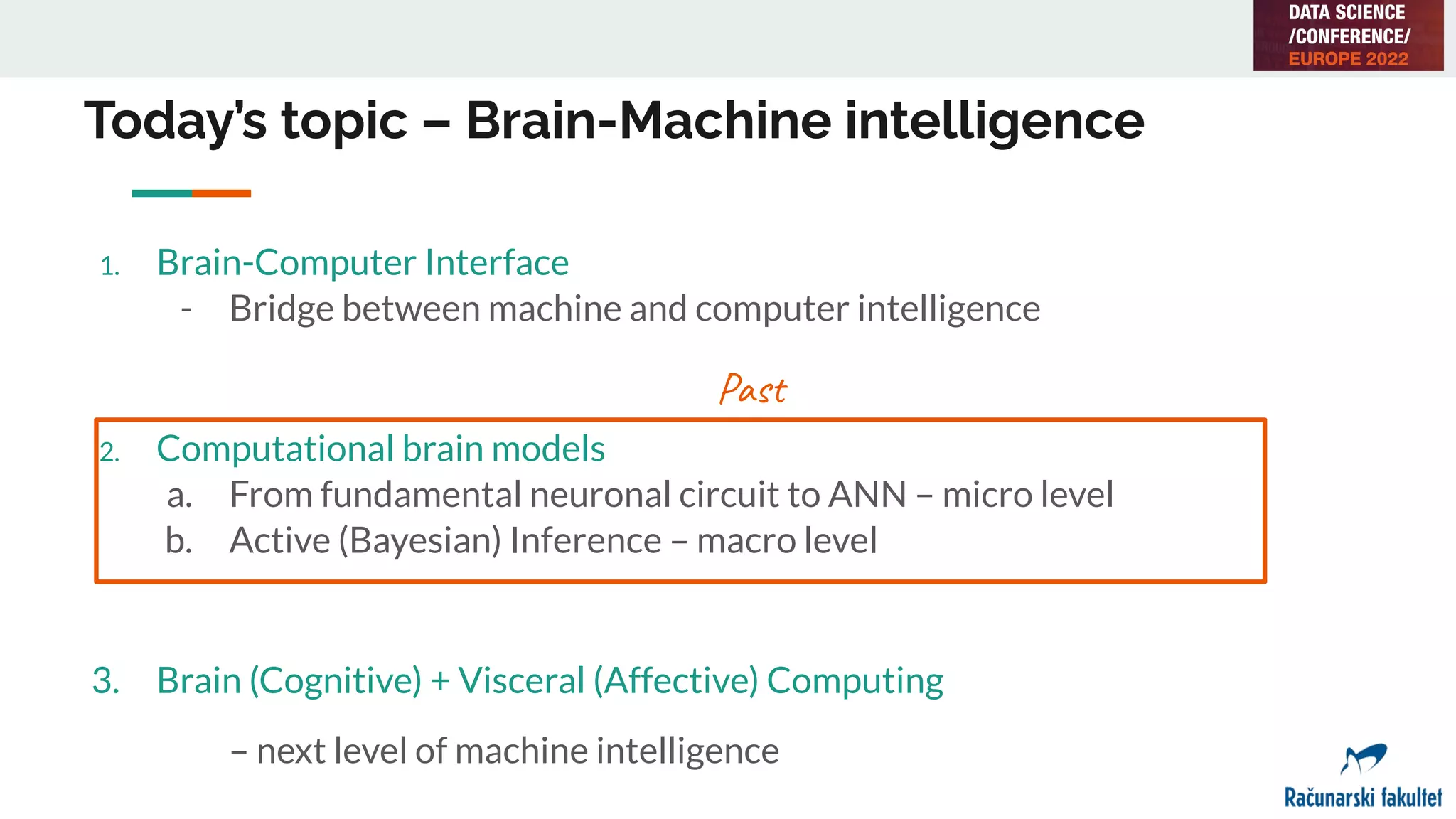
Today’s topic – Brain-Machine intelligence
1. Brain-Computer Interface
- Bridge between machine and computer intelligence
2. Computational brain models
a. From fundamental neuronal circuit to ANN – micro level
b. Active (Bayesian) Inference – macro level
3. Brain (Cognitive) + Visceral (Affective) Computing
– next level of machine intelligence
Past
Hodgkin-Huxley
Experiments with Squid axon (1939)
H-H set of differential Equations
1952 (Nobel Prizes)
Image courtesy of hans hillewaert
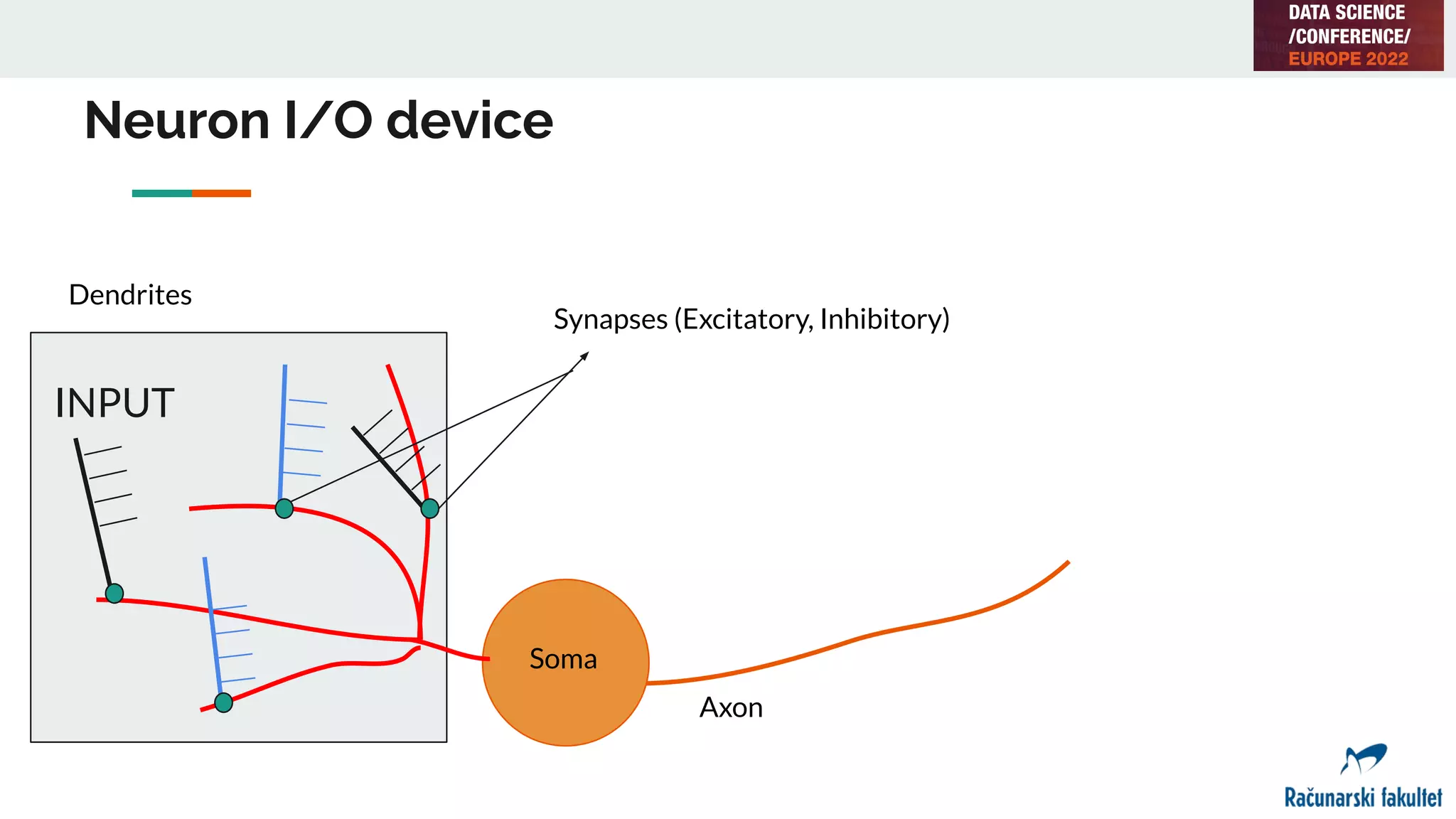
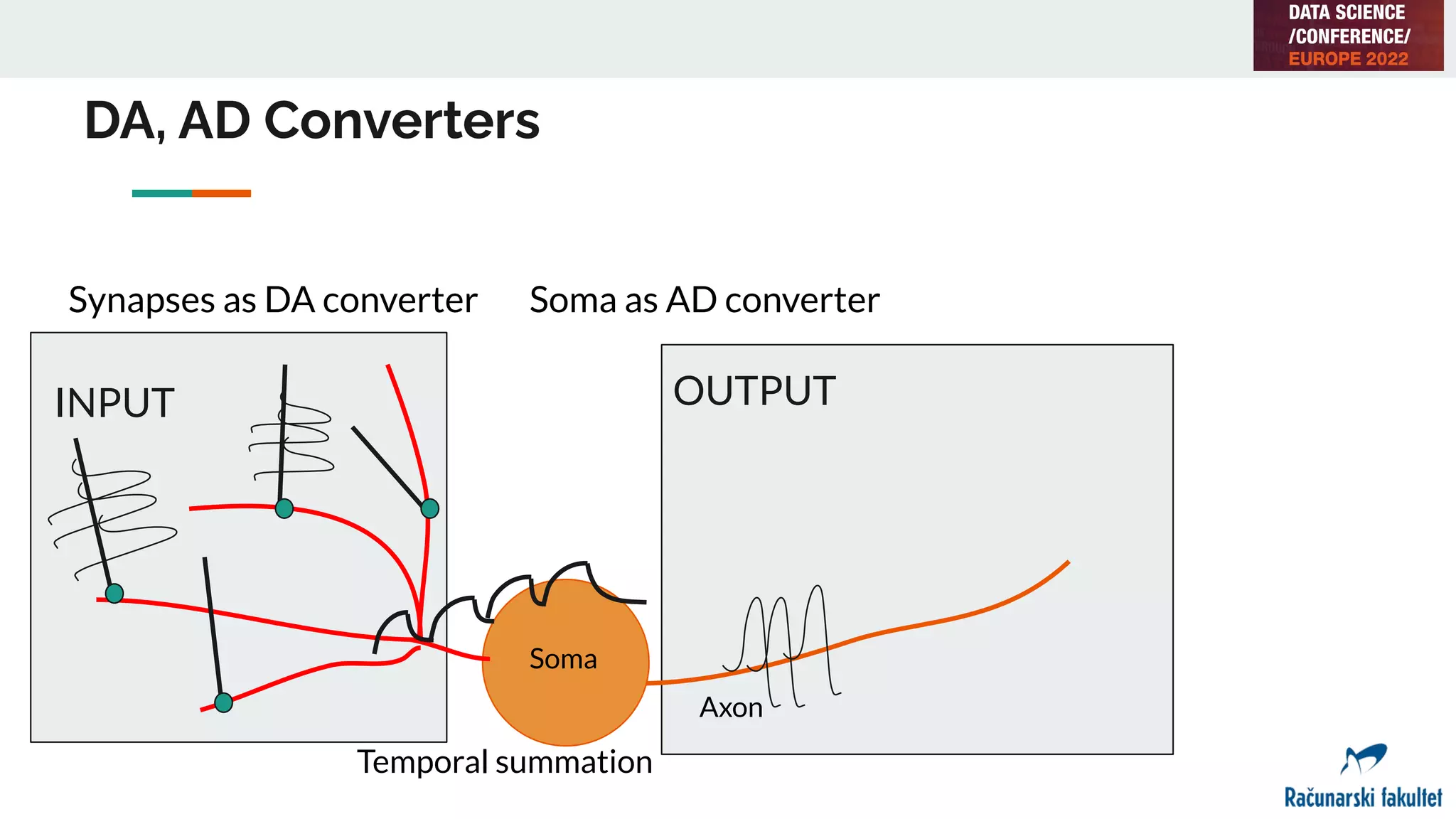
Neuron I/O device
INPUT
Soma
Dendrites
Axon
Synapses (Excitatory, Inhibitory)
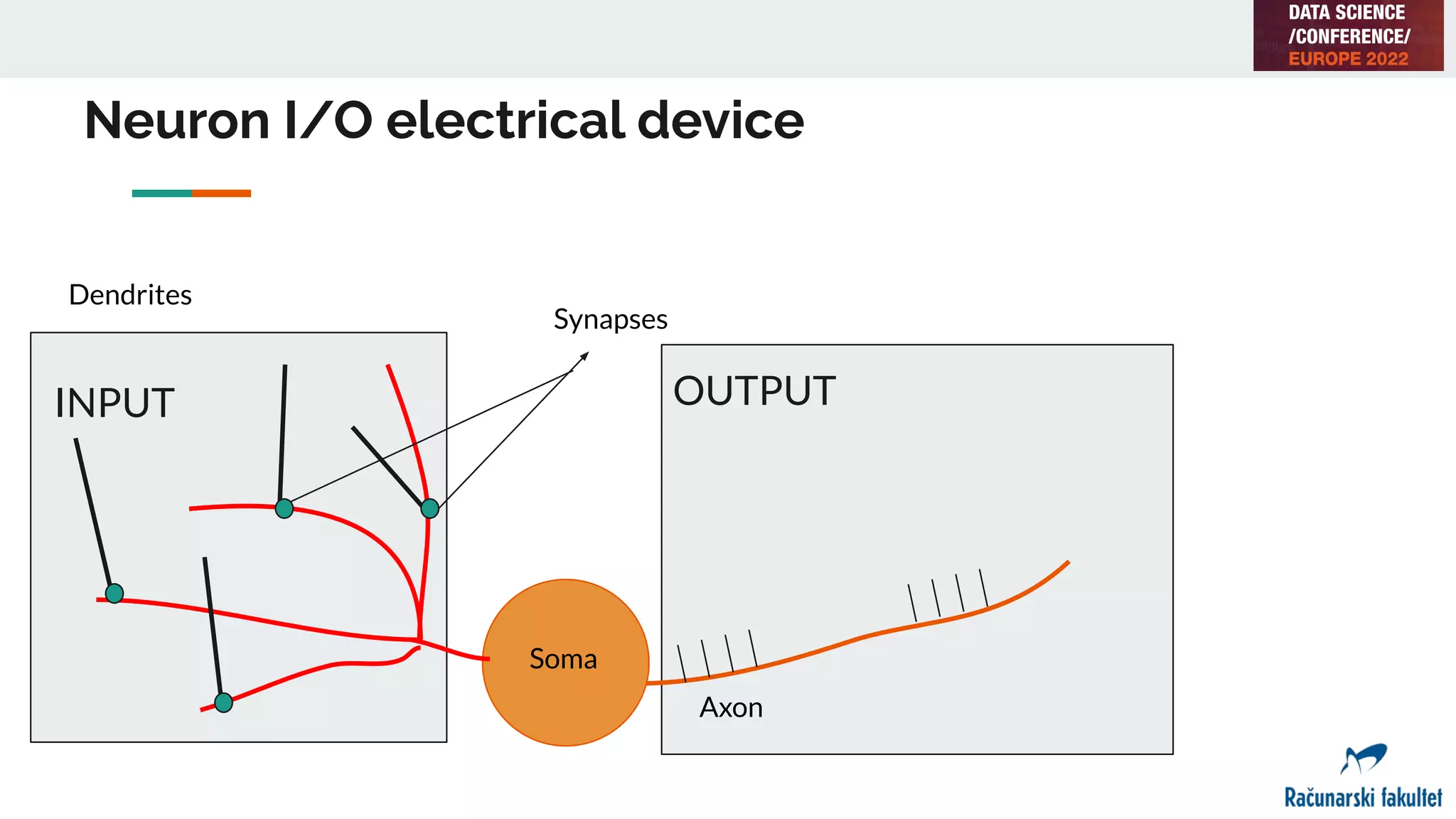
Neuron I/O electrical device
INPUT OUTPUT
Soma
Dendrites
Axon
Synapses
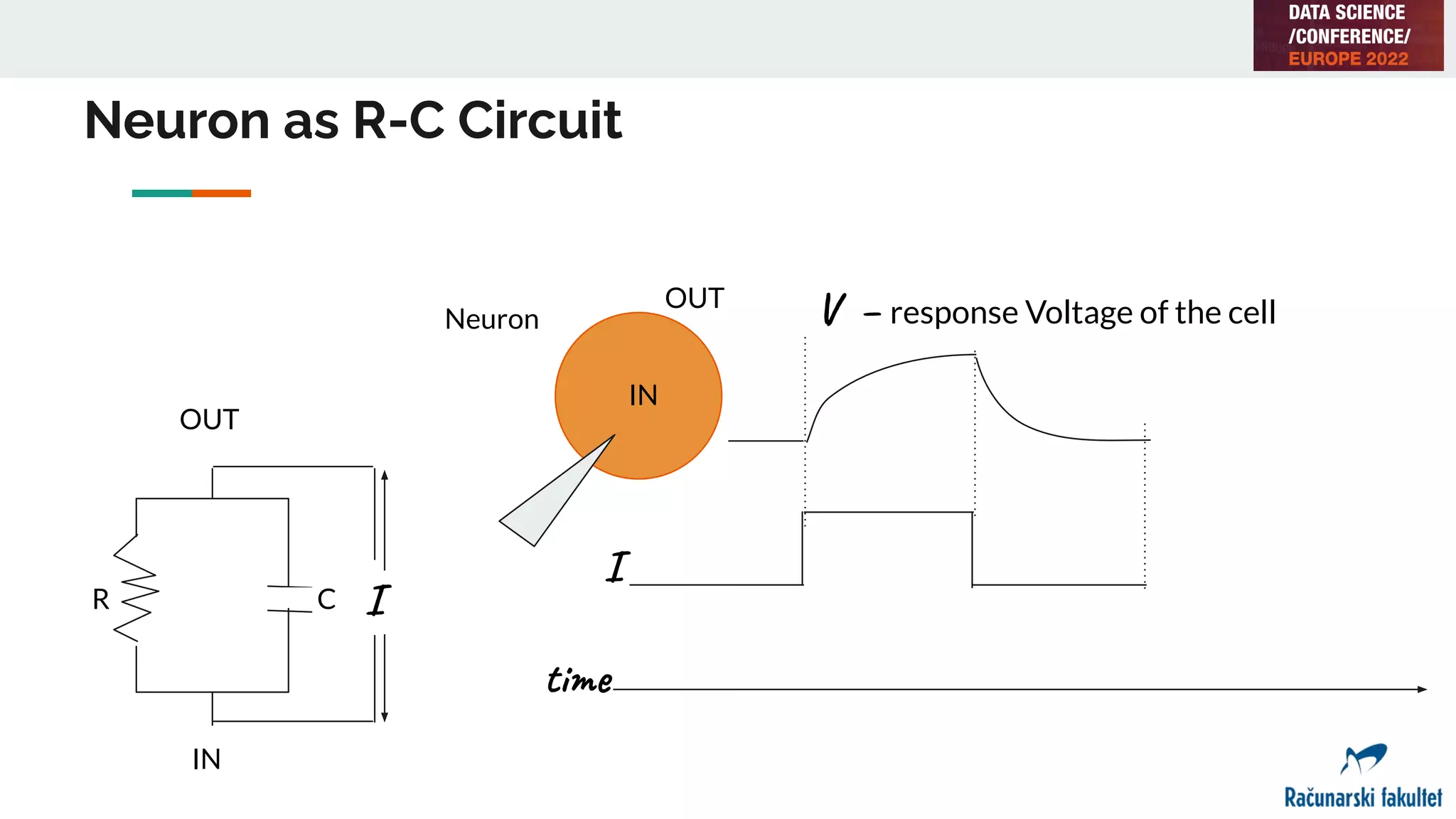
Neuron as R-C Circuit
I
IN
OUT
V – response Voltage of the cell
time
Neuron
R C
OUT
IN
I
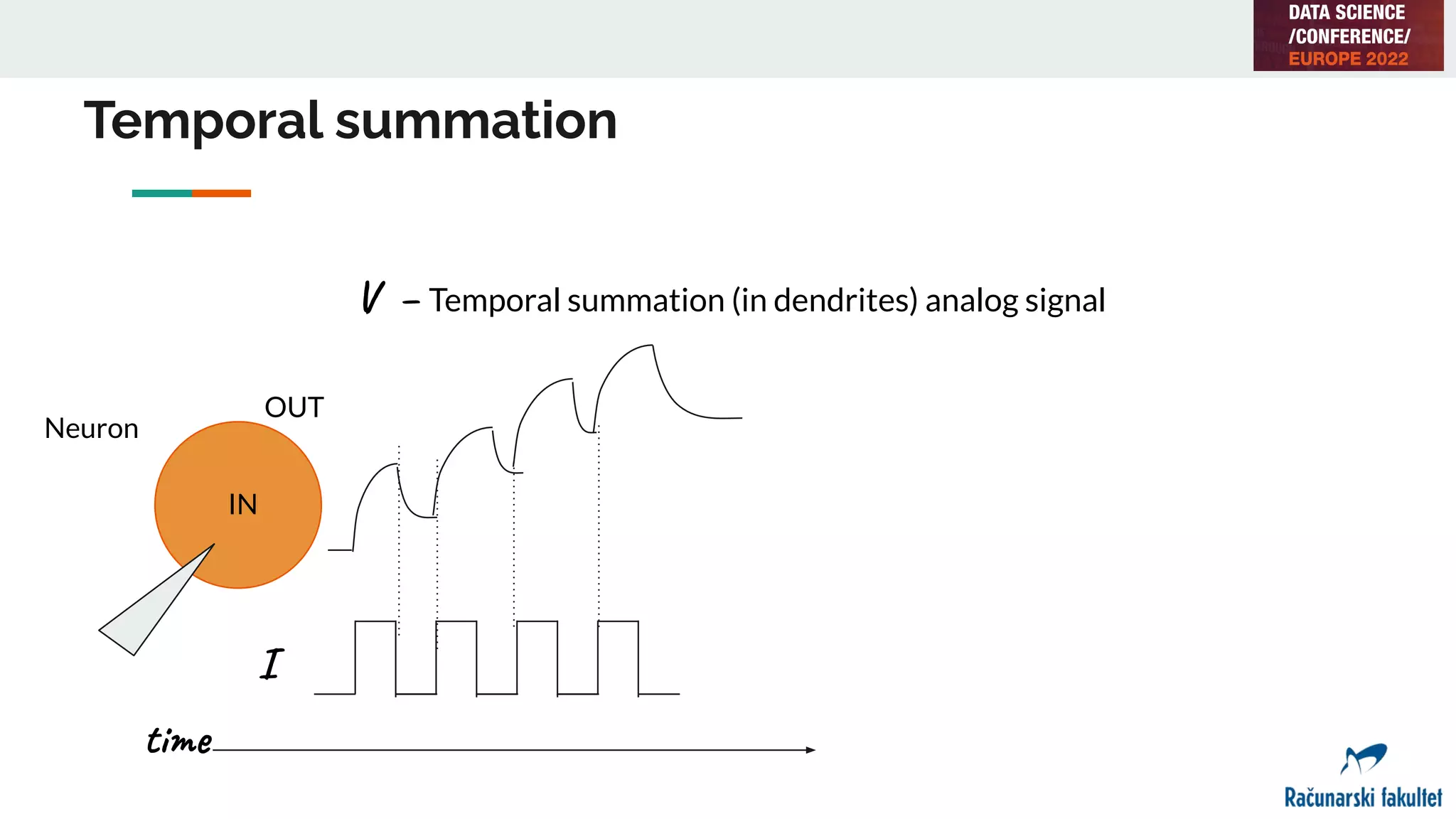
Temporal summation
I
IN
OUT
V – Temporal summation (in dendrites) analog signal
time
Neuron
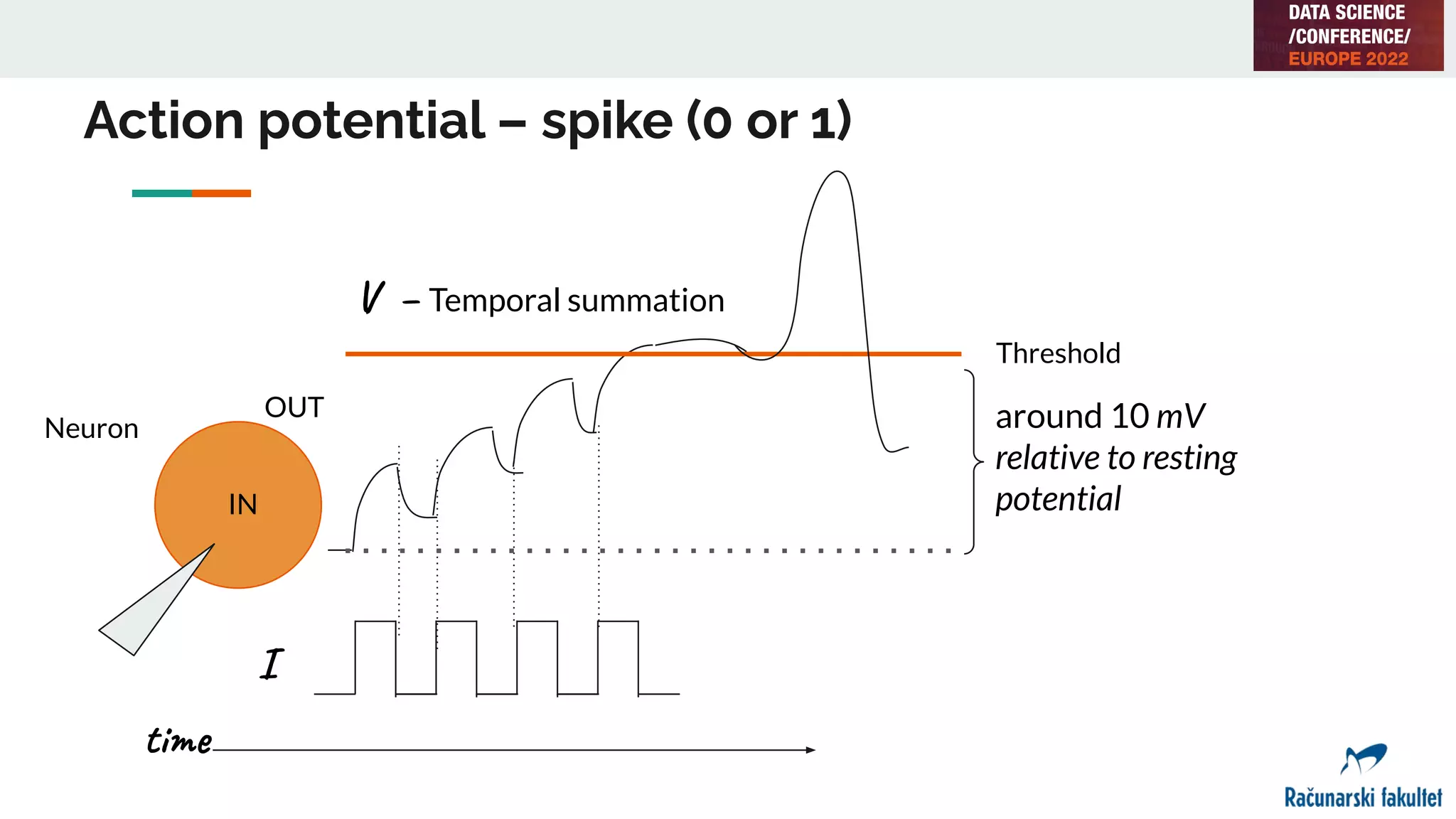
Action potential – spike (0 or 1)
I
IN
OUT
V – Temporal summation
time
Neuron
Threshold
around 10 mV
relative to resting
potential
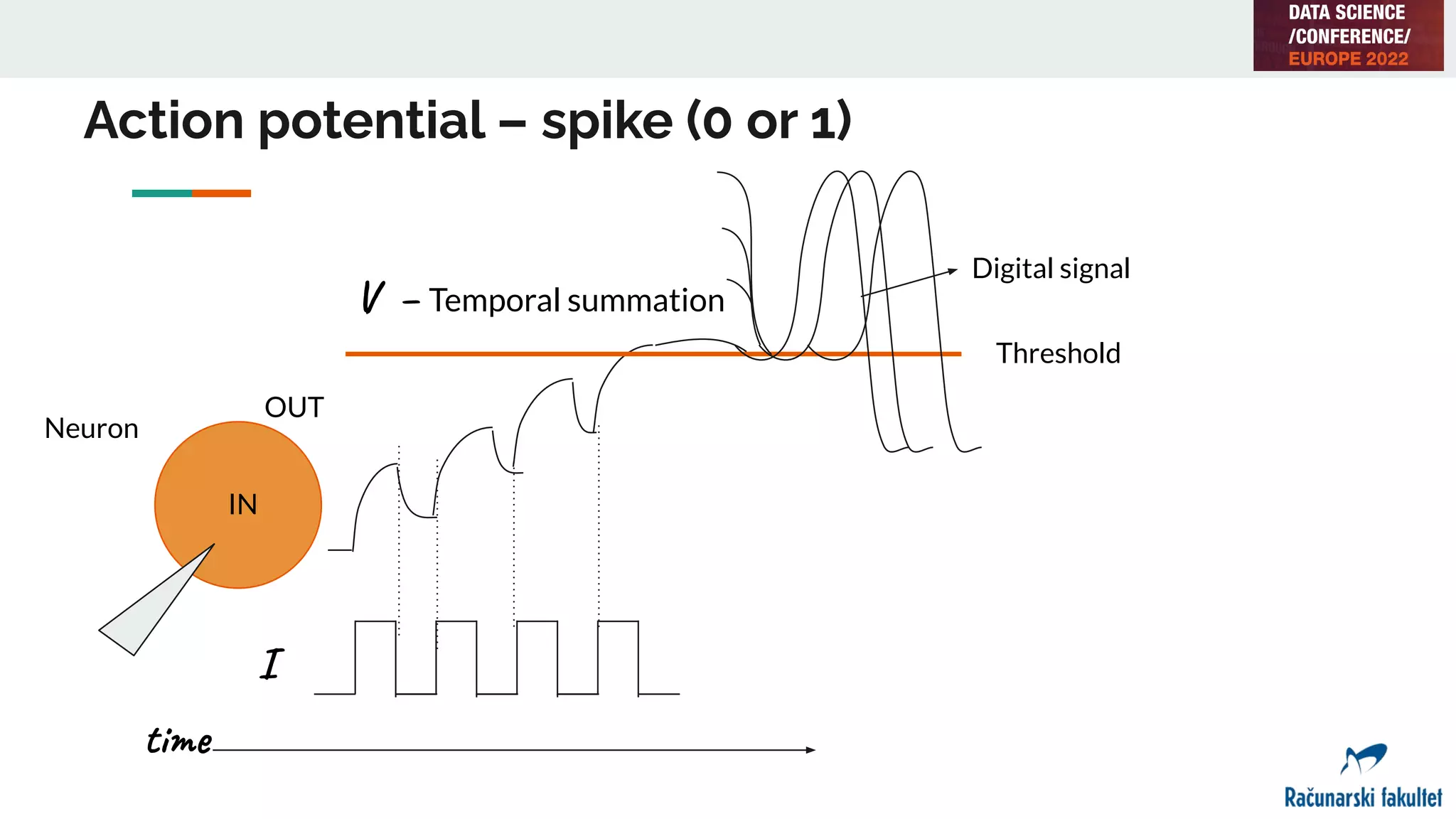
Action potential – spike (0 or 1)
I
IN
OUT
V – Temporal summation
time
Neuron
Threshold
Digital signal
INPUT OUTPUT
Synapses as DA converter
Axon
DA, AD Converters
Temporal summation
Soma
Soma as AD converter
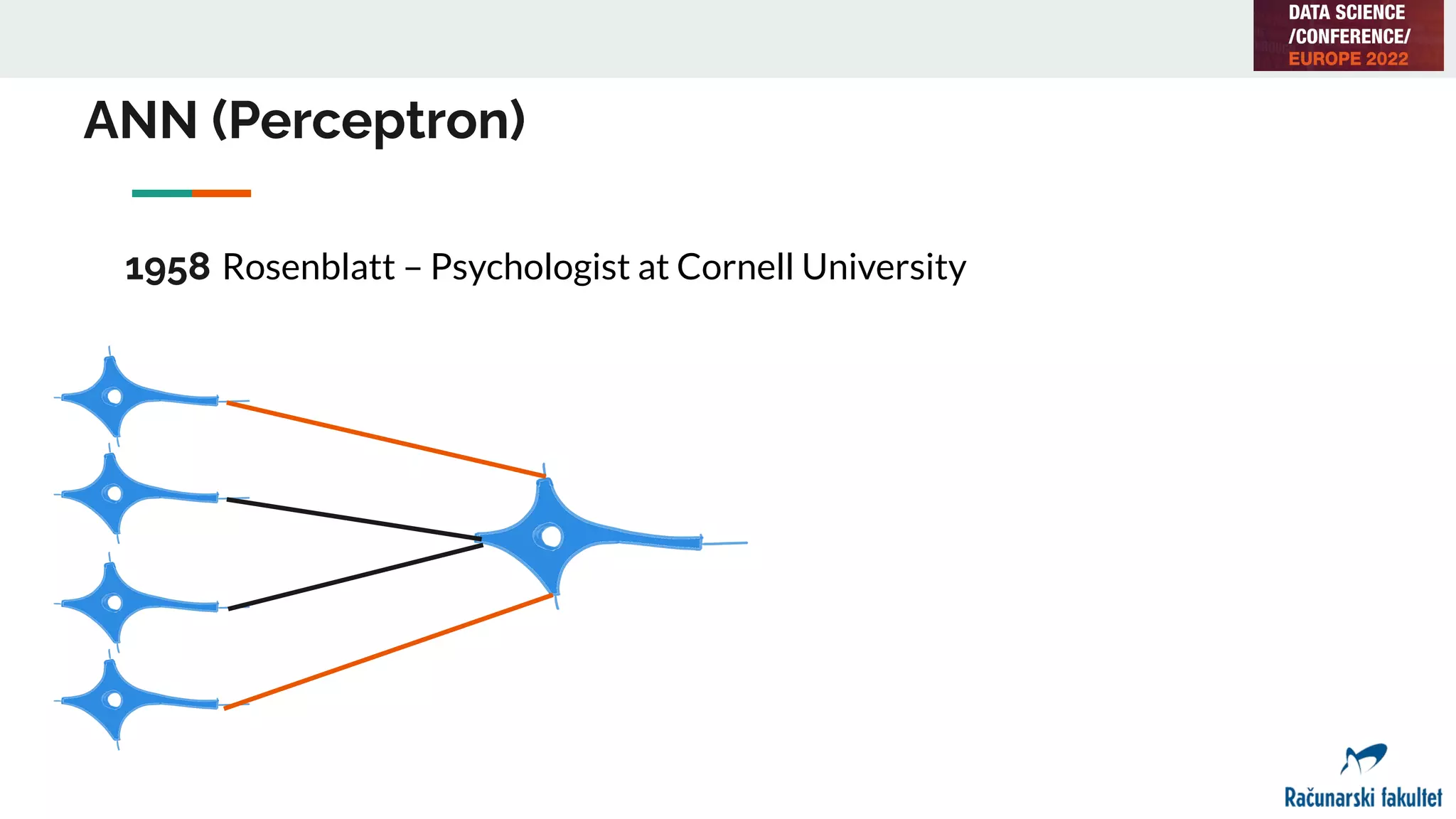
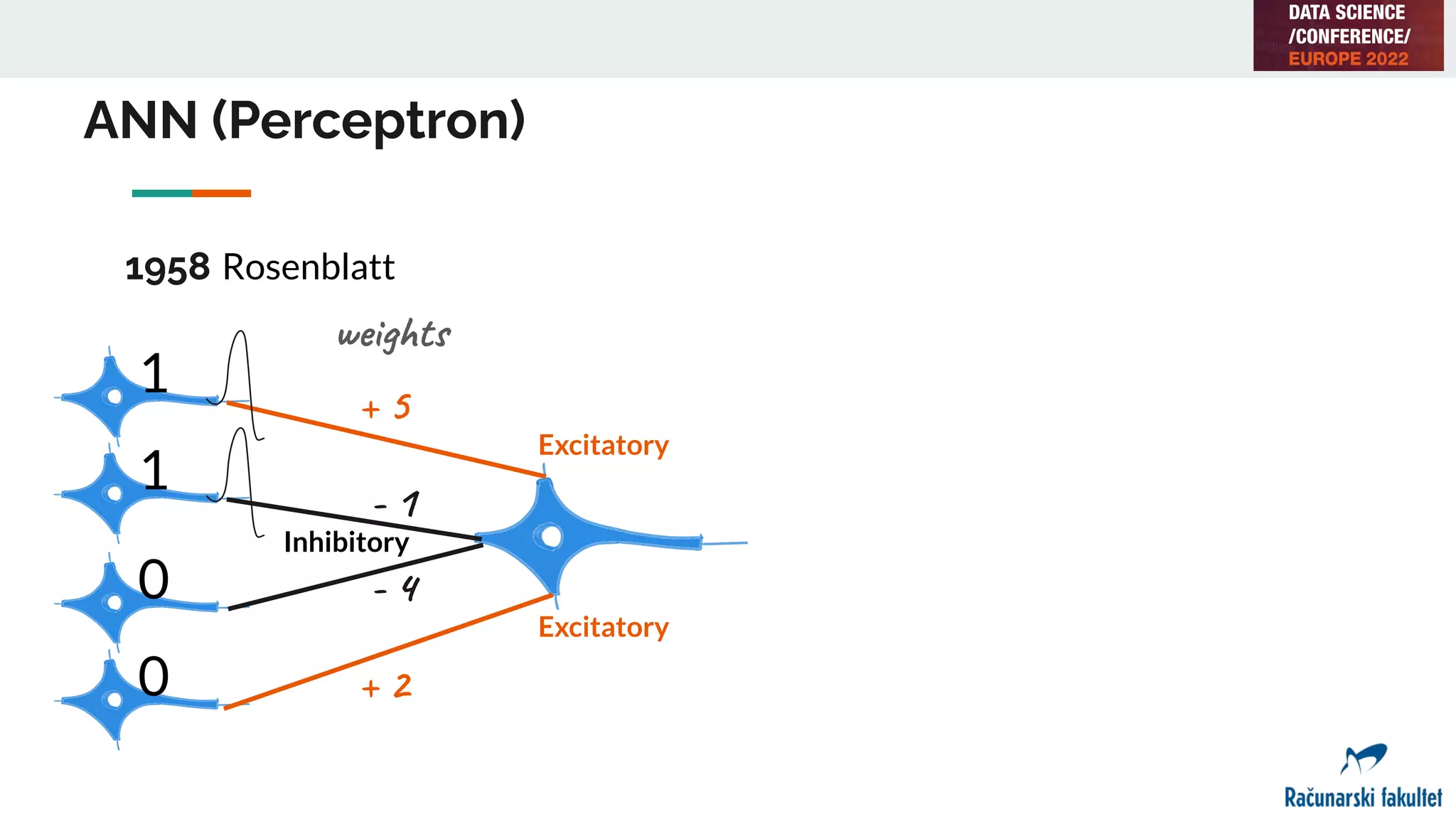
ANN (Perceptron)
1958 Rosenblatt – Psychologist at Cornell University
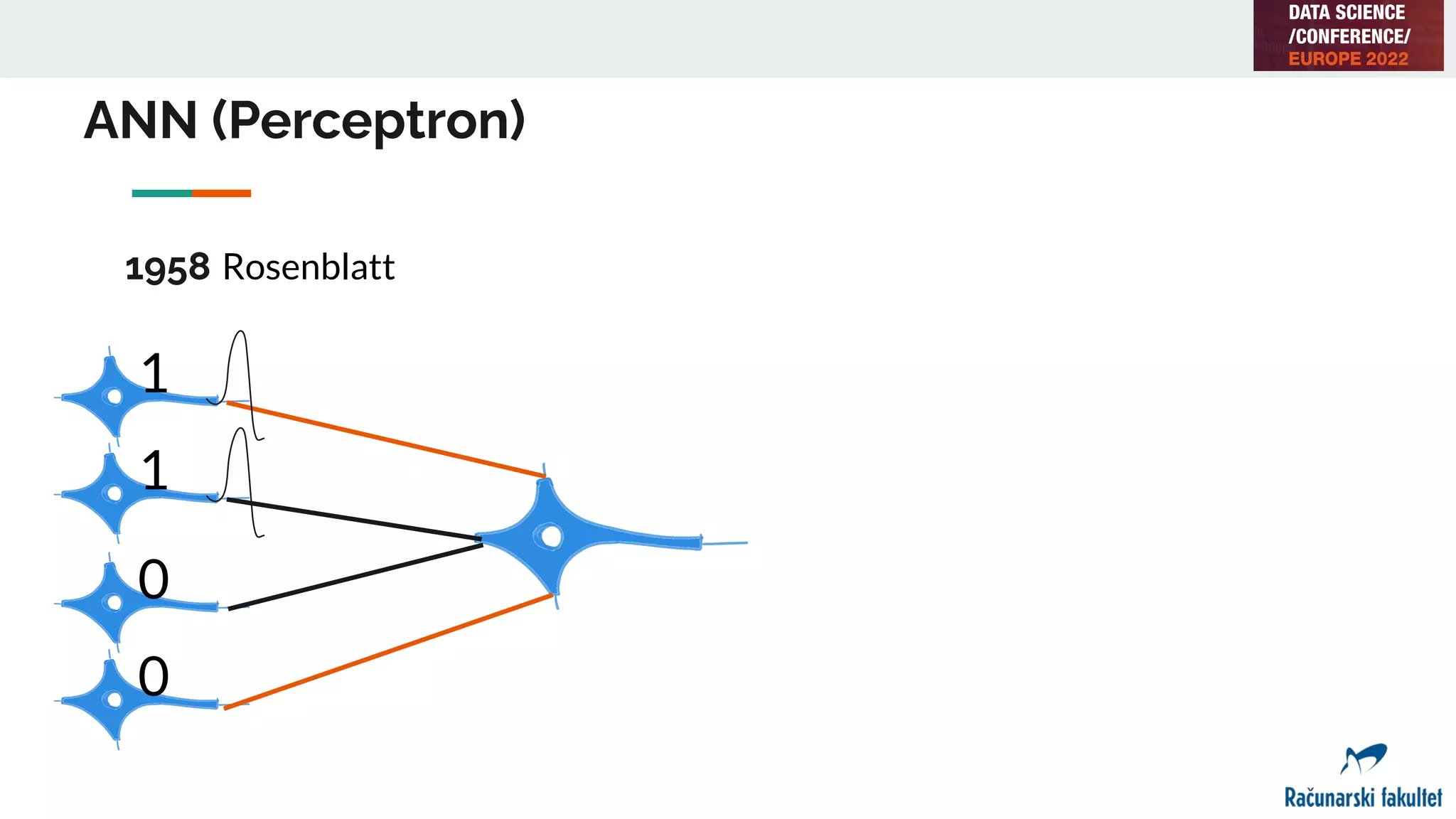
ANN (Perceptron)
1958 Rosenblatt
1
1
0
0
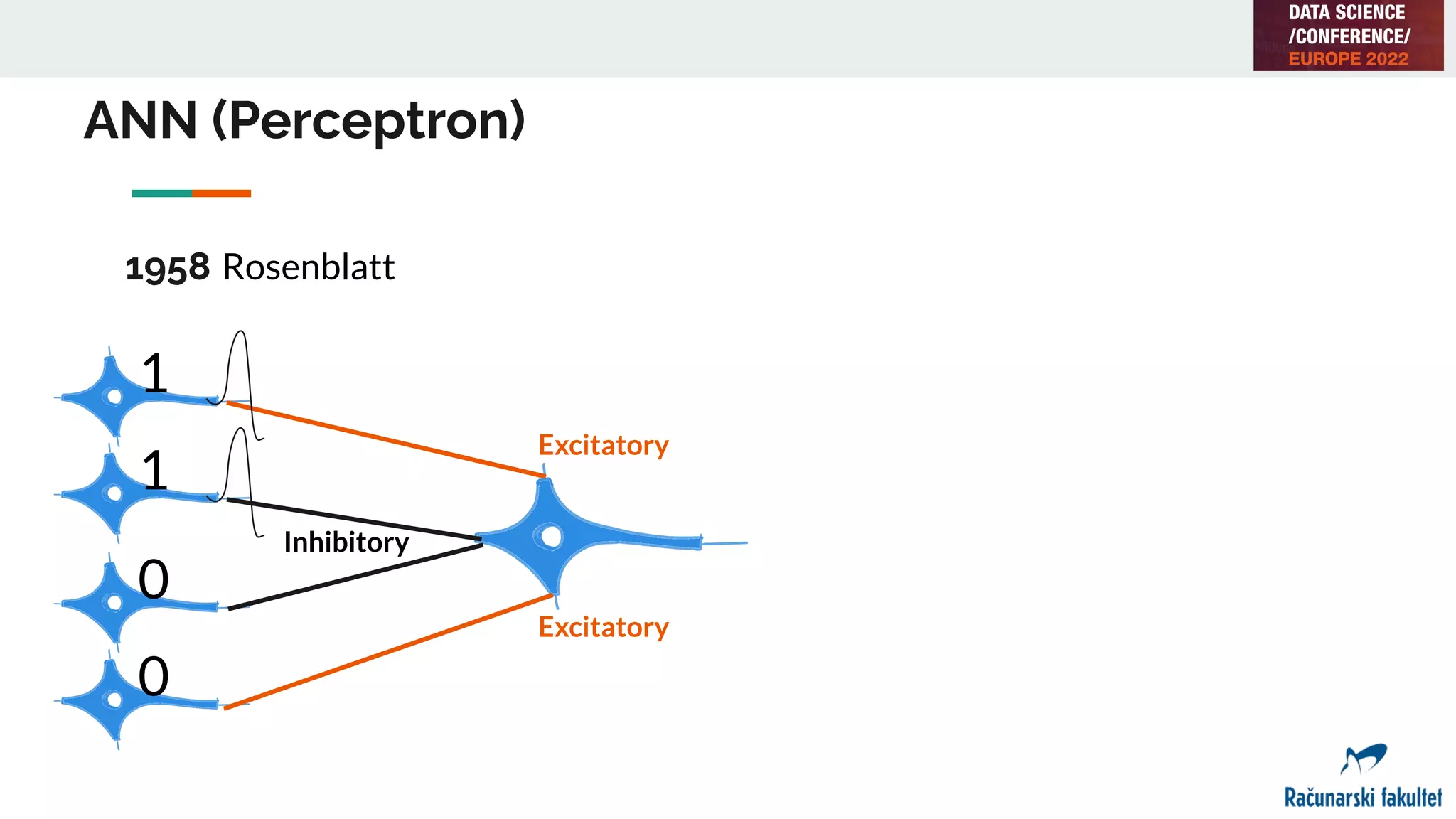
ANN (Perceptron)
1958 Rosenblatt
Excitatory
Excitatory
Inhibitory
1
1
0
0
ANN (Perceptron)
1958 Rosenblatt
Excitatory
Excitatory
Inhibitory
+ 5
+ 2
- 1
- 4
weights
1
1
0
0
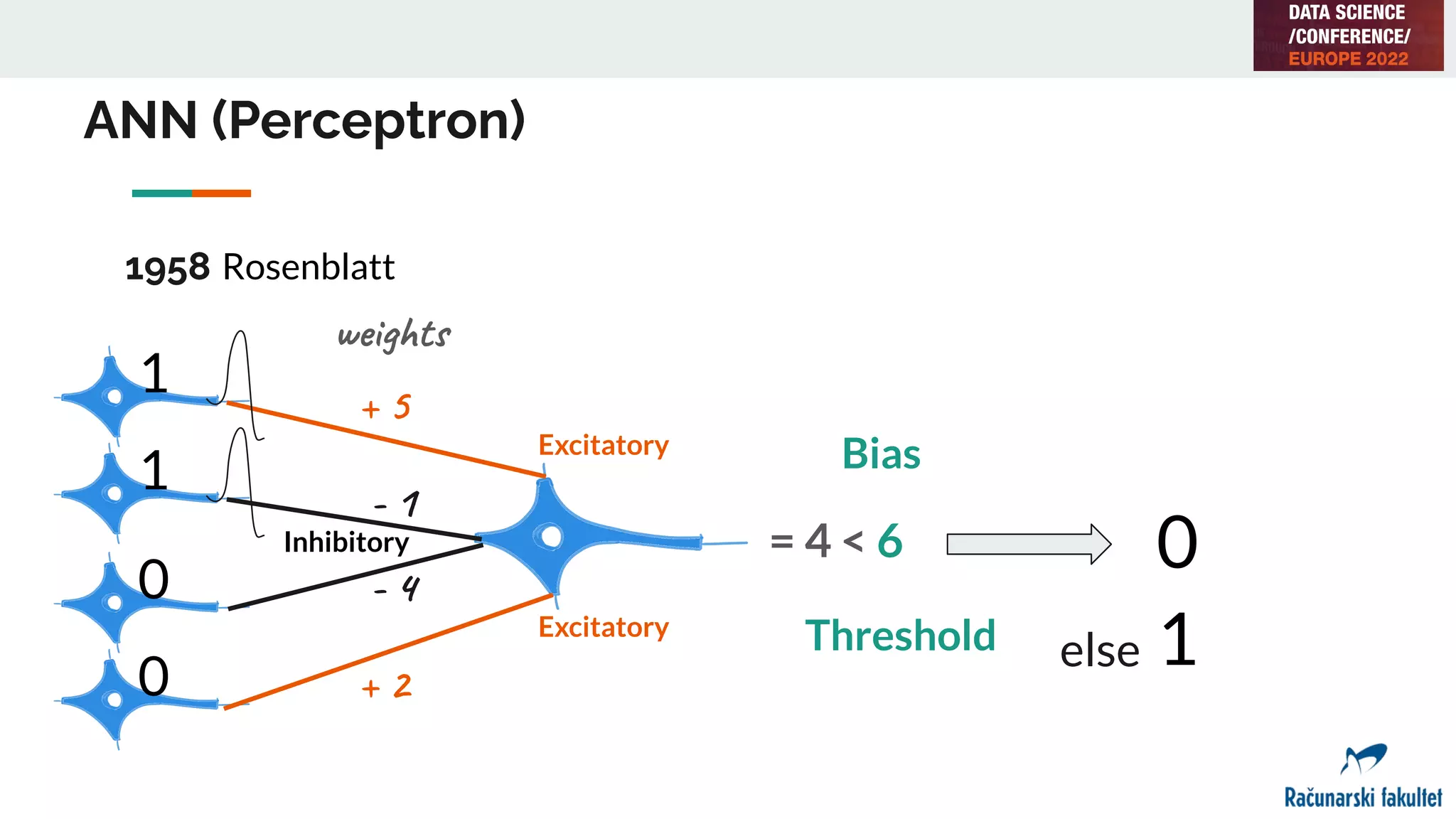
ANN (Perceptron)
1958 Rosenblatt
Excitatory
Excitatory
Inhibitory
+ 5
+ 2
- 1
- 4
weights
= 4 < 6
Bias
0
Threshold else 1
1
1
0
0
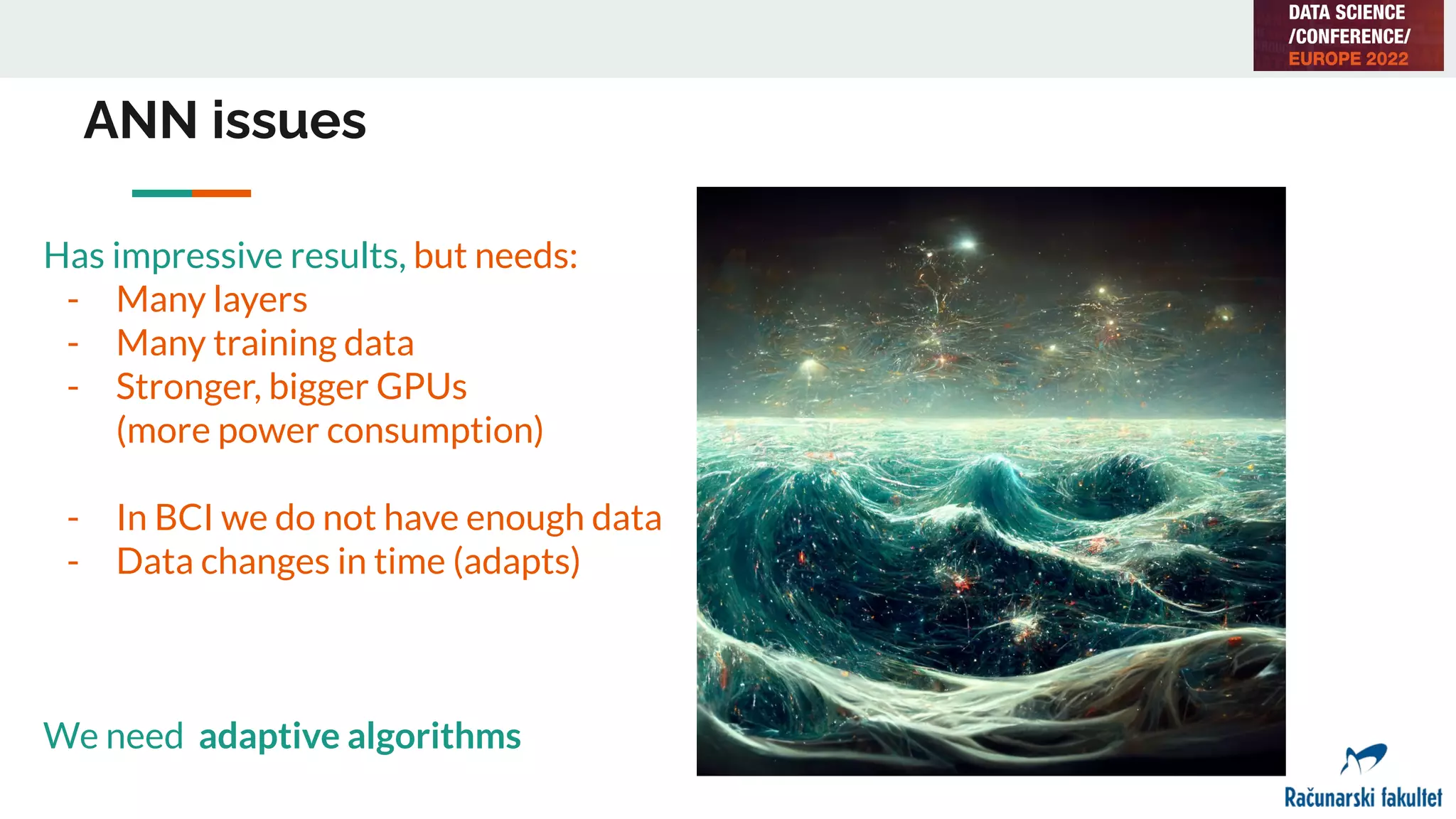
ANN issues
Has impressive results, but needs:
- Many layers
- Many training data
- Stronger, bigger GPUs
(more power consumption)
- In BCI we do not have enough data
- Data changes in time (adapts)
We need adaptive algorithms
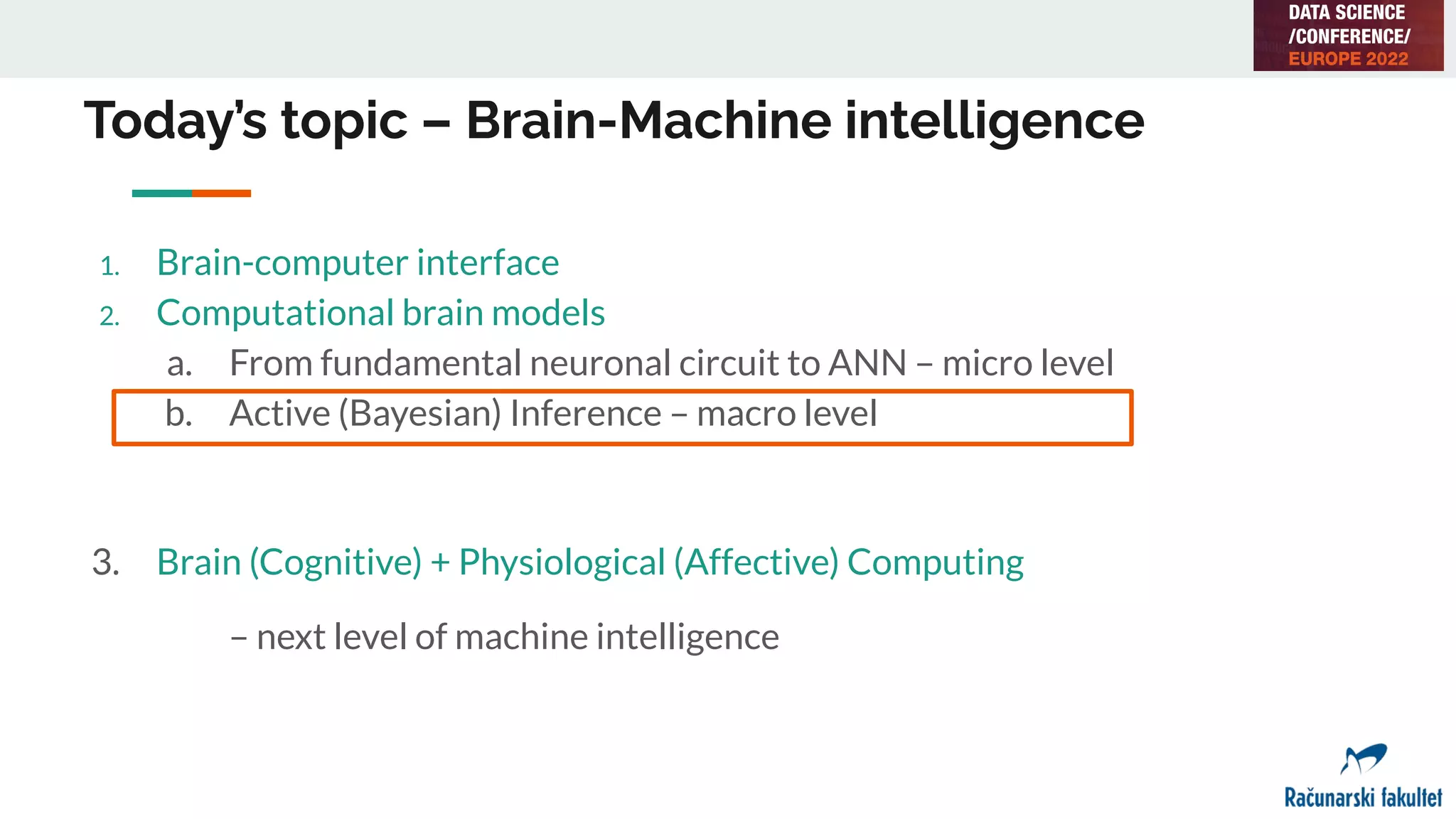
1. Brain-computer interface
2. Computational brain models
a. From fundamental neuronal circuit to ANN – micro level
b. Active (Bayesian) Inference – macro level
3. Brain (Cognitive) + Physiological (Affective) Computing
– next level of machine intelligence
Today’s topic – Brain-Machine intelligence
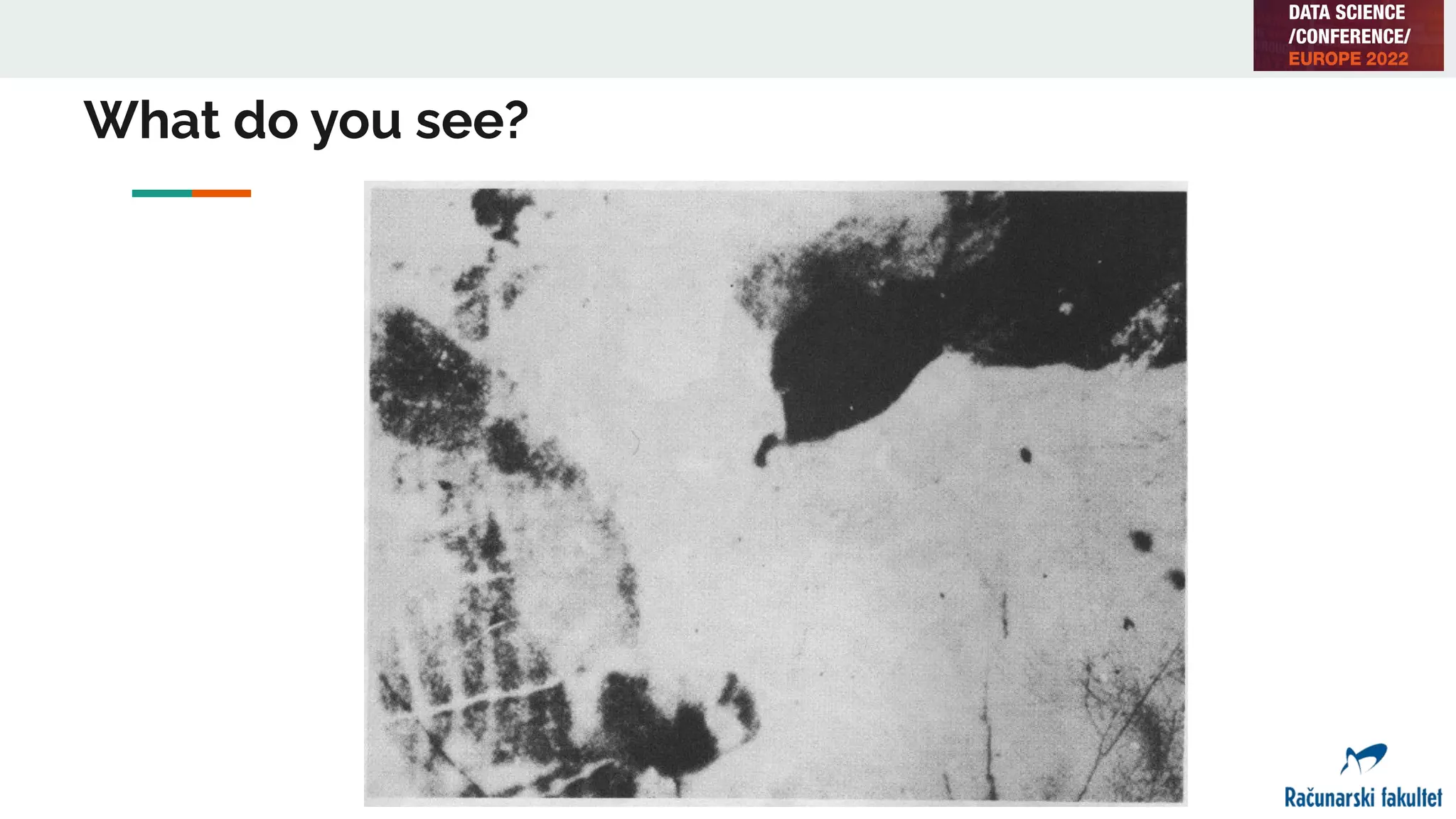
What do you see?
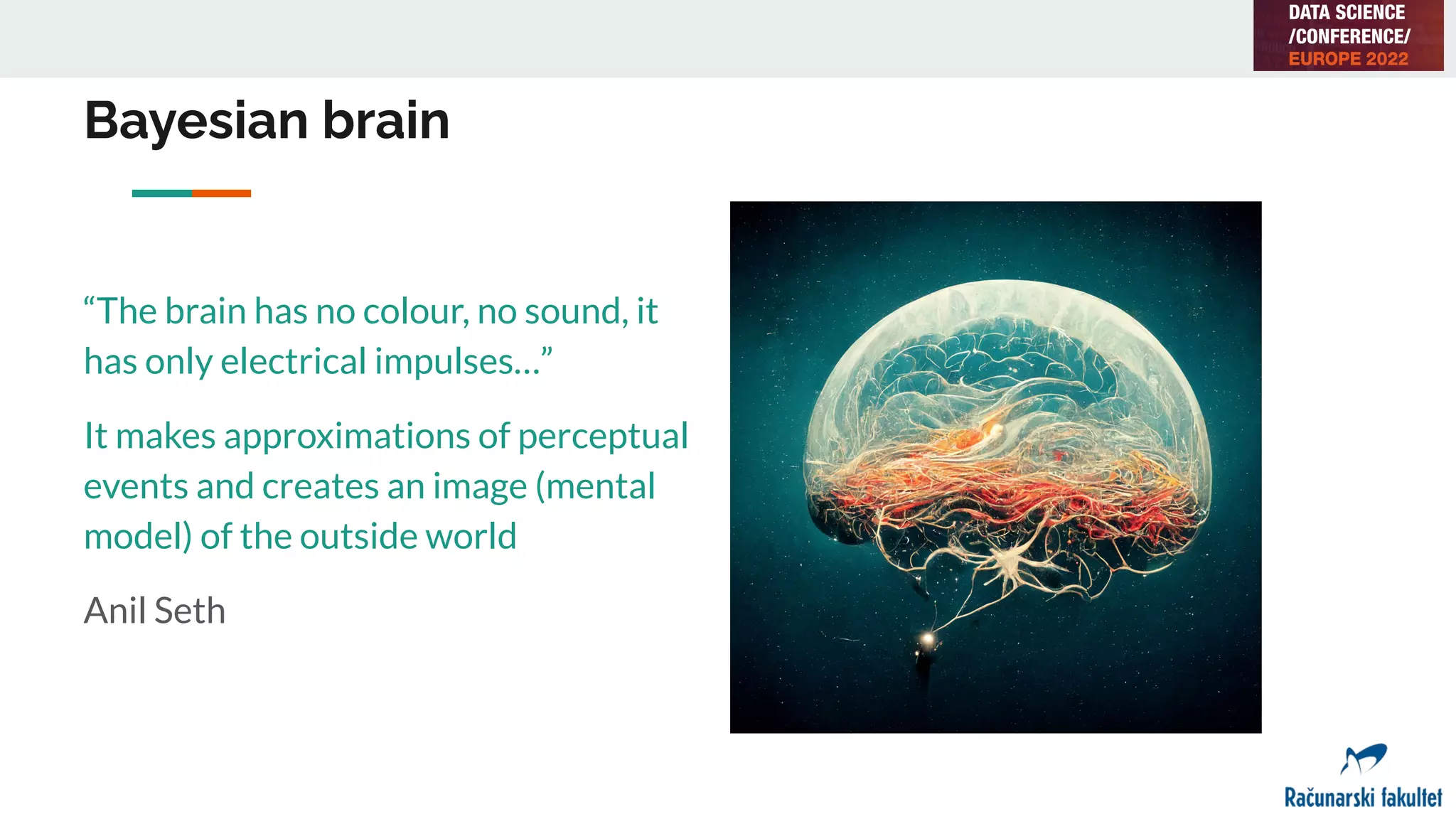
Bayesian brain
“The brain has no colour, no sound, it
has only electrical impulses…”
It makes approximations of perceptual
events and creates an image (mental
model) of the outside world
Anil Seth
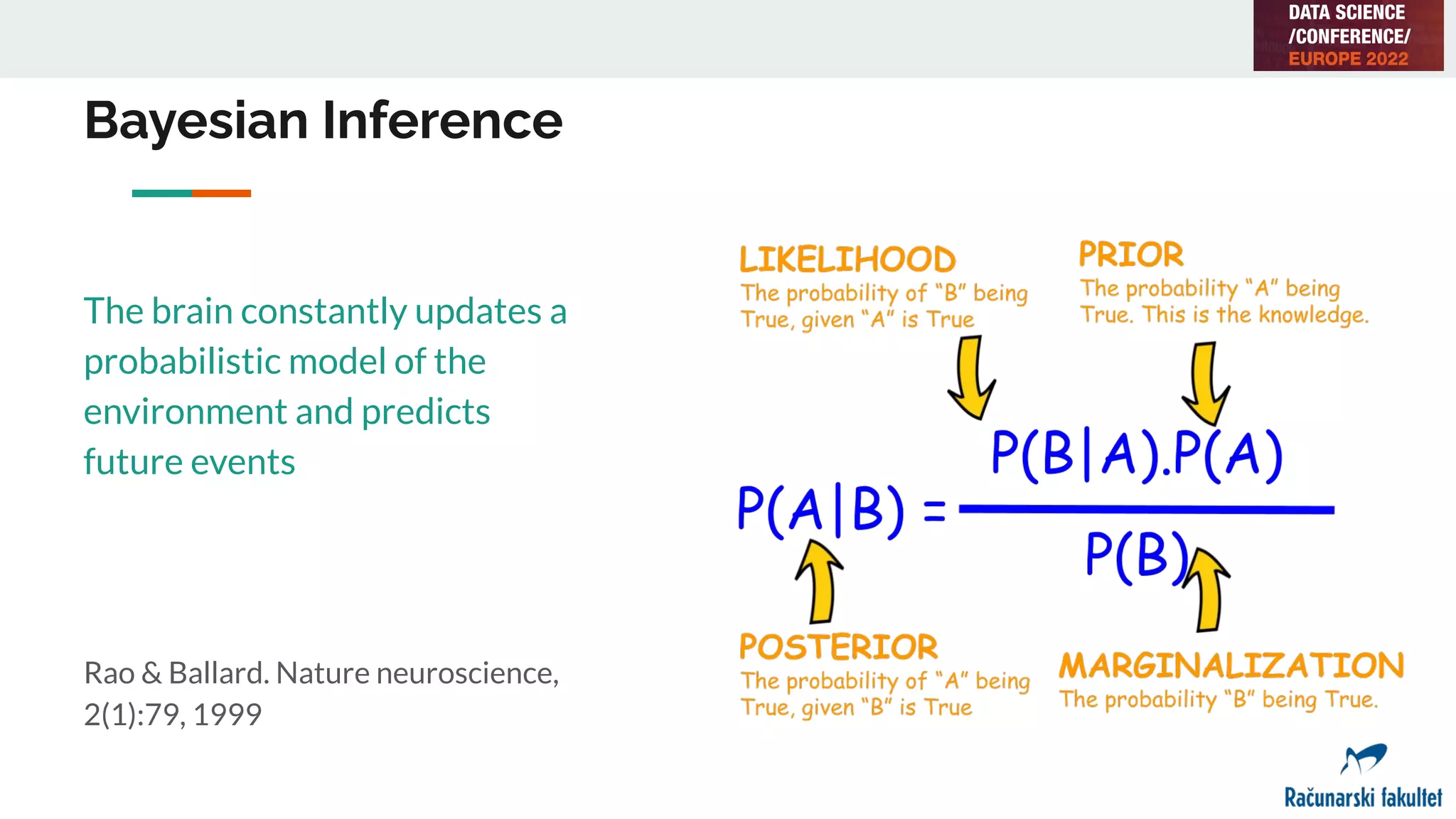
Bayesian Inference
The brain constantly updates a
probabilistic model of the
environment and predicts
future events
Rao & Ballard. Nature neuroscience,
2(1):79, 1999
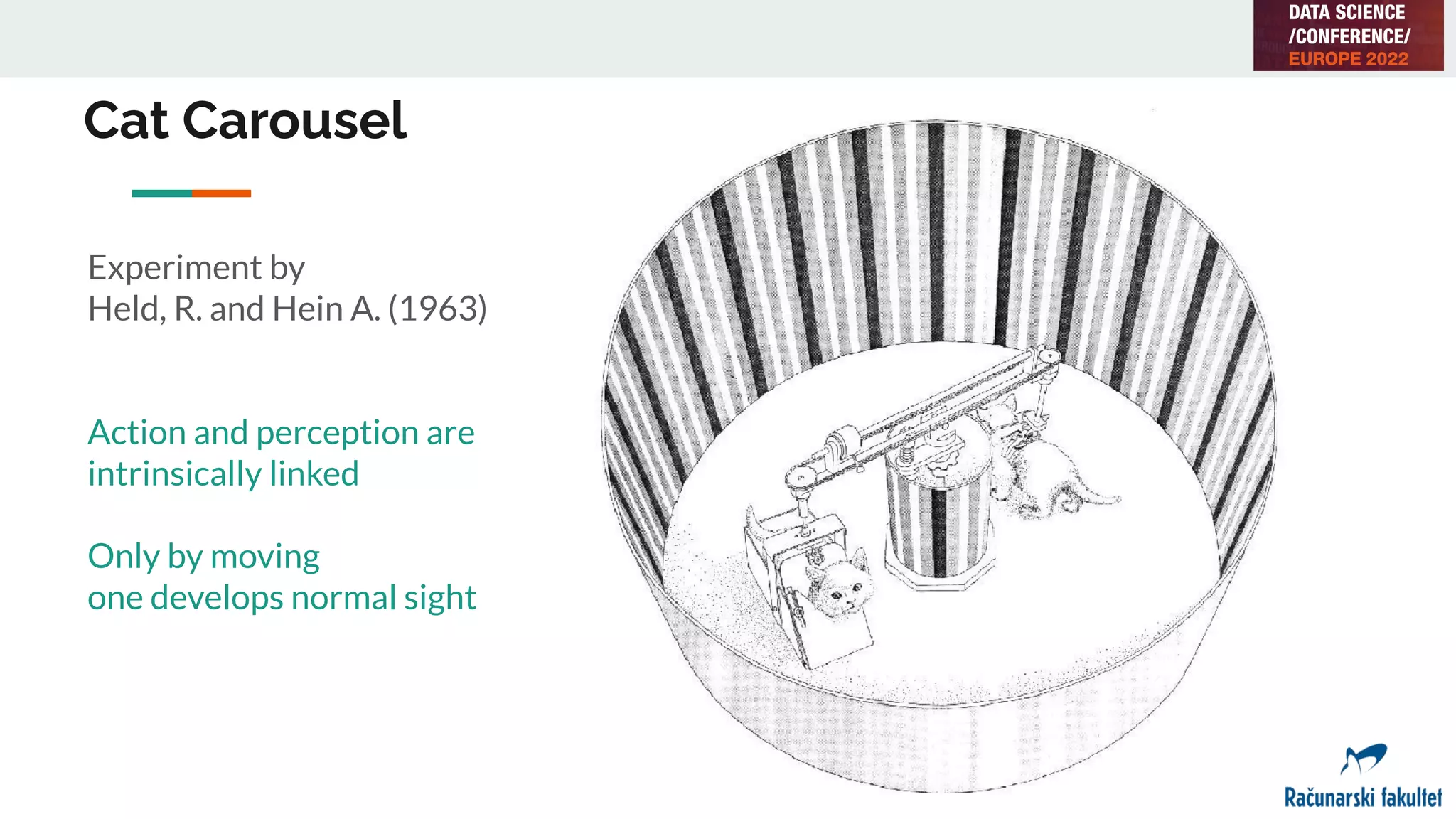
Cat Carousel
Experiment by
Held, R. and Hein A. (1963)
Action and perception are
intrinsically linked
Only by moving
one develops normal sight
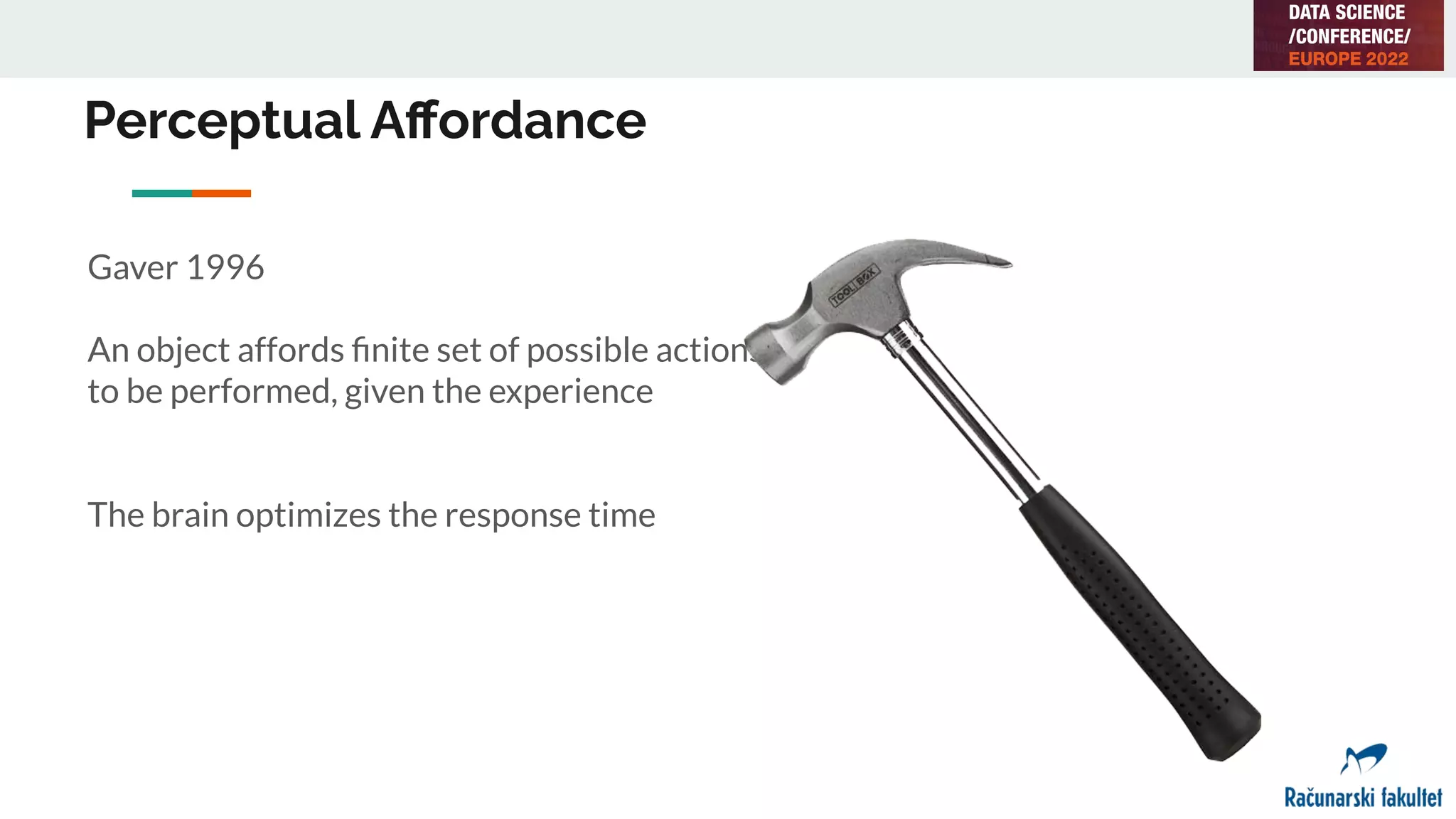
Perceptual Affordance
Gaver 1996
An object affords finite set of possible actions
to be performed, given the experience
The brain optimizes the response time
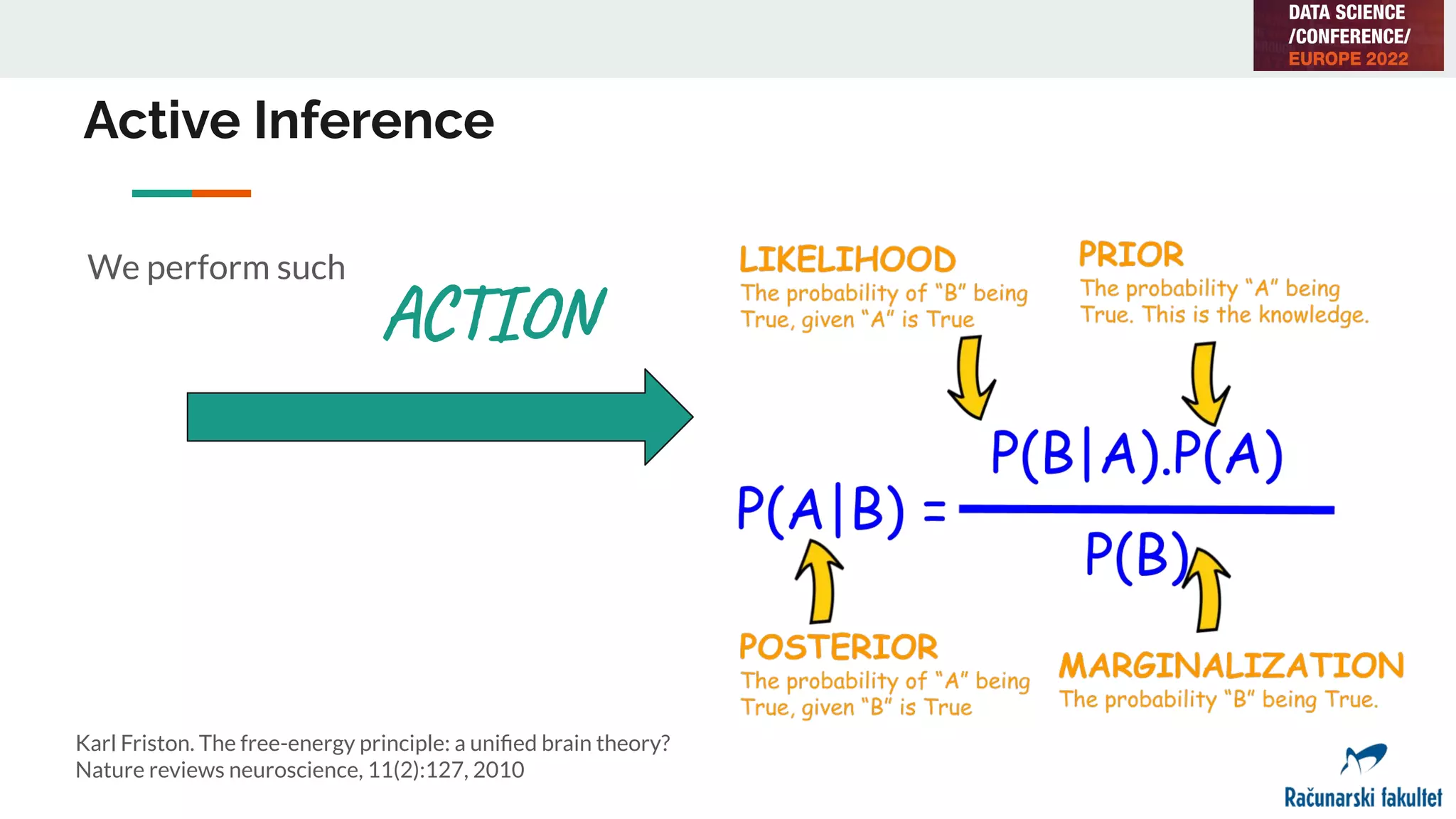
Active Inference
ACTION
We perform such
Karl Friston. The free-energy principle: a unified brain theory?
Nature reviews neuroscience, 11(2):127, 2010
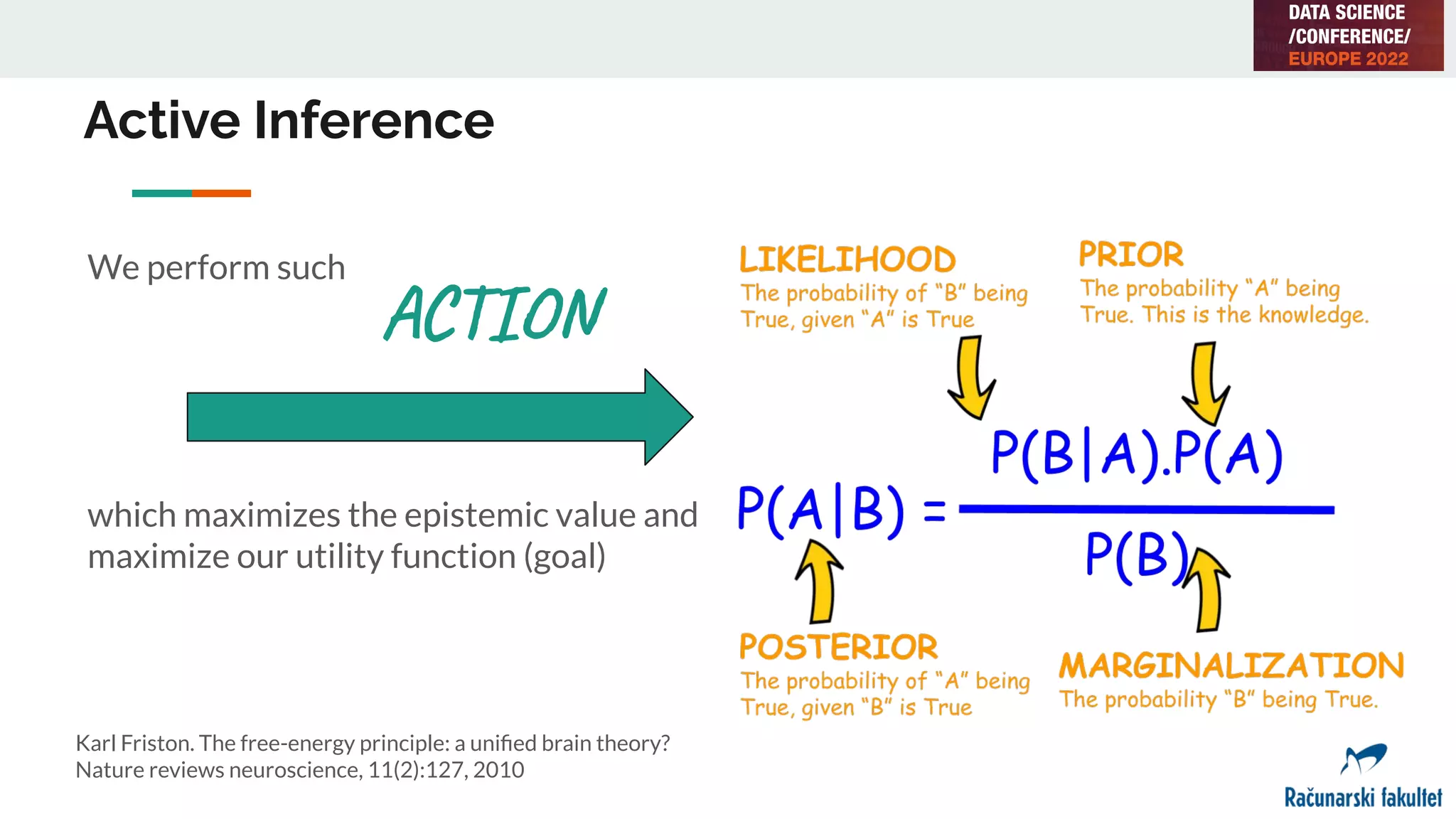
Active Inference
ACTION
We perform such
which maximizes the epistemic value and
maximize our utility function (goal)
Karl Friston. The free-energy principle: a unified brain theory?
Nature reviews neuroscience, 11(2):127, 2010
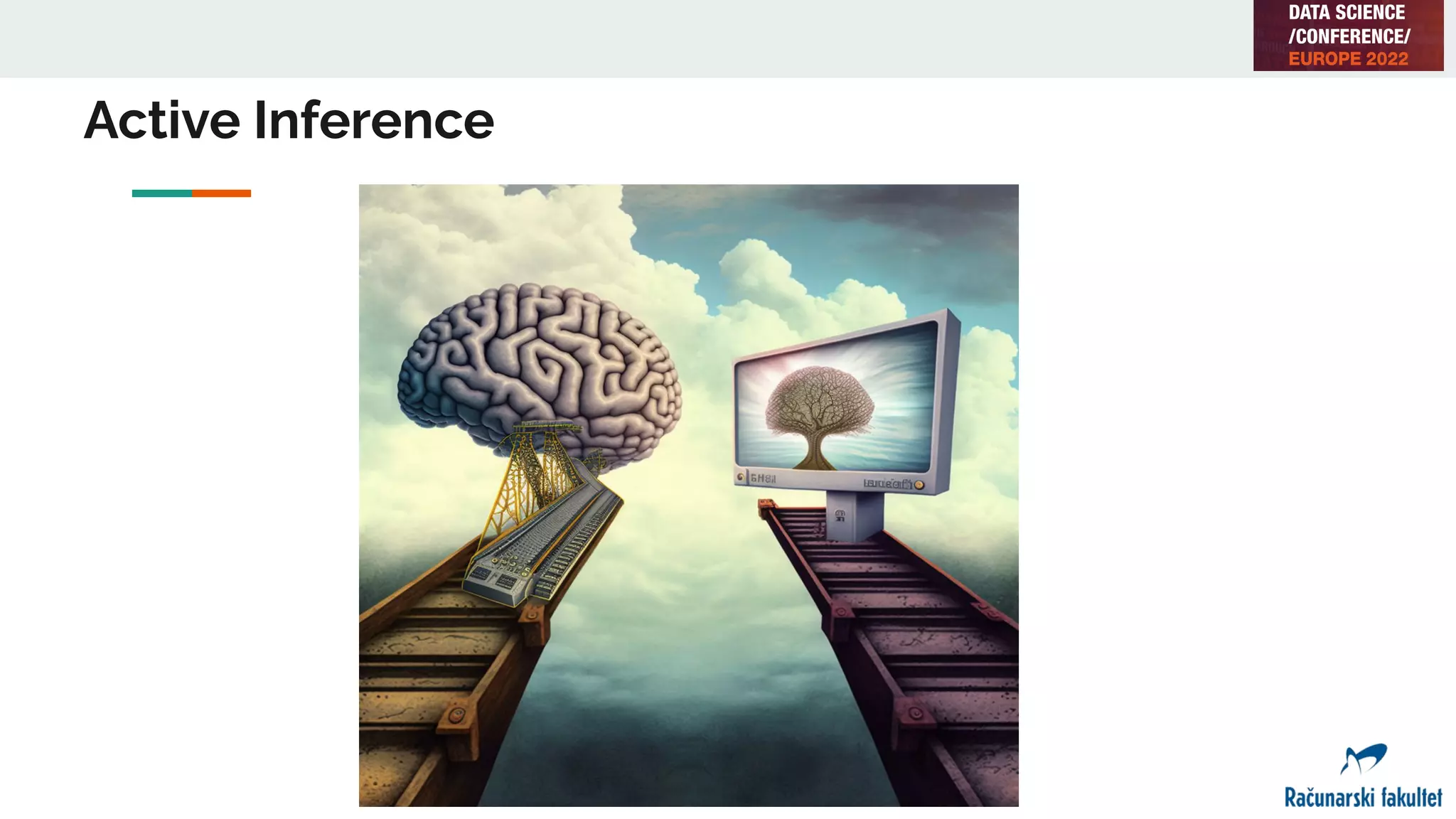
Active Inference
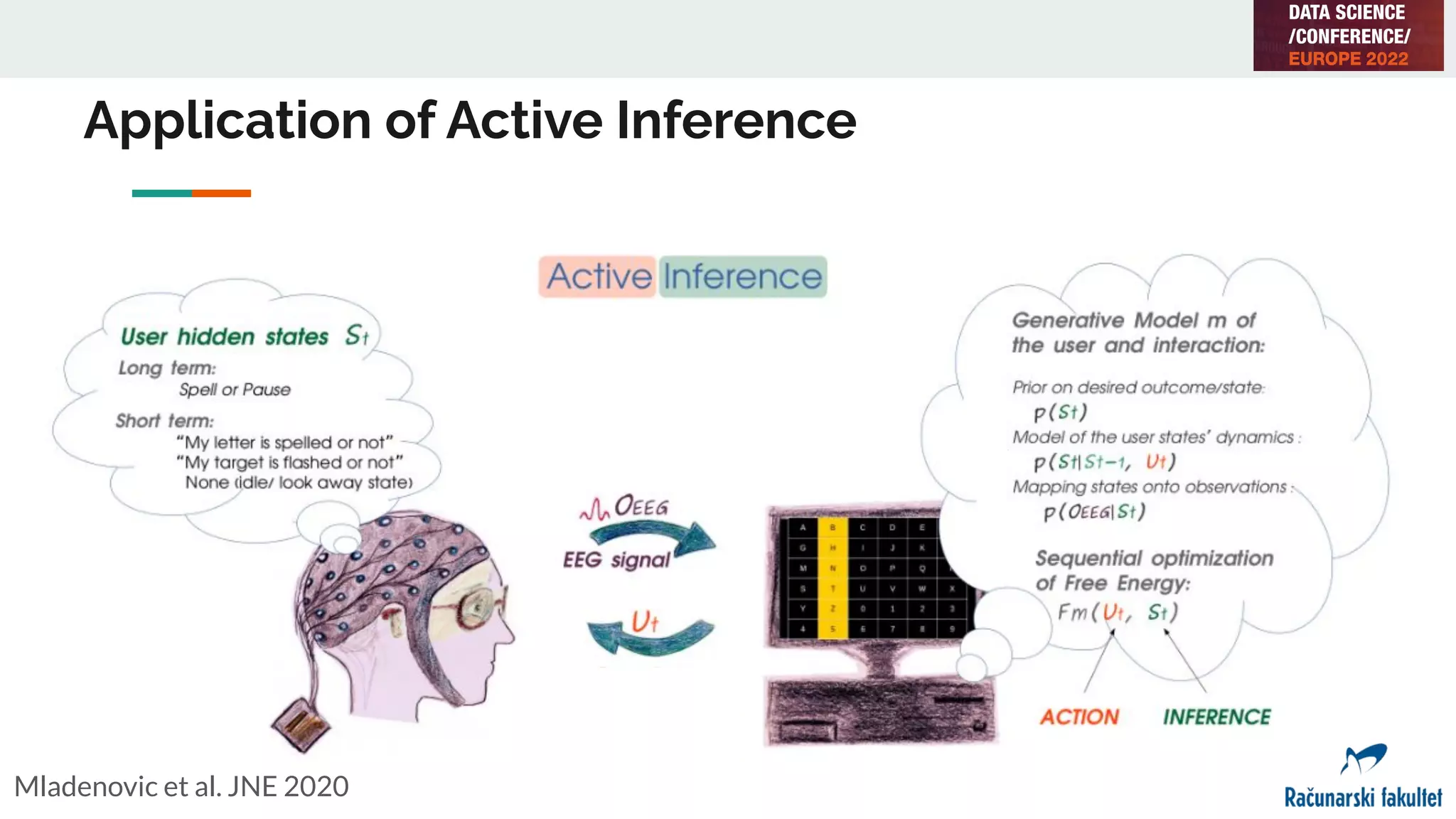
Application of Active Inference
Mladenovic et al. JNE 2020
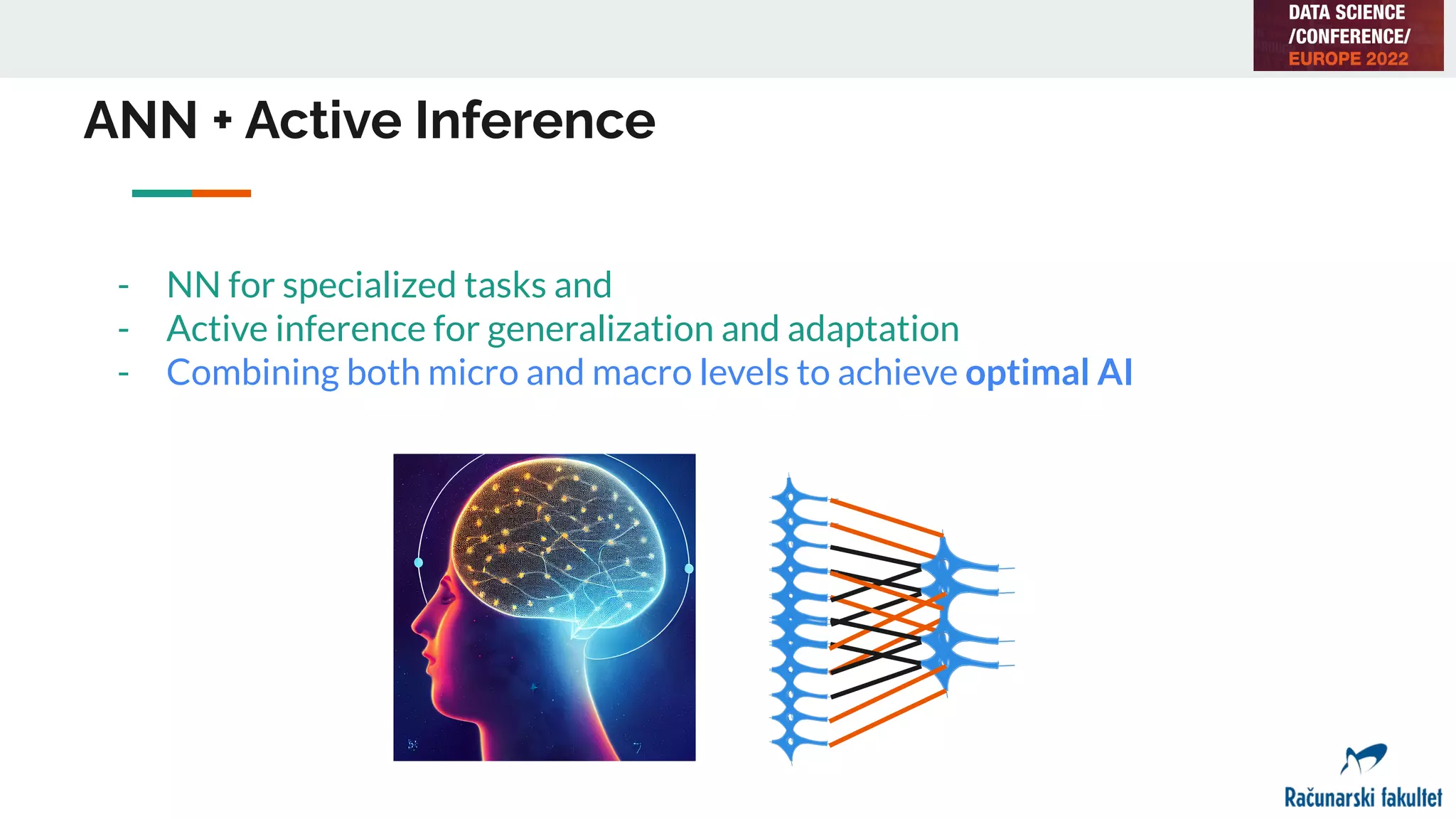
ANN + Active Inference
- NN for specialized tasks and
- Active inference for generalization and adaptation
- Combining both micro and macro levels to achieve optimal AI
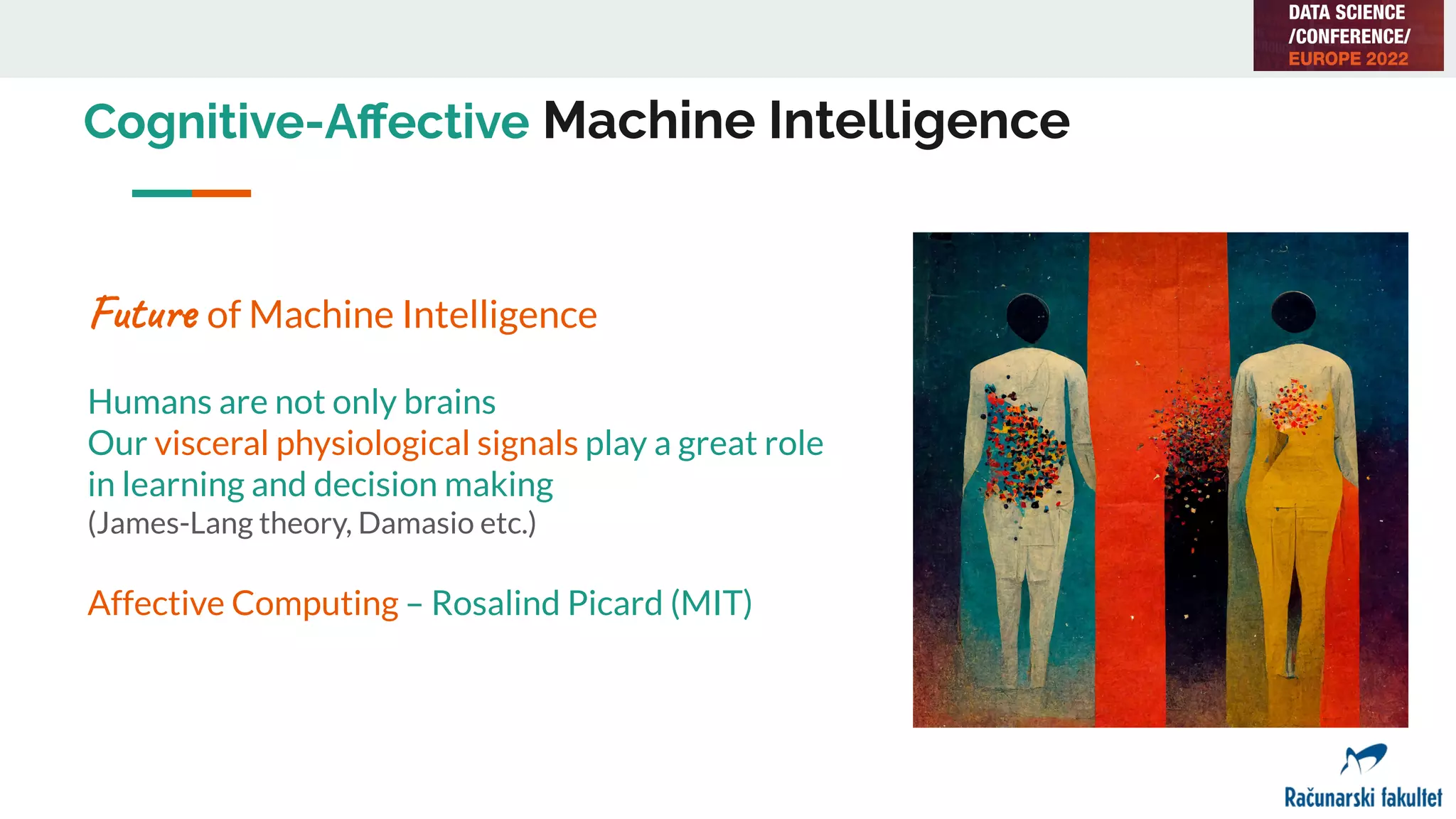
Cognitive-Affective Machine Intelligence
Future of Machine Intelligence
Humans are not only brains
Our visceral physiological signals play a great role
in learning and decision making
(James-Lang theory, Damasio etc.)
Affective Computing – Rosalind Picard (MIT)
Brain-Machine Intelligence :
Past, Present and Future
Prof Dr Jelena Mladenović
Computing Faculty, Union University
Belgrade, Serbia
https://jmladeno.net
emails: jmladenovic@raf.rs ; jelena.mladenovic@neurotechx.com

[DSC Europe 22] Brain-Machine Intelligence: Past, Present and Future - Jelena Mladenovic

  • 1.
    Brain-Machine Intelligence : Past,Present and Future Prof Dr Jelena Mladenović Computing Faculty, Union University Belgrade, Serbia
  • 2.
    About the speaker PhDin Brain-computer Interface in Inria and Inserm, France Research Fellow in Reichman University, Israel Associate professor at Computing Faculty, teaching: 1. Brain-computer Interface 2. Physiological Computing 3. Robotics
  • 3.
    Ongoing projects onthe brain 1. Connectomics – 3D road map of the brain (MIT) 2. Brainbow – colourful genetically modified brain (Harvard) 3. Optogenetics – light activated brain circuits (genetically modified) 4. Computer simulations of the brain : – EU Blue Brain Project – EPFL – Obama BRAIN Initiative – USA 5. Brain-computer/machine Interfaces – interacting with the machine via only neural activity
  • 4.
    Today’s topic –Brain-Machine intelligence 1. Brain-Computer Interface - Bridge between machine and computer intelligence 2. Computational brain models a. From fundamental neuronal circuit to ANN b. Active (Bayesian) Inference 3. Brain (Cognitive) + Visceral (Affective) Computing – next level of machine intelligence Present Past Future
  • 5.
    Today’s topic –Brain-Machine intelligence 1. Brain-Computer Interface - Bridge between machine and computer intelligence 2. Computational brain models a. From fundamental neuronal circuit to ANN b. Active (Bayesian) Inference 3. Brain (Cognitive) + Visceral (Affective) Computing – next level of machine intelligence Present
  • 6.
    Brain-Machine Interface “A systemthat measures neural activity and converts it into artificial output that replaces, restores, enhances, supplements, or improves natural neural output and thereby changes the ongoing interactions between the central nervous system and its external or internal environment” Wolpaw, Handbook of Clinical Neurology 2013.
  • 7.
    Brain-Computer Interface (BCI) Asystem as a type of human-computer interaction in real time, which uses neural impulses as input data, and displays perceptual events at the output. It is used in medicine as a neurorehabilitation tool, in psychotherapy, interaction, art, gaming, transport, security, marketing, etc.
  • 8.
  • 9.
    BCI Measure brain activity withe.g. EEG Filter and process signals
  • 10.
    BCI Measure brain activity withe.g. EEG Filter and process signals Machine learning Calibration or training Testing
  • 11.
    BCI Measure brain activity withe.g. EEG Filter and process signals Machine learning Calibration or training Testing Machine control
  • 12.
    BCI Measure brain activity withe.g. EEG Filter and process signals Machine learning Calibration or training Testing Machine control Influences human
  • 13.
    BCI Machine learning Calibration or training Testing Humanlearning Ideally the machine should learn the same way the brain does But how?
  • 14.
    Today’s topic –Brain-Machine intelligence 1. Brain-Computer Interface - Bridge between machine and computer intelligence 2. Computational brain models a. From fundamental neuronal circuit to ANN – micro level b. Active (Bayesian) Inference – macro level 3. Brain (Cognitive) + Visceral (Affective) Computing – next level of machine intelligence Past
  • 15.
    Hodgkin-Huxley Experiments with Squidaxon (1939) H-H set of differential Equations 1952 (Nobel Prizes) Image courtesy of hans hillewaert
  • 16.
  • 17.
    Neuron I/O electricaldevice INPUT OUTPUT Soma Dendrites Axon Synapses
  • 18.
    Neuron as R-CCircuit I IN OUT V – response Voltage of the cell time Neuron R C OUT IN I
  • 19.
    Temporal summation I IN OUT V –Temporal summation (in dendrites) analog signal time Neuron
  • 20.
    Action potential –spike (0 or 1) I IN OUT V – Temporal summation time Neuron Threshold around 10 mV relative to resting potential
  • 21.
    Action potential –spike (0 or 1) I IN OUT V – Temporal summation time Neuron Threshold Digital signal
  • 22.
    INPUT OUTPUT Synapses asDA converter Axon DA, AD Converters Temporal summation Soma Soma as AD converter
  • 23.
    ANN (Perceptron) 1958 Rosenblatt– Psychologist at Cornell University
  • 24.
  • 25.
  • 26.
  • 27.
    ANN (Perceptron) 1958 Rosenblatt Excitatory Excitatory Inhibitory +5 + 2 - 1 - 4 weights = 4 < 6 Bias 0 Threshold else 1 1 1 0 0
  • 28.
    ANN issues Has impressiveresults, but needs: - Many layers - Many training data - Stronger, bigger GPUs (more power consumption) - In BCI we do not have enough data - Data changes in time (adapts) We need adaptive algorithms
  • 29.
    1. Brain-computer interface 2.Computational brain models a. From fundamental neuronal circuit to ANN – micro level b. Active (Bayesian) Inference – macro level 3. Brain (Cognitive) + Physiological (Affective) Computing – next level of machine intelligence Today’s topic – Brain-Machine intelligence
  • 30.
  • 31.
    Bayesian brain “The brainhas no colour, no sound, it has only electrical impulses…” It makes approximations of perceptual events and creates an image (mental model) of the outside world Anil Seth
  • 32.
    Bayesian Inference The brainconstantly updates a probabilistic model of the environment and predicts future events Rao & Ballard. Nature neuroscience, 2(1):79, 1999
  • 33.
    Cat Carousel Experiment by Held,R. and Hein A. (1963) Action and perception are intrinsically linked Only by moving one develops normal sight
  • 34.
    Perceptual Affordance Gaver 1996 Anobject affords finite set of possible actions to be performed, given the experience The brain optimizes the response time
  • 35.
    Active Inference ACTION We performsuch Karl Friston. The free-energy principle: a unified brain theory? Nature reviews neuroscience, 11(2):127, 2010
  • 36.
    Active Inference ACTION We performsuch which maximizes the epistemic value and maximize our utility function (goal) Karl Friston. The free-energy principle: a unified brain theory? Nature reviews neuroscience, 11(2):127, 2010
  • 37.
  • 38.
    Application of ActiveInference Mladenovic et al. JNE 2020
  • 39.
    ANN + ActiveInference - NN for specialized tasks and - Active inference for generalization and adaptation - Combining both micro and macro levels to achieve optimal AI
  • 40.
    Cognitive-Affective Machine Intelligence Futureof Machine Intelligence Humans are not only brains Our visceral physiological signals play a great role in learning and decision making (James-Lang theory, Damasio etc.) Affective Computing – Rosalind Picard (MIT)
  • 41.
    Brain-Machine Intelligence : Past,Present and Future Prof Dr Jelena Mladenović Computing Faculty, Union University Belgrade, Serbia https://jmladeno.net emails: jmladenovic@raf.rs ; jelena.mladenovic@neurotechx.com