A Book Review:
Executing Data Quality Projects
Danette McGilvray’s Ten Steps to Quality Data
Presented by Angela Boyd
2013
Agenda for Data Quality Book Review:
• Introduction – Stated Purpose and Uses
• Methodology Summary
• Information Quality Defined
• Framework for Information Quality (FIQ)
• Additional Highlights in Handout to Review
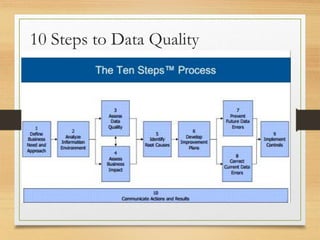
• 10 Steps to Data Quality
• Additional Highlights in Handout to Review
• Usage Examples for 10 Step Process
• Group Discussion and Questions
• Appendixes - DGO Objectives for Data Quality Program
Introduction:
• Danette McGilvray’s stated purpose for the book:
• Providing a systematic approach for improving and creating data and
information quality within any business
• Uses:
o Information quality-focused projects (i.e.. database assessments, data
quality business impact)
o Guidebook for people responsible for daily data quality
o To integrate data quality activities into other projects (i.e.. Enterprise
Resource Planning migration, building a data warehouse or application
development and implementation)
o As foundation to create or standardize data quality activities into project
life cycle
Methodologies:
• Conceptual Framework
– Framework for Information Quality (FIQ), including concepts
• The Ten Steps
– Processes for implementing Framework concept
o Data Quality Dimensions
• Aspects or features of information used for defining, measuring,
and managing data
o Business Impact Techniques
• Qualitative and quantitative techniques for analyzing the impact
of data quality issues
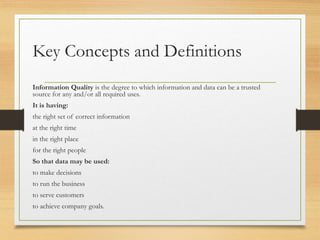
Key Concepts and Definitions
Information Quality is the degree to which information and data can be a trusted
source for any and/or all required uses.
It is having:
the right set of correct information
at the right time
in the right place
for the right people
So that data may be used:
to make decisions
to run the business
to serve customers
to achieve company goals.
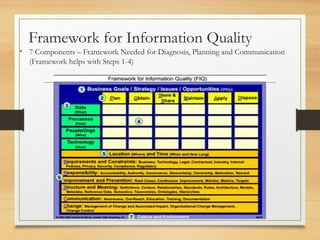
Framework for Information Quality
• 7 Components – Framework Needed for Diagnosis, Planning and Communication
(Framework helps with Steps 1-4)
10 Steps to Data Quality
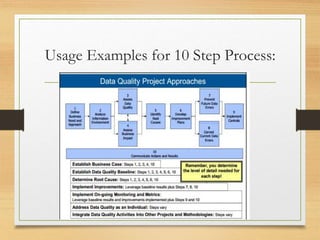
Usage Examples for 10 Step Process:
Discussion Time:
• Group Discussion and Questions
• (Appendixes cover the DGO stated objectives and goals
for Data Quality Program)
• Data Quality Program Next Steps?
Appendixes
• BJC Data Quality Program Stated Objective (Slide
from Presentation to ITWG)
• BJC Data Governance Office 2014 Goals and
Objectives (referenced from drafted DGO Charter)
• DGO Priority Projects (referenced from drafted
DGO Charter)
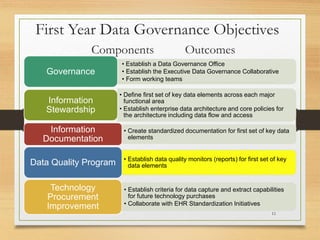
First Year Data Governance Objectives
Components Outcomes
• Establish a Data Governance Office
• Establish the Executive Data Governance Collaborative
• Form working teams
Governance
• Define first set of key data elements across each major
functional area
• Establish enterprise data architecture and core policies for
the architecture including data flow and access
Information
Stewardship
• Create standardized documentation for first set of key data
elements
Information
Documentation
• Establish data quality monitors (reports) for first set of key
data elementsData Quality Program
• Establish criteria for data capture and extract capabilities
for future technology purchases
• Collaborate with EHR Standardization Initiatives
Technology
Procurement
Improvement
11
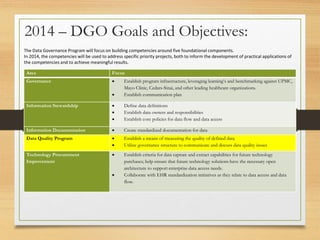
2014 – DGO Goals and Objectives:
Area Focus
Governance  Establish program infrastructure, leveraging learning’s and benchmarking against UPMC,
Mayo Clinic, Cedars-Sinai, and other leading healthcare organizations.
 Establish communication plan
Information Stewardship  Define data definitions
 Establish data owners and responsibilities
 Establish core policies for data flow and data access
Information Documentation  Create standardized documentation for data
Data Quality Program  Establish a means of measuring the quality of defined data
 Utilize governance structure to communicate and discuss data quality issues
Technology Procurement
Improvement
 Establish criteria for data capture and extract capabilities for future technology
purchases; help ensure that future technology solutions have the necessary open
architecture to support enterprise data access needs.
 Collaborate with EHR standardization initiatives as they relate to data access and data
flow.
The Data Governance Program will focus on building competencies around five foundational components.
In 2014, the competencies will be used to address specific priority projects, both to inform the development of practical applications of
the competencies and to achieve meaningful results.
2014 Priority Projects
Priority projects for 2014 (Objectives include Data Quality Program):
• OR Data Analytics
• Supply Chain Data Analytics (See Charter appendix for details on these projects).
Key Impact (Program will align with key project initiatives to):
• Ensure standard, accessible data documentation exists for the 2 priority projects
• Measure quality of data elements defined as critical by the supply chain analytics team and other
key stakeholders; report quality metrics for these fields at each Data Governance Office meeting.
• Baseline and reduce the number of one-off extracts from the SIS OR system.
• Baseline and increase the number of user accesses of the normalized OR stores.
• Measure the adoption of data governance policies

DQ Book Review

  • 1.
    A Book Review: ExecutingData Quality Projects Danette McGilvray’s Ten Steps to Quality Data Presented by Angela Boyd 2013
  • 2.
    Agenda for DataQuality Book Review: • Introduction – Stated Purpose and Uses • Methodology Summary • Information Quality Defined • Framework for Information Quality (FIQ) • Additional Highlights in Handout to Review • 10 Steps to Data Quality • Additional Highlights in Handout to Review • Usage Examples for 10 Step Process • Group Discussion and Questions • Appendixes - DGO Objectives for Data Quality Program
  • 3.
    Introduction: • Danette McGilvray’sstated purpose for the book: • Providing a systematic approach for improving and creating data and information quality within any business • Uses: o Information quality-focused projects (i.e.. database assessments, data quality business impact) o Guidebook for people responsible for daily data quality o To integrate data quality activities into other projects (i.e.. Enterprise Resource Planning migration, building a data warehouse or application development and implementation) o As foundation to create or standardize data quality activities into project life cycle
  • 4.
    Methodologies: • Conceptual Framework –Framework for Information Quality (FIQ), including concepts • The Ten Steps – Processes for implementing Framework concept o Data Quality Dimensions • Aspects or features of information used for defining, measuring, and managing data o Business Impact Techniques • Qualitative and quantitative techniques for analyzing the impact of data quality issues
  • 5.
    Key Concepts andDefinitions Information Quality is the degree to which information and data can be a trusted source for any and/or all required uses. It is having: the right set of correct information at the right time in the right place for the right people So that data may be used: to make decisions to run the business to serve customers to achieve company goals.
  • 6.
    Framework for InformationQuality • 7 Components – Framework Needed for Diagnosis, Planning and Communication (Framework helps with Steps 1-4)
  • 7.
    10 Steps toData Quality
  • 8.
    Usage Examples for10 Step Process:
  • 9.
    Discussion Time: • GroupDiscussion and Questions • (Appendixes cover the DGO stated objectives and goals for Data Quality Program) • Data Quality Program Next Steps?
  • 10.
    Appendixes • BJC DataQuality Program Stated Objective (Slide from Presentation to ITWG) • BJC Data Governance Office 2014 Goals and Objectives (referenced from drafted DGO Charter) • DGO Priority Projects (referenced from drafted DGO Charter)
  • 11.
    First Year DataGovernance Objectives Components Outcomes • Establish a Data Governance Office • Establish the Executive Data Governance Collaborative • Form working teams Governance • Define first set of key data elements across each major functional area • Establish enterprise data architecture and core policies for the architecture including data flow and access Information Stewardship • Create standardized documentation for first set of key data elements Information Documentation • Establish data quality monitors (reports) for first set of key data elementsData Quality Program • Establish criteria for data capture and extract capabilities for future technology purchases • Collaborate with EHR Standardization Initiatives Technology Procurement Improvement 11
  • 12.
    2014 – DGOGoals and Objectives: Area Focus Governance  Establish program infrastructure, leveraging learning’s and benchmarking against UPMC, Mayo Clinic, Cedars-Sinai, and other leading healthcare organizations.  Establish communication plan Information Stewardship  Define data definitions  Establish data owners and responsibilities  Establish core policies for data flow and data access Information Documentation  Create standardized documentation for data Data Quality Program  Establish a means of measuring the quality of defined data  Utilize governance structure to communicate and discuss data quality issues Technology Procurement Improvement  Establish criteria for data capture and extract capabilities for future technology purchases; help ensure that future technology solutions have the necessary open architecture to support enterprise data access needs.  Collaborate with EHR standardization initiatives as they relate to data access and data flow. The Data Governance Program will focus on building competencies around five foundational components. In 2014, the competencies will be used to address specific priority projects, both to inform the development of practical applications of the competencies and to achieve meaningful results.
  • 13.
    2014 Priority Projects Priorityprojects for 2014 (Objectives include Data Quality Program): • OR Data Analytics • Supply Chain Data Analytics (See Charter appendix for details on these projects). Key Impact (Program will align with key project initiatives to): • Ensure standard, accessible data documentation exists for the 2 priority projects • Measure quality of data elements defined as critical by the supply chain analytics team and other key stakeholders; report quality metrics for these fields at each Data Governance Office meeting. • Baseline and reduce the number of one-off extracts from the SIS OR system. • Baseline and increase the number of user accesses of the normalized OR stores. • Measure the adoption of data governance policies

Editor's Notes

  • #7 2 – Information Life Cycle, aka: Information Chain, Information Value Chain, Data Life Cycle, Information Resource Life Cycle (includes lineage and provenance) 3 – Key Components 4 – Interaction Matrix 6 – Broad-Impact Components – Additional affecting factors of information quality.