1
PMS Inspection
Overview and Next
Phase
March 2017
About CQC: our purpose
The Care Quality
Commission is the
independent regulator of
health and adult social care
in England.
We make sure health and social
care services provide people
with safe, effective,
compassionate, high-quality
care and we encourage care
services to improve.
2
About CQC: our role
3
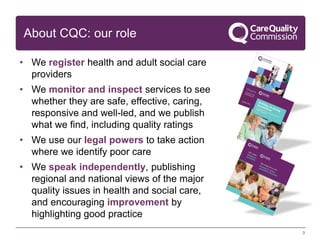
• We register health and adult social care
providers
• We monitor and inspect services to see
whether they are safe, effective, caring,
responsive and well-led, and we publish
what we find, including quality ratings
• We use our legal powers to take action
where we identify poor care
• We speak independently, publishing
regional and national views of the major
quality issues in health and social care,
and encouraging improvement by
highlighting good practice
About CQC: our role
4
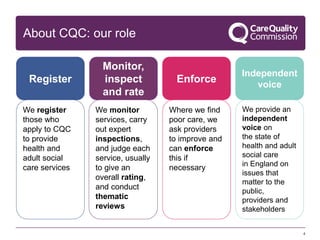
Register
Monitor,
inspect
and rate
Enforce
Independent
voice
We register
those who
apply to CQC
to provide
health and
adult social
care services
We monitor
services, carry
out expert
inspections,
and judge each
service, usually
to give an
overall rating,
and conduct
thematic
reviews
Where we find
poor care, we
ask providers
to improve and
can enforce
this if
necessary
We provide an
independent
voice on
the state of
health and adult
social care
in England on
issues that
matter to the
public,
providers and
stakeholders
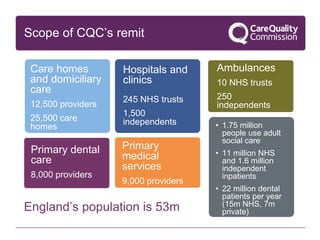
Scope of CQC’s remit
Primary
medical
services
9,000 providers
Hospitals and
clinics
245 NHS trusts
1,500
independents
Ambulances
10 NHS trusts
250
independents
Care homes
and domiciliary
care
12,500 providers
25,500 care
homes
Primary dental
care
8,000 providers
• 1.75 million
people use adult
social care
• 11 million NHS
and 1.6 million
independent
inpatients
• 22 million dental
patients per year
(15m NHS, 7m
private)England’s population is 53m
6
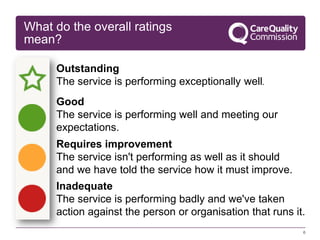
Outstanding
The service is performing exceptionally well.
Good
The service is performing well and meeting our
expectations.
Requires improvement
The service isn't performing as well as it should
and we have told the service how it must improve.
Inadequate
The service is performing badly and we've taken
action against the person or organisation that runs it.
What do the overall ratings
mean?
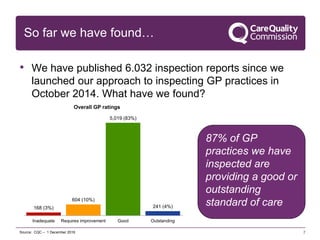
So far we have found…
• We have published 6.032 inspection reports since we
launched our approach to inspecting GP practices in
October 2014. What have we found?
7
87% of GP
practices we have
inspected are
providing a good or
outstanding
standard of care
Source: CQC – 1 December 2016
168 (3%)
604 (10%)
5,019 (83%)
241 (4%)
0
50
100
Inadequate Requires improvement Good Outstanding
Overall GP ratings
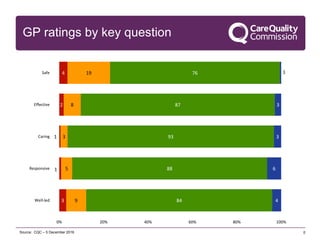
4
2
1
1
3
19
8
3
5
9
76
87
93
88
84
1
3
3
6
4
0% 20% 40% 60% 80% 100%
Safe
Effective
Caring
Responsive
Well-led
GP ratings by key question
8Source: CQC – 5 December 2016
9
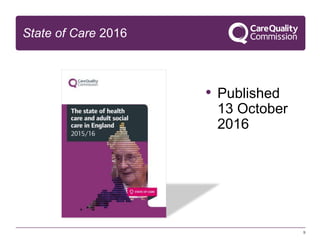
State of Care 2016
• Published
13 October
2016
10
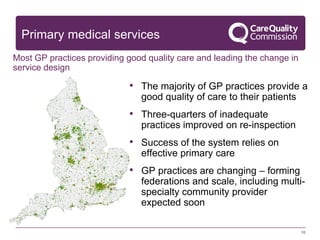
Primary medical services
Most GP practices providing good quality care and leading the change in
service design
• The majority of GP practices provide a
good quality of care to their patients
• Three-quarters of inadequate
practices improved on re-inspection
• Success of the system relies on
effective primary care
• GP practices are changing – forming
federations and scale, including multi-
specialty community provider
expected soon
LEARNING POINTS PMS
11
Well led: key themes in good care
• GP practices are generally well-led, with 87% rated good or outstanding
• Our inspection findings show good leadership is the foundation of an
outstanding organisation. Examples include:
• Patients at the centre of their developments, with effective
patient participation groups involved in multiple aspects of the
practice’s business
• Excellent staff development and support, with the
development of special programmes to aid staff development or
support staff in their role
• Embedded clinical governance systems
• The role and capability of the practice manager has an important
influence, and the level of training and support for practice managers is
important
12
13
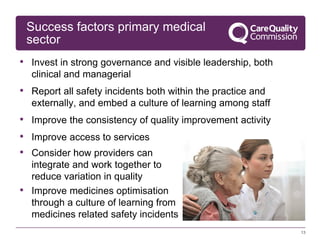
Success factors primary medical
sector
• Invest in strong governance and visible leadership, both
clinical and managerial
• Report all safety incidents both within the practice and
externally, and embed a culture of learning among staff
• Improve the consistency of quality improvement activity
• Improve access to services
• Consider how providers can
integrate and work together to
reduce variation in quality
• Improve medicines optimisation
through a culture of learning from
medicines related safety incidents
Helpful resources for practices
 Make sure you’ve read our provider handbook, and
understand the key lines of enquiry our inspectors will focus
on
 Read our myth-busters for tips and further guidance
 Read our outstanding practice web tool kit and consider
what would make care for people who use your services
outstanding
 Read our ‘What to expect from an inspection’ and case
studies to understand what an inspection looks and feels like
We’ve signposted all of these resources and more in our
provider toolkit. Simply visit: www.cqc.org.uk/GPProvider
14
15
Find out more
• Read the monthly bulletin for primary care providers
• Sent to all providers and registered managers, or
sign up through our website
• Join our provider and public online communities
• Visit our new guidance page for GP practices
www.cqc.org.uk/gpintroguide
Find all of the above and more at:
www.cqc.org.uk/GPProvider
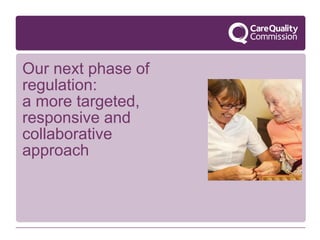
Our next phase of
regulation:
a more targeted,
responsive and
collaborative
approach
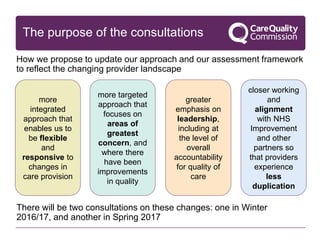
The purpose of the consultations
How we propose to update our approach and our assessment framework
to reflect the changing provider landscape
There will be two consultations on these changes: one in Winter
2016/17, and another in Spring 2017
more
integrated
approach that
enables us to
be flexible
and
responsive to
changes in
care provision
more targeted
approach that
focuses on
areas of
greatest
concern, and
where there
have been
improvements
in quality
greater
emphasis on
leadership,
including at
the level of
overall
accountability
for quality of
care
closer working
and
alignment
with NHS
Improvement
and other
partners so
that providers
experience
less
duplication
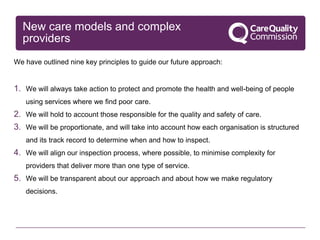
New care models and complex
providers
We have outlined nine key principles to guide our future approach:
1. We will always take action to protect and promote the health and well-being of people
using services where we find poor care.
2. We will hold to account those responsible for the quality and safety of care.
3. We will be proportionate, and will take into account how each organisation is structured
and its track record to determine when and how to inspect.

4. We will align our inspection process, where possible, to minimise complexity for
providers that deliver more than one type of service.
5. We will be transparent about our approach and about how we make regulatory
decisions.
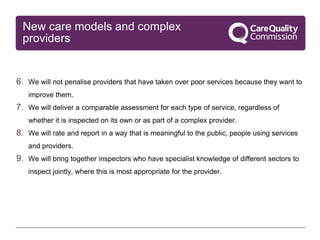
New care models and complex
providers
6. We will not penalise providers that have taken over poor services because they want to
improve them.
7. We will deliver a comparable assessment for each type of service, regardless of
whether it is inspected on its own or as part of a complex provider.
8. We will rate and report in a way that is meaningful to the public, people using services
and providers.
9. We will bring together inspectors who have specialist knowledge of different sectors to
inspect jointly, where this is most appropriate for the provider.
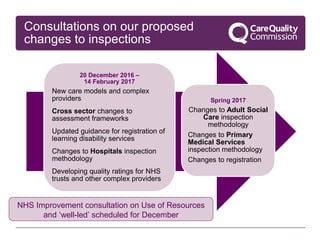
Consultations on our proposed
changes to inspections
NHS Improvement consultation on Use of Resources
and ‘well-led’ scheduled for December
20 December 2016 –
14 February 2017
New care models and complex
providers
Cross sector changes to
assessment frameworks
Updated guidance for registration of
learning disability services
Changes to Hospitals inspection
methodology
Developing quality ratings for NHS
trusts and other complex providers
Spring 2017
Changes to Adult Social
Care inspection
methodology
Changes to Primary
Medical Services
inspection methodology
Changes to registration
2121
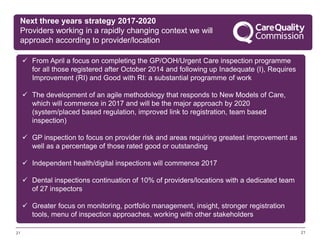
 From April a focus on completing the GP/OOH/Urgent Care inspection programme
for all those registered after October 2014 and following up Inadequate (I), Requires
Improvement (RI) and Good with RI: a substantial programme of work
 The development of an agile methodology that responds to New Models of Care,
which will commence in 2017 and will be the major approach by 2020
(system/placed based regulation, improved link to registration, team based
inspection)
 GP inspection to focus on provider risk and areas requiring greatest improvement as
well as a percentage of those rated good or outstanding
 Independent health/digital inspections will commence 2017
 Dental inspections continuation of 10% of providers/locations with a dedicated team
of 27 inspectors
 Greater focus on monitoring, portfolio management, insight, stronger registration
tools, menu of inspection approaches, working with other stakeholders
Next three years strategy 2017-2020
Providers working in a rapidly changing context we will
approach according to provider/location
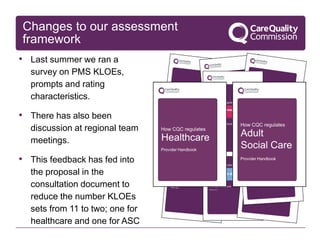
Changes to our assessment
framework
• Last summer we ran a
survey on PMS KLOEs,
prompts and rating
characteristics.
• There has also been
discussion at regional team
meetings.
• This feedback has fed into
the proposal in the
consultation document to
reduce the number KLOEs
sets from 11 to two; one for
healthcare and one for ASC
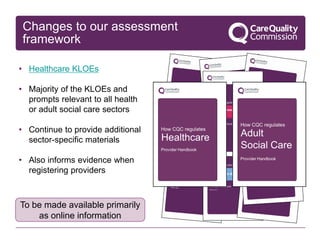
Changes to our assessment
framework
• Healthcare KLOEs
• Majority of the KLOEs and
prompts relevant to all health
or adult social care sectors
• Continue to provide additional
sector-specific materials
• Also informs evidence when
registering providers
To be made available primarily
as online information
Get involved
First consultation on our next phase of inspections ran
to 14 February 2017, next phase Spring 2017
• www.cqc.org.uk/nextphase
• nextphase@cqc.org.uk
• @CareQualityComm using #CQCnextphase
To respond to the NHS Improvement
joint consultation on Use of Resources
and the ‘well-led’ domain, please follow
the link on the above web page.
25
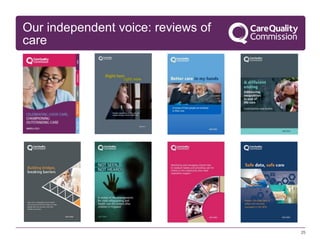
Our independent voice: reviews of
care
26
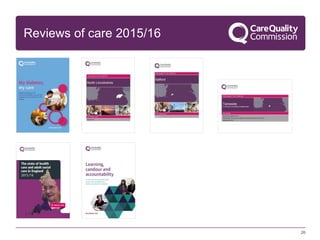
Reviews of care 2015/16
27
www.cqc.org.uk
enquiries@cqc.org.uk
@CareQualityComm
Alison Holbourn
Deputy Chief Inspector, Primary Medical Services and Integrated Care
Thank you and questions
GP Indemnity
&
governance
March 2017
Keira Liburd
Assistant Head of Primary Care (Quality and Regulation)
David Geddes
Director of Primary Care Commissioning
GP Indemnity Review partners
DH
GPC
RCGP
MDOs
Indemnity Review
GPs should be no more exposed to the costs of indemnity than a
secondary care doctor
GPFV – the need for change
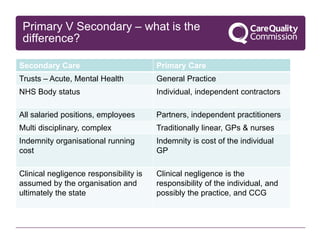
Primary V Secondary – what is the
difference?
Secondary Care Primary Care
Trusts – Acute, Mental Health General Practice
NHS Body status Individual, independent contractors
All salaried positions, employees Partners, independent practitioners
Multi disciplinary, complex Traditionally linear, GPs & nurses
Indemnity organisational running
cost
Indemnity is cost of the individual
GP
Clinical negligence responsibility is
assumed by the organisation and
ultimately the state
Clinical negligence is the
responsibility of the individual, and
possibly the practice, and CCG
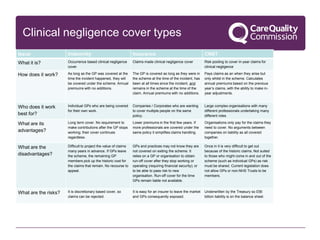
Issue Indemnity Insurance CNST
What it is? Occurrence based clinical negligence
cover
Claims made clinical negligence cover Risk pooling to cover in-year claims for
clinical negligence
How does it work? As long as the GP was covered at the
time the incident happened, they will
be covered under the scheme. Annual
premiums with no additions.
The GP is covered as long as they were in
the scheme at the time of the incident, has
been at all times since the incident, and
remains in the scheme at the time of the
claim. Annual premiums with no additions.
Pays claims as an when they arise but
only whilst in the scheme. Calculates
annual premiums based on the previous
year’s claims, with the ability to make in-
year adjustments.
Who does it work
best for?
Individual GPs who are being covered
for their own work.
Companies / Corporates who are wanting
to cover multiple people on the same
policy.
Large complex organisations with many
different professionals undertaking many
different roles
What are its
advantages?
Long term cover. No requirement to
make contributions after the GP stops
working; their cover continues
regardless.
Lower premiums in the first few years. If
more professionals are covered under the
same policy it simplifies claims handling.
Organisations only pay for the claims they
need to cover. No arguments between
companies on liability as all covered
together.
What are the
disadvantages?
Difficult to project the value of claims
many years in advance. If GPs leave
the scheme, the remaining GP
members pick up the historic cost for
the claims that remain. No recourse to
appeal.
GPs and practices may not know they are
not covered on exiting the scheme. It
relies on a GP or organisation to obtain
run-off cover after they stop working or
operating (requiring financial security); or
to be able to pass risk to new
organisation. Run-off cover for the time
GPs remain liable not available.
Once in it is very difficult to get out
because of the historic claims. Not suited
to those who might come in and out of the
scheme (such as individual GPs) as risk
must be shared. Current legislation does
not allow GPs or non-NHS Trusts to be
members.
What are the risks? It is discretionary based cover, so
claims can be rejected.
It is easy for an insurer to leave the market
and GPs consequently exposed.
Underwritten by the Treasury so £56
billion liability is on the balance sheet.
Clinical negligence cover types
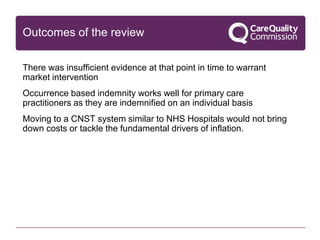
Outcomes of the review
There was insufficient evidence at that point in time to warrant
market intervention
Occurrence based indemnity works well for primary care
practitioners as they are indemnified on an individual basis
Moving to a CNST system similar to NHS Hospitals would not bring
down costs or tackle the fundamental drivers of inflation.
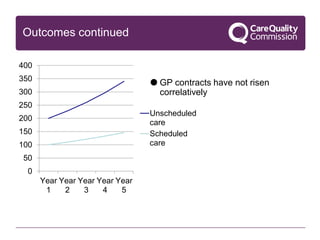
 GP contracts have not risen
correlatively
Outcomes continued
0
50
100
150
200
250
300
350
400
Year
1
Year
2
Year
3
Year
4
Year
5
Unscheduled
care
Scheduled
care
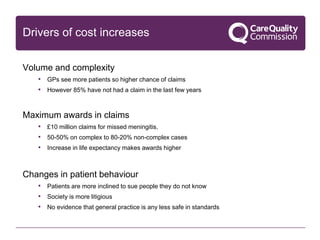
Volume and complexity
• GPs see more patients so higher chance of claims
• However 85% have not had a claim in the last few years
Maximum awards in claims
• £10 million claims for missed meningitis.
• 50-50% on complex to 80-20% non-complex cases
• Increase in life expectancy makes awards higher
Changes in patient behaviour
• Patients are more inclined to sue people they do not know
• Society is more litigious
• No evidence that general practice is any less safe in standards
Drivers of cost increases
Of the drivers some of these can be positively affected by good
governance arrangements.
Good record keeping
Appropriate supervision
Patient hand-offs
Maintaining personalised care
Team interaction and learning
Education and continuing professional development
How does this relate to governance?
Longer term
Any Questions?

3.5 Governance at scale - Alison Holburn

  • 1.
    1 PMS Inspection Overview andNext Phase March 2017
  • 2.
    About CQC: ourpurpose The Care Quality Commission is the independent regulator of health and adult social care in England. We make sure health and social care services provide people with safe, effective, compassionate, high-quality care and we encourage care services to improve. 2
  • 3.
    About CQC: ourrole 3 • We register health and adult social care providers • We monitor and inspect services to see whether they are safe, effective, caring, responsive and well-led, and we publish what we find, including quality ratings • We use our legal powers to take action where we identify poor care • We speak independently, publishing regional and national views of the major quality issues in health and social care, and encouraging improvement by highlighting good practice
  • 4.
    About CQC: ourrole 4 Register Monitor, inspect and rate Enforce Independent voice We register those who apply to CQC to provide health and adult social care services We monitor services, carry out expert inspections, and judge each service, usually to give an overall rating, and conduct thematic reviews Where we find poor care, we ask providers to improve and can enforce this if necessary We provide an independent voice on the state of health and adult social care in England on issues that matter to the public, providers and stakeholders
  • 5.
    Scope of CQC’sremit Primary medical services 9,000 providers Hospitals and clinics 245 NHS trusts 1,500 independents Ambulances 10 NHS trusts 250 independents Care homes and domiciliary care 12,500 providers 25,500 care homes Primary dental care 8,000 providers • 1.75 million people use adult social care • 11 million NHS and 1.6 million independent inpatients • 22 million dental patients per year (15m NHS, 7m private)England’s population is 53m
  • 6.
    6 Outstanding The service isperforming exceptionally well. Good The service is performing well and meeting our expectations. Requires improvement The service isn't performing as well as it should and we have told the service how it must improve. Inadequate The service is performing badly and we've taken action against the person or organisation that runs it. What do the overall ratings mean?
  • 7.
    So far wehave found… • We have published 6.032 inspection reports since we launched our approach to inspecting GP practices in October 2014. What have we found? 7 87% of GP practices we have inspected are providing a good or outstanding standard of care Source: CQC – 1 December 2016 168 (3%) 604 (10%) 5,019 (83%) 241 (4%) 0 50 100 Inadequate Requires improvement Good Outstanding Overall GP ratings
  • 8.
    4 2 1 1 3 19 8 3 5 9 76 87 93 88 84 1 3 3 6 4 0% 20% 40%60% 80% 100% Safe Effective Caring Responsive Well-led GP ratings by key question 8Source: CQC – 5 December 2016
  • 9.
    9 State of Care2016 • Published 13 October 2016
  • 10.
    10 Primary medical services MostGP practices providing good quality care and leading the change in service design • The majority of GP practices provide a good quality of care to their patients • Three-quarters of inadequate practices improved on re-inspection • Success of the system relies on effective primary care • GP practices are changing – forming federations and scale, including multi- specialty community provider expected soon
  • 11.
  • 12.
    Well led: keythemes in good care • GP practices are generally well-led, with 87% rated good or outstanding • Our inspection findings show good leadership is the foundation of an outstanding organisation. Examples include: • Patients at the centre of their developments, with effective patient participation groups involved in multiple aspects of the practice’s business • Excellent staff development and support, with the development of special programmes to aid staff development or support staff in their role • Embedded clinical governance systems • The role and capability of the practice manager has an important influence, and the level of training and support for practice managers is important 12
  • 13.
    13 Success factors primarymedical sector • Invest in strong governance and visible leadership, both clinical and managerial • Report all safety incidents both within the practice and externally, and embed a culture of learning among staff • Improve the consistency of quality improvement activity • Improve access to services • Consider how providers can integrate and work together to reduce variation in quality • Improve medicines optimisation through a culture of learning from medicines related safety incidents
  • 14.
    Helpful resources forpractices  Make sure you’ve read our provider handbook, and understand the key lines of enquiry our inspectors will focus on  Read our myth-busters for tips and further guidance  Read our outstanding practice web tool kit and consider what would make care for people who use your services outstanding  Read our ‘What to expect from an inspection’ and case studies to understand what an inspection looks and feels like We’ve signposted all of these resources and more in our provider toolkit. Simply visit: www.cqc.org.uk/GPProvider 14
  • 15.
    15 Find out more •Read the monthly bulletin for primary care providers • Sent to all providers and registered managers, or sign up through our website • Join our provider and public online communities • Visit our new guidance page for GP practices www.cqc.org.uk/gpintroguide Find all of the above and more at: www.cqc.org.uk/GPProvider
  • 16.
    Our next phaseof regulation: a more targeted, responsive and collaborative approach
  • 17.
    The purpose ofthe consultations How we propose to update our approach and our assessment framework to reflect the changing provider landscape There will be two consultations on these changes: one in Winter 2016/17, and another in Spring 2017 more integrated approach that enables us to be flexible and responsive to changes in care provision more targeted approach that focuses on areas of greatest concern, and where there have been improvements in quality greater emphasis on leadership, including at the level of overall accountability for quality of care closer working and alignment with NHS Improvement and other partners so that providers experience less duplication
  • 18.
    New care modelsand complex providers We have outlined nine key principles to guide our future approach: 1. We will always take action to protect and promote the health and well-being of people using services where we find poor care. 2. We will hold to account those responsible for the quality and safety of care. 3. We will be proportionate, and will take into account how each organisation is structured and its track record to determine when and how to inspect. 4. We will align our inspection process, where possible, to minimise complexity for providers that deliver more than one type of service. 5. We will be transparent about our approach and about how we make regulatory decisions.
  • 19.
    New care modelsand complex providers 6. We will not penalise providers that have taken over poor services because they want to improve them. 7. We will deliver a comparable assessment for each type of service, regardless of whether it is inspected on its own or as part of a complex provider. 8. We will rate and report in a way that is meaningful to the public, people using services and providers. 9. We will bring together inspectors who have specialist knowledge of different sectors to inspect jointly, where this is most appropriate for the provider.
  • 20.
    Consultations on ourproposed changes to inspections NHS Improvement consultation on Use of Resources and ‘well-led’ scheduled for December 20 December 2016 – 14 February 2017 New care models and complex providers Cross sector changes to assessment frameworks Updated guidance for registration of learning disability services Changes to Hospitals inspection methodology Developing quality ratings for NHS trusts and other complex providers Spring 2017 Changes to Adult Social Care inspection methodology Changes to Primary Medical Services inspection methodology Changes to registration
  • 21.
    2121  From Aprila focus on completing the GP/OOH/Urgent Care inspection programme for all those registered after October 2014 and following up Inadequate (I), Requires Improvement (RI) and Good with RI: a substantial programme of work  The development of an agile methodology that responds to New Models of Care, which will commence in 2017 and will be the major approach by 2020 (system/placed based regulation, improved link to registration, team based inspection)  GP inspection to focus on provider risk and areas requiring greatest improvement as well as a percentage of those rated good or outstanding  Independent health/digital inspections will commence 2017  Dental inspections continuation of 10% of providers/locations with a dedicated team of 27 inspectors  Greater focus on monitoring, portfolio management, insight, stronger registration tools, menu of inspection approaches, working with other stakeholders Next three years strategy 2017-2020 Providers working in a rapidly changing context we will approach according to provider/location
  • 22.
    Changes to ourassessment framework • Last summer we ran a survey on PMS KLOEs, prompts and rating characteristics. • There has also been discussion at regional team meetings. • This feedback has fed into the proposal in the consultation document to reduce the number KLOEs sets from 11 to two; one for healthcare and one for ASC
  • 23.
    Changes to ourassessment framework • Healthcare KLOEs • Majority of the KLOEs and prompts relevant to all health or adult social care sectors • Continue to provide additional sector-specific materials • Also informs evidence when registering providers To be made available primarily as online information
  • 24.
    Get involved First consultationon our next phase of inspections ran to 14 February 2017, next phase Spring 2017 • www.cqc.org.uk/nextphase • nextphase@cqc.org.uk • @CareQualityComm using #CQCnextphase To respond to the NHS Improvement joint consultation on Use of Resources and the ‘well-led’ domain, please follow the link on the above web page.
  • 25.
  • 26.
  • 27.
    27 www.cqc.org.uk enquiries@cqc.org.uk @CareQualityComm Alison Holbourn Deputy ChiefInspector, Primary Medical Services and Integrated Care Thank you and questions
  • 28.
  • 29.
    Keira Liburd Assistant Headof Primary Care (Quality and Regulation) David Geddes Director of Primary Care Commissioning GP Indemnity Review partners DH GPC RCGP MDOs Indemnity Review
  • 30.
    GPs should beno more exposed to the costs of indemnity than a secondary care doctor GPFV – the need for change
  • 31.
    Primary V Secondary– what is the difference? Secondary Care Primary Care Trusts – Acute, Mental Health General Practice NHS Body status Individual, independent contractors All salaried positions, employees Partners, independent practitioners Multi disciplinary, complex Traditionally linear, GPs & nurses Indemnity organisational running cost Indemnity is cost of the individual GP Clinical negligence responsibility is assumed by the organisation and ultimately the state Clinical negligence is the responsibility of the individual, and possibly the practice, and CCG
  • 32.
    Issue Indemnity InsuranceCNST What it is? Occurrence based clinical negligence cover Claims made clinical negligence cover Risk pooling to cover in-year claims for clinical negligence How does it work? As long as the GP was covered at the time the incident happened, they will be covered under the scheme. Annual premiums with no additions. The GP is covered as long as they were in the scheme at the time of the incident, has been at all times since the incident, and remains in the scheme at the time of the claim. Annual premiums with no additions. Pays claims as an when they arise but only whilst in the scheme. Calculates annual premiums based on the previous year’s claims, with the ability to make in- year adjustments. Who does it work best for? Individual GPs who are being covered for their own work. Companies / Corporates who are wanting to cover multiple people on the same policy. Large complex organisations with many different professionals undertaking many different roles What are its advantages? Long term cover. No requirement to make contributions after the GP stops working; their cover continues regardless. Lower premiums in the first few years. If more professionals are covered under the same policy it simplifies claims handling. Organisations only pay for the claims they need to cover. No arguments between companies on liability as all covered together. What are the disadvantages? Difficult to project the value of claims many years in advance. If GPs leave the scheme, the remaining GP members pick up the historic cost for the claims that remain. No recourse to appeal. GPs and practices may not know they are not covered on exiting the scheme. It relies on a GP or organisation to obtain run-off cover after they stop working or operating (requiring financial security); or to be able to pass risk to new organisation. Run-off cover for the time GPs remain liable not available. Once in it is very difficult to get out because of the historic claims. Not suited to those who might come in and out of the scheme (such as individual GPs) as risk must be shared. Current legislation does not allow GPs or non-NHS Trusts to be members. What are the risks? It is discretionary based cover, so claims can be rejected. It is easy for an insurer to leave the market and GPs consequently exposed. Underwritten by the Treasury so £56 billion liability is on the balance sheet. Clinical negligence cover types
  • 33.
    Outcomes of thereview There was insufficient evidence at that point in time to warrant market intervention Occurrence based indemnity works well for primary care practitioners as they are indemnified on an individual basis Moving to a CNST system similar to NHS Hospitals would not bring down costs or tackle the fundamental drivers of inflation.
  • 34.
     GP contractshave not risen correlatively Outcomes continued 0 50 100 150 200 250 300 350 400 Year 1 Year 2 Year 3 Year 4 Year 5 Unscheduled care Scheduled care
  • 35.
    Volume and complexity •GPs see more patients so higher chance of claims • However 85% have not had a claim in the last few years Maximum awards in claims • £10 million claims for missed meningitis. • 50-50% on complex to 80-20% non-complex cases • Increase in life expectancy makes awards higher Changes in patient behaviour • Patients are more inclined to sue people they do not know • Society is more litigious • No evidence that general practice is any less safe in standards Drivers of cost increases
  • 36.
    Of the driverssome of these can be positively affected by good governance arrangements. Good record keeping Appropriate supervision Patient hand-offs Maintaining personalised care Team interaction and learning Education and continuing professional development How does this relate to governance?
  • 37.
  • 38.